Every Animal That Has Been Sent to Space
On February 20, 1947, a captured German V-2 rose from the New Mexico desert carrying the first travellers ever sent beyond the atmosphere: a small container of fruit flies. They rode to about 109 km, floated back under a parachute, and were recovered alive after roughly three minutes aloft. The flies had no idea they were making history, which is more or less the condition of every animal in this story.
What followed was not a triumphant procession but a long, uneven, frequently fatal experiment. Before any human left the ground, engineers in New Mexico and on the Soviet steppe strapped monkeys, dogs, and mice, and eventually cats, frogs, tortoises, and jellyfish, into nose cones to find out what space would do to a living body. Some came home to retirement at the National Zoo. Many did not come home at all. The animals were the instruments, and the instruments were treated as expendable.
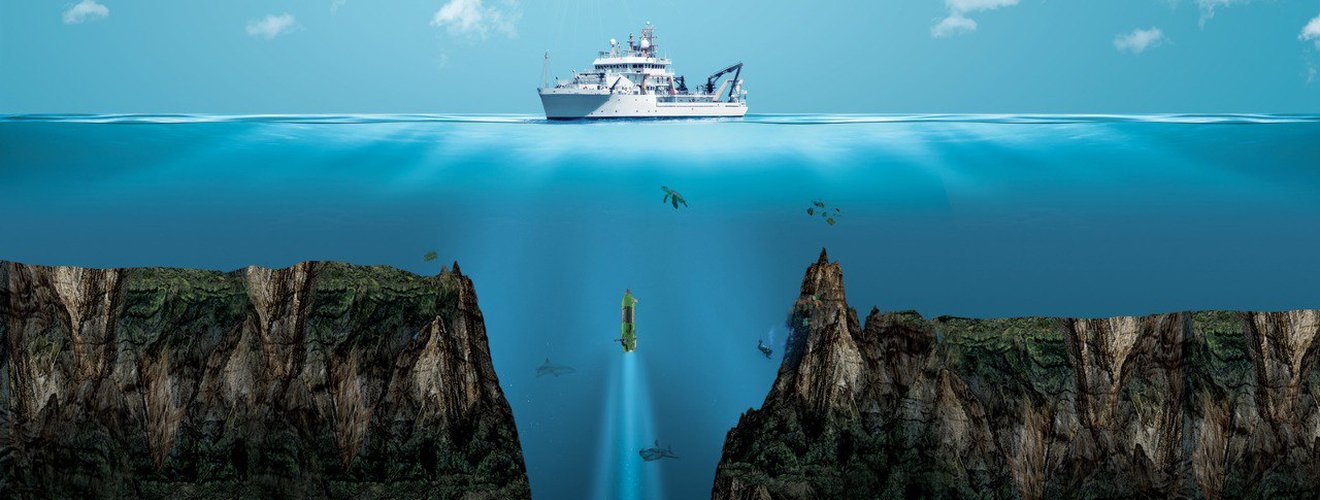
The result is a roster running from that 1947 fly flight to two mouse missions in 2025, taking in creatures that never cleared the launch tower and creatures that went round the Moon and came back. Animals went first because nobody knew what the trip would do to a body, the same reason the deep ocean was mapped by instrument long before any of the people who have reached the bottom of the Mariana Trench climbed into a submersible. This is every animal that made the trip up, in the order it happened.
Sixty-one entries make up the complete record of animals sent to space, from the 1947 fruit flies to a pair of mouse flights in 2025. Each covers a single mission or a grouped set of them, and the passengers include monkeys, dogs, a cat, tortoises, spiders and geckos, launched by six countries.
Fruit Flies
On February 20, 1947, a V-2 rocket rose from White Sands Proving Ground in New Mexico carrying the first living things ever sent past the edge of the atmosphere. They were fruit flies, sealed in a small capsule, and they climbed to roughly 109 km before a parachute eased them back to the desert floor. The whole trip lasted about three minutes. The flies were recovered alive, which made them not just the first animals in space but the first ones brought home from it.
The choice of passenger was deliberate. Drosophila melanogaster, the common fruit fly, was already the most thoroughly mapped organism in genetics, so any damage from cosmic radiation would show up plainly in its offspring. American scientists, working with captured German rockets and captured German expertise, wanted to know whether the radiation above the atmosphere would tear living tissue apart before anyone risked sending up a person. The recovered flies showed no measurable genetic harm at the dose they had absorbed.
There had been an earlier attempt the previous summer, in July 1946, but that capsule was never found, which is why February 1947 gets the credit rather than a footnote. The flies themselves, naturally, understood none of this. They had been to the edge of space and back before lunch, and carried on being fruit flies.
Albert I
Albert I was a nine-pound rhesus macaque, and on June 11, 1948 he became the first monkey the United States strapped into a rocket and fired toward space. The vehicle was a V-2, missile number 37, launched from the same New Mexico range that had sent up the fruit flies. It was, by the standards of what came later, a grim little flight. Albert reached an apogee of only about 63 km, short of the 100 km Karman line that officially marks the start of space, so the first monkey ever launched upward did not, strictly speaking, arrive.
He also did not survive. The best reconstruction is that Albert suffocated in his cramped, poorly ventilated capsule, possibly before the rocket even left the pad, and his parachute failed on the way down as well. No usable medical data came back. The record is so thin that historians still argue over whether he died during ascent or never made it off the ground breathing.
None of this stopped the effort. Albert I was simply the first of a run of monkeys, all named Albert, who would keep dying on American rockets for the next three years. He got the number one and very little else, including, for decades, much notice at all.
Albert II
The distinction of first mammal in space belongs not to a person or a household pet but to Albert II, a rhesus macaque who cleared the Karman line on June 14, 1949. His V-2, missile 47, carried him to an apogee of 134 km, comfortably past the 100 km boundary his predecessor had missed by a wide margin. For a few minutes, a laboratory monkey was the highest-flying living creature Earth had ever produced.
Then the recovery system betrayed him. Instruments in the capsule recorded Albert’s heartbeat and breathing all the way up and all the way down, giving researchers their first continuous read on how a mammal handled the climb and the weightlessness. The data stopped at the instant of impact, because the parachute failed and the capsule struck the ground at full speed. Albert II had survived space and was killed by the landing.
It is a pattern worth holding onto, because it recurs. The monkeys of this era rarely died in flight; they died coming back, undone by hardware that could loft a body to the edge of space but not set it down gently. Albert II proved a mammal could go up and keep functioning. Proving one could come home intact would take three more dead Alberts and a change of rocket.
Albert III
Not every flight in the series reached space, and this one barely cleared the pad. On September 16, 1949, about 10.7 seconds after liftoff, the V-2 carrying Albert III blew apart roughly three miles up, missile 32 tearing itself to pieces. The crab-eating macaque inside died instantly. Where his predecessors had at least been lofted to the fringe of the atmosphere, he got a few thousand feet and a fireball.
He is the odd one out for a second reason: he was a different species. Albert I, II, and IV were rhesus macaques, while Albert III was a cynomolgus, or crab-eating, macaque, a smaller relative pressed into the same doomed role. Sources cannot even agree on how high he got before the failure, with estimates ranging from about three miles to just under 11 km, though everyone agrees it was nowhere near space.
Because the flight ended so early and so violently, it produced no medical data at all, not even the tragic and useful kind that Albert II’s fatal landing had yielded. For that reason Albert III tends to vanish from the cheerful retrospectives about pioneering space animals. He is the one Albert launched on a space-bound rocket who, by any honest measure, never left the sky he started in.
Albert IV
December 1949 brought the fourth monkey and the fourth heartbreak. Albert IV, a rhesus macaque riding V-2 missile 31, flew a clean, successful mission that carried him to an apogee somewhere between 130 and 134 km, well past the Karman line, and returned him through the atmosphere in good health. He had done everything asked of him. Then his parachute failed, exactly as his predecessor’s had, and he died on impact.
The date itself is contested: NASA’s own history puts the launch on December 12, 1949, while other reliable accounts give December 8. What no one disputes is the outcome, or its awful familiarity. By the close of 1949 the United States had flown four monkeys named Albert and buried all four, two of them killed by the identical mechanical fault on the way down.
NASA credits Albert IV with proving that a primate could survive the launch and weightless phases without harm, which sounds like progress and was. It narrowed the problem down to one stubborn issue: getting the animal back to the ground alive. Solving it would require abandoning the V-2 for the smaller Aerobee and rebuilding the recovery gear from scratch. The monkeys, meanwhile, kept paying the tuition for lessons the engineers had not yet learned.
Albert V
The fifth and final Albert changed rockets and changed nothing else. On April 18, 1951 he became the first monkey flown on the Aerobee, the smaller sounding rocket the program had turned to after four straight V-2 fatalities. The hope was that a fresh vehicle and a redesigned recovery system might finally bring a monkey home alive. Instead his parachute failed during descent, and he joined the others.
His flight is oddly under-documented for a mission of such firsts. The apogee usually quoted for him, about 72 km, is identical to the figure given for the very next Aerobee monkey flight five months later, a coincidence suspicious enough that it is probably a copied number rather than a measured one. His species is listed in the standard reference table simply as unknown. Even the detailed period histories that lovingly track Albert I through IV tend to fall silent when they reach him.
What is not in doubt is the tally. Five monkeys had now been launched by the United States under the name Albert, and five had died, most of them not in the violence of the ascent but in the final seconds over home ground. The recovery problem that had haunted the V-2 flights had simply followed the program onto its new rocket.
Dezik, Tsygan, and Lisa
While the Americans were losing monkeys over New Mexico, the Soviet Union was quietly succeeding with dogs. On July 22, 1951, two mongrels named Dezik and Tsygan rode an R-1 rocket to about 110 km and parachuted back to the steppe alive, the first mammals anywhere to survive a trip to space and return. Sergei Korolev, the secretive chief designer behind the whole Soviet effort, was reportedly beside himself with delight. The dogs got sausage and sugar. The flight got no public announcement.
The Soviets favoured strays on the theory that a dog who had survived a Moscow winter on the streets could survive nearly anything, and they preferred small females to fit the plumbing of the suits. Dezik and Tsygan proved the concept in a single quarter-hour hop, feeling roughly four minutes of weightlessness along the way.
The triumph curdled fast. About a week later Dezik went up again, this time paired with a dog named Lisa, and their parachute did not open. Both were killed. Tsygan, spared the second flight, was adopted by the physicist Anatoly Blagonravov and lived out an ordinary life with a couple of litters of puppies. Dezik helped prove a mammal could come home from space, and was dead within a week of doing it.
Smelaya, Malyshka, ZIB, Albina, and the Other Early Soviet Space Dogs
Behind a handful of Soviet space dogs anyone remembers stand dozens more, most now barely names in a logbook. Between 1951 and 1960 the program flew dogs on 15 suborbital R-1 missions to around 100 km, 11 R-2A missions to around 200 km, and 3 R-5A missions to around 450 km, a sustained campaign of which Laika’s orbital flight was only the famous tip.
The best story in the pile belongs to ZIB. When the dog scheduled for a 1951 flight, Bobik, ran off from the launch site days before liftoff, engineers grabbed an untrained stray wandering the base, dropped him in the capsule, and flew him successfully to around 100 km. His name was an acronym meaning, roughly, substitute for the missing Bobik. He performed perfectly, which says something uncomfortable about how much of the training actually mattered.
The records for these flights are a mess even by Cold War standards, with one compiler openly warning of conflicting evidence about the dogs’ names and even the dates. Smelaya and Malyshka flew together, and three reputable sources give three different endings for them: recovered safely, crashed but found alive, or killed outright. Albina, ejected at 85 km in 1958 and floated down on her own parachute, at least has the mercy of an agreed-upon survival.
Yorick and the Eleven Mice
Yorick’s fate depends entirely on which source you believe, which is a strange thing to say about a monkey but true. On September 20, 1951, he and eleven mice flew an Aerobee to about 236,000 feet, roughly 72 km, and came down under a parachute. NASA’s official history calls Yorick the first monkey to live through a spaceflight and leaves it there, a clean milestone.
Other, more detailed accounts are grimmer. By their telling the capsule landed intact with all twelve animals alive, but the recovery crews took too long to reach it, and Yorick and two of the mice died of heat prostration inside the sealed cabin under the New Mexico sun. In that version the flight is only a partial success, and the monkey who supposedly proved a primate could survive space actually died on the ground waiting to be collected. Both framings sit in the record, unreconciled.
What survives cleanly is the mice. By the grimmer account, nine of the eleven came through the flight and the wait alive, which gives them a fair claim to being the most overlooked survivors of the early American space effort. Nobody put up a plaque. Nobody argued about their fate. They simply reached the edge of space, endured a bad afternoon in a hot box, and lived, which is more than most of the monkeys managed.
Patricia, Mike, Mildred, and Albert
Four animals went up on an Aerobee in the spring of 1952, and for the first time in the American program, all four came back down alive. Patricia and Mike were cynomolgus monkeys; Mildred and Albert were two white mice who tend to be dropped from the retelling entirely. The flight reached an altitude the sources argue about, with Wikipedia’s table saying 26 km and a Philippine account saying 36 miles, more than double, but the important number was the body count, which for once was zero.
The parachute worked. After four years in which the recovery hardware had been the very thing killing monkey after monkey, a capsule finally floated its passengers down to a soft landing. NASA dates the flight to May 22, 1952; other accounts say May 21. Either way, it was the moment the program stopped being a string of funerals.
Patricia and Mike were never flown again. They were retired to the National Zoological Park in Washington, where Patricia lived a couple more years and Mike lived until 1967, dying of old age in a zoo enclosure fifteen years after his single afternoon at the edge of space. The two mice went uncelebrated, as mice do. Somebody, somewhere, had finally built a nose cone that gave its animals a way home.
Laika
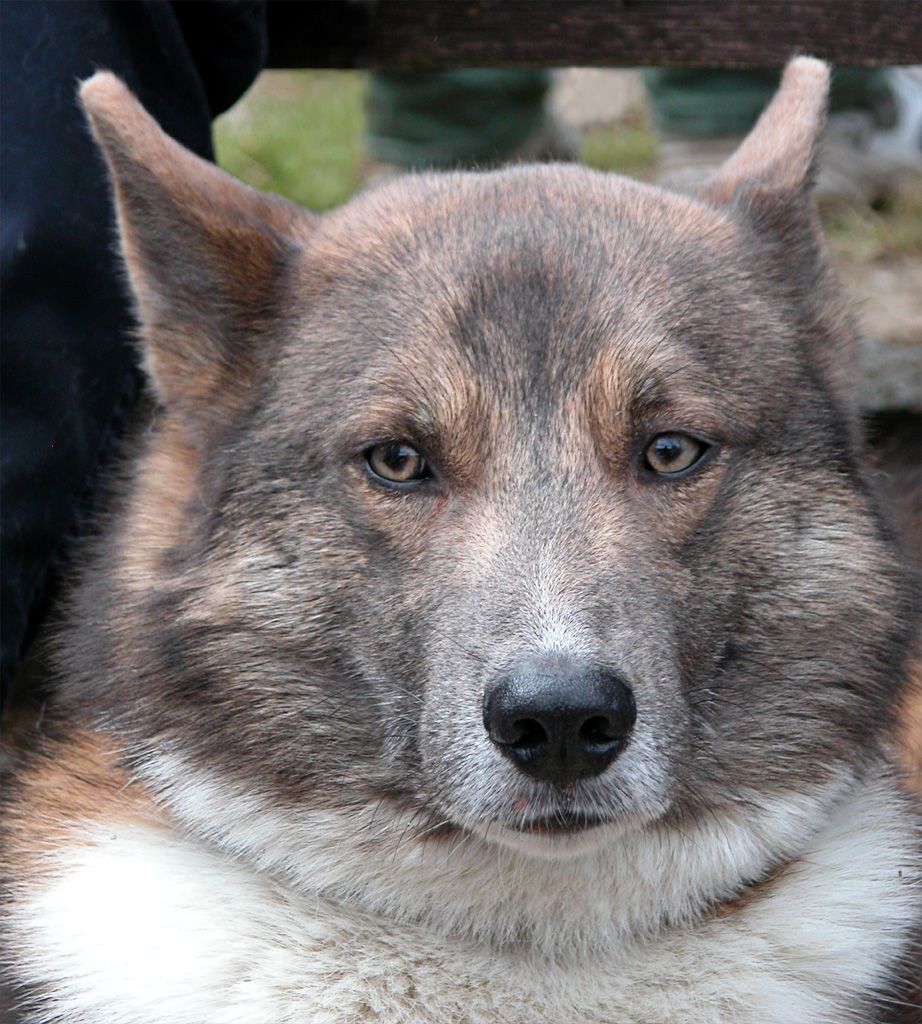
Kudryavka was her real name, meaning Little Curly, and for a while the handlers also called her Zhuchka. The Western press settled on Laika, Russian for barker, and that is the name attached forever to the first animal to circle the Earth. She was a stray of about three years old, five or six kilograms, taken off the streets of Moscow because the programme wanted animals that had already proved they could go without. Her backup, Albina, was passed over partly because she had recently had puppies and had grown too attached to the staff.
Sputnik 2 went up on November 3, 1957 with no recovery system of any kind. There was no hardware to bring her down and no intention of doing so; the mission was built around her death from the start. The Soviet account for the next four decades was that she had lived a week aloft and died peacefully. What actually happened, admitted only in 2002 by the biologist Dimitri Malashenkov, was that the thermal control failed, the cabin climbed to around 40 degrees Celsius, and she died of heat by the fourth orbit.
Her capsule stayed up until April 14, 1958, burning on reentry after some 2,570 orbits. Oleg Gazenko, who had picked her and trained her, said later: “The more time passes, the more I’m sorry about it. We shouldn’t have done it.”
The MIA Mice
Three rockets went up from Cape Canaveral in 1958 with a single mouse aboard each, and not one body ever came back. The Mouse-In-Able program aimed its Thor-Able rockets at altitudes of roughly 600 to 1,000 miles, and contrived to lose every passenger it launched.
MIA-1 went first, on April 23, 1958, carrying a mouse nicknamed Minnie Mouse. A gearbox fault in the first stage tore the rocket apart shortly after liftoff, so that particular mouse got nowhere. The two that followed flew beautifully and ended up no better off. MIA-2 launched July 9, 1958 and completed its whole profile; by NASA’s reckoning the mouse rode out about 60g of acceleration and some 45 minutes of weightlessness before splashing into the Atlantic, where search crews could not find the nose cone. MIA-3, carrying a mouse named Wickie, repeated the performance precisely on July 23, 1958.
Wickie, for what it is worth, was named for Mercer Livermore, a reporter who covered launches at the Cape. It is the kind of detail that outlasts the animal it belongs to. What the program left behind is telemetry and nothing else: three sets of heartbeats climbing away from Florida, three nose cones somewhere on the sea floor, and a contemporary technical paper describing physiological responses measured on mice nobody ever saw again.
Gordo
On December 13, 1958, a South American squirrel monkey rode a Jupiter AM-13 off Cape Canaveral to about 310 miles, five and a half months before the flight everybody remembers. His trainers had nicknamed him Old Reliable for the unbothered way he took the preparation, and the name held: telemetry showed heartbeat and breathing steady the entire way, through roughly 10g on the climb, about 8.3 minutes of weightlessness at the top, and something near 40g coming back down at close to 10,000 miles an hour.
He survived every bit of that. What he did not survive was the sea. The flotation mechanism on his 28-pound nose cone failed, the capsule sank into the Atlantic, and six hours of searching produced nothing. Officials recorded him as dead, though the data indicates he was alive and in good order at the moment of splashdown, killed by a piece of recovery gear rather than by anything space did to him.
So Gordo demonstrated precisely what the program most wanted demonstrated, that a mammal could absorb the entire punishing ride and come through physiologically intact, and then left no body behind for anyone to examine. The evidence that he was fine is a line on a chart, transmitted from a capsule now lying somewhere on the ocean floor.
The Four Black Mice of Discoverer 3
Three separate crews of mice were assembled for one launch in 1959, and every one of them died. The first group poisoned itself gnawing at the Krylon coating inside the cages. The second urinated on the humidity sensor and ruined the cabin telemetry. The four black mice who finally flew were picked as physically stronger and steadier than the standard laboratory animal, and were fed on a mixture of oatmeal, ground peanuts, orange juice, water, and gelatin.
They lifted off June 3, 1959 aboard a Thor-Agena A from Vandenberg, under a cover story about biomedical satellite science. Discoverer 3 was really part of Corona, the CIA and Air Force reconnaissance program, and the animals were as much scenery as experiment. During separation the Agena pitched downward instead of continuing up, and drove itself into the Pacific. Accounts differ on the mechanism, one detailed mission history blaming early propellant depletion instead, but nobody disputes where the mice ended up.
British and American animal welfare organizations filed formal complaints afterward, among the earliest public pushback against live animals in the satellite program. The mice were a standard black laboratory strain, riding in pure oxygen at about 570 millibars, humidity near 50 percent, temperature held between 18 and 26 degrees Celsius. Someone had thought very carefully about their comfort and not nearly carefully enough about the rocket.
Able and Baker
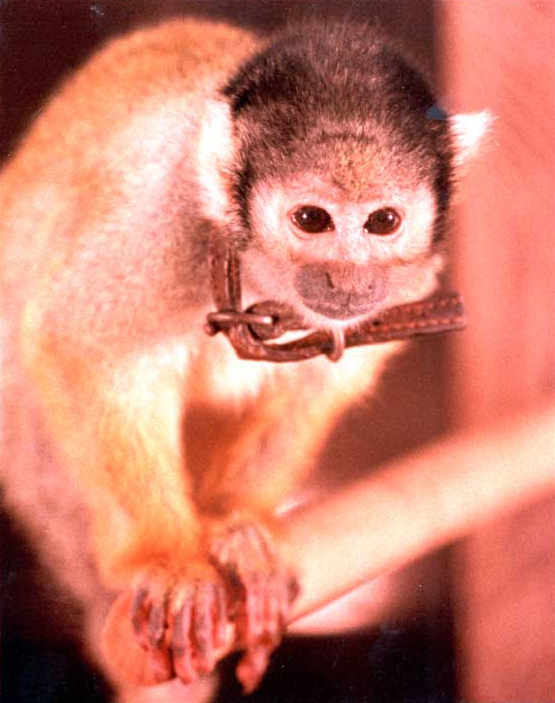
Able and Baker came home. On May 28, 1959 a rhesus macaque and a squirrel monkey went up on a Jupiter AM-18 to roughly 300 miles, splashed down some 1,500 miles off Puerto Rico, and were lifted out of the water unharmed, the first animals the United States sent past the edge of space and got back. Two species of wildly different size and metabolism had taken the same 16 minutes of violence and shrugged it off.
Able’s reprieve lasted four days. On June 1, 1959 she went into respiratory arrest under anesthesia during a straightforward operation to remove an implanted electrode, and the precise cause was never established. She had survived a rocket and was killed by a minor surgery.
Baker did rather better. She spent 1959 to 1971 at the Naval Aerospace Medical Center in Pensacola, then moved to the U.S. Space and Rocket Center in Huntsville, where schoolchildren wrote her 100 to 150 letters a day. She was married in a 1962 ceremony to a monkey called Big George, who died on January 8, 1979, and took up afterward with a squirrel monkey named Norman. She died on November 29, 1984 at about 27, the oldest squirrel monkey anyone has recorded. Visitors to her grave in Huntsville still leave bananas on the stone.
Sam
The letters stood for the School of Aviation Medicine in San Antonio, where he had trained, which is a thoroughly bureaucratic way to name a monkey and entirely typical of the period. Sam, a rhesus, went up on December 4, 1959 from Wallops Island aboard Little Joe 2, a squat solid-fuel test rocket built to prove that a Mercury capsule could tear itself clear of a failing booster.
He reached about 55 miles, which is an awkward altitude to have reached. It clears the 80-kilometer boundary the United States has used to define space, and falls short of the 100-kilometer Karman line most of the world prefers. Sam therefore did or did not go to space, depending entirely on whose ruler you happen to pick up. He took as much as 12g, floated weightless for roughly three minutes, and came down after 11 minutes and 6 seconds, where the destroyer USS Borie fished him out alive and undamaged.
The flight had never been about altitude. It was about the escape tower, the single piece of hardware meant to save an astronaut if the rocket beneath him failed. Sam went back to San Antonio and lived out his life at the school whose initials he wore, which in this company counts as a happy ending.
Miss Sam
Seven weeks later a second rhesus monkey flew the same class of rocket to a spectacularly unimpressive height. Little Joe 1B lifted off from Wallops Island on January 21, 1960 and carried Miss Sam to about 9.3 miles before the escape tower fired and pulled her capsule away.
That was the whole point. Little Joe 1B was a max Q test, triggering the abort system at the instant of maximum aerodynamic stress, the moment engineers considered the most dangerous in any ascent. Altitude was irrelevant to the experiment; violence was the variable being measured. The capsule she rode was a boilerplate Mercury shell, a structural mockup built to be blown off a rocket rather than to go anywhere in particular. It travelled about 11.7 miles out to sea across 8 minutes and 35 seconds, and a Marine Corps helicopter had her back on Wallops Island inside about 45 minutes, in good condition.
An earlier attempt at this same test had gone wrong when the escape tower fired prematurely on the pad, with no animal aboard, so hers was in effect the second try at validating a system that had already embarrassed itself once. Miss Sam never came within sight of space. Her flight mattered more to the engineers than a higher one would have, because it proved the mechanism meant to save a human being when everything else failed.
Bars and Lisichka
Sergei Korolev, the chief designer who ran the entire Soviet space effort from behind a wall of state secrecy, had a favourite among the dogs. Lisichka, whose name means Little Fox, was remembered by institute staff as the brightest and most affectionate of the candidates, and witnesses described Korolev speaking gently to her in the hours before the launch.
She and a dog recorded variously as Bars or Chaika lifted off from Baikonur on July 28, 1960, intended for a full day in orbit. It was the dress rehearsal for the mission that would make two other dogs world famous three weeks later. About 23.6 seconds into the flight, an RD-107 engine on one of the four strap-on boosters burned through and disintegrated. The rocket came apart and fell. Both animals died instantly, at an altitude no greater than a passenger jet cruises at.
The descent module struck the ground hard, with no time for its parachute to open, which means the recovery system would very likely have failed them even if the booster had held together. Engineers tore into the escape and recovery procedures before putting dogs on another rocket, and that work is the reason the next crew survived. Bars and Lisichka are left out of most tallies of Soviet space dogs entirely, on the technicality that they never got there.
Belka and Strelka
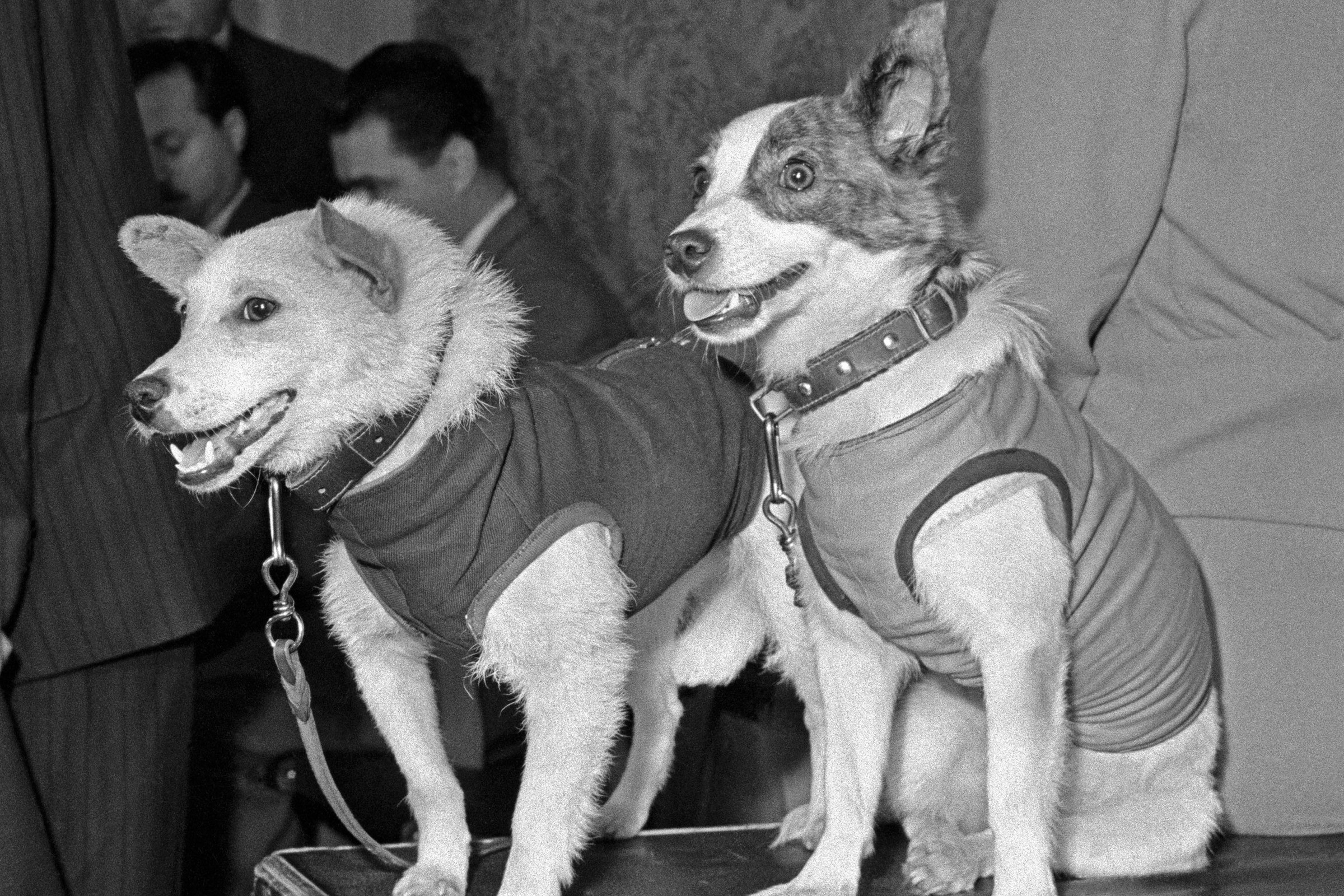
The first creatures to come back alive from orbit were two mixed-breed dogs launched on August 19, 1960 aboard Korabl-Sputnik 2, announced to the world as Sputnik 5. They circled at roughly 306 by 339 kilometers, at an inclination of 64.96 degrees, and the sources cannot quite agree how long they stayed: seventeen orbits over 27 hours by one account, eighteen orbits over 26 hours and 23 minutes by another.
The telling moment arrived on the fourth pass, when Belka vomited and shuddered. It was the first distress either dog had shown, and the historian Chris Dubbs describes it as the point at which both animals seemed to break out of an initial trance-like stillness. That reaction was the actual result of the mission. It told Soviet doctors that weightlessness did something measurable to a living body, which was precisely the question the flight existed to answer. Both dogs landed safely the following day.
In 1961 Khrushchev handed one of Strelka’s puppies, Pushinka, to the Kennedy family, a gift with rather more diplomatic freight than the average puppy carries. Pushinka went on to have four of her own with a White House dog named Charlie: Blackie, Butterfly, White Tip, and Streaker. Belka and Strelka were both eventually stuffed, and stand in a Moscow museum to this day, still on duty.
The Sputnik 5 Menagerie
Forty-odd mice, two rats, and a single grey rabbit made that same trip, and nobody has ever built them a statue. The Korabl-Sputnik 2 capsule was a crowded place: sources give either 40 or 42 mice depending on which account you consult, plus the rats, the rabbit, fruit flies, and a quantity of plants and fungi packed in alongside the two dogs.
The arrangement was deliberate. One detailed account divides the rodents into comparison groups, 12 mice housed with insects, plant material, and germ cultures, and another 28 sharing quarters with the two white rats. The species were chosen for contrast, so that scientists could see how bodies of very different size and metabolism handled an identical stretch of weightlessness and radiation. The plant cargo ran to wheat, peas, onions, and corn, tissue that registers radiation damage in ways a dog’s nervous system does not.
Every animal aboard came down alive on August 20, 1960, which makes this the first successful multi-species round trip to orbit and back. The rabbit’s name, assuming it had one, does not reliably survive in the record. It went to orbit, came back, and returned at once to anonymity, the common fate of very nearly every passenger on this list.
Pchelka and Muska
Nobody can quite agree on how these two dogs died, which is fitting for a programme that told the public almost nothing while it was happening. Korabl-Sputnik 3 lifted off at 07:30:04 UTC on December 1, 1960 carrying Pchelka and Mushka, the Little Bee and the Little Fly, along with mice, rats, flies and plants, on a planned day in orbit. NASA’s history office disposes of what happened next in a single flat line: the capsule and animals burned up on re-entry.
The fuller account is stranger. On the seventeenth orbit an infrared orientation sensor misfired, the attitude jets pushed the ship out of alignment, and the descent module failed to separate cleanly. The resulting trajectory would have dropped it outside Soviet territory, and Boris Chertok, who was in the room, calculated China. So the automatic APO charge aboard did exactly the job it had been fitted for and blew the descent module to pieces. The dogs were not killed by reentry. They were killed by a device installed to guarantee that no foreign government ever got a close look at a Vostok capsule.
Mushka had trained as a candidate for the Sputnik 2 mission in 1957 and was dropped for refusing to eat properly, which is how Laika got the assignment instead. Time magazine ran the mission’s obituary under the headline Goodbye Pchelka. They were the last dogs the Soviet programme ever lost.
Damka and Krasavka
Search teams heard barking from inside the sealed capsule before anyone had managed to cut it open. This was the second day after the landing, in deep Siberian snow at temperatures logged around minus 43 degrees Celsius, and it meant two dogs already written off were still alive in there.
The flight had gone wrong almost immediately. Launched December 22, 1960 as another orbital attempt, the upper stage failed and turned the mission into a suborbital arc that nonetheless climbed to 214 kilometers, comfortably across the Karman line, before the capsule came down far off course. What saved Damka and Krasavka was a second failure and then a third. The ejection seat did not fire, so they were not flung out into the cold. The primary self-destruct charge did not detonate either. Soviet capsules carried that charge precisely so a stray landing could never be found and examined by anybody else, which means two systems failing in succession is the only reason there was anything left alive to rescue.
The mice riding with them froze to death before help arrived. The dogs were wrapped in sheepskin coats for the journey back to Moscow. Oleg Gazenko, who ran the animal training programme and would spend his later years regretting Laika out loud, took Krasavka home. She lived with his family for about fourteen years and had puppies.
Ham
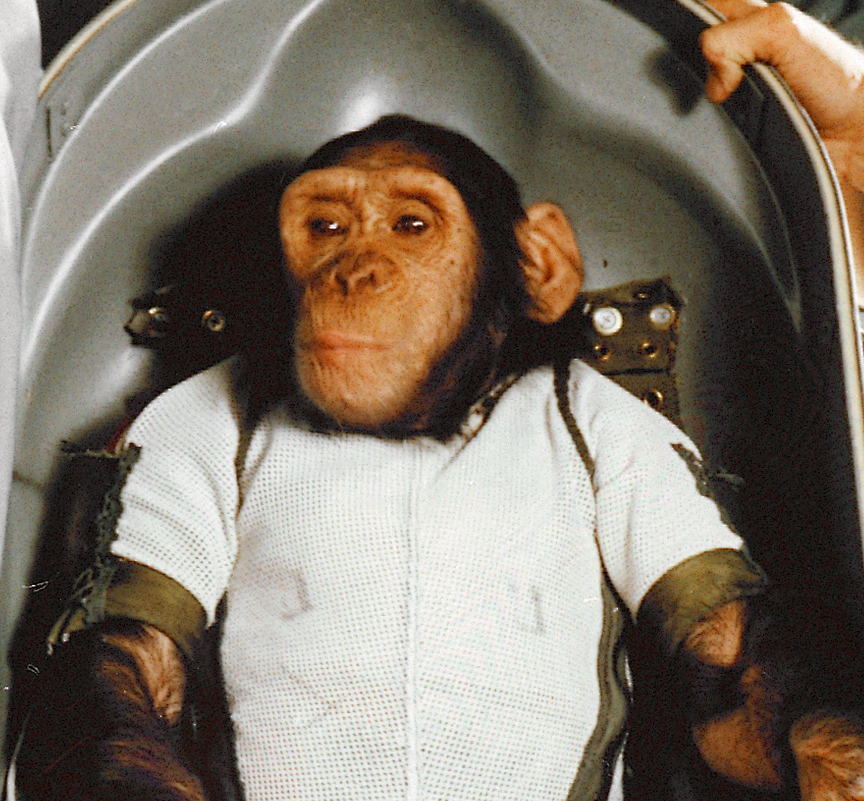
Chimp No. 65 was what the Holloman handlers called him, and Chimp No. 65 he remained right up until he came back alive. Only afterward did he become Ham, an acronym for the Holloman Aerospace Medical Center. Naming him in advance would have been awkward if the flight had gone the way several before it had gone.
He had been taken as an infant in French Cameroon, sold through a Miami animal dealership, and bought by the Air Force on July 9, 1959. His training under the neuroscientist Joseph Brady required him to pull a lever within five seconds of a blue light or take a mild electric shock to the soles of his feet, a routine he logged for 219 hours across fifteen months.
On January 31, 1961 his Mercury-Redstone 2 overshot badly. The escape system fired early when the booster ran out of liquid oxygen 2 minutes and 17 seconds in, and instead of the planned 115 miles he went to 157. He absorbed roughly 17g climbing and 14.7g returning, and carried on pulling his levers correctly throughout. The capsule splashed down about 60 miles from the nearest recovery ship, half swamped and shipping some 800 pounds of seawater.
Ham died on January 19, 1983. In July 2026 North Carolina put up a highway marker for him beside the zoo where he spent his last years.
Chernushka and the First Guinea Pig in Space
Nobody ever gave a name to the guinea pig that went into orbit on March 9, 1961. It rode Korabl-Sputnik 4 alongside the dog Chernushka, a Moscow stray, together with dozens of mice in black and white varieties, reptiles, seeds, and samples of human blood and cancer cells, plus a dummy cosmonaut the engineers had christened Ivan Ivanovich. NASA’s history office, marking the anniversary, described the manifest as an unusual crew, which is restrained of them.
The flight ran to a single orbit, launching at 06:29 UTC and coming down at 08:09:54 the same morning. Its real business was the ejection seat. Ivan Ivanovich was fired out of the descending capsule to prove the system that would throw a cosmonaut clear on landing, and he came down under his own parachute roughly 165 miles from where the dog touched down.
Everything worked. After the capsule destroyed the previous December and the abort three weeks after that, this was the first test in the series where guidance, recovery and ejection all performed at once. Chernushka was recovered unharmed. Five weeks later Yuri Gagarin flew the same design.
The guinea pig, the first of its kind above the atmosphere, appears in the record exactly long enough to be counted and then vanishes from the story altogether.
Zvezdochka
Yuri Gagarin named her. Eighteen days before he became the first human being to leave the atmosphere, Gagarin watched the countdown of the final uncrewed rehearsal and gave the dog aboard the name Zvezdochka, Little Star. He and Gherman Titov attended the launch in person, for the obvious reason that whatever happened to her was going to happen to one of them next.
Korabl-Sputnik 5 lifted off at 05:54 UTC on March 25, 1961 and flew one orbit of roughly 105 minutes. Ivan Ivanovich went along again, wearing a replacement head after the original was damaged in parachute testing. The communications check broadcast a recording of the Piatnitsky Choir followed by a spoken recipe for cabbage soup, on the reasoning that a foreign listener intercepting the signal would conclude they had found a Soviet transmission rather than something from elsewhere in the universe.
She came down near Izhevsk into snow deep enough that recovery took the better part of a day. A 1966 Soviet stamp depicting her later circulated on first-day covers bearing an authenticated ink paw print, obtained by a collector who wrote to the space programme asking for the dogs’ autographs and, astonishingly, received them.
Eighteen days after the snow outside Izhevsk, the man who had named her went into orbit himself.
Goliath
Thirty-five seconds is the entire duration of Goliath’s spaceflight. His Atlas E cleared the pad at Cape Canaveral on November 10, 1961, came apart, and killed him: a squirrel monkey weighing roughly 1.5 pounds who never got within reach of the upper atmosphere, let alone space.
The mission had an acronym, as everything did. SPURT stood for Small Primate Unrestrained Test, an Air Force programme rather than a NASA one, built to study how an animal behaved loose in a capsule instead of strapped into a couch. That is why they used squirrel monkeys. A chimpanzee had to be harnessed; something weighing a pound and a half could simply be allowed to float.
The rocket itself was a variant developed primarily as an intercontinental ballistic missile, which says most of what needs saying about how completely the American space and weapons programmes shared hardware in 1961. Nineteen days after Goliath died over that pad, a chimpanzee called Enos went into orbit from the same stretch of Florida coast and came home to a medical examination and a bowl of fruit.
Almost nothing about Goliath survives beyond his species, his weight, and the manner of his death. He is here because he was strapped into a rocket built to reach space, which is the whole of what qualifies anybody on this list, and because leaving him out would make a tidier story than the truth supports.
Enos
The lever apparatus turned on him. Enos had trained for months on a panel that rewarded correct answers and punished wrong ones with a mild shock to the feet, and somewhere above the Atlantic a contact plate failed, so that through the fourth of his four tasks he was shocked dozens of times in a row regardless of what he did. He went on working the levers correctly anyway, which is either a tribute to the training or a fairly bleak comment on it.
Mercury-Atlas 5 launched November 29, 1961 and was cut from three orbits to two after a metal chip in a fuel line corroded a roll thruster and left the capsule drifting off attitude. He circled at 99 by 147 miles. A heat exchanger froze briefly and let his body temperature climb from about 65 to 100.5 degrees Fahrenheit before the system sorted itself out.
He then waited around three hours in the water to be collected, during which he tore off his medical sensors, worked free of his restraints, and pulled out his own urinary catheter. Handlers settled him with fresh fruit. Examined in Bermuda, he was pronounced in good physical condition, which under the circumstances reads as generous.
Enos died on November 4, 1962 of antibiotic-resistant dysentery an autopsy found unconnected to his flight. His remains were reportedly sent to the Smithsonian and have never been traced.
Félicette
Her name was never Felix. The press invented that, borrowing from the cartoon cat, and the French research centre CERMA quietly corrected it to the feminine Felicette once the thing had stuck, because the first cat above the atmosphere was female: a black-and-white Parisian stray carrying the laboratory designation C 341.
She launched at 8:09 in the morning on October 18, 1963, aboard a Veronique AGI 47 sounding rocket fired from France’s range in the Algerian Sahara. The flight reached 152 kilometers, gave her about five minutes of weightlessness within a total of some thirteen, and put as much as 9.5g through her on the way up and 9g when the parachute opened. A helicopter collected the capsule. She had survived, and remains the only cat confirmed to have gone up and come back.
Electrodes implanted in her skull transmitted her neurological activity for the whole flight, which is also why CERMA euthanized her roughly two months afterward, in order to examine the brain those electrodes had been reading.
Six days after her flight a second French cat went up on a nearly identical rocket. An explosive release bolt failed, the vehicle launched at a wild angle, and the cat died. It was never publicly named. Felicette waited fifty-six years for any memorial at all, until a bronze statue of her was unveiled in Strasbourg on December 18, 2019.
Veterok and Ugolyok
Twenty-two days remains the longest spell any dog has ever spent in space, and for five years it was the longest for any Earth creature at all. Veterok and Ugolyok went up on Kosmos 110 at 20:09:36 GMT on February 22, 1966 and landed on March 16, having gone round 330 times.
The orbit was chosen to punish them. With an apogee of 882 kilometers against a perigee of 190, the flight deliberately carried the dogs up through the inner Van Allen belt, because Soviet planners wanted radiation data before committing people to higher orbits. Three weeks of it left both animals severely dehydrated, with lost weight, wasted muscle and wrecked coordination, and they needed weeks on the ground before they were themselves again.
NASA’s history page says twenty-one days rather than twenty-two, a discrepancy of precisely one day that nobody has ever troubled to resolve.
Plants rode along and got mixed reviews: the lettuce came back yielding about 50 percent more than its ground-grown controls, while some of the beans germinated poorly. Researchers afterward published a paper on the two dogs’ spermatogenesis, wanting to know whether three weeks of weightlessness had done anything permanent to their capacity to breed. No human crew stayed up longer until the Soyuz 11 cosmonauts came down in June 1971, having beaten the dogs by two days and died in the process.
The Chinese Space Dogs
Xiao Bao was afraid of heights, which is an unhelpful quality in a candidate for spaceflight. He panicked on the walk out to the capsule and had to be coaxed aboard by his handler, having already come through a selection process that involved shutting more than a hundred candidate puppies in a room and hitting them with noise above 100 decibels to find the ones that could tolerate a rocket.
He and a second dog, Shan Shan, flew separately from Base 603, a secret site in Guangde county, Anhui province, run by the Chinese Academy of Sciences. Xiao Bao went first, on either July 14 or July 15 of 1966 depending on which account you trust, reaching an altitude reported at roughly 100 km. Shan Shan followed on July 28. Both came back alive, and unlike the rodents flown before them, neither was dissected afterward.
The programme had form. Eight white mice went up and returned on July 19, 1964, the first successful biological flight of the Chinese effort, with further rodent flights the year after. By August 1966 the Institute of Biophysics was preparing to send monkeys.
Then the Cultural Revolution arrived, the research institutions came apart, and the monkeys never flew. Shan Shan’s July launch was the last Base 603 ever made. The whole business stayed classified for decades.
Biosatellite I and II
Every organism aboard the first of these two satellites burned. Biosatellite 1’s entry capsule separated from its bus exactly as designed on December 14, 1966, and then the deorbit motor failed to ignite, leaving the whole experiment stranded in a slowly decaying orbit for two months until it came down and destroyed itself on February 15, 1967. Frog eggs, a parasitic wasp, flour beetles, fruit flies, wheat seedlings and amoebas had gone up into a 296 by 309 kilometer orbit, and not one of them came back to be studied.
So the programme did the whole thing over. Biosatellite 2 launched September 7, 1967 with 13 experiments and largely the same roster of organisms, plus a radiation source mounted ahead of the capsule so researchers could separate the effects of radiation from those of weightlessness. The recovery worked this time. The flight itself was cut to 45 hours by a tropical storm bearing down on the Pacific recovery zone and by communications trouble with the ground.
Two missions, one lost outright and one curtailed by weather, between them produced a partial version of a data set designed to be complete. The recovered capsule survives, catalogued by the National Air and Space Museum, though in recent years it has been out on loan to a museum in Chicago rather than on display in Washington.
The Zond 5 Tortoises
Three months before Apollo 8 carried human beings around the Moon and back, two Russian steppe tortoises had already done it. Zond 5 lifted off on September 14, 1968 at 21:42 UTC, swung round the far side, passed within 1,950 kilometers of the lunar surface on September 18, and splashed into the Indian Ocean on September 21 after 6 days, 18 hours and 24 minutes. The tortoises were alive when the hatch came open.
They were chosen for their metabolism. A steppe tortoise can go a long time without eating, which suited a capsule with no room for a feeding system, and these two weighed between 0.34 and 0.4 kilograms apiece. They came back about 10 percent lighter, roughly double the 5 percent their ground-based controls shed over the same period, and were reported to have lost no appetite whatsoever.
They did not travel alone. Packed in around them were fruit fly eggs, cell cultures of wheat, barley, pea, pine, carrot and tomato, wildflower seeds, three strains of algae and a strain of lysogenic bacteria. Soviet sailors aboard the Vasily Golovnin fished the capsule out of the water, and the tortoises reached Bombay on October 3, 1968, having gone round the Moon and back before any of the twelve men who walked on the Moon had so much as left the launch pad.
The Zond 6 Biological Payload
November 10, 1968 sent a second consignment of animals toward the Moon, and this one did not come back alive. Zond 6 launched at 19:11:31 UTC carrying turtles, flies and bacteria, a leaner manifest than the botanical garden that had ridden Zond 5 two months earlier.
The fatal problem started as routine housekeeping. Ground controllers rotated the spacecraft to warm its hydrogen peroxide tanks, and the manoeuvre damaged the door seal around the reentry cabin. The leak was slow but it was steady, and by a few hours before reentry on November 17, the cabin had emptied and every animal aboard was dead. What followed reads almost as an insult. The residual pressure had fallen to roughly 25 mmHg, exactly the regime in which a coronal discharge can trigger a parachute, so the chute fired early and the capsule slammed into the ground about 70 kilometers northeast of Tyuratam.
The film magazines came through it intact. The Soviet Union developed the lunar photographs, published them, and announced the mission a complete success, which by the standards of what it had set out to photograph was arguably true. No public mention was made of the turtles. Zond 5’s passengers got a homecoming and a weigh-in; Zond 6’s got a sealed cabin with the air going out of it.
The Zond 7 Turtles
Nobody ever wrote down whether they survived. That is the odd gap at the centre of the Zond 7 story, because by every other measure the mission was the cleanest of the series: launched August 7, 1969, past the Moon at 1,984.6 kilometers on August 11, and down on August 14 in a soft, on-target landing 50 kilometers south of Kustanai. Four turtles rode the whole way. Soviet engineers concluded afterward that this was the first flight in the programme they would have been willing to put a cosmonaut on.
What the published record contains is a 1971 histological study by Sutulov and colleagues examining the turtles after the flight. What it does not contain is a plain sentence saying they were alive when it landed. The successful recovery is the only evidence anyone has, and it is strong evidence, but it is inference rather than testimony, which is worth saying out loud on a list like this one.
Zond 7 also brought back colour photographs of both the Earth and the Moon, a step up from the panchromatic film its predecessors carried. Set against the two flights before it, the circumlunar reptile record reads as one confirmed survival, one capsule of dead turtles, and this one, where the hardware worked perfectly and nobody thought to write down what happened to the passengers.
Bonnie
Sources cannot agree on when Bonnie launched or when he died. NASA’s history office gives June 28, 1969 for the launch; the standard mission article gives June 29. NASA says he died eight hours after being pulled from the Pacific, of a heart attack brought on by dehydration; the other account puts his death on July 8, a full day after recovery. Everybody agrees on the shape of it, which is that a 6-kilogram male pig-tailed macaque went up for a planned 30 days and was brought down at 8.8 because he was failing.
The mission had been loaded with ambition. Biosatellite 3 monitored his brain states, his behavioural performance, his cardiovascular condition, his fluid and electrolyte balance and his metabolic state, an extraordinary slate of measurements to hang on a single animal. Reviewers afterward pointed to exactly that as the design flaw: too much asked of one subject, with no fallback when the subject deteriorated. The capsule came back fine. The science did not.
The press had taken to calling him an astromonk, distinguishing him from the chimponauts of the early decade. His death effectively ended American primate spaceflight for sixteen years. NASA did not send another monkey up until two squirrel monkeys rode a Spacelab mission in 1985, by which point the agency had a shuttle and a rather different attitude to the whole business.
Bullfrogs
A Louisiana congressman lobbied to get hometown frogs onto the flight, and won. Edwin Edwards championed the Louisiana Frog Co. of Rayne as supplier, which is how two American bullfrogs named Pierre and Tee-Nom came to be the passengers on NASA’s Orbiting Frog Otolith satellite, launched from Wallops Island on a Scout B at 06:00 GMT on November 9, 1970.
The otolith is the little calcium-carbonate stone in the inner ear that tells a vertebrate which way is down, and the entire mission existed to watch what one did when nothing was pulling on it. To keep the frogs still and their metabolisms low across a flight with no food supply, engineers sealed them into water-filled capsules with severed limb nerves, artificial lungs and heaters, a life-support arrangement designed to last about a month. Their inner ears responded strongly at the onset of weightlessness and then drifted back toward normal readings as the days passed, which was precisely the acclimatization the experiment had been built to catch.
The battery failed around November 15, after more than six days, and the frogs died. This surprised nobody: OFO was a one-way mission by design, with no recovery hardware aboard at any point. NASA recorded it as fully successful, and by its own terms it was. Nobody had ever intended Pierre and Tee-Nom to come home.
The Apollo 17 Pocket Mice
Five animals have reached lunar orbit and four of them came home, a record nothing has touched. They were little pocket mice, and they spent December 1972 going round the Moon inside a locker in the Apollo 17 command module America, while Gene Cernan and Jack Schmitt worked the surface and Ron Evans flew the ship above them.
NASA chose the species for its plumbing. A little pocket mouse is a desert animal that never needs to drink, concentrating its urine so efficiently it can be sealed in a canister for the length of a lunar mission with no water at all. Each of the five carried a radiation dosimeter surgically implanted under the scalp, built from layers of Lexan and cellulose nitrate on a platform moulded to the animal’s skull. Between them they logged about 80 high-energy cosmic ray tracks across 75 lunar orbits and 147 hours.
The crew called them Fee, Fi, Fo, Fum and Phooey. The paperwork called them A3305, A3326, A3352, A3356 and A3400. A3352 was dead when the canister was opened at Pago Pago seven hours after splashdown, and the report never established why. The four survivors were dissected. Their brains showed no cosmic-ray lesions whatsoever, and every flight animal had severe, unexplained damage to the olfactory epithelium. They were the last animals to fly an Apollo mission, and Apollo 17 was the last time anybody went, leaving it to bootprints, dead hardware, and the fifteen people memorialized on the Moon.
Arabella and Anita
Judith Miles was a high school student in Lexington, Massachusetts when she read something about spiders in a magazine and wondered whether one could still spin a web with no gravity to hang it from. Her proposal flew. Web Formation in Zero Gravity went up aboard Skylab 3 on July 28, 1973 at 11:10:50 UTC, carrying two European garden cross spiders called Arabella and Anita.
Arabella’s first attempt was a mess, a rudimentary tangle thrown together on day one. By the second day she had produced a complete and properly formed web, and both spiders ended up spinning silk finer than anything they had made on the ground. The animal had, in effect, worked the problem out mid-mission, which is more adaptability than the engineers had reason to expect from a spider.
Both died during or just after the flight, most likely of dehydration in their small enclosures. Anita’s body is at the Smithsonian’s Udvar-Hazy Center; Arabella’s sits on long-term loan in Huntsville, Alabama, at the rocket museum that also keeps Miss Baker’s grave. The two spiders are not displayed together.
They had company aboard. The same mission carried six pocket mice, two mummichog minnows with 50 fertile eggs, and 720 fruit fly pupae. The minnows swam in disoriented loops for days, while the ones that hatched in orbit oriented themselves correctly from birth.
The Bion Biosatellites
In 1975 the United States joined a Soviet biological space programme, which was not the sort of thing the two countries were doing that decade. Bion 3, flying as Cosmos 782, launched November 25, 1975 with a NASA radiation dosimeter riding alongside 25 Wistar rats, tortoises, fruit flies and around 1,000 embryos of the mummichog fish. Scientists from seven countries took part. The satellites themselves were built on the Zenit reconnaissance bus, which descends directly from the capsule that carried Gagarin, so the hardware had a certain pedigree.
Bion 4, Cosmos 936, went up on August 3, 1977 with a genuinely clever arrangement: 20 rats floating free and 10 more spinning in an onboard centrifuge, so that the effects of weightlessness could be separated from the general battering of spaceflight. The rats averaged 215 grams and 62 days old. The centrifuged group came through it noticeably better.
Bion 5, Cosmos 1129, flew from September 29 to October 14, 1979 with 37 rats and Japanese quail aboard, and attempted the first mammalian breeding in space. It failed. None of the females gave birth, though two were later found to have been pregnant with embryos their bodies had reabsorbed. Gunter’s Space Page dates that launch to September 25 instead. Four days is not much, but nobody can now say which is right.
Abrek and Bion
It took the Soviet Union 34 years from the first American monkey flight to launch one of its own. The programme that had put dogs up before anyone else, and had run them through more than two dozen flights, simply never bothered with primates until Bion 6 lifted off on December 14, 1983 at 07:00 UTC with two rhesus macaques aboard.
Abrek and Bion were both about three years old and weighed roughly 4 kilograms each, deliberately matched for age and size so that individual variation would not muddy the results. They came down on December 19 at 04:48 UTC after 4 days, 21 hours and 48 minutes, and both were alive and in good order. Eighteen pregnant rats had flown with them and went on to produce normal litters after landing, which answered a question the earlier failed breeding attempt had raised.
The monkeys were named in the Soviet habit of giving an animal a word rather than a name; Bion took its designation straight from the spacecraft it rode. What mattered to the engineers was less the individuals than the demonstration that their recovery hardware could bring a primate down alive and intact. They would need that capability again in about nineteen months, when the next pair went up.
Verny and Gordy
Two rhesus macaques spent a week in orbit in the summer of 1985, and the English-language record cannot settle on what to call them. NASA’s history office names them Verny and Gordy, and helpfully translates: Faithful and Proud. The standard encyclopedia entry for the same flight calls them Gordyy and Oomka. One of those is a spelling variant of the other, which accounts for half the confusion and none of the rest of it.
The flight itself is not in dispute. Bion 7, catalogued as Cosmos 1667, launched July 10, 1985 and was recovered July 17, a seven-day mission, slightly longer than the five days its predecessor had managed and correspondingly richer in physiological data. The experiments run aboard were eventually compiled into a dedicated paper in Advances in Space Research, itemising exactly what had been measured and when.
Both animals came home alive, which by this point in the Bion programme was becoming an expectation rather than a hope. The Soviet primate flights had a survival record the early American monkey programme would have envied, largely because the Soviets came to primates late, after three decades of practice at getting things down out of the sky in one piece. Whatever their names were, the two of them were fine.
Squirrel Monkeys and Rats: STS-51-B
Within about three hours of liftoff, the cages began to leak. Food crumbs and animal waste worked out through gaps in the seals and drifted into the Spacelab module and up onto the flight deck as a fine, organic-smelling cloud. It is the single most quoted thing about the mission, and it prompted a full redesign of the housing hardware before NASA flew another animal on a shuttle.
STS-51-B, flying the Spacelab 3 payload, launched April 29, 1985 and landed May 6 after 7 days, 0 hours, 8 minutes and 46 seconds, carrying two squirrel monkeys and 24 rats in the Research Animal Holding Facility. It was only the second time the agency had put live non-human mammals aboard the shuttle. The physician on the crew, William Thornton, became the de facto zookeeper, inventing procedures on the fly once the containment problem became apparent.
There is a detail people skip past. Mission specialist Don Lind noticed early on that the monkeys had chewed roughly a quarter of an inch off the ends of their own tails during the stress of launch. The mess produced editorial cartoons of a relieved astronaut giving thanks that nobody had asked him to bring elephants.
Yerosha and Dryoma
Somewhere in the middle of a thirteen-day flight, Yerosha got an arm loose. He was a rhesus macaque, his name translating roughly to Drowsy, and having worked one limb partly free of his restraints he spent the rest of the mission investigating a cage nobody had designed to be investigated. Bion 8, catalogued as Cosmos 1887, had launched September 29, 1987 with him and a second macaque called Dryoma aboard.
The landing was worse than the flight. The recovery capsule came down about 1,850 miles off target, in conditions cold enough to kill some of the fish riding along, and it was October 12 before anyone had the two monkeys back. Both survived it, along with ten Wistar rats, newts, guppies, grasshoppers, beetles and a quantity of fruit flies. The fish were less fortunate.
This was cooperative science in the last years of the Cold War, an arrangement in which American researchers flew experiments on Soviet biosatellites while both governments raced each other everywhere else. The finding that mattered was undramatic and useful: two macaques had spent thirteen days weightless and come through without serious physiological harm, which cleared the path for the longer primate flights of the following decade. A claim that Dryoma was later handed to Fidel Castro turns up in one compilation and nowhere reputable, so treat it as a story rather than a fact.
Zhakonya and Zabiyaka
A thermal control system failed partway through the flight, and most of the science died with it. Bion 9, catalogued as Cosmos 2044, launched September 15, 1989 carrying two rhesus macaques whose names NASA renders as Zhakonya and Zabiyaka, the second of which translates to Troublemaker. Of the 80 experiments planned for the mission, roughly 30 came back with data anyone could use. The rest were cooked, along with a number of the smaller specimens sharing the capsule.
The monkeys themselves were fine. They came down on September 28 after what NASA counts as 14 days and one detailed account puts at 13 days and 17 hours, and either figure made it the longest primate spaceflight anybody had yet flown. That record was set on a mission where more than half the experiments failed, which is a fair summary of how space biology tended to go in this period: the animals endured, and the equipment did not.
It is worth being careful with the numbering here, because the published record has muddled it before. Bion 9 is Cosmos 2044. Cosmos 1667 was Bion 7, four years earlier, with an entirely different pair of monkeys aboard. The two flights are four years and two entirely different pairs of monkeys apart, and they are confused constantly.
Japanese Quail Chicks
A Progress freighter delivered 33 fertilized quail eggs to the Mir space station on March 3, 1990, and on March 22 one of them hatched. That chick was the first bird ever born off the planet, and by most accounts eight of the 33 eggs eventually opened, though the Audubon Society’s version of events counts six. The discrepancy has never been resolved and probably never will be.
What happened next is the part nobody anticipates. A newly hatched chick on Earth spends its first hours working out which way is up and then pecking at things on the ground. A chick hatched in orbit has no such reference and cannot manage either task. They could not orient themselves, could not grip, and could not find food, so the cosmonauts hand-fed them a paste through a tube roughly every two hours. Researchers later tried fitting the birds with little harness jackets to hold them near a feeder so they might have a go at eating unaided.
The surviving chicks were euthanized on return so their physiology could be examined. Quail research on Mir carried on for years afterward, with NASA sending another 48 fertile eggs up for a later mission. Birds remain almost absent from spaceflight, partly because a hatchling with no sense of down turns out to be very hard to keep alive.
FSW-13
Roughly sixty animals and plants went into orbit from Jiuquan on October 5, 1990, aboard a recoverable capsule launched by a Long March 2C. Rats and guinea pigs were among them, and they made this the first Chinese mission to carry live mammals into orbit rather than up on a brief suborbital arc. The capsule came down eight days later.
Nobody ever published a proper manifest. The sources agree on the approximate total and on the presence of rats and guinea pigs, and not one of them says how many of each, a thinner record than any comparable Soviet or American flight of the same era left behind. What the mission set out to measure is clearer: how weightlessness affects metabolism, food requirements and excretion, questions with obvious application to a country that intended to put people up there eventually.
The satellite flew between roughly 208 and 311 kilometers at an inclination of 57 degrees, part of a series that ran five missions between 1987 and 1993. Capsules of that generation weighed around 2,100 kilograms and were rated for seven to ten days aloft, so eight days was a full and unremarkable working life.
Even the name is contested. Trackers disagree about where the flight sits in the cumulative numbering, a fittingly modest confusion for a mission that established a national first.
Jellyfish
Something like 60,000 animals came home from a mission that went up with 2,478 of them. STS-40 launched June 5, 1991 and landed nine days later on June 14, carrying moon jellyfish polyps that the experiment’s team, led by the cell biologist Dorothy Spangenberg of Eastern Virginia Medical School, triggered into their next life stage with injections of iodine while in orbit. The polyps duly became ephyrae, and multiplied enormously.
The point was the rhopalia. When a jellyfish develops into an ephyra it grows these gravity-sensing organs, each containing tiny crystals called statoliths that work on much the same principle as the human inner ear. Spangenberg wanted to know what such an organ becomes when it forms in an environment with no down to detect. The answer, once the animals were tested back on the ground, was that ephyrae grown in orbit were around six times more likely to pulse abnormally than jellyfish raised on Earth.
That finding has outlasted its mission. It stands as early evidence that a nervous system assembled from scratch in weightlessness may not readjust cleanly to gravity afterward, which is a live question for anyone contemplating a child born off the planet. Thirty rodents flew on the same mission for parallel studies. NASA’s own summary describes the jellyfish cargo simply as thousands, and leaves the counting to the researchers.
Krosh and Ivasha
It got too hot. That is the short version of Bion 10, which launched December 29, 1992 from Plesetsk with two rhesus macaques named Krosh and Ivasha, and which had to be brought down roughly two days ahead of schedule on January 7, 1993 when cabin temperatures climbed past what anyone was comfortable with.
Both monkeys were treated for dehydration on landing. One of them reportedly refused food for three days after the temperature spike before his appetite came back, which is about the response you would expect from an animal that had just spent a week and a half in a slowly warming box. Seven of the fifteen tadpoles aboard died. Krosh, whose name means Tiny, had been trained along with Ivasha to work food and juice dispensers and a foot pedal that measured muscle response, part of a research package covering bone loss, neuromuscular decline, vestibular function and metabolism.
Both survived, which puts this among the rougher successes in the programme’s history. A claim that Krosh fathered offspring after rehabilitation circulates in general survey articles without support from NASA’s own records, so it belongs in the same drawer as the Castro story. Within four years the Bion programme would run into something considerably worse than a thermostat.
Frogs and Carp: STS-47
Frog eggs were fertilized in orbit for the first time in September 1992, and by the Wednesday of the flight they were hatching. The African clawed frog is a laboratory standard precisely because its development is so well documented on the ground, which made it the obvious animal for answering a question nobody had been able to test: whether a vertebrate embryo actually needs gravity to assemble itself correctly.
STS-47 launched September 12, 1992 and landed September 20, flying the Spacelab-J payload. Mae Jemison was aboard as science mission specialist, becoming the first Black woman in space, and worked the life-sciences experiments alongside the frog studies. The tadpoles that developed in weightlessness swam in a distinctive looping pattern, which mission scientists connected to the way buoyancy regulation and lung inflation interact when there is no surface to swim up toward.
Two Japanese carp went along as well, one of them surgically deprived of an otolith before launch so that researchers could watch a fish with a working balance organ and a fish without one adapt side by side. The middeck also held 230 oriental hornets in an Israeli-designed experiment, of which 202 died when the water delivery system failed and the survivors built nothing. Not every payload on a good mission has a good time.
Lapik and Multik
One monkey died on an operating table in January 1997, and an entire programme died with him. Bion 11 had launched from Plesetsk on December 24, 1996 aboard a Soyuz-U, carrying rhesus macaques Lapik and Multik and, unusually, no Cosmos number at all: the flight went into the catalogues as 1996-073A, breaking with the convention of the seven primate missions before it.
Both animals landed safely. The following day, January 8, 1997, Multik was anesthetized for a post-flight biopsy and suffered a heart attack under the anesthetic. He had survived a fortnight in orbit and was killed by the examination afterward, which is precisely what had happened to the American monkey Able in 1959, thirty-eight years and one Cold War earlier.
The consequences were immediate. International criticism combined with the withdrawal of American funding, and the planned Bion 12 flight for December 1998 was cancelled outright. No monkey has ridden a Bion satellite since. Lapik went back to the primate nursery at Adler near Sochi that had supplied the animals for the whole programme, and saw out his years there quietly.
The satellites themselves never stopped. Bion-M2 flew in August 2025 with mice and fruit flies aboard. The hardware line continues; the primates were quietly written out of it.
STS-90 Neurolab
Two thousand animals rode Columbia into orbit in the spring of 1998, which NASA described afterward as the largest collection of living organisms sent off the planet up to that point. Rats, mice, snails, crickets and two species of fish went up together on April 17 and came home on May 3 after 16 days and 256 orbits. It was the final flight of the Spacelab module, the European-built laboratory that had been going up in shuttle payload bays since the early eighties.
The science was ambitious to the point of overreach: 26 experiments run by eight research teams, all of them examining how nervous systems develop, adapt and function, with six space agencies collaborating on a single mission and the seven crew members doubling as operators and test subjects. Four oyster toadfish flew, chosen along with the swordtails because their inner-ear balance organs are unusually accessible to study.
Then the newborn rats began dying at a rate nobody had forecast, and the Mammalian Development team had to tear up its plan mid-flight and decide which questions it could still answer. A fifteen-year-old orbital laboratory, six space agencies, and a payload of two thousand carefully selected animals, undone in part by the fragility of very young rats. Spacelab closed out its fifteen years on that note rather than a triumphant one.
C. elegans Worms
They outlived the crew. When Columbia broke apart over Texas on February 1, 2003, killing all seven astronauts aboard, a canister of nematode worms in a middeck locker came through the disintegration, the fall, and the impact, and was recovered from the debris field weeks later with the worms alive inside. The researcher Nathaniel Szewczyk found only minor heat damage to their exteriors. The findings were published in the journal Astrobiology in December 2005.
The locker had been reinforced to protect its contents, and it separated from the orbiter and fell on its own, which is most of the explanation. The rest is that Caenorhabditis elegans is about a millimetre long, and small things survive impacts that destroy large ones. It is a grim footnote to the worst day in the shuttle programme, and it is also a real piece of evidence: simple multicellular life can survive an uncontrolled fall through a planet’s atmosphere, which bears directly on how living material might move between worlds.
This particular worm has a habit of firsts. Its genome, completed in December 1998, was the first of any animal to be fully sequenced. Descendants of the Columbia worms are still kept at a genetics centre in Minnesota, and a fresh batch went up around April 2026 for 15 weeks of deep-space radiation exposure ahead of the Moon and Mars missions.
Tardigrades
Nothing about a tardigrade suggests it ought to survive the open vacuum of space. It is a water-dwelling animal under a millimetre long with eight stubby legs, and it looks less like a survivor than like something drawn by a child. About 3,000 of them went up aboard the European Space Agency’s Foton-M3 in September 2007, spent 12 days in orbit, and were exposed with no shielding whatsoever to hard vacuum, total dehydration and unfiltered solar and cosmic radiation.
They came back alive. Some of them went on to lay viable eggs that hatched normally, which is the detail that turns a curiosity into a finding. The experiment, run by Ingemar Jonsson of the University of Kristianstad in Sweden, published in Current Biology in 2008 and established tardigrades as the first animals known to survive open space with nothing between them and it.
There is a coda that nobody can close. When Israel’s Beresheet lander crashed into the Moon on April 11, 2019, it was carrying thousands of dehydrated tardigrades, dried into the dormant state they use to wait out bad conditions, glued to a digital archive aboard. Later impact testing put their survival ceiling at roughly 900 meters per second, close to the speed Beresheet was making when it hit, and the researchers concluded the animals most likely did not come through it. Probably, then, there is nothing alive up there. Probably.
Iranian Space Animals
In February 2010 Iran put a mouse, two turtles and about a dozen worms on a Kavoshgar-3 rocket, and became the newest country to send animals off the planet. Three years later, on January 28, 2013, it launched a rhesus monkey named Fargam aboard a Pishgam capsule to an altitude above 120 kilometers, and state media reported that the capsule came down under parachute with the animal alive inside.
Then the pictures did not match. The monkey in the pre-flight promotional footage had darker hair and a prominent mole above its left eye. The monkey presented afterward had neither. Iran’s space agency explained that backup photographs of a different animal had been released by mistake, which is plausible and also exactly what you would say. The astronomer Jonathan McDowell, who tracks launches for a living, concluded the monkey in the promotional material was the one that died in Iran’s failed 2011 attempt, while adding that he saw no particular reason to doubt the 2013 flight itself had worked.
One clarification belongs here, because the story circulates wrongly. Iran launched a bio-space capsule on December 6, 2023 that was widely reported as carrying animals. It did not. Pressed by PETA for confirmation, the Iranian Space Agency replied in writing that no real animals were used and that sensors and simulation kits had collected the data instead.
Medaka Fish
Bone loss is among the nastier things weightlessness does to a body, and it is very difficult to watch happening inside a living animal. Unless the animal is transparent. The Japanese rice fish is naturally see-through, and JAXA flew a transgenic line of them with fluorescent tags on their bone cells, so researchers could observe a skeleton dismantling itself in real time without dissecting anything.
The Medaka Osteoclast experiment ran aboard the Kibo module from November 9, 2012 to January 29, 2013, with follow-up observational work reported complete by March 7, 2014. The fish were sampled partway through and again near the end of a rearing period stretching close to two months. When the results were published in Scientific Reports on September 21, 2015, they showed that microgravity had substantially increased both the activity and volume of osteoclasts, the cells that break bone down, and that mineral density in the fishes’ tooth-bearing region had dropped by roughly 24 percent.
Two stress-response genes were strongly upregulated in the flight fish as well, giving the bone loss a molecular signature rather than just an outcome. Medaka had form here: back on STS-65 in July 1994 they became the first vertebrates known to mate in space and produce healthy young. The fish were dismantling their own jaws in orbit, and researchers could watch it happen through the skin.
Bion-M No.1
Forty-five mice, fifteen geckos and eight gerbils went into orbit together on April 19, 2013, along with snails and fish, one of the fullest menageries ever loaded into a single spacecraft. Bion-M No.1 flew free of any station for 30 days and landed near Orenburg on May 19. What came back was not what went up.
All eight gerbils were dead, killed when their habitat lost power, ventilation, lighting and food supply together. Most of the mice were dead too, a food-dispenser malfunction accounting for a large share of them. The fish were dead. Nearly every warm-blooded animal aboard had been undone not by space but by equipment, in a mission specifically designed to test whether animals could endure a long stretch away from Earth.
The geckos were fine. All fifteen came through the full month without apparent difficulty, which is a result nobody planned and which quietly says something about how much easier a reptile’s requirements are to meet than a mammal’s. Survivors were euthanized afterward for tissue study, standard practice for this class of Russian biosatellite. NASA collaborated on the flight and took some of the mice for its own work. Russian scientists framed the mission as a rehearsal for deep-space biology, an ambition rather undercut by how few of the travellers came home.
FOTON-M4 Geckos
Roscosmos sent five lizards into orbit in July 2014 to find out whether they would mate in weightlessness, and the press did what the press was always going to do with that. The geckos launched on July 18 aboard Foton-M4, and were being called the sex geckos in print within about a day.
Things then went sideways in a genuinely alarming way. Shortly after reaching orbit the satellite stopped answering ground commands altogether, and for several days nobody on Earth could talk to it. Controllers eventually regained contact and the flight continued, but the incident produced a peculiar international moment: the comedian John Oliver ran a mock rescue campaign under the hashtag GoGetThoseGeckos, which drew supportive messages from Buzz Aldrin and Patrick Stewart, among others.
The capsule came down on September 1, 2014 and all five geckos were dead inside it. Roscosmos examined the recovered hardware and announced that it could not determine when or how they had died, and that remains the official position. No mechanical cause was ever identified. The fruit flies riding in the same capsule survived the whole thing, developed normally, and bred, which is the sort of contrast that makes a biologist thoughtful and an engineer uneasy. The question the mission set out to answer was never answered.
Rodent Research-1
Before 2014, American rodent studies were bounded by how long a shuttle could stay up. Across 27 Space Shuttle missions flown between 1983 and 2011, they ran between 4 and 18 days, and a body needs longer than that to show what weightlessness really does to it. A whole category of biology was simply out of reach.
Rodent Research-1 fixed that. It launched September 21, 2014 aboard a SpaceX Dragon on the CRS-4 resupply run, carrying 20 mice: 10 for a muscle-atrophy investigation and 10 more devoted to proving the hardware worked. The study ran 37 days, double the longest any shuttle had allowed, with the animals monitored through daily downlinked video. They stayed healthy, groomed normally, and behaved like mice.
The hardware is the actual legacy. What this mission validated was the Rodent Habitat, a cage system capable of keeping rodents alive and observable for more than five weeks in orbit, along with the tissue-collection procedures needed to get usable RNA out of them afterward. Every ISS rodent study since has run on that foundation, through a numbered series that has continued for years. It is an unglamorous kind of milestone: a mission whose chief accomplishment was a cage that worked.
Zebrafish
Four fish and some pondweed kept each other alive for 43 days aboard a Chinese space station, which does not sound like much until you consider that the previous record for a self-sustaining aquatic ecosystem in orbit was 16 days, set by German researchers flying swordtails. Shenzhou-18 launched on April 25, 2024 carrying two male and two female zebrafish along with hornwort, the plant handling oxygen production while the fish supplied the carbon dioxide.
The fish did not enjoy it. Astronauts recorded them swimming upside down, spinning, and circling, a comprehensive loss of orientation in an animal that normally knows exactly which way is up. Zebrafish take their bearings partly from light and partly from gravity, and with one of those removed they defaulted to something close to nonsense. They also, at some point, laid eggs, which turned up in the aquarium during the experiment.
China planned a second group of six fish for 2025, and by May 2026 the Tianzhou-10 cargo craft was delivering zebrafish embryos and cells rather than adults, a shift from asking whether they can survive to asking what happens to them as they form. JAXA has run its own separate zebrafish work in the Kibo module studying muscle atrophy. For a fish that cannot tell up from down without gravity, it has had a remarkable amount of work.
Bion-M No.2
Russia deliberately flew this one through more radiation than anybody normally accepts. Bion-M No.2 launched from Baikonur on a Soyuz-2.1b on August 20, 2025 into a near-polar orbit inclined about 96.9 degrees, between roughly 363 and 381 kilometers up, a path chosen precisely because it exposes its cargo to substantially harsher cosmic radiation than the International Space Station ever sees. The planners wanted numbers relevant to deep-space and lunar missions, and the only way to get them was to go somewhere unpleasant.
Aboard were 75 mice and around 1,500 fruit flies, plus microbes, cell cultures, plant seeds and a quantity of simulated lunar soil. The satellite came down in the Orenburg region on September 19, 2025 after roughly a month. Ten of the 75 mice did not survive, according to the director of the Institute for Biomedical Problems, which ran the biological programme.
The orbit had originally been planned much higher, at 800 kilometers, and was brought down during 2025 to match where Russia intends to put its future orbital station. Press coverage reached for a Noah’s Ark comparison, a label that sits awkwardly against a flight where a portion of the animals did not disembark. A further satellite, Bion-M No.3, was reported in December 2025 as planned for launch the following year.
Shenzhou-21 Mice
About 300 candidates were screened over roughly 60 days to find the four that flew. The tests included balancing on an accelerating rotating rod, resisting motion sickness while being spun in several directions at once, hanging upside down without panicking, and solving mazes. What emerged were two male and two female mice, launched aboard Shenzhou-21 on October 31, 2025 to the Tiangong station for China’s first study of a mammal in orbit.
The scientific interest is in stress and confinement rather than anatomy: how a mammal’s behaviour and stress response change when it is weightless and shut in a small space, questions that transfer to humans because mice share roughly 85 percent of their genes with us. The mice came home on November 14, 2025, landing at Dongfeng in Inner Mongolia, and they came home early. Debris had damaged the Shenzhou-20 spacecraft, so the stranded Shenzhou-20 crew came home in Shenzhou-21’s capsule and the mice rode down with them, an improvised swap Chinese state media described as a first for the programme.
The most interesting result arrived afterward. On December 10, 2025 one of the female mice gave birth to nine pups, then a second litter of 10, then a third of nine by early 2026. Nine or ten pups a litter is a good deal more than a mouse usually manages.
Frequently Asked Questions
What was the first animal to orbit the Earth?
Laika, a Moscow street dog, became the first creature in orbit aboard Sputnik 2 on November 3, 1957. The capsule had no recovery system, so there was never any plan to bring her back down. Her flight proved a living body could survive launch and weightlessness.
Have any animals been to the Moon?
Two kinds have. Five pocket mice orbited the Moon aboard Apollo 17 in December 1972 and four came home, the only animals ever to manage it. Soviet tortoises had already looped past the Moon on Zond 5 in 1968. None has ever landed on the surface.
Which animals have travelled furthest from Earth?
The Zond tortoises. Zond 5 took two Russian steppe tortoises around the far side of the Moon in September 1968, closing to 1,950 kilometers of it, and Zond 7 carried four more past the following August. Both capsules came back to Earth intact.
How does this list define being sent to space?
An animal counts if it was launched on a rocket bound for space, even when the flight fell short or failed, since several early monkeys died without ever crossing the 100 km Karman line. Only true animals qualify, so the yeast flown on Artemis I in 2022 is left out.
Have many animals died in space?
A great many. Laika died of overheating hours after reaching orbit in 1957, a cabin leak killed every creature aboard Zond 6 in 1968, and two bullfrogs died when their satellite battery failed in 1970. Several early monkeys survived their flights and were killed on landing.
What is the most recent animal spaceflight?
Two flights in 2025. Russia’s Bion-M No.2 launched August 20, 2025 with 75 mice and about 1,500 fruit flies on a month-long orbital run, and China’s Shenzhou-21 carried four mice up to the Tiangong station on October 31, 2025. Both sets of animals have since come home.
- NASA History, A Brief History of Animals in Space
- NASA SP-4001, Project Mercury chronology
- Scientific Reports, microgravity and osteoclast activity in medaka
- Smithsonian Magazine, The Sad Story of Laika
- World Spaceflight, Soviet space dogs flight log
- Drew Ex Machina, Korabl-Sputnik 2 and the first animals recovered from orbit
- APS News, Fruit Flies Were the First Animals in Space
- PETA, Iranian Space Agency confirms no animals used in capsule launch