All 25 Fossil Pokemon and the Real Prehistoric Creatures They're Based On
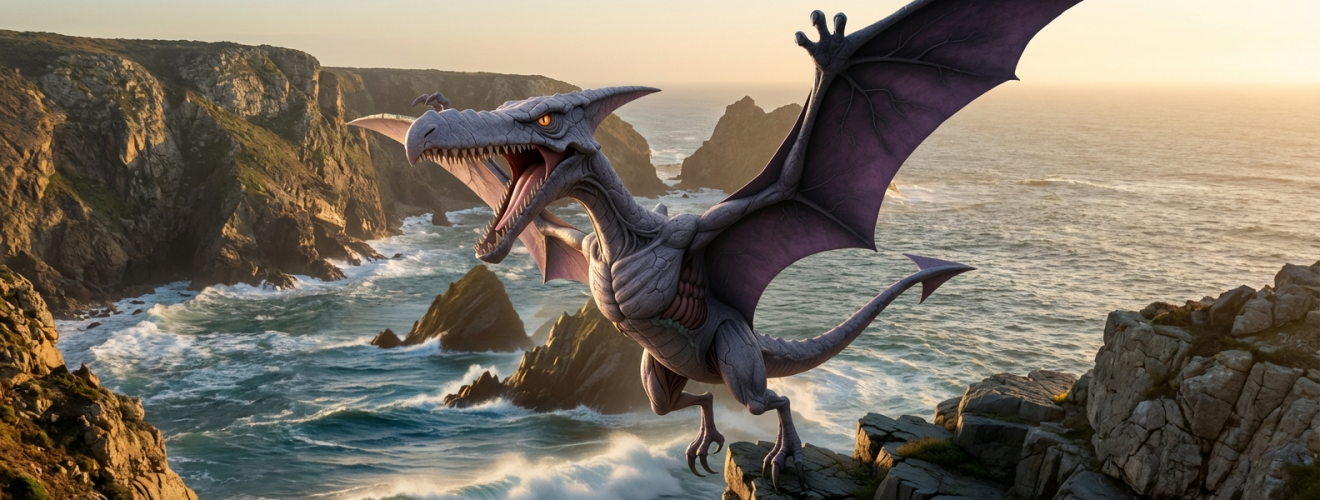
On 22 May 2026 the Field Museum in Chicago opened a hall where part of a juvenile Nyctosaurus, a flying reptile about 85 million years old, stands beside a model of Aerodactyl. It is the North American stop of the Pokemon Fossil Museum, which The Pokemon Company built with Japan’s National Museum of Nature and Science and toured for five years – past ammonites captioned for Omanyte and a Pachycephalosaurus captioned for Cranidos and Rampardos – drawing more than a million visitors before it crossed the Pacific. Chicago keeps it until 11 April 2027.
Nobody at Game Freak has ever confirmed a word of it. Across every generation that has offered a fossil, no developer has gone on record naming the real animal behind a single Pokemon, and the museums are careful not to overclaim on their behalf. The Japanese organisers say only that visitors can compare the fossil Pokemon with similar prehistoric life forms. Pokemon’s own writeup of the Chicago show is blunter: these comparisons aren’t always explicitly made for you, it says, and that’s intentional.
So the pairings below arrive with their evidence attached. Where an official source has set a Pokemon beside a named animal, this list says which source and where. Where the resemblance is obvious but nobody official has ever endorsed it, it says that too – and in four cases the resemblance is to no single animal, because somebody bolted two fossils together and hoped.
Twenty-five Pokemon have been revived from fossils across the main Pokemon series – eleven single-fossil lines plus the four Galar chimeras – grown from fifteen distinct fossil items. Their real-world counterparts range from Cambrian Anomalocaris and Jurassic Archaeopteryx to Tyrannosaurus, ammonites, crinoids and giant prehistoric sea turtles.
Aerodactyl
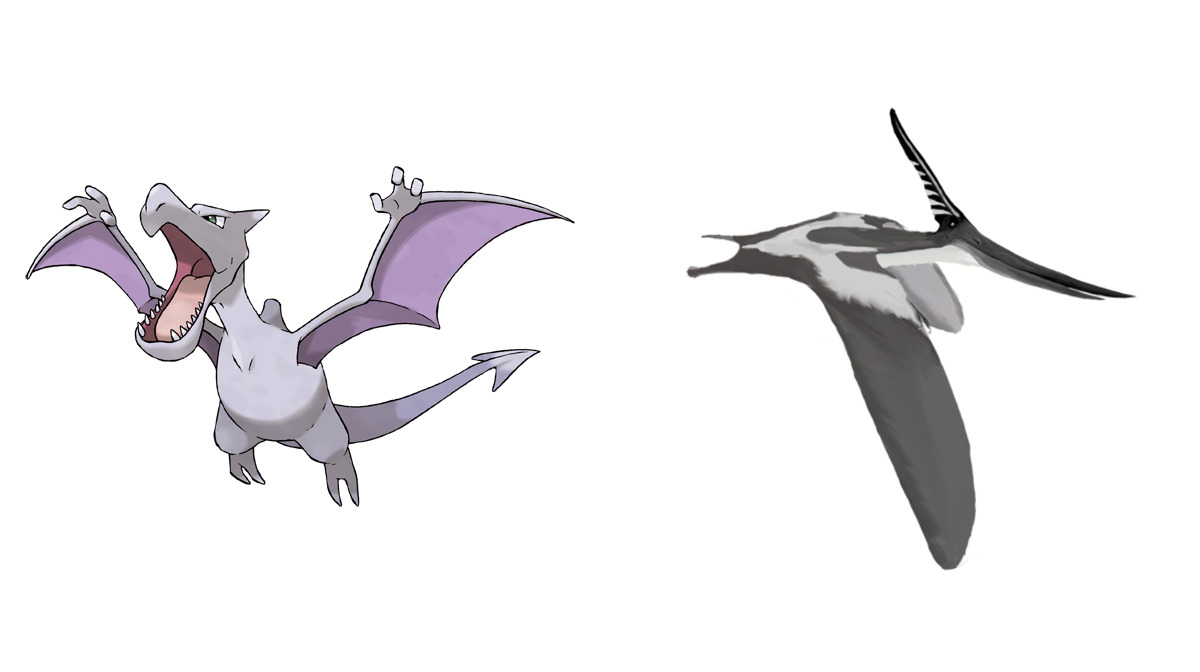
In 2014 two palaeontologists at the University of Portsmouth, Steven Vidovic and David Martill, erected a new genus of pterosaur and stated in the paper itself that the name derives from the Nintendo Pokemon Aerodactyl. They called it Aerodactylus. It is one of the real species scientists have named after Pokemon, and the only one where the borrowing ran backwards, from the game to the rock.
The type specimen came out of the Solnhofen limestone in Bavaria, the same lithographic quarries that have produced every Archaeopteryx ever found. Aerodactyl’s own fossil is Old Amber, which sits in the Pewter Museum of Science until a player carries it to Cinnabar Island and gets a level 30 Rock and Flying type back.
Museums pair it with pterosaurs – Anhanguera in Tokyo, the Nyctosaurus in Chicago – and the Pokedex mostly plays along. Moon reports a widely accepted theory that it went extinct due to a large meteor impact. Pteranodon, the pterosaur most people actually picture, was gone by around 80 million years ago, well before the asteroid arrived 66 million years ago. Ultra Sun is franker about what reviving something like this involves: restored from DNA found in amber, it exhibited ferocity greater than expected, and some casualties resulted.
Omanyte & Omastar
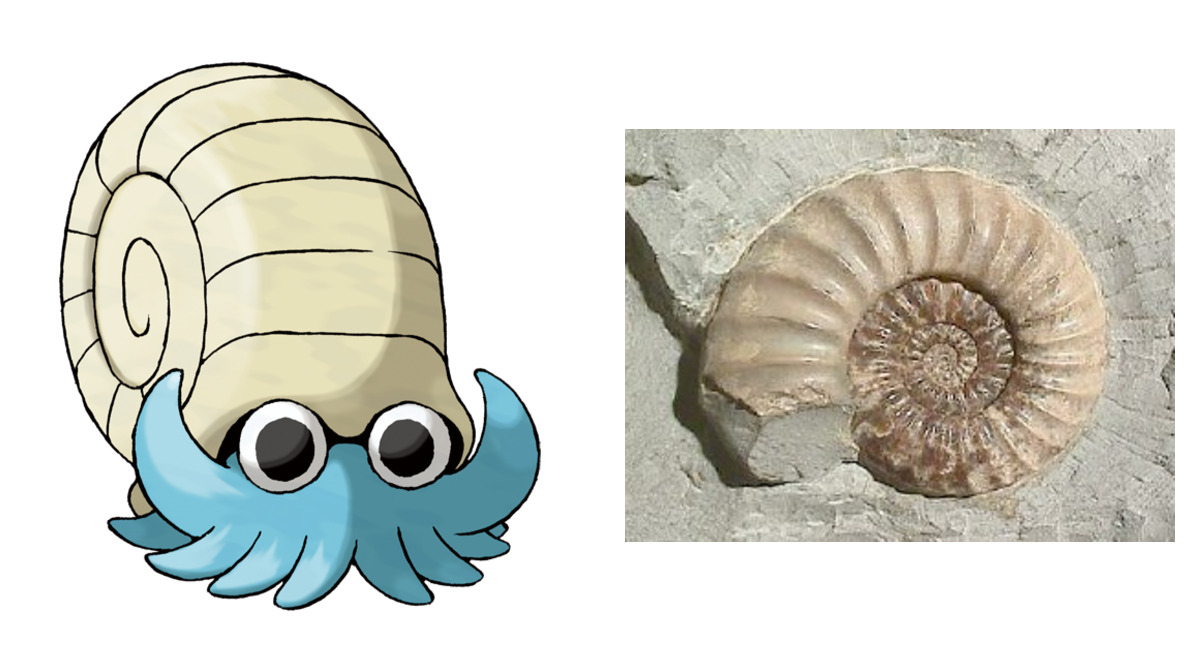
The coiled shell is the most misleading thing about an ammonite. Modern taxonomy files them as stem-group coleoids, closer to squid, octopus and cuttlefish than to the nautilus they so plainly resemble, and gives them around eight arms rather than a fringe of tentacles. Omanyte’s Pokedex has been insisting on 10 tentacles since Yellow.
The group is right even where the count is not. Ammonoids appear in the Devonian more than 400 million years ago, true ammonites arrive around 200 million years ago, and the whole lineage ends 66 million years ago with the dinosaurs. Omastar gets a smaller, sadder ending: the games agree it died out when its own shell grew too heavy for it to catch prey.
Kanto’s prehistoric roster runs to just three fossil lines, which looks thin until you count the Pokemon designs cut before Red and Blue shipped. What survived became strangely load-bearing. From February 2014, Twitch Plays Pokemon handed one save file to tens of thousands of people typing commands at once; the Helix Fossil sat near the top of the item list and got selected by accident for 11 days straight, and the crowd built a religion around it. Rodrigo Salvador, a palaeontologist at Te Papa Tongarewa, later noted that Helix is the scientific genus for common land snails.
Kabuto & Kabutops
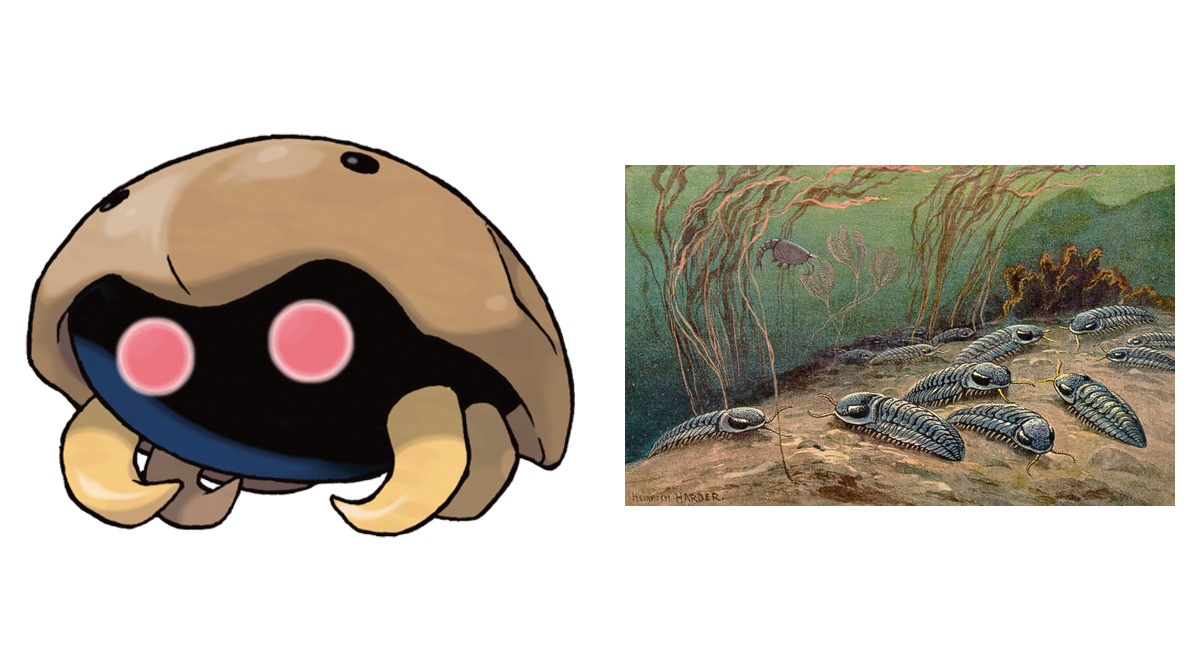
Two working palaeontologists look at Kabuto and see different animals. Jingmai O’Connor of the Field Museum calls it a real-life trilobite look-alike. Harriet Drage of the University of Lausanne reads Kabutops as trilobites hanging on into the modern day, a Dead Clade Walking, the term for a lineage that persists in reduced form long after its real heyday ended. Bulbapedia says horseshoe crab. Time Out Chicago reports the exhibition pairing it with horseshoe crabs as well.
The Pokedex takes a side without meaning to. Ruby and Sapphire claim living examples have turned up and that Kabuto has not changed at all for 300 million years, which is horseshoe crab biology precisely – the real animal has held its shape for about 450 million years and is closer kin to spiders and scorpions than to crabs. Trilobites died out 252 million years ago and left no descendants whatsoever.
The Dome Fossil is buried deep in Mt. Moon, where a trainer forces a choice between it and its neighbour. The rejected fossil is not thrown away. It gets revived anyway and put on public display at the Safari Zone in Fuchsia City – a town the player will not reach until Koga, fifth of Kanto’s original eight Gym Leaders. The animal you declined to bring back has been alive in a zoo for four badges by the time you arrive.
Lileep & Cradily
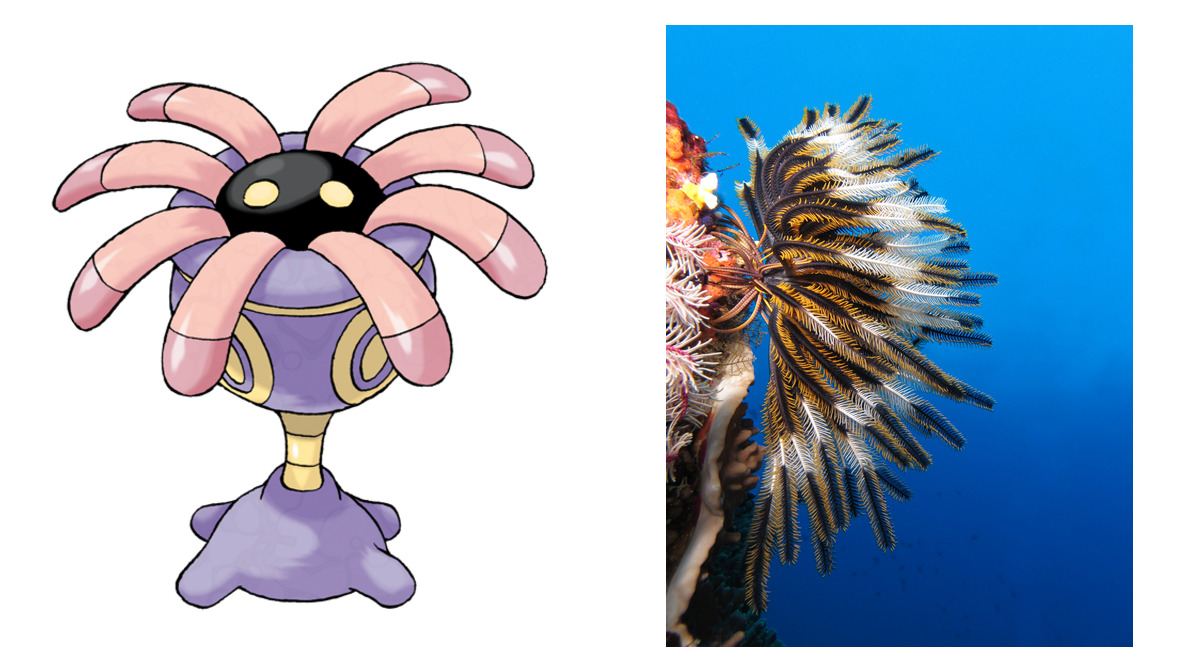
Lileep is the Sea Lily Pokemon. Cradily is the Barnacle Pokemon. Those are the official categories on Pokemon’s own Pokedex, and they name two completely unrelated animals – a crinoid, which is an echinoderm and a cousin of the starfish, and a barnacle, which is a crustacean and a cousin of the crab. The evolution changes phylum.
Lileep’s Ruby entry states that it became extinct approximately a hundred million years ago, which is an odd claim to make about crinoids, since crinoids are still here. Stalked ones live in deep water; unstalked feather stars drift through shallow seas worldwide. They did come close at the end of the Permian, about 252 million years ago, when almost every crinoid species died and one or two surviving lines founded everything alive today.
Cradily follows the barnacle instead. It anchors in place, puts its tentacles out and, per the Sapphire entry, secretes a strong digestive fluid from them. Real barnacles cement themselves head-down to rocks and hulls and comb the water with feathery limbs, an arrangement so peculiar that Charles Darwin spent eight years on it, from 1846 to 1854, producing two volumes on living Cirripedia and, in an 1852 letter, the complaint that he hated a barnacle as no man ever did before, not even a sailor in a slow-sailing ship.
Anorith & Armaldo
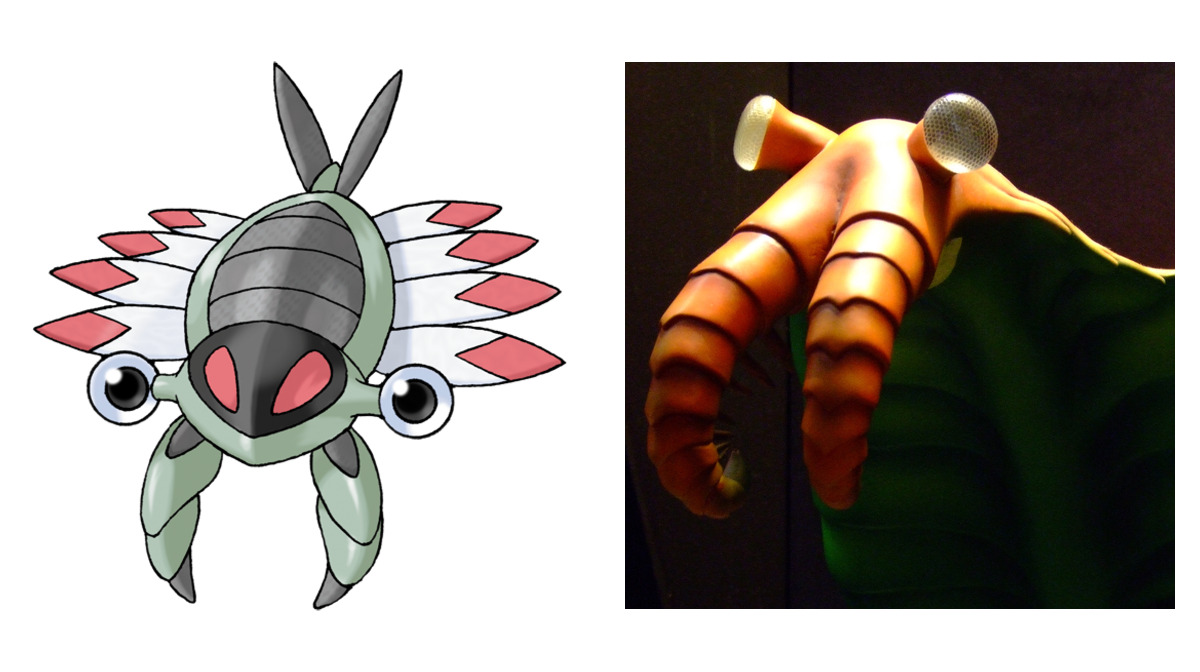
For 93 years, Anomalocaris existed in the scientific literature as three separate animals. Joseph Whiteaves described a detached grasping appendage in 1892 and took it for the body of a shrimp. Charles Walcott, in a single 1911 paper, catalogued its circular mouthparts as a jellyfish named Peytoia and a body impression as a sea cucumber named Laggania. In 1928 K. L. Henriksen tried attaching the appendage to a fourth creature altogether.
Derek Briggs worked out in 1979 that the appendage belonged to an unknown arthropod. Harry Whittington then found specimens with two of them still attached to a body wearing the Peytoia mouth, and the two men reunited all three in 1985. The animal they assembled lived roughly 505 million years ago, ran to 25 centimetres in its largest complete specimen, with loose fragments hinting at a metre, and was the largest predator the Burgess Shale has produced.
Anorith is that animal, and the exhibition’s supervisor Daisuke Aiba says so on the record while walking a reporter past the case, noting the one thing the design misses: Anomalocaris had compound eyes. A 2011 study in Nature counted at least 16,700 lenses in a single fossilised one. The terror has faded slightly since: Russell Bicknell modelled those appendages in 2023 and found they would have snapped on trilobite armour, so it was chasing soft prey all along. Armaldo, which Anorith becomes, has never been paired with anything official at all. The Pokedex calls it the Plate Pokemon and leaves it there.
Cranidos & Rampardos
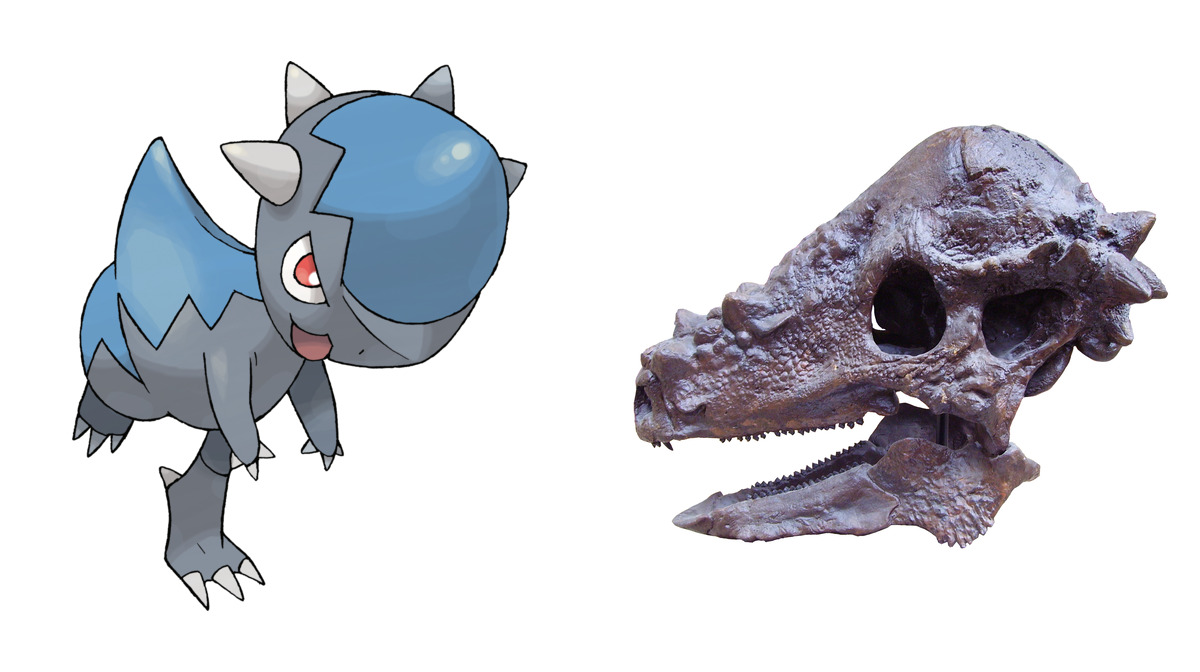
Rampardos carries a base Attack stat of 165, beaten in the whole Diamond and Pearl Pokedex only by a specialised forme of Deoxys, and propped up by a Defense of 60 and a Speed of 58. It is a battering ram with a Pokemon attached. Its own entry jokes that two of them could smash heads together and neither would faint.
Whether the real animal managed it even once is unsettled. Mark Goodwin and John Horner examined seven Pachycephalosaurus skulls across a growth series in 2004 and found that the porous, blood-rich bone a juvenile would need to absorb a head blow disappears in adults; they concluded the dome was for display. Joseph Peterson and colleagues went the other way, reporting lesions on 22 percent of 109 pachycephalosaur domes against 9.8 percent in Stegosaurus. The argument is still running.
Roark opens Diamond and Pearl with a level 12 Geodude and a level 12 Onix, then closes with a level 14 Cranidos. He is the first of all eight of Sinnoh’s Gym Leaders, which makes a revived fossil the very first ace a player has to get past. Field Museum curator Arjan Mann names Rampardos his favourite because it resembles Dracorex, the dome-headed dinosaur named in 2006 after Hogwarts. Horner and Goodwin argued in 2009 that Dracorex is not a species at all, merely a young Pachycephalosaurus.
Shieldon & Bastiodon
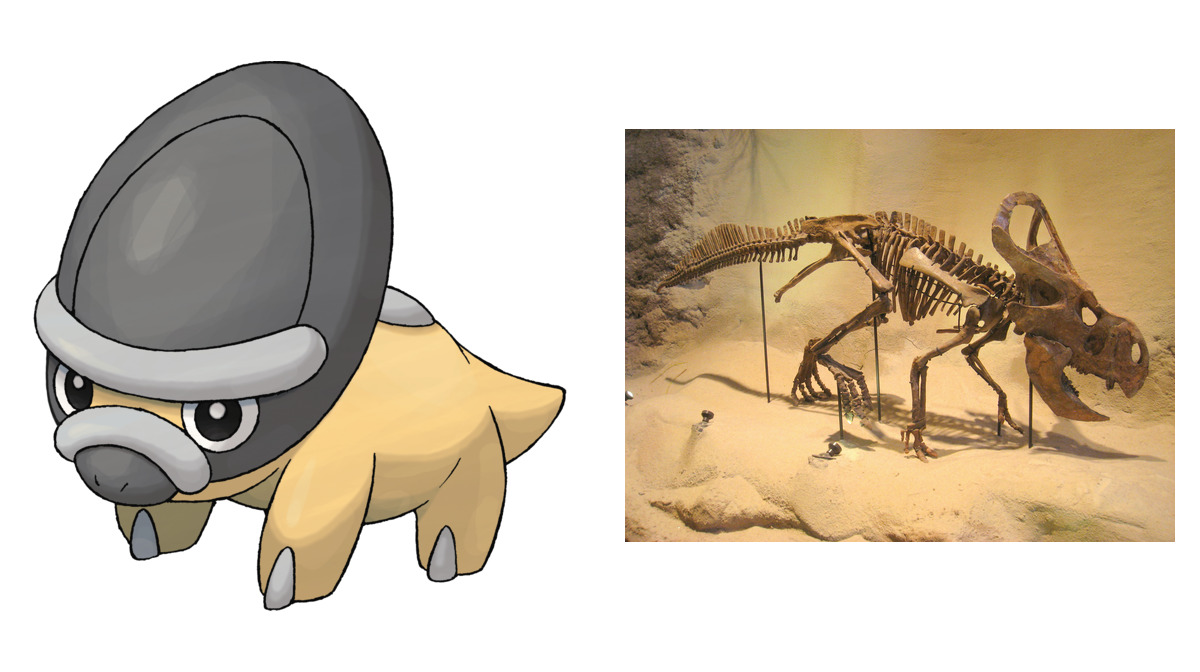
The armour is on the wrong side. Shieldon and Bastiodon carry a slab of a face and very little behind it – Bastiodon’s Scarlet entry concedes it is left without recourse when attacked from behind – whereas the ceratopsian frill they get compared to sat at the back of the skull, where the Natural History Museum suggests it may have helped protect the neck.
The comparison is official all the same. A Japanese government press release for the Tokyo run of the exhibition lists Triceratops displayed alongside Shieldon and Bastiodon by name. The Field Museum’s chief fossil preparator, Akiko Shinya, extends it: baby ceratopsids would have had shorter, narrower frills than the broader, squared versions adults grew, which is roughly what happens when Shieldon evolves at level 30.
Triceratops lived 68 to 66 million years ago and reached nine metres. Protoceratops, hornless and parrot-beaked, ran to about 1.8 metres and is known from hundreds of individuals at every growth stage. Those Gobi skeletons had a famous second career: the folklorist Adrienne Mayor proposed in 1989, and expanded in a 2000 book, that nomads finding them invented the griffin. Mark Witton and Richard Hing took the theory apart in 2024, calling it an ex post facto geomyth. Bastiodon, being Rock and Steel, still takes quadruple damage from both Fighting and Ground – undone, as ever, by anything that declines to attack the face.
Tirtouga & Carracosta
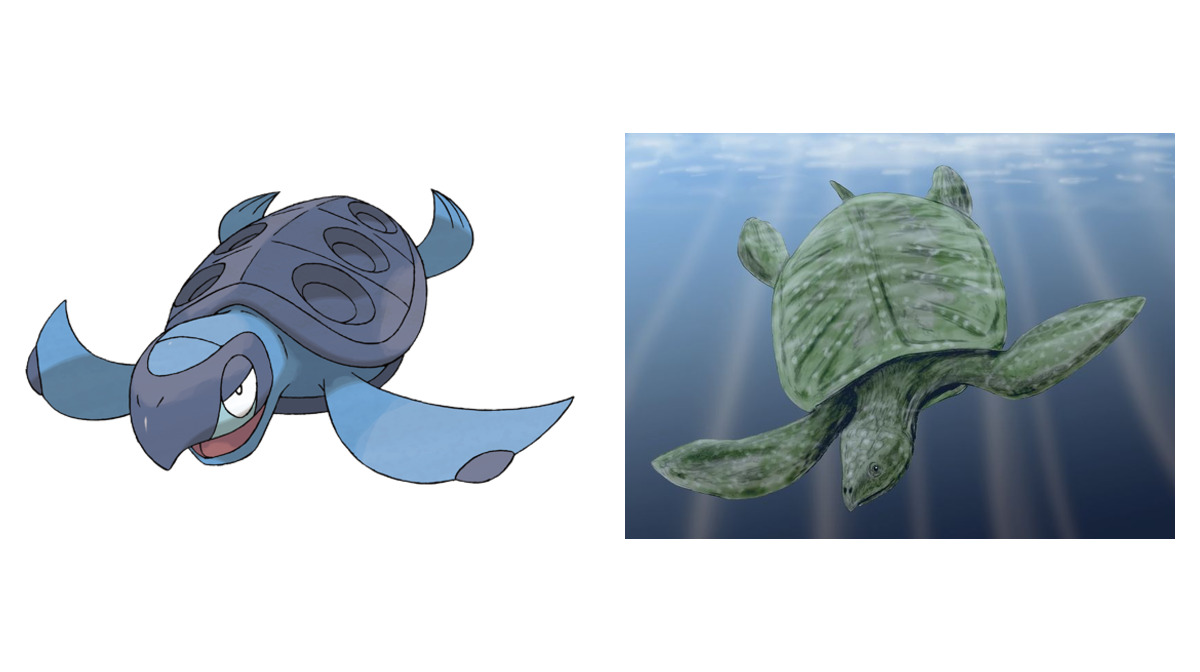
An underbelly shell piece some 80 million years old sits in the Chicago exhibition beside Tirtouga, captioned by age alone. No official source has ever said which turtle it means. Bulbapedia names both Protostega and Archelon, the two largest genera known, and declines to separate them.
Archelon’s shell was mostly skin. The largest sea turtle that ever lived carried, in the words of North Dakota’s geological survey, a framework of transverse bony struts, made of ribs, that were probably covered by a thick coat of leathery skin – the arrangement a leatherback still uses, and nothing whatever like the rock-plated dome Tirtouga and Carracosta are drawn with. Protostega swam the Western Interior Seaway around 85 million years ago at over 12 feet and up to 2,000 pounds. Archelon’s holotype, described by George Wieland in 1896 out of the Pierre Shale and held at Yale since 1907, measures about 3.5 metres, while the largest ever collected, dug out of South Dakota in the mid-1970s and now in Vienna, reaches roughly 4.5.
The games are less equivocal and considerably more violent. Tirtouga’s White entry has these Pokemon swimming the oceans 100 million years ago and coming onto land to attack prey; Carracosta’s has jaws that chew up steel beams and rocks along with the prey itself. The real animal could not retract its head or flippers at all. It had a beak that crushed bone and nowhere to hide.
Archen & Archeops
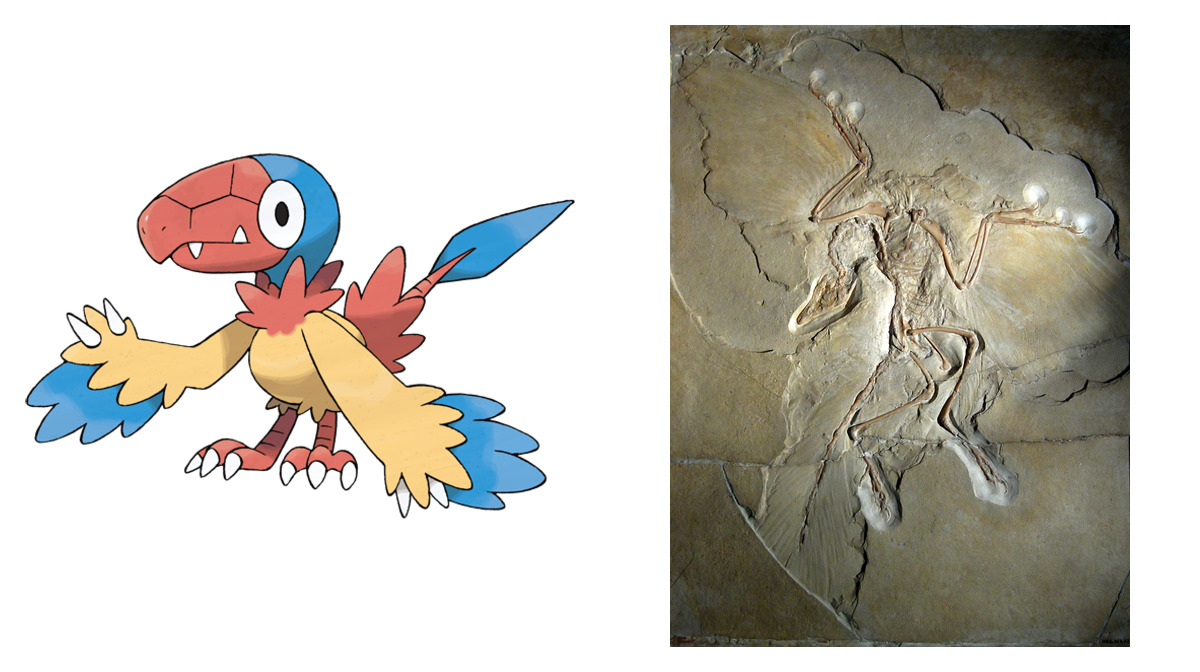
Specimen FMNH PA 830 is the fourteenth Archaeopteryx ever found, and the Field Museum’s Arjan Mann calls it the best-preserved in the world. It lives in Chicago, a few floors from the Pokemon it now shares a building with. In May 2025 a team led by the museum’s Jingmai O’Connor published it in Nature, describing tertial feathers nobody had recorded in the animal before – the ones that close the gap between wing and body and make lift possible.
So it flew. Badly. By modern standards, O’Connor said, it was a very poor flyer. The creature itself lived 149 to 145 million years ago and was roughly the size of a magpie, and the first trace of it, a single feather, surfaced in 1861, two years after On the Origin of Species and at an almost inconveniently perfect moment.
Archen’s Pokedex has tracked the science in miniature. White called it the ancestor of all bird Pokemon; Ultra Sun withdraws the claim, noting that some of the latest research suggests that may not be the case. The real animal got the same treatment – a 2011 paper in Nature pushed it out of the bird lineage, a 2012 analysis pulled it back. Archeops, for its part, has an ability called Defeatist, which halves both its attack stats the moment its health falls to half or less.
Tyrunt & Tyrantrum
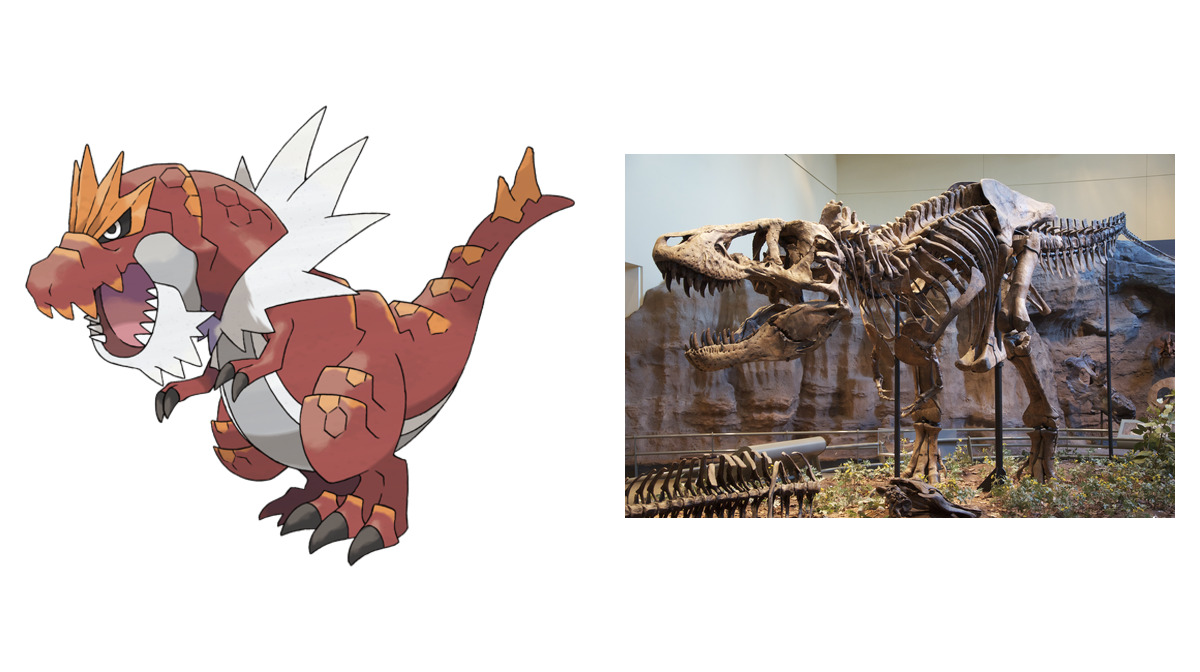
Four separate Pokedex entries put the Tyrunt line 100 million years in the past. The American Museum of Natural History dates Tyrannosaurus rex to roughly 69 to 66 million years ago. The games have been repeating the older figure since Pokemon Y, and no developer has ever addressed the gap. Tyrantrum, appropriately enough, is the Despot Pokemon.
The pairing is otherwise unusually well documented. A Japanese government press release names Tyrannosaurus displayed with Tyrunt and Tyrantrum; Tokyo went further and set a full Tarbosaurus skeleton beside a life-size Tyrantrum model. Arjan Mann of the Field Museum is specific about why it holds up, calling Tyrantrum very T. rex-inspired in its dentition, its size, the two diminutive fingers on the forearms.
In Chicago the Tyrantrum model stands next to a skull cast of Sue, which is a considerable thing to be measured against. Sue was found in 1990 by Sue Hendrickson north of Faith, South Dakota, is about 90 percent complete, and cost the museum $8.4 million at auction in 1997 – the most anyone had then paid for a fossil. In X and Y the Jaw Fossil that produces a Tyrunt costs nothing at all. It is lying on the floor of the Glittering Cave in Kalos, and the only price is that the player must abandon the other one.
Amaura & Aurorus
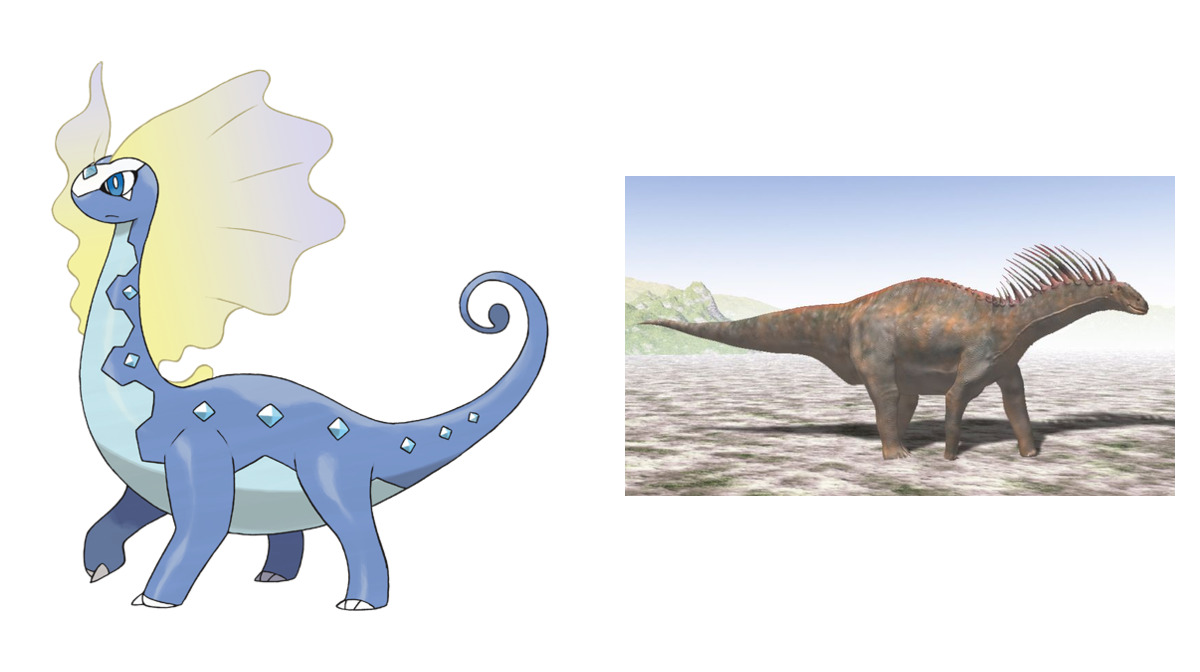
Whether Amargasaurus had a sail at all was unsettled until 2022, which is an awkward position for the animal behind an item called the Sail Fossil. The double row of hugely elongated spines down its neck and back was never in dispute. What those spines carried was: bare horns, or skin stretched between them.
Ignacio Cerda and three colleagues – among them Leonardo Salgado, who named the species with Jose Bonaparte in 1991 – went at the bone histology in the Journal of Anatomy. The evidence, they concluded, does not support a keratinised sheath, ruling out horns, while the pattern of Sharpey’s fibres indicates an important system of interspinous ligaments consistent with a cervical sail. Game Freak named the fossil for a sail years before anyone could stand one up.
The exhibition sets the real skeleton beside Aurorus rather than Amaura – the launch visual paired them directly, and Time Out Chicago photographed the pair on site – which leaves the smaller form to fend for itself. Amaura’s entry has it restored from part of its body frozen in ice for over 100 million years, and that describes La Amarga not at all: the Argentine formation preserves braided river channels, lake limestone and swamp, somewhere between 132 and 120 million years old, and nothing remotely glacial. Amaura evolves at level 39, but only at night. Tyrunt evolves at level 39 too, and only by day. Kalos made its two fossils exact opposites and then buried them in the same cave.
Dracozolt
In the games’ own words, Dracozolt is a Fossil Pokemon. So are Arctozolt, Dracovish, Arctovish and Aerodactyl, and nothing else. Out of the 25 Pokemon that come out of a rock, only those five carry the literal species category: Omanyte is the Spiral Pokemon, Kabuto the Shellfish Pokemon, Bastiodon the Shield Pokemon. The four assembled by hand in Galar, plus one pterosaur, are the only fossil Pokemon the series is willing to call fossil Pokemon.
Dracozolt is a Fossilized Bird bolted onto a Fossilized Drake, and the top half sets the primary type, which is how it arrives Electric and Dragon. The work is done on Route 6 by a researcher called Cara Liss, whose name comes from careless. Sword says it went extinct after it depleted all its plant-based food sources, which sits strangely against an upper half plainly built for hunting; Shield observes that compared to its lower body, its upper half is entirely too small.
The Pokedex is not a reliable narrator here. Bulbapedia records the suggestion that the entries for all four of Cara Liss’s creations were made up by her and others, from their own theories about what the species could do. Hitoshi Ariga, who designed the quartet, has said only that they are basically happy, with very expressive faces. The Pokemon Fossil Museum exhibits none of them. There is nothing to stand them beside.
Arctozolt
One of the two fossils that make Arctozolt is called the Fossilized Dino, and whatever its bottom half is, it is not a dinosaur. Bulbapedia reads it as a marine reptile – a plesiosaur, a mosasaur or an ichthyosaur, and it declines to choose – and none of those three were dinosaurs. They were separate reptile lineages that shared the seas with them; plesiosaurs alone ran from roughly 215 million years ago to the end of the Cretaceous.
The upper half comes from a Fossilized Bird, making Arctozolt Electric and Ice, a pairing no other full species holds. The only other thing carrying it is Frost Rotom, and Rotom is one Pokemon wearing household appliances. Shield says it lived on prehistoric seashores and preserved food with the ice on its body, then went extinct because it moved so slowly. Sword adds that the shaking of its freezing upper half is what generates its electricity, and that it has a hard time walking around.
Both entries are describing an animal that produces power by shivering. Competitively this went better than it sounds: its hidden ability Slush Rush doubles its Speed in hail, and in March 2021 someone rode a hail team built around exactly that from a 1722 rating to the top of Smogon’s ladder at 2110, losing one game on the way. It also cannot breed. A dead end in every direction the games could manage.
Dracovish
In September 1868 Edward Drinker Cope presented a reconstruction of the marine reptile Elasmosaurus to the Academy of Natural Sciences of Philadelphia with the skull mounted on the tail. He published it that way the following year. Joseph Leidy corrected him at the Academy on 8 March 1870, pointing out that the vertebrae Cope had taken for a tail were still fused to the back of the skull.
Dracovish has its head on the end of its tail. Bulbapedia’s origin section draws the line to Cope directly, which is the closest thing to a stated intention anywhere in this section of the roster, because Game Freak has said nothing at all. The head is a Fossilized Fish, generally read as Dunkleosteus, the armoured Devonian predator out of the Cleveland Shale that had no teeth whatsoever, only bony jaw blades that sharpened themselves as they wore against each other. Its reputation has shrunk: Russell Engelman’s 2023 study in Diversity cut typical adults from figures as high as 8.79 metres to about 3.4.
The Pokemon did not shrink. Fishious Rend hits for 85 base power and doubles to 170 if Dracovish moves first, and since its Japanese name means Gill Bite it counts as a biting move, so Strong Jaw adds another 50 percent. Smogon banned it from OU on 1 June 2020.
Arctovish
Arctovish cannot eat properly. That is not a fan complaint, it is the official Pokedex: Sword records that though it is able to capture prey by freezing its surroundings, it has trouble eating the prey afterward because its mouth is on top of its head. Shield reports that the skin on its face is impervious to attack, but breathing difficulties made this Pokemon go extinct anyway.
The construction accounts for it. A Fossilized Fish went on top, upside down, and a Fossilized Dino underneath, producing a Water and Ice type with a Speed stat of 55 and weaknesses to Grass, Electric, Rock and Fighting. It shares its signature move with its Dragon-type cousin and gets almost nothing out of it; Smogon’s own analysis calls that Speed pitiful and says Arctovish is completely outclassed. Its base stats total 505, precisely what Dracozolt gets, arranged into bulk it has no way to use.
Serebii has spent years describing the recipe backwards, its Fossilized Fish page pairing the Drake with Arctovish and the Dino with Dracovish, which is the reverse of what the machine on Route 6 actually does. Arctovish is 175 kilograms of animal that the games themselves say could neither feed nor breathe. It is, at least, consistent about it.
Frequently Asked Questions
Can you still revive fossil Pokemon in the newest Pokemon game?
Yes. Pokemon Legends: Z-A, released 16 October 2025, restored the mechanic after Scarlet and Violet dropped it. The Stone Emporium on Vernal Avenue in Lumiose City sells the Jaw Fossil and Sail Fossil for 20,000 each and Old Amber for 30,000, reviving Tyrunt, Amaura and Aerodactyl at level 20.
Is Genesect a fossil Pokemon?
No. Genesect is the Paleozoic Pokemon, and although its lore describes an ancient bug revived from a fossil and then rebuilt by Team Plasma, no game has ever let a player revive it. Every release from Black 2 onward has come through Mystery Gift event distribution instead.
Which fossil Pokemon is based on the oldest real animal?
It depends on Kabuto. If Kabuto is a horseshoe crab, the answer is Anorith, whose Anomalocaris dates to about 505 million years ago. If Kabuto is a trilobite, Kabuto wins – trilobites reach back roughly 521 million years, older than anything else here.
Can you get both fossils in a Pokemon game, or is the choice permanent?
Only Hoenn relents. Emerald lets the player dig the abandoned fossil out of the Desert Underpass on Route 114 after the Mirage Tower collapses. Unova and Kalos are final – choose the Cover Fossil over the Plume, or the Jaw over the Sail, and the other is gone from that save file.
Is Relicanth a fossil Pokemon?
No. Relicanth is the Longevity Pokemon, caught underwater with Dive in Hoenn rather than revived at a lab. Its Shield entry calls it a living fossil whose appearance has not changed in 100,000,000 years. The Pokemon Fossil Museum does display it, beside a coelacanth.
Are Paradox Pokemon like Great Tusk fossil Pokemon?
No. The Paradox Pokemon of Paldea were pulled through time by the machine Professor Sada and Professor Turo built in Area Zero, which sent Poke Balls to other points in the timeline. Nothing about them involves a rock, a lab or a revival machine.
Are there any fossils in Pokemon Gold and Silver?
None at all. No new fossils appeared in Gold, Silver or Crystal, and the three Generation 1 fossils were stripped from the games’ data altogether. Bulbapedia notes that revival scientists turn up in every core series game apart from those and the Paldea pair.
- Bulbapedia – Category: Fossil Pokemon (the complete 25-member roster)
- Bulbapedia – Fossil (every fossil item and what it revives)
- The Pokemon Company – official Pokedex entry for Lileep
- PokemonDB – Aerodactyl Pokedex entry and species category
- The Field Museum – Pokemon Fossil Museum exhibition
- Smithsonian Magazine – the museum using Pokemon to teach visitors about fossils
- Britannica – plesiosaurs
- Serebii – Fossilized Fish item entry