Every Vice President Who Inherited the Presidency
The Vice Presidency has always been a strange job. You’re one heartbeat away from the most powerful office in the world, but nobody voted for you to have it. Nine times in American history, that heartbeat stopped – or, in one case, a president simply quit – and a vice president found himself running a country he hadn’t campaigned to lead.
Some of them rose to the occasion spectacularly. Some were disasters. One was sworn in by his own father in the middle of the night by kerosene lamp. One learned about the atomic bomb only after he was already president. And one was never elected to either office he held – making him the only truly unelected president in American history.
Here are all nine, in the order they arrived.
John Tyler
William Henry Harrison gave the longest inauguration speech in history. He did it in freezing rain without a coat. Thirty-one days later, he was dead.
John Tyler was back home in Virginia playing marbles when the messenger arrived. He was sworn in, moved into the White House, and immediately faced a political crisis: Congress wasn’t sure he was actually president. Some argued he was merely “Acting President,” a caretaker until the next election. Tyler’s response was simple and devastating – he refused to open any correspondence addressed to “Acting President Tyler.” He returned letters unopened. He ignored resolutions. He governed with full presidential authority and dared Congress to stop him.
Congress couldn’t. Tyler’s interpretation – that a vice president fully becomes president upon succession, not just a temporary placeholder – became known as the Tyler Precedent. It wasn’t formally written into law until the 25th Amendment in 1967. For 126 years, the entire chain of presidential succession rested on one stubborn man’s refusal to acknowledge his mail.
His own party expelled him while he was in office. Opponents called him “His Accidency.” He was never elected president. In 1844, he briefly sought the Democratic nomination, failed to get it, and withdrew. Tyler left the presidency as the only man to hold the office without a party – and the only one who created constitutional law by returning letters unopened.
Millard Fillmore
Zachary Taylor died of gastroenteritis in July 1850, likely from contaminated food at a Fourth of July ceremony. Millard Fillmore, his Vice President, was so politically irrelevant that Taylor’s entire cabinet resigned within 24 hours of Fillmore’s swearing-in.
All seven of them. Gone, within a day.
Taylor’s cabinet members were personally loyal to Taylor and politically hostile to Fillmore, so rather than serve under him, they simply walked out. The new president had no executive infrastructure, no allies in government, and a nation in crisis over the Compromise of 1850 – all within hours of taking office. Fillmore immediately replaced the entire cabinet with his own picks and reversed Taylor’s policy position almost overnight.
Fillmore’s presidency is remembered mostly for his support of the Fugitive Slave Act, the most controversial provision of the Compromise of 1850, which required Northern states to return escaped enslaved people to their enslavers. It satisfied almost no one and split the Whig Party beyond repair. The Whigs denied him their 1852 nomination. He ran again in 1856 as the Know-Nothing Party candidate, won over 20% of the popular vote, and lost decisively. He never held office again.
The seven-cabinet-resignation story isn’t taught in schools, but it remains one of the most extraordinary first 24 hours of any presidency in American history.
Andrew Johnson
The plot to destroy the Lincoln administration on the night of April 14, 1865 was not just about Lincoln. While John Wilkes Booth shot the president at Ford’s Theatre, a co-conspirator named Lewis Powell savagely attacked Secretary of State William Seward at his home. A third conspirator, George Atzerodt, was assigned to assassinate Vice President Andrew Johnson at the Kirkwood House hotel.
Atzerodt had a room at the same hotel. He spent the night drinking in a bar instead.
Had Atzerodt followed through, both the president and the vice president would have been killed on the same night, triggering a constitutional succession crisis with no clear answer. Instead, Johnson woke up the next morning, learned that Lincoln was dead, and was sworn in as the 17th President at 10:00 AM.
The presidency that followed was one of the most turbulent in American history. Johnson clashed ferociously with the Republican Congress over Reconstruction, vetoing bill after bill only to be overridden. In 1868, the House of Representatives impeached him – the first impeachment of a sitting president – primarily for violating the Tenure of Office Act by firing Secretary of War Edwin Stanton. The Senate trial ended with an acquittal, one vote short of conviction.
Johnson was never elected president. The Democrats didn’t even nominate him in 1868. He returned to Tennessee, eventually winning a U.S. Senate seat in 1874 – the only former president to serve in the Senate – and died later that year.
Chester Arthur
Charles Guiteau shot President James Garfield at a Washington train station on July 2, 1881, explicitly because he wanted Chester Arthur to become president. Guiteau was a delusional office-seeker who believed the “Stalwart” wing of the Republican Party – Arthur’s faction – deserved control of government patronage. Garfield, he reasoned, was in the way. Arthur would fix things.
Garfield did not die immediately. He lay for 79 days while his doctors introduced fatal infections through unsterilized probing of the wound. He died on September 19, 1881. Chester Arthur was sworn in at his Manhattan home at 2:15 AM.
Then Arthur did the exact opposite of everything Guiteau had expected.
Once in the White House, Arthur championed the Pendleton Civil Service Reform Act of 1883, which dismantled the patronage spoils system entirely and replaced it with a merit-based civil service. The very system Guiteau had killed to protect was abolished by the man Guiteau put in power. Arthur also turned out to be suffering from Bright’s disease, a fatal kidney condition he kept secret from the public, which explained why he made little effort to seek re-election in 1884.
Guiteau was hanged on June 30, 1882. He composed a poem for the occasion and recited it before the crowd.
Theodore Roosevelt
Republican Party bosses put Theodore Roosevelt on the 1900 ticket specifically to get him out of the way. As Governor of New York, he had been causing trouble for machine politicians with his aggressive reform agenda. Making him Vice President seemed like the perfect solution: a prestigious but powerless job that would sideline him.
On September 6, 1901, anarchist Leon Czolgosz shot President McKinley at the Pan-American Exposition in Buffalo. McKinley appeared to recover, so Roosevelt left for a hiking trip on Mount Marcy, the highest peak in the Adirondacks. When McKinley suddenly worsened, rangers were dispatched into the wilderness to find the Vice President. A guide tracked Roosevelt down on the mountainside. What followed was a frantic overnight carriage race down rough mountain roads in the dark, switching horses at relay points, racing to catch a train to Buffalo.
Roosevelt arrived hours after McKinley’s death and was sworn in that afternoon at the Ansley Wilcox House, becoming at 42 the youngest president in American history.
The party bosses who had engineered his removal from New York state politics had succeeded beyond their wildest dreams – and created their worst nightmare. Roosevelt went on to win the 1904 election in a landslide, bust the railroad trusts, create the FDA, establish the national parks system, and win the Nobel Peace Prize.
Republican senator Mark Hanna, who had opposed putting Roosevelt on the ticket, reportedly said after McKinley’s death: “Now look – that damned cowboy is President of the United States.”
Calvin Coolidge
Warren Harding died of a heart attack in a San Francisco hotel room on August 2, 1923. The news reached Calvin Coolidge in the middle of the night at his family’s farmhouse in Plymouth Notch, Vermont – a remote village with no telephone line.
Coolidge was awakened, came downstairs, and received the news by messenger. The question of how to administer the presidential oath at 2:47 AM in a rural Vermont farmhouse with no judges, no officials, and no electricity was solved simply: Coolidge’s father, Colonel John Calvin Coolidge Sr., was a local notary public and justice of the peace. He swore in his son as President of the United States in the sitting room of their family home, by the light of a kerosene lamp.
It is one of the most quietly remarkable scenes in the history of the American presidency – a father swearing in a son, in a farmhouse, in the dark. There was later a technical question about whether a notary public had the constitutional authority to administer a presidential oath, so a federal judge quietly re-administered it a few days later.
Coolidge won the 1924 election decisively, then chose not to seek another term in 1928, distributing slips of paper to reporters that read simply: “I do not choose to run for President in nineteen twenty-eight.” He died in 1933, before the Great Depression fully set in – a timing that spared his legacy considerable damage.
Harry S. Truman
Harry Truman had been Vice President for 82 days. In that time, he had met privately with Franklin Roosevelt exactly twice.
FDR had deliberately kept Truman away from military briefings, diplomatic cables, and sensitive cabinet discussions. Truman had no idea the United States was building an atomic bomb. He had no knowledge of the advanced state of the war in Europe or the Pacific. He was, in every practical sense, completely unprepared for what he was about to inherit.
Roosevelt died of a cerebral hemorrhage in Warm Springs, Georgia on April 12, 1945. Truman was summoned to the White House and sworn in at 7:09 PM in the Cabinet Room. That same night, Secretary of War Henry Stimson pulled him aside and told him about the Manhattan Project.
Within 16 weeks of taking office, Truman ordered the use of atomic weapons against Japan.
He described his first moment as president: “I felt like the moon, the stars, and all the planets had fallen on me.” The country he inherited was fighting a world war on two fronts, had a secret superweapon nearing completion, and was weeks away from the German surrender. Truman made every decision without having been briefed on any of it.
He won the 1948 election in one of the greatest upsets in American political history. The Chicago Tribune printed “DEWEY DEFEATS TRUMAN” before the votes were counted. Truman won.
Lyndon B. Johnson
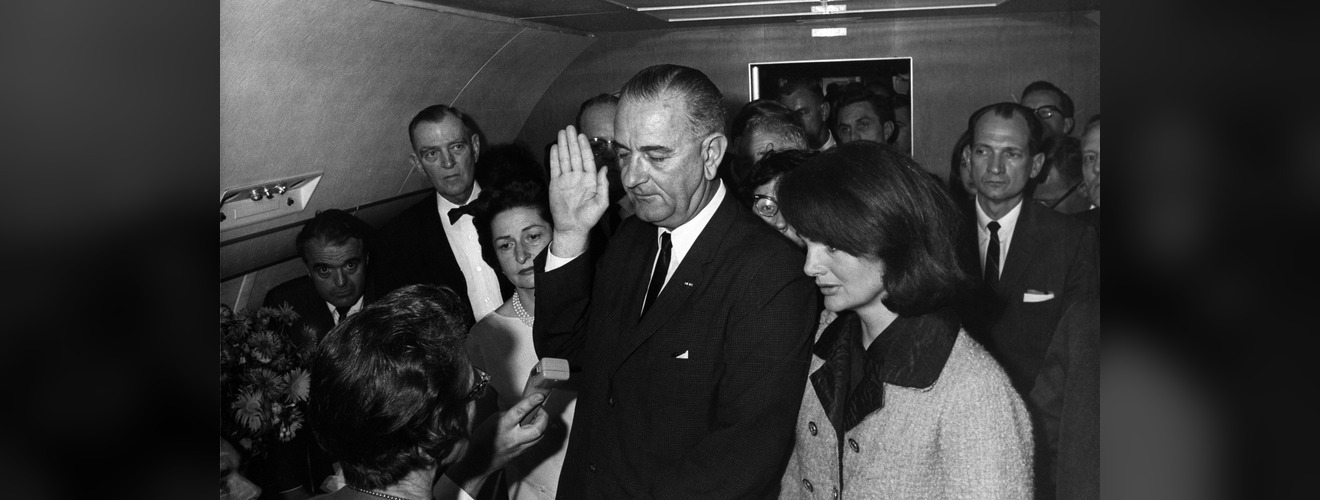
President Kennedy was shot in Dallas on November 22, 1963. Johnson was riding two cars behind in the motorcade. Within hours, he was sworn in as the 36th President aboard Air Force One, still parked on the tarmac at Dallas Love Field.
The ceremony was administered by Federal District Judge Sarah T. Hughes – the first woman in American history to swear in a president. Standing to Johnson’s left was Jacqueline Kennedy, still in her pink Chanel suit stained with her husband’s blood. She had been asked if she wanted to change. She refused: “Let them see what they’ve done.”
Johnson had specifically requested that Mrs. Kennedy be present for the swearing-in. A Bible could not quickly be found, so the oath was administered over a Catholic missal from Kennedy’s desk. Lady Bird Johnson stood to LBJ’s right. The photograph taken by Cecil Stoughton became one of the most iconic images in American political history.
Johnson won the 1964 election with 61.1% of the popular vote – the largest popular vote margin in modern presidential history. He passed the Civil Rights Act, the Voting Rights Act, and Medicare. Then Vietnam consumed his presidency. He announced he would not seek re-election on March 31, 1968, citing the divisions tearing the country apart. He died in January 1973, one day after the Vietnam ceasefire was announced, and just hours before his second term would have ended.
Gerald Ford
Richard Nixon resigned on August 9, 1974, becoming the only president in American history to do so. Gerald Ford was sworn in that morning with a declaration that has become one of the most quoted in presidential history: “Our long national nightmare is over.”
What made Ford’s ascension categorically different from every other entry on this list was that he hadn’t been elected Vice President either.
In October 1973, Spiro Agnew had resigned as VP amid a bribery scandal. Nixon appointed Ford as his replacement under the 25th Amendment – a congressional confirmation process, not a public election. Ford was confirmed by both chambers and became VP in December 1973. Nine months later, Nixon resigned and Ford became president.
The United States had just experienced something that had never happened before: the complete turnover of the executive branch’s top two positions without a single vote from the American public. Then Ford appointed Nelson Rockefeller as his Vice President – also via congressional confirmation, not election – meaning that for the first time in American history, neither the President nor the Vice President had been elected by anyone.
Ford lost the 1976 election to Jimmy Carter. Historians largely attribute his defeat to his decision, just one month after taking office, to issue a full pardon to Richard Nixon. Ford later said it was the right decision. The country never fully forgave him for it.
He was the only person in American history to be both an unelected Vice President and an unelected President – a record that, given the circumstances, is unlikely to be broken.
Nine vice presidents. Four assassinations. Four natural deaths. One resignation. And one man who established the rules every other president on this list lived by – because he refused to accept his mail.