All Fossil Pokemon and the Real Prehistoric Creatures They’re Based On
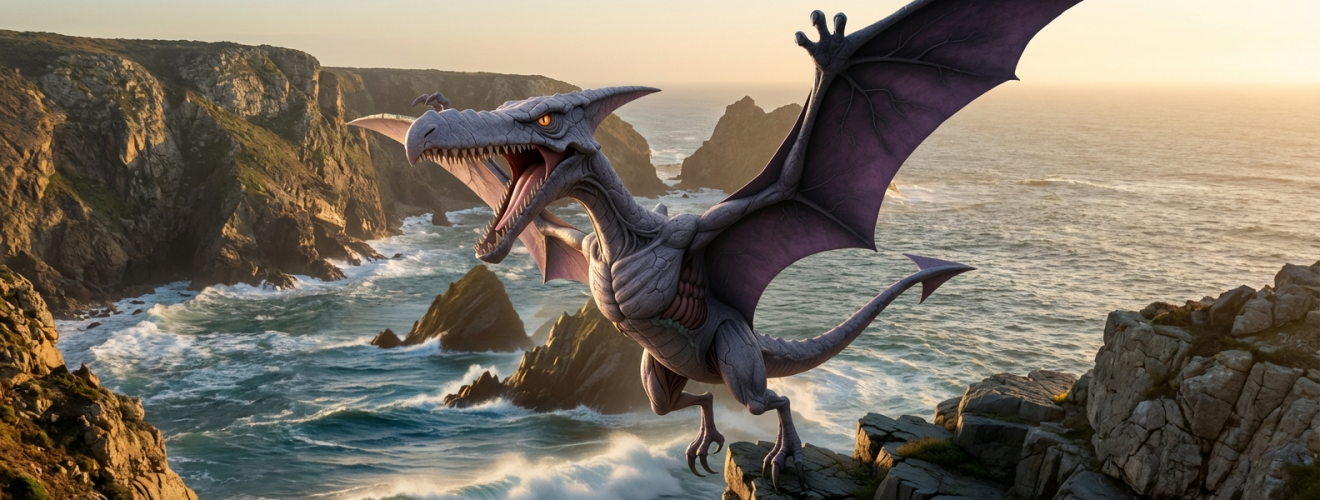
Long before Pokemon trainers roamed the world, real creatures inspired by fossils walked, swam, and flew across our planet. The Pokemon franchise has always paid homage to paleontology, creating Pokemon that can be resurrected from ancient fossils found buried in the game world. But these designs aren’t random-each fossil Pokemon draws direct inspiration from actual prehistoric organisms that scientists have discovered and studied.
From the spiral-shelled Omanyte based on extinct ammonites to the terrifying Tyrantrum modeled after T-Rex, Game Freak’s designers have consistently looked to Earth’s ancient past for inspiration. Some connections are obvious, while others reveal surprising links between Pokemon and creatures most people have never heard of. Here’s every fossil Pokemon and the real prehistoric organism that inspired its design.
Aerodactyl
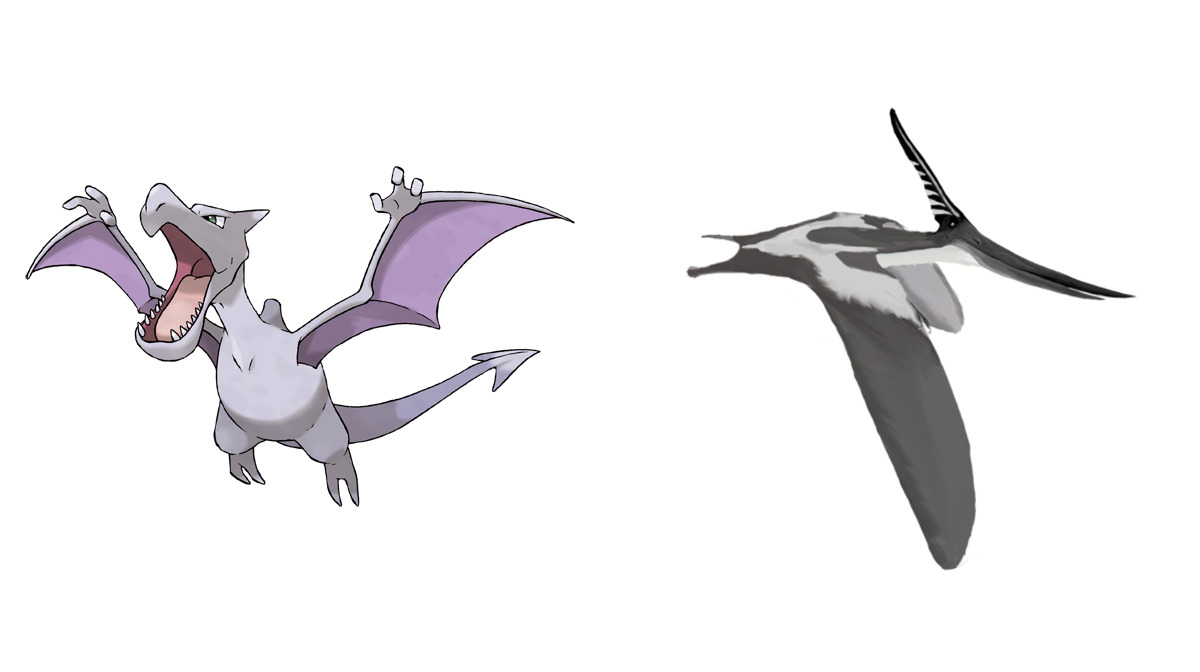
Aerodactyl was one of the first fossil Pokemon introduced, revived from Old Amber in Generation I. Its design draws heavily from pterosaurs-the flying reptiles that dominated prehistoric skies for over 160 million years. Specifically, Aerodactyl resembles a mix of Pteranodon and Rhamphorhynchus, combining the large wingspan of one with the toothy jaw of the other.
Real pterosaurs weren’t dinosaurs, though they lived alongside them. They were the first vertebrates to achieve powered flight, beating birds to the sky by about 70 million years. Some species had wingspans exceeding 30 feet-larger than many small aircraft. Aerodactyl’s Rock/Flying typing reflects how these creatures are known primarily through fossilized remains, and its Mega Evolution adds prehistoric spikes that make it look even more like artistic reconstructions of ancient pterosaurs.
The name “Aerodactyl” combines “aero” (air) with “pterodactyl,” the common but technically incorrect term people often use for all pterosaurs.
- Revived from Old Amber
- Based on pterosaurs (Pteranodon/Rhamphorhynchus)
- Pterosaurs lived 228-66 million years ago
- First vertebrates capable of powered flight
Omanyte & Omastar
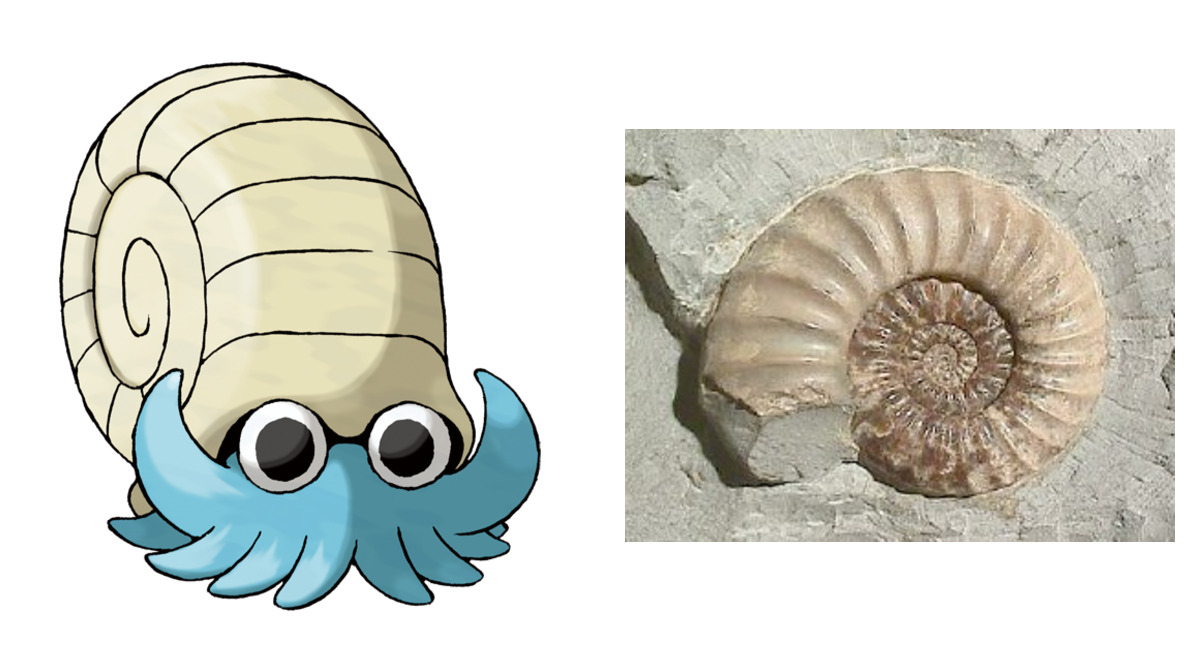
The spiral-shelled Omanyte and its evolution Omastar are unmistakably based on ammonites-extinct marine mollusks that thrived in Earth’s oceans for over 300 million years. Ammonites were cephalopods, related to modern squids and octopuses, but they lived inside coiled shells that fossilized beautifully.
Ammonite fossils are so common that ancient cultures worldwide developed myths about them. In England, they were called “snakestones” and believed to be petrified serpents. In Nepal, they’re considered sacred manifestations of the god Vishnu. The Helix Fossil that produces Omanyte became an internet phenomenon during “Twitch Plays Pokemon,” where players jokingly worshipped it as a deity.
Real ammonites ranged from tiny species smaller than a coin to giants over six feet in diameter. They went extinct alongside the dinosaurs 66 million years ago, likely victims of the same asteroid impact. Omastar’s tentacles and predatory nature reflect what scientists believe about how ammonites hunted-using their tentacles to capture prey while their shells provided protection from predators.
- Revived from Helix Fossil
- Based on ammonites (extinct cephalopods)
- Ammonites lived 400-66 million years ago
- Shells are among the most common fossils found worldwide
Kabuto & Kabutops
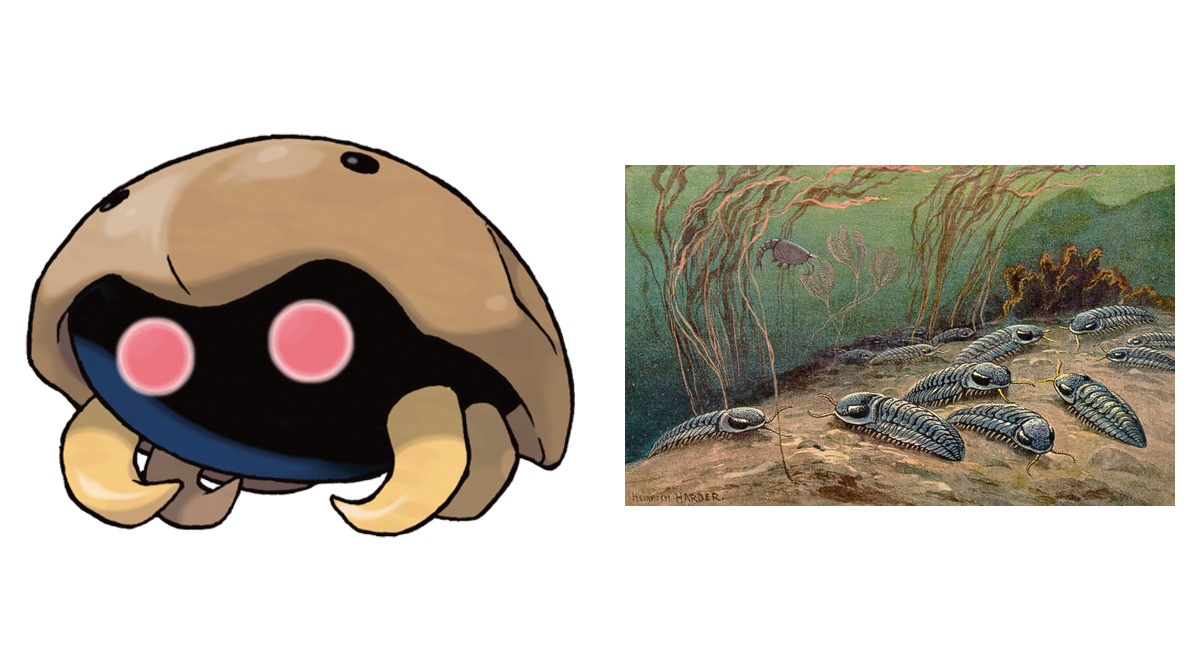
Kabuto’s design brilliantly combines two arthropods: the extinct trilobite and the still-living horseshoe crab. Trilobites dominated Earth’s oceans for nearly 300 million years before going extinct, while horseshoe crabs have survived virtually unchanged for 450 million years-making them true “living fossils.”
The dome-shaped shell and multiple legs of Kabuto mirror both creatures perfectly. When it evolves into Kabutops, the design shifts toward a more predatory form with blade-like arms, possibly inspired by eurypterids (sea scorpions) that were apex predators in ancient seas.
Horseshoe crabs are remarkable survivors. Their blue blood contains a chemical called LAL that’s used to test medical equipment for bacterial contamination-every vaccine you’ve ever received was likely tested using horseshoe crab blood. Trilobites, meanwhile, were so successful that over 20,000 species have been identified from fossils. They had some of the most complex eyes ever evolved, with crystalline lenses made of calcite.
- Revived from Dome Fossil
- Based on trilobites and horseshoe crabs
- Trilobites: 521-252 million years ago
- Horseshoe crabs still exist today (450 million years old)
Lileep & Cradily
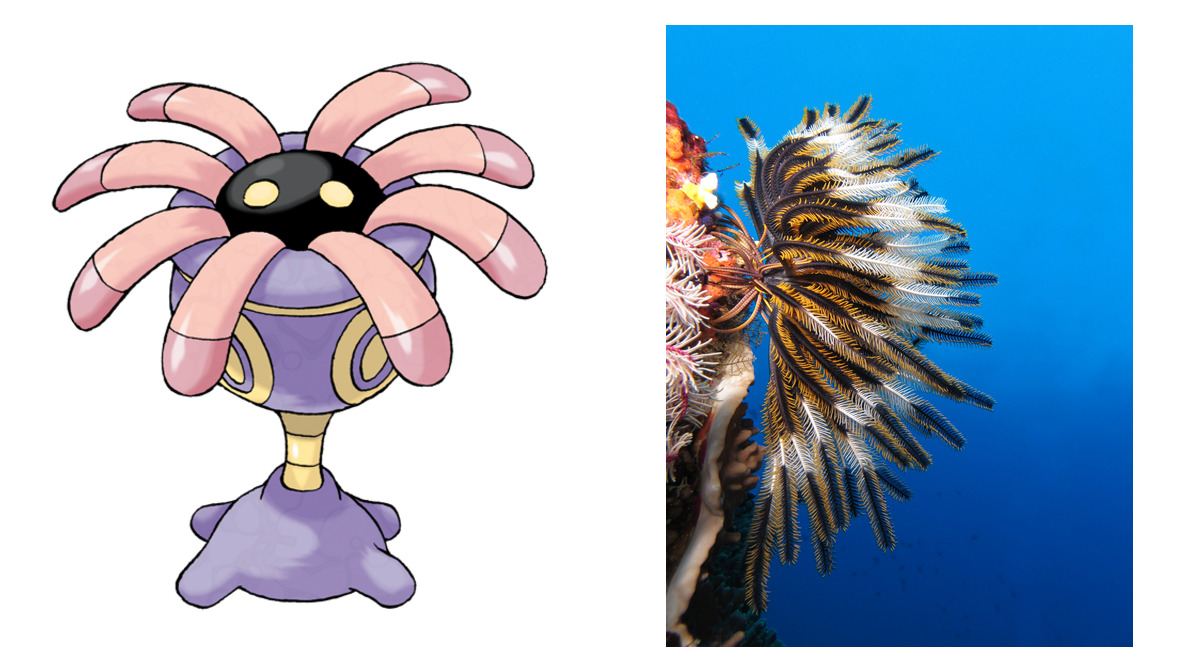
Lileep and Cradily are based on crinoids, commonly called “sea lilies”-and here’s the twist that confuses most people: despite looking exactly like plants, crinoids are animals. They’re echinoderms, related to starfish and sea urchins, and they’ve existed for nearly 500 million years.
Ancient crinoids attached themselves to the seafloor with long stalks, waving feathery arms to filter food particles from the water. Their fossils are so abundant that entire limestone formations are composed primarily of crinoid fragments. In some areas, you can find “crinoid columnals”-disc-shaped segments of their stalks-scattered across beaches and hillsides.
What makes crinoids remarkable is their survival. While most stalked crinoids went extinct, some species still exist today in deep ocean environments. The Grass/Rock typing of Lileep and Cradily perfectly captures the plant-like appearance combined with their rocky fossil nature.
- Revived from Root Fossil
- Based on crinoids (sea lilies)
- Crinoids are animals, not plants
- Existed for 480+ million years, some still alive today
Anorith & Armaldo
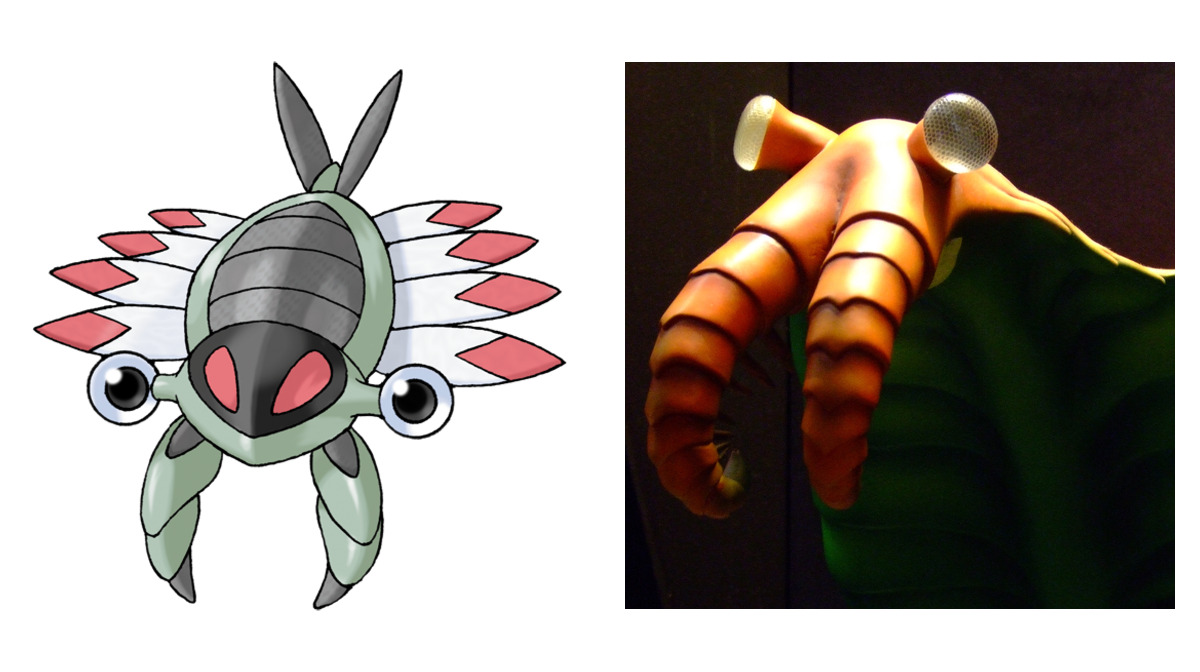
Anorith and Armaldo take their inspiration from Anomalocaris, one of the most terrifying predators of the Cambrian period-the era when complex animal life first exploded onto the scene over 500 million years ago. At up to three feet long, Anomalocaris was a giant compared to most Cambrian creatures.
The name Anomalocaris means “abnormal shrimp,” given because scientists initially found only its circular mouth and thought it was a jellyfish. Its grasping appendages were classified as shrimp. Only later did paleontologists realize all these parts belonged to one creature-the apex predator of ancient seas.
Anorith’s large eyes and grasping claws directly mirror Anomalocaris’s hunting tools. The real animal had compound eyes with over 16,000 lenses each, giving it incredible vision for tracking prey. Its mouth was a circular structure that could crush the shells of trilobites-we’ve found trilobite fossils with bite marks matching Anomalocaris’s mouth.
- Revived from Claw Fossil
- Based on Anomalocaris
- Lived during the Cambrian period (520-485 million years ago)
- Apex predator of early complex ocean life
Cranidos & Rampardos
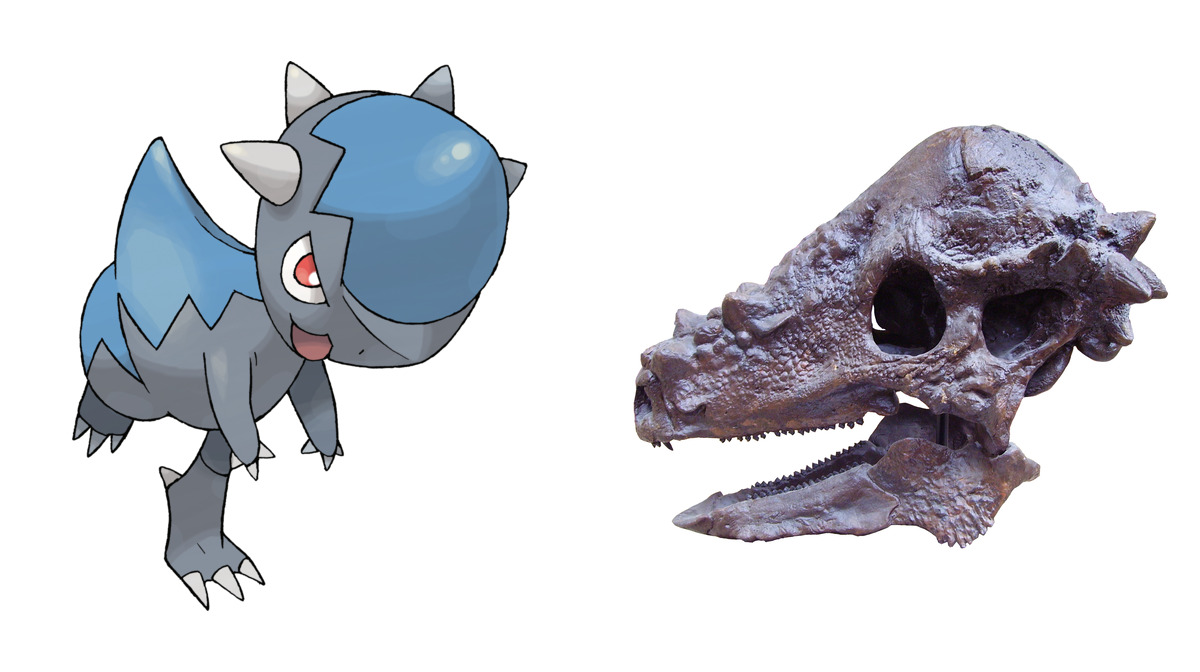
Cranidos and Rampardos are clearly based on Pachycephalosaurus, the famous “thick-headed lizard” known for its dome-shaped skull. These dinosaurs lived during the late Cretaceous period, right up until the mass extinction 66 million years ago.
Pachycephalosaurus skulls could be up to 10 inches thick-solid bone that scientists long believed was used for headbutting rivals, similar to how bighorn sheep compete today. However, recent research has questioned this theory. Biomechanical studies suggest the dome shape might not have been ideal for direct head-on collisions, and some scientists now think the skulls were primarily for display or flank-butting instead.
Rampardos’s Pokedex entry claims it can knock down almost anything with its headbutt and that its skull is hard enough to withstand any impact-playing directly into the traditional headbutting hypothesis. The games give it one of the highest Attack stats among non-legendary Pokemon.
- Revived from Skull Fossil
- Based on Pachycephalosaurus
- Lived 70-66 million years ago
- Skull was up to 10 inches thick
Shieldon & Bastiodon
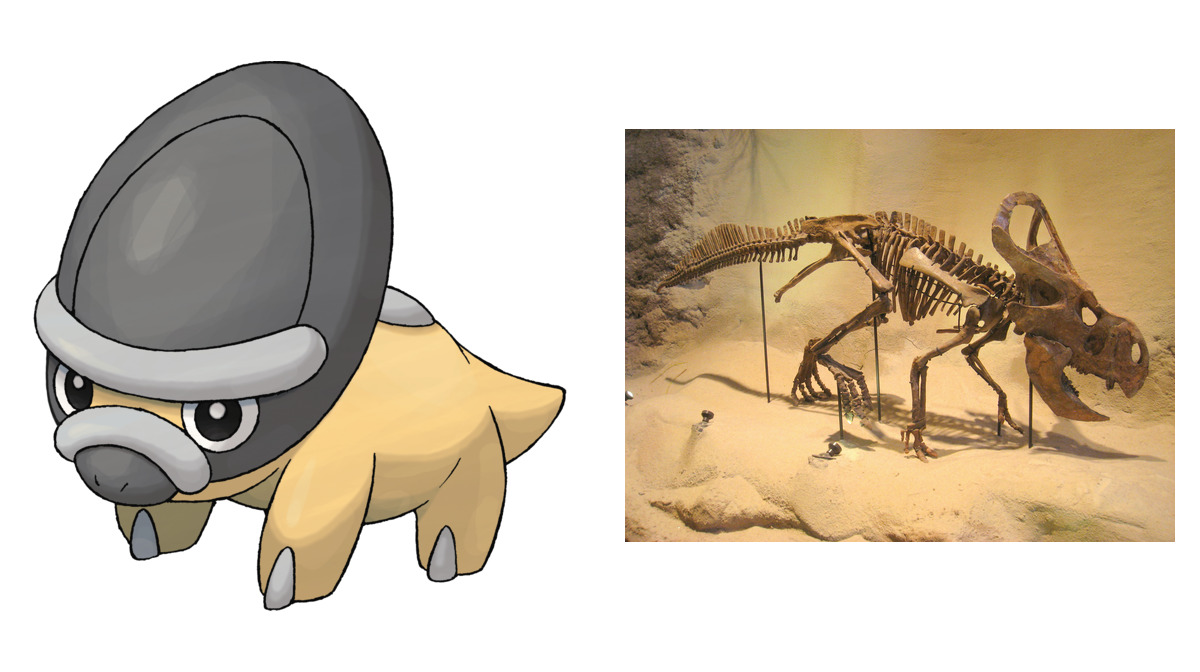
Shieldon and Bastiodon draw inspiration from ceratopsian dinosaurs-the group that includes Triceratops. More specifically, they resemble earlier ceratopsians like Protoceratops or Zuniceratops, which had prominent facial shields but smaller or no horns compared to their later relatives.
The name “ceratopsian” means “horned face,” and these dinosaurs are famous for their elaborate frills and horns. Scientists believe these features served multiple purposes: defense against predators, temperature regulation, species recognition, and display for attracting mates. Bastiodon’s face-shield design perfectly captures the defensive interpretation.
Protoceratops, one likely inspiration, is historically significant because its fossils were so common in the Gobi Desert that some researchers believe they inspired the mythical griffin. Nomadic peoples finding beaked skulls with four-legged bodies may have imagined a lion-eagle hybrid.
- Revived from Armor Fossil
- Based on ceratopsian dinosaurs (Protoceratops/Zuniceratops)
- Lived 75-71 million years ago
- Frills possibly inspired griffin mythology
Tirtouga & Carracosta
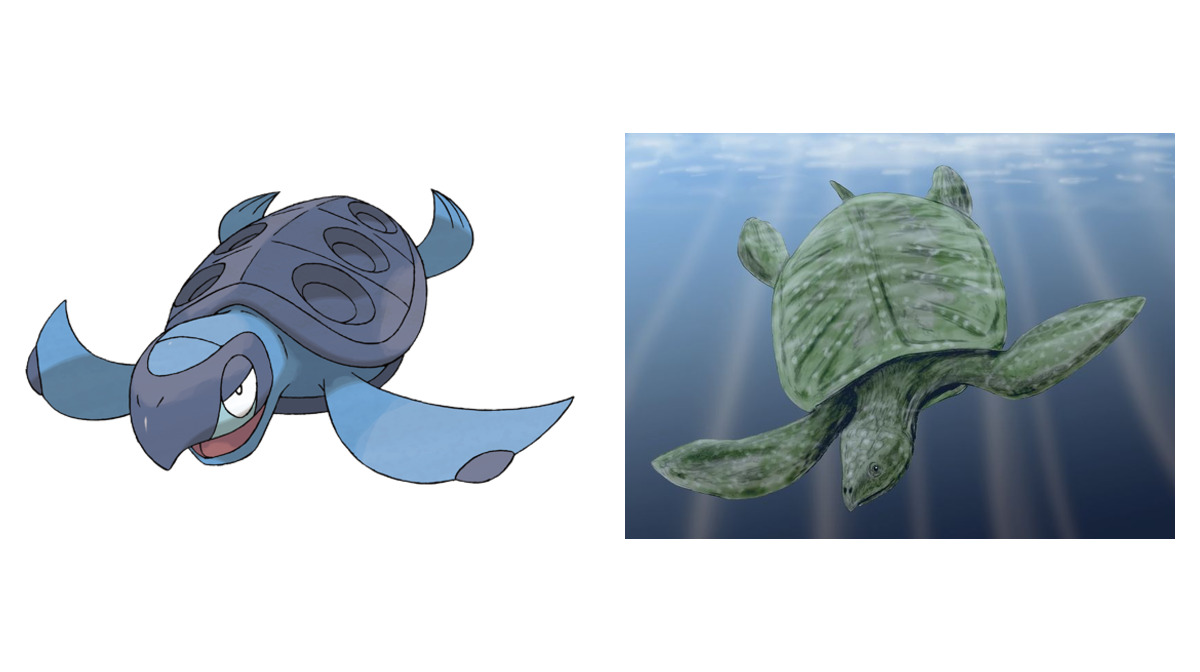
Tirtouga and Carracosta are based on Archelon, one of the largest sea turtles ever known. This massive reptile swam through the Western Interior Seaway-a shallow sea that split North America in two during the late Cretaceous period-reaching lengths of up to 15 feet.
Archelon’s shell wasn’t solid like modern turtle shells. Instead, it had a leathery skin covering a framework of bones, similar to today’s leatherback sea turtles. This design made Archelon lighter and more maneuverable in water but offered less protection from predators like mosasaurs-giant marine lizards that ruled Cretaceous seas.
The Water/Rock typing of Carracosta captures this prehistoric nature while its powerful limbs and sturdy build reference how Archelon’s flippers made it an efficient swimmer. The type specimen of Archelon was discovered in South Dakota in 1895 and is now displayed at the Yale Peabody Museum.
- Revived from Cover Fossil
- Based on Archelon (giant sea turtle)
- Lived 80-74 million years ago
- Could reach 15 feet in length
Archen & Archeops
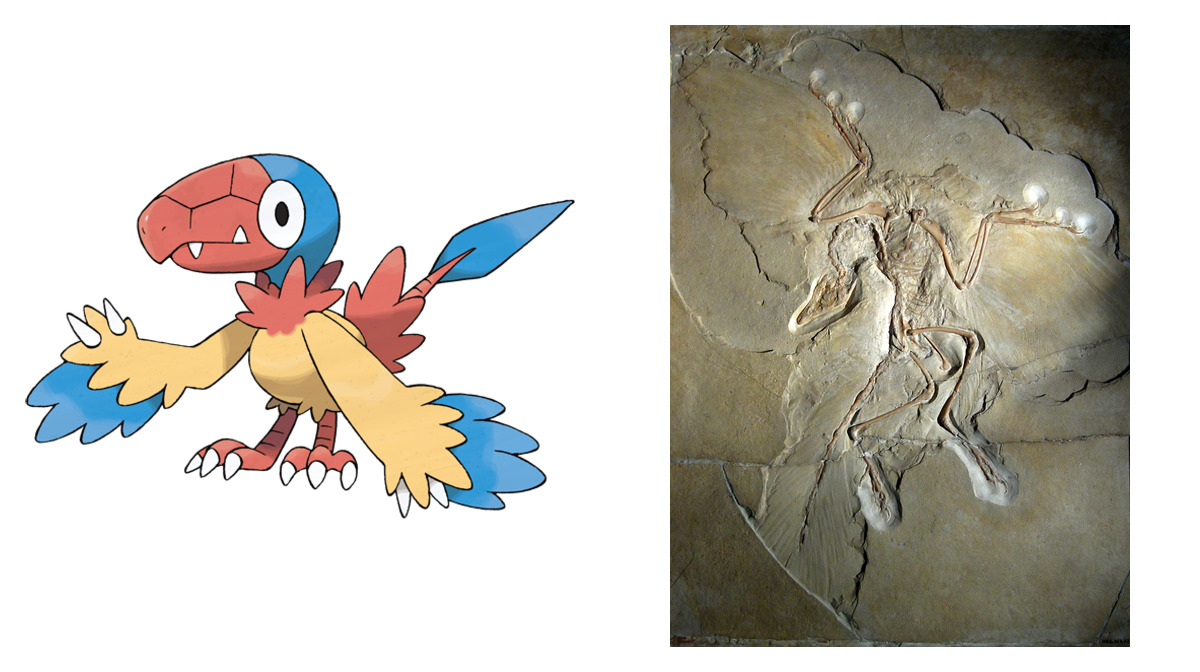
Archen and Archeops are directly named after Archaeopteryx, widely considered the first known bird and one of the most important fossils ever discovered. Found in German limestone quarries, Archaeopteryx provided crucial evidence linking dinosaurs to birds-it had feathered wings like a bird but teeth, claws, and a bony tail like a dinosaur.
The first Archaeopteryx fossil was discovered in 1861, just two years after Darwin published “On the Origin of Species.” This timing was remarkable-Darwin’s critics had demanded transitional fossils proving evolution, and here was exactly that. Archaeopteryx became an icon of evolutionary biology.
Archeops’s Pokedex entry states it could fly but not well, requiring a running start-matching what scientists believe about Archaeopteryx’s flight capabilities. Its Ability “Defeatist” (which sharply reduces its stats when HP falls below half) might reference how Archaeopteryx was likely a vulnerable creature.
- Revived from Plume Fossil
- Based on Archaeopteryx
- Lived approximately 150 million years ago
- Key transitional fossil between dinosaurs and birds
Tyrunt & Tyrantrum
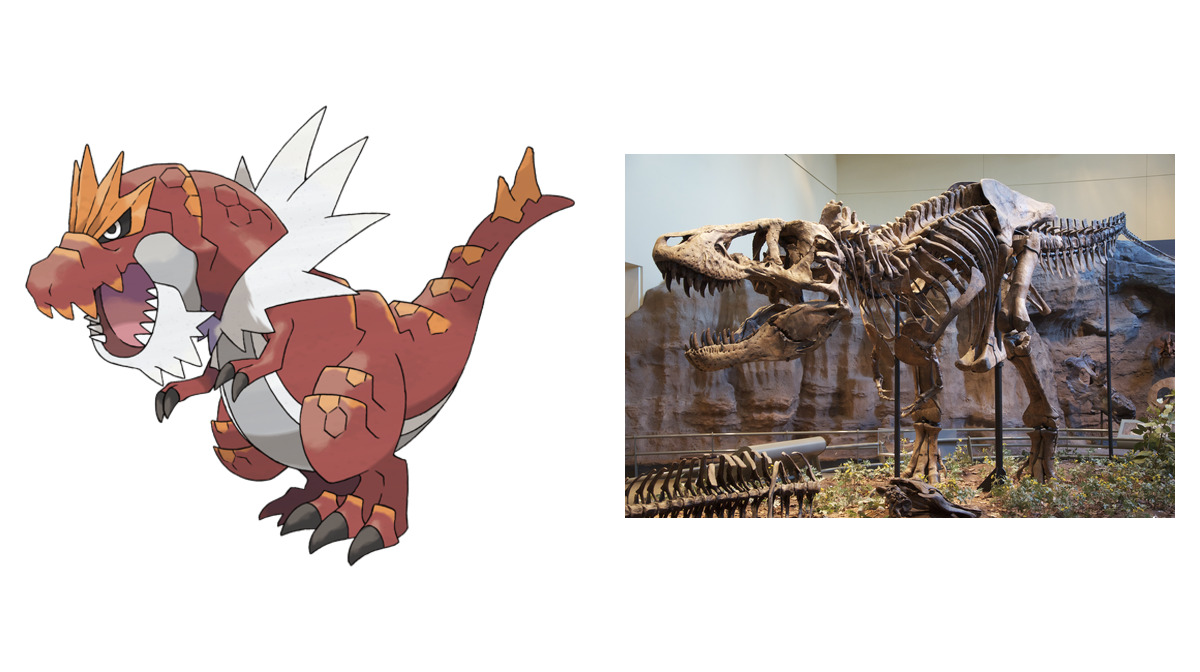
Tyrunt and Tyrantrum need little explanation-they’re based on Tyrannosaurus Rex, the most famous dinosaur of all time. T-Rex lived during the final years of the Cretaceous period in what is now North America, and it remains the popular imagination’s quintessential predator.
T-Rex was genuinely massive: up to 40 feet long, standing 12 feet tall at the hip, with a skull over 5 feet in length. Its bite force has been estimated at over 12,000 pounds-strong enough to crush bone. Those tiny arms? Each could still lift around 400 pounds, so they weren’t useless, just relatively small compared to the rest of the animal.
Tyrantrum’s Rock/Dragon typing is interesting-Dragon references the ancient, powerful nature of the creature, while Rock ties it to its fossil origins. The “king” theme runs throughout: Tyrantrum has a crown-like frill, its name includes “tyrant,” and it behaves dominantly in the games.
- Revived from Jaw Fossil
- Based on Tyrannosaurus Rex
- Lived 68-66 million years ago
- Bite force over 12,000 pounds
Amaura & Aurorus
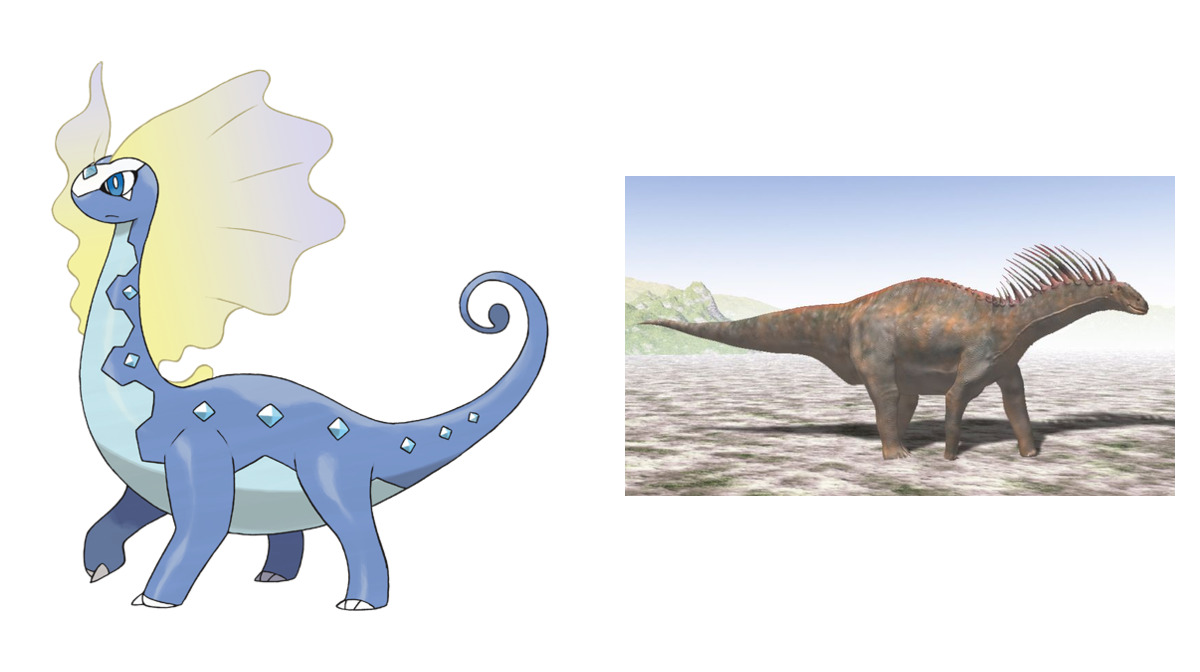
Amaura and Aurorus take their inspiration from sauropods with distinctive spinal sails, most likely Amargasaurus. This unusual dinosaur from Early Cretaceous Argentina had twin rows of elongated spines running down its neck and back, creating a sail-like structure unique among sauropods.
Scientists debate what Amargasaurus’s spines were for. Theories include temperature regulation (blood vessels in a skin sail could absorb or release heat), display for attracting mates or intimidating rivals, or defense against predators. The spines may have also made noise when rattled together.
Aurorus’s Ice/Rock typing is an interesting choice-there’s no evidence Amargasaurus lived in cold environments. However, the frozen aesthetics might reference how well-preserved fossils are sometimes found in permafrost. The gentle, peaceful nature described in Aurorus’s Pokedex entries matches what we know about sauropods-they were herbivores that likely lived in herds.
- Revived from Sail Fossil
- Based on Amargasaurus
- Lived 130-125 million years ago
- Distinctive twin spine sails of unknown purpose
BONUS: The Galar Chimeras
Generation VIII introduced the most unusual fossil Pokemon yet-four creatures created by combining mismatched fossil pieces. Dracozolt, Arctozolt, Dracovish, and Arctovish aren’t based on real animals. Instead, they satirize Victorian-era paleontology, when scientists frequently assembled fossils incorrectly.
The most famous example is “Brontosaurus”-originally created when paleontologist O.C. Marsh put the wrong skull on an Apatosaurus skeleton. For decades, museum displays showed this chimera before the mistake was recognized. (Ironically, recent research suggests Brontosaurus might actually be valid after all.)
Galar’s fossil scientists are portrayed as enthusiastic but careless, forcing pieces together without concern for whether they actually fit. Dracovish became competitively famous despite its absurd appearance-its ability “Strong Jaw” combined with the move “Fishious Rend” made it one of the most powerful Pokemon in competitive play. Arctovish’s head is literally upside down, making it the most obviously “wrong” of the four.
This meta-commentary reminds players that scientific understanding is always evolving, and today’s confident explanations might be tomorrow’s embarrassing mistakes.
- Created from mismatched fossil pieces
- Satirizes Victorian paleontology errors
- Dracovish became competitively dominant
- Arctovish’s head is attached upside down
Sources
- Bulbapedia – Fossil Pokemon entries
- Natural History Museum – Pterosaur information
- Smithsonian National Museum of Natural History – Dinosaur database
- Journal of Vertebrate Paleontology – Pachycephalosaurus studies
- Yale Peabody Museum – Archelon specimen information