
Every Memory Viewed in the Pensieve in Harry Potter
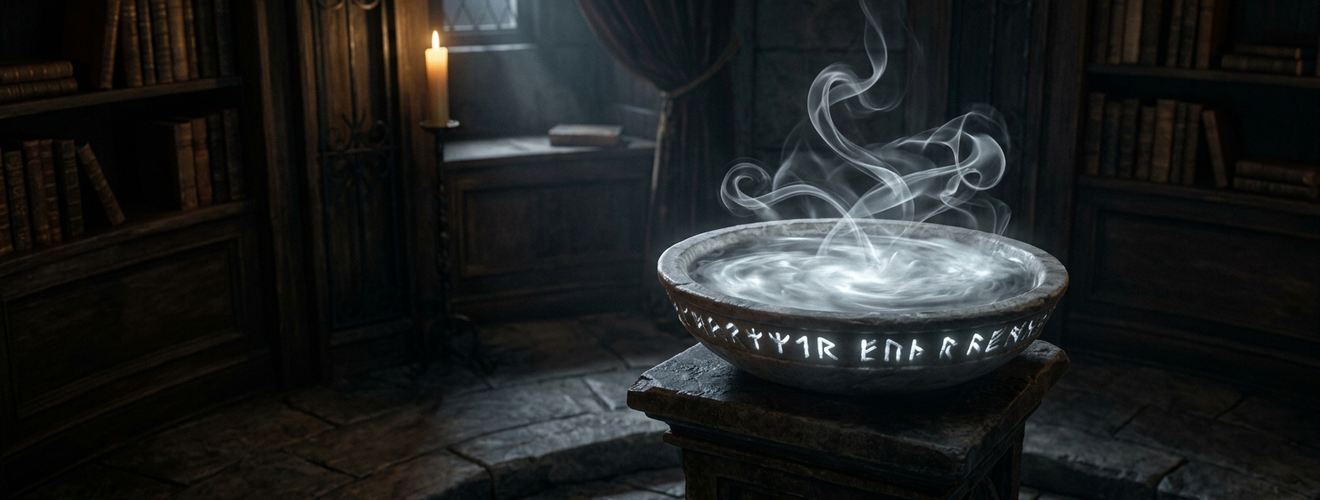
‘One simply siphons the excess thoughts from one’s mind,’ Dumbledore tells a schoolboy who has just been caught inside his, ‘pours them into the basin, and examines them at one’s leisure.’ Harry’s own first look at the stuff in the basin had produced a less tidy description: it looked like light made liquid, or like wind made solid, and he could not make up his mind which. Whatever it was, he had touched it, and it had swallowed him, and the first thing he saw on the other side was a courtroom.
The Pensieve is usually remembered as Dumbledore’s, and for most of the series it behaves that way: a headmaster’s filing system, fed from small crystal bottles of other people’s recollections that he has spent years collecting so that a sixth-year can be walked, as a bystander, through the life of Tom Riddle. The last of it is nothing of the kind. The final basin-load is Snape’s, poured out of his own head as he died in the Shrieking Shack, with an instruction to take it, and they are the only memories on this list Harry watches with nobody left alive to explain them.
Between that courtroom and that gift lie four novels’ worth of viewings, two rooms at Hogwarts and two kinds of watching: the memories Harry walks into, and the handful that rise to the surface as a figure while he stays outside. What follows is every one of them, in the order the books show them, from a Ministry dungeon in Goblet of Fire to the headmaster’s office in the small hours of 2 May, with what happens inside each and what the record does and does not say about how Harry saw it.
Harry views thirty-four memories in the Pensieve across the seven Harry Potter novels: a memory counts when he enters it, or when its figure rises to the surface and is watched. Four books carry them, Goblet of Fire, Order of the Phoenix, Half-Blood Prince and Deathly Hallows, and nineteen of the thirty-four come in a single sitting, The Prince’s Tale.
Karkaroff’s Hearing
The first thing Harry ever sees in a Pensieve is a courtroom, and the first thing he learns there is that nobody can see him. Alone in Dumbledore’s office in Goblet of Fire, he has found a stone basin in a black cabinet, its rim carved with runes and symbols he does not recognize, and touched the silver inside. A moment later he is in a dungeon holding at least two hundred witches and wizards, none of whom looks his way. Igor Karkaroff is brought in between two Dementors, and the chair’s chains snake up his arms.
What follows is a plea bargain. Karkaroff trades names for freedom, in order: Antonin Dolohov, already in custody; Evan Rosier, dead resisting arrest and, as the Moody beside Harry mutters, the man who took a chunk of Moody’s nose with him; Travers; Mulciber; Augustus Rookwood, the spy inside the Department of Mysteries and the one name the jury wants; and, last, Severus Snape. All six sit on the roster of the confirmed Death Eaters named across the series. It took Moody six months to catch one of the men now being bargained away, and he says so.
The Snape name is the one that matters. Dumbledore puts on record that Snape had indeed been a Death Eater, had rejoined their side before Voldemort’s downfall, and had turned spy at great personal risk. It is the first time Harry hears it. The rest of the series decides whether to believe it.
Ludo Bagman’s Hearing
Ludo Bagman was never accused of being a Death Eater. Harry assumes he was, and the hearing corrects him: the charge before the Council of Magical Law is passing information to one, Augustus Rookwood, and Bagman’s defence is that old Rookwood was ‘a friend of my dad’s’ and that it ‘never crossed my mind he was in with You-Know-Who.’ Crouch, presiding, is unmoved. He has got as far as suggesting ‘a term of imprisonment in Azkaban lasting no less than’ something when a witch in the crowd interrupts to congratulate Bagman ‘on his splendid performance for England in the Quidditch match against Turkey last Saturday.’
That is the whole trial, more or less. Bagman had been a Beater, for England and for one of the professional Quidditch teams of Britain and Ireland, and the room is full of people who had watched him play. The applause does the jury’s work. Crouch is left staring at the defendant ‘with an expression of the utmost severity and dislike’ while the court lets a popular hero walk. Harry, invisible on the benches, has just watched a plea bargain succeed on evidence; now he watches an acquittal succeed on fame.
The memory earns its place for what it says about the man Harry already knows. The Bagman of Goblet of Fire runs the Department of Magical Games and Sports and helps organise a Quidditch World Cup, and he is still, underneath, the boy who got off. Charm, in this court, is a defence.
The Sentencing of Barty Crouch Jr. and the Lestranges
Four people are brought to the chained chair for the third hearing, and one of them is the judge’s son. Rodolphus and Rabastan Lestrange come in with Bellatrix, who sits ‘as though it were a throne,’ and with a boy in his late teens, ‘shivering, his straw-colored hair all over his face.’ Barty Crouch Sr. reads the charge himself: capturing an Auror, Frank Longbottom, and subjecting him to the Cruciatus Curse in the belief that he knew where their vanished master was, and then, when Frank would not talk, using the same curse on his wife.
Crouch demands a verdict rather than waiting for one, asking the jury to raise their hands if they agree that these crimes deserve a life sentence in Azkaban. The hands go up together. The crowd that had clapped Bagman out of the room now applauds with ‘faces full of savage triumph,’ and the boy begins to scream. Bellatrix does not. She rises and tells Crouch that the Dark Lord will rise again, that they will wait in Azkaban, that they alone were faithful. Crouch condemns his only child without a flicker of sorrow.
The memory is the origin of Neville Longbottom’s childhood, lived in the shadow of what was done to his parents, and it matters more than the two hearings before it. The screaming boy became the first prisoner to escape Azkaban in almost 300 years, and has spent this year wearing the face of the man Harry calls Moody.
Bertha Jorkins Behind the Greenhouses
Bertha Jorkins is sixteen in this memory, and she is following a boy. The boy has met a girl named Florence behind the greenhouses; Bertha sees it, the boy sees Bertha, and he hexes her. That is the whole of it. The scene is not one Harry walks into. Her figure rises from the surface of the basin and is watched from above, a glimpse rather than a room he can stand in, one of a handful here that work that way.
It is also the memory J.K. Rowling reaches for when she wants to explain how a wizard’s presence can outlive the wizard. Asked on her own website how the Marauder’s Map could still insult Snape years after James Potter’s death, she answered with a list of magical recordings of people, and the first item on it was ‘think of Bertha Jorkins rising out of the Pensieve,’ ahead of the Sorting Hat and Mrs Black’s portrait. Dumbledore kept a schoolgirl’s punishment in his basin, and its author called that her clearest example.
What the reader knows, and the sixteen-year-old does not, is where the habit leads. Sirius remembers a Bertha who ‘had an excellent memory for gossip’ and ‘never knew when to keep her mouth shut.’ Crouch Sr. later put a Memory Charm on her for stumbling onto his secret; Voldemort broke it, took what she knew, and killed her. Rowling’s example of a voice that outlasts its owner is a girl who could not keep quiet.
Snape Reports His Dark Mark
Dumbledore adds this one to the basin himself. Back in his office, rather than close the cabinet, he tips in a fresh memory and swirls the Pensieve the way a prospector pans for gold, while Harry, astonished, sees his own face swimming on the surface of the bowl. Then, in the chapter’s words, he ‘saw his own face change smoothly into Snape’s, who opened his mouth and spoke to the ceiling, his voice echoing slightly.’ Snape is reporting that the Dark Mark on his arm is growing clearer.
It is a strange thing for a headmaster to keep on file, and Rowling later said what it was for. In her own writing on the Pensieve she describes Dumbledore in this scene reminding himself of the hidden connection between Snape and Harry, the one the books will not spell out until the very end. The face that becomes Snape’s is Harry’s. Dumbledore has, in effect, filed the two of them together.
The mark is the plot’s early-warning system. Karkaroff, seen in the dock a few memories earlier, watches his own tattoo darken and eventually burn, and flees the castle; Snape stays, and at the end of the book shows Fudge the mark as proof that Voldemort has returned. In the office, Dumbledore tells Harry that curiosity is not a sin, but that one should exercise caution with it. Harry has just read the headmaster’s private note about the teacher who most dislikes him. Caution seems late.
Snape’s Worst Memory
The Pensieve in this memory is borrowed. Snape took Dumbledore’s basin to his own office for the Occlumency lessons, removed the memories he could not risk Harry seeing, and left it on his desk; Harry looks in while Snape is out of the room. He follows his fifteen-year-old father out onto the grounds beside the lake, just after the Defence Against the Dark Arts O.W.L. James is playing with a stolen Snitch. Sirius is bored. Then Sirius spots Snape sitting alone, and they go to work.
They disarm him, knock him down, and fill his mouth with pink soap bubbles by way of Scourgify. Lily Evans arrives to tell James he is ‘just an arrogant, bullying toerag,’ Snape frees himself and cuts James’s face, and James answers with a silent jinx that leaves Snape ‘hanging upside-down in the air, his robes falling over his head to reveal skinny, pallid legs and a pair of greying underpants.’ The jinx is Levicorpus. It sits with Sectumsempra among the spells the books credit to a named inventor, and the inventor is Snape: James is humiliating him with a spell from Snape’s own textbook. Snape’s reply, to the one person defending him, is ‘I don’t need help from filthy little Mudbloods like her!’
Snape returns, hauls Harry out and, by the official account, throws glass jars at his head. Harry sees it again inside The Prince’s Tale, nearly two years later. It is the one memory here he sees twice, unchanged.
Trelawney’s Prophecy
On a cold, wet night, by Dumbledore’s account sixteen years earlier, a Divination candidate named Sybill Trelawney sat down for an interview at the Hog’s Head and, partway through, stopped being herself. The one with the power to vanquish the Dark Lord approaches, said the voice that came out of her, born to those who have thrice defied him, born as the seventh month dies. Dumbledore had not been impressed until then. He hired her, and by Rowling’s later telling did so because the interview had revealed her as the unconscious possessor of important knowledge.
Dumbledore keeps the memory, and after the battle at the Ministry, in the chapter called The Lost Prophecy, he gives Harry the whole of it, down to the line that neither can live while the other survives. He also tells him that the eavesdropper at the door was caught only a short way in and thrown from the building. He does not, in that chapter, say who the eavesdropper was.
The record here is thinner than for any other entry: the index that places it among the Pensieve’s contents describes what the memory shows and nothing of how Harry sees it, so this list claims only that it exists, and where. Two details survive regardless. Neville Longbottom was also born as the seventh month dies, to parents who had also defied Voldemort three times, and the prophecy could have marked him instead. And Trelawney has no memory of making it.
Bob Ogden at the Gaunt House
‘This time, you enter the Pensieve with me,’ Dumbledore tells Harry at the start of the sixth-year lessons, ‘and, even more unusually, with permission.’ The memory is Bob Ogden’s, of the Magical Law Enforcement Squad, and it opens at a shack in the woods with a dead snake nailed to the door and rafters showing through the roof. Inside is Morfin Gaunt, twisting a live adder between his fingers and hissing it a rhyme about the door, which Harry understands and Ogden does not.
The patriarch, Marvolo, wants to know whether Ogden is pure-blood. ‘That’s neither here nor there,’ says Ogden, and Harry’s respect for him rises. Marvolo then produces the two objects that put this memory first on the syllabus: a clumsy gold ring with a black stone, in the family for centuries by his account, and a heavy gold locket with an S picked out in emeralds that belonged to Salazar Slytherin, with which he nearly throttles his daughter. Two of the Horcruxes Voldemort would go on to make are in the room, one on a finger and one round a neck, before Voldemort has been born.
A handsome young man named Tom Riddle rides past, and Merope watches him as she watches nothing else. Ogden is driven out, returns with reinforcements, and arrests father and son. Dumbledore’s love-potion theory comes afterwards, labelled a guess. Ogden appears on thirteen pages of the entire series. On one of them a Gaunt comes at him with a knife.
Merope Sells the Locket to Caractacus Burke
Ten Galleons. That is what Salazar Slytherin’s locket fetched, and Harry’s reaction to the figure is the chapter’s own: ‘He only gave her ten Galleons?’ The seller was Merope Gaunt, by then Merope Riddle, heavily pregnant, alone in London and, in the official telling, destitute. The buyer was Caractacus Burke of Borgin and Burkes, a small old man with a thatch of hair over his eyes who knew precisely what the thing was worth and drove a hard bargain anyway. It was, by Burke’s own account, just before Christmas.
This is not a memory Harry walks into. Dumbledore pours it into the Pensieve and swirls the stone basin between his long fingers, and the two of them watch Burke’s account play out. It is the only memory on the list told by a shopkeeper, and it reads like one: the goods, the price, the mark.
The locket does not stay on Burke’s shelf. It is bought by a collector named Hepzibah Smith and stolen from her by the boy Merope died giving birth to, who by then works for the shop that swindled his mother. Merope reached the steps of the orphanage, in the official account, seeming to know she would not survive. Voldemort, Dumbledore tells Harry in a later lesson, would have seen the locket, at least, as rightfully his. He was not wrong, exactly. His mother had sold it for ten Galleons.
Dumbledore Meets Tom Riddle at the Orphanage
The matron is the first person in this memory to be handled, and Dumbledore does the handling. Mrs Cole is sceptical of the visitor until her eyes fall on ‘a bottle of gin and two glasses that had certainly not been present a few seconds before,’ after which she talks. The boy upstairs is strange, she says: two children, Amy Benson and Dennis Bishop, went into a cave with Tom Riddle on the seaside outing and ‘were never quite right afterwards.’
Upstairs is ‘a small bare room with nothing in it except an old wardrobe and an iron bedstead,’ and an eleven-year-old on the grey blankets with a book. Harry and Dumbledore enter this one together. The boy does not believe he is talking to a wizard, and tries ‘Tell the truth!’, spoken with a ringing force that was almost shocking. When he does believe it, he supplies his credentials unprompted: ‘I can make bad things happen to people who annoy me. I can make them hurt if I want to.’ He can speak to snakes, too, and wants to know whether that is normal.
Dumbledore, then the Transfiguration teacher, tells him to return the box of other children’s trinkets in his wardrobe. There is no trace of the Gaunts in the face; it is his handsome father in miniature, which was Merope’s dying wish. He is eleven. He has already worked out what magic is for, and already asked whether that is usual.
Morfin Gaunt’s Memory
Three murders, one confession, and the wrong man in Azkaban: that is the end of this memory; the beginning is a teenage Tom Riddle, in the summer of his sixteenth year, walking into the filthy Gaunt hovel he has tracked down from the orphanage and finding his uncle in it. Morfin tells him about the family, and it is the moment Riddle learns that his father was a Muggle.
What happens next is told to Harry by Dumbledore rather than shown, because Morfin did not see it either. Riddle Stupefied him, crossed to the big house, killed Tom Riddle Senior and both his parents with Morfin’s own wand, came back, left the wand with his uncle and took the ring off his finger. Then he modified Morfin’s memory. When the Ministry arrived, Dumbledore says, Morfin admitted to the murder on the spot, giving details only the murderer could know, and let himself be led off to Azkaban without a fight. A convicted Muggle-hater who had already been jailed once for hexing one of the victims was never going to be believed anyway.
Harry and Dumbledore enter this memory together, the first of two in a single sitting of the sixth-year lessons. It is the first memory on this list that its owner would not have recognised. It is not the last.
Slughorn’s Tampered Memory
The memory has gone bad in the bottle. That is how it looks before Harry and Dumbledore even enter it: congealed, the chapter says, as though it had spoiled, and once inside there is a strange fog over the scene. A young Horace Slughorn, his hair ‘thick, shiny, straw-colored,’ sits among a group of students while Tom Riddle, wearing a ring he took from his uncle that summer, asks him about Horcruxes. Then the fog thickens and Slughorn, out of nowhere, scolds the boy for asking.
Dumbledore does not pretend otherwise. He tells Harry the memory has been edited by the man who supplied it, and the reason is the memory’s whole subject: Slughorn, by the official account, had carried the guilty shadow of that conversation across the years and doctored his own recollection out of shame before handing it over. It is the second memory of the sitting, following straight on from Morfin’s, and Dumbledore uses the two of them to make a point about what an edited memory looks like from the inside. One was tampered with by a murderer to hide a crime. This one was tampered with by a Potions master to hide his embarrassment.
The lesson ends with homework. Harry is to get the real version out of Slughorn himself, and the rest of Half-Blood Prince runs on his failing to.
Hokey’s Memory of Hepzibah Smith
‘Lovely, madam,’ squeaks the house-elf, and Harry, standing beside Dumbledore in a room like a cross between an antique shop and a conservatory, privately disagrees. Hepzibah Smith is an immensely fat old lady in an elaborate ginger wig and brilliant pink robes, and she is expecting a visitor: a handsome young man from Borgin and Burkes named Tom Riddle, whose hollow cheek she pinches. The memory belongs to Hokey, the tiny, papery-skinned elf who serves her, which is how Harry comes to watch a murder from the servant’s side of the room.
Hepzibah has two things to show the boy, and she cannot resist showing him both. One is a small golden cup with two finely wrought handles and a badger engraved on it, Helga Hufflepuff’s, from whom she claims descent. The other is the locket Merope Gaunt sold, which Hepzibah bought from the same shop Riddle now works for.
Two days later Hepzibah is dead of poisoned cocoa, both treasures are gone, and Hokey has confessed. She did not do it. Riddle modified her memory so that she would, exactly as he had modified Morfin’s, and the official account is blunt that the death was pinned on the elf. The Lexicon’s editors mark this as the first time Voldemort killed purely for gain. A founder’s cup and a founder’s locket went out of the house in the pocket of a shop assistant, and the elf was left believing she had killed her mistress.
Voldemort Asks for the Defence Against the Dark Arts Post
Dumbledore is headmaster by the time of this memory, and the man who comes to his office for a job is no longer called Tom Riddle by anyone but him. ‘I know what you are known as,’ Dumbledore says, smiling pleasantly, ‘but to me, I’m afraid, you will always be Tom Riddle.’ The visitor wants to teach Defence Against the Dark Arts, and Dumbledore turns him down. The chapter’s own epigraph is the line he says while doing it: the time is long gone when he could frighten this man with a burning wardrobe.
It is the second time the post has been refused him. Straight out of school he had asked Armando Dippet, who told him that at eighteen he was too young, and the vacancy that had caught his eye then was Galatea Merrythought’s, retiring after nearly fifty years in the job. Merrythought sits among the Hogwarts professors named across the seven books, and after this interview nobody held her post for long.
Dumbledore tells Harry afterwards that Hogwarts has never kept a Defence Against the Dark Arts teacher longer than a year since he refused the post to Voldemort, and the official line is that the rejected applicant was strongly suspected of jinxing it in revenge. He and Dumbledore enter the memory together, and it is the only one on the list in which Dumbledore watches himself say no.
Slughorn’s Real Memory
Harry got this memory by getting lucky, in the literal sense. He drank a mouthful of Felix Felicis, the luckiest of the potions named in the Harry Potter books, on the night of Aragog’s burial, followed Slughorn to Hagrid’s hut and, once Hagrid had fallen asleep, asked him to be as brave as Lily had been and not let her death be in vain. Slughorn handed it over. Nobody was drugged; the potion worked on Harry, and Harry worked on Slughorn.
Dumbledore pours it into the basin just after midnight, and the two of them go in. It is the same room, the same young Slughorn, now with a gingery-blond moustache, feet on a velvet pouffe and one hand rummaging in a box of crystallised pineapple, and the same boy with the stolen ring. This time the fog does not come. Riddle asks about Horcruxes, and then about whether one could make more than one. ‘Seven!’ says Slughorn. ‘Isn’t it bad enough to think of killing one person?’ He looks, the chapter notes, as though he is seeing the boy plainly for the first time, and he asks him not to tell anyone.
That single number is what Dumbledore has been waiting a book for. He reckons afterwards that Riddle made six, names the ring, the diary, the locket, the cup and Nagini, and admits he cannot identify the sixth. The hunt for the rest occupies everything that follows. It took Slughorn one word.
Cokeworth Playground
The stone Pensieve lay in the cabinet where it had always been, and Harry heaves it onto the headmaster’s desk, pours in what Snape gave him, and falls into a playground. It is asphalt, with a swing set, somewhere near a river and a brick row house on Spinner’s End. Lily Evans and her older sister Petunia are there. Watching them from behind a flowering bush is a boy of no more than nine or ten, sallow, small and stringy, his hair overlong, in too-short jeans, an odd smocklike shirt and a shabby, overlarge coat that might have belonged to a grown man. Harry has never seen Snape this young. Nobody has.
The girl he is watching is Lily, the younger of the two. The scene is the first of the sitting, the first thing Harry sees after carrying Snape’s memories up from the Shrieking Shack, and it sets the terms for everything that follows: a boy who has been spying for a while, a girl who has no idea what she is, and a sister who is already watching both of them.
The official commentary on the chapter calls this stretch the beauty of friendship, two outsiders finding each other, and singles out the image of two children lying on the ground under a canopy of leaves. That comes later. Here the boy is still behind the bush.
Snape Tells Lily She Is a Witch
‘You are a witch,’ the boy says, when he finally comes out from behind the bush. ‘I’ve been watching you for a while. But there’s nothing wrong with that. My mum’s one, and I’m a wizard.’ It is, on the record, how Lily Evans found out what she was, and a strange way to learn it: not from a letter or a professor but from a scruffy boy of nine or ten who has been spying on her from the shrubbery and now offers the news as reassurance.
The friendship that follows is built in this memory in miniature. Snape has all the information and Lily has all the questions, and the picture of the two magical children talking to the exclusion of an upset Petunia, in the Lexicon’s phrase, is the shape their next few years will take. Petunia is present here too, hiding behind a tree. The Lexicon’s editors connect that tree to something Harry never understood in Order of the Phoenix: how his aunt came to know what dementors were. She was listening.
The sources keep this scene to its script; where it happened beyond ‘near Spinner’s End’ is not stated, and this list does not invent a setting. What is stated is the thing that matters. Snape tells Lily there is nothing wrong with being a witch in the same breath as telling her she is one. It is the kindest thing he says to her in any of them.
Platform Nine and Three-Quarters
Petunia Evans wrote to Dumbledore. That is the fact this memory exists to deliver, and it delivers it on the platform on the morning Lily leaves for Hogwarts for the first time, in front of the train. Petunia had asked, in her letter, whether she might attend the school too; the reply, which Lily and Snape found and read, was a refusal. ‘I saw his reply,’ Lily says. ‘It was very kind.’ Petunia, humiliated twice over, calls her sister a freak, and the boy beside her a weirdo, and turns away.
The official account is direct about what was underneath it. Petunia’s contempt for magic was jealousy; she had yearned to belong to the community herself and been told, kindly, that she could not. Snape, for his part, cannot get over the mechanics of the thing: he cannot believe a Muggle could have contacted Hogwarts at all, and offers Lily the theory that there must be wizards working undercover in the postal service. It is the most ordinary he ever sounds.
Harry watches this from inside the memory, standing on a platform he knows well beside a boy he knows as a man, and the person he learns the most about is the aunt who raised him. The Dursleys’ hostility to magic was never ignorance. It was a rejected application.
The Hogwarts Express
Two boys in a train compartment have already decided what they are going to be. ‘Gryffindor, where dwell the brave at heart!’ says one of them, quoting the Sorting Hat’s song before he has heard it, and the other agrees. The half-blood Severus Snape and the Muggle-born Lily Evans have just walked in on the pure-bloods James Potter and Sirius Black, and Snape’s fondest wish, that he and Lily will be sorted together into Slytherin, a house for brains over brawn as he sees it, gets laughed at.
James started bullying Snape from the moment they met, in the Lexicon’s phrase, and the mockery starts here, with the nickname Snivellus. It is worth knowing who the two boys are. By their fifth year both would be unregistered Animagi, a stag and a great black dog, and they sit together among the Animagi named across the series. In this compartment they are first-years, and the most dangerous thing about them is their confidence.
Harry has heard his father described by Sirius, by Lupin, by Snape, and has seen him at fifteen. This is the first time he sees him at the start, before any of it, and the boy on the seat is exactly as unbearable as Snape always said. The friends are sorted into different houses and, in the official summary, Snape falls in with the wrong crowd. The compartment is where that begins.
The Sorting
Lily goes to Gryffindor. Snape goes to Slytherin. That is the whole of the scene, and it is enough. Harry, who has just watched two children on a train agree that they would be sorted together, now stands in the Great Hall of a Hogwarts decades before his own and hears what the official commentary calls Snape’s tiny groan as the Hat sends Lily to the wrong table. There is nothing he can do about it. Neither, as it turns out, can Snape.
The Slytherin bench welcomes him with a detail Harry cannot have enjoyed: Lucius Malfoy, a prefect badge gleaming on his chest, already at the table. Across the hall Harry watches Lupin, Pettigrew and his father join Lily and Sirius at the Gryffindor table, which means that every one of the people who will matter most to Snape for years to come has just been arranged around him in a single evening, and all of them are on the other side of the room. The houses that divide the school for the rest of the series divide these two children first.
The sources do not put a date on the night, and neither does this list. What they do put on it is a pattern. The Sorting is the last moment in the memories at which the friendship is still intact and undivided; from here on every scene is a widening of the gap that opens between two tables in this hall.
Lily and Snape Argue About Mulciber
Somewhere in their early teens the friendship starts to crack over company. ‘I detest Avery and Mulciber!’ Lily tells him. ‘Mulciber! What do you see in him, Sev, he’s creepy! D’you know what he tried to do to Mary MacDonald the other day?’ Whatever it was, Snape’s defence of his friends is thin enough that Lily has to say the names for him. The record does not say where they are standing, so this list does not either; the Lexicon calls it fast-forwarding to their early teens, and leaves the room out.
The two names are worth pausing on, because the books pay both off. Avery turns up at Voldemort’s rebirth in the graveyard at the end of Goblet of Fire. Mulciber, whom Lily calls creepy, becomes a specialist in the Imperius Curse and fights at the Department of Mysteries. Lily’s objection to Snape’s friends, in other words, is not a schoolgirl’s snobbery; the boys she names are exactly what she says they are, and she says it years before anyone else does. The official account puts it plainly: Snape had been drawn to the Dark Arts from a young age, and the friends he made in Slytherin were partial to them too.
The Lexicon notes, for what it is worth, that Mulciber is also the name of a fallen angel in Paradise Lost, the architect of Hell’s capital. Lily, one suspects, would not have been surprised.
Snape’s Apology Outside Gryffindor Tower
Mary Macdonald fetched her. That is how Lily explains her presence: ‘I only came out because Mary told me you were threatening to sleep here.’ ‘Here’ is the corridor outside the Fat Lady’s portrait, the entrance to Gryffindor Tower, where Snape has camped after the afternoon by the lake to say sorry for the word he used. The memory is the direct aftermath of Snape’s worst memory, and the only time on this list Harry sees Snape try to take something back.
It does not work. Lily’s answer, in the official reproduction of the scene, is that she has made excuses for him for years, that none of her friends understand why she still talks to him, that he cannot wait to join You-Know-Who, and that he does not even deny it. He opens his mouth and closes it without speaking. She tells him that he has chosen his way and she has chosen hers, and goes back inside. The Lexicon’s event page calls the break irreparable at that point, and it is: this is the last conversation between the two of them that the memories contain.
The official commentary reads the scene as the moment the reader understands how decent Lily is, a girl who would not be treated badly however loyal she had been. What Harry takes from it is simpler. The boy outside the portrait hole was not lying about wanting to be forgiven. He was lying about everything else.
Windy Hilltop
Snape picked the spot himself: a lonely, windswept hilltop, and a message to Dumbledore to meet him there. When Dumbledore arrives the first thing the Death Eater says is ‘Don’t kill me,’ and he means it: Death Eaters were being killed on sight by both sides, and a summons to a hilltop from one of them looks like a trap. ‘Well, Severus?’ Dumbledore asks. ‘What message does Lord Voldemort have for me?’ ‘No – no message – I’m here on my own account!’
The account is this. Snape carried part of Trelawney’s prophecy to Voldemort, who read it as a boy born at the end of July; there were two such boys, he has chosen the Potters’ son, and Snape has come to ask that Lily be spared. Dumbledore’s reaction to the shape of that request, one woman and not her husband or child, is disgust, and he asks what Snape will give him in return for hiding all of them. ‘Hide them all, then,’ Snape says. ‘Keep her – them – safe. Please.’ And when Dumbledore repeats the question, he gets his answer: ‘Anything.’
It is a hilltop, and the sources put no date on it. What they do record, on Snape’s own Lexicon page, is what came next: Dumbledore took him on as Potions master, to give him cover as a spy and a safe place to live. Every memory after this one on the list runs on the word he said here.
Dumbledore’s Office After the Potters’ Deaths
Snape is sobbing like a wounded animal when this one begins, in Dumbledore’s office, and the reason is that the thing he asked for on the hilltop has not been done. James and Lily Potter were killed on 31 October 1981 at Godric’s Hollow, betrayed, though neither man in the room knows it yet, by Peter Pettigrew; both of them, like everyone else, blame Sirius Black. Lily is dead. Snape says so, more or less, and Dumbledore does not disagree.
What Dumbledore does instead is make use of the moment. Her son has survived, and the boy will need protecting for years, in case the Dark Lord returns; the official account describes Snape, at his lowest, deciding reluctantly that her death would not be in vain and that he would protect her son. He agrees on one condition, and it is the condition that shapes the rest of the series: Dumbledore must swear never to tell anyone why. The Lexicon’s summary calls it his unrequited love for Lily, and the secret holds until this memory is poured into a basin.
What the memory records is the shape of the deal. A promise made in grief, to a man who had just watched the previous promise fail, by someone with every reason to walk out of the office and none to stay. He stayed.
Snape Reports on First-Year Harry
This one begins with a list of insults. The office dissolves and re-forms, the Pensieve’s own way of turning a page, and Snape is pacing in front of Dumbledore’s desk, mid-sentence: ‘mediocre, arrogant as his father, a determined rule-breaker, delighted to find himself famous, attention-seeking and impertinent.’ The subject is a first-year Snape has known for a few months, who is now standing invisibly in the room, listening to himself be described.
Dumbledore does not look up. ‘You see what you expect to see, Severus,’ he says, from behind a copy of Transfiguration Today; the other teachers report a modest, likeable and reasonably talented child, and he personally finds the boy engaging. Then he changes the subject to the one thing that matters in the scene, which is why the scene is on this list at all: ‘Keep an eye on Quirrell, won’t you?’ It is a private conversation, and it dates itself by that question: Quirrell’s own Lexicon page notes that the stammering man in the turban had certainly made Dumbledore suspicious.
The payoff is one Harry has already lived through without understanding it. Snape spends that year watching Quirrell, and referees a Quidditch match, by Quirrell’s own later admission, to protect Harry Potter, while the Gryffindors in the stands assume he is there to cheat. Rowling’s own note on Quirrell records the school rumour that the turban was stuffed with garlic to ward off vampires. It was not. It was worse.
The Yule Ball: ‘We Sort Too Soon’
Fleur Delacour and Roger Davies are walking away from something, and Snape is watching them go, when Dumbledore asks him whether he is tempted to rejoin his old master. That is the setting: the Yule Ball of Harry’s fourth year, cross-referenced by the Lexicon to the chapter of Goblet of Fire the ball occupies, and the subject is the Dark Mark, which has begun to darken on the arms of the Death Eaters who still have one. Igor Karkaroff, who has one, wants to run. Snape does not. ‘I am not such a coward.’
‘No,’ Dumbledore agrees. ‘You are a braver man by far than Igor Karkaroff. You know, I sometimes think we Sort too soon...’ The Lexicon’s account records Snape’s look at that as stricken. It is the nearest anyone in the books comes to saying that the boy on the train picked the wrong table, and the man saying it is the one who let the Hat decide, and Harry, watching, has just seen the Sorting himself a few memories earlier.
Karkaroff’s cowardice is not hypothetical. His own Lexicon page records that he ran for his life when the Mark burned, which is exactly what Dumbledore and Snape are anticipating here. Snape stays, and is still there when it does. Whether he was sorted too soon is a question the series raises once, on a night out, and never answers.
The Ring Curse
Dumbledore’s right hand dangles over the side of the chair, blackened and burned, and Snape wants to know what he thought he was doing. ‘Why ... why did you put on that ring? It carries a curse, surely you realized that. Why even touch it?’ The ring is Marvolo Gaunt’s, and the stone in it is the reason Dumbledore could not leave it alone: he had recognised it and, in the official account, been tempted to see his parents and sister again. He put it on. The curse took the hand.
Snape has contained it, and tells Dumbledore what containment buys: there is no halting such a spell forever, it is the sort that strengthens over time, and the official figure for what is left is about a year. Dumbledore turns the number into a plan. Voldemort has ordered Draco Malfoy to kill him; he would rather Snape did it, sparing the boy’s soul and himself a slow death. Snape’s reply, heavy with irony, is one of the chapter’s memorable lines: ‘Would you like me to do it now? Or would you like a few moments to compose an epitaph?’
Harry has spent a year believing that the man who killed Dumbledore did it as a Death Eater. This is the memory in which he learns that the death on the Astronomy Tower was scheduled, in this office, by the victim. The hand is enough.
Dumbledore’s Secrets in One Basket
Snape wants to know why Harry is told things he is not. Dumbledore is giving the boy private lessons, and Snape, who is being asked to spy, lie and eventually kill on his behalf, is kept in the dark about what they are for. The answer he gets is the line this memory is remembered for, and it is Dumbledore’s, not Snape’s: ‘I prefer not to put all my secrets in one basket, particularly not a basket that spends so much time dangling on the arm of Lord Voldemort.’
It is a joke about the Dark Mark, and not a joke. The forearm is how Voldemort summons a Death Eater, so the arm is, quite literally, always within his reach, and Dumbledore is saying to Snape’s face that the trust he extends to him has a ceiling. The official account frames the same policy from the other side: Dumbledore would trust the job of spying on Voldemort, with just enough information not to arouse suspicion, to nobody but Snape. Nobody else, and not all of it.
The Lexicon’s summary calls this stretch a series of important memories, and this list counts the basket exchange as one of them, separate from the conversation about Harry’s death that follows; readers who count them as one will find the alternative total in the questions below. Rowling, asked about Dumbledore after the last book, called him quite a Machiavellian figure who had been pulling strings. The basket is one of the strings.
Harry Must Die, and ‘Always’
The doe lands on the office floor. The silver doe of this memory bursts from Snape’s wand in the headmaster’s office, bounds once across the room and soars out of the window, and the two men watching are Dumbledore and the man just told what Harry is for. A fragment of Voldemort’s soul lives inside the boy, Dumbledore says, and for Voldemort to die, Harry must die at his hand; the signal to act will be Voldemort keeping Nagini unusually close. Snape hears him out. ‘So the boy ... the boy must die?’ Kept alive, Snape says, so that he can die at the right moment.
Then the accusation, verbatim on the chapter page: ‘I have spied for you, and lied for you, put myself in mortal danger for you. Everything was supposed to be to keep Lily Potter’s son safe. Now you tell me you have been raising him like a pig for slaughter.’ Dumbledore asks whether Snape has grown to care for the boy after all. ‘For him?’ And the Patronus comes, and Dumbledore’s eyes fill, and he asks, ‘After all this time?’ ‘Always.’
The official commentary calls it perhaps the most memorable exchange in the series; the Lexicon’s editors say the one word sums Snape up. Harry, in an office he has sat in as a schoolboy, is watching two men agree that he should be killed. The memory contains no reassurance that he might live. Neither does he get one.
Dumbledore’s Portrait and the Seven Potters
Thirty Death Eaters were waiting over southern England, because Snape had told them nearly everything. That is the outcome of this memory, a conversation between a living headmaster and a dead one: Snape, in the office he now occupies, taking instructions from Dumbledore’s portrait behind the desk. The instructions concern Harry’s removal from Privet Drive. Snape is to give Voldemort the correct date, so as to keep his trust, and is to see that the Order of the Phoenix moves the boy by decoy, six friends Polyjuiced into copies of him and each pair bound for a different safe house on 27 July 1997.
The portrait’s brief is quoted on the Lexicon’s page for Snape: ‘To give Voldemort what appears to be valuable information while withholding the essentials is a job I would entrust to nobody but you.’ Snape does exactly that. He tells Voldemort the date and most of the plan and keeps back the single detail that makes it work, that there will be seven Potters in the air and not one, which is why the ambush is large and why it fails.
The plan reaches the Order because Snape sees to it that the idea appears to come from inside, which the next memory shows. The portrait behind the desk, meanwhile, is the same one that hides the sword of Gryffindor, which is where this list will end.
Mundungus Gets an Idea
Nobody in the Order of the Phoenix thought the decoy plan was Snape’s, which was the point. The Lexicon’s coded sentence on the Polyjuice ruse is plain about the authorship: it was actually Snape’s plan, planted with Mundungus Fletcher so that the Order would adopt it as their own. This memory is the planting. Harry watches Snape put the decoy idea into the head of the least reliable man the Order had. The chapter’s index lists the Confundus Charm among its magic; a coded sentence describing the charm being cast on Mundungus is something the record does not provide, so this entry states only that the meeting happened, and where in the book it sits.
What the record does provide is Mundungus. Percy Weasley names him after the Quidditch World Cup, claiming for a twelve-bedroomed tent with en-suite Jacuzzi when Percy knows he slept under a cloak propped on sticks. He did a stretch in Azkaban for impersonating an Inferius during an attempted burglary. This is the man Snape chose to carry the plan that would keep Harry alive.
He carried it, and then he did not. On the night itself Mundungus flew as one of the decoys, paired with Mad-Eye Moody, and when Voldemort appeared he Disapparated, leaving Moody to be killed. The idea was sound. The messenger was Mundungus.
George’s Ear
One curse, one ear. Snape, flying with the Death Eaters on the night of the Seven Potters, sees one of them take aim at Remus Lupin’s back, and casts Sectumsempra at the man’s wand hand. He misses. The curse hits George Weasley instead, and takes the ear off. George is a decoy that night, Polyjuiced into Harry, and Lupin is his protector; the Lexicon’s coded account has George-as-Harry and Lupin on broomsticks together, pursued by Snape among others, when the curse connects. Harry, inside the memory, is watching himself get hurt from the wrong side of the wand.
He already knows the ground-level version, because he lived it, and the official feature quotes it: Harry seized George’s legs, he and Lupin carried him into the house, and one of George’s ears was missing, the side of his head and neck drenched in wet, shockingly scarlet blood. What he did not know was who cast it, or why, or that the caster had been trying to save the man carrying George.
Sectumsempra has history here. It is Snape’s own invention, and Harry had tried to use it on him at the end of the previous book, on the night Dumbledore died, and failed. George’s joke about being holey belongs to the Burrow and the chapter after the flight; the memory ends in the air, with the wrong man hit and the right one unharmed.
Grimmauld Place
Lily wrote to Sirius a few months before she died, and the letter is about a broomstick. Harry’s godfather had sent the boy a toy one for his first birthday, 31 July 1981, and Lily’s letter thanks him for it, reports that Harry is already zooming along on the thing, mentions that Bathilda Bagshot was the only other guest at a quiet birthday tea, and trails off into Bathilda’s stories about Dumbledore, which Lily found incredible. The place Harry watches it being read is Sirius’s old bedroom in the house at Grimmauld Place, and the reader is Snape.
Snape has come to the house weeks before Harry will, in the summer after the Astronomy Tower, and he weeps over the letter. Then he tears off the signature, ‘Love, Lily,’ in her own hand, and takes it, and takes with it half of the photograph that came with the letter: the half with Lily and the baby on the broomstick. The half with James and Harry he leaves behind.
That is the half Harry finds, weeks later and knowing nothing of this, when he searches the same room. He notices that the handwritten g in the surviving page looks like his own, and that each line felt, in the chapter’s phrase, like a friendly little wave glimpsed from behind a veil. It was not age that tore the page. It was a man keeping the only part of it that was hers.
Phineas Nigellus and the Sword
Hermione let it slip. In the Forest of Dean she opened her bag, said where they were, and the portrait of Phineas Nigellus Black inside it heard her. In the last memory of the night Harry watches the other end of that mistake: Phineas reporting to the headmaster’s office, and calling Hermione ‘the Mudblood’ as he does it. ‘Do not use that word!’ Snape tells him. Harry, who has watched the same word end a friendship a dozen memories earlier, understands the rebuke better than the portrait does.
What follows is the sword. Dumbledore’s portrait had told Snape that the sword of Gryffindor ‘must be taken under conditions of need and valour,’ which is why it could not simply be posted, and it has been hidden in a chamber behind that same portrait since Dumbledore’s death. Snape takes it down and goes. That is where the memory ends. The frozen pool, the doe in the trees and Harry diving for the blade are a different chapter, seen with his own eyes, and the Pensieve shows him none of it; Rowling has written that the choice of a pool under ice was really due to a spiteful impulse of Snape’s, the last joke the man makes at Harry’s expense.
The sword is goblin-made, a thousand years old, silver set with rubies. Harry puts the basin down, and goes to the forest to die.
Frequently Asked Questions
Who does the Pensieve belong to in Harry Potter?
The school, not Dumbledore. J.K. Rowling’s own essay on the object states that the Hogwarts Pensieve belongs to no individual but to the school, used by a long line of headmasters and headmistresses, and that it is carved stone engraved with modified Saxon runes older than Hogwarts. The name, she adds, puns on pensive and sieve.
Which Pensieve memories does Harry watch without entering?
Two are unambiguous: Bertha Jorkins being hexed, and Snape reporting his Dark Mark, both in Goblet of Fire, where a figure rises from the basin. Caractacus Burke’s memory of the locket sale is poured in and swirled, with no entering described. For Trelawney’s prophecy the sources describe the memory’s contents and nothing of its staging.
Which memories in the Pensieve were tampered with?
Three, all in Half-Blood Prince. Slughorn edited his own memory of telling Riddle about Horcruxes out of shame, which is why it arrives fogged and congealed. Voldemort modified two other people’s: Morfin Gaunt’s, so that Morfin confessed to the Riddle murders, and Hokey’s, so that the house-elf confessed to poisoning Hepzibah Smith. Dumbledore shows Harry all three.
Why does The Prince’s Tale count as nineteen memories?
Because the chapter is one sitting made of many scenes, each a change of place or time, and this list counts every scene. Two boundaries are debatable. Treating Dumbledore’s ‘one basket’ exchange and the talk of Harry’s death as one memory gives thirty-three; splitting Phineas Nigellus’s report from the taking of the sword, as the Lexicon’s summary does, gives thirty-five.
Where does Harry use the Pensieve?
Two rooms. The headmaster’s office, Dumbledore’s at the time, holds the Goblet of Fire viewings and every Half-Blood Prince lesson, and The Prince’s Tale is watched there too, after his death, the Pensieve heaved out of its cabinet. Snape’s Worst Memory is seen in Snape’s own office, on the basin he had borrowed for the Occlumency lessons.
Do Snape’s Occlumency memories and Tom Riddle’s diary count?
No. Before the Occlumency lessons Snape siphons memories into the borrowed Pensieve and puts them away unwatched; Harry sees only the one he looks at uninvited, and the sources give no count for the rest. The diary in Chamber of Secrets is a Horcrux carrying a thread of memory, not a Pensieve; the Lexicon draws that line explicitly.
Are the films, Cursed Child or the games included?
No. This list draws on the seven novels, with Rowling’s own writing as colour, and the official Pensieve fact file lists appearances in exactly four of those books. The films rearrange and cut: the Half-Blood Prince film, in IGN’s account, ‘cuts the Gaunts out completely.’ The play and the games sit outside it.
Similar Lists
Every Spell Invented by a Specific Character in Harry Potter

Every Act That Played Woodstock in 1969

Every Film That Got Both Best Actor and Best Actress Nominations and Lost Both