Every Harry Potter Book Published
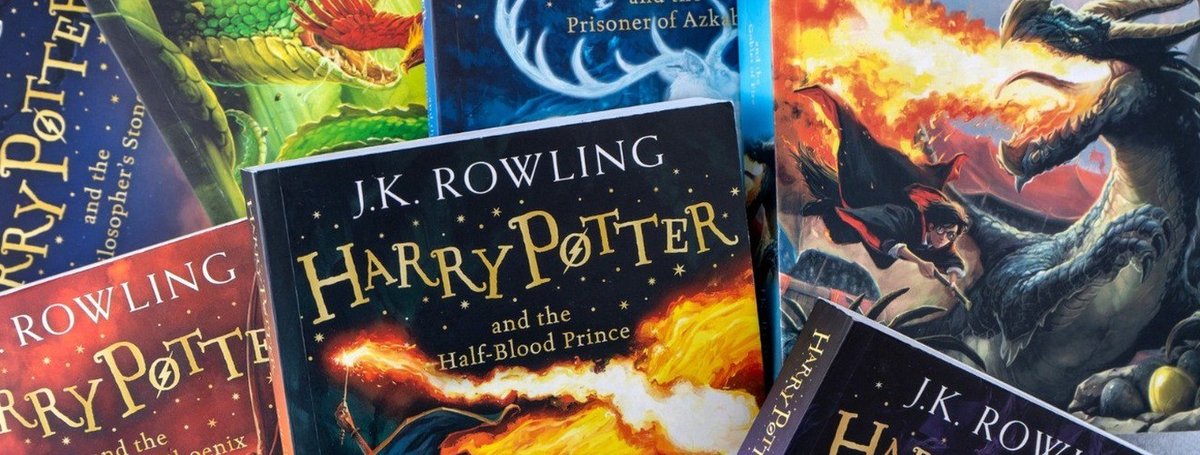
In June 1997 Bloomsbury printed 500 hardback copies of a first novel by an unknown author, and sent 300 of them straight to libraries. The name on the cover was not quite the author’s own. Her publisher, worried that a book by an obviously female author might not appeal to the young boys it was meant for, asked for initials, and so the world met J.K. Rowling. The initials stuck. The modest print run did not.
Seven novels made her famous, but Rowling’s own bibliography runs well past the seventh into stranger territory: two schoolbooks credited to authors who do not exist, a collection of wizarding fairy tales that began life as a handful of copies made by hand, the script of a two-part stage play, and three film screenplays. Put in the order they actually appeared, the list stops being the neat series of seven that most readers carry around in their heads. The textbooks turn up between Goblet of Fire and Order of the Phoenix, and the play arrives before the first of the screenplays.
That is the order used here, from the first Bloomsbury hardback to the last screenplay, with the British and American dates given wherever they part company. Along the way there is a stolen lorry, leaked pages, a hotel bust with the author’s handwriting on it, and one textbook that raised money for Comic Relief while pretending to belong to Harry. The books, it turns out, have had nearly as eventful a life as the boy in them.
J.K. Rowling has published 14 Wizarding World books, as of September 2026, according to her own official bibliography: the seven Harry Potter novels (1997-2007), three Hogwarts Library companion books, the Cursed Child play script, and three Fantastic Beasts screenplays (2016-2022). They are listed in order of first publication; editions and reissues are not counted separately.
Harry Potter and the Philosopher’s Stone

Thomas Taylor was 23 when he painted the cover for Harry Potter and the Philosopher’s Stone, a watercolour of Harry at the Hogwarts Express that took him two days. It sold at Sotheby’s London in 2001 for £85,750. On 26 June 2024 the same painting sold at Sotheby’s in New York for $1.9 million, then an auction record for a Harry Potter item. Not bad for two days’ work.
The novel underneath it was a harder sell. Other publishers had turned the manuscript down before Bloomsbury’s founder, Nigel Newton, paid Rowling an advance of £2,500, and the book reached British shops on 26 June 1997. In America, Arthur A. Levine of Scholastic came across it at the Bologna Children’s Book Fair in 1997, and Scholastic published it as Harry Potter and the Sorcerer’s Stone in September 1998, starting with just 50,000 copies. The American first edition’s own copyright page, confusingly, reads ‘First American edition, October 1998.’
The prizes began at once: the Nestle Smarties Gold Award in November 1997, then the British Book Awards’ Children’s Book of the Year in February 1998. Collectors, meanwhile, identify a true first UK printing partly by a mistake on the back cover, where the title is misspelled ‘Philospher’s.’ For once, the misprint is the selling point.
Harry Potter and the Chamber of Secrets

The most consequential object in the second book is a diary, and readers needed four more novels to understand why. Tom Riddle’s diary does its damage in Chamber of Secrets and is then quietly set aside, until Half-Blood Prince reveals that it had been one of the Horcruxes Voldemort created. Rarely has a plot device waited so patiently to be taken seriously.
Bloomsbury published the book on 2 July 1998. Scholastic followed on 2 June 1999, an 11-month wait that already looked short beside the first book’s, and printed 250,000 copies to begin with. The critics were quicker still. In December 1998 Chamber of Secrets won the Nestle Smarties Gold Award, making Rowling the first author to win that prize two years in a row, and in February 1999 it took the same British Book Awards children’s prize its predecessor had won.
The tally kept growing through 1999. In June the book took one of the inaugural Scottish Arts Council Children’s Book Awards and the Children’s Book Award, a prize decided by the votes of 60,000 children, which is about as unbribable as a jury gets. The paperback, in January 1999, came with a stunt that has aged rather well: a time capsule holding children’s predictions for the seventh book, which did not yet exist, was buried at King’s Cross station.
Harry Potter and the Prisoner of Azkaban

One vote. That was the margin by which the 1999 Whitbread judges, having already given Prisoner of Azkaban the children’s category, chose Seamus Heaney’s translation of Beowulf over it for the overall Book of the Year, 5-4. Publishers Weekly reported that Rowling’s book ‘had been widely expected to win, and would have been the first children’s book to do so.’ An Anglo-Saxon monster story beat a modern one, which at least kept the prize in the genre.
In the shops, the verdict had come in months earlier. Bloomsbury published the third book on 8 July 1999 and it went straight past Thomas Harris’s Hannibal to the top of the UK bestseller list. Scholastic’s edition followed on 8 September 1999, only two months behind, with a first print run of 500,000 copies. In December the Smarties Gold Award went to Rowling again, making her the first author to take that prize three years running.
The novel also changed the series’ furniture. Its closing chapters supply much of what readers know about the Animagi in Harry Potter canon, including the revelation that three of the four Marauders secretly taught themselves the transformation, unregistered, to keep their werewolf friend Remus Lupin company at the full moon. It is a remarkably sweet reason to break the law, and the Ministry, as usual, never noticed.
Harry Potter and the Goblet of Fire

On Saturday 8 July 2000, FedEx mobilised 100 of its regularly scheduled flights, 9,000 delivery staff and vehicles from 700 stations for a single novel. Their job was to bring 250,000 copies of Harry Potter and the Goblet of Fire to Amazon.com customers on publication day. Amazon had taken 350,020 advance orders for the book, its largest to that point, more than eight times the 40,000 it had logged for Prisoner of Azkaban.
This was the first of the novels to reach British and American shops on the same day, after the transatlantic gap had shrunk from well over a year to two months. Scholastic printed 3.8 million copies for the first US run, sold 3 million over the first weekend and went back to press for 3 million more. Publishers Weekly called it the fastest-selling book in history, and the book was also the longest yet, at 636 pages in the Bloomsbury first edition and 734 in Scholastic’s.
In 2001 it won the Hugo Award for Best Novel. Amazon’s founder, Jeff Bezos, marked the launch by saying, ‘As a simple Muggle, I am astounded at the huge number of pre-orders we received.’ His books general manager, Lyn Blake, went further: ‘Not since Santa Claus, the elves and the reindeer has one delivery made this many kids happy.’ The reindeer have not been asked for comment.
Fantastic Beasts and Where to Find Them

Neither the author nor the publisher of this book exists. Fantastic Beasts and Where to Find Them is credited to Newt Scamander and issued by Obscurus Books of 18a Diagon Alley, London, and it is presented as Harry’s own copy of a Hogwarts textbook, complete with a foreword by Albus Dumbledore and graffiti in the margins. Harry and Ron play hangman over the word ACROMANTULA, which Ron loses, and somebody has written ‘Harry loves Moaning Myrtle’ on the title page.
Rowling wrote it straight after Goblet of Fire, and has said the two short companion books ‘didn’t take long at all’ by comparison. Comic Relief had asked her for something; she could not choose between two ideas, so she wrote both. Fantastic Beasts and Quidditch Through the Ages were published together on 12 March 2001, and Rowling has said that over 80% of the cover price went to the charity. The first edition runs to just 42 numbered pages, plus front matter.
The entries are small encyclopaedias of the magical creatures of the Harry Potter books, with the occasional revelation about our own world. The Diricawl, for instance, is a plump, flightless bird that Muggles knew as the dodo and believe extinct, having never noticed that it can vanish at will. Newt later got a film series of his own. The textbook, fictional publisher and all, had already paid its way in real money.
Quidditch Through the Ages

‘Do not rip out the pages. Do not drop it in the bath.’ The warning comes from Albus Dumbledore, whose foreword presents Quidditch Through the Ages as the Hogwarts library’s own copy, prised from the librarian Madam Pince for the benefit of Muggle readers. The cover credits the book to Kennilworthy Whisp, a sportswriter who, like its publisher, Whizz Hard Books, was invented for the occasion.
It appeared on the same day as its companion, with the proceeds going to Comic Relief, and it runs to 56 pages in the American first edition. What Rowling produced is a straight-faced history of an imaginary sport, written with the solemnity of a county cricket almanac. The game, it explains, takes its name from Queerditch Marsh, where it was first recorded by an 11th-century Saxon witch called Gertie Keddle.
One chapter surveys the professional Quidditch teams of Britain and Ireland, from the all-female Holyhead Harpies to the Chudley Cannons, the side Ron Weasley supports. The Cannons last won the League in 1892. In 1972 they changed their club motto from ‘We shall conquer’ to ‘Let’s all just keep our fingers crossed and hope for the best,’ which is the most honest thing any sports club has ever printed.
Harry Potter and the Order of the Phoenix

Days before the fifth book went on sale, thieves drove off with a lorry full of it. The truck had been parked outside a warehouse on the Deacon Trading Estate in Newton-le-Willows, in northern England; police found it the next morning about 20 miles away, empty. Whoever took the books had, at least, excellent taste in cargo.
Harry Potter and the Order of the Phoenix was published in Britain and America on 21 June 2003, almost three years after Goblet of Fire and the longest wait between any two of the seven novels. Scholastic had printed a record 6.8 million copies for its first US run and still ran short, adding a second printing of 1.7 million and, on 24 June, a third of 800,000, which took the total to 9.3 million. The book sold an estimated 5 million US copies in its first 24 hours, and 11 million in its first 12 weeks.
The shortage produced its own small economy. One bookseller in the Midwest was offered warehouse-club copies at $15.39 each, declined, and sold her own for $23.99, while the Wal-Mart next door, which had been selling it for $17, ran out. Barbara Marcus, who ran Scholastic’s children’s publishing, tried to see past the logistics. ‘We are publishing a children’s book,’ she told Publishers Weekly, ‘and it’s a great children’s book.’
Harry Potter and the Half-Blood Prince

Seventy young fans were carried up to Edinburgh Castle in horse-drawn carriages to be among the first to hear the sixth book. At midnight on 16 July 2005, in an entrance hall dressed to look like Hogwarts, J.K. Rowling read them a passage from its sixth chapter. On the red carpet outside she had already promised, ‘You get a lot of answers in this book.’ It was not an exaggeration.
Across the Atlantic, more than 5,000 midnight parties were held in American shops. Scholastic’s opening print run was a then-record 10.8 million, and it ordered 2.7 million more as advance orders climbed, and the book sold 6.9 million copies in the United States in its first 24 hours. Bloomsbury and Scholastic published it on the same day, as they had every novel since Goblet of Fire, and for once the new book was shorter than the one before it.
A good deal of the story happens in the past. Dumbledore and Harry work through a series of memories viewed in the Pensieve, tracing Tom Riddle’s early life, and one of them, Riddle’s conversation with Professor Slughorn, finally explains what a Horcrux is. The book’s ending did the rest. Wizarding World’s own retrospective calls it ‘the death scene heard around the world,’ and notes that readers ‘had to wait two years to find out what happened next.’ Rowling’s promise of answers had, in fairness, said nothing about comfort.
Harry Potter and the Deathly Hallows

On 11 January 2007, in room 552 of Edinburgh’s Balmoral Hotel, J.K. Rowling finished writing the seventh Harry Potter novel and then did something most guests are asked not to do. She wrote on the statuary. Her message went on the marble bust of Hermes in the room: ‘J.K. Rowling finished writing Harry Potter and the Deathly Hallows in this room (552) on 11th Jan 2007.’ Few pieces of graffiti have been better received.
The book reached shops on 21 July 2007, though not everyone waited. Photographs of its pages circulated online weeks beforehand, and when the retailer DeepDiscount.com shipped copies early, Scholastic publicly asked the recipients to ‘keep the packages hidden until midnight on July 21.’ Scholastic’s first printing, 12 million copies, was another record. In the first 24 hours the book sold 8.3 million of them, which Guinness World Records recognised as the fastest-selling book of fiction in 24 hours, and Barnes & Noble alone sold 560,000 copies in its first hour.
Rowling signed 1,600 copies herself over the launch weekend. The novel ends with an epilogue called ‘Nineteen Years Later,’ set on Platform Nine and Three-Quarters as the next generation leaves for Hogwarts. Scholastic’s press release, which credited Lisa Holton, the head of its trade publishing, as ‘Chief Muggle,’ reached for the only comparison that seemed big enough: the weekend, she said, ‘was a bit like the Beatles’ first visit to the U.S.’
The Tales of Beedle the Bard

J.K. Rowling made the first copies of this book by hand, all seven of them. In 2007 she wrote out and illustrated The Tales of Beedle the Bard seven times, had each bound in brown morocco leather and set with semi-precious stones, and gave six to people closely involved with the Harry Potter books. The seventh went to auction for charity.
On 13 December 2007 it sold at Sotheby’s in London for £1.95 million, against an estimate of £30,000 to £50,000, and the buyer was Amazon.com. Guinness World Records recorded it as the most expensive children’s book sold at auction. The general edition followed on 4 December 2008, with its proceeds going to the Children’s High Level Group, the charity Rowling had co-founded and which was renamed Lumos in 2010. It collects five wizarding fairy tales, each followed by a commentary from Albus Dumbledore. One of them, The Tale of the Three Brothers, had already been told inside Deathly Hallows, where it supplies the legend of the Elder Wand. Of all the named wands in the series, that is the one the final novel is built around.
One of the six gifted copies went to Barry Cunningham, the editor who first accepted Harry Potter for publication. Rowling inscribed it: ‘To Barry, the man who thought an overlong novel about a boy wizard in glasses might just sell... THANK YOU.’ It sold at Sotheby’s for £368,750 in December 2016. He had been right about that, too.
Harry Potter and the Cursed Child – Parts One and Two

London’s Palace Theatre staged the play’s premiere on 30 July 2016, and the script followed it into the shops the next morning. The Special Rehearsal Edition of Harry Potter and the Cursed Child – Parts One and Two went on sale on 31 July 2016, which is also Harry’s birthday, and it picks up the story nineteen years after the Battle of Hogwarts, with Harry’s younger son, Albus Severus Potter, struggling under the weight of the family name.
A published script is not usually a publishing event. This one was. In its first three days on sale it sold more than 680,000 copies in Britain, BBC News reported, beating the 664,478 copies that Fifty Shades of Grey sold in a single week in 2012. Publishers Weekly reported that it topped Nielsen BookScan’s fiction chart for 2016 in America with 4.4 million copies sold that year, and Guinness World Records named it the best-selling playscript, with 9,237,886 copies sold worldwide by 7 November 2020, counting only the hardback and paperback.
The stage production kept pace. In 2017 it won a record-breaking nine Olivier Awards, including Best New Play and Best Director for John Tiffany. On Broadway it opened at the Lyric Theatre on 22 April 2018 and won six Tony Awards that year, among them Best Play, which Jack Thorne collected alongside the producers Sonia Friedman and Colin Callender.
Fantastic Beasts and Where to Find Them: The Original Screenplay

Cinemas got this story on 18 November 2016, and so did bookshops. It was J.K. Rowling’s first screenplay, and the book went on sale the day the film opened. Little, Brown published it in Britain and Scholastic in America, and Scholastic’s own description is admirably plain about what buyers were getting: ‘a published screenplay, not a traditional novel.’ It was the first of the screenplay books that followed the Fantastic Beasts films into print.
The title will look familiar. On the shop page its main title is word for word the same as the 2001 textbook’s, with The Original Screenplay carried underneath as a subtitle, which means this list contains two books with the same main title. The first was a Comic Relief textbook credited to a fictional magizoologist. The second took that invented author and gave him a story, sending Newt Scamander to 1920s New York, where the case full of magical creatures he carries goes missing and chaos follows.
It marked a change in what Rowling was publishing. harrypotter.com, announcing it in April 2016, called it ‘J.K. Rowling’s screenwriting debut,’ the first of her books written to be filmed rather than read. Of the two Fantastic Beasts books on this list, only this one has a plot.
Fantastic Beasts: The Crimes of Grindelwald – The Original Screenplay

French readers got it first. The Crimes of Grindelwald screenplay went on sale in Britain and America on 16 November 2018, but Gallimard’s French edition reached shops a day earlier, on 15 November.
Little, Brown published it in the UK and Scholastic in the US and Canada, and harrypotter.com unveiled what it called ‘the cover for the second Fantastic Beasts screenplay.’ The cover and the line art inside both came from the graphic design studio MinaLima, with what Little, Brown’s catalogue calls ‘some surprising nods to the Harry Potter stories that will delight fans of both the books and films.’ Scholastic’s American first edition runs to 287 pages, and the British and American editions carry different ISBNs but share the same on-sale date.
The story picks up Newt Scamander once more, as Albus Dumbledore enlists his former Hogwarts student to help thwart the plans of the dark wizard Gellert Grindelwald. It is the second of the Fantastic Beasts screenplays, arriving two years after Where to Find Them, and it kept that book’s subtitle, The Original Screenplay. It also kept its sole author. Rowling wrote it alone, as she had the first. The third would arrive with a co-writer’s name beside hers.
Fantastic Beasts: The Secrets of Dumbledore – The Complete Screenplay

Its film came first, by a distance. The Secrets of Dumbledore opened in British and Irish cinemas on 8 April 2022, and the book of the script followed only in July 2022, on a date that its own official sources do not quite agree on. harrypotter.com announced it as out on 18 July; Little, Brown’s catalogue gives 19 July.
It broke the pattern in other ways too. The subtitle changed from The Original Screenplay to The Complete Screenplay, and for the first time on a screenplay Rowling shared the writing credit: harrypotter.com states that ‘the screenplay is written by J.K. Rowling and Steve Kloves.’ Three houses published it, Little, Brown in Britain, Scholastic across North America and Pottermore Publishing for the ebook, and Scholastic’s edition runs to 304 pages, with bonus material drawing on the film’s designers, among them the costume designer Colleen Atwood and the studio MinaLima.
The story follows Albus Dumbledore as he entrusts Newt Scamander to lead what the publishers call ‘an intrepid team of wizards, witches, and one brave Muggle baker’ on a mission to stop Gellert Grindelwald seizing control of the wizarding world. It is the fourteenth title in Rowling’s official bibliography. Fourteen books in, a baker had finally made the team.
Frequently Asked Questions
How many copies have the Harry Potter books sold?
More than 600 million, according to J.K. Rowling’s official website, which says the books have been translated into 85 languages and calls them ‘the best-selling book series in history.’ Guinness World Records, using a Bloomsbury figure of more than 500 million from February 2018, lists Harry Potter as the best-selling book series for children.
Which Harry Potter book is the longest?
Order of the Phoenix is the longest of the seven novels, at 766 pages in Bloomsbury’s first edition and 870 in Scholastic’s. It also has the most chapters, 38. Half-Blood Prince and Deathly Hallows, oddly, share an identical length in their UK first editions: 607 pages each.
Why was Philosopher’s Stone renamed Sorcerer’s Stone in the US?
The change was made for Scholastic’s American edition of 1998 and, Rowling’s official site says, was suggested by her publisher. Rowling said in a 2001 Comic Relief web chat that she agreed but later regretted it: ‘it was my first book, and I was so grateful that anyone was publishing me I wanted to keep them happy.’
Did J.K. Rowling write Harry Potter and the Cursed Child?
Not alone. The script is credited as a new play by Jack Thorne, based on an original new story by J.K. Rowling, John Tiffany and Jack Thorne. Rowling includes it in her official bibliography, and both its UK publisher, Little, Brown, and harrypotter.com call it the eighth story in the Harry Potter series.
How many words are in the Harry Potter books?
The seven novels contain 1,100,086 words, according to harrypotter.com, which published the total on 1 February 2018. The figure covers only the seven novels, with no per-book breakdown, and leaves out the companion books, the Cursed Child script and the screenplays.
Why aren’t Pottermore Presents or the Harry Potter prequel included?
Neither appears on Rowling’s own list of her Wizarding World books. Pottermore Presents was three ebook-only collections published on 6 September 2016, gathering writing from the Pottermore website along with some new work. The prequel was an untitled story of about 800 words, handwritten on a card for a 2008 charity auction, where it sold for £25,000.
Do the illustrated editions count as separate books?
No. Editions count once, as the work they reprint: Jim Kay’s illustrated editions, which began with Philosopher’s Stone on 6 October 2015; the 2017 edition of Fantastic Beasts with six new creatures; and the Cursed Child Definitive Collector’s Edition of 25 July 2017. Harry Potter: A History of Magic, the British Library’s 2017 exhibition book, is not Rowling’s.
- J.K. Rowling – Writing (official bibliography)
- Scholastic – Harry Potter Highlights and Milestones
- Harry Potter (harrypotter.com) – 500 million Harry Potter books have now been sold worldwide
- Guinness World Records – Most expensive children’s book sold at auction
- Sotheby’s – Handwritten copy of J.K. Rowling’s The Tales of Beedle the Bard
- Publishers Weekly – Order of the Phoenix debut smashes records
- Amazon press release – Day-of-launch delivery of Harry Potter and the Goblet of Fire (July 2000)
- BBC News – Cursed Child is fastest-selling UK book this decade