Every Tom Brady Super Bowl Touchdown Pass
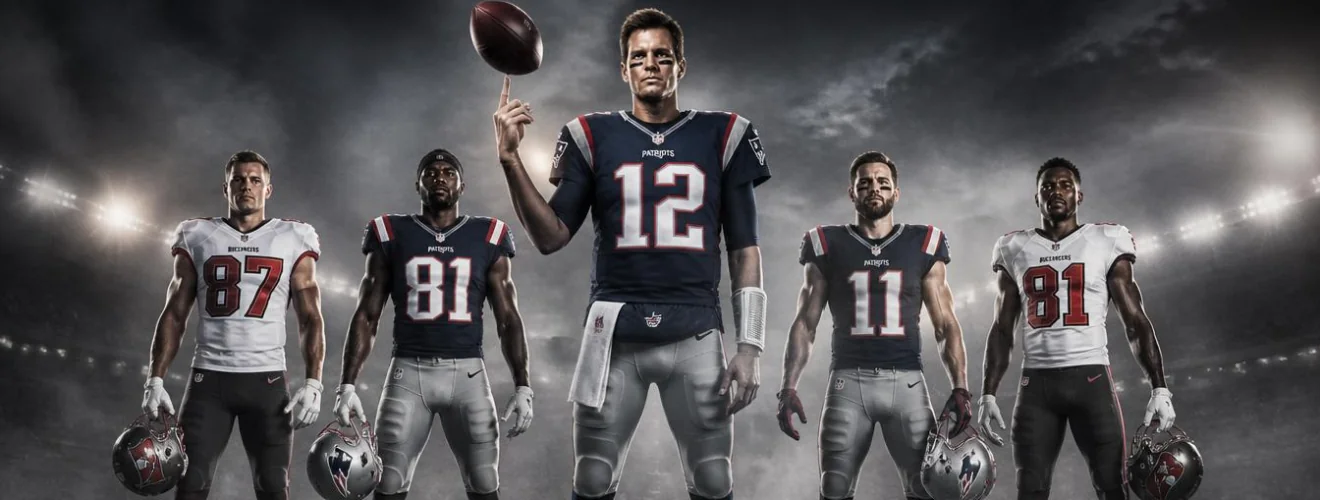
Tom Brady won the Super Bowl seven times, which is more than any NFL franchise has managed. The Patriots and the Steelers have six apiece. Everyone else is chasing a man who was drafted 199th.
The popular memory of those games is all deep balls and drama, but the ledger tells a stubbier story. Sixteen of the touchdown passes Brady threw in Super Bowls traveled ten yards or fewer, and not one of them covered thirty. Laid end to end, the entire collection comes to 159 yards – a championship career built almost exclusively from point-blank range, one patient drive at a time.
What follows is every one of those throws, first to last, in the order they left his hand – who caught them, what the moment demanded, and the strange specific details the box scores leave out.
Tom Brady threw 21 touchdown passes in Super Bowl play, more than any other quarterback in NFL history. The throws span his 10 Super Bowl appearances, from February 2002 with New England to February 2021 with Tampa Bay, and were caught by 12 different receivers.
David Patten – 8 Yards, Super Bowl XXXVI
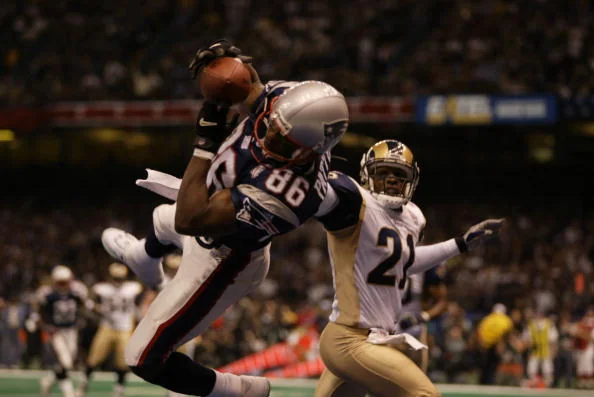
The first man to catch a Super Bowl touchdown pass from Tom Brady spent the fall of 1996 loading coffee beans onto trucks. David Patten had gone undrafted out of Western Carolina that spring, and while he waited for professional football to notice him he worked as an electrician and a landscaper, with a brief stop at the Albany Firebirds of the Arena League. The New York Giants signed him in 1997. The Patriots signed him in 2001, and that October, against the Colts, he ran for a touchdown, caught one, and threw a third – the first NFL player to manage all three in a game since Walter Payton in 1979.
His Super Bowl moment came on February 3, 2002, against the St. Louis offense known as the Greatest Show on Turf. With 36 seconds left in the first half, Brady found him at the back pylon from 8 yards out for a 14-3 lead. It was the only touchdown pass Brady threw that night, and the Patriots needed every point of it in a 20-17 win.
Patten won three rings in New England, retired, and became a preacher in South Carolina, where he founded his own ministry. He died on September 2, 2021, in a motorcycle crash near Columbia, at 47.
Deion Branch – 5 Yards, Super Bowl XXXVIII
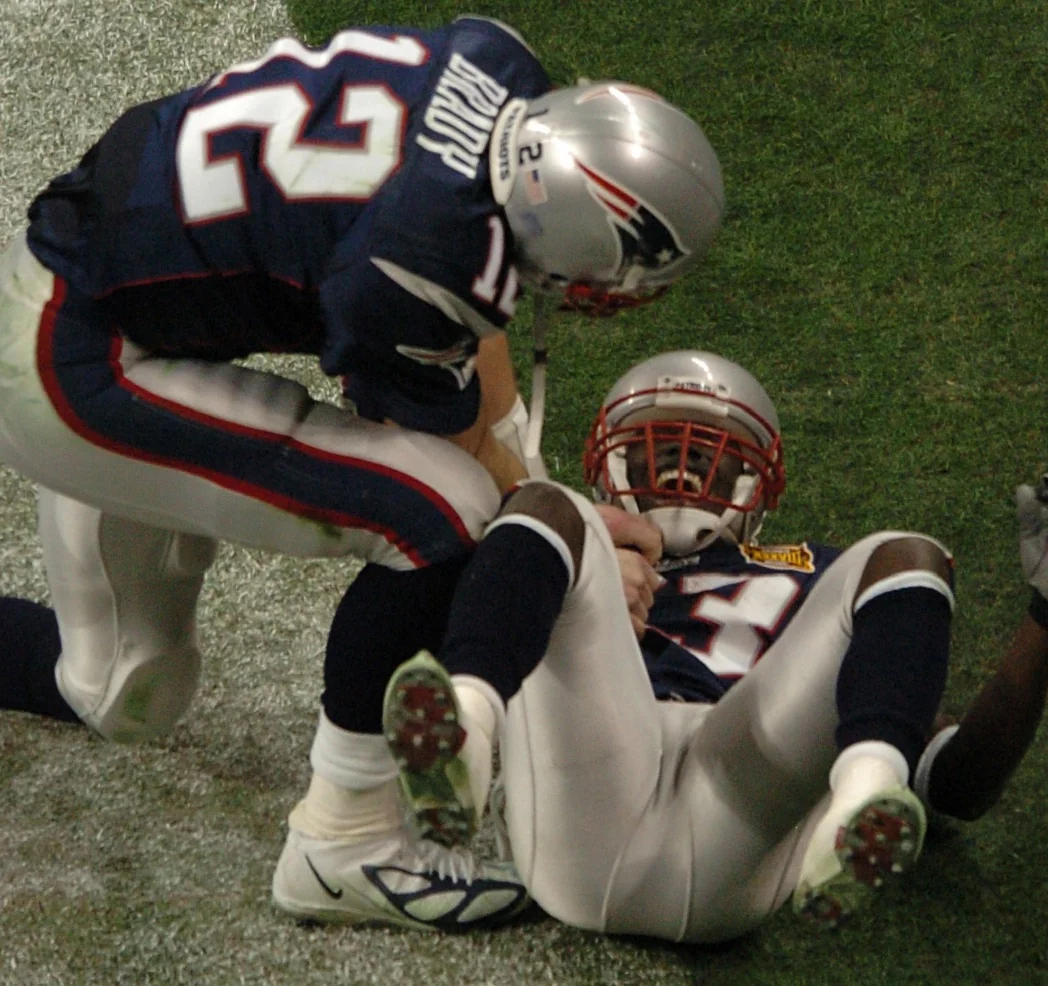
Nobody scored for 26 minutes and 55 seconds, the longest anyone has ever waited for points in a Super Bowl. Adam Vinatieri missed one field goal and had a second blocked, and the game seemed determined to stay at nothing-nothing forever. Then Jake Delhomme fumbled at his own 20. Three plays later Tom Brady scrambled 12 yards to the Carolina 5, and on the next snap he faked a handoff to Antowain Smith. Linebacker Dan Morgan bought the fake completely, Deion Branch drifted open behind him, and the game’s first points arrived with 3:05 left in the half.
The scoring, once it started, refused to stop. The teams packed 24 points into the last three minutes of the half and a record 37 into the fourth quarter, and the Patriots needed a field goal with four seconds left to win 32-29.
Branch was the engine of that offense – a second-year receiver from Louisville who led the team with 803 receiving yards in 2003. His stranger distinction came twelve months later, when he was named MVP of the next Super Bowl with 11 catches and 133 yards despite never reaching the end zone. Only Joe Namath and Fred Biletnikoff had ever won the award without scoring or throwing a touchdown. Branch made it three.
David Givens – 5 Yards, Super Bowl XXXVIII
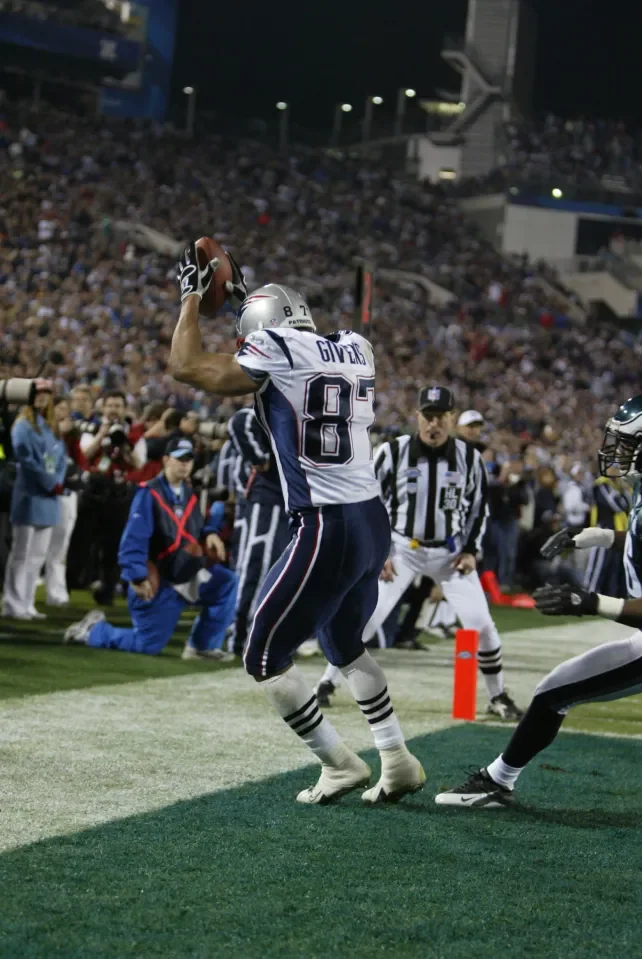
The best throw on this drive was not the touchdown. Carolina had just tied the game at 7-7 with 1:07 to play in the half, and the sensible move was to kneel out the clock. Instead Brady hit David Givens for 12, then dropped a 52-yard rope onto Deion Branch at the Carolina 24. Three plays later Givens gathered in a 5-yard touchdown with 18 seconds left, and the Patriots carried a 14-7 lead into a locker room still processing what had happened to the defensive struggle everyone had been promised.
Givens was a seventh-round pick from Notre Dame, taken 253rd overall in 2002, and he was only starting because the man ahead of him had broken down. Notre Dame had used him mostly at running back. He spent the season as the emergency replacement for an injured David Patten and turned the assignment into 510 yards and a team-leading six touchdown catches.
Kasay answered with a 50-yard field goal as the half expired, trimming it to 14-10 and completing a stretch in which the game had gone from comatose to unhinged without pausing anywhere in between. The man Givens spent 2003 replacing had caught the previous touchdown on this list. Patten watched this one from injured reserve.
Mike Vrabel – 1 Yard, Super Bowl XXXVIII
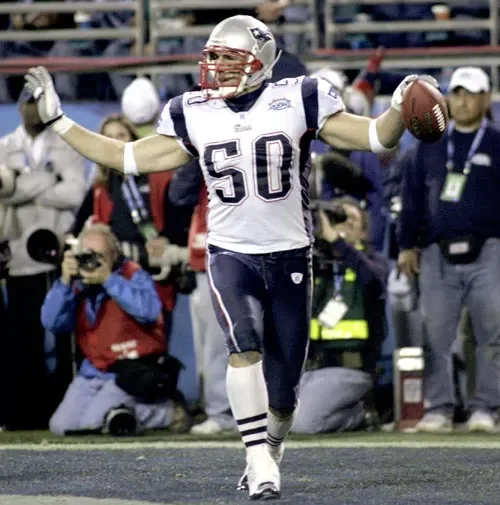
With 2:51 to play and Carolina in front 22-21, the Patriots faced third-and-goal at the 1 and sent on a linebacker. Mike Vrabel had spent the evening tormenting Jake Delhomme – two sacks, plus the forced fumble that gift-wrapped New England’s opening score – and now he reported as an eligible tight end, leaked into the end zone, and caught the touchdown that put the Patriots back in front.
Only one defensive player had scored an offensive touchdown in a Super Bowl before him: William “The Refrigerator” Perry, for the 1985 Bears, against these very Patriots. It had taken New England eighteen years to return the compliment.
The conversion that followed was its own little heist. Kevin Faulk took a direct snap and ran in the two points that made it 29-22 – the only points, as it happens, Faulk scored during the entire 2003 season, a year in which he piled up more than a thousand combined yards from scrimmage. Ricky Proehl tied the game with 1:08 remaining, exactly as he had done to these Patriots in the Super Bowl two years earlier, and Adam Vinatieri had the final word. A man paid to stop touchdowns had caught the go-ahead score in a Super Bowl. He would shortly make a habit of it.
David Givens – 4 Yards, Super Bowl XXXIX
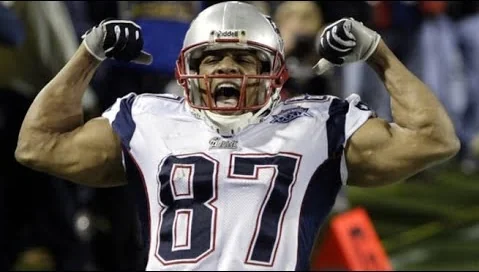
A 29-yard punt is a small catastrophe, and Dirk Johnson’s shank late in the second quarter handed New England the ball at the Philadelphia 37. Seven plays later David Givens stood in the corner of the end zone with the football and a decision to make. He chose to celebrate his 4-yard touchdown by flapping his arms – the signature move of Eagles receiver Terrell Owens, performed in front of Owens’ own crowd. Owens, playing weeks after leg surgery, would finish with 122 receiving yards, so the taunt took a certain amount of nerve.
The score, with 1:10 left in the half, made it 7-7, and 7-7 is how the half ended – only the second halftime tie in Super Bowl history, and the first time both of a Super Bowl’s opening quarters had finished level. The game was still tied, at 14, entering the fourth quarter. That was a first too.
The touchdown also extended a streak that has aged remarkably well. Starting with the AFC Championship Game in January 2004, Givens scored in seven consecutive playoff games – the second-longest run in NFL postseason history – and he left New England holding the franchise record for postseason touchdown catches. It stood until January 2016, when it was taken from him by a tight end who appears five times later in this list.
Mike Vrabel – 2 Yards, Super Bowl XXXIX
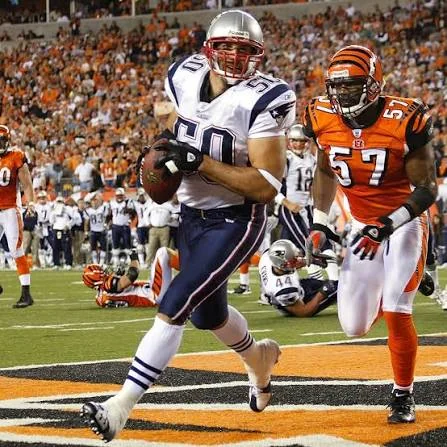
The Eagles had a full year of film on this exact routine, and it did not help them. On the opening drive of the second half, with the score tied 7-7, New England moved 60 yards in nine plays, most of it through Deion Branch, who caught four passes along the way. At the goal line, out came Vrabel again, reporting eligible at tight end for the second Super Bowl running. Jevon Kearse grabbed a fistful of him. Vrabel caught the 2-yard touchdown anyway, and the photograph of him hauling it in while being openly held ended up on the cover of the 2005 NFL Record and Fact Book, which is about as institutional as immortality gets.
Vrabel’s receiving career deserves its own display case. He was thrown 16 passes in his NFL life and caught 12 of them, and all 12 went for touchdowns – short scores collected at the goal line across a decade, including two from Matt Cassel after he moved on to Kansas City. Scott Pioli, the Patriots’ personnel chief, said years later that Vrabel tried to have the pass-catching written into his contract, on the grounds that it ought to be worth money.
It never was. He settled for three rings and, eventually, the Patriots’ head coaching job.
Randy Moss – 6 Yards, Super Bowl XLII
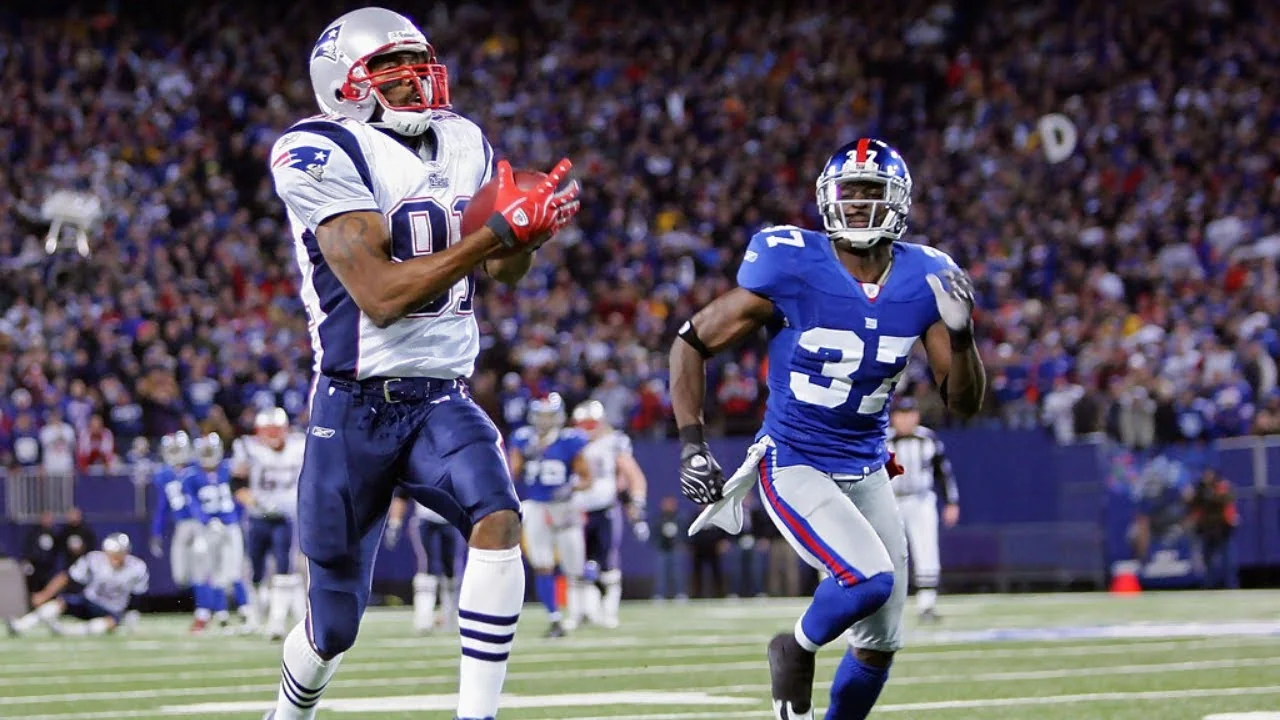
The Patriots arrived in Glendale with eighteen wins, no losses, and the two gaudiest passing seasons ever produced by one huddle: Tom Brady had thrown a record 50 touchdown passes, and Randy Moss had caught a record 23 of them. Then the Giants’ pass rush spent three and a half quarters dismantling all of it, and the highest-scoring offense in league history found itself trailing 10-7 with under eight minutes to play.
The answer was a 12-play, 80-yard drive of almost deliberate modesty – Brady went 8 of 11 on it and completed nothing longer than 13 yards – and it ended on third-and-goal with Moss beating single coverage in the corner, six yards, 14-10, with 2:42 on the clock. A perfect season sat one defensive stop away.
The stop never came. David Tyree pinned a football to his helmet, Plaxico Burress scored from 13 yards with 35 seconds left, and the fourth quarter finished with a Super Bowl record three lead changes. The Moss touchdown had held up for exactly two minutes and seven seconds. New England’s last two passes of the entire season, on third-and-20 and fourth-and-20, were both launched deep in Moss’s direction. Neither one came down. The perfect season died at 18-1.
Danny Woodhead – 4 Yards, Super Bowl XLVI
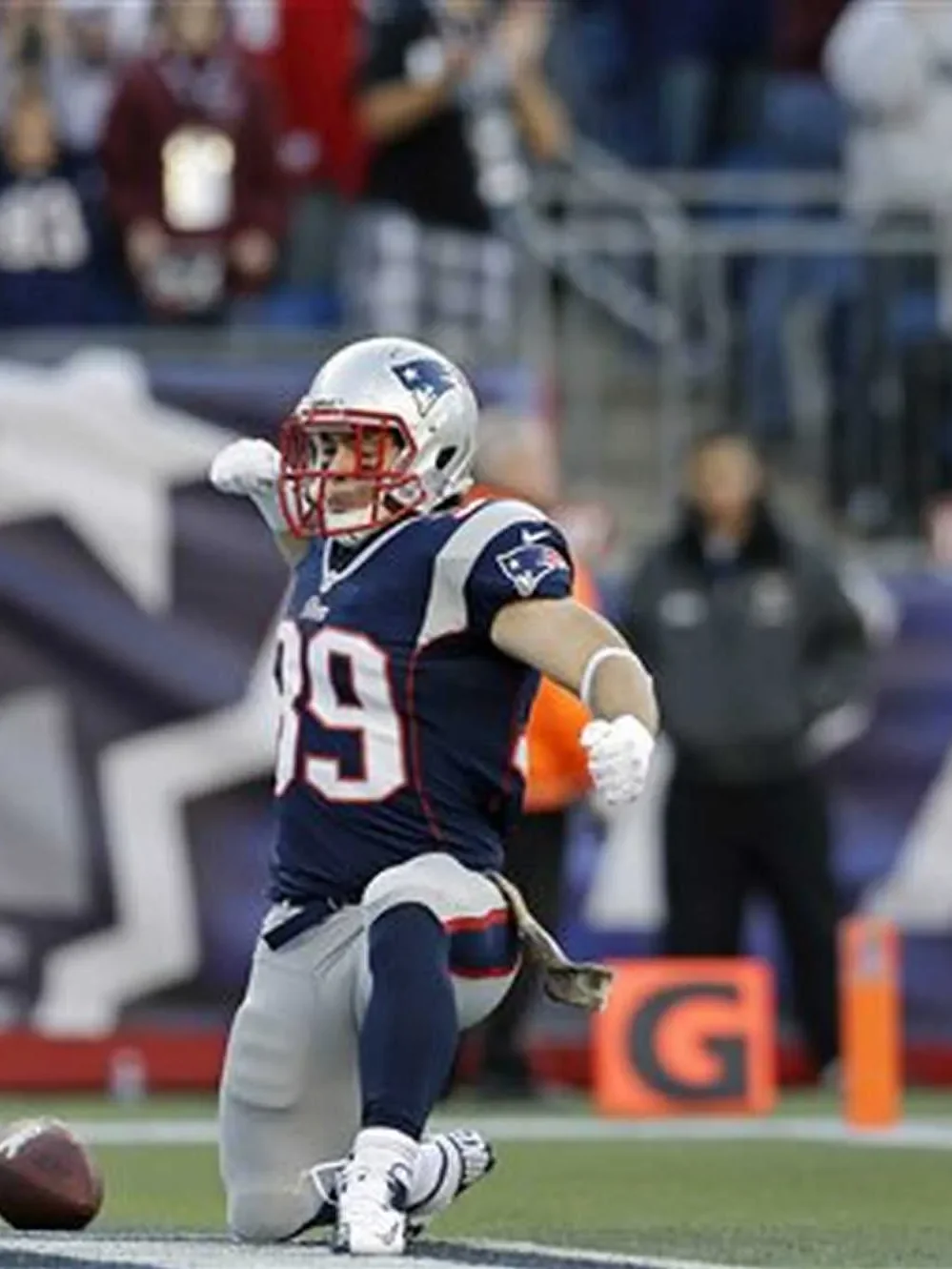
Danny Woodhead was the first player in Chadron State’s 96-year history to be offered a full football scholarship, and he repaid the Division II school by becoming the leading rusher in the history of all of college football – 7,962 yards, two Harlon Hill Trophies, and no invitation whatsoever to the NFL scouting combine. He went undrafted in 2008 and signed with the Jets, who released him in September 2010. The Patriots signed him four days later.
A season and a half on, he was in the Super Bowl, and the evening had begun about as badly as an evening can. Brady’s first pass of the game, thrown from his own end zone under pressure, was flagged for intentional grounding – a safety, two points for the Giants, before anyone had settled into their seats. By late in the second quarter New England trailed 9-3 and was pinned at its own 4-yard line.
What followed tied the record for the longest touchdown drive in Super Bowl history: 96 yards in 14 plays, Brady a perfect 10 for 10 for 98 of them, finished by a 4-yard flip over the middle to Woodhead with 15 seconds left in the half. The Patriots led 10-9. Brady’s first throw of the night had cost his team two points in his own end zone. His last one of the half was this.
Aaron Hernandez – 12 Yards, Super Bowl XLVI
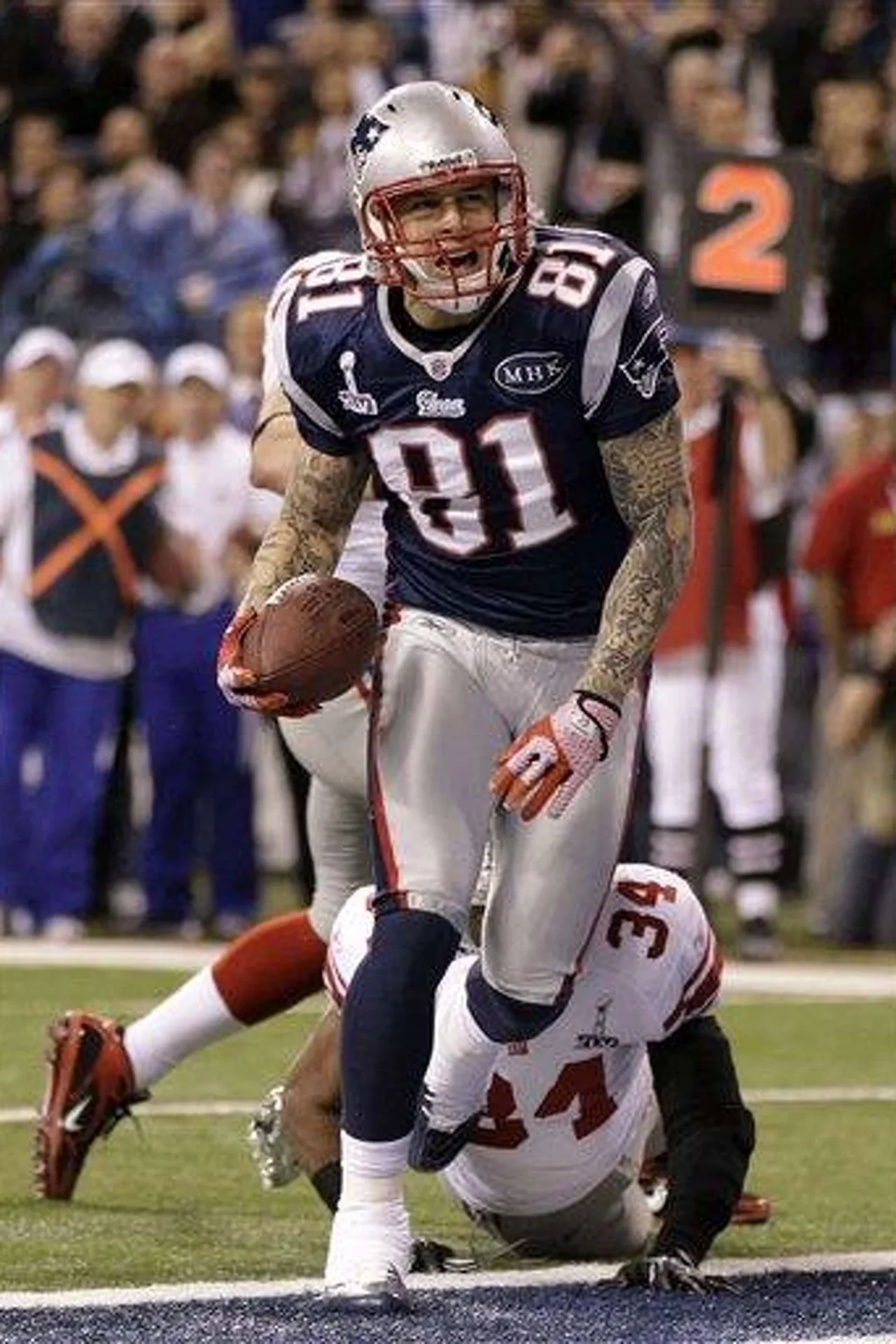
The 2011 Patriots built their offense around two tight ends, and for a season it looked like the future of football. Rob Gronkowski set the position’s records with 1,327 receiving yards and 17 touchdown catches; Aaron Hernandez added 79 catches, 910 yards, and seven scores; together they became the first tight end pair to produce five touchdowns apiece in consecutive seasons for the same team. Hernandez was 22, a fourth-round pick out of Florida who moved like a wide receiver.
His touchdown came on the first drive of the third quarter, with New England protecting a 10-9 lead. Brady was in the middle of a run of 16 consecutive completions, a Super Bowl record at the time, and the 12-yard throw over the middle to Hernandez stretched the lead to 17-9. It was the high-water mark of the night. The Giants scored the game’s final 12 points, and New England never led again.
Six months later the Patriots gave Hernandez a five-year extension worth up to $40 million. In June 2013 he was arrested for the murder of Odin Lloyd, a semi-professional player who was dating the sister of his fiancee, and the Patriots released him within two hours. He was convicted of first-degree murder in April 2015 and sentenced to life without parole. On April 19, 2017, he died by suicide in his prison cell, at 27. Researchers later found the most severe CTE ever documented in a person his age.
Brandon LaFell – 11 Yards, Super Bowl XLIX
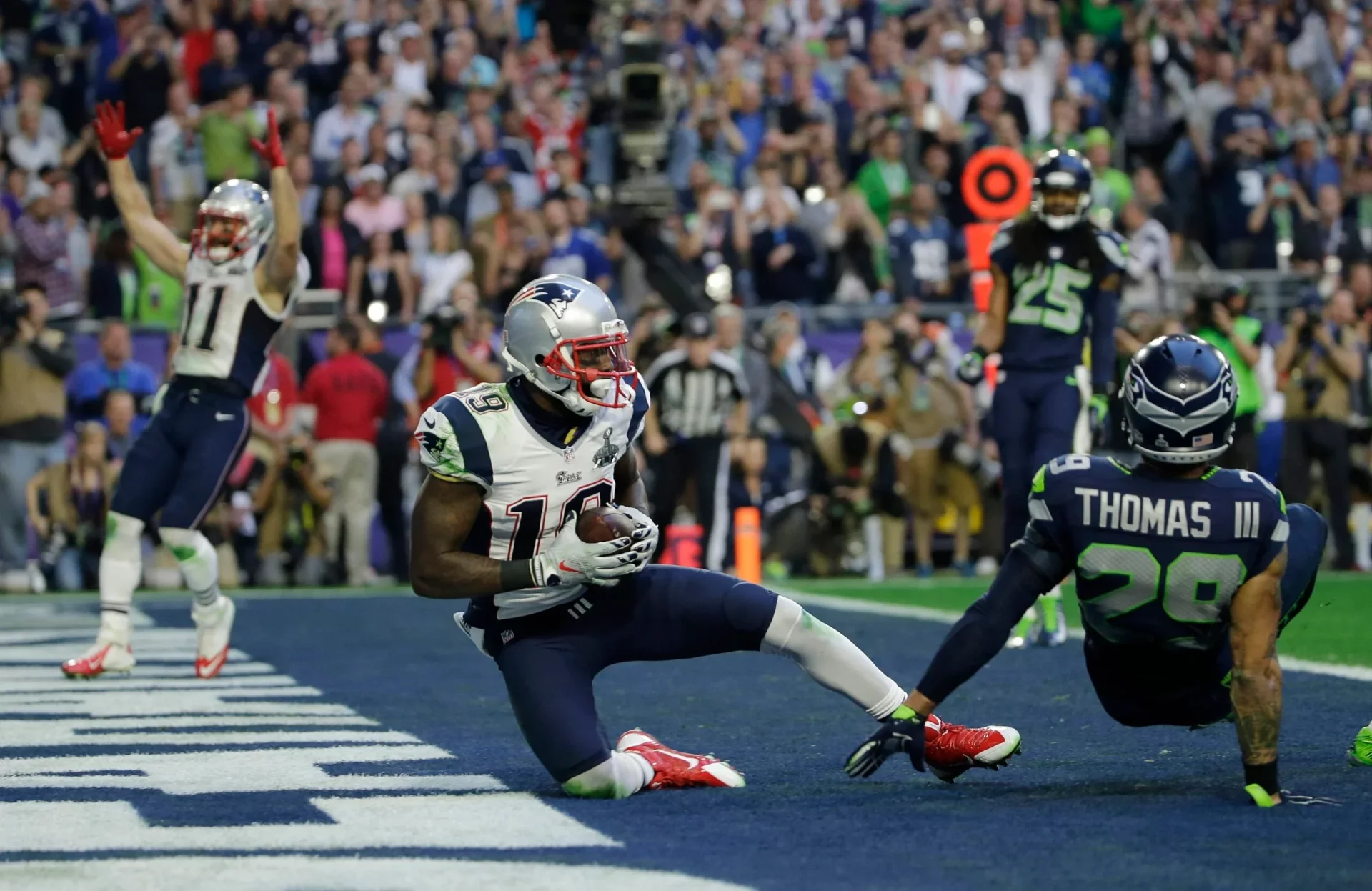
The play that shaped Super Bowl XLIX was an interception. Late in the first quarter Brady forced a throw at the goal line, and Seattle’s Jeremy Lane picked it off for the first interception of his career – then broke his wrist and tore a knee ligament on the return tackle and never came back. His replacement at corner was Tharold Simon, and Brady spent the rest of the evening treating Simon the way water treats a crack.
The first result arrived early in the second quarter of a game that was still scoreless. New England went 65 yards in nine plays, converting a third-and-9 with a 23-yard throw at Simon’s man, Julian Edelman, and finishing with an 11-yard touchdown to Brandon LaFell, also lined up across from Simon. 7-0.
LaFell was a free-agent bargain – three years and $9 million, signed away from Carolina the previous March – and 2014 was the season of his life: 74 catches, 953 yards, seven touchdowns, plus the go-ahead score against Baltimore in the divisional round with the Patriots trailing by three. Thirteen months after the Super Bowl, New England released him, which is roughly how that team worked. Brady, meanwhile, had filed the Simon matchup away. He would need it again in the fourth quarter.
Rob Gronkowski – 22 Yards, Super Bowl XLIX
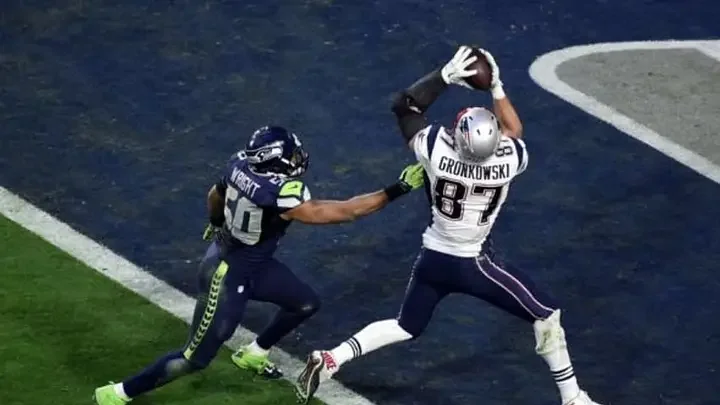
Seattle’s plan for Rob Gronkowski involved covering him with a linebacker, which by 2015 amounted to a dare. Gronkowski had just finished a season of 82 catches, 1,124 yards, and 12 touchdowns, and when Marshawn Lynch’s 3-yard run tied the game at 7 with 2:16 left in the half, Brady went looking for the mismatch.
The answer took eight plays, 80 yards, and one minute and 45 seconds. Shane Vereen converted twice underneath, and then Brady found Gronkowski running away from linebacker K.J. Wright down the right side for a 22-yard touchdown with 31 seconds on the clock. It was Brady’s longest scoring throw of the night by half, and it should have sent New England to the locker room in front.
Instead Seattle produced one of the odder sequences in Super Bowl history. Chris Matthews – a receiver with no catches in the entire regular season – had already set up Lynch’s touchdown with a 44-yard grab, the first reception of his NFL career. Now, with six seconds left, the Seahawks passed up a field goal, and Russell Wilson hit Matthews for an 11-yard touchdown. 14-14. Seattle never really solved Gronkowski, and in the game’s final seconds Bruce Irvin was ejected for punching him – the first ejection in Super Bowl history. Covering the man did strange things to people.
Danny Amendola – 4 Yards, Super Bowl XLIX
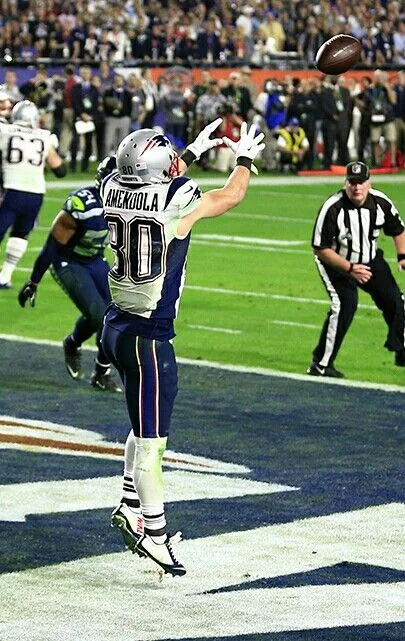
No team had ever entered the fourth quarter of a Super Bowl trailing by ten points and won it. Seattle led 24-14 after three, courtesy of a Doug Baldwin touchdown, and the Patriots’ response was a nine-play, 68-yard drive that Brady steered almost single-handedly, going 5 of 7 for 60 of the yards and finishing with a 4-yard fade that Danny Amendola caught in front of Earl Thomas. 24-21.
The throw carried some history. It was Brady’s 12th career Super Bowl scoring throw, one more than Joe Montana, whose record of 11 had stood for a quarter of a century. Montana compiled his in four Super Bowls. Brady broke the record midway through his sixth, pushed it to 13 before the night was over, and kept going for years. The final total sits at the top of this page.
Amendola held a thankless job. New England signed him from the Rams in 2013 to replace Wes Welker, the most productive slot receiver of his era, and he spent years being measured against a man whose volume he was never asked to supply. But Welker played in two Super Bowls without catching a touchdown. Amendola caught one in each of his next two.
Julian Edelman – 3 Yards, Super Bowl XLIX
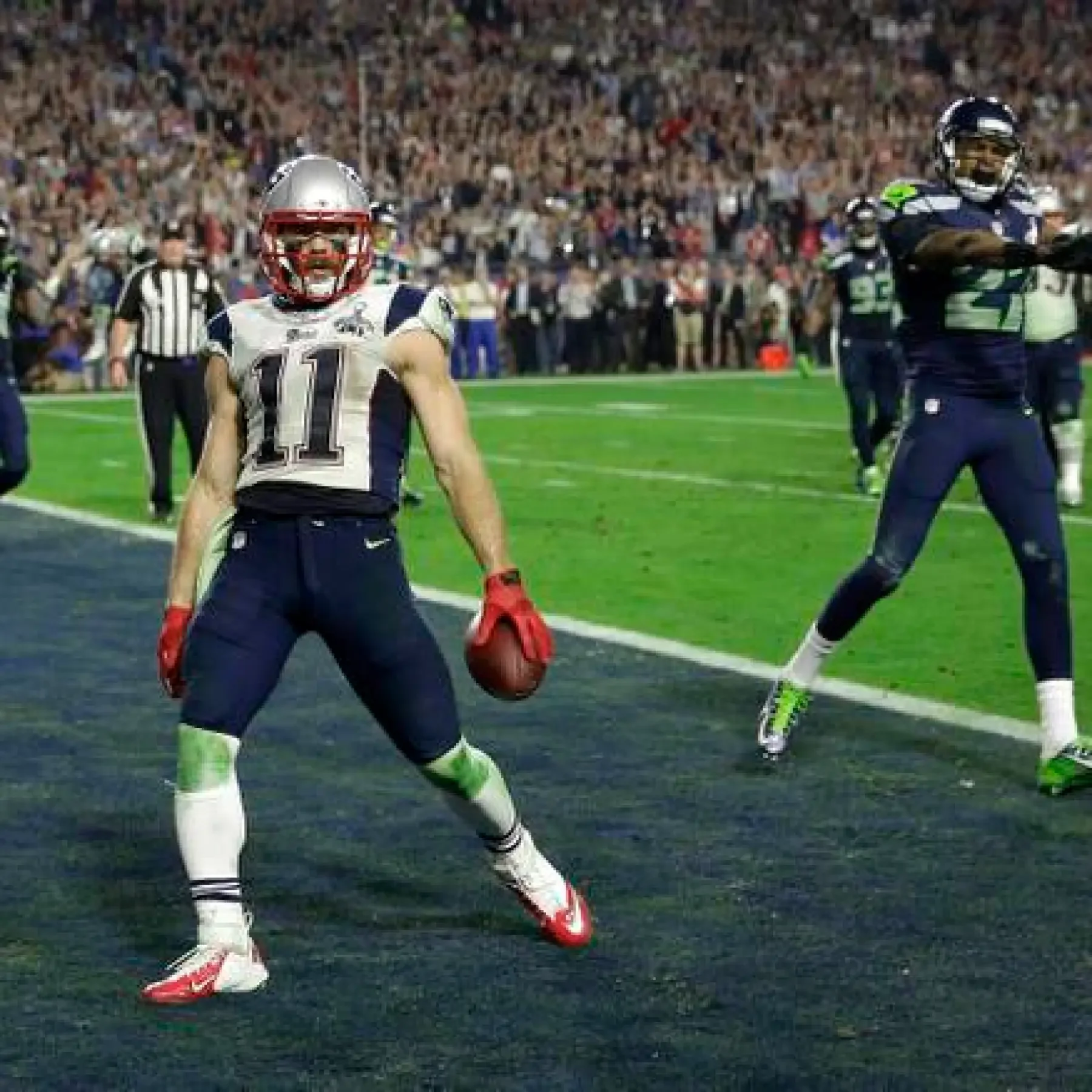
The man who caught the winning touchdown of Super Bowl XLIX should, by any sensible reading, have been in the medical tent. Midway through the fourth quarter Julian Edelman took a helmet-to-helmet hit from Kam Chancellor and got up visibly scrambled – a league medical observer was overheard on the radio, twice, saying Edelman needed to be examined. He was never removed. Two possessions later he was still out there, which is either a testament to toughness or an indictment of the system, depending on your seat.
The winning drive began at the New England 32 with 6:52 to play. Brady went 8 for 8 on it, for 65 yards, the last three of them to Edelman – who had lined up, one more time, across from Tharold Simon, the backup corner Brady had been picking on all night. 28-24 with about two minutes left. Brady finished 37 of 50, a Super Bowl record for completions.
Seattle nearly took it all back. Jermaine Kearse hauled in a tipped ball while lying on the ground for 33 yards, and the Seahawks reached the 1-yard line with the clock draining. Then they threw a slant, and Malcolm Butler, a rookie cornerback, jumped it at the goal line. Edelman finished with nine catches, 109 yards, a ring, and a leading role in the league’s long argument with itself about head injuries.
James White – 5 Yards, Super Bowl LI
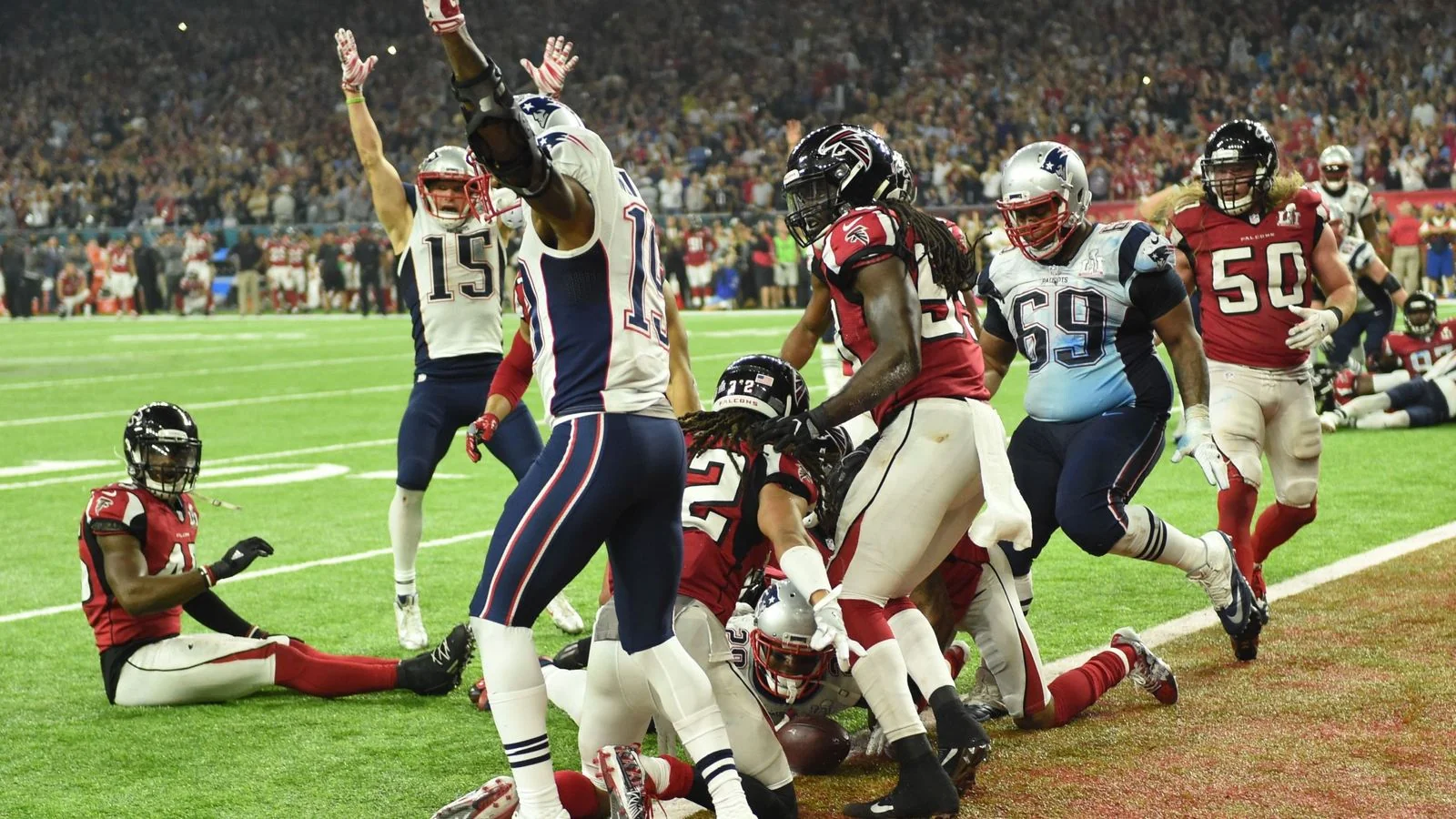
James White spent the Patriots’ previous Super Bowl win in street clothes, a rookie left off the game-day roster. Two years later, in Houston, he put together the greatest statistical night any running back has had on that stage – and most of it happened with his team in a state of emergency.
Atlanta led 28-3 midway through the third quarter, a score that has since become cultural shorthand for disaster. The response drive took 12 plays and more than six minutes, survived a fourth-and-3 thanks to a 17-yard Brady throw to Danny Amendola, and ended with White curling out of the backfield for a 5-yard touchdown with 2:06 left in the quarter. Stephen Gostkowski then missed the extra point. The comeback everything now gets measured against began, in other words, at 28-9, with a shank.
White simply never stopped. He finished with 14 catches, a Super Bowl record; 110 receiving yards; three touchdowns, tying the record; and 20 points, breaking the record for a single player. A fourth-round pick from Wisconsin, drafted 130th in 2014, he ended the night with the 2-yard run in overtime that won it – the first overtime touchdown in Super Bowl history. Not a bad line for a man who, at the previous one of these, couldn’t get dressed.
Danny Amendola – 6 Yards, Super Bowl LI
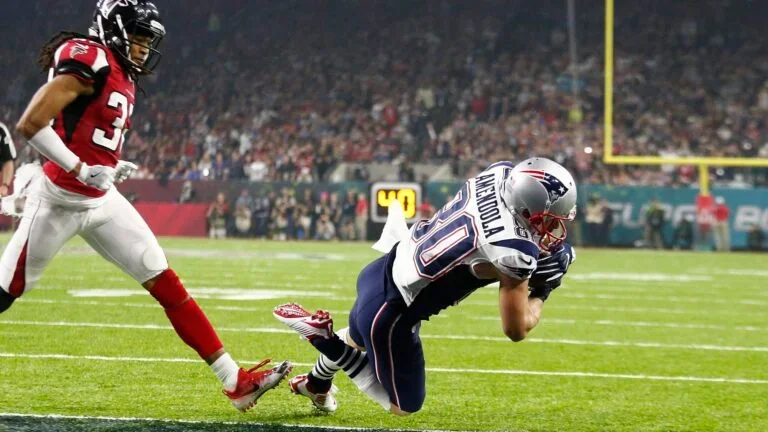
Dont’a Hightower came around the edge untouched, and the whole night pivoted. Matt Ryan, facing third-and-1 with a two-score lead and under nine minutes to play, chose to pass; Hightower hit him blind-side, the ball came loose, and Alan Branch fell on it at the Atlanta 25. Five plays later Brady flicked a 6-yard touchdown to Danny Amendola, James White ran the conversion up the middle, and a game that had been a coronation was suddenly 28-20 with 5:56 on the clock.
Atlanta still had the ball, a lead, and Julio Jones, whose sideline catch at the New England 22 should have ended everything. A sack and a holding penalty pushed the Falcons back out of field goal range instead, and Matt Bosher’s punt pinned the Patriots at their own 9 with 3:40 to go. The tying drive covered 91 yards, and its final act belonged to Amendola again: after White’s touchdown run, Amendola caught the two-point conversion that made it 28-28 with 57 seconds left.
The 25-point hole New England climbed out of remains the deepest any team has escaped in a Super Bowl. Amendola’s evening amounted to eight points – a touchdown and a conversion. Every one of them was required.
Rob Gronkowski – 5 Yards, Super Bowl LII
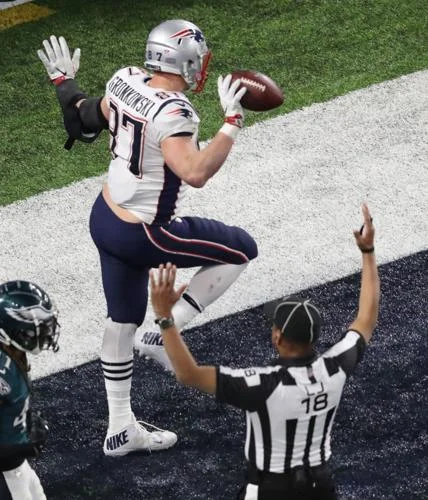
Two weeks before the game, Rob Gronkowski was in the league’s concussion protocol after a hit in the AFC Championship against Jacksonville, and his availability for the Super Bowl was a genuine question for much of the buildup. He then spent the first half doing very little – one catch, nine yards – while Nick Foles and the Eagles built a 22-12 halftime lead.
The second half opened with a correction. New England took the kickoff and went 75 yards in eight plays and 2 minutes 45 seconds, and Gronkowski was the entire argument: four catches for 68 yards on the drive, the last a 5-yard touchdown that cut the lead to 22-19. It was less a scheme than a decision – throw it to the enormous man until somebody stops him – and Philadelphia never really did. He finished the night with nine catches for 116 yards, and Danny Amendola, working underneath him, added 152 more.
There is a strain of Super Bowl story in which the team’s best receiver is doubtful all week and delivers anyway, and Gronkowski’s night belongs to it, with one qualification: he delivered twice, and New England lost all the same. The second touchdown appears two entries from here.
Chris Hogan – 26 Yards, Super Bowl LII
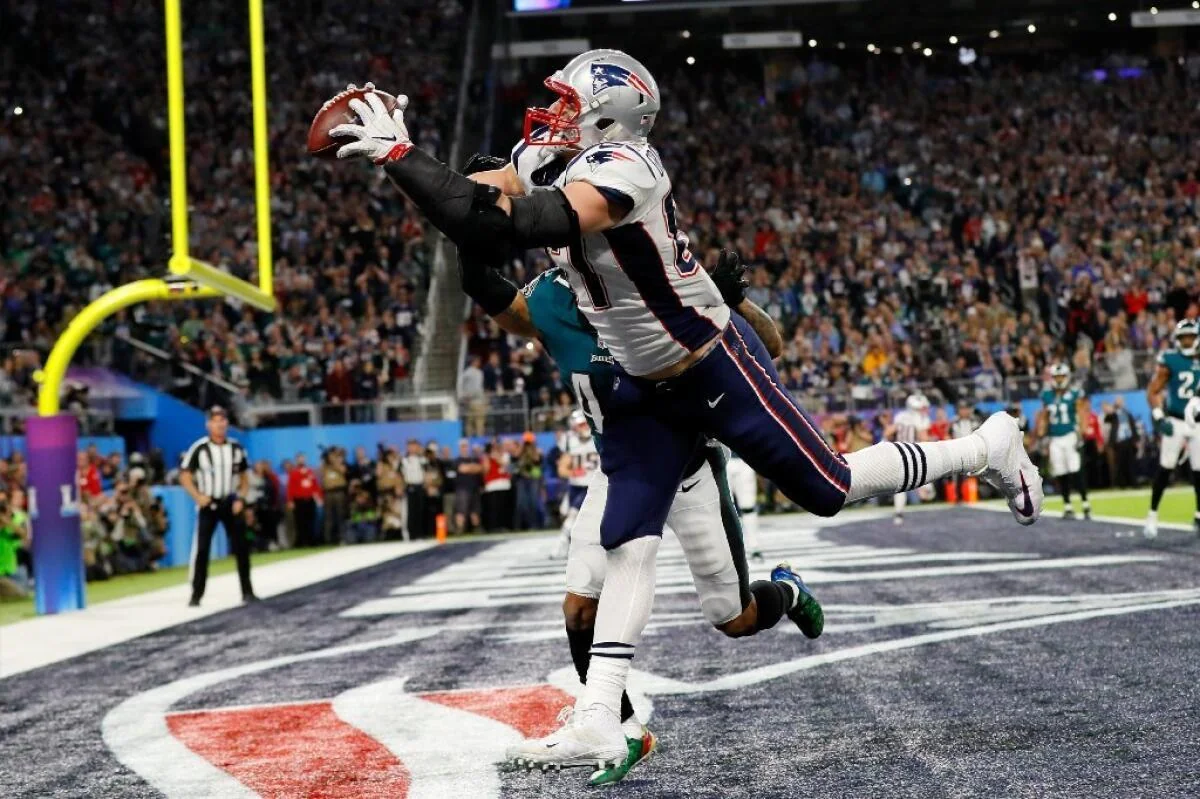
The man who caught the longest touchdown of Brady’s Super Bowl career spent his college years playing lacrosse. Chris Hogan was a midfielder at Penn State – 57 goals, a degree, no football – and used a leftover year of eligibility to catch 12 passes for Monmouth in 2010. Three NFL teams cut him in his first two years as a pro. On the Dolphins’ practice squad he picked up the nickname 7-Eleven, on the grounds that he was always open.
Super Bowl LII needed him sooner than expected. Brandin Cooks, the Patriots’ deep threat, was knocked out of the game in the second quarter by a Malcolm Jenkins hit, and Hogan absorbed the role: six catches, 128 yards, and the 26-yarder with 3:23 left in the third quarter that pulled New England within 29-26. Brady, for his part, threw for 505 yards – a Super Bowl record, and the most in any postseason game in league history – breaking the mark of 466 he had set in this game twelve months earlier. He lost anyway.
The night’s cruelest symmetry involved trick plays. Each team ran one, a pass thrown to its own quarterback. Nick Foles caught his, on fourth-and-goal, for a touchdown that still has a name – the Philly Special. Brady, wide open on third down, dropped his.
Rob Gronkowski – 4 Yards, Super Bowl LII
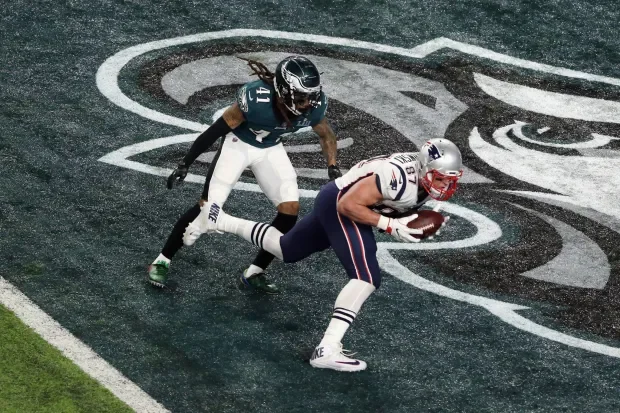
The only lead New England held in Super Bowl LII lasted about seven minutes, and Rob Gronkowski supplied it. Trailing 32-26 early in the fourth quarter, Brady produced his third 75-yard touchdown drive of the game, hitting Danny Amendola three straight times for 46 yards along the way, and finished it with a 4-yard toss to Gronkowski in the corner. With 9:22 to play, the Patriots led 33-32. It was the first time all evening anyone in white had been in front.
Philadelphia took the lead back with a long drive that included a fourth-and-1 conversion from their own 45 and ended with Zach Ertz’s 11-yard touchdown with 2:21 left. Two snaps after that, Brandon Graham – recording the only sack of the entire game – knocked the ball out of Brady’s hand, and a 46-yard field goal stretched the lead to eight with 1:05 remaining. Brady’s final act was a Hail Mary toward Gronkowski, who stood in the end zone wearing six defenders. The ball was batted down as time expired.
The two teams had combined for 1,151 yards, the most in any game in the NFL’s history, and punted once between them. The one sack, it turned out, mattered more than all 1,151 yards combined.
Rob Gronkowski – 8 Yards, Super Bowl LV
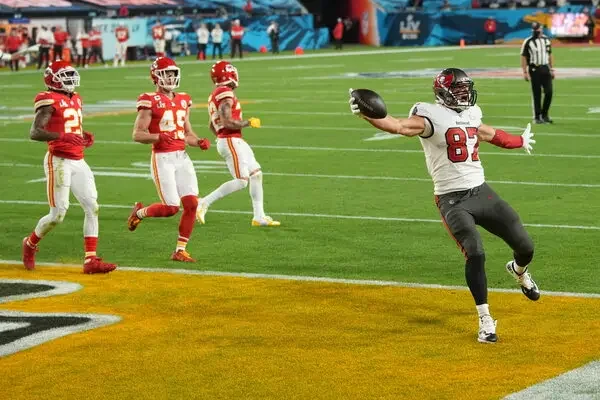
Across nine Super Bowls with New England, Tom Brady’s teams scored three first-quarter points. Total. Whatever else those two decades produced, they never once produced an opening-quarter touchdown pass, and the drought had become one of the stranger footnotes of his career. Then he moved to Tampa Bay, brought his favorite tight end with him, and fixed it inside one evening.
Rob Gronkowski had retired after the 2018 season, worn down at 29. When Brady signed with the Buccaneers in March 2020, Gronkowski un-retired within weeks, and Tampa Bay traded with New England for his rights. The two had one more trick to run: late in the first quarter of Super Bowl LV, the Bucs showed a quick slant to Mike Evans, cornerback Bashaud Breeland jumped it, and Gronkowski leaked out of the formation into the space Evans had vacated. The 8-yard touchdown made it 7-3, and the oldest drought on Brady’s resume was over.
It also settled an old account. The throw was the 13th postseason touchdown between Brady and Gronkowski, breaking the record they had shared with Joe Montana and Jerry Rice. Montana and Rice needed a dynasty to build their twelve. These two needed a dynasty plus a retirement, a trade, and a change of address.
Rob Gronkowski – 17 Yards, Super Bowl LV
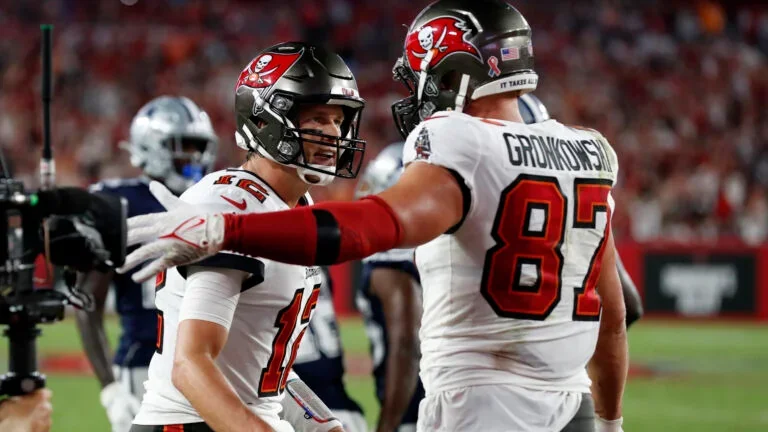
Two punts on the same fourth down set this touchdown in motion. A holding flag wiped out Tommy Townsend’s first attempt, and his second dribbled out of bounds for a net of 29 yards, handing Tampa Bay the ball at the Kansas City 38. What followed was a small anthology of self-sabotage. Tyrann Mathieu intercepted Brady, and a defensive holding call gave the ball back. The Buccaneers stalled at the edge of field goal range, sent out Ryan Succop for a 40-yard attempt, and watched Antonio Hamilton jump offside – a fresh set of downs. On the very next snap Brady found Gronkowski from 17 yards for a 14-3 lead with 6:05 left in the half.
Gronkowski, to his credit, checked before celebrating. He hesitated with the ball in his hand, waiting to confirm that the newest flag on the ground was another one on Kansas City, and only then spiked it.
The catch was the 14th postseason touchdown of the Brady-Gronkowski partnership, the one that turned a broken record into a buried one, and it made Gronkowski the second player ever – Jerry Rice is the other – with multiple touchdown catches in multiple Super Bowls. The Chiefs finished the half with more penalty yards than points.
Antonio Brown – 1 Yard, Super Bowl LV
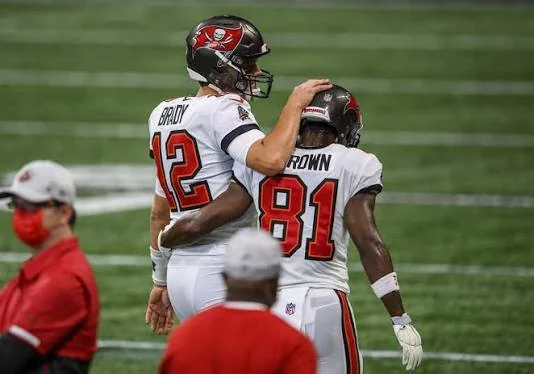
The last touchdown pass of Tom Brady’s Super Bowl career went to a man who had been out of football for more than a year. Antonio Brown – the best receiver of the 2010s, unemployed after a chaotic two years and an eight-game league suspension – was signed by Tampa Bay after Week 6 of the 2020 season, largely because Brady lobbied for him. In the final minute of the first half of Super Bowl LV, the investment paid out.
Kansas City’s secondary handed over 42 yards on two pass interference penalties on the drive, the second of them against Tyrann Mathieu in the end zone. From the 1-yard line, Brady flipped the ball to Brown for a 21-6 halftime lead. It was Brady’s 50th touchdown pass of the season, playoffs included. Mathieu, boiling, drew an unsportsmanlike-conduct flag moments later for an exchange with Brady on the way to the tunnel.
The rout ended 31-9. Brady, at 43, broke his own record as the oldest player to win a Super Bowl, collected his fifth MVP award, and joined Peyton Manning as the only quarterbacks ever to win it with two franchises. The Buccaneers were the first team ever to win a Super Bowl in their own stadium, whose pirate ship had been barred from firing its cannons after touchdowns all evening. When the clock ran out, it fired them anyway.
Frequently Asked Questions
Which receiver caught the most Super Bowl touchdown passes from Tom Brady?
Rob Gronkowski caught five, nearly a quarter of the total – one against Seattle in Super Bowl XLIX, two against Philadelphia in Super Bowl LII, and two against Kansas City in Super Bowl LV. He is also the only player who caught Brady Super Bowl touchdowns for two different franchises.
Did Tom Brady throw a touchdown pass in every Super Bowl he played in?
No. Super Bowl LIII, New England’s 13-3 win over the Rams in February 2019, was the only one of his ten without a scoring throw. It was the lowest-scoring Super Bowl ever played; Brady’s biggest completion that night set up the game’s lone touchdown rather than producing one.
What was Tom Brady’s longest Super Bowl touchdown pass?
A 26-yard strike to Chris Hogan in the Super Bowl LII loss to Philadelphia, in February 2018. Nothing else came close to deep: the second-longest was a 22-yarder to Rob Gronkowski against Seattle three years earlier, and every other one covered 17 yards or fewer.
How many of Brady’s Super Bowl touchdown passes came in losses?
Six. One in the 17-14 loss to the Giants in Super Bowl XLII, two in the 21-17 loss to the Giants in Super Bowl XLVI, and three in the 41-33 loss to the Eagles in Super Bowl LII. All three of his Super Bowl defeats came against NFC East teams.
What is the most touchdown passes Brady threw in a single Super Bowl?
Four, against the Seahawks in Super Bowl XLIX in February 2015, all of them to different receivers. He managed three in a game on three other occasions, in Super Bowls XXXVIII, LII, and LV. The four that night went to Brandon LaFell, Rob Gronkowski, Danny Amendola, and Julian Edelman, in that order.
Who caught Tom Brady’s last Super Bowl touchdown pass?
Antonio Brown, from 1 yard out, six seconds before halftime of Super Bowl LV on February 7, 2021. Brown had joined Tampa Bay midway through that season. Brady played two more seasons without reaching another Super Bowl, so Brown’s catch closed the collection.
- Super Bowl LII official recap – Patriots.com Press Room
- Tom Brady, Rob Gronkowski set record for most playoff TDs by QB-receiver combo – NFL.com
- Records abound in high-scoring Super Bowl LII – ESPN
- Patriots’ James White Ties or Breaks Multiple Super Bowl Records – Bleacher Report
- Aaron Hernandez – Britannica