Every FIFA Cover Player, 1993 to 2022
There has never really been a single FIFA cover. For most of the series’ thirty-year run, the same game shipped with different footballers on the box depending on where you bought it, so the player who fronted FIFA in Britain was often a stranger to someone buying the identical disc in Japan or Mexico.
The whole thing began with a licence that granted almost nothing. In 1993 EA signed a five-year deal with FIFA, football’s governing body, for what the company itself later called minuscule royalties, and discovered the agreement had bought them the four letters on the box and little else. No club badges, no stadia, not even the players’ real names. That absence explains the strange early years, when the cover of a game named after the sport’s world authority went to goalkeepers, journeymen, and a couple of future managers before it ever reached a Beckham or a Messi.
This list runs through every cover athlete of the main series, beginning with FIFA International Soccer in 1993 and ending with FIFA 23, the last edition to carry the FIFA name before EA renamed the franchise. Each entry leads with the headline star or stars, then names the notable faces from the regional editions – the teenagers who became superstars, the local heroes, and the occasional choice nobody has ever fully explained.
The main FIFA series ran for thirty annual games between 1993 and 2022, and every one carried at least one cover athlete. Headline stars ranged from David Platt on the first game to Kylian Mbappe on the last three, while dozens more footballers appeared on regional editions sold in individual countries.
David Platt & Piotr Swierczewski
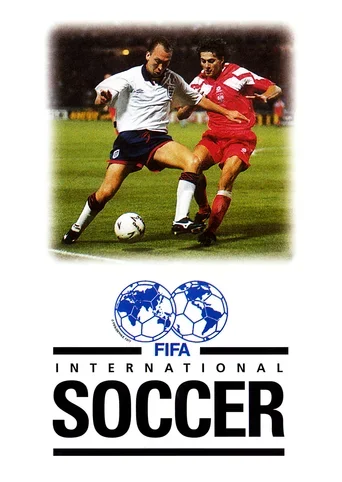
David Platt, the England midfielder then earning a fortune in Italy with Sampdoria, fronted the very first FIFA game alongside the Polish midfielder Piotr Swierczewski. It was an odd pairing to sell a football title, and odder still once you knew what was inside. The game contained no real players at all. EA had signed with FIFA but not with any clubs or players, so the teams were national sides filled with invented names, and several of the programmers quietly wrote themselves onto the squad lists.
Released for the Mega Drive in the weeks before Christmas 1993, it broke from the flat top-down view of rivals like Sensible Soccer and tilted the pitch into a slanted, isometric angle that looked, at the time, like the future. EA had expected to shift around 300,000 copies in Europe. It sold 400,000 in the final fortnight of December in Britain alone, knocked Street Fighter II off the top of the charts, and stayed at number one for six months.
It also shipped with one of the more useful bugs in sports gaming. Stand your player directly in front of the opposing goalkeeper as he cleared the ball, and it would rebound off your shins and roll politely into the net. A generation of children learned to score this way, then pretended they hadn’t.
Erik Thorstvedt
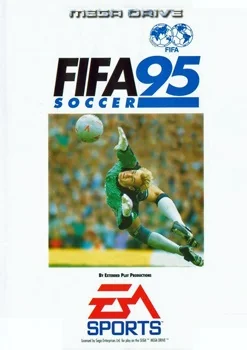
A goalkeeper got the cover this time, which was already a slightly unusual way to sell a game about scoring. Erik Thorstvedt of Tottenham Hotspur, a Norway international, took the honor in Europe, while North America went with Alexi Lalas, the ginger-bearded United States defender who had become an unlikely folk hero at the 1994 World Cup.
FIFA Soccer 95 carries a quieter distinction too: it is the only game in the whole main series to appear on a single console, the Sega Mega Drive. Every other FIFA, before and since, spread across half a dozen platforms or more. This one stayed put because it was less a new game than a polish of the first, running on the same engine with the corners buffed.
The real change was club football. Where the original had offered only national teams, FIFA 95 added eight domestic leagues, from England and Italy to Brazil and, oddly, a United States division stocked with second-tier sides, since the top flight barely existed yet. The players were still fictional, plenty of them recycled straight from the year before. What mattered was that you could now lose 4-0 as a real club rather than as a whole country, which felt, at the time, like tremendous progress.
Frank de Boer, Jason McAteer, Andy Legg & Ioan Sabau
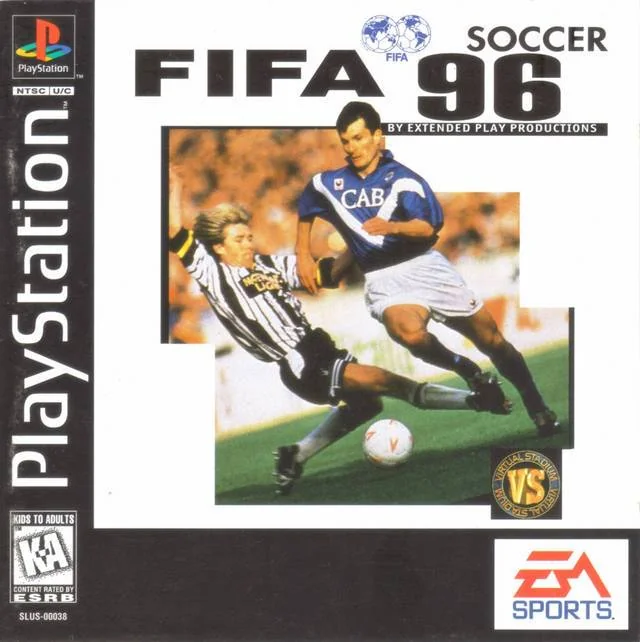
Four footballers appeared on the cover of FIFA 96, and which two you saw depended entirely on your postcode. In Europe the box paired the Dutch defender Frank de Boer with the Republic of Ireland midfielder Jason McAteer. In North America and Japan, EA went instead with Andy Legg and Ioan Sabau – a Welshman playing for Notts County in the third tier of English football, and a Romanian at Brescia. It remains one of the least starry cover line-ups the series ever assembled, which is part of its charm.
The game beneath them was a genuine leap. FIFA 96 was the first to secure the FIFPro licence, meaning that for the first time the players on the pitch had their real names. It was also the first to use EA’s Virtual Stadium technology, in which flat sprite players moved around a stadium rendered in real-time 3D, and the first to let you edit teams and squads yourself.
EA marketed it as Next Generation Soccer, which was true enough for the Saturn, PlayStation and PC versions. Owners of the ageing Mega Drive and Super Nintendo received a warmed-over version of the previous engine with a fresh coat of paint. The result was two genuinely different games sold under one name – a habit the series would keep, in one form or another, for the next quarter of a century.
David Ginola & Bebeto
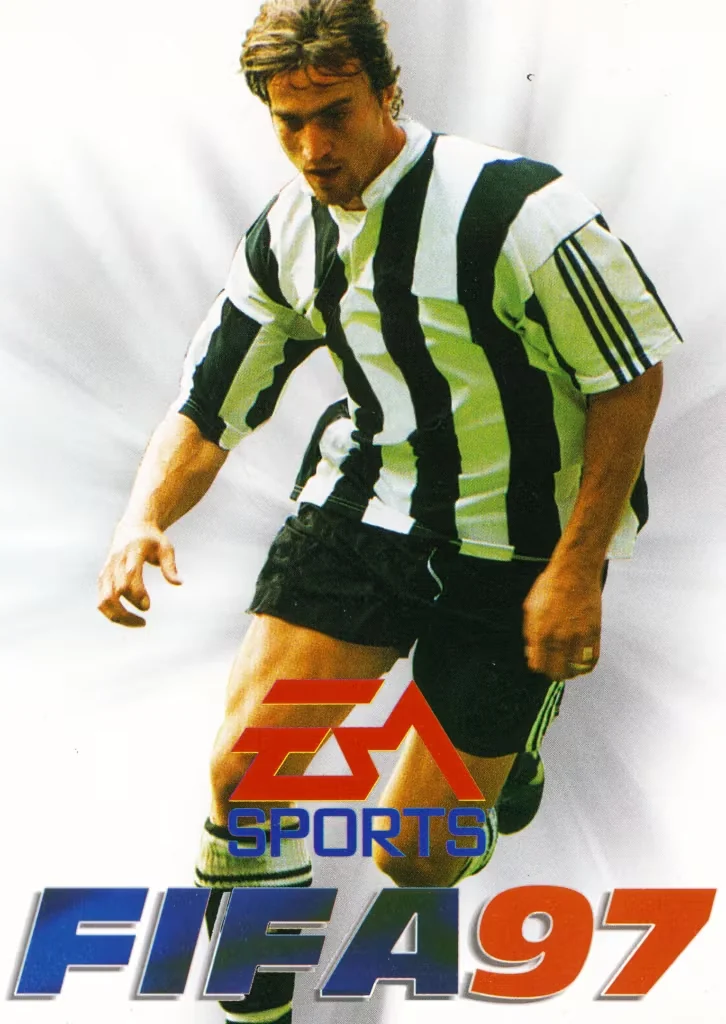
The headline addition to FIFA 97 was six-a-side indoor soccer, a frantic little mode played on a walled pitch that let you ricochet the ball off the boards. It was also the first FIFA to abandon flat sprites for genuine polygonal players, and the motion for those players was captured from David Ginola, the Newcastle United winger who happened to also be the cover star across Europe. Outside Europe, the box instead carried the Brazilian striker Bebeto, whose baby-cradling goal celebration at the 1994 World Cup had made him briefly world-famous.
Ginola was an inspired choice for a game selling flair, being one of the few players of the era who could make a stepover look like a dare. He is French, and was then in the middle of the two-year Newcastle spell that made him a cult figure in England.
The Nintendo 64 got its own version, titled simply FIFA 64, and its own cover star: Jordi Cruyff, the son of the great Johan Cruyff. Jordi was, by the polite estimate of most who watched him, a perfectly acceptable Manchester United squad player, which made him an eccentric candidate to carry an entire console’s football game alone. The surname, one suspects, did a great deal of the heavy lifting.
David Beckham
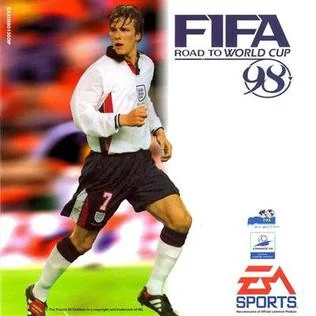
Six different footballers fronted Road to World Cup 98, one for each of the game’s major markets. Britain got David Beckham, then a promising Manchester United midfielder and not yet the most photographed Englishman alive. Italy got Paolo Maldini, Germany got Andreas Moller, France got David Ginola again, Spain got a young Raul, and the United States got Roy Lassiter. The game itself was the moment the series stopped being merely good and started being essential.
It was the first FIFA with a licensed pop soundtrack, opening on “Song 2” by Blur, whose wordless chorus became, for a certain generation, the sound of switching on a games console. The Road to World Cup mode let you drag any of the world’s national teams through real qualifying groups toward France 98, and for the first time the offside rule actually worked, penalizing players only when the situation genuinely called for it rather than whenever they stood still.
Beckham’s selection now looks like clairvoyance. In late 1997 he was a talented young player with one very famous goal from the halfway line to his name. Within a year he would be sent off at a World Cup and vilified across an entire nation, and within a few years after that he would be a global brand. EA got him cheap.
Dennis Bergkamp
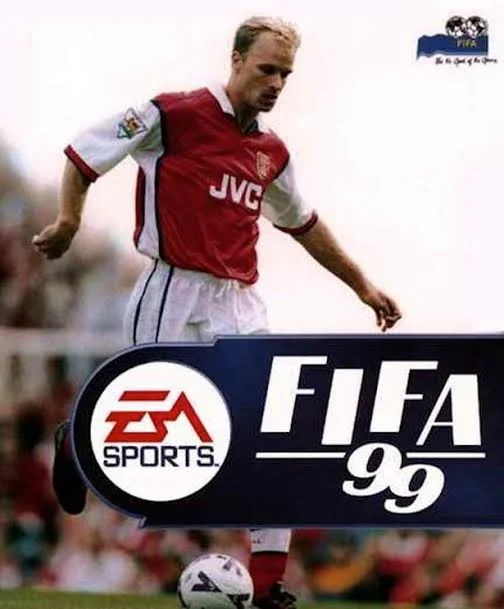
FIFA 99 handed its worldwide cover to Dennis Bergkamp, the Arsenal forward whose close control was so precise that opponents sometimes appeared to be standing in a different game. It was a fitting choice, though a faintly ironic one for a franchise sold on international travel: Bergkamp was famously afraid of flying, a phobia that earned him the nickname the Non-Flying Dutchman and occasionally left him behind while his team played abroad.
As had become the pattern, other countries got other faces. Japan received Hidetoshi Nakata, then the most famous footballer in Asia and about to move to Serie A; France got the goalkeeper Fabien Barthez; Italy the striker Christian Vieri; Spain Fernando Morientes. The menus, meanwhile, thumped along to “The Rockafeller Skank” by Fatboy Slim, a track so relentlessly upbeat that it is now impossible to hear without picturing a loading screen.
Under all this, FIFA 99 finally fixed a lingering embarrassment. The Brazilian club rosters, which had been stuffed with retired players for years, were at last corrected to something resembling reality. The game also added a clutch of European leagues and a manager mode with real transfer budgets, quietly turning what had been an arcade kickabout into something you could disappear into for a season.
Sol Campbell
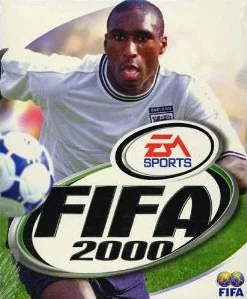
The footballer on the Spanish cover of FIFA 2000 would go on to win more major trophies as a manager than almost anyone in the sport’s history. At the time he was simply Pep Guardiola, the elegant Barcelona midfielder who dictated games from deep and had not yet imagined a life on the touchline. Britain, meanwhile, got Sol Campbell, then the pride of Tottenham, in one of the last cover appearances before a transfer that Spurs fans have still not forgiven.
FIFA 2000 was where the series finally admitted that the United States played football too. The fictional American league of previous games was replaced with the real Major League Soccer, three years after MLS had actually kicked off. Over forty classic teams were added, letting players field sides of retired greats, and the opening video starred Campbell himself, motion-captured and then sent to play a computer-generated team from 1904.
There was one especially odd inclusion. Robbie Williams, the pop star who recorded the theme song “It’s Only Us,” was a devoted supporter of Port Vale, and so Port Vale duly appeared in the Rest of the World section, a modest English lower-league club rubbing shoulders with the giants of Europe. Somewhere in EA’s offices, someone decided to fit the pop star’s boyhood club into a FIFA game, and no one seems to have objected.
Paul Scholes
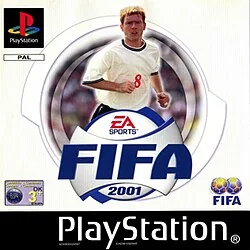
FIFA 2001 was the first game in the series you could play against a stranger over the internet, provided you owned the PC version and possessed the patience of a saint, since this was the era of the dial-up modem. It was a genuine novelty at the time, and a glimpse of the online future the series would spend the next twenty years chasing.
The British cover went to Paul Scholes, the red-haired Manchester United midfielder admired by nearly everyone he ever played against and asthmatically allergic to giving interviews. France, as it had for a couple of years now, got Thierry Henry, and elsewhere the box carried Filippo Inzaghi in Italy, the great Gheorghe Hagi in Romania, and Lothar Matthaus in Germany. The theme was “19-2000” by Gorillaz, the cartoon band’s impossibly catchy contribution, and the game finally gave clubs their real crests instead of the generic colored pennants of before.
Scholes was an unusual sort of star to sell a game with, in that he actively disliked attention and would go on to retire, unretire, and retire again without ever quite explaining why. His fellow professionals rated him among the best midfielders England has produced, a verdict he would presumably prefer nobody kept repeating.
Thierry Henry
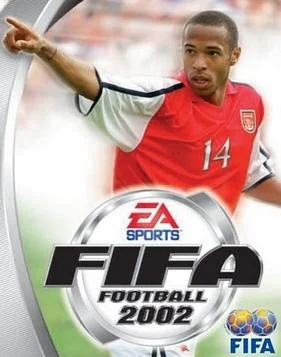
In the autumn of 2001, EA put a twenty-year-old on the Swedish cover of FIFA Football 2002. His name was Zlatan Ibrahimovic, and he had broken into the Ajax first team only months earlier, which made him a bold pick for a box that in other countries carried established stars. He has since appeared on or in every FIFA and EA football game made, a run of more than two decades, though he would later complain loudly about the company using his face without, as he saw it, his permission.
The global cover belonged to Thierry Henry, by now the most feared forward in England, with Francesco Totti fronting Italy, Ruud van Nistelrooy the Netherlands, and a young Iker Casillas in goal for Spain. The game introduced a power bar for passing and a card-collecting reward system licensed from Panini, the sticker company, a small idea that would grow, years later, into the money-printing machine known as Ultimate Team.
It also marked a quiet loss. FIFA Football 2002 was the last game in the main series to feature the Japanese national team, because the Japan Football Association sold its exclusive rights to the rival Pro Evolution Soccer. Japanese players abroad stayed in the game, but the national side vanished for fifteen years.
Roberto Carlos, Ryan Giggs & Edgar Davids
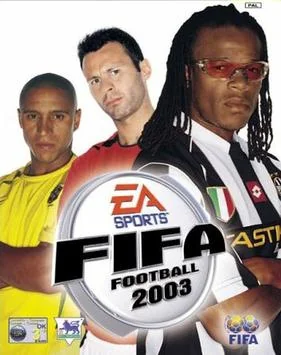
Most of the world got three cover stars for FIFA Football 2003. The United States got one. The international box was the first in the series to feature a trio, lining up Roberto Carlos of Real Madrid, Ryan Giggs of Manchester United and Edgar Davids of Juventus, three players about as glamorous as the early 2000s had to offer. American buyers, meanwhile, opened their copies to find Landon Donovan standing alone, which tells you roughly how much marketing weight EA thought a Brazilian, a Welshman and a Dutchman carried in Ohio.
The game marked a real technical jump, dumping the tired graphics of the previous two editions for sharper stadiums, kits and faces, and adding a broadcast-style presentation with half-time highlights and analysis. It was slick enough that it briefly felt like watching football rather than playing a cartoon of it.
More lasting was a piece of plumbing nobody noticed at the time. FIFA Football 2003 introduced EA Trax, the in-game music system that turned the menu screen into a curated playlist and the soundtrack into something people genuinely argued about. The theme that year was “To Get Down” by Timo Maas. Every FIFA since has had a playlist, and a fair few players bought albums off the back of one.
Thierry Henry, Alessandro Del Piero & Ronaldinho
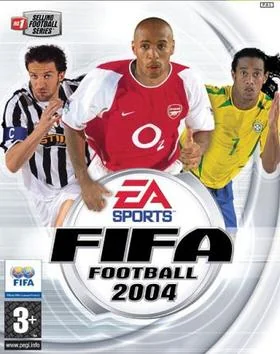
The opening sequence of FIFA Football 2004 was filmed at St James’ Park, the home of Newcastle United, and starred the three men on its cover: Thierry Henry, Alessandro Del Piero and Ronaldinho. It was the peak of a particular kind of early-2000s glamour, three continental artists lined up as if the game were selling perfume rather than football.
The most important change that year was buried in the menus. FIFA 2004 introduced second-tier leagues for the first time, which meant you could take a lower-division club and drag it, season by promoted season, into the Champions League – the exact fantasy that would keep Career Mode players up until 3am for the next two decades. It also let you control two players at once, moving a runner into the box while you held up play, a fiddly idea that mostly ended in confusion.
Ronaldinho was the constant here. He had appeared on FIFA Street and the packaging of the previous game, and 2004 was the season he began turning into the best player on earth, all impossible flicks and a grin that never left his face. EA had found its man. He would not leave the cover for four more years.
Patrick Vieira, Fernando Morientes & Andriy Shevchenko
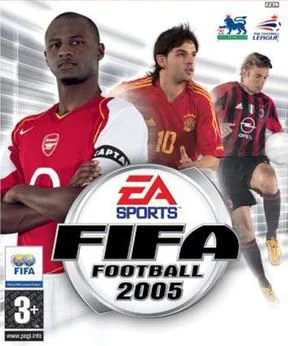
EA pushed FIFA Football 2005 into shops in early October 2004, weeks ahead of its usual late-October slot, purely to get a clear run at Pro Evolution Soccer before Konami’s game arrived. The cover starred a midfield-heavy trio: Patrick Vieira of Arsenal, Fernando Morientes of Real Madrid and Andriy Shevchenko, the Milan striker who would win the Ballon d’Or that December. North America, as ever marching to its own drum, replaced Vieira with the Mexican goalkeeper Oswaldo Sanchez, which at least made a change from all the strikers.
The headline feature was first-touch control, which finally let players trap, flick and shield the ball with something like real technique rather than gluing it to their feet. It sounds minor. It changed the feel of the entire game, and it was the clearest sign yet that EA had studied what made Pro Evolution Soccer play so well and quietly borrowed it.
There was no opening video this time, and in its place the game leaned on its soundtrack, with the British DJ Paul Oakenfold composing an original FIFA theme built partly from crowd noise and snippets of commentary. It is the kind of detail nobody asked for and nobody forgot, which is roughly the highest praise a FIFA soundtrack can hope for.
Wayne Rooney & Ronaldinho (FIFA 06)
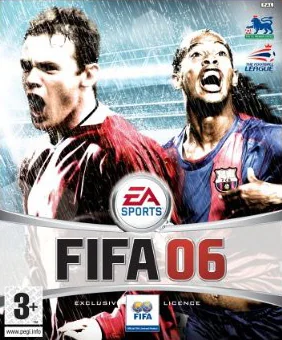
Wayne Rooney was nineteen years old and already terrifying defenders across Europe when he made his first appearance on a FIFA cover, sharing FIFA 06 with Ronaldinho. He had scored his first Premier League goal at sixteen, become England’s youngest ever scorer at seventeen, and lit up Euro 2004 before a broken foot ended his tournament. EA had signed a young man who looked like a plausible heir to the game itself.
Beside him stood Ronaldinho, then the reigning FIFA World Player of the Year and, by common agreement, the most joyful footballer alive. It was a cover built entirely on youth and flair, which was also the pitch for the game: EA had rewritten more than half the code and introduced team chemistry, a system measuring how well your players actually gelled.
North America, meanwhile, did something quietly poignant. Alongside Ronaldinho it placed Freddy Adu, the Ghanaian-American prodigy who had signed a professional contract at fourteen and been anointed the future of the sport before he could legally drive. Rooney went on to break records for club and country. Adu drifted through a dozen clubs across several continents and never came close to the career everyone had promised him. The cover caught both of them at the exact moment anything still seemed possible.
Wayne Rooney & Ronaldinho (FIFA 07)
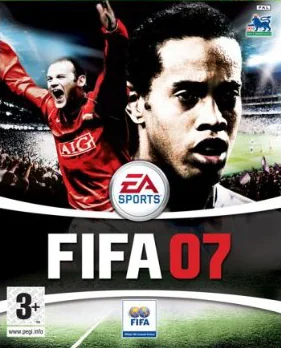
FIFA 07 rebuilt two of English football’s newest landmarks in pixels: the rebuilt Wembley, then still a building site in real life, and Arsenal’s brand-new Emirates Stadium. Both appeared in a game whose cover, for the second year running, belonged to Wayne Rooney and Ronaldinho, while Germany received Ronaldinho alongside a 21-year-old Lukas Podolski.
The Xbox 360 version was effectively a different game. EA built it on an engine written from scratch for the console, dropped the lower divisions, and focused everything on the four big European leagues, which annoyed anyone who had bought the machine expecting the full experience. The other consoles got the familiar version with a new Interactive Leagues feature, which synced the in-game season to real-world results, so a good weekend for your club nudged your virtual one along too.
It was, in truth, a quiet year, the sort of incremental update that FIFA had been accused of churning out for a decade. The stadiums were lovely, the roster was current, and the cover was identical to the last one. Nobody minded much. The game sold in enormous numbers regardless, because by 2006 buying the new FIFA every autumn had stopped being a decision and started being a ritual, like putting the clocks back.
Wayne Rooney & Ronaldinho (FIFA 08)
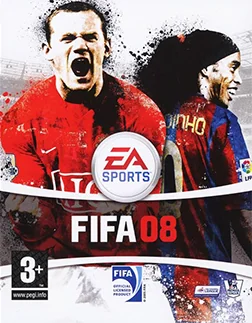
The new idea in FIFA 08 was Be a Pro, a mode that shrank your view of the match down to a single outfield player and left the other twenty-one to their own devices. It was disorienting at first, spending ninety minutes as a lone full-back making runs nobody rewarded, and then quietly brilliant once it clicked. It was also the year FIFA arrived on the PlayStation 3 and the Wii, the latter bringing motion controls that let you shoot by flailing a remote at the screen, with mixed results.
On the cover, for the third consecutive year, were Wayne Rooney and Ronaldinho. Germany got Ronaldinho with Miroslav Klose, fresh off winning the Golden Boot at the 2006 World Cup on home soil, and Spain got him with a 21-year-old Sergio Ramos, then better known for his red cards than his trophies, which meant the two most famous faces of the mid-2000s stared out from the box for the third straight autumn.
Ronaldinho was the quiet story that year. He was still on the box, still the golden boy, but at Barcelona his form had begun to slide, the late nights beginning to outpace the football. FIFA covers tend to be a snapshot of a player at his peak. This one, without quite meaning to, caught a great one just as he started coming down.
Wayne Rooney & Ronaldinho (FIFA 09)
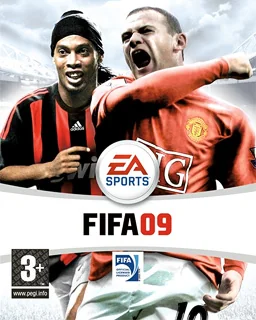
The most consequential thing about FIFA 09 was not on the cover at all. Midway through the game’s life, in March 2009, EA released a downloadable add-on called Ultimate Team, which let players open packs of cards, assemble fantasy squads, and, crucially, spend real money doing it. Almost nobody noticed at the time. It would grow into one of the most lucrative products in all of gaming, quietly reorganizing the entire franchise around itself.
The cover, for the fourth and final time, paired Wayne Rooney with Ronaldinho, though the Brazilian now wore the colors of AC Milan rather than Barcelona, a small detail that told its own story about where his career was heading. Spain, unusually, paired Rooney with Sergio Ramos, while Germany kept Ronaldinho alongside Kevin Kuranyi.
FIFA 09 also handed players control of their goal celebrations for the first time, so that scoring became an occasion for elaborate, often idiotic choreography. This was, on paper, a minor feature. In practice it launched a thousand playground arguments about whether celebrating a last-minute winner with a backflip constituted good sportsmanship. It did not, which was precisely the point. For a generation raised on FIFA, the celebration became half the fun, and occasionally more memorable than the goal.
Theo Walcott, Frank Lampard & Wayne Rooney
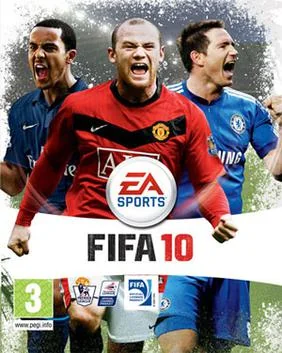
In the summer of 2009, a twenty-year-old striker at Lech Poznan posed for the Polish cover of FIFA 10, standing between Wayne Rooney and Frank Lampard. His name was Robert Lewandowski. In the game itself he was rated a forgettable 72, a promising unknown outside Poland; over the following decade he would climb to a 99, score more Champions League goals than almost anyone alive, and become one of the greatest strikers the sport has produced. He later admitted the cover made his head spin, seeing his own name beside Rooney and Xavi.
The main cover was an all-English affair. Rooney, there yet again, was joined by Lampard and the Arsenal winger Theo Walcott, a selection that raised eyebrows even in England, where the general view was that Walcott had done little to earn it.
Under the hood, FIFA 10 replaced the old eight-direction movement with genuine 360-degree control, which sounds like marketing and in fact transformed how the game felt to dribble. Players could now run at angles the previous games had never allowed, and defenders had to learn footwork they had never needed. It was the moment FIFA started to feel less like a board game with fancy graphics and more like football.
Kaka
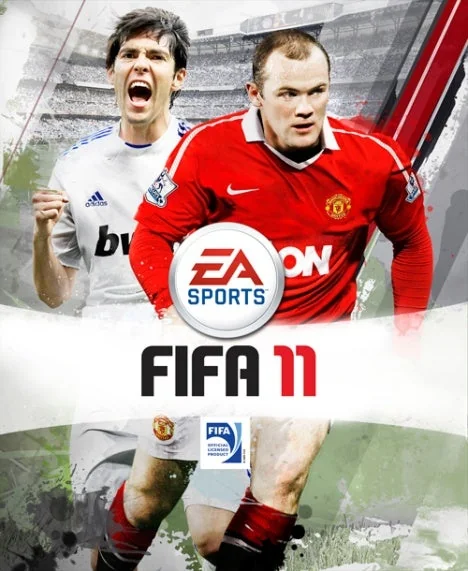
For the first time in years, the global cover and the British one showed different men. The worldwide box belonged to Kaka, the Brazilian playmaker who had recently been the most expensive footballer on the planet and the last man to win the Ballon d’Or before Messi and Cristiano Ronaldo annexed it for a decade. Britain, predictably, got Wayne Rooney once more. Germany went with a young Mesut Ozil, freshly anointed at the 2010 World Cup, and North America lined up Kaka with Landon Donovan and Carlos Vela.
FIFA 11 rebranded the old Manager Mode as Career Mode and, for the first time in the series, let you play as the goalkeeper – ninety minutes of standing about, then one instant where everything depended on you.
The choice followed a rule EA rarely broke: the cover star almost always carried one of the highest ratings in the game. Kaka, in 2010, still did. Within a year or two his knees would begin to fail, his move to Real Madrid curdling into four injury-hit seasons, and the playmaker who had once cost a world-record fee slid quietly out of the game’s front rank. It was the only time Kaka fronted a FIFA worldwide.
Wayne Rooney & Jack Wilshere
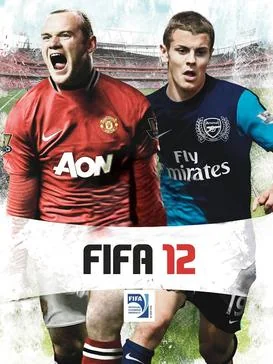
FIFA 12 sold 3.2 million copies in its first week, generating more than $186 million at retail, which made it, at the time, the fastest-selling sports game ever made. EA had spent years catching Pro Evolution Soccer and then years pulling away from it, and this was the moment the gap became a chasm.
The British cover paired Wayne Rooney, there once again, with Jack Wilshere, the Arsenal teenager tipped by nearly everyone to become the midfielder England had been waiting a generation for. He was nineteen, gifted, and fearless. He was also, though nobody knew it yet, about to lose most of the next four years to a catalogue of ankle and foot injuries that would slowly dismantle the career the cover had just promised.
Underneath, FIFA 12 shipped its biggest gameplay change in a decade. The Player Impact Engine modeled collisions in real time, so that players tangled, stumbled and fell in ways the old canned animations never managed, occasionally producing footballers who folded into each other like deckchairs. Alongside it came Tactical Defending, which made stealing the ball a genuine skill rather than a button you held down and hoped. It was harder, and it was better, and a great many people hated it at first.
Lionel Messi (FIFA 13)
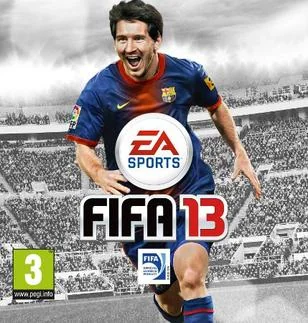
In 2012 EA finally did the thing it had wanted to do for a decade: it signed Lionel Messi away from Pro Evolution Soccer. For years Messi had been a Konami man, his likeness anchoring the rival game, and prying him loose was less a marketing deal than an act of war. His face went onto the global cover of FIFA 13, the first of what would become four in a row.
It was a coronation. Messi was, by 2012, comfortably the best footballer on the planet and in the middle of a season in which he would score ninety-one goals in a calendar year, a record that still stands. Putting anyone else on the cover would have looked eccentric. The United Kingdom version squeezed in Manchester City’s Joe Hart and the Arsenal teenager Alex Oxlade-Chamberlain beside him, a slightly baffling pair of hangers-on at the great man’s coronation.
The game introduced first-touch control that could send a ball skidding off a shin, and became the first FIFA to support the Kinect and PlayStation Move, so shouted instructions and flailing limbs could, in theory, affect the match. It also brought Saudi Arabian league football into the series for the first time. Mostly, the motion controls affected the patience of everyone else in the room.
Lionel Messi (FIFA 14)
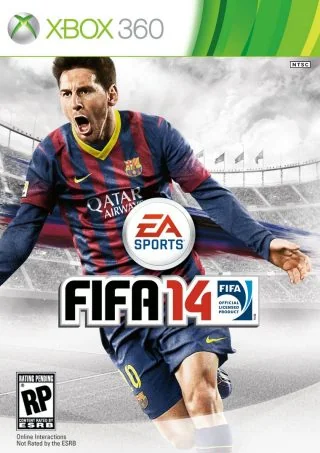
The FIFA 14 cover exists in two versions, and the difference between them is a transfer fee. Gareth Bale was chosen for the British box in the shirt of Tottenham Hotspur; then, midway through the summer of 2013, he left for Real Madrid in a deal worth a world-record sum, and EA quietly reprinted the cover with Bale in white. The global star, for all regions, was Lionel Messi, back for a second straight year.
Underneath, FIFA 14 was really two games. On the PlayStation 3 and Xbox 360 it was a polished version of the familiar engine. On the newly launched PlayStation 4 and Xbox One, for which it was a launch title, it ran on a brand-new engine called Ignite, which modeled crowds, weather and the way a player’s body prepared for a collision.
It was also the first FIFA in North America since 2001 to drop the word Soccer from its name, a small concession to the fact that Americans had, at long last, started calling it football too. The game shipped with real signature celebrations, so you could finally recreate Bale’s heart-shaped hand gesture. For anyone who bought the new consoles that November, though, the point of FIFA 14 was simply that it looked, for the first time, less like a video game and more like a televised match.
Lionel Messi (FIFA 15)
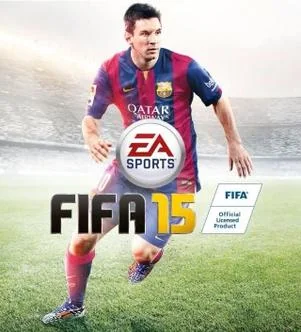
The big promise of FIFA 15 was that every one of the twenty Premier League grounds would be recreated exactly, down to the advertising hoardings and the tunnel. It was the first game released under EA’s deal as the Premier League’s Official Sports Technology Partner, which granted photographers access to shoot each stadium in detail, so that Anfield and Old Trafford finally looked like themselves rather than like generic bowls with the right colored seats.
Lionel Messi kept the global cover, but the regional spread that year was unusually strong. Eden Hazard took Britain, France, Belgium and the Netherlands; Gonzalo Higuain fronted Italy; and the United States, in a nod to a genuinely popular player, got Clint Dempsey, the Seattle Sounders midfielder who had spent years in the Premier League. It was the closest a FIFA cover ever came to a proper multinational lineup.
The gameplay pitch was emotion, plus a ground-up rewrite of goalkeepers, who for the first time in years stopped flapping at crosses like startled pigeons. Players now reacted to the flow of a match, snarling at referees, shoving opponents, and slumping when a goal went in against them. On paper it added drama. In practice it produced a lot of footballers behaving like sulky teenagers, which, to be fair, is a reasonably accurate simulation of professional football.
Lionel Messi (FIFA 16)
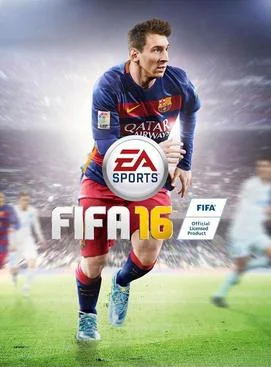
The first women ever to appear on a FIFA cover arrived in the autumn of 2015, three of them, each on a different national edition of FIFA 16. Alex Morgan took the United States box, Christine Sinclair took Canada, and Steph Catley took Australia after winning a fan vote to get there. All three shared the cover with Lionel Messi, who held the global edition for the fourth and final time.
The covers followed the real story inside the game. FIFA 16 was the first in the series to include women’s football at all, adding twelve national teams, among them the United States, Germany, England and Brazil, playable in exhibition matches. It had taken twenty-two years, and it arrived only after a petition and a summer in which the Women’s World Cup drew record television audiences.
The reception was not uniformly gracious. A vocal slice of the internet complained loudly about the intrusion, which mostly served to demonstrate why the addition had been necessary in the first place. The women, for their part, simply got on with it. Catley later called sharing a cover with Messi the highlight of her career, which is the correct response to sharing a cover with Messi.
Marco Reus
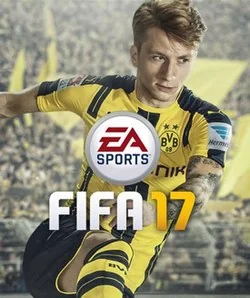
When EA threw the FIFA 17 cover open to a public vote, the result was not the name most people expected. Up against Eden Hazard, Anthony Martial and James Rodriguez, the winner was Marco Reus, the Borussia Dortmund forward – quick, elegant, and chronically, almost operatically injured. He was a fine player having a good season. He was also the least starry of the four options, which is presumably why the fans, being contrary creatures, picked him.
What happened next entered FIFA folklore. Reus promptly lost most of the following two seasons to injury, and a superstition took hold that the cover itself was cursed, a theory that gained weight every time a chosen star pulled a hamstring. EA has since stuck almost exclusively to players too durable to embarrass it.
FIFA 17 mattered for two larger reasons. It was the first game in the series built on the Frostbite engine, the technology behind Battlefield, which gave the whole thing a heavier, more cinematic look. And it launched The Journey, a full story mode following a fictional young player named Alex Hunter through the highs and indignities of a professional career, which turned out to be far better than a bolted-on narrative had any right to be.
Cristiano Ronaldo (FIFA 18)
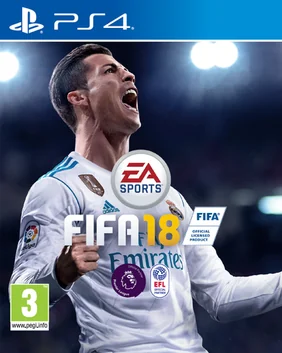
There were two Ronaldos on the covers of FIFA 18, which is one more than most people noticed. The standard edition belonged to Cristiano Ronaldo, then of Real Madrid, appearing as the sole global face of a FIFA game for the first time in his career – a mild surprise, given that he had spent a decade as one of the two best players alive, tussling with Lionel Messi for every trophy going.
The other Ronaldo was the interesting one. The Icon Edition, a deluxe version costing around ninety pounds, put the Brazilian Ronaldo on its cover – Ronaldo Nazario, the buck-toothed phenomenon who won two World Cups and terrorized defenses in the late 1990s. He had never once appeared on a FIFA cover during his actual career, which ran alongside the series for over a decade. He turned up only in 2017, retired and slightly rounder, as the first of EA’s new Ultimate Team Icons.
It was a neat piece of symmetry, and a quietly generous one. The game that finally crowned the modern Ronaldo also, in the same breath, paid overdue respect to the original, a player a generation of fans had grown up imitating in playgrounds long before either had a controller in his hand.
Cristiano Ronaldo (FIFA 19)
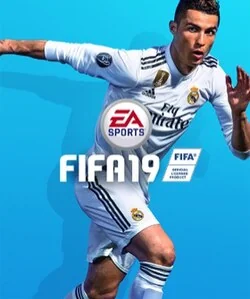
The cover of FIFA 19 barely changed – Cristiano Ronaldo again, this time with Neymar joining him on the Champions Edition – but underneath, EA had pulled off a genuine coup. For years the Champions League, the biggest club competition in the world, had belonged exclusively to the rival Pro Evolution Soccer, a glaring hole in FIFA’s otherwise complete collection of licenses. FIFA 19 finally landed it, along with the Europa League and the Super Cup.
EA celebrated by commissioning the film composer Hans Zimmer, with the rapper Vince Staples, to record a new version of the competition’s famous anthem specifically for the game. It was an oddly lavish gesture for a menu screen, and it worked, lending the mode a gravity the football itself sometimes struggled to match.
There was one small awkwardness. EA had shot Ronaldo’s cover while he was still a Real Madrid player, and then, that summer, he moved to Juventus, leaving the marketing to scramble. The Journey reached its third and final chapter, sending Alex Hunter off into retirement, and the Chinese Super League joined the game for the first time – a reminder that FIFA’s true product was never really the football, but the sheer, obsessive completeness of its licensing.
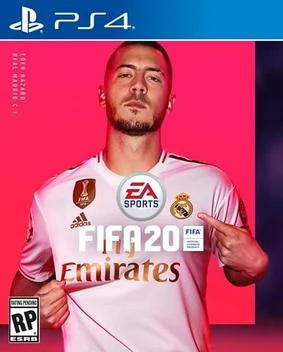
Eden Hazard
For all the money EA poured into the main game every year, the most talked-about thing in FIFA 20 was a nostalgic detour. Volta Football dropped the eleven-a-side match for small-sided street games on caged courts and rooftops, the first proper return to the arcade spirit of the old FIFA Street series in nearly a decade. It was a deliberate grab for players who found the main game too serious, and it mostly succeeded.
The standard cover went to Eden Hazard, freshly arrived at Real Madrid after seven years at Chelsea and looking, in the promotional shots, like a man who had finally reached the club he was meant for. The Champions Edition carried Virgil van Dijk, and the Ultimate Edition put Zinedine Zidane on the front as a new Icon, letting a generation who had only heard about Zidane finally play as him.
Hazard’s timing, as it turned out, was cruel. His Madrid career would be wrecked almost immediately by injury and lost form, and the cover, all confidence and white kit, became a small monument to a move that never delivered. He would play only a handful of good games for the club he had waited his whole career to join.
Kylian Mbappe (FIFA 21)
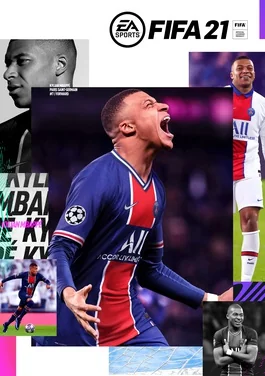
FIFA 21 marked a changing of the guard: for the first time since Cristiano Ronaldo in 2018, a single player took every version of the cover alone. That player was Kylian Mbappe, the Paris Saint-Germain forward who had won a World Cup at nineteen and moved like the ball was on a string tied to his boot. He was twenty-one, and EA had bet the franchise’s face on him for what would become three straight years.
The choice was sound. The execution divided the fanbase, who spent a good deal of energy online arguing about the cover art itself, which set Mbappe against a background of angular graphics that some found dynamic and others found faintly nauseating. It was, in fairness, the sort of argument only possible when the football underneath had reached a settled kind of excellence.
FIFA 21 arrived in October 2020, later than usual and against considerable odds, since a global pandemic had shut down football and scattered EA’s developers to their spare bedrooms for the better part of a year. That the game shipped at all, on time and functional, was a quiet feat of remote coordination. That it played almost identically to the previous one was, by then, entirely expected.
Kylian Mbappe (FIFA 22)
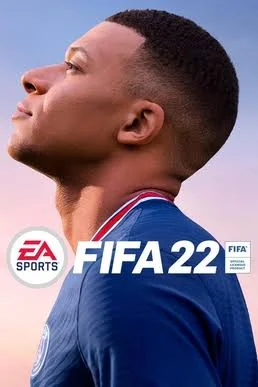
To build FIFA 22, EA put twenty-two footballers in motion-capture suits and had them play a full match on a specially rigged pitch, capturing every stride and shoulder-barge at once rather than piecing animations together in a studio. The resulting technology, called HyperMotion, was the headline feature, available only on the newest consoles, and it made players move with a fluid, unrehearsed quality the series had been chasing for years.
Kylian Mbappe returned to the cover, solo again, for the second of his three consecutive years. By now his presence had the settled inevitability of a Rooney or a Messi before him, a face so obviously correct for the job that the annual reveal barely counted as news. Mbappe was, by any measure, the best young player in the world, and the game’s ratings agreed, handing him a 91.
Underneath the new animation, though, FIFA 22 was the same argument the series always had with itself. Purists wanted realism; the vast Ultimate Team audience wanted fast, punchy, rewarding football that sold card packs. HyperMotion leaned toward the former while the game’s economy leaned hard toward the latter, a tension that had defined FIFA for a decade and would follow it, unresolved, right out the door under its own name.
Kylian Mbappe & Sam Kerr
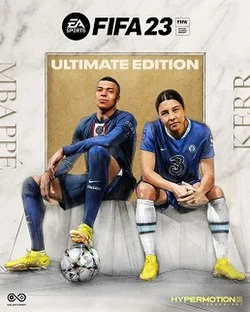
Sam Kerr was the first woman to front the global edition of a FIFA game, sharing the FIFA 23 cover with Kylian Mbappe on the Ultimate Edition in 2022. The Chelsea and Australia striker was also the first openly gay player to appear on a FIFA cover, and she marked the occasion by pointing out that she had gone from playing the game as a kid to being on the front of it, which is the sort of thing that happens to very few people.
Mbappe took the standard edition, completing his run of three consecutive covers, while Kerr appeared alone on the boxes sold in Australia and New Zealand. Inside, FIFA 23 finally added women’s club football, letting players field teams from the English and French women’s leagues for the first time, seven years after the women’s national teams had arrived.
And then it ended. FIFA 23 was the last game EA would release under the FIFA name, the thirty-year partnership collapsing over money after football’s governing body reportedly demanded far more than EA was willing to pay. The series carried on, rechristened EA Sports FC, but the four letters that had sat on every cover since 1993 were gone. Kerr and Mbappe, it turned out, were closing a door.
Frequently Asked Questions
Who appeared on the most FIFA covers?
Wayne Rooney holds the record, appearing on seven consecutive covers from FIFA 06 to FIFA 12. For four of those years he was paired with Ronaldinho. Lionel Messi and Kylian Mbappe come next, with four and three straight covers respectively, though neither matched Rooney’s unbroken run.
Who was the first woman to appear on a FIFA cover?
Three women appeared first, all in 2015: Alex Morgan on the United States edition of FIFA 16, Christine Sinclair in Canada, and Steph Catley in Australia, each beside Messi. The first woman on the worldwide cover came later, in 2022, when Sam Kerr joined Mbappe on FIFA 23.
Why is there no FIFA video game anymore?
EA and FIFA ended their thirty-year partnership in 2022 over money, with FIFA reportedly asking for more than double the previous licensing fee. EA kept making the game under a new name, EA Sports FC, retaining every league, club and player. Only the FIFA name and the World Cup license were lost.
Why did the same FIFA game have different players on the cover?
For most of the series, EA printed region-specific covers, each fronting a local hero to boost sales in that market. A British buyer and a Mexican buyer got the same disc in different boxes. The practice peaked with FIFA 16, which shipped with around eighteen different covers worldwide.
Was Lionel Messi or Cristiano Ronaldo on more FIFA covers?
Messi, narrowly. He fronted the global cover four years running, from FIFA 13 to FIFA 16, after EA lured him from the rival Pro Evolution Soccer. Ronaldo followed with two, on FIFA 18 and FIFA 19. Between them they held the worldwide cover for six straight years.
Which FIFA cover star was chosen by a public vote?
Marco Reus, for FIFA 17 in 2016. EA let fans choose from four candidates, and the Borussia Dortmund forward edged out James Rodriguez, Anthony Martial and Eden Hazard. It was the only time the public picked a FIFA cover star, and the injuries that followed Reus fed a lasting cover-curse superstition.
- EA SPORTS Announces Alex Morgan and Christine Sinclair as First Ever Female Cover Athletes – Electronic Arts
- FIFA Soccer 12 Breaking Records Worldwide – Electronic Arts
- EA FC/FIFA Cover History: All Cover Athletes – Sports Illustrated
- Cristiano Ronaldo revealed as FIFA 18 global cover star – Goal.com
- FIFA 23: Sam Kerr first woman on Ultimate Edition cover – PinkNews