Every Hall of Fame Player Who Was Kobe Bryant's Teammate
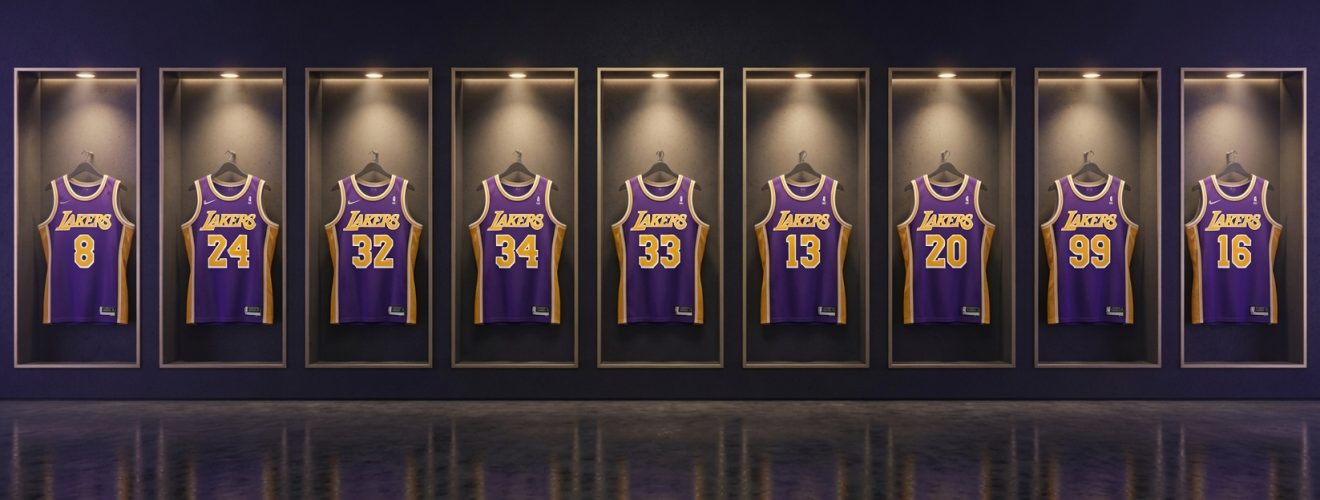
Over twenty seasons in Los Angeles, Kobe Bryant shared the floor with more than a hundred and thirty teammates, and only a small fraction of them ended up in the Hall of Fame. The number is not the seven you might guess from the championship banners, because two of the men in question barely registered at the time – a 37-year-old Dennis Rodman who lasted twenty-three games, and a 36-year-old Vlade Divac who lasted fifteen.
Those two are the surprises. The rest range from the inevitable to the poignant. Shaquille O’Neal was Kobe’s co-star for three straight titles and his antagonist for most of them. Pau Gasol arrived in a 2008 trade that rival executives called a robbery and helped deliver two more championships. And three all-time greats – Karl Malone, Gary Payton, and Steve Nash – came to Los Angeles late in their careers chasing the ring that had eluded them, and left, in every case, still chasing it.
A word on the rules, since they decide the edges. This counts men the Hall admitted for their playing careers who shared a Lakers roster with Kobe in any season, however little either of them played. That leaves out Phil Jackson above all, who won five titles with him from the bench, plus Del Harris and Rudy Tomjanovich. It also leaves out the men this kind of list always strands: Magic Johnson, who played his final game one season before Kobe’s first; Robert Horry, a seven-time champion with three rings won beside Kobe, who is somehow still not enshrined; and Glen Rice, an All-Star and 2000 champion alongside Kobe who never got the call. Here are the ones who did, in the order they first suited up with him.
Nine Hall of Fame players were Kobe Bryant’s Lakers teammates: Shaquille O’Neal, Dennis Rodman, Mitch Richmond, Gary Payton, Karl Malone, Vlade Divac, Pau Gasol, Steve Nash, and Dwight Howard. Each is enshrined in the Naismith Memorial Basketball Hall of Fame as a player, not as a coach or contributor.
Shaquille O’Neal
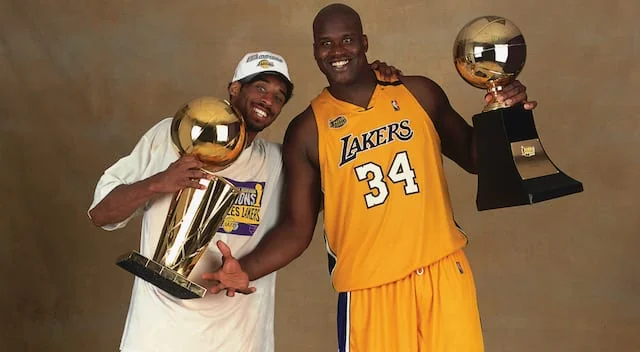
On July 18, 1996, the Lakers handed Shaquille O’Neal a seven-year contract worth $120 million, the richest in NBA history at the time, and plenty of people thought they had lost their minds. Weeks earlier they had traded the center Vlade Divac to Charlotte for the draft rights to a seventeen-year-old guard named Kobe Bryant. In a single summer, general manager Jerry West had assembled the most dominant duo the league would see for a decade.
What followed was three straight championships from 2000 to 2002, with O’Neal named Finals MVP all three years and league MVP in 2000. At his physical peak he was close to unguardable, a 7-foot-1 center weighing well over 300 pounds who moved defenders aside and dunked. The Lakers reached four Finals in his eight seasons in purple and gold, and he went into the Hall of Fame in 2016.
The complication was that O’Neal and Bryant could not stand each other, and everyone knew it. The feud simmered through the titles and boiled over after Los Angeles lost the 2004 Finals to Detroit. Forced to choose between a 32-year-old center and a guard entering his prime, the front office kept Bryant. O’Neal was traded to Miami that July for Lamar Odom, Caron Butler, Brian Grant, and a draft pick. He won a fourth ring in Miami two years later, one suspects partly to make a point.
Dennis Rodman
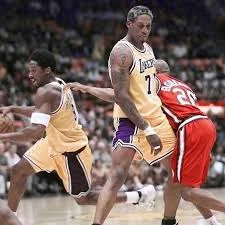
Dennis Rodman owns five championship rings, and not one of them came from Los Angeles. This is the chapter of his career nobody remembers, partly because it lasted about seven weeks. The Lakers, desperate to win their first title since 1988, signed the 37-year-old rebounding savant in February 1999, midway through the lockout-shortened season, on the theory that his defense and ferocity were exactly what a Shaq-and-Kobe team needed to get over the hump.
Rodman played 23 games, started 11 of them, and averaged 2 points and 11 rebounds, the rebounding still elite and the rest of him plainly checked out. He was one of the great rebounders in history, with seven consecutive rebounding titles from 1992 to 1998 and two Defensive Player of the Year awards from his Detroit Bad Boys days. He had just won three straight championships in Chicago alongside Michael Jordan. The Hall of Fame would come calling in 2011.
It did not work in Los Angeles. Discipline problems and unexplained absences piled up, the team bottomed out in a 113-86 loss at Portland, and the Lakers released him that spring. They then won the next three NBA championships without him, beginning the very next season. Rodman, who had come to chase a title, left one year too early to get one.
Mitch Richmond
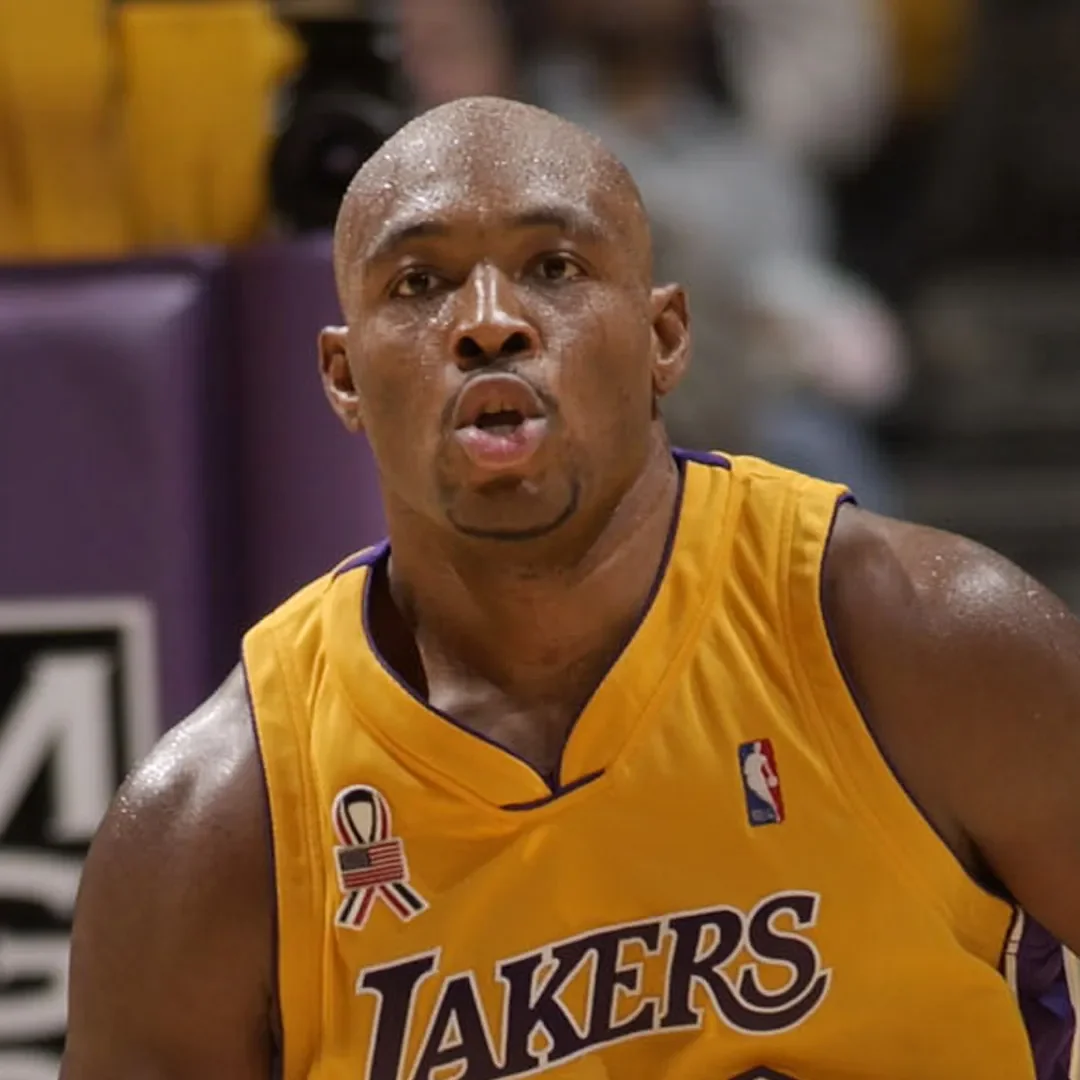
Run TMC was the most thrilling offense in basketball at the start of the 1990s, and it won absolutely nothing. The trio of Tim Hardaway, Mitch Richmond, and Chris Mullin, all three eventually Hall of Famers, scored at a pace that delighted everyone except the people responsible for winning playoff series. Richmond was the M. He had been Rookie of the Year in 1989 at 22 points a game, and Golden State traded him to Sacramento in 1991 for the rights to Billy Owens, which dismantled the whole experiment.
In Sacramento he became a six-time All-Star and a scoring machine on teams that mostly lost. He retired with 20,497 career points and a reputation as one of the purest shooters of his era, and for thirteen seasons he never came close to a championship.
Then, at 36, he signed with the Lakers for the 2001-02 season and finally got one. Playing strictly off the bench behind Kobe Bryant, he averaged about four points a game and barely appeared in the postseason as Los Angeles completed its three-peat. It was the least he ever contributed to a basketball team and the only time he finished a season a champion. He retired that summer, and the Hall of Fame inducted him in 2014.
Gary Payton
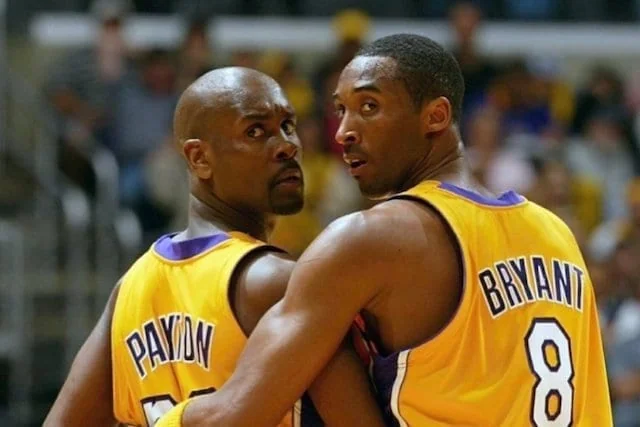
For thirty-nine years, exactly one point guard had ever won the NBA’s Defensive Player of the Year award, and his name was Gary Payton. He won it in 1996, the same season he dragged the Seattle SuperSonics to the Finals against Michael Jordan’s Bulls, and he held the distinction alone until Marcus Smart joined him in 2022. They called him The Glove, a nickname from the 1993 playoffs meaning he stuck to opposing scorers like one.
By the summer of 2003 he was 35 and had spent thirteen years in Seattle without a ring. So he signed with the Lakers for far below his market value, joining Shaquille O’Neal, Kobe Bryant, and fellow free-agent recruit Karl Malone on a roster built for one purpose. It opened the season as the prohibitive favorite to win the title and lost the 2004 Finals to the Detroit Pistons in five games, which is still remembered as one of the sport’s great upsets.
Payton kept chasing. After a detour through Boston he signed with the Miami Heat, hit a game-winner in the 2006 Finals, and got his championship at last. He went into the Hall of Fame in 2013. The ring he had come to Los Angeles for arrived two years later, in someone else’s colors.
Karl Malone
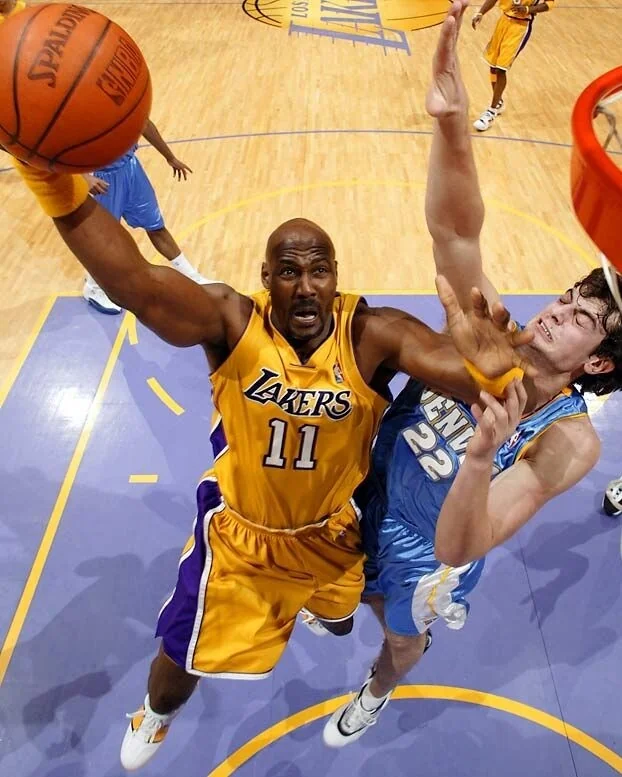
When Karl Malone retired, only one man in NBA history had scored more points than he had, and that man was Kareem Abdul-Jabbar. The Mailman finished with 36,928 points, two MVP awards, fourteen All-Star selections, and eighteen seasons in Utah running the most reliable pick-and-roll the league has ever seen with John Stockton. He had also, across all of it, never won a title, losing the Finals to Jordan’s Bulls in 1997 and again in 1998.
He was 40 when he took the veteran’s minimum to join the Lakers for 2003-04, the other marquee free agent in that summer’s gamble. It became the worst-timed breakdown of his career. A knee injury in December cost him roughly forty games and dropped him to a career-low 13.2 points a night. He returned for the playoffs, then re-injured the knee in the Finals and watched the deciding game from the bench.
So the most prolific scorer of his generation finished without a ring, a fact that seemed to bother everyone more than it bothered him. He was enshrined in the Hall of Fame in 2010 and made a point of going in as a Jazz man. He had spent eighteen years earning the right to call himself one, and a single borrowed season in Los Angeles was never going to change that.
Vlade Divac
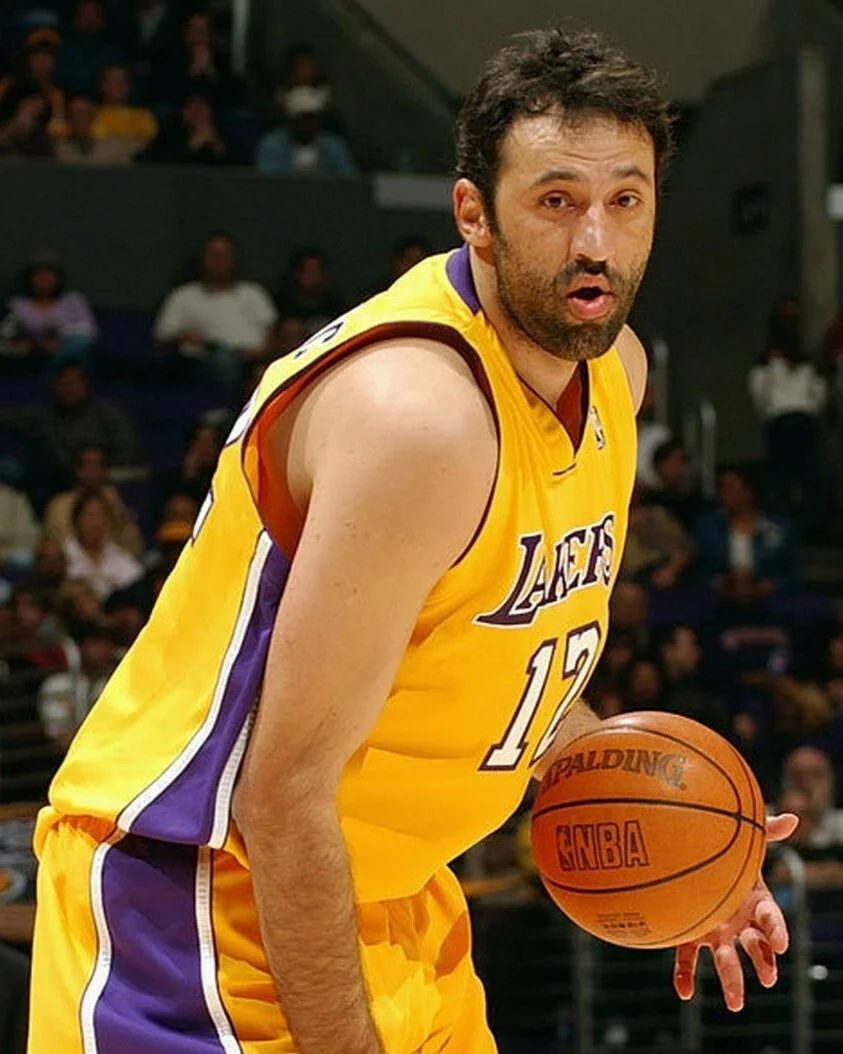
The Lakers got Kobe Bryant by giving up Vlade Divac. On draft night in 1996 they traded the popular Serbian center to the Charlotte Hornets for the rights to the high schooler Charlotte had just selected thirteenth overall, a deal that worked out for Los Angeles about as well as any trade in franchise history. Divac went on to anchor the Sacramento Kings teams that nearly knocked the Lakers out of the 2002 Western Conference Finals, losing Game 7 in overtime.
He was one of the first European stars to thrive in the NBA, a 7-foot-1 passer with soft hands and a theatrical relationship with contact that helped popularize the flop. Over sixteen seasons he scored more than 13,000 points and was, by one accounting, the first foreign-trained player to appear in 1,000 NBA games. The Hall of Fame inducted him in 2019.
And then, in a quiet bit of symmetry, he came back. In the summer of 2004 the 36-year-old Divac signed with the Lakers for a final season and became, at long last, a teammate of the man he had once been traded for. A herniated disc in his back held him to 15 games, and he retired that spring. The player Los Angeles gave away to get Kobe Bryant ended his career handing him the ball.
Pau Gasol
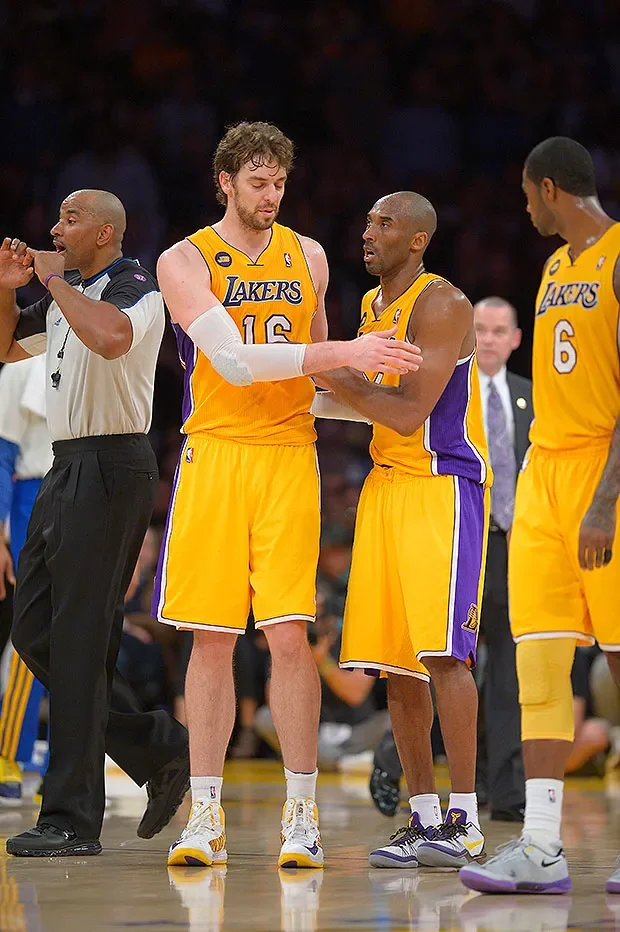
Gregg Popovich thought the trade should have been illegal. When the Lakers acquired Pau Gasol from the Memphis Grizzlies on February 1, 2008, the San Antonio coach told Sports Illustrated the deal was beyond comprehension and that the league needed a committee to veto trades that made no sense. He was not alone. Executives around the NBA agreed Los Angeles had essentially stolen an All-Star.
What the Lakers surrendered was Kwame Brown, Javaris Crittenton, Aaron McKie, two first-round picks, and the draft rights to a young center named Marc Gasol, Pau’s own younger brother, then still playing in Spain. Marc would become a three-time All-Star, a Defensive Player of the Year, and a champion himself, which complicated the robbery narrative considerably. But in the moment, the Lakers had their first true low-post threat since Shaquille O’Neal, and it changed them overnight. They went 22-5 with Gasol in the lineup and reached three consecutive Finals, winning the title in 2009 and again in 2010.
Gasol, the 2002 Rookie of the Year and, in 2023, a Hall of Famer, fit alongside Kobe Bryant almost perfectly. The two of them took to speaking Spanish to each other during games, on the sound reasoning that the other nine men on the floor could not understand a word of it.
Steve Nash
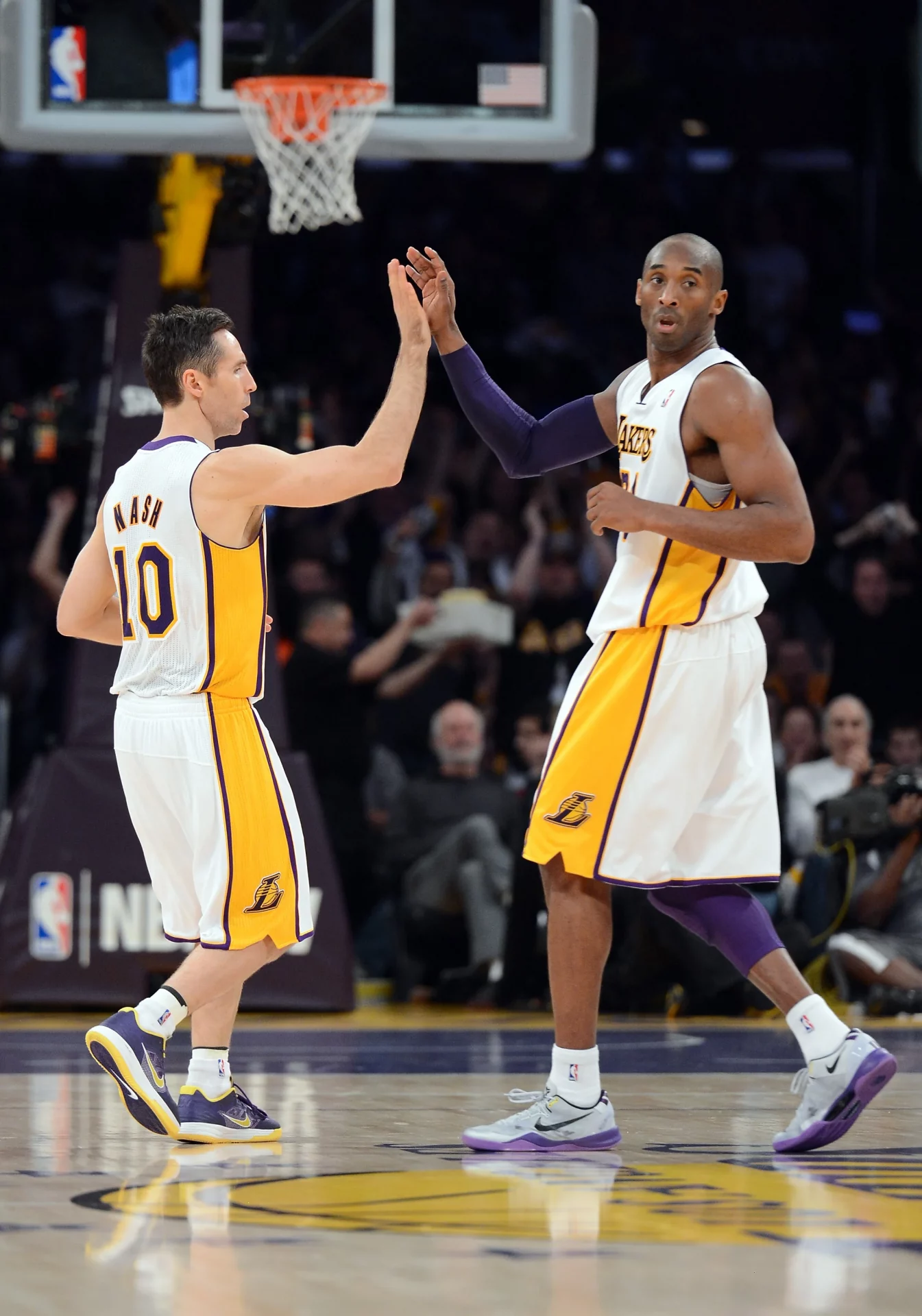
The collision happened in Portland, in the second game of the season. Steve Nash had come to the Lakers at 38, near the end of a long and ringless career, for one last run at a championship. He ran into the rookie Damian Lillard, fractured his left leg, and was carried off. He had played exactly one healthy game in the uniform, and he would never really be healthy in it again.
He had arrived in a 2012 sign-and-trade as the missing piece of a championship-or-bust roster: himself, Kobe Bryant, Dwight Howard, and Pau Gasol, a collection of names that looked unbeatable on paper and lost in the first round of the playoffs. He was a two-time MVP, the most accurate free-throw shooter the league had yet seen, at 90.4 percent, and a passer of rare gifts. Across three seasons in Los Angeles, hobbled first by the leg and then by nerve damage in his back, he managed just 65 games. The Lakers paid him $28 million for them.
On April 8, 2014, he threw a pass to Jodie Meeks for a dunk against Houston. It was the 10,335th assist of his career, which moved him past Mark Jackson into third place all-time. It was also the last assist he ever threw. He retired the next spring, a Hall of Famer in 2018, having never once reached an NBA Finals.
Dwight Howard
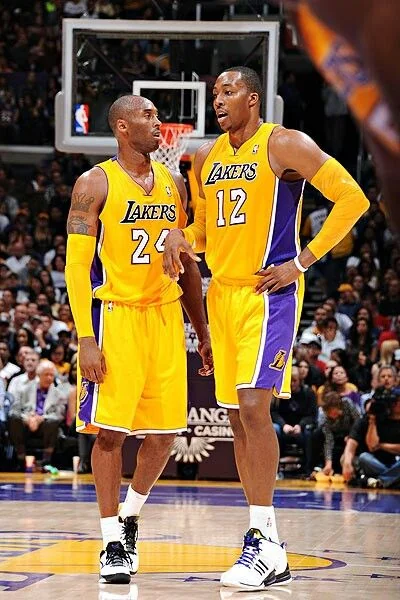
Dwight Howard is both a Lakers champion and a Kobe Bryant teammate, and through a quirk of timing he managed to be each of those things without ever being them at once. He arrived in Los Angeles for the 2012-13 season as the final piece of that doomed superteam, a three-time Defensive Player of the Year fresh off eight dominant years in Orlando. The fit with Kobe was a disaster. The two clashed, the season collapsed, and Howard left for Houston after a single year.
This is a man who once won a slam dunk contest in a Superman cape, leaping from near the free-throw line in 2008, the rare center to claim the title. At his peak he was almost untouchable, with three straight Defensive Player of the Year awards from 2009 to 2011 and a Magic team he carried to the 2009 Finals, where he lost to Kobe’s Lakers. The two did win Olympic gold together on the 2008 Redeem Team, which is its own odd footnote.
Howard returned to the Lakers in 2019 on a veteran’s minimum, a humbled role player by then, and finally won the championship that had escaped him. It came in October 2020, nine months after Kobe Bryant died in a helicopter crash. The teammate he had feuded with so publicly never saw it. Howard was elected to the Hall of Fame, first ballot, in 2025.
Frequently Asked Questions
Is Kobe Bryant in the Hall of Fame?
Yes. Bryant was elected in his first year of eligibility with the Class of 2020, less than three months after his death, and enshrined on May 15, 2021, after the pandemic postponed the ceremony. His family chose Michael Jordan to present him.
Who is the most recent Kobe Bryant teammate to make the Hall of Fame?
Dwight Howard, elected on the first ballot with the Class of 2025. The Class of 2026, announced in April, included no former Bryant teammates – its closest connection was Mike D’Antoni, his Lakers head coach from 2012 to 2014, who went in as a contributor. Howard keeps the distinction for now.
Who was the first of Kobe’s teammates inducted into the Hall of Fame?
Karl Malone, elected in 2010. Dennis Rodman followed in 2011, Gary Payton in 2013, and Mitch Richmond in 2014, which means the four one-year veterans all reached Springfield before Shaquille O’Neal, who was not eligible until 2016 and made it on the first try.
Was Vlade Divac really traded for Kobe Bryant?
Yes. On draft night in 1996 the Lakers sent Divac to Charlotte for the rights to the thirteenth overall pick, a 17-year-old Bryant. Eight years later Divac signed back with Los Angeles for one final, injury-shortened season, making him the only man ever traded for Kobe who then became his teammate.
Did Dwight Howard win a championship with Kobe Bryant?
No. Their one season together, 2012-13, went badly enough that Howard left for Houston that summer. He came back in 2019 as a reserve and won the 2020 championship the following autumn, nine months after Bryant’s death – a ring earned with the franchise but never alongside the man.
Did Karl Malone or Gary Payton win a ring with the Lakers?
No. Both signed in the summer of 2003 for one run at a title, and the Lakers fell to Detroit in the 2004 Finals in five games. Payton got his championship with Miami in 2006. Malone never got one, despite retiring with 36,928 points, second on the scoring list at the time.
Did Steve Nash ever win an NBA championship?
No, and he never played in a Finals either. Nash won two MVP awards, made eight All-Star teams, and retired in March 2015 holding the highest career free-throw percentage in league history, at 90.43, a record Stephen Curry has since taken. The Lakers years were the coda: three seasons, 65 games, and a lot of treatment tables.
- Basketball Reference – Vlade Divac (Hall of Fame as player 2019, career and Lakers 2004-05)
- NBA.com – Pau Gasol announced for Basketball Hall of Fame Class of 2023
- NBA.com – Legends Profile: Karl Malone
- Naismith Memorial Basketball Hall of Fame – Gary Payton
- Naismith Memorial Basketball Hall of Fame – Mitch Richmond
- Britannica – Steve Nash
- Britannica – Dennis Rodman
- CBS Sports – Dwight Howard elected to the Hall of Fame, Class of 2025