Every Monopoly Property and Its Real Atlantic City Location

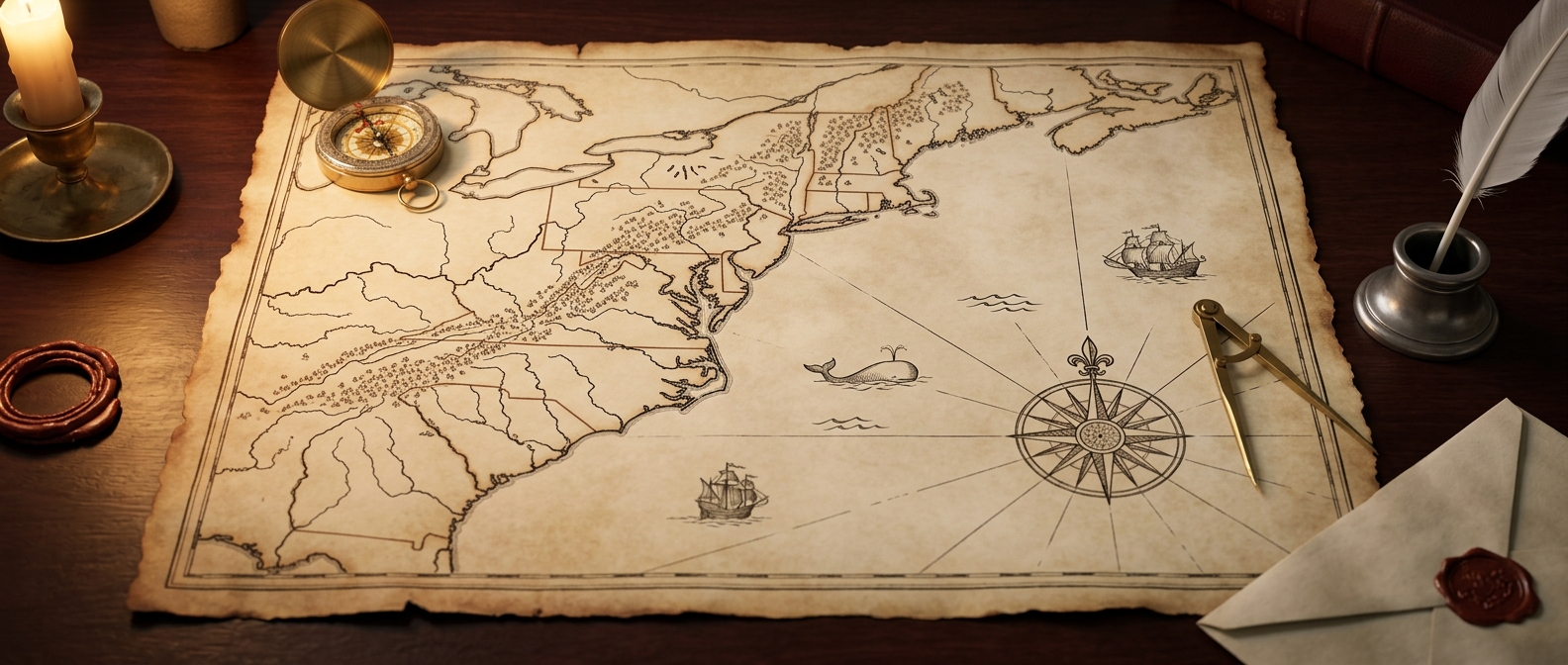
The street names on a Monopoly board are not invented. Every one of them was lifted from Atlantic City, New Jersey, a real resort town on a real barrier island, and for ninety years players have been buying and selling a slightly frozen snapshot of it without quite realizing. Boardwalk is a real boardwalk. Marvin Gardens is a real neighborhood, misspelled. The whole board is a map – a strange, simplified, accidentally honest map of one American city as it stood around 1933.
The pieces that move around these streets have their own graveyard – thirteen tokens retired over ninety years.
The map was not drawn by the man who got famous for it. Monopoly’s real origin runs back to 1904, when a Washington stenographer named Lizzie Magie patented The Landlord’s Game to show how landlords bleed tenants dry – an anti-monopolist teaching tool that became, through a long irony, the most famous celebration of monopoly on earth. Homemade versions spread by hand for decades. One reached Atlantic City in 1929 with a Quaker schoolteacher named Ruth Hoskins, whose friends Cyril and Ruth Harvey renamed the squares after streets they knew and had a local real estate man, Jesse Raiford, set the prices. The Harveys taught it to Charles Todd, who taught it to a salesman named Charles Darrow, who copied it down, sold it to Parker Brothers as his own invention in 1935, and grew rich. Magie sold her patent for five hundred dollars.
What Darrow handed Parker Brothers was a particular Atlantic City, captured at a particular moment, and the city has spent the decades since refusing to hold still. Streets have been demolished, renamed, paved into casino parking lots, and absorbed by neighboring towns. Two of the four railroads never served the city, and one of those two was not a railroad. What follows walks the board in order from GO, matching every name to the real place it came from – and to whatever became of it.
All 28 buyable squares on the standard American Monopoly board – 22 streets, four railroads and two utilities – are named for real places in Atlantic City, New Jersey, and the two shore towns south of it. Quakers living there fixed those names to a homemade board from 1929 onward, six years before Parker Brothers published it.
Mediterranean Avenue
Mediterranean Avenue is the cheapest property on the board, which is fitting, because on the original Atlantic City game it was called something colder. Ruth Hoskins and the circle of Quakers who first pinned local street names onto the board around 1929 labeled this square Arctic Avenue. Somewhere in the chain of hands that carried the game from Atlantic City to Charles Darrow and on to Parker Brothers, somebody decided a warmer name had more appeal, and Arctic became Mediterranean. The price stayed at the bottom.
The real Mediterranean Avenue still runs northeast through the city, a low-rise residential street far from the boardwalk. In the 1920s and 1930s this was one of Atlantic City’s poorer, predominantly Black neighborhoods, and its placement at the very start of the board – the square you pass right after collecting your $200 – was not an accident. The men who assigned the prices knew exactly which streets were worth the least, and they put them here.
The avenue has aged better than its $60 valuation suggests, an ordinary working street in an extraordinary game. It is the square almost nobody wants to land on and almost everybody eventually owns. For a street named after the warmest sea in the world, it has spent ninety years standing in for the cheapest dirt money can buy.
Baltic Avenue
Tucked on the corner of Baltic Avenue today is a J. Crew, which would astonish anyone who grew up regarding Baltic as the property you mortgage first and lose without a thought. The second-cheapest square on the board now anchors a thriving little retail strip near the entrance to the city, full of chain stores and foot traffic. Real estate, like the game, eventually moves on.
Baltic earned its place for a reason that has nothing to do with shopping. When Cyril and Ruth Harvey – the Atlantic City Quakers who refined Hoskins’s homemade board into the version that reached Darrow – chose which streets to immortalize, they reached for places they knew personally. Their maid, a Black woman named Clara Watson whom they were said to adore, lived on Baltic Avenue near Mediterranean, in one of the segregated neighborhoods the tourist brochures never mentioned. So the cheapest corner of America’s favorite game memorializes the home of a domestic worker in a city that kept its races firmly apart.
This is the uncomfortable thing about Monopoly’s geography: it is honest. The board does not pretend Baltic was Boardwalk. It put the poor streets where the poor streets were, at the bottom, cheap and crowded together, and then sold sixty million copies without anyone much noticing what they were looking at.
Reading Railroad
Of Monopoly’s four railroads, the Reading is the one you can still ride, more or less. The line was chartered in 1833 as the Philadelphia and Reading, opened in 1842, and spent the next century hauling anthracite coal down the Schuylkill River to Philadelphia – the clean-burning fuel that built the region’s fortune. It is pronounced “Redding,” which trips up roughly every first-time player who has ever proudly announced they own the Reading Railroad.
Unlike two of its boardmates, the Reading genuinely served Atlantic City. Through its control of the Atlantic City Railroad, it ran trains down to the shore packed with day-trippers and vacationers. Its rivalry with the Pennsylvania Railroad over that beach traffic grew so expensive that in 1933 the two competitors simply gave up and merged their South Jersey operations into the Pennsylvania-Reading Seashore Lines. Two of Monopoly’s railroads, in other words, were real enemies who became business partners.
The Reading’s later history is the standard tragedy of American railroading. Anthracite traffic collapsed, the Penn Central merger gutted its bridge business, and in 1971 the company went bankrupt for the last time. On April 1, 1976, its assets were folded into Conrail, and the lines were eventually split between Norfolk Southern and CSX. The railroad that printed money on the board went broke in real life. The board never updated the deed.
Oriental Avenue
Oriental Avenue runs a scant ten blocks through the southeastern corner of Atlantic City and then stops at the sand, which makes it one of the shortest streets to lend its name to the board. For most of its length it is a quiet strip of row beach houses, the kind of low, weathered places that outlasted a century of the city’s booms and collapses. One homeowner on the end has hung an oversized Monopoly title deed above the porch, which is either civic pride or a very patient joke.
The name is a relic of how Atlantic City sorted its people. In the early twentieth century, the avenue was where the city’s Chinese restaurants and Jewish delicatessens clustered – an immigrant pocket on a board that quietly recorded the city’s ethnic geography street by street. The light-blue properties were cheap, and they sat where the cheap, crowded, interesting neighborhoods were.
At the southern end of Oriental, the view changed in 2012, when the $2.4 billion Revel casino rose fifty-two stories into the air, sheathed in mirrored glass. It was meant to save Atlantic City. It went bankrupt within two years, closed, and later reopened under the name Ten. Oriental Avenue, the modest blue square nobody fights over, now has a failed billion-dollar monument looming over its beach houses.
Vermont Avenue
The tallest lighthouse in New Jersey stands on Vermont Avenue, which is the most distinguished thing any light-blue property can claim. The Absecon Lighthouse rises 171 feet over the north end of the city, built in 1854 to stop ships wrecking on the shoals where the Atlantic met Absecon Inlet. Its first keeper lit the lamp that January, and the tower has been a fixed point of the skyline ever since.
The lighthouse was officially decommissioned in 1933, its job made obsolete by better navigation and a coastline that had filled in with hotels far brighter than any beacon. But it never went dark for good. The light still switches on every night, now as a preserved monument rather than a working aid, and visitors can climb its 228 steps to the top. There is a recreated keeper’s house at the base.
Vermont Avenue itself is unremarkable – a short residential street, the middle child of the three blues, the sort of square that changes hands in a game without comment. Its claim to fame is borrowed entirely from the tower at its edge. The street that almost nobody remembers landing on happens to point straight at the oldest and tallest lighthouse in the state, still faithfully lighting a stretch of ocean that no longer especially needs it.
Connecticut Avenue
Connecticut Avenue is the priciest of the three light-blue properties, which in Monopoly terms is the difference between very cheap and slightly less cheap. In real Atlantic City it is a more consequential street than its $120 tag implies, running straight from the residential interior down to the boardwalk and the ocean. Land assembled along its lower end became the site of the Revel, and later the Ocean Casino Resort, one of the largest hotels on the East Coast.
The avenue has also quietly lost part of its own name. In 2018, the city rechristened the stretch from Melrose Avenue down to Oriental Avenue as “Ocean Beach Boulevard,” presumably because a boulevard sounds grander than an avenue to a tourist deciding where to gamble. The Monopoly square still says Connecticut. The street sign increasingly does not. The light blues are the cheapest full set a player can realistically lock down early in a game, which is the entire quiet case for owning them.
This is the recurring strangeness of the Atlantic City board. The game froze the city’s street map sometime around 1933 and then sold it, unchanged, to the whole world for the next ninety years, while the actual city kept renaming, demolishing, and rebuilding underneath it. Connecticut Avenue exists, mostly. Part of it is something else now. The board, as ever, declines to notice.
St. Charles Place
St. Charles Place is the first property most players ever buy that no longer exists. In its heyday, from the 1920s through the 1940s, it was a single elegant block of well-kept homes running from the boardwalk to Pacific Avenue, its entrance marked by brick columns with the street’s name worked into the masonry. A local historian once described it as an avenue of the genuinely exclusive.
Then the city declined and St. Charles Place declined with it. In 1968, the board of commissioners formally gave up the city’s rights to the street as part of an urban renewal scheme, erasing it from the map. Two decades later, in 1987, the Showboat casino was built across the land it had occupied. The block of fine homes became, eventually, a fenced-in valet parking lot for a Mardi Gras-themed gambling hall.
So when you land on the first pink square and weigh whether to buy it, you are bidding on a street that was vacated by municipal vote, paved over, and turned into a place to leave your car. The game preserves it perfectly – same name, same color, same $140 price – while the real St. Charles Place has been gone longer than most players have been alive. On the board, it remains a desirable property. Make of that what you will.
Electric Company
The Electric Company is one of two Monopoly spaces that isn’t a place at all, which is why generations of players have argued about how its rent works without ever wondering where it is. It corresponds to Atlantic City Electric, a utility founded in 1924 to wire the booming resort, and unlike most of the board’s locations, it is still very much in business – serving around 560,000 customers across southern New Jersey today as a subsidiary of the energy giant Exelon.
On the board, the Electric Company is famously unsatisfying. You cannot build houses on it. Its rent comes from a dice roll rather than a fixed schedule – four times the throw if you own one utility, ten times if you own both – so landing on it might cost an opponent eight dollars or it might cost forty, and either way nobody is going bankrupt over a lightbulb.
What the utilities capture, in their odd way, is something real about a 1920s seaside resort. Atlantic City ran on electricity and water at a scale most American towns could not imagine – the piers, the hotels, the boardwalk lit up like a permanent carnival. Jesse Raiford, the real estate man who priced the original board, slotted the power company and the waterworks into the game because no city like this one could function without them. The lightbulb on the square is crudely drawn. The grid behind it was not.
States Avenue
States Avenue is a very short street, and most of what made it interesting now belongs to somebody else. It runs a brief stretch along the west side of the Showboat, the same casino complex that swallowed its pink neighbor, St. Charles Place. The two cheaper pinks were once distinct city blocks. Today they sit in the shadow of one gambling hall that absorbed the whole corner.
The name comes from the founding logic of Atlantic City’s grid. When Dr. Jonathan Pitney laid the town out in the 1850s, the streets running parallel to the ocean were named for the world’s great waters – Atlantic, Pacific, Baltic, Mediterranean – and the streets running inland were named for the states. A player circling the Monopoly board is, without quite realizing it, touring that scheme: States, Virginia, Pennsylvania, the Atlantic and the Pacific. The town laid itself out as a map of America facing a map of the world, and the game inherited the whole arrangement intact.
There is not a great deal else to say about States Avenue, which is rather the point of it. It is a middling pink square, the kind you complete a set with but never celebrate. The real street is short, quiet, and mostly notable for what got built beside it. Some squares on the board carry a whole history. This one mostly carries cars to the casino.
Virginia Avenue
Follow Virginia Avenue to its end and you arrive at the Hard Rock Hotel and Casino, which spent most of its existence as something gaudier: the Trump Taj Mahal. The street is lined now with mostly newer homes, an ordinary approach to an extraordinarily strange building – a billion-dollar pleasure palace topped with onion domes and minarets that Donald Trump opened in 1990 and that limped through bankruptcies until it closed in 2016. Hard Rock bought it, gutted the Mughal fantasia, and reopened in 2018.
Virginia Avenue is the most expensive of the three pink properties, though “expensive” on the pink monopoly is a relative term. Its real-world fortunes have swung with whatever stood at its terminus – first the grand pre-casino hotels, then the Taj, now the guitar-shaped empire of a restaurant chain that became a casino company.
What is easy to miss is how faithfully the pink group traces a single neighborhood. St. Charles, States, and Virginia were three short streets clustered near the same stretch of boardwalk, and the game placed them together, priced them together, colored them together. Buy the set and you have, in effect, reassembled a small corner of 1930s Atlantic City: one street now a parking lot, one in a casino’s shadow, and one running straight at a demolished palace. The neighborhood is gone. The monopoly endures.
Pennsylvania Railroad
The Pennsylvania Railroad was, for a time, the largest corporation in the world, which makes its flat $200 price on the board feel almost insulting. At its peak it called itself the Standard Railroad of the World, and it nearly earned the boast – more track, more freight, and more employees than most national governments could manage. On the board it is merely the second railroad, sitting between Virginia Avenue and St. James Place, worth precisely as much as the other three.
It reached Atlantic City the way a giant reaches a small resort: through a subsidiary. The West Jersey and Seashore Railroad carried the Pennsylvania’s passengers down to the beach, competing for day-trippers until the rivalry with the Reading became pointless and the two combined their South Jersey routes in 1933. For a company of the Pennsylvania’s size, the Atlantic City run was a rounding error. For Atlantic City, it was a lifeline that delivered the crowds the whole town was built to absorb.
The decline, when it came, was as large as everything else about the railroad. In 1968 the Pennsylvania merged with its ancient rival the New York Central to form Penn Central, and within two years Penn Central had filed what was then the biggest corporate bankruptcy in American history. The wreckage went into Conrail and Amtrak. The greatest railroad the country ever built ended as a byword for collapse, and stayed, on the board, two hundred unbothered dollars.
St. James Place
St. James Place runs for only a couple of blocks, tucked between New York and Tennessee Avenues just south of Pacific, and it is the first of the orange properties – the set hardened Monopoly strategists prize above all others. The orange group sits just past Jail, in the landing zone where players spill out after their stay, which makes it statistically one of the most profitable color sets on the board. Whether the men who priced the game in 1933 understood this is doubtful. They were ranking Atlantic City real estate, not running probability tables.
The real St. James Place is one of the board’s quieter survivors. It still exists, still bears its name, and carries none of the dramatic fate that befell its neighbors – no demolition, no renaming, no billion-dollar casino rising and falling at its end. It is simply a short city street that happened to sit near the Harveys’ friends and so got written onto the most famous board game in the world.
There is a particular pleasure in the orange group for anyone who plays seriously. St. James, Tennessee, and New York are cheap enough to buy early and lethal once built up, sitting exactly where opponents leaving Jail tend to land. The square named after a modest two-block street is, in careful hands, one of the deadliest pieces of property in the game. Atlantic City never knew.
Tennessee Avenue
Run your eye along the middle of the orange monopoly and you reach Tennessee Avenue, the set’s center square and one of the most-landed-on properties in the entire game. The math is unglamorous but reliable: it sits a short, common dice roll past Jail, and because so many players pass through Jail so often, the dice keep depositing them onto Tennessee. Owning it with a hotel is one of the surest ways to bleed an opponent dry.
The real Tennessee Avenue runs parallel to New York Avenue through the heart of old Atlantic City, and in the resort’s heyday it was thick with restaurants, bars, and the after-dark business of a town that never closed. It was a working entertainment street, less notorious than its neighbor but busy in its own right, the place where the city’s nightlife spilled off the boardwalk into the blocks behind it.
The gap between the street and the square is what makes the orange group quietly fascinating. On the board, Tennessee is a calculated kill zone, a property serious players fight over with real intensity. On the map, it is a mid-tier Atlantic City avenue that the Harveys happened to know and like. The game turned an ordinary street into a weapon, purely by accident of where it fell relative to a cardboard jail.
New York Avenue
New York Avenue completes the orange set and carries the most surprising history of any street on the board. Long before the subject was discussed in polite company, the avenue was home to some of the earliest gay bars in the United States – an established district of clubs that drew people from across the region to a resort which had always made its money by looking the other way. Atlantic City sold itself as a place where the ordinary rules relaxed for a week, and New York Avenue was where that promise ran deepest.
The historian Mary Pilon, who untangled the game’s true origins, documented how the avenue’s reputation was an open secret in the Atlantic City the Harveys knew. The street that now sits in Monopoly’s most coveted color group was, in the 1920s and 1930s, the center of the city’s gay nightlife, decades ahead of almost anywhere else in the country.
None of this reaches the board, of course. New York Avenue appears as an orange rectangle priced at $200, indistinguishable in tone from any other square, its history sanded flat by a game aimed at the family table. The men who built the board chose these streets because they knew them – and they knew this one. The most quietly radical street in twentieth-century America spent ninety years disguised as a property you buy to finish a set.
Kentucky Avenue
In 1935, the same year Parker Brothers patented Monopoly, a nightclub called Club Harlem opened at 32 North Kentucky Avenue, and for the next half-century it was the most electric address in Atlantic City. The red property players grab on the way around the board sat, in real life, on the street that held the beating heart of Black American entertainment on the East Coast. Sammy Davis Jr. played there. So did Louis Armstrong, Dinah Washington, Sarah Vaughan, and Gladys Knight. The Sunday breakfast shows started at five in the morning and the music did not stop until Monday.
Kentucky Avenue ran through the Northside, the neighborhood where Atlantic City’s segregated Black community had lived since the First World War, and “Kentucky Avenue and the Curb” became shorthand for a strip of clubs – Club Harlem, Grace’s Little Belmont, the Wonder Garden – that pulled in white celebrities like Frank Sinatra after their own boardwalk shows let out. The town kept its races apart by day and quietly mixed them on Kentucky Avenue by night.
The casinos killed it. As gambling moved onto the boardwalk in the late 1970s, the streetfront clubs emptied, and Club Harlem closed for good in 1986. The building was demolished in 1992. The red square remains worth $220, the same as ever – a price on a street whose real value was never measured in rent.
Indiana Avenue
On the night of October 18, 2007, a crowd of tens of thousands gathered along the Atlantic City boardwalk to watch the Sands casino disappear. Four hundred pounds of sequenced explosives dropped the twenty-one-story tower in under twenty seconds, the first time a casino-hotel had ever been imploded on the East Coast. The Sands stood on Indiana Avenue, the red property players snap up on the third side of the board, and its Copa Room had once been where Frank Sinatra and the Rat Pack performed when they were in town.
The implosion was sold as a beginning, not an end. A Las Vegas company had bought the site to build a $1.5 billion megacasino, and the demolition was staged like a celebration, complete with fireworks and commemorative cocktails at the neighboring hotels. Then the financial crisis hit, the project collapsed, and the cleared lot on Indiana Avenue simply sat there, an expensive hole where a famous casino used to be.
This is the pattern Indiana Avenue captures better than almost any square on the board. Atlantic City keeps demolishing its past to make room for a future that does not arrive. The red group is one of the more valuable color sets in the game, worth fighting for, full of promise. The real Indiana Avenue spent years as a vacant lot behind Bally’s, waiting for the thing that was meant to replace what got blown up.
Illinois Avenue
Illinois Avenue is the single most-landed-on property in Monopoly, and it does not even rely on the dice to get you there. The Chance deck contains a card that reads “Advance to Illinois Avenue,” a direct summons from anywhere on the board, which is why a red square in the middle of the third side collects more visits than anything else in the game. Build a hotel on it and you own the busiest corner in Monopoly.
The real street has done less well. In 1988, Atlantic City renamed Illinois Avenue as Dr. Martin Luther King Jr. Boulevard, so the most-landed-on property in the world’s most famous board game no longer exists under the name printed on the board. In its prime it was a grand address. The Traymore Hotel – a tan-brick, gold-domed giant nicknamed the Skyscraper by the Sea – stood at Illinois Avenue and the boardwalk until it was demolished in 1972, four years before gambling was even legalized. The Paradise Club on Illinois was where the Count Basie Orchestra played.
So the busiest square on the board points to a street that has shed its name, lost its grandest hotel, and reinvented itself as a memorial boulevard. The game still sends millions of players to Illinois Avenue every year. Most of them have no idea they are visiting a place that quietly stopped being Illinois Avenue decades ago.
B&O Railroad
There is one small problem with the B&O Railroad as an Atlantic City landmark: it never went anywhere near the place. The Baltimore and Ohio, as its name plainly states, ran between Baltimore and the Ohio River, hundreds of miles from the Jersey Shore. How it ended up on a board otherwise built entirely from Atlantic City geography is a question the game has never satisfactorily answered.
It is, in fairness, a genuinely historic railroad – arguably the most historic of the four. Chartered in 1827, the B&O was the first common carrier railroad in the United States and the oldest, and when construction began on July 4, 1828, the ceremonial first stone was laid by Charles Carroll, the last surviving signer of the Declaration of Independence. It pioneered American railroading, crossed the Appalachians, reached the Midwest, and survived into the 1980s before vanishing into the Chessie System and then CSX.
But it was the wrong railroad for this board. A booklet packaged with a later reprint of the 1935 edition quietly admitted the truth: the four lines actually serving Atlantic City in the mid-1930s were the Jersey Central, the Seashore Lines, the Reading, and the Pennsylvania. Two of those made it onto the board. The B&O, which did not, got a square anyway, probably because Charles Darrow simply liked the sound of it. It is the most famous railroad in the game that has nothing to do with the city the game is about.
Atlantic Avenue
Run the length of Atlantic City and you are mostly running the length of Atlantic Avenue, the long main artery that gave the whole resort its name. It is one of the few Monopoly streets that is genuinely major – a working commercial spine, one block in from the boardwalk, lined today with shops, casinos, and the ordinary business of a city. Where Mediterranean and Baltic are short and poor, Atlantic Avenue is the real thing: the street the town was organized around.
Like its yellow neighbor Ventnor, Atlantic Avenue does not stop at the city limits. It runs clear out of Atlantic City and continues into the adjoining town of Ventnor City, which means part of the avenue printed on the board lies outside the city the board supposedly maps. This is the quiet secret of the yellow group: it drifts toward the suburbs, away from the boardwalk glamour, into the residential edge of Absecon Island.
The avenue takes its name from the same scheme that named the city – the ocean-parallel streets honoring the world’s great waters, with the Atlantic the grandest of them all. There is a tidy circularity to it. The ocean named the city, the city named the street, and the street named a square that millions of people now buy and trade without ever seeing the water it points to.
Ventnor Avenue
Ventnor Avenue spends part of its life outside Atlantic City entirely, which makes it one of two yellow properties that quietly leave the city the board is named for. The avenue begins in Atlantic City and continues straight into Ventnor City, the neighboring town just down the island, where the street keeps its name but changes its municipality. A player who lands on Ventnor is buying real estate that is partly somewhere else.
This matters more than it sounds, because Ventnor City is half of a more famous geographic puzzle. The yellow group’s third property, Marvin Gardens, takes its name from a neighborhood on the border of Ventnor City and Margate – the two towns that gave Marven Gardens its stitched-together name. So the yellow set is the board’s suburban corner, the place where Atlantic City blurs into the quieter shore towns around it, full of the kind of residential streets families actually lived on.
Ventnor itself is unremarkable in the game, a middling yellow worth $260, the sort of property you complete a monopoly with rather than celebrate. Its real distinction is honesty about geography. The board calls it an Atlantic City street, and for part of its length that is simply not true. Ventnor Avenue keeps going after the city ends, indifferent to the municipal line and to the game that immortalized it.
Water Works
Water Works is the second of Monopoly’s two non-places, the square that pays out on a dice roll and that nobody has ever been thrilled to own. It corresponds, loosely, to Atlantic City’s municipal water supply – the system that pulled drinking water from reservoirs and the deep sand aquifers beneath Absecon Island to serve a resort that, at its peak, had to quench the thirst of a quarter-million summer visitors at once.
The mapping is softer than the streets, because a water system is not an address. There is no single building you can photograph and call Water Works. The public authority that runs Atlantic City’s water today, the Atlantic City Municipal Utilities Authority, did not even exist until 1978 and only took over the old city water utility in 1980 – long after Jesse Raiford slotted a generic waterworks onto the original board in the early 1930s.
What Raiford understood is that no city like this one runs without water and power, so he gave the game one of each, tucked between the colored streets like infrastructure between neighborhoods. The two utilities are the least glamorous squares in Monopoly and among the least useful to own. They are also, in their dull way, the most honest. Behind the lit-up boardwalk and the grand hotels, a real city needs pipes and a pumping station. The board found room for the pipes.
Marvin Gardens
Marvin Gardens does not exist, and it never did. The real place is Marven Gardens, spelled with an e, a small residential neighborhood the board has misspelled continuously since 1935. The error came from Charles Todd, the friend who taught the game to Charles Darrow on a hand-drawn board. Todd wrote “Marvin,” Darrow copied it, Parker Brothers printed it, and a typo became one of the most reproduced words in American leisure.
It gets stranger. Marven Gardens is the only property on the entire board that is not in Atlantic City at all. It sits two miles south, straddling the border between Margate City and Ventnor City – which is exactly where the name comes from, a portmanteau of Margate and Ventnor stitched together. Parker Brothers did not formally apologize for the misspelling until 1995, sixty years in, and then declined to correct it on the grounds that fixing every board would cost too much. Margate had earlier passed a resolution proposing that the real neighborhood be renamed Marvin to match the game. It went nowhere.
Today the streets of Marven Gardens – Circle Drive, East Drive, West Drive – carry signs that lean into the confusion, the name spelled correctly on a yellow background with little replica Monopoly houses on the posts. The neighborhood the game misspelled, relocated, and never properly apologized to has decided to enjoy the attention. It is the wisest response available.
Pacific Avenue
One block in from the boardwalk, Pacific Avenue has become both the most valuable and the most desolate street on the board. The big resorts back onto it – their towers rise from Pacific while their fronts face the ocean – and so does a long stretch of vacant lots, boarded houses, and the hard evidence of a city that has been losing residents for decades. On the green property players prize as prime real estate, the real street alternates between billion-dollar casinos and empty ground.
It is the first of the green group, the second-most-expensive color set, and the greens trace the busy commercial core where Atlantic City did its serious business. Pacific carried the city’s main post office, the building where, in the resort’s heyday, federal agents reportedly listened in on the men who really ran the town. Atlantic City was governed for thirty years by a political boss named Nucky Johnson, and Pacific Avenue ran straight through the middle of his world.
The street still works, after a fashion. Bally’s sits at 1900 Pacific, and other casinos line it. But Pacific Avenue is also where the gap between the board and the city yawns widest – a green square that signals wealth in the game and shows you, in real life, exactly what happened to a resort that bet everything on gambling and did not entirely win.
North Carolina Avenue
American casino gambling outside Nevada began on North Carolina Avenue. On May 26, 1978, Resorts International opened its doors in the converted Chalfonte-Haddon Hall at the corner of North Carolina and the boardwalk, the first legal casino in the United States outside Las Vegas. The line of people waiting to get in stretched down the boardwalk and around the corner onto Pennsylvania Avenue – which is to say, the queue for the first East Coast casino ran from one green Monopoly property to the next.
The building itself was older than the game. The Haddon House had opened in 1869, expanded into the grand Haddon Hall over the following decades, and stood as a respectable boardwalk hotel for nearly a century before a paint company turned developer gutted its lower floors for a gaming room. When New Jersey legalized gambling, Resorts got there first, and the rush that followed remade the entire city.
North Carolina Avenue is a middle green, worth $300, the kind of property a serious player wants because the green set is genuinely lucrative. What the board cannot tell you is that this particular green square is where the modern Atlantic City was born – where the gamble on gambling paid off, briefly and spectacularly, before the rest of the casinos arrived and the long, complicated decline set in. Every casino in the city traces back to a doorway on North Carolina Avenue.
Pennsylvania Avenue
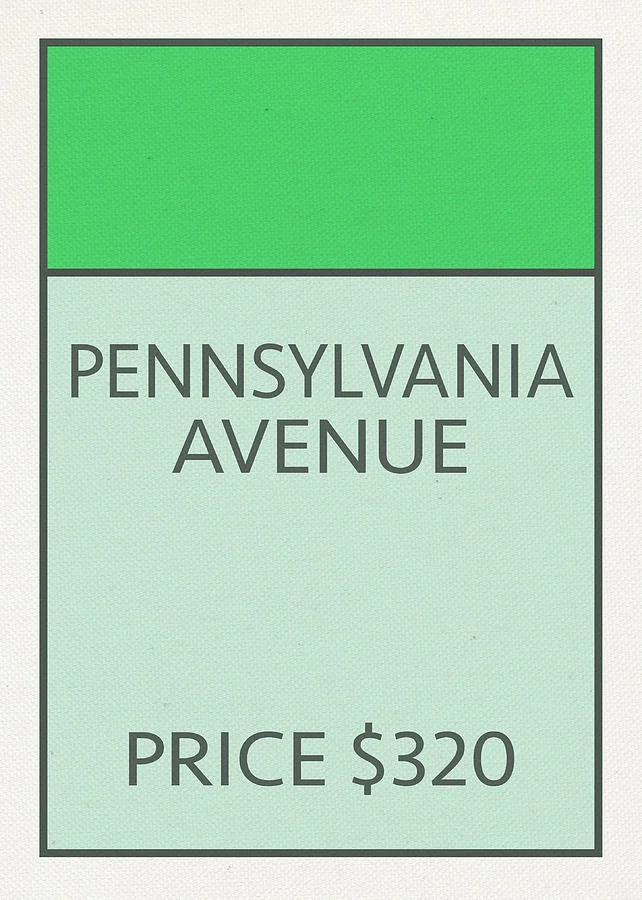
Pennsylvania Avenue is on the board because the people who built the board lived on it. Cyril and Ruth Harvey, the Atlantic City Quakers who took Ruth Hoskins’s homemade game and refined it into the version that reached Charles Darrow, made their home on Pennsylvania Avenue – and when they chose which streets to write into the game, they gave their own one of the highest prices on it. Pennsylvania is the most expensive of the three greens at $320, behind only Park Place and Boardwalk.
There is something quietly revealing in that. The board’s prices were assigned by the Harveys’ friend Jesse Raiford, a local real estate man, and they track real 1930s property values with surprising honesty – the poor streets cheap, the boardwalk dear. But the Harveys also got to immortalize their own address and rank it near the top, which is the sort of small, human liberty anyone would take if handed the power to turn their neighborhood into a game.
The green group sits at the wealthy end of the board, the last full color set before the dark-blue summit, tracing the busy and desirable heart of the old resort. Pennsylvania Avenue anchors it. The couple who, more than anyone, decided what Atlantic City looked like on a Monopoly board made sure their own front door landed in the expensive neighborhood. It is hard to blame them.
Short Line
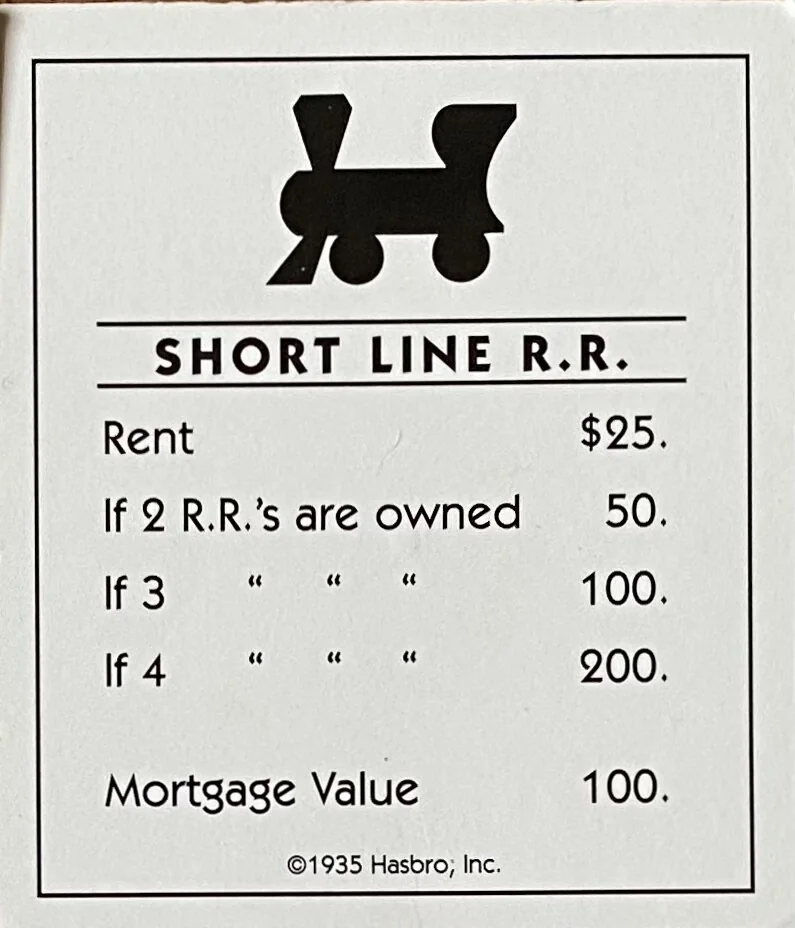
The Short Line was not a railroad. It was a trolley. The name is a shortened form of the Shore Fast Line, an electric interurban streetcar service that the friends who built the board trimmed to “Short Line” to fit the small square. The Atlantic City and Shore Railroad ran it, and for four decades it carried passengers the eleven miles from Atlantic City down to Ocean City, threading through the mainland towns of Pleasantville, Northfield, Linwood, and Somers Point.
It opened in 1907, in the great age of the American trolley, when electric interurbans connected towns the way buses and cars later would. The Shore Fast Line was a genuine piece of the region’s transit, not a mainline railroad but a real and useful thing, humming along its viaduct over the marshes between the island and the shore towns. Then, in 1948, a hurricane wrecked the viaduct, and with trolleys already dying out across the country, no one judged it worth the cost to rebuild. The line simply stopped.
So of Monopoly’s four railroads, only two were real railroads that served Atlantic City. One, the B&O, served the wrong city. And one, the Short Line, was a streetcar that a storm finished off in 1948 and that has not existed in any form for over seventy years. The board still charges $200 for it. You are buying a ticket on a trolley that drowned.
Park Place
Park Place is the second-most-expensive property in Monopoly and one of the least-landed-on, a combination that has frustrated players for ninety years. It is the cheaper half of the dark-blue monopoly, the square you need to pair with Boardwalk to assemble the most fearsome color set in the game, and the one opponents seem to glide past while landing on everything around it. When someone does land on a developed Park Place, the game is usually nearly over.
The real Park Place was named for a small park near the boardwalk that no longer exists. What does survive is a plaque on the street commemorating Charles Darrow, the salesman who sold the game as his own invention and grew rich, while the woman who actually devised it, Lizzie Magie, sold her patent for five hundred dollars and got no credit at all. The plaque, in other words, honors the wrong person, which is somehow fitting for a street named after a vanished park.
Park Place once held one of the grandest hotels in Atlantic City, the Marlborough-Blenheim, a turreted fantasy modeled on the ancestral palace of the Dukes of Marlborough. It was torn down in the 1970s like most of the old resort’s landmarks, and Bally’s now occupies much of the ground. The most expensive neighborhood on the board lost its park and lost its palace, and what remains is a plaque honoring the one man in the whole story who least deserved it.
Boardwalk
The most expensive square in Monopoly began as a way to keep sand out of hotel lobbies. In the summer of 1870, a railroad conductor named – with almost suspicious convenience – Alexander Boardman, together with a hotelier named Jacob Keim, persuaded Atlantic City to lay down a temporary wooden walkway along the beach, so that visitors would stop tracking sand into the hotels and the railroad cars. It was eight feet wide, about a mile long, and dismantled and stored away each winter. It was the first boardwalk in America.
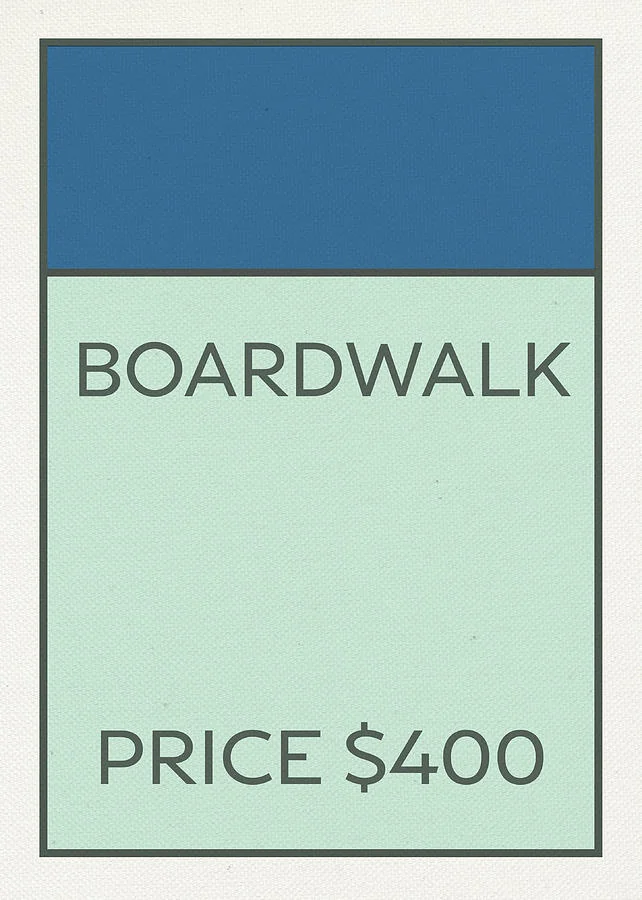
It did not stay temporary or modest for long. The walkway was rebuilt bigger again and again, lined with hotels and amusement piers, and became the promenade that defined Atlantic City – the place people came to be seen, to stroll, to spend. By the time the game froze the city in cardboard, Boardwalk had become shorthand for the most desirable ground in town, and so it sits at the board’s highest corner, priced at $400, the property everyone wants and dreads in equal measure.
There is a neat joke buried in the deed. The single most coveted square in the most famous real estate game ever made is named not for a grand avenue or a fashionable address, but for a humble wooden footpath invented so that wealthy tourists would not have to feel sand between their toes. The whole glittering empire of Monopoly rests, at its most expensive point, on a device for keeping shoes clean.
Frequently Asked Questions
Is Marvin Gardens a real place?
Yes, but the board spells it wrong. The real Marven Gardens takes an e, and the name is a portmanteau of Margate City and Ventnor City, the two towns it straddles about two miles south of Atlantic City. Parker Brothers apologized to residents in 1995 and then declined to fix the boards.
Which Monopoly property is landed on most often?
Illinois Avenue, and it gets help. A Chance card sends players straight to it from anywhere on the board, and the square also sits a common roll past Jail. Only Jail itself is visited more, which is why a hotel there earns more than any square but Boardwalk.
Why is Boardwalk the most expensive property in Monopoly?
Because it stands for the first boardwalk in the world. Atlantic City laid an eight-foot wooden walkway along its beach on June 26, 1870, at the urging of a railroad conductor and a hotelier tired of sand indoors. By the 1930s the ground beside it carried the city’s highest values.
Why is the B&O Railroad on the Monopoly board if it never reached Atlantic City?
Nobody has established why. The Baltimore and Ohio ran west from Baltimore toward the Ohio River, hundreds of miles from the Jersey Shore. The four lines actually serving Atlantic City in the mid-1930s were the Jersey Central, the Seashore Lines, the Reading and the Pennsylvania. Two made the board.
Was Monopoly’s Short Line a real railroad?
No. Short Line was shorthand for the Shore Fast Line, an electric trolley the Atlantic City and Shore Railroad ran eleven miles down to Ocean City from 1907. A hurricane wrecked its viaduct over the marshes in 1948, and with trolleys dying out nobody rebuilt it.
Does Illinois Avenue still exist in Atlantic City?
Not under that name. Atlantic City renamed it Dr. Martin Luther King Jr. Boulevard, dedicating the new signs in January 1988 after a council vote the previous May. Parker Brothers asked the city to preserve the old name somewhere. A councilman suggested the company change its board instead.
Do any Monopoly streets no longer exist at all?
One does not. St. Charles Place, the first pink property, was a block of homes running down to the Boardwalk until it vanished under the Showboat casino, which opened on March 30, 1987. Every other street on the board is still on the map somewhere.
Which Monopoly property is where American casinos outside Nevada began?
North Carolina Avenue. Resorts International opened there on May 26, 1978, in the converted Haddon Hall, and became the first legal casino in America outside Nevada. The hotel it took over had stood on the site since 1869, sixty years before the game reached Atlantic City.
- Encyclopedia of Greater Philadelphia: Monopoly
- Britannica: Baltimore and Ohio Railroad
- Big Think / Strange Maps: How Atlantic City inspired the Monopoly board
- Scouting NY: What the Monopoly Properties Look Like in Real Life
- City of Atlantic City: History of Atlantic City
- Atlantic County, NJ: Atlantic City’s First Boardwalk, June 1870
- Atlantic City Municipal Utilities Authority: About Us