Every Greek God of War: All 21 Divine Beings of Battle in Greek Mythology
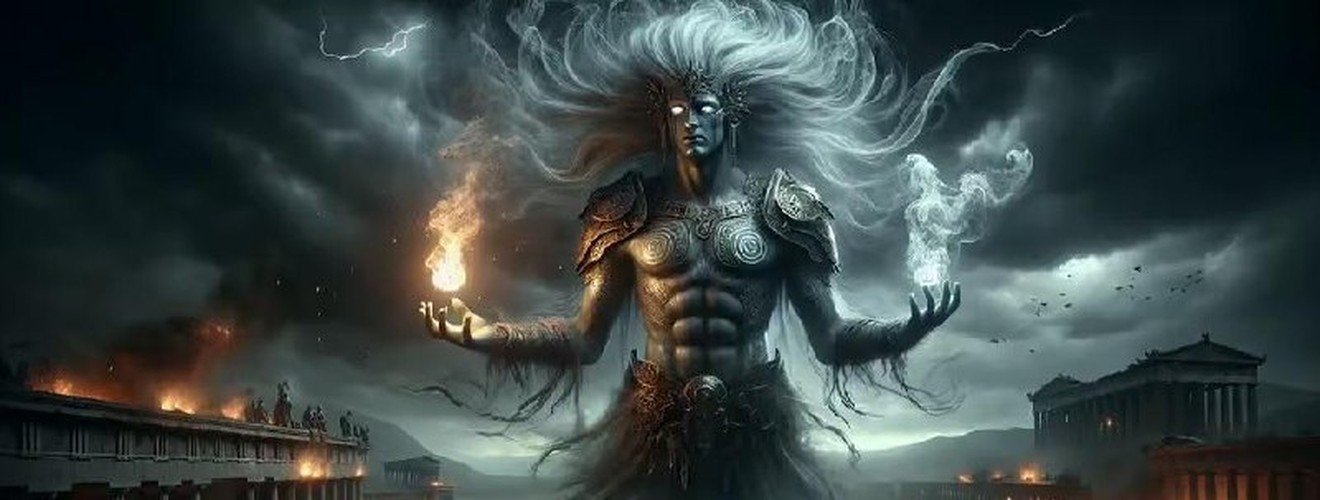
Hesiod gives Strife fourteen children and no husband. In the Theogony (in Hugh G. Evelyn-White’s translation), “abhorred Strife bore painful Toil and Forgetfulness and Famine and tearful Sorrows”, and then, sharing a single line of the Greek, “Fightings also, Battles, Murders, Manslaughters”. After that she moves on to Quarrels, Lying Words, Disputes, Lawlessness and Ruin, and finishes with Oath, “who most troubles men upon earth when anyone willfully swears a false oath”. Four of the fourteen are war. The rest are what war tends to leave behind.
This is roughly how the Greeks thought about battle. They did not have a god of war so much as a crowd of them. Homer gives names to the rout, the onset, the din and the valour of a fight; the poet of the Shield of Heracles adds the pursuit, the flight and the noise; a verse credited to Pindar names the war cry, and Aristophanes walks War himself onto the stage. Many of these figures live in a single line of a single poem, and a few sit so close to ordinary words that the only thing separating the spirit from the noun is whether the Greek text gives it a capital letter.
What follows is every one of them that an ancient Greek text actually presents as a power of war or battle, with the line that does it. Two are great Olympians and the rest are their followers, and they come in the order the texts introduce them: Homer’s battlefield first, then Hesiod’s family of Strife, then the cast of the Shield, and the latecomers last. Rome’s war gods and a few figures who only look martial are dealt with in the questions at the end.
Greek mythology has 21 gods and spirits of war: two Olympians, Ares and Athena, and 19 lesser daimones and personifications, including Enyalios, Phobos, Deimos, Eris, Enyo, Nike, Polemos and the Makhai. Each one is here because an ancient Greek text names it with a domain of war or battle, and they appear in the order those texts introduce them.
Ares
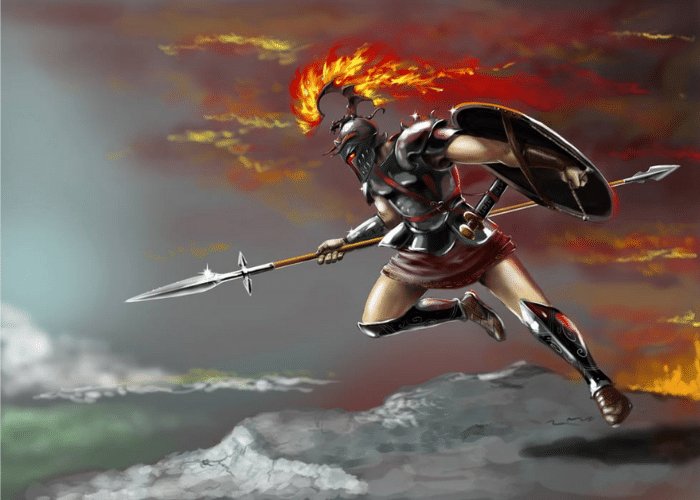
The god of war was the god his own father liked least. When Ares goes back to Olympus bleeding in the fifth book of the Iliad, Zeus offers no sympathy at all: “Sit thou not in any wise by me and whine, thou renegade. Most hateful to me art thou of all gods that hold Olympus, for ever is strife dear to thee and wars and fightings” (in A. T. Murray’s translation). The Greek behind “renegade” means something nearer to turncoat, a god who changes sides.
He was in that state because Diomedes, with Athena steering the spear, had caught him low in the belly, and Ares “bellowed loud as nine thousand warriors or ten thousand cry in battle”, which set Greeks and Trojans alike trembling. It was not his first indignity. Earlier in the same book Dione recalls that the sons of Aloeus, Otus and Ephialtes, once bound him, and “in a brazen jar he lay bound for thirteen months” until Hermes stole him out.
The Athenians honoured him all the same, after their fashion. Pausanias says the Areopagus was “the Hill of Ares, so named because Ares was the first to be tried here”, charged with killing the man who had violated his daughter Alcippe. And the Homeric Hymn to Ares, having hailed him as golden-helmed and shield-bearer, ends with the poet asking for the boldness “to abide within the harmless laws of peace”. Even his own hymn hoped he would calm down.
Athena
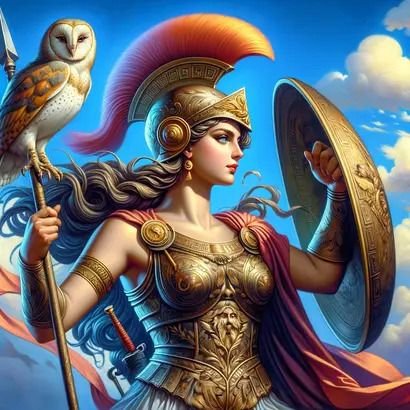
Athena came into the world shouting. In Pindar’s seventh Olympian ode (Diane Arnson Svarlien’s translation), Hephaestus splits Zeus’s head with a bronze-forged hatchet, and she leaps from the top of it and cries aloud “with a mighty shout”, so that “the Sky and mother Earth shuddered before her”. The Homeric Hymn to Athena adds that she arrived dressed for work, “arrayed in warlike arms of flashing gold” and “shaking a sharp spear”, while great Olympus reeled.
Hesiod’s Theogony gets her titles into one breath: “the awful, the strife-stirring, the host-leader, the unwearying, the queen, who delights in tumults and wars and battles”. Unlike Ares, she tends to win. When he charges her late in the Iliad, calling her a dog-fly, she picks up a black, jagged stone that “men of former days had set to be the boundary mark of a field”, hits him on the neck and stretches him out over seven roods. Then she laughs at him.
Athens put her up in bronze on the Acropolis, a work of Pheidias paid for as a tithe from the Persians who landed at Marathon, and Pausanias says the point of her spear and the crest of her helmet could be seen by anyone sailing for Athens “as soon as Sunium is passed”. Homer sums up one of her afternoons by saying that she and Hera went home once they “had made Ares, the bane of mortals, to cease from his man-slaying”. War, it seems, had a supervisor.
Enyalios
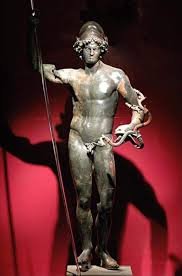
Each company of Spartan youths sacrificed a puppy to Enyalios at night before its fight in the Plane-tree Grove, on the reasoning, Pausanias says, “that the most valiant of tame animals is an acceptable victim to the most valiant of the gods”. Then they set trained boars to fight one another, and the company whose boar won generally won the fight as well.
Sparta also kept “an old image of Enyalius in fetters”, on the theory that, chained, he “will never run away from them” – the same idea, Pausanias notes, as the Athenians’ Wingless Victory, who “having no wings, will always remain where she is”. Who exactly they had chained is a harder question. The Iliad uses the name nine times, and Enyalios often looks like another name for Ares: Hector is filled by “Ares, the dread Enyalius”, and a man Homer calls a son of Enyalius is later claimed by Ares as his own. Yet in Aristophanes’ Peace, Ares and Enyalios are offered up as two separate candidates for a cheer, and Athenian ephebes swore their oath before Enyo, Enyalios and Ares as three different witnesses.
The name is older than the argument. A Linear B tablet from the Room of the Chariot Tablets at Knossos lists four gods, and one of them is e-nu-wa-ri-jo, which the classicist Thomas Palaima renders “to Enualios”. Whoever Enyalios was, somebody in the Bronze Age was already keeping his accounts.
Deimos
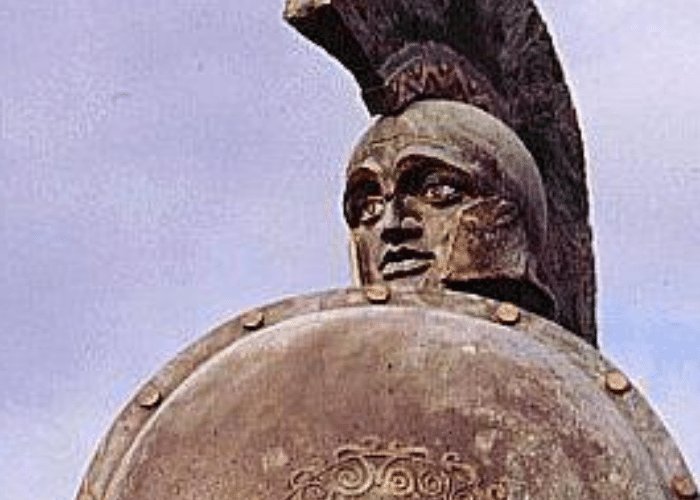
Three times the Iliad names Deimos, always ahead of his brother Phobos, and on the last occasion he is told to get the horses ready for a trip that never happens. Ares has just learned from Hera that his son Ascalaphus is dead; he smites “his sturdy thighs with the flat of his hands” and “bade Terror and Rout yoke his horses” (Murray’s Terror is Deimos). Before anyone can leave, Athena takes the helmet off his head, the shield off his shoulders and the spear out of his hand, and sits him back down on his throne.
The Shield of Heracles, a poem long attributed to Hesiod, at least lets the brothers drive. When Heracles wounds Ares in the thigh, “Panic and Dread quickly drove his smooth-wheeled chariot and horses near him” and carried him off to Olympus. Hesiod’s Theogony makes the pair sons of Ares and Aphrodite, “terrible gods who drive in disorder the close ranks of men in numbing war”.
On August 11, 1877, Asaph Hall of the U.S. Naval Observatory found the smaller of the two moons of Mars, and on August 17 the larger one, and named them for the sons of Ares. Deimos, the first found, measures 15 by 12 by 11 kilometers and goes round Mars every 30 hours. NASA notes that it has a smoother appearance than its brother, some of its craters partly filled in. In that family, smooth counts as a distinction.
Phobos
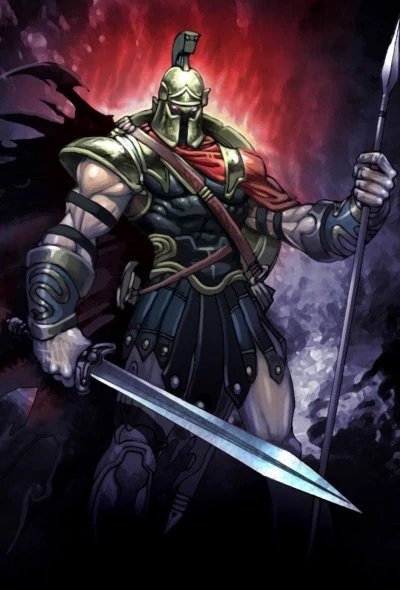
Sparta had a temple of Fear, and it was usually kept closed. Plutarch tells how, when Cleomenes’s men cut down the city’s ephors, one of them, Agylaeus, lay still as though dead, then “crept unobserved into a little building which was a temple of Fear”, found it open for once, bolted himself in and walked out alive the next day. The Spartans, Plutarch explains, honoured Fear not to keep it away but “because they believe that fear is the chief support of their civil polity”. Alexander the Great, with the Persian army in sight, spent the night in front of his tent with his seer Aristander, “sacrificing to the god Fear”.
Homer’s Phobos is a slightly different creature. In the Iliad the word mostly means flight, and Murray renders the god as Rout: when Ares goes to war, “with him followeth Rout, his son, valiant alike and fearless”. A fearless Fear is the sort of thing only a poet gets away with. Pausanias saw him on the Chest of Kypselos at Olympia, on Agamemnon’s shield, “whose head is a lion’s”.
The larger moon of Mars carries his name and measures 27 by 22 by 18 kilometers. NASA says it orbits the planet three times a day and is drawing closer by 1.8 meters a century, so that it will either crash into Mars in 50 million years or break up into a ring. Panic flight, it turns out, has nowhere left to run.
Eris
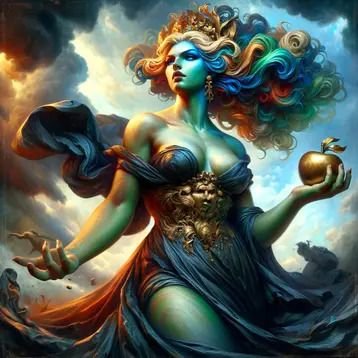
Eris starts small. That is Homer’s own account of her in book 4 of the Iliad, where she is “sister and comrade of man-slaying Ares” and “at the first rears her crest but little, yet thereafter planteth her head in heaven, while her feet tread on earth”. In book 11 she is the only one of the gods who bothers to turn up: Strife “was glad as she looked thereon; for alone of the gods she was with them in their fighting”, while the rest stayed home on Olympus.
Hesiod, unusually, decided there were two of her. Works and Days separates the Strife who “fosters evil war and battle, being cruel” from an elder, kinder sister who makes neighbours compete – “potter is angry with potter, and craftsman with craftsman” – and calls that one “wholesome for men”. The golden apple, tossed among the goddesses because she alone had been left off the guest list at the wedding of Peleus and Thetis, is a late arrival: the snub and the apple come from Hyginus and Colluthus, while the old Epic Cycle summary has her simply turn up at the feast and start a dispute.
In 2006 a newly discovered dwarf planet was named Eris, and its moon Dysnomia, Lawlessness, after one of the children Hesiod gives her. NASA calls the name fitting, since the discovery of Eris “led to the demotion of Pluto from planet to dwarf planet”. Even at the edge of the solar system, she started an argument.
Enyo
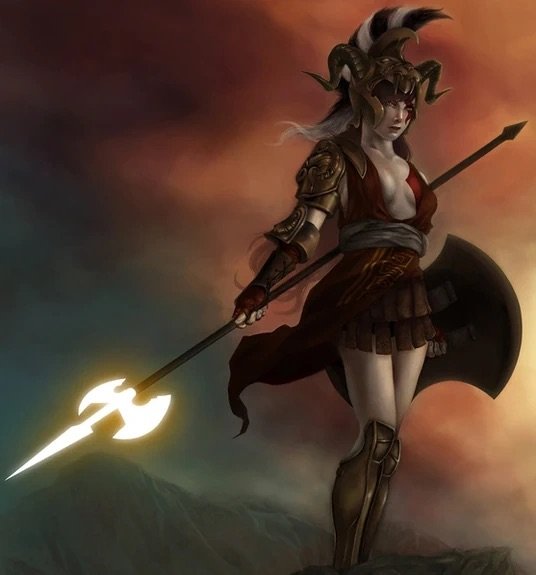
“Sacker of cities” is Enyo’s title, not Athena’s. In the Iliad Diomedes runs Aphrodite off the field because he can see she is a weakling goddess, “no Athene she, nor Enyo, sacker of cities”, and later in the same book Enyo leads the Trojan battalions beside Ares, “she bringing ruthless Din of War”. Those two lines are the whole of her Iliad. Homer never gives her a word to say.
Later Greeks gave her more room. Pausanias saw “an image of Enyo, made by the sons of Praxiteles” in the sanctuary of Ares at Athens. Hesiod, unhelpfully, gives the same name to one of the Graiae, the grey-haired sisters of the Gorgons – “saffron-robed Enyo” – and Apollodorus adds that the Graiae had “but one eye and one tooth” among them, which they passed around. Nothing in either text connects that Enyo with the war goddess.
When Plutarch wrote about Rome in Greek, Enyo was the name he gave Bellona. The temple where Sulla summoned the Senate is, in Plutarch’s Greek, the temple of Enyo, and it was there, he says, that Sulla began addressing the senators at the very moment his men began cutting down six thousand prisoners in the circus. The screams carried. The senators, Plutarch reports, were dumbfounded, which seems the least they could be.
Kydoimos
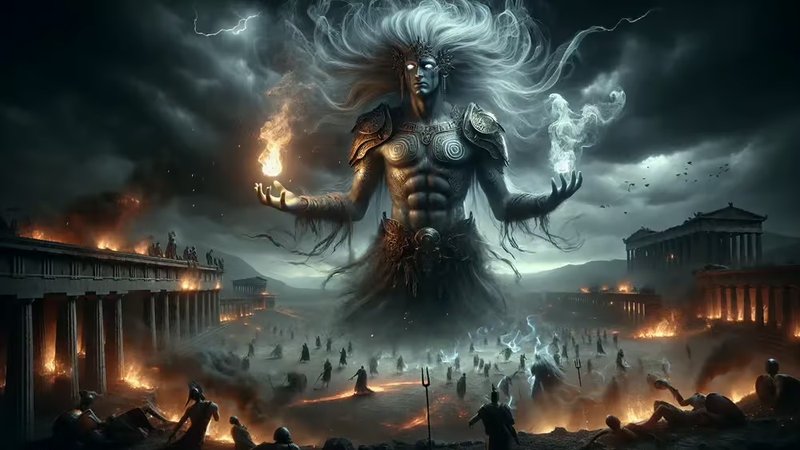
“Hi! Tumult, you slave there!” War bellows in Aristophanes’ Peace (in Eugene O’Neill Jr.’s translation), and the spirit of battlefield din steps forward to receive a cuff on the head. “Oh! how it stings!” says Kydoimos. “Master, have you got garlic in your fist, I wonder?” He is then sent for a pestle so that War can pound the cities of Greece in his mortar. He comes back from Athens empty-handed – “the Athenians have lost their pestle – the tanner, who ground Greece to powder” – and back from Sparta empty-handed too, because the Spartans had lent theirs to allies in Thrace, who lost it.
In Homer he is less domestic. Enyo carries him into the fighting in the Iliad, Murray’s “ruthless Din of War”, and on the shield Hephaestus makes for Achilles he joins the fray beside Strife and deadly Fate. The Greek edition capitalizes his name in exactly those two lines; everywhere else in the Iliad kydoimos is just a word for uproar. The Shield of Heracles repeats the shield scene almost word for word, with Strife, Kydoimos and Fate in the same company.
His one speaking part does not end in triumph. With both pestles lost, War announces that he will go indoors and make one for himself, and Kydoimos, having failed twice, is not asked again.
Alke
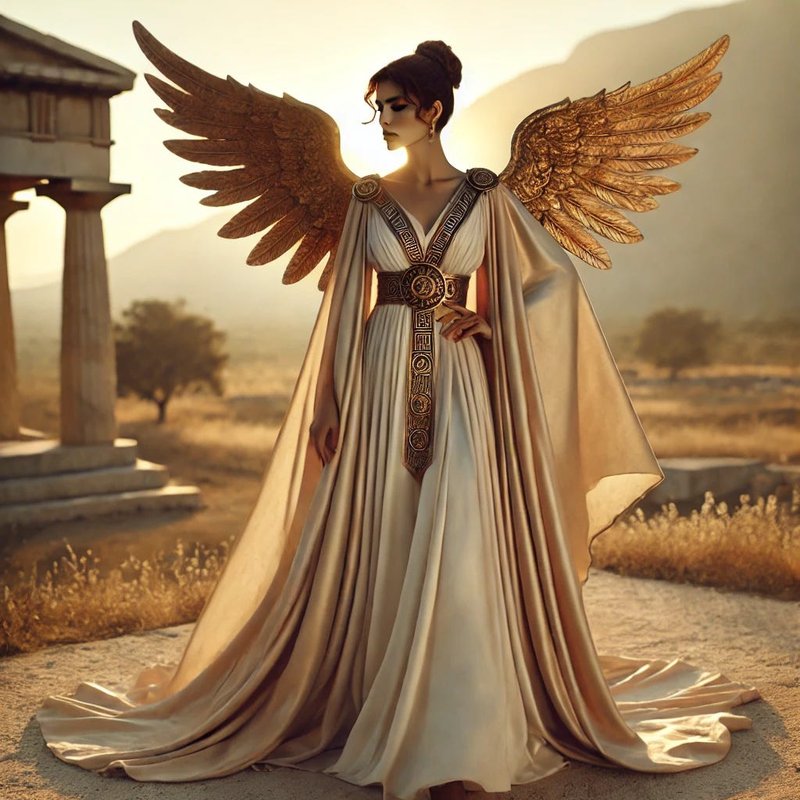
One capital letter makes Alke a goddess. In the Greek of the Iliad alke is an ordinary word for fighting strength, and it turns up as a plain noun on 57 other lines; heroes on both sides keep telling their men to “bethink you of furious valour”, in Murray’s version, a call the Greek repeats on seven separate lines. Only once, at line 740 of book 5, does the edition print the word with a capital, and that once is on Athena’s aegis.
The scene is worth having in full. Athena lets fall on her father’s floor the soft robe she wove herself, puts on “the tunic of Zeus, the cloud-gatherer”, and arms for war. Over her shoulders goes the tasselled aegis, “fraught with terror”, ringed by Rout as a crown, and on it “therein is Strife, therein Valour, and therein Onset”, with the head of the Gorgon among them. Murray’s Valour is Alke, third of the four. Her helmet, for good measure, is golden, with two horns and four bosses, and “fitted with the men-at-arms of an hundred cities”.
The rest of what is usually said about Alke – that she was one of the Makhai, that Eris was her mother – is the inference of the Theoi website, which itself admits her parentage is nowhere stated. She has no story and no family. She has a capital letter and a place on Athena’s armour, and that has turned out to be enough.
Ioke
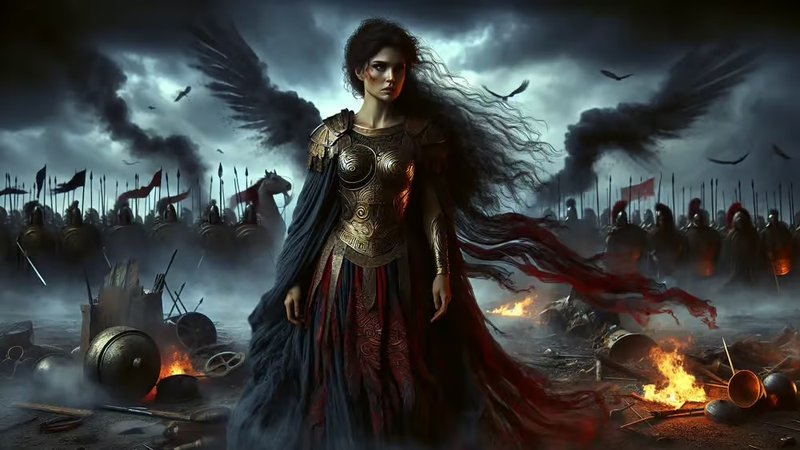
Last in line on Athena’s aegis, after Rout, Strife and Valour, comes Ioke, “Onset, that maketh the blood run cold”. The Greek adjective is kryoessa, chilling, and her translators all seem to feel it: Richmond Lattimore makes her “heart-freezing Ioke”. In the Iliad, that aegis is the only place she is a person. The word occurs just three times in the whole Iliad, and the other two are ordinary nouns – the Trojans’ “onsets” in book 5, and the moment in book 11 when Achilles stands by the stern of his ship “gazing upon the utter toil of battle and the tearful rout”.
That second line matters more than it looks. What Achilles sees in the rout is Nestor’s mares carrying Nestor and the wounded Machaon out of the battle, and he calls his comrade Patroclus out of the hut. Patroclus comes “like unto Ares; and this to him was the beginning of evil”. The road that ends at Patroclus’s death starts with a glance at the tearful ioke.
The standard Greek lexicon, Liddell-Scott-Jones, defines the word as “rout, pursuit”, which overlaps with Proioxis, the Pursuit on the Shield of Heracles. They are different words all the same, and Ioke never appears in the Shield at all. She belongs to Homer, and to one line of him.
Keres
On the shield that Hephaestus forges for Achilles, in a fight beside a river, one figure moves through the battle grasping a man alive and freshly wounded, another without a wound, and dragging a third, dead, “through the mellay by the feet”. A. T. Murray calls her “deadly Fate”, and her cloak is “red with the blood of men”. The Greek calls her Ker, and the edition gives her a capital letter.
The Shield of Heracles brings a whole pack of them. Behind the fighting stand “the dusky Fates, gnashing their white fangs, lowering, grim, bloody, and unapproachable”, all of them “longing to drink dark blood”; when a man falls, one of them clasps her great claws about him and his soul goes down to Hades. Over them stand Clotho, Lachesis and Atropos, and all of them make “a fierce fight over one poor wretch”. Pausanias found another on the same carved chest at Olympia, behind the fallen Polyneices, a woman “with teeth as cruel as those of a beast” and fingernails bent like talons.
Strictly, the Keres were never only war’s. Elsewhere in Homer the word is lowercase and simply means the fates of death: Achilles says his mother has told him “twofold fates are bearing me toward the doom of death”, and Hesiod files Ker among the children of Night alongside Doom and Death. The soldier’s version of all this belongs to Sarpedon: “fates of death beset us, fates past counting, which no mortal may escape or avoid”.
Hysminai
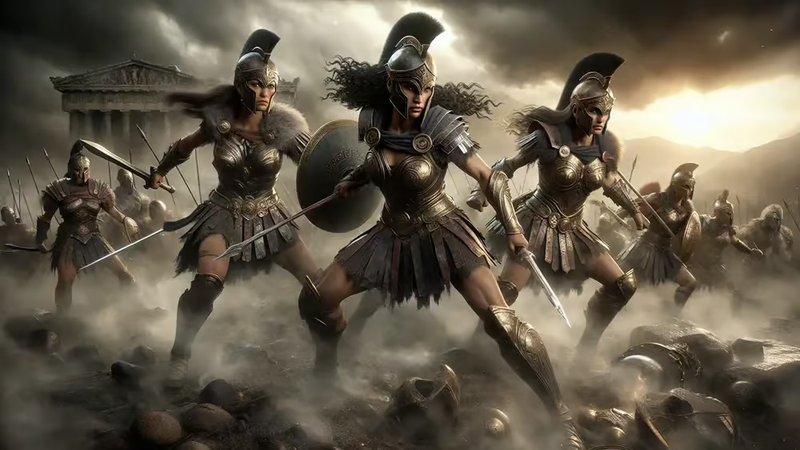
As an ordinary word, hysmine is everywhere in Greek epic. As a goddess, or rather a crowd of them, she turns up once. The Hysminai are the first of the four battle children packed into a single line of Hesiod’s Theogony, and their name is simply the plural of a common Homeric word for a fight, which LSJ, the great Greek lexicon, defines as “fight, battle, combat”.
Homer uses that word constantly, and always in lowercase. The Iliad speaks early on of woes for Trojans and Danaans alike “throughout the course of stubborn fights”, in Murray’s version, and the formula for stubborn fights keeps coming back across the poem like a drumbeat; in book 4 a falling warrior “crashed as doth a wall, in the mighty conflict”. Even Hesiod, later in the same poem that names the Hysminai, describes the war between the gods and the Titans with the very same word in lowercase, as though he had forgotten they were people. The Shield of Heracles does the same, so the capital at Theogony 228 is the only personified Hysminai in the epic texts checked.
What Hesiod does give them is a position. The four battle names stand in his list between the Sorrows on one side and the Quarrels on the other, grief before and bickering after. As a description of where fighting sits in human affairs, it has not dated much.
Makhai
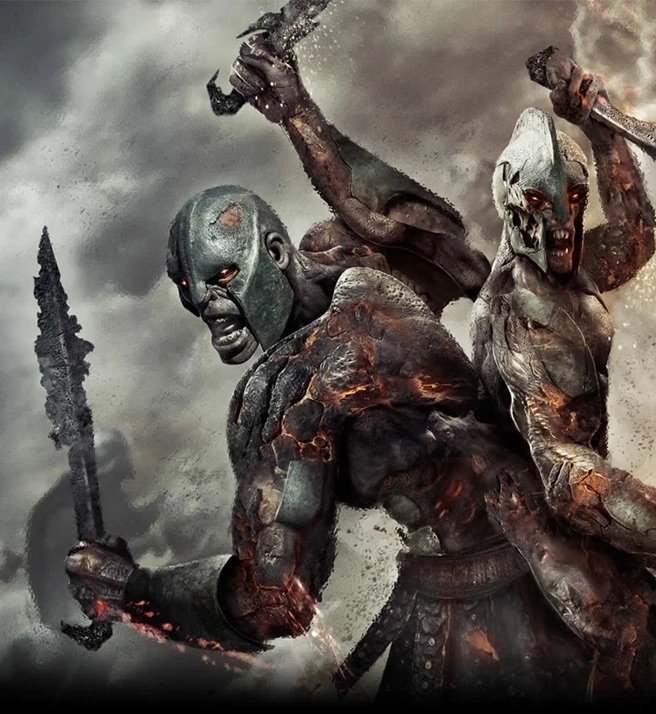
English still carries the Makhai around, mostly without noticing. The suffix -machy, as in logomachy, a war about words, comes from Greek, from “machē battle, fight”, in Merriam-Webster’s wording, and logomachy itself entered English in the mid-1500s. Gigantomachy, the war fought between the gods of Olympus and the rebelling giants, is the same word with giants attached.
In Hesiod’s Theogony the Makhai are the second of Strife’s martial brood, Battles in Evelyn-White’s English, plural and faceless: Hesiod names them and moves straight on, with no member, no story and no portrait. What they do have is a famous word pair. When Ajax, in the seventh book of the Iliad, declares that he knows the business of war, he says “Nay, full well know I battles and slayings of men”, which in Greek is machas t’ androktasias te – the same two names Hesiod capitalizes, with Murders between them, in his line of four.
The Theoi website suggests that several figures on this list – Homados, Alala, Proioxis, Palioxis, Ioke, Alke and Kydoimos – “were probably numbered amongst the Makhai”. It is a reasonable guess, but no ancient text puts any of them in the brood, and Alala, at least, is given a different parent. Here they keep entries of their own, and the Makhai keep the one line Hesiod gave them.
Phonoi
An English translator gave the Phonoi their face. In the Fall of Troy, a late Greek epic by Quintus of Smyrna, the fighting hardens at one point and, in Arthur S. Way’s version, “incarnate Strife Stalked through the midst, with Slaughter ghastly-faced”. Way’s Strife is Kydoimos, and his Slaughter is Phonos, capitalized in the Greek edition – the only capital the name receives in the whole poem. The ghastly face is Way’s own contribution; the Greek has no word for a face at all.
Otherwise the Phonoi are a single word in Hesiod’s list of Strife’s children, Murders in Evelyn-White’s translation, third in the line of four battle names. Hesiod gives them no scene and no setting. The Theoi website’s claim that they were spirits of murder and killing outside of war is its own inference, and Theoi itself concedes that some ancient writers do not draw such a distinction. They belong on this list on the strength of the company they keep, and of that one battle line in Quintus.
The name can mislead in the other direction too. Theoi quotes Aeschylus’s Seven Against Thebes with a capitalized Phonos, but the Greek edition has an ordinary lowercase phonos there, and H. W. Smyth’s “servant of Slaughter” describes a man-slayer at the gates of Thebes rather than a god. The Phonoi remain what Hesiod made them: a plural noun, standing in a crowd.
Androktasiai
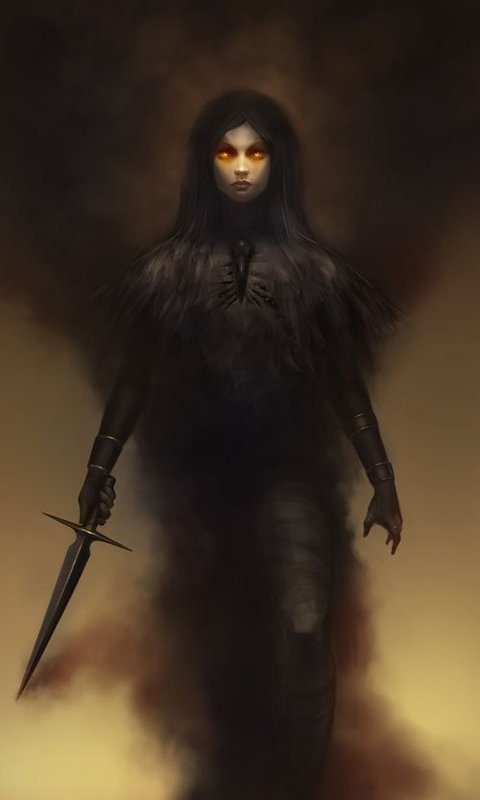
The word that names the Androktasiai is the one Patroclus uses for the killing that cost him his childhood home. His ghost, visiting Achilles in the Iliad, recalls being brought to Peleus as a little lad “by reason of grievous man-slaying, on the day when I slew Amphidamus’ son in my folly, though I willed it not, in wrath over the dice”. It is also the word for what Hera and Athena make Ares stop doing at the end of book 5.
LSJ defines androktasia as “slaughter of men in battle, mostly in pl.”, and notes that it is personified in Hesiod’s Theogony, where the Androktasiai close Strife’s line of four battle children as Manslaughters. The Shield of Heracles gives the figure in the singular, Androktasie, capitalized, standing with Homados and Phobos in the poem’s crowd of battle spirits, where Evelyn-White calls her Slaughter. In Homer, by contrast, the noun is always lowercase and turns up only a handful of times.
The best of those comes near the end of the Iliad. Achilles, consoling the grieving Priam, tells him that since the gods brought the war upon him “ever around thy city are battles and slayings of men”. Hesiod made the pair into spirits. Achilles was describing the weather.
Nike
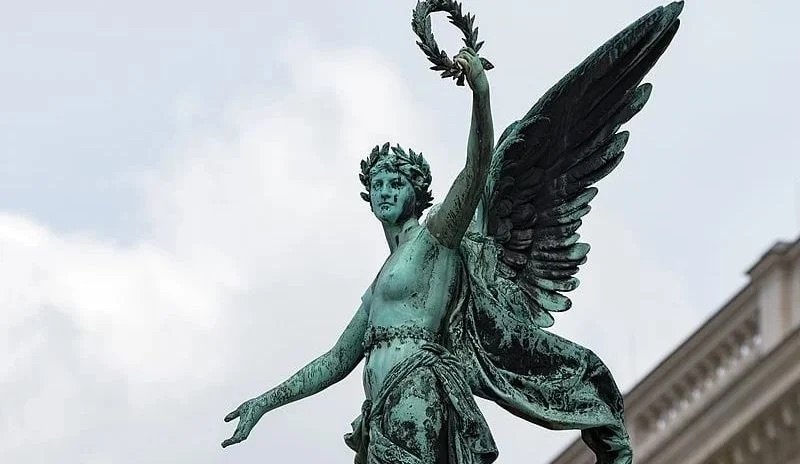
Hesiod gives Victory a Titan for a father. In the Theogony, Styx, daughter of Ocean, “was joined to Pallas and bore Zelus (Emulation) and trim-ankled Nike (Victory) in the house”, along with Cratos and Bia, and this Pallas, a son of Crius, belongs among the Titans of Greek mythology rather than with Athena, whose name he shares. The Homeric Hymn to Ares, not to be outdone, calls Ares the “father of warlike Victory”. Ancient genealogy was flexible about who got credit for a win.
Hesiod keeps the four children always at Zeus’s side and says Styx brought them to Olympus when Zeus called for allies against the Titans, though he never says they fought. Apollodorus does: Zeus had the gods swear by the water of Styx “because she and her children had fought on his side against the Titans”. Nike’s portfolio was never purely military, either. Pindar has a winning charioteer fall “into the lap of golden Victory” at the precinct of Olympian Zeus.
Athens gave her a temple on the right of the Acropolis gateway, and Calamis reputedly made the Mantineans a Victory without wings in imitation of the wooden image there. The best-known survivor, the Victory of Samothrace in the Louvre, dates to about 200-175 BC and rises about 5.6 meters, ship’s prow included. Inside the Parthenon, meanwhile, Pausanias saw Athena holding “a statue of Victory about four cubits high” in one hand. The goddess of war, it seems, carried victory about as an accessory.
Proioxis
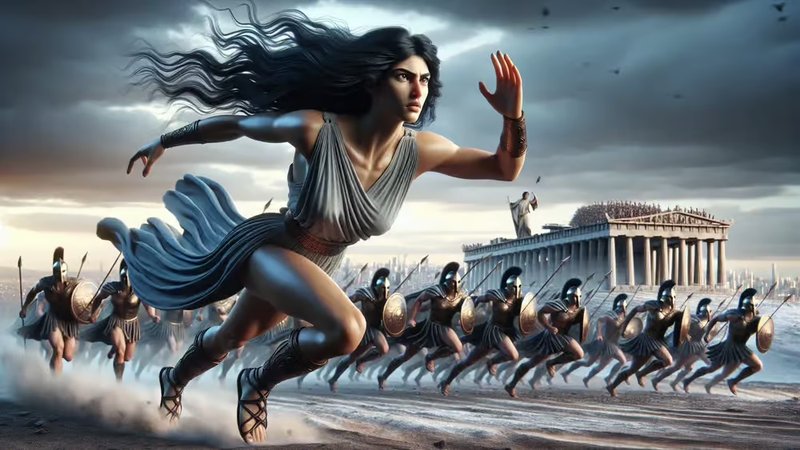
Even ancient scholars doubted the poem that Proioxis lives in. The Shield of Heracles has come down under Hesiod’s name, but an ancient summary reports that Aristophanes of Byzantium suspected it was the work of someone trying to imitate the shield in the Iliad, while Apollonius of Rhodes defended it as Hesiod’s, partly because the Catalogue also makes Iolaus the charioteer of Heracles. Either way, line 154 is the only place Proioxis exists: “Upon the shield Pursuit and Flight were wrought”.
The shield is quite an object. It is “all glittering: no one ever broke it with a blow or crushed it”, and its orb shimmers with enamel, white ivory, electrum and gold, banded with a deep blue glass-paste. At its center, in the text Evelyn-White followed, is Fear “worked in adamant”, though the manuscripts, as some editors read them, put a snake there instead. Around it run eight battle figures in three lines – Pursuit, Flight, Tumult, Panic, Slaughter, Strife, Uproar and Fate – and the poet describes how only the last of them looks.
Proioxis is half of a pair. LSJ defines her partner Palioxis as pursuit in turn, the opposite of Proioxis, and Koopman, in a 2014 University of Amsterdam thesis, reads the two as “Pursuit and Pursuit-in-turn” that “symbolize the constant turning of the tide of battle”. The Theoi website adds that she was Palioxis’s sister and probably the same as Ioke. The poem says neither.
Palioxis
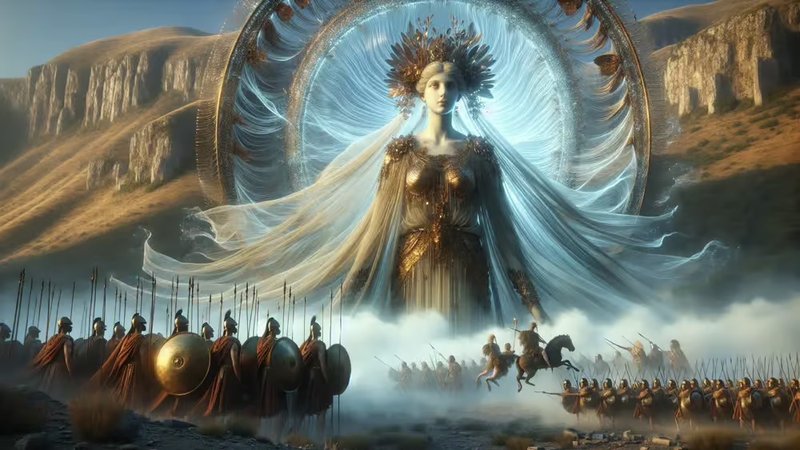
Palioxis has had more English names than she has lines of poetry. In the Shield of Heracles, her only appearance, Evelyn-White calls her Flight; the Theoi website prefers Backrush or Retreat; Koopman gives Rally; and LSJ defines the word with some care as “pursuit in turn, when fugitives rally and turn on their pursuers”. It is built, LSJ adds, from pali, again, and ioke, the rout, which makes her the onset coming back the other way.
Homer knew the word, in lowercase, and used it three times, and two of those belong to Zeus. On Mount Ida he lays out for Hera exactly how the war will go: Achilles will kill Hector, and “then from that time forth shall I cause a driving back of the Trojans from the ships evermore continually, until the Achaeans shall take steep Ilios through the counsels of Athene”. A little later Zeus is described waiting for the glare of a burning ship before he grants that driving-back. The whole endgame of the Trojan War, in other words, is filed under this noun.
So the tidy contrast sometimes drawn – Palioxis as flight, Phobos as fear – does not survive the lexicon. In Homer phobos itself mostly means flight, and Palioxis is not running away so much as turning round. The Theoi website calls her Proioxis’s sister, which the poem never says. The line simply sets the two names side by side, joined by a pair of small Greek words for “and”.
Homados
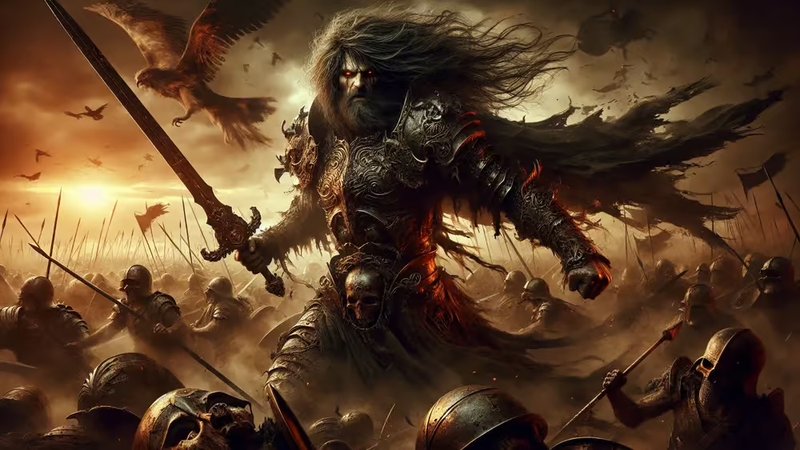
Homer’s first din is not a battle at all but a meeting. The Greek word is homados, and its first appearance in the Iliad comes when the Greeks gather in the second book and the earth groans as they sit down “and a din arose. Nine heralds with shouting sought to restrain them”, in Murray’s translation. The word, LSJ explains, means noise, “esp. of the confused voices of a number of men”, and Homer uses it for crowds, a storm and battle alike, always in lowercase.
In the epics, only the Shield of Heracles makes a figure of it. In line 155 Homados leads a trio, “and Tumult, and Panic, and Slaughter”, in Evelyn-White’s English, and later the same poem uses the plain noun when the blood-drinking Fates “rush back again into the tumult and the fray”. English makes this harder than it needs to be, since Evelyn-White’s Tumult is Homados, while Murray’s and O’Neill’s Tumult is Kydoimos, a different spirit standing a line further down the same shield.
The Iliad also gives Homados a rival sound. Agamemnon, awake at night, marvels at the Trojan fires “and at the sound of flutes and pipes, and the din of men”. The Spartans, Thucydides says, advanced into battle to many flute-players for a purely practical reason, to “advance evenly, stepping in time, without breaking their order”. Noise was the enemy of discipline, and Agamemnon himself had made the point: “amid the uproar of many how should a man either hear or speak?”
Alala
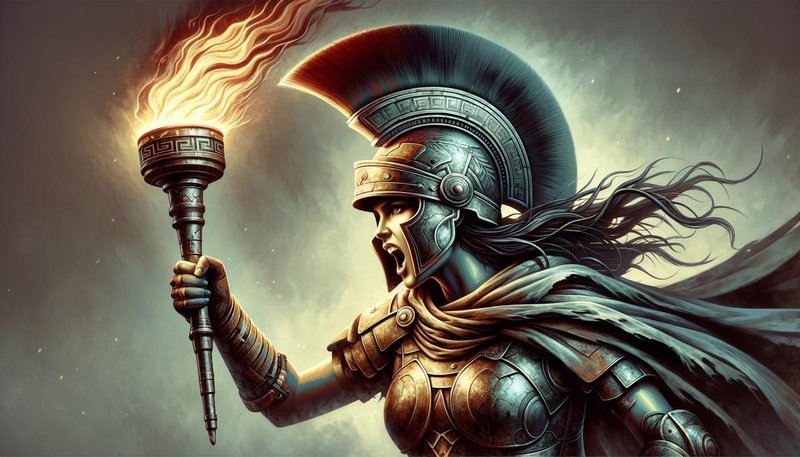
Nearly everything known about Alala fits in three lines of verse: “Hearken, Alala, daughter of War, Thou prelude of clashing spears, thou to whom are offered Heroes in the holy sacrifice of death.” They survive mainly because Plutarch quoted them in his essay On the Glory of the Athenians, as the cry of the Theban Epameinondas when he and his men dedicated themselves to a struggle for their native land. Plutarch does not say who wrote it. Editors assign it to Pindar, as fragment 78, and the “clashing” belongs to the translator, F. C. Babbitt. The Greek says only “prelude of spears”.
As a common noun, alala was the Greek war-shout itself. Pindar uses it for “the spear-clashing war-shout of the Lycians and Phrygians and Dardanians”, and the verb built from it is the one he gives Athena as she bursts from her father’s head. Xenophon’s hoplites, charging at the run, “raised the war cry to Enyalius”, although Marchant’s Greek text has a different cry there, the eleleu, and LSJ treats the alala verb as the variant reading.
Plutarch evidently liked the line, because he used it again, in his essay On Brotherly Love, for brothers who quarrel over their father’s goods and “declare war on each other, as the majority do”, and then, “shouting Hearken, Alala, daughter of War, go out to meet each other ready armed”. A war cry, it turns out, works just as well for a probate dispute.
Polemos
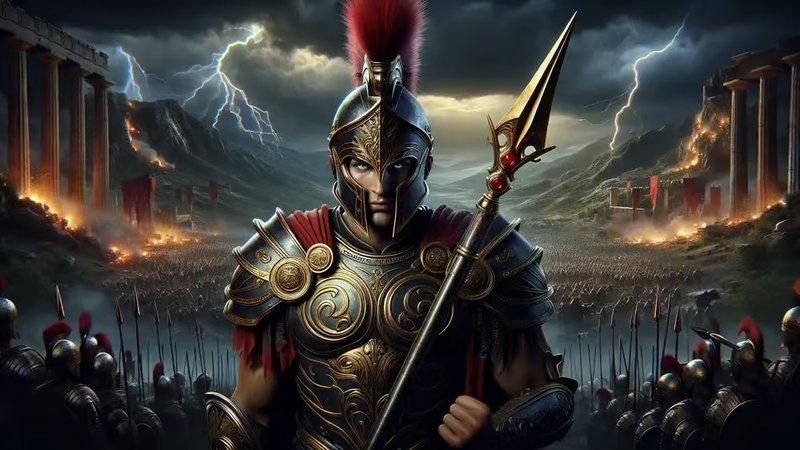
At the City Dionysia of 421 BC, Athenians watched War walk onstage carrying a huge mortar. In Aristophanes’ Peace, the gods have moved out of their house in their wrath against the Greeks, left War in it with full power, and let him bury Peace in a deep pit under heaps of stones; now he enters with “Oh! mortals, mortals, wretched mortals, how your jaws will snap!” and starts tossing the Greek cities in to be pounded. In the stage directions of O’Neill’s translation the ingredients are leeks for the Laconian town of Prasiae, garlic for Megara, cheese for Sicily and honey for Athens, though the Greek itself names only the honey. Trygaeus begs him to use another sort, since “this kind is worth four obols”.
The play took second prize, and less than a fortnight later the Athenians and the Peloponnesians ratified the Peace of Nicias. The two pestles War cannot find, says Henderson’s Loeb introduction, are Cleon and Brasidas, both killed at Amphipolis – “the two pestles with which War had been pounding the Greeks”.
Polemos has a family, too. Plutarch’s verse about Alala makes him her father, and Quintus of Smyrna calls Enyo “sister of War”. The fable writer Babrius even found him a wife. When the gods were pairing off, War “chanced till last of all to wait”, fell for Insolence, who had also been left alone, and won her. “Where’er she goes,” an 1860 English version concludes, “he follows in her train.”
Frequently Asked Questions
Who was the Greek god of war, Ares or Athena?
Both. In the Iliad Zeus tells Aphrodite that works of war are not hers to meddle in, because “all these things shall be the business of swift Ares and Athene” (Murray). Homer then puts them on opposite sides: Ares leads the Trojan battalions, while Athena urges on the Greeks, which makes the war at Troy partly a family quarrel.
What is the Roman god of war?
Mars, the Roman counterpart of Ares, with Bellona as the Roman goddess conventionally paired with Enyo. Bellona’s temple began as a battlefield bargain: in 296 BC Appius Claudius Caecus, fighting the Etruscans and Samnites, vowed her a temple if she granted victory that day. Both are Roman, so neither appears on this list of Greek figures.
Why aren’t Phyge and Lyssa on the list?
Neither is a war spirit in the Greek texts. Phyge, or Panic, rests on Iliad 9.2, where the Greek prints phyza as an ordinary lowercase noun; the capital in Murray’s “wondrous Panic” belongs to the translator. Lyssa is Madness: in Euripides’ Heracles, Iris brings her on Hera’s orders to drive Heracles to kill his own children.
Is Pallas a Greek god of war?
Not on the evidence of the texts. Hesiod’s Theogony makes Pallas a Titan-generation god, son of Crius and Eurybia, who married Styx and fathered Nike, Zelus, Cratos and Bia – but it gives him no domain at all. The label god of battle is the Theoi website’s, not an ancient poet’s, so he belongs among the Titans.
Are Kratos and Bia gods of war?
No. They are Nike’s siblings, children of Styx and Pallas, and Hesiod’s Theogony, in Evelyn-White’s English, calls them Cratos (Strength) and Bia (Force), with a brother Zelus (Emulation). Their best-known scene opens Aeschylus’ Prometheus Bound, where they haul Prometheus to a crag in the Scythian wilderness. Kratos does most of the talking there. Bia never speaks a line.
Is Harmonia the daughter of Ares?
Yes. Hesiod’s Theogony has Aphrodite bear Ares the terrible pair Panic and Fear – Phobos and Deimos – and then Harmonia, “whom high-spirited Cadmus made his wife”. Her brothers drive the ranks of men into disorder; her name means harmony, and no ancient text gives her a part in battle, which is why she stays off the list.
- Homer, Iliad, trans. A. T. Murray (Perseus Digital Library)
- Hesiod, Theogony, trans. Hugh G. Evelyn-White (Perseus Digital Library)
- NASA Science: Deimos
- Plutarch, On the Glory of the Athenians, trans. F. C. Babbitt (LacusCurtius, University of Chicago)
- Thomas G. Palaima, Linear B Sources (University of Texas at Austin, PASP)
- Aristophanes, Peace, ed. and trans. Jeffrey Henderson (Loeb Classical Library)
- Theoi Greek Mythology: Makhai
- Merriam-Webster: logomachy