Every Item on the Original McDonald's Bar-B-Q Menu
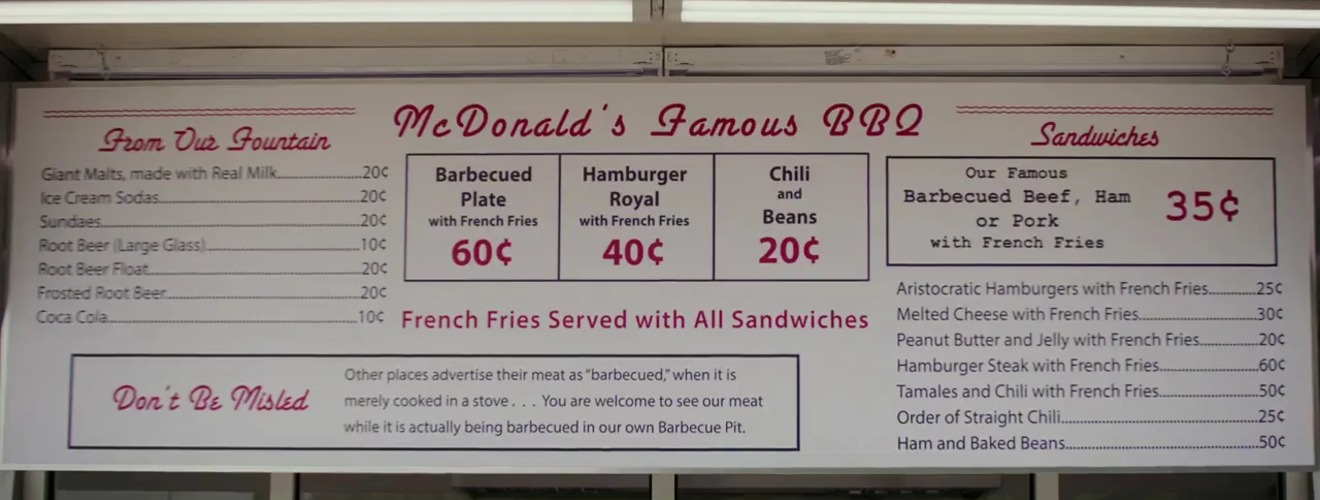
On May 15, 1940, two brothers from Manchester, New Hampshire opened a drive-in restaurant at the corner of 14th and E streets in San Bernardino, California. They served slow-cooked barbecue from a pit stocked with hickory chips imported from Arkansas. They employed 20 carhops, all young women, dressed in usherette uniforms recycled from a failed cinema the brothers had run earlier in the decade. The menu wandered from Mexican-American street food to New England comfort plates, with a peanut butter and jelly sandwich thrown in at 20 cents. The restaurant was called McDonald’s Bar-B-Q.
For eight years this is what McDonald’s was. There were no Golden Arches. There was no Speedee Service System. There was no Ray Kroc. The Bar-B-Q operation was so successful that by 1945 the brothers were among the richest families in San Bernardino, buying three new Cadillacs each every year and living in a 25-room mansion. They were also, without realising it, running entirely the wrong restaurant. By 1947, hamburger sales accounted for roughly 80 percent of revenue, and the brothers’ patient hickory smoking was a labour-intensive sideshow that nobody was particularly buying. In October 1948 they closed for three months, fired the carhops, tore out the barbecue pit, smashed the dishwasher, and reopened with a nine-item menu that would invent fast food as we know it.
What follows is every item documented from the BBQ era – the menu McDonald’s served before McDonald’s was McDonald’s. A few items, like the hamburger and the milkshake, survived the 1948 reset and went on to take over the world. Most did not. The peanut butter and jelly sandwich, the tamales, the barbecued ribs, the ham-and-baked-beans plate – all of them disappeared in October 1948 and have never returned. They live on only in the surviving photographs of the original menu board and in the memorabilia held at the Historic Original McDonald’s Museum, which now occupies the site of the original restaurant. This is what was on the menu.
The original McDonald’s menu, served from 1940 to 1948, carried roughly 25 items: hickory-smoked beef, pork, and ham sandwiches, barbecued ribs and dinner plates, hamburgers, hot dogs, chili, diner sandwiches, sides, and a soda-fountain line of desserts and drinks, all delivered to parked cars at the brothers’ San Bernardino drive-in.
Barbecued Beef Sandwich
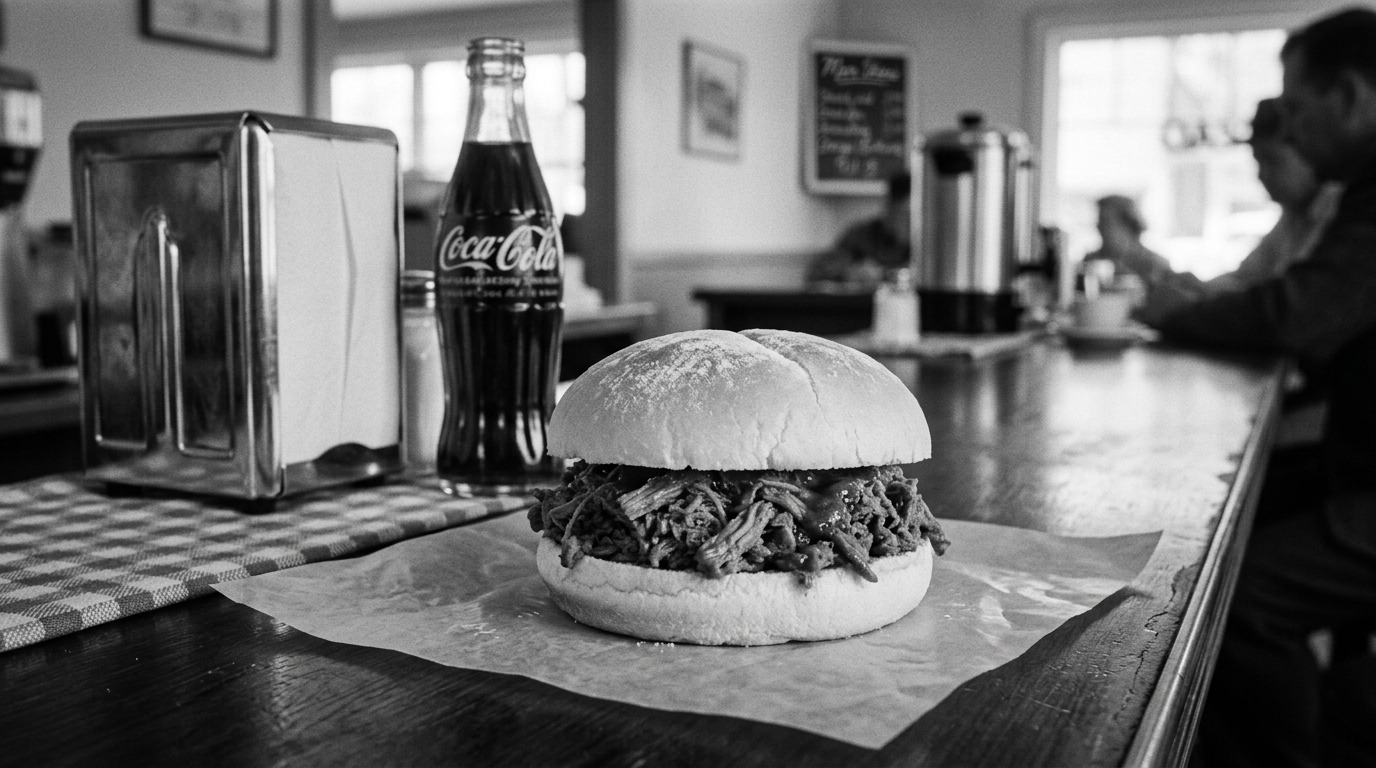
The feature item at McDonald’s Bar-B-Q was a sandwich made from beef that had been slow-cooked for hours over a pit of hickory chips imported from Arkansas. The meat was sliced thin, piled on a soft bun, and served with French fries for 35 cents. Dick and Mac McDonald wanted customers to know this was real barbecue, and they were prepared to be peevish about it. Printed directly on the original menu was the sentence: ‘Other places advertise their meat as barbecued when it is merely cooked in the store. You are welcome to see our meat while it’s actually being barbecued in our own Barbecue Pit.’
This was, in 1940 Southern California, a defensible flex. Drive-ins were proliferating across the region in the years after the Depression, and ‘barbecue’ was acquiring the same loose definition that ‘artisan’ would acquire seven decades later. The brothers had spent $5,000 they could barely scrape together on a single restaurant, and they were not about to share menu space with imposters serving oven-roasted beef.
The barbecued beef sandwich was on the menu for the full eight years of the Bar-B-Q era, generating most of the early sales alongside its pork and ham counterparts. It also turned out to be the item the brothers would eventually destroy their own business model to escape from. The hickory pit was the first thing torn out in October 1948.
Barbecued Pork Sandwich
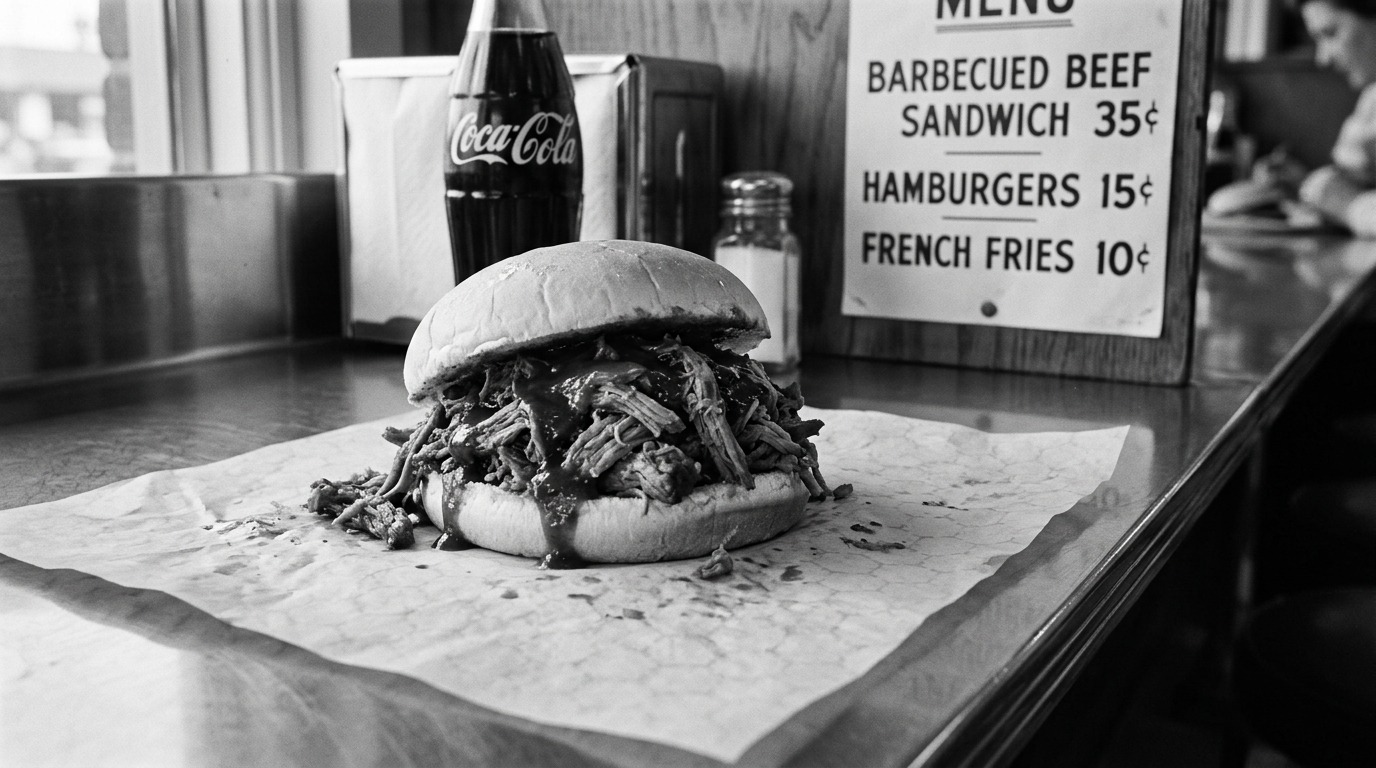
Of the three barbecued sandwiches McDonald’s served between 1940 and 1948, the pork was probably the most authentic to the cuisine the brothers were trying to imitate. American barbecue traditions had emerged from the Southeast – the Carolinas, Tennessee, Memphis – and the meat at the centre of those traditions was pork. Hickory smoke and pork shoulder is the canonical combination. Dick and Mac, two New Hampshire transplants who had never lived east of the Mississippi as adults, were doing their best.
The sandwich was served on the same soft bun as the beef and ham versions, sliced thin, with a side of French fries, at the same 35 cents. Whether the brothers ran their pit closer to a Carolina vinegar style or a Memphis dry rub or something invented entirely by themselves is lost to history – no recipe survived the 1948 closure, and Dick McDonald, in interviews he gave decades later, was more interested in talking about the Speedee Service System than about how the pork was seasoned.
What we do know is that the pork sandwich was popular enough to remain a fixed feature of the menu for the entire BBQ era, and unpopular enough relative to hamburgers that the brothers eventually concluded they were running the wrong restaurant. By 1948, hamburger sales accounted for roughly 80 percent of revenue. The pork sandwich’s name was never mentioned on a McDonald’s menu again.
Barbecued Ham Sandwich
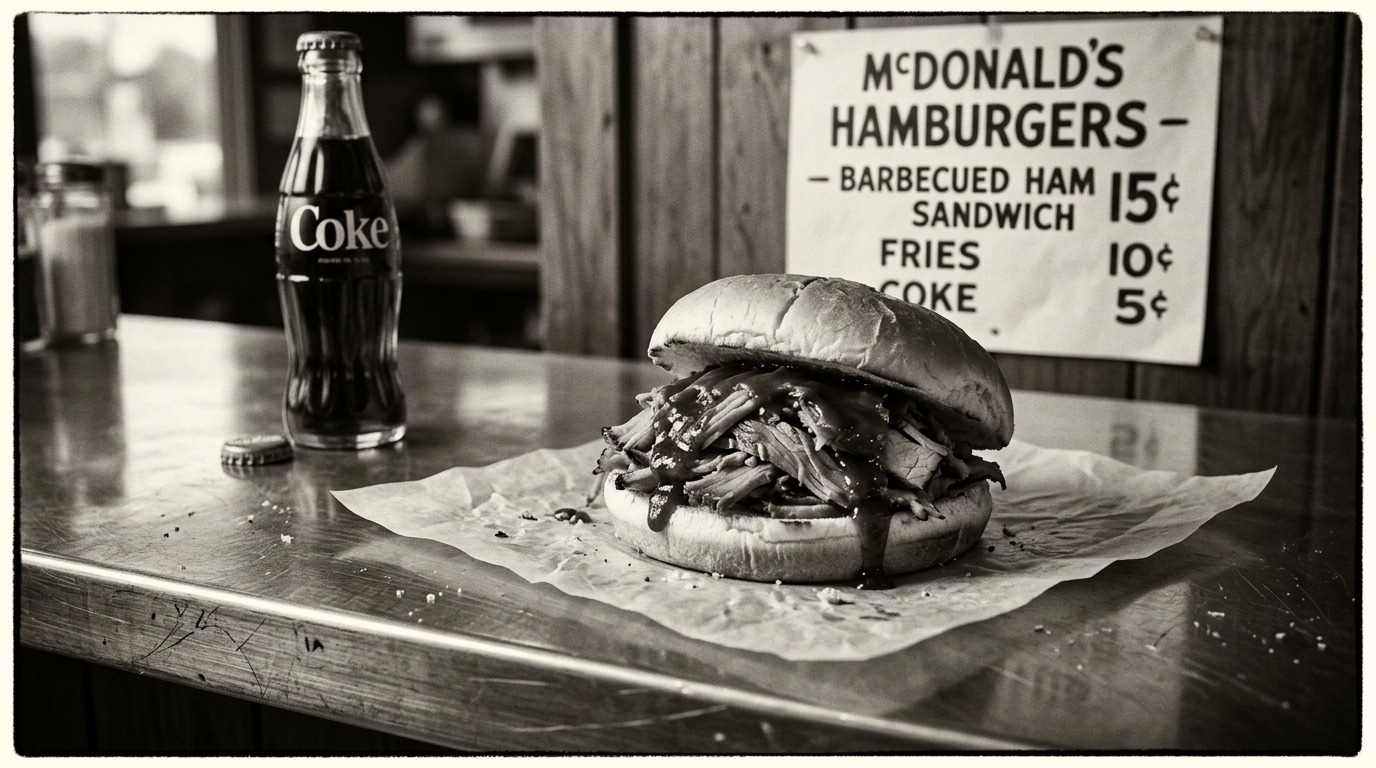
The third of the three barbecued sandwiches was ham, and it is the one that most modern readers find genuinely confusing. Barbecued ham was a fairly common American diner item in the 1940s, often made from a cured ham steak briefly grilled and brushed with sauce, or from sliced ham warmed through and served on bread. At McDonald’s Bar-B-Q the ham came out of the same hickory pit as the beef and pork, which suggests something closer to actual smoked ham than the diner shortcut.
It cost 35 cents with French fries, was served on the standard bun, and was advertised in early McDonald’s promotional copy as ‘famous barbecue beef, ham or pork.’ The three meats were marketed as essentially interchangeable. The Library of Congress, in writing about the original menu, mentions specifically that competitors had begun selling ‘more hamburgers than barbequed ham’ – a clue that the ham sandwich was the slowest seller of the three even before the broader collapse of barbecue’s commercial appeal at the location.
When the brothers closed the restaurant in October 1948 to overhaul the menu, the ham sandwich was among the first casualties. It would not return. McDonald’s has, in the eighty years since, sold breakfast ham, ham-and-cheese variants, and Hispanic-market Cuban sandwiches, but a slow-smoked barbecued ham sandwich has not appeared on the corporate menu in any form. There are presumably reasons.
Barbecued Ribs
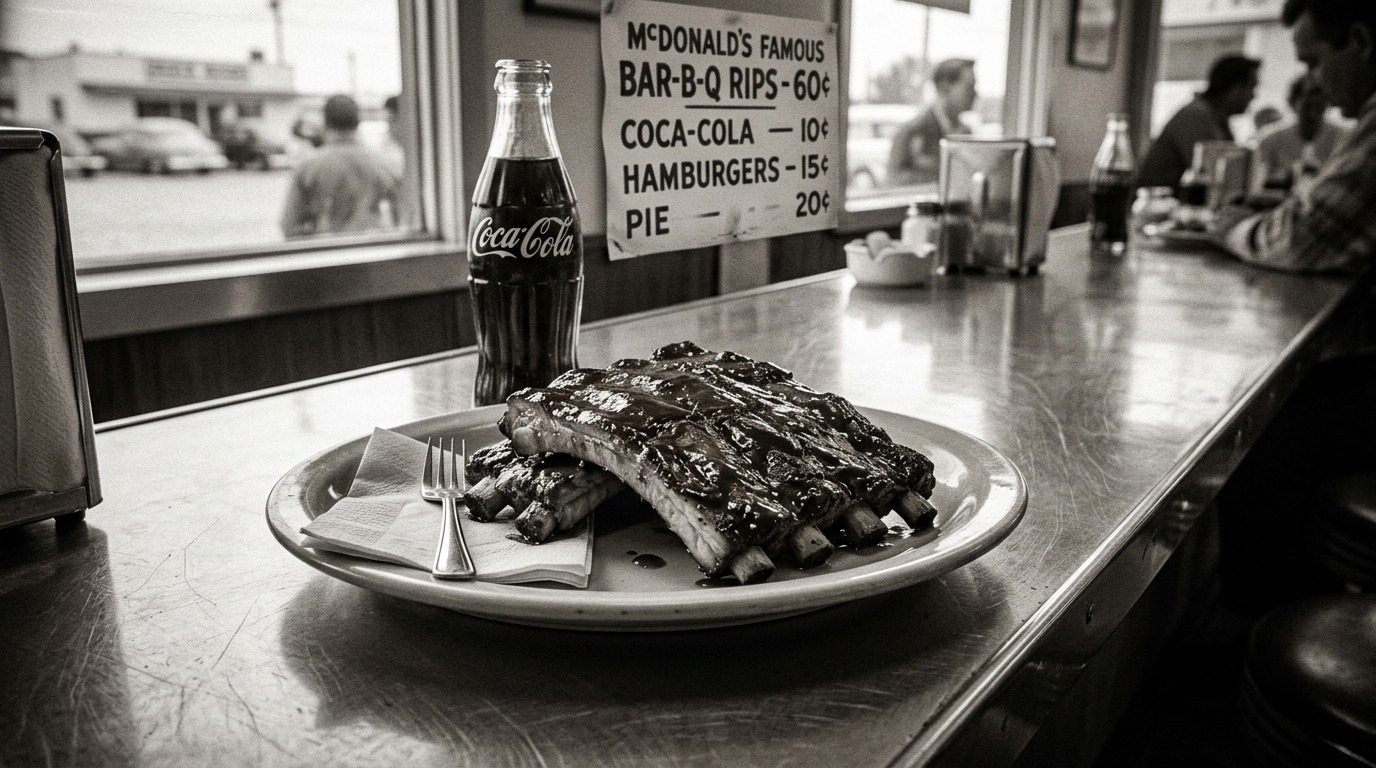
Barbecued ribs were the most labour-intensive item on the McDonald’s menu, which is a sentence that has not been true at any point since 1948. Ribs require hours of slow cooking, careful temperature management, and a pit operator who knows what they are doing. They are, in other words, the precise opposite of fast food. That they appeared on the McDonald’s menu at all is a useful reminder of how completely the restaurant industry was reinvented over the following decade, and how much of that reinvention was carried out by the same two brothers who put ribs on this menu in the first place.
The ribs were served as a portion with sides, sometimes appearing in sources as a standalone order and sometimes as part of the larger 60-cent barbecued plate. The hickory chips came from Arkansas because Arkansas hickory was considered the gold standard for slow-smoking, and the brothers were willing to ship it across two thousand miles to get it.
What strikes a modern reader is the contrast between the patience required to produce these ribs and the assembly-line philosophy the brothers would eventually invent in the same building. In 1940, McDonald’s was a restaurant where you waited. By 1948, it was a restaurant where waiting was the enemy. The pit that had cooked the ribs was demolished as part of the 1948 renovation. The ribs went with it.
Barbecued Plate
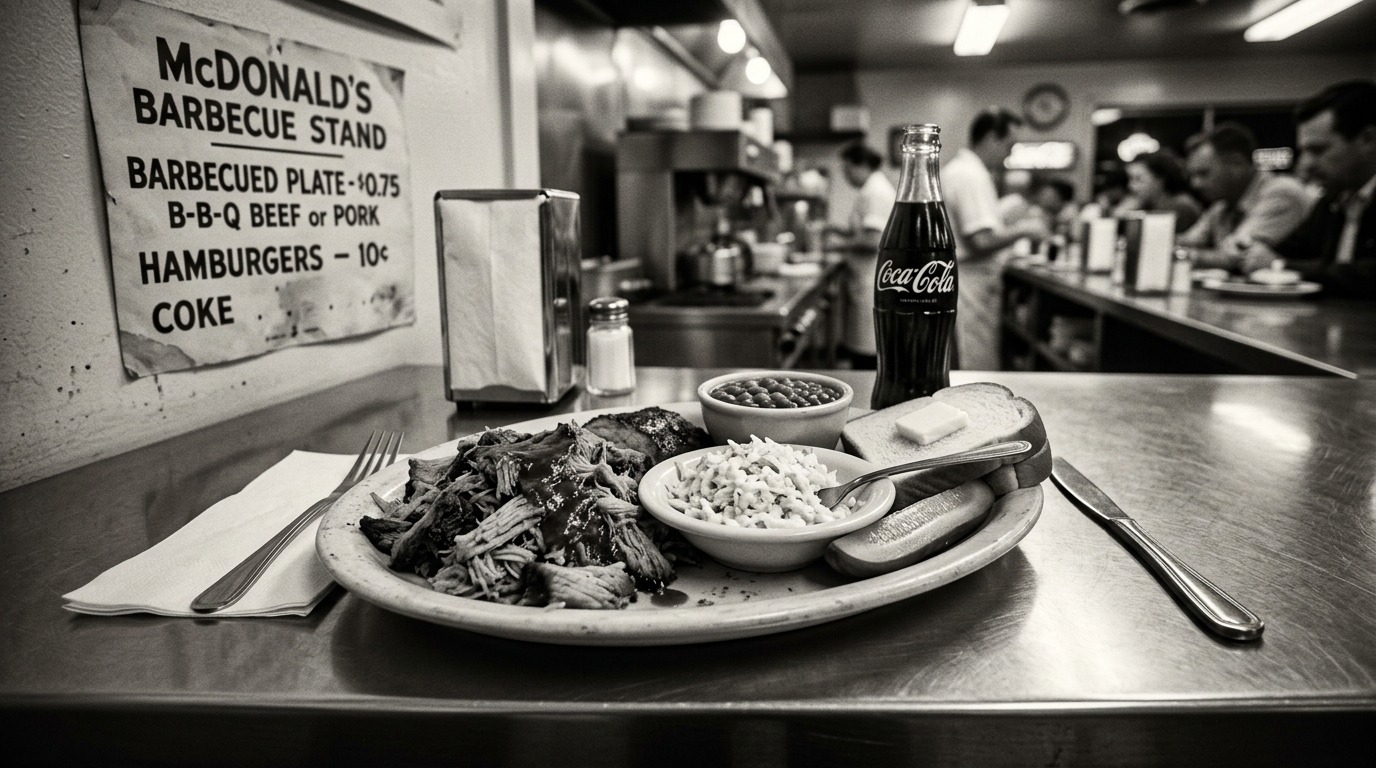
At 60 cents, the Barbecued Plate was the most expensive item on the original McDonald’s menu, tied only with the Hamburger Steak. The plate was the full sit-down barbecue experience: a serving of barbecued meat, presumably with the customer’s choice of beef, pork or ham, with sides, served on actual china. The whole thing was delivered to your car by a carhop in a usherette uniform recycled from the brothers’ failed cinema, the Beacon Theater in Glendora. Drive-ins of the era were inventing American consumer culture as they went along, and the McDonald’s parking lot was where significant chunks of it were tested.
The plate was not a sandwich. The sandwich versions of the same meats cost 35 cents and came in your hand. The plate was a dinner, eaten with utensils, on real plates, in your car – which created a problem the brothers eventually identified as fatal to their margins. The china got broken. The silverware got stolen. The dishwashers cost money. In 1948, when they finally closed for the three-month renovation, the china and silverware were among the first things to go, replaced with paper wrappers and cardboard cups.
The 60-cent Barbecued Plate, then, represented the most expensive way to eat at McDonald’s at the same moment in history. It was also one of the items most directly responsible for ending the restaurant that served it.
Aristocratic Hamburger
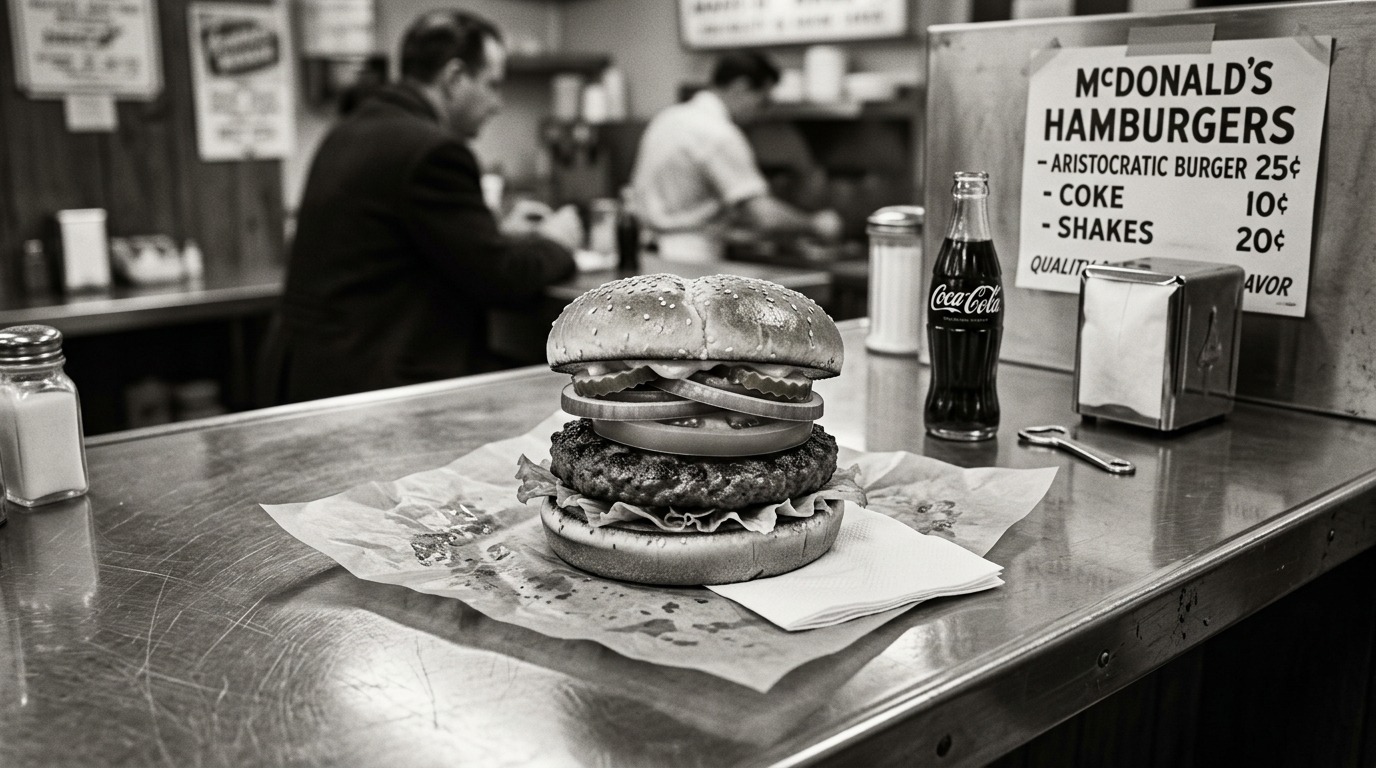
The Aristocratic Hamburger was on the McDonald’s menu from the beginning, eight years before McDonald’s became a restaurant primarily known for selling hamburgers. The naming is the giveaway. In 1940, at a barbecue drive-in, a hamburger needed an adjective. It needed to compete with the slow-cooked beef sandwich at the next price point up and the hot dog at the price point below. So the brothers called it aristocratic, charged 25 cents, and waited to see what would happen.
What happened, eventually, was that the aristocratic hamburger and its plainer cousins quietly took over the restaurant. By 1947, Dick McDonald was reviewing the sales receipts and finding the same thing every month: 80 percent of revenue, give or take, was coming from hamburgers. The barbecue that the menu had been built around, that the imported Arkansas hickory had been bought for, that the carhops had been trained to push – the barbecue was an expensive sideshow. The hamburger was the business.
‘The more we hammered away at the barbecue business,’ Dick said later, ‘the more hamburgers we sold.’ The 25-cent Aristocratic Hamburger, sitting modestly on the 1940 menu between the chili and the hot dog, was already the thing that would end the rest of the menu. The brothers just hadn’t noticed yet.
Hamburger Steak
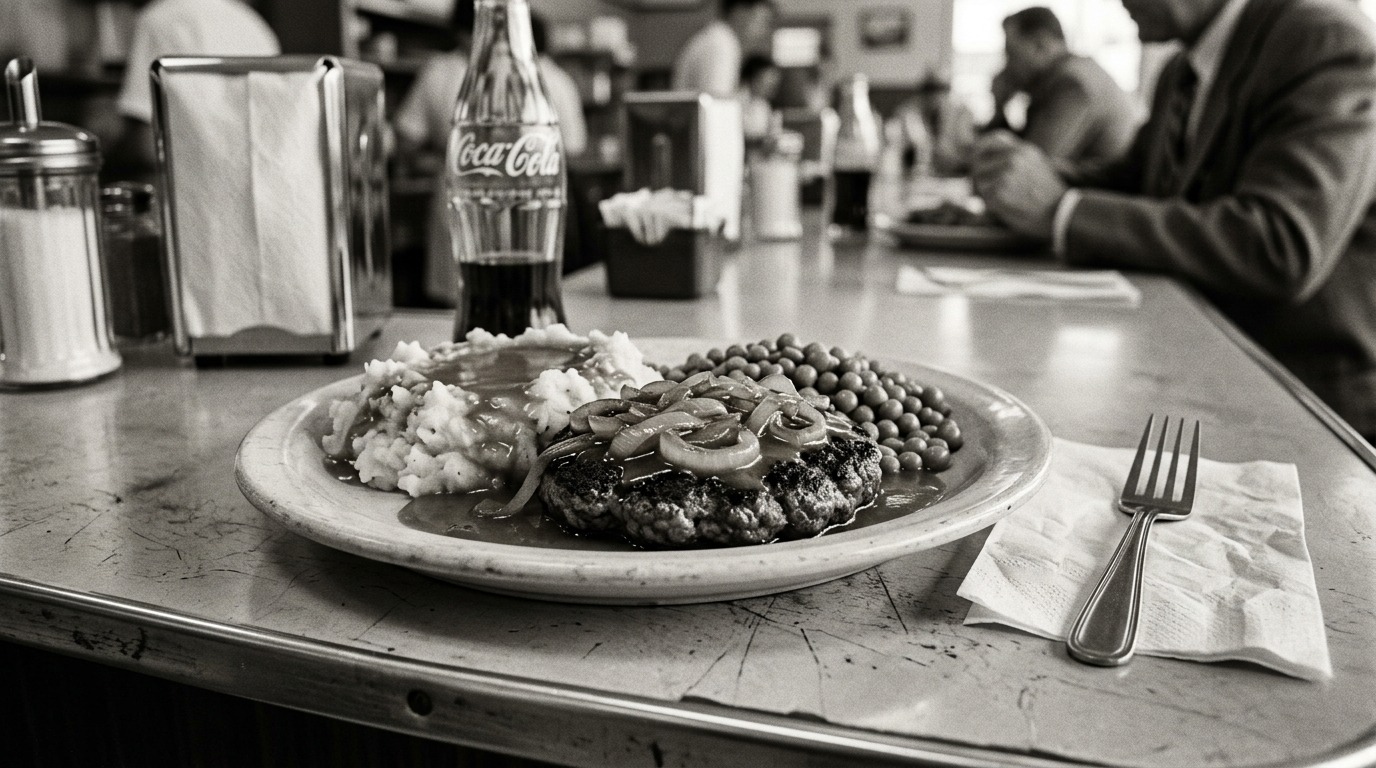
The Hamburger Steak was the most expensive item on the McDonald’s menu, tied with the Barbecued Plate at 60 cents, and the version of hamburger you would order if you wanted a proper dinner rather than a sandwich. A hamburger steak in 1940 was essentially a Salisbury steak: a thick patty of ground beef, often with onions and breadcrumbs mixed in, served unbunned on a plate with sides and gravy. It was eaten with a knife and fork.
This is the item on the original menu that most clearly shows the brothers were trying to be a full-service restaurant rather than a hamburger stand. A 25-cent Aristocratic Hamburger was the snack version. A 60-cent Hamburger Steak was the full dinner, priced at 2.4 times the snack, served on the same breakable china as the barbecued plate. The carhops carried both out to the cars, knives, forks, gravy and all.
The hamburger steak vanished in 1948 along with everything else that required cutlery. What survived was the 25-cent sandwich version, which dropped to 15 cents under the Speedee Service System and went on to become the most-sold prepared food item in human history. The hamburger steak, more dignified, more expensive, served with gravy on a real plate, did not. There is a small lesson in there about which version of a food product gets to take over the world.
Hot Dog
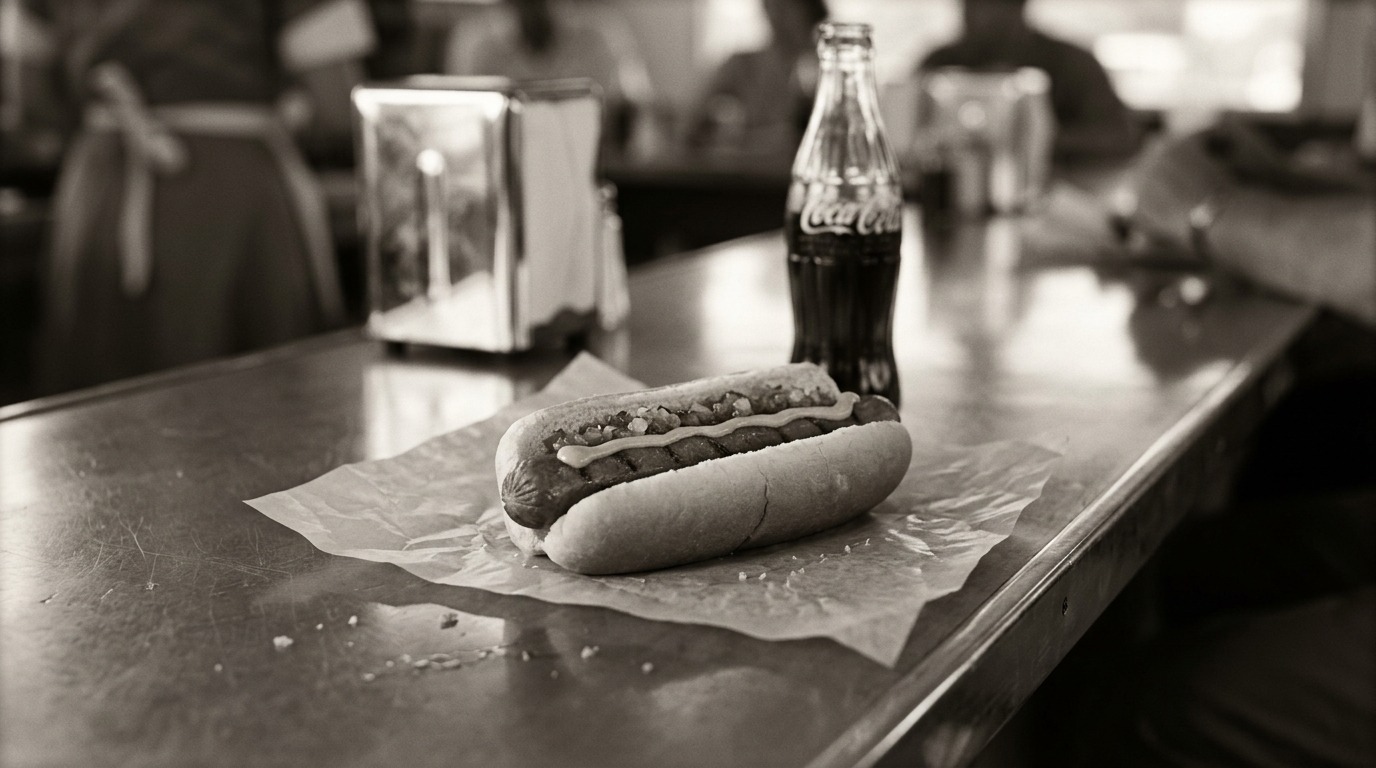
The hot dog was on the McDonald’s menu before there was a McDonald’s. In 1937, three years before the San Bernardino restaurant opened, the brothers were operating a tiny octagonal hot dog and orange juice stand called The Airdrome on Route 66 near the Monrovia airport, where they sold hot dogs to people coming to watch planes take off. Hamburgers were added later as a 10-cent afterthought. When the brothers decided in 1940 to move 40 miles east to San Bernardino and pivot to a full barbecue drive-in, they paid a mover $200 to slice the octagonal Airdrome building in half and transport it in pieces. The new restaurant was built around the old one. The hot dog came with the building.
It stayed on the menu for the entire Bar-B-Q era, and it stayed after the 1948 reset, and it stayed all the way through the early Kroc franchising years. Some sources suggest hot dogs were actually the brothers’ single most popular item before the hamburger took over – a claim that is contested but tells you the dog was no afterthought.
The hot dog was finally banished by Ray Kroc, who bought the brothers out for $2.7 million in 1961 and decided he could not control hot dog quality the way he could control beef. He apparently runs a tight ship.
Ham Sandwich
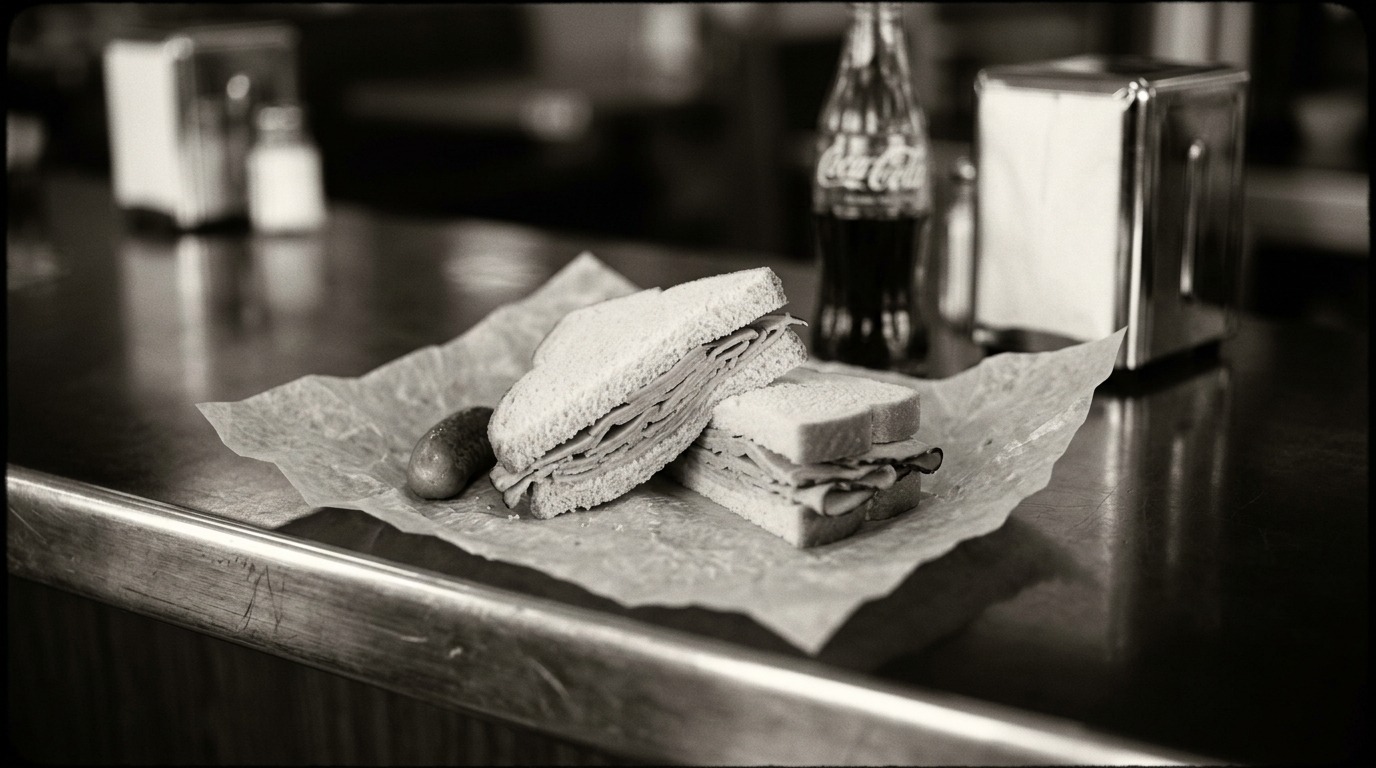
Distinct from the barbecued ham sandwich and slightly cheaper, the plain ham sandwich was the diner-counter version of the same idea: cold or grilled ham, on bread, without the eight hours of hickory smoke. It was the kind of item every American drive-in served in 1940 because every American drive-in needed a sandwich for the customer who wanted something straightforward and was not interested in the brothers’ opinions about authentic barbecue.
The ham sandwich gives you a useful sense of how the McDonald’s Bar-B-Q menu was actually constructed. The brothers built the menu around the barbecue pit because the barbecue pit was the marketing hook – the thing the carhops mentioned, the thing the printed menu boasted about, the thing that justified the trip from out of town. But for the customer who pulled in already knowing they wanted lunch, there had to be backup options. The ham sandwich, the melted cheese sandwich, the PB&J – these were the safety net. They allowed McDonald’s to function as a normal restaurant for the customer who did not feel like ordering smoked meat at one in the afternoon.
What this means is that the items most people associate with the original McDonald’s – barbecue, ribs, big plates – were the romance. The ham sandwich was the practical reality. It was on the menu because somebody, every day, ordered one.
Ham and Baked Beans
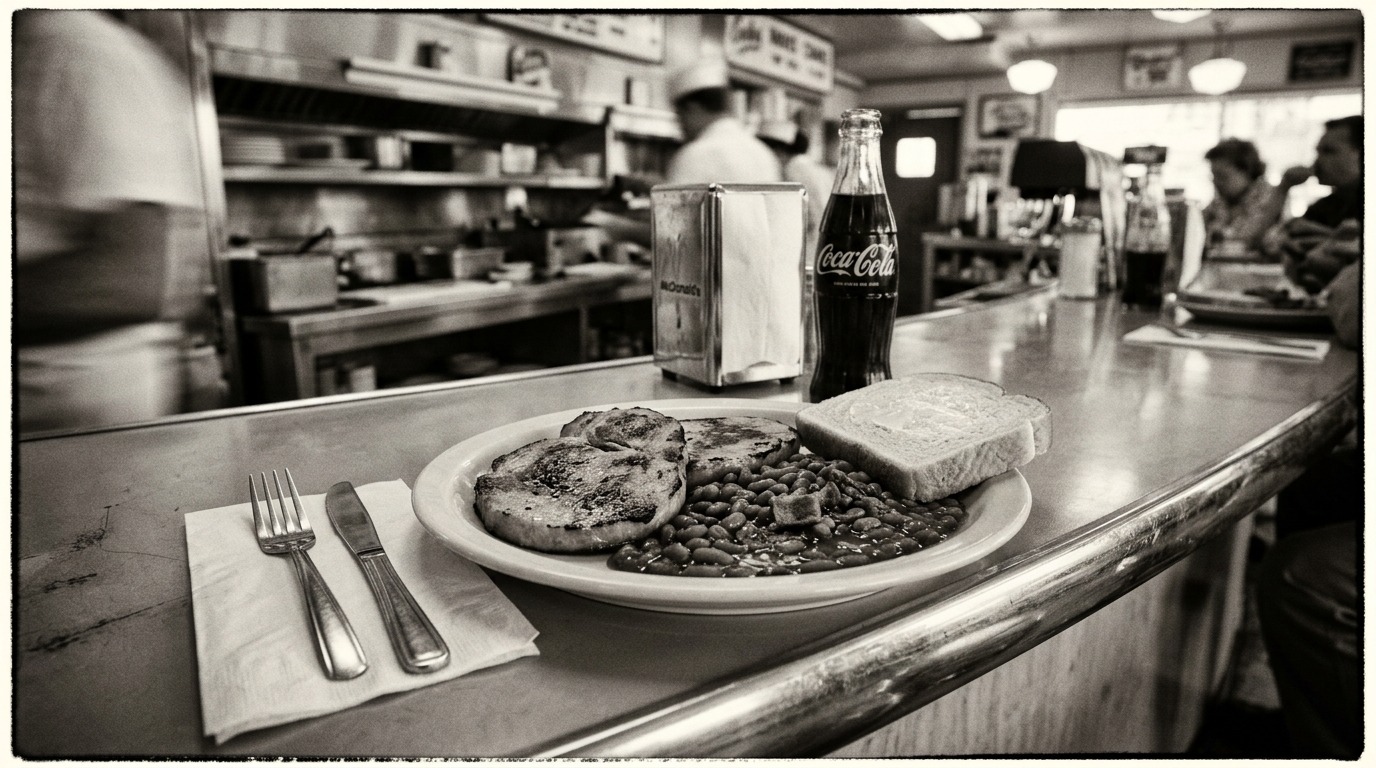
The Ham and Baked Beans plate is the item on the original menu that most clearly betrays the brothers’ New Hampshire upbringing. Baked beans served with ham is a New England staple – specifically a Saturday-night Boston-area tradition that traces back to colonial puritan households, where the beans were baked low and slow because Saturday-night cooking had to last through a Sabbath when cooking was forbidden. Dick and Mac grew up in Manchester, New Hampshire, eating exactly this kind of food. When they built their California drive-in menu, the food they remembered from home went on it.
The plate was a full dinner, served on china with utensils, sitting in the same slot as the hamburger steak and the barbecued plate but at a lower price point. It was carbohydrate-heavy, slow to eat, and almost completely alien to the Southern California car culture the restaurant was trying to serve. A San Bernardino teenager pulling into the lot in a Ford coupe in 1944 was not, by and large, hoping for a New England Saturday-supper plate.
What this tells you is that the McDonald brothers had not yet fully understood their own market. The food on the menu was a mixture of what they thought California wanted (barbecue, hot dogs, hamburgers) and what they personally liked (Boston baked beans, Mexican tamales, peanut butter sandwiches). It would take eight years of sales data before they finally accepted what the customer was actually buying.
Melted Cheese Sandwich
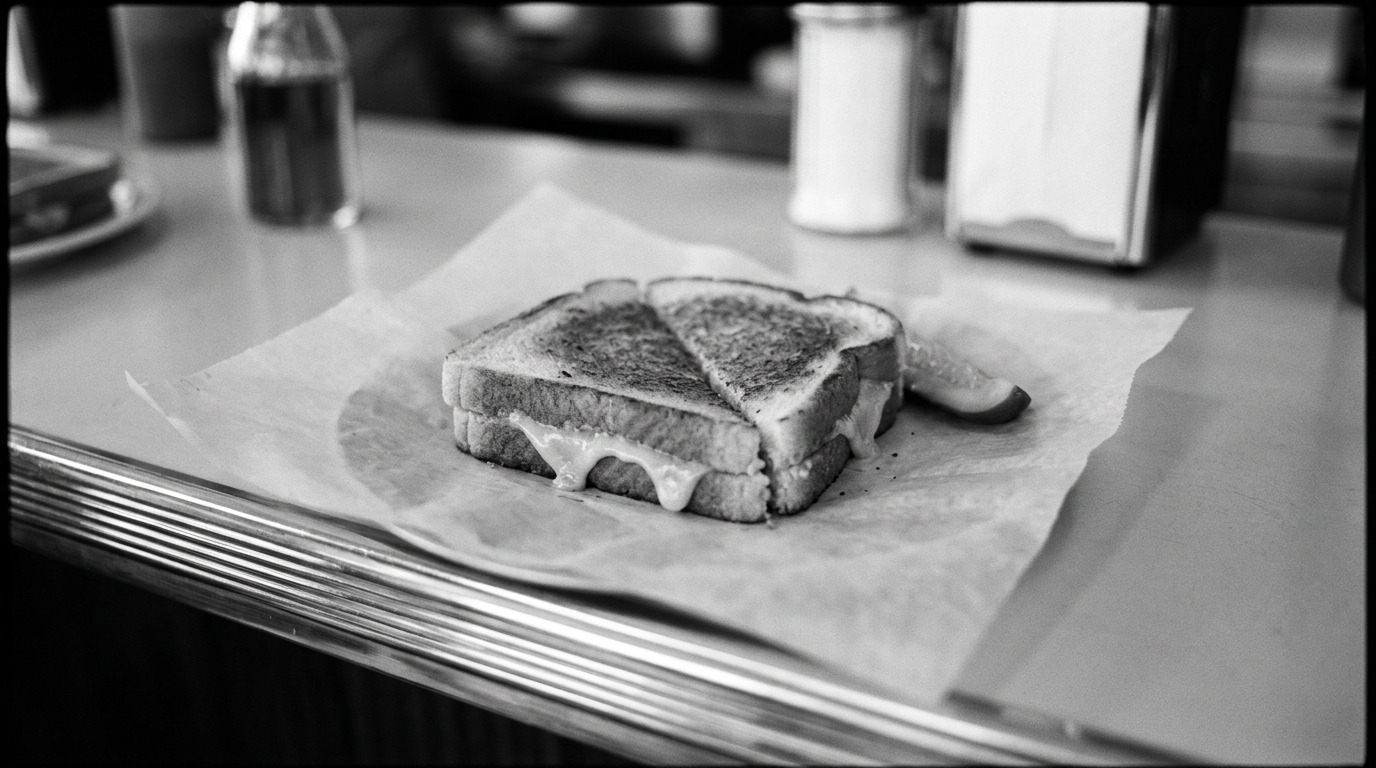
The Melted Cheese Sandwich was the McDonald’s menu’s concession to the customer who wanted lunch but not meat – which, in 1940, was a smaller portion of the population than it is now but still a real one. Catholic customers observed meatless Fridays. Children who would not eat ham were sent inside with their parents and needed something to order. The melted cheese sandwich, essentially the grilled cheese that would become a permanent feature of American kid menus, was the answer.
It was a simple item to produce, requiring only bread, butter, cheese, and a grill – all of which the kitchen already had on hand for the hamburgers. It was profitable for the same reason it was simple. And it had the rare distinction, on the 1940 McDonald’s menu, of being something the brothers could prepare in roughly the time it took to slice a tomato, in a kitchen otherwise built around hours-long smoking and slow-roasted sides.
A grilled cheese sandwich, in retrospect, is the closest thing on the 1940 menu to a Speedee Service item. The brothers had not yet realised this. When they finally simplified the operation in 1948 and reduced the menu to nine items, the melted cheese sandwich did not make the cut. McDonald’s would not sell a grilled cheese sandwich at scale until the 21st century, when various international markets reintroduced one as a nostalgia item. Sometimes the right idea is hiding in plain sight on your own menu for eight years.
Peanut Butter and Jelly Sandwich
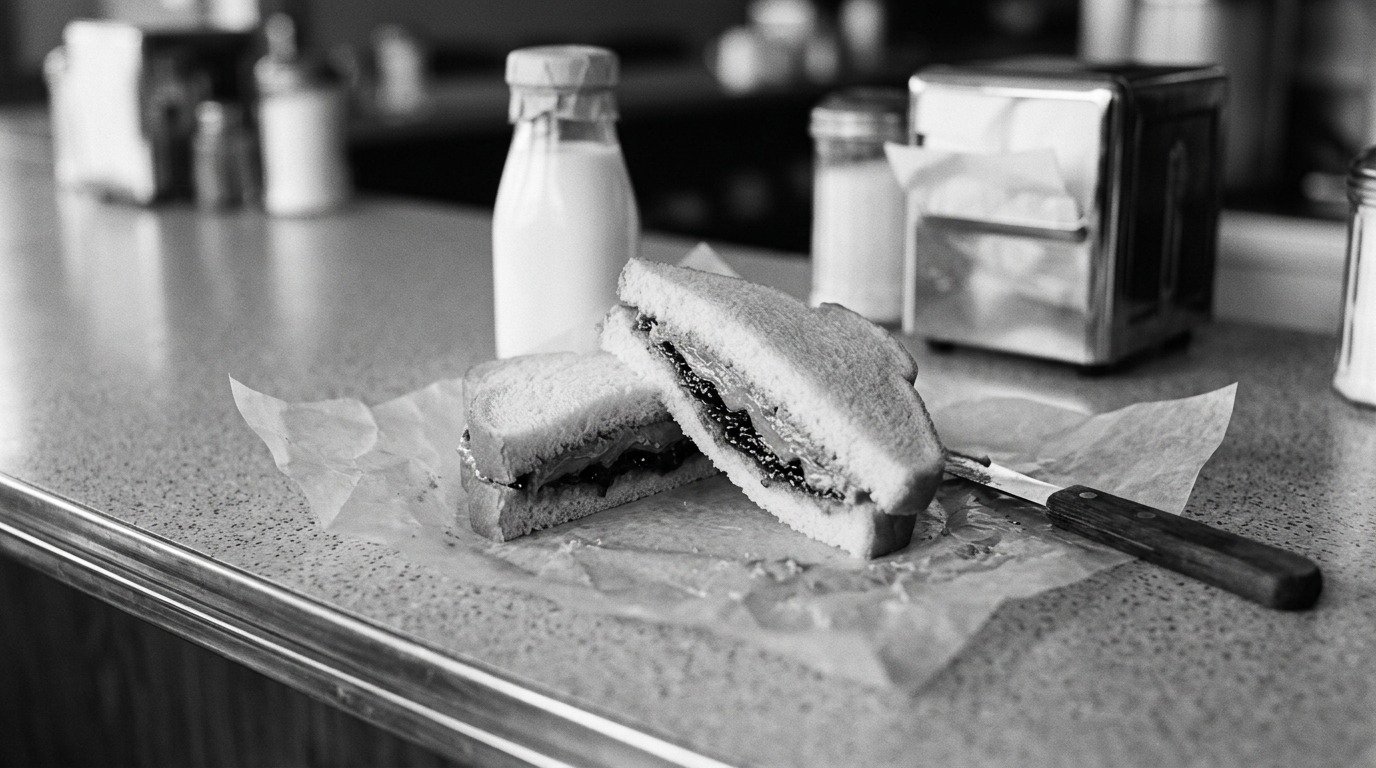
A peanut butter and jelly sandwich was, in 1940, an entirely defensible item for a roadside drive-in to sell. PB&J had been popularised during the Great Depression as cheap protein for children and had migrated up into casual adult menus through the 1930s. The American military issued peanut butter and jelly together in ration packs in World War II, which would in a few years cement the sandwich as a national staple for an entire generation of returning servicemen. None of which makes it any less strange to see today, on a list of items once available at McDonald’s.
The PB&J at McDonald’s Bar-B-Q came with French fries for 20 cents – half the price of the cheapest cup of coffee at a sit-down restaurant of the era, and the kind of meal a 1942 mother could order at the carhop window for a 7-year-old in the back seat without thinking twice. According to The Daily Meal, the standard pairing for a McDonald’s PB&J was a root beer float or an ice cream soda from the fountain, both of which were also on the menu. There has never been a McDonald’s meal combination more difficult to imagine ordering through a modern drive-thru.
The PB&J was killed in the 1948 renovation along with everything else not made of ground beef. It has not returned, in any market, in any decade, in any form. Make of that what you will.
Tamales and Chili
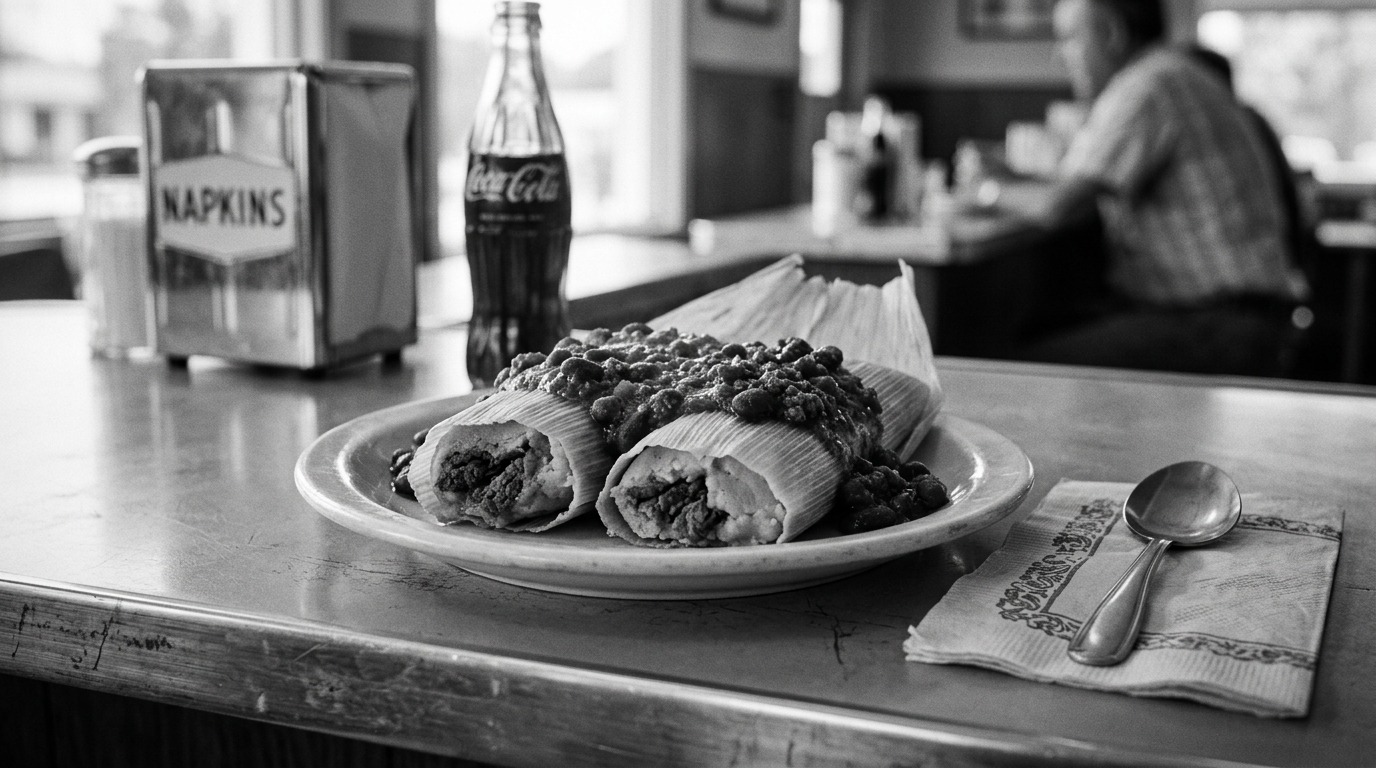
Tamales were genuinely popular street food in 1940 Southern California, and putting them on a drive-in menu was not the wildly eccentric choice it sounds like today. The dish had migrated north from Mexico into California, Texas, and the Mississippi Delta beginning in the 1880s, and by the 1930s tamale vendors were a fixture of working-class urban food culture across the American Southwest. The McDonald brothers, opening their drive-in fifty miles from the Mexican border, were doing what every roadside restaurant in San Bernardino did: putting Mexican food on the menu because Mexican food was what local people ate.
The plate at McDonald’s was tamales smothered in chili – the standard mid-century American presentation, which would have used corn-husk-wrapped masa tamales topped with a meat-and-bean chili rather than the more delicate Latin presentations. It was hearty, cheap, and the kind of thing a carhop could deliver to a car window without much trouble. Sources consistently name it among the more popular items on the BBQ-era menu.
What strikes a modern reader is how casually this was treated as a standard American menu item. There was no special section, no asterisk, no marketing about authenticity. Tamales were simply lunch. The 1948 reset eliminated them, and McDonald’s spent the next seventy years deciding, at intervals, whether to reintroduce anything Hispanic to the national menu. The brief 2001 South Florida experiment with Cuban sandwiches did not stick. Neither has anything else.
Chili
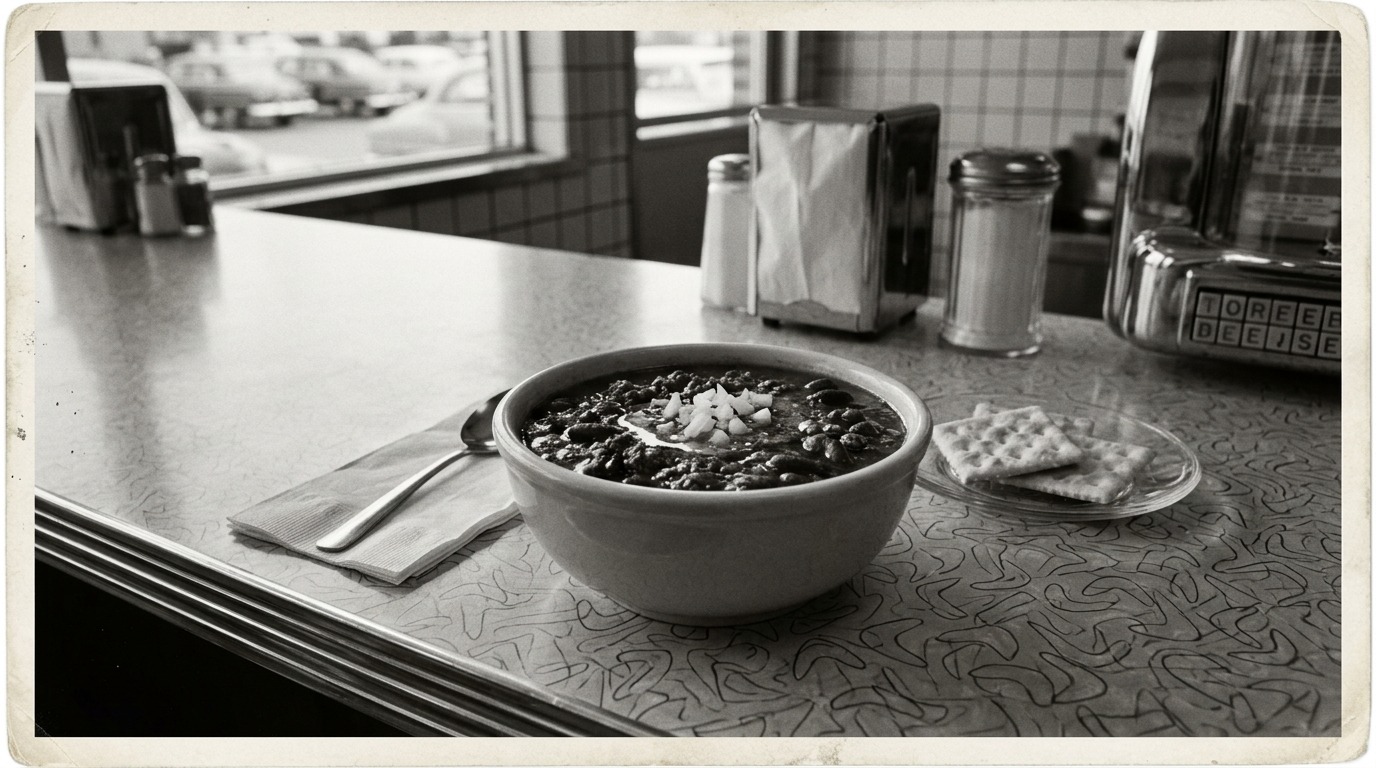
A bowl of chili was the standalone version of the menu item the tamales were drowning in, served on its own, in a bowl, the way roughly every American diner in 1940 served chili. The McDonald’s chili would have been a meat-and-bean variety, ground beef simmered with tomatoes, beans, and whatever chile powder the brothers were buying wholesale that month. It was filling, cheap to produce, and could sit on a steam table for hours without losing quality – the precise attributes that make a menu item profitable for a drive-in.
Chili is one of the items where it’s worth pausing to consider how genuinely strange the original McDonald’s was as a restaurant. In a single visit in 1944, you could order a bowl of chili, a plate of barbecued ribs, a peanut butter and jelly sandwich, and a root beer float. You could eat all of this in your car, with proper silverware, delivered by a young woman in a usherette uniform recycled from a failed cinema in Glendora. None of this would seem unusual to your fellow customers. The menu was a fair representation of what a 1940 Californian drive-in did – an everything-and-the-kitchen-sink approach to roadside dining that the brothers themselves would eventually find indefensible.
Chili did not survive the 1948 reset. It would reappear briefly in McDonald’s history as McChili in test markets in the 1980s, where it failed quickly enough that most people never noticed.
French Fries
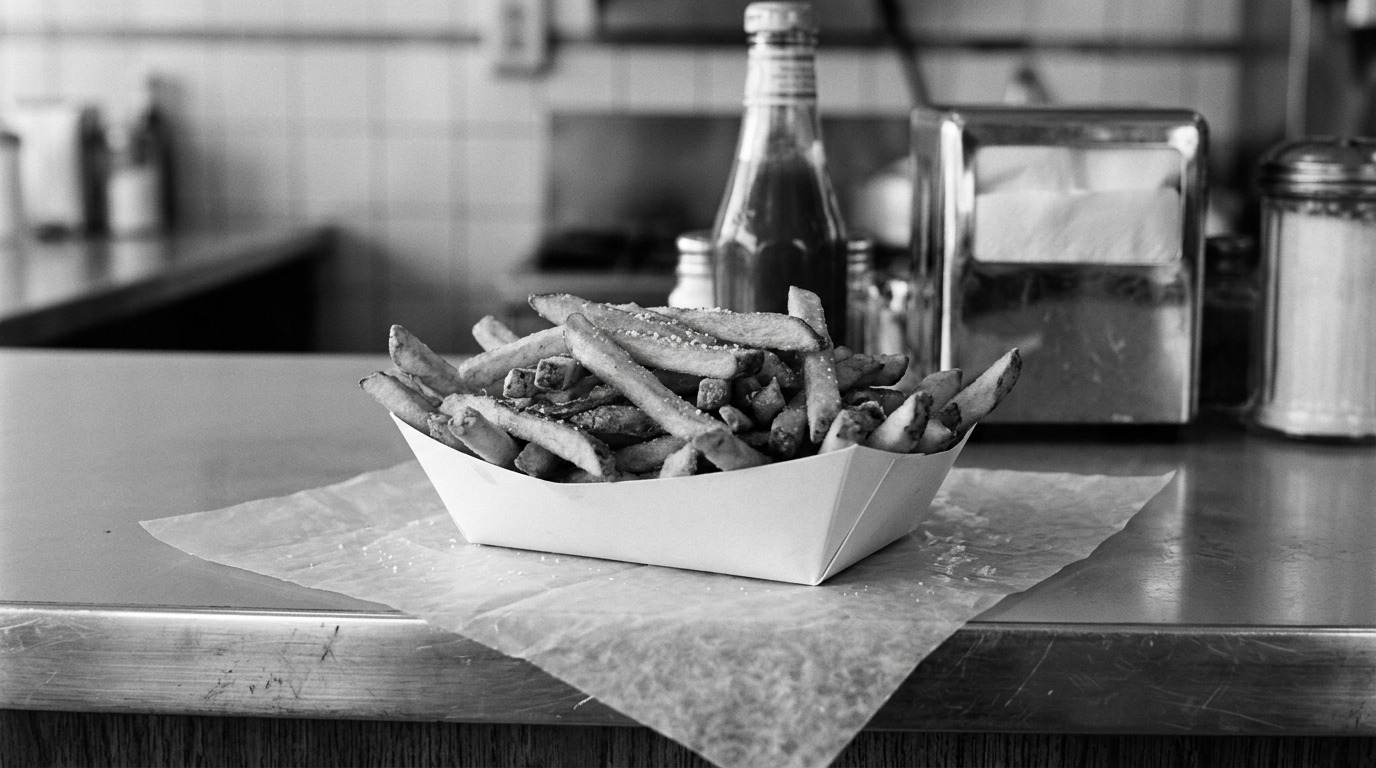
French fries at McDonald’s Bar-B-Q were not yet the famous McDonald’s french fries. The famous version came later, after the brothers spent the better part of 1949 perfecting a frying technique that would let them produce 900 servings an hour. The 1940-1948 fries were a standard drive-in side: potatoes peeled and hand-cut in-house, fried in beef tallow, salted, and served alongside the 35-cent barbecue sandwiches as part of the basic combo. They came with the meal. Customers ate them without thinking about them very much.
This is genuinely surprising once you sit with it. The french fry is now so central to McDonald’s identity that the company’s own corporate materials list fries alongside the Big Mac as one of the two bestselling licensed items. But in 1940, fries were not a featured item. They were a side. The brothers thought the BBQ was the draw. The fries were just what came with it.
When the 1948 reset happened, fries were initially removed because they slowed down service. Potato chips replaced them on the new nine-item menu. Within a year, customer demand was overwhelming enough that fries were reintroduced, and within five years they had become the single best-selling item McDonald’s sold. The brothers had spent eight years treating their secret weapon as an afterthought.
Potato Chips
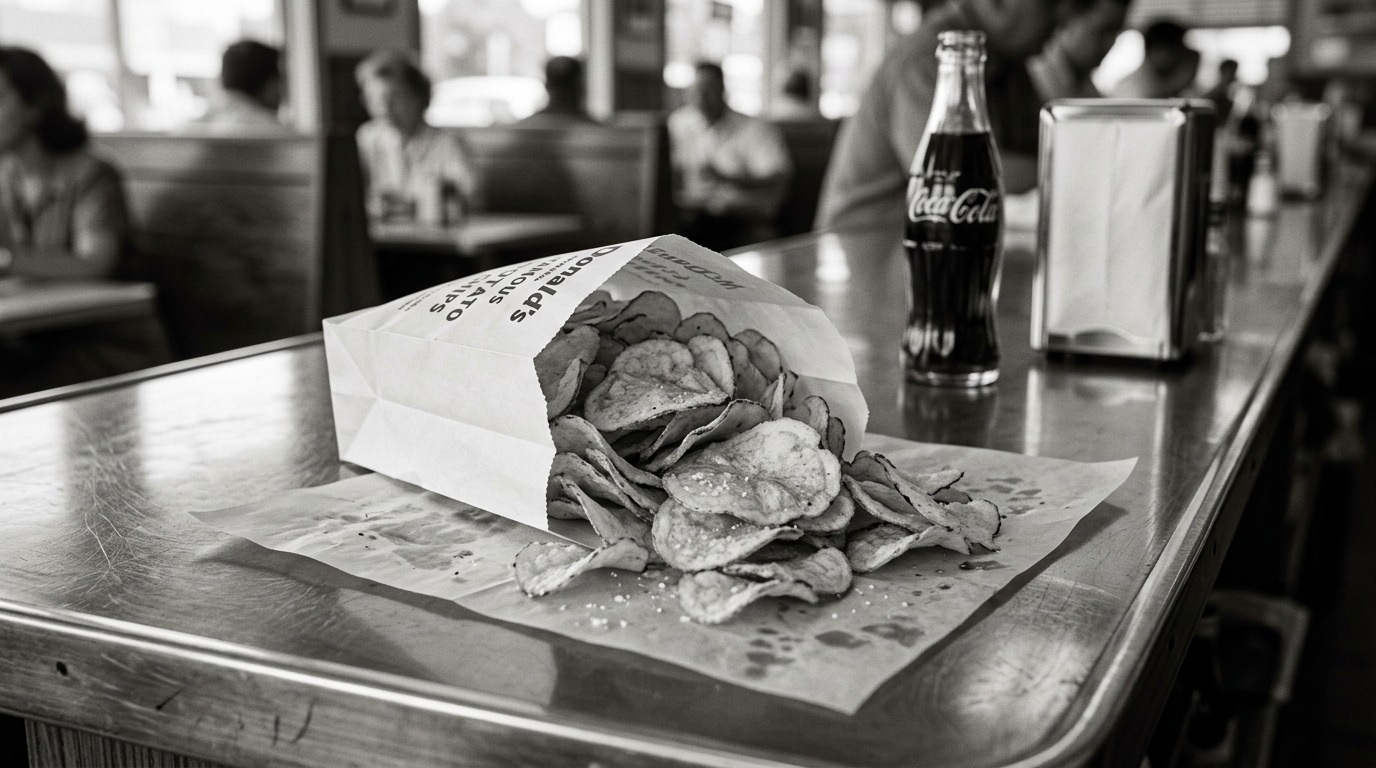
Potato chips were the alternate side to French fries at McDonald’s Bar-B-Q, available for customers who wanted something faster, lighter, or just different. They were almost certainly bought in from a regional supplier rather than produced in-house – house-made chips would have required a dedicated frying station the brothers did not yet have, and pre-packaged chips were a thriving Southern California product by 1940, with Laura Scudder’s San Pedro plant having pioneered the waxed-paper chip bag a decade earlier. McDonald’s was almost certainly buying chips out of bags and serving them in baskets.
The reason chips matter on this list, despite being a fairly boring item, is that they would briefly become the central side at McDonald’s. In December 1948, when the brothers reopened with the simplified nine-item Speedee menu, fries were temporarily off and chips were the only potato option. The chips lasted exactly one year in that role. By December 1949, the fries were back, the chips were gone, and McDonald’s had committed – permanently, as it turned out – to the hand-cut russet potato as its defining side dish.
The potato chips on the 1940 menu, in other words, were almost a brief fast-food empire. Then they were not.
Baked Beans
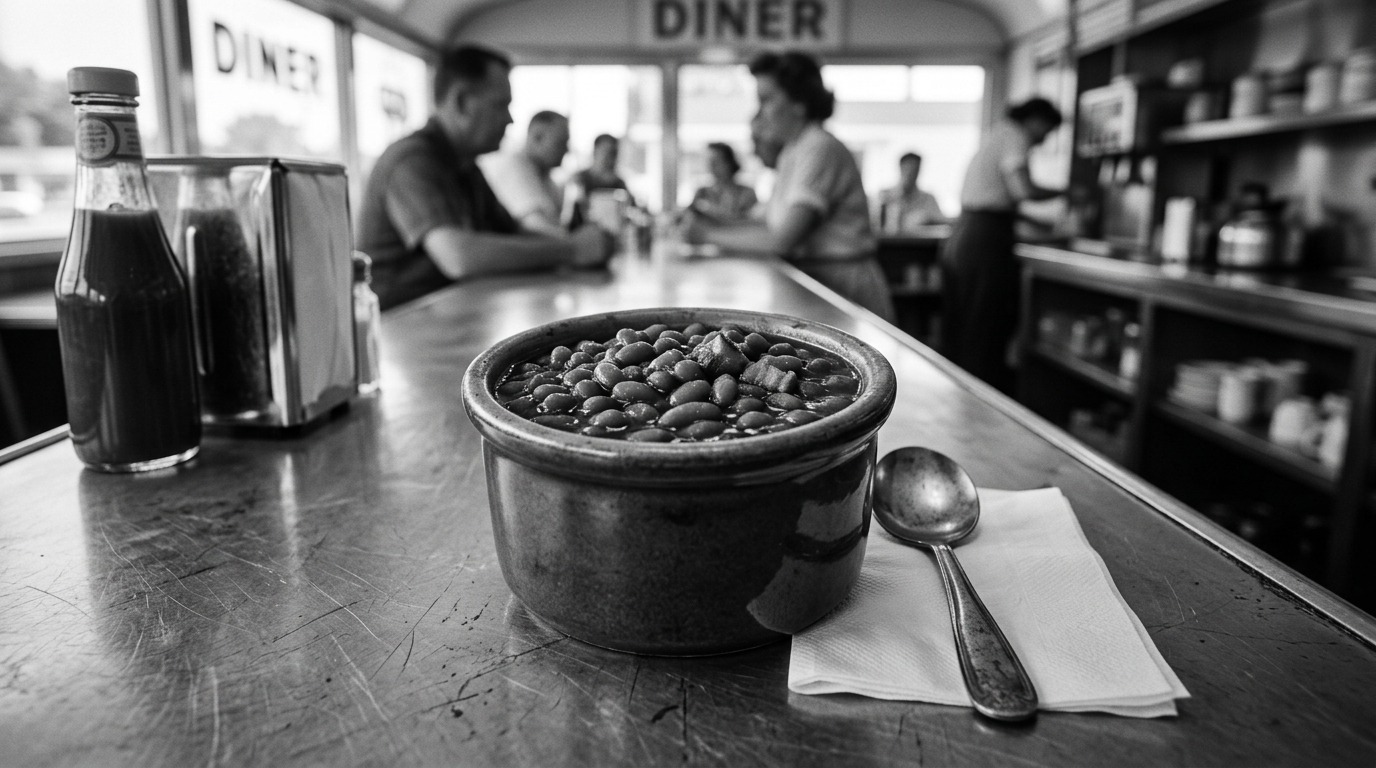
Baked beans appeared on the 1940 menu both as the side to the ham plate and as a standalone option, which reflects the brothers’ New England upbringing more than any sensible read of Southern California taste. Boston baked beans – molasses-sweetened, slow-cooked, traditionally simmered for hours on a Saturday – were a New Hampshire household staple Dick and Mac would have grown up eating weekly. When they opened a restaurant in California, they put baked beans on the menu the way an Italian immigrant restaurateur in Brooklyn would have put marinara on his.
A standalone bowl of baked beans is not, in 2026, what most people would order at a drive-in. It was not, in 1940 either. The item lived on the menu as a side, a hot accompaniment, and a marginal standalone for the customer who wanted exactly that. McDonald’s was not the place where you went for baked beans, but the McDonald brothers thought baked beans should be available regardless, because that was the kind of restaurant they understood.
The beans disappeared in 1948 along with most of the other items the brothers personally liked but customers ignored. McDonald’s has never sold them since, in any market, in any format – which is consistent with the company’s broader history of removing the founders’ personal taste from the menu and replacing it with whatever data said sold the most.
Pie
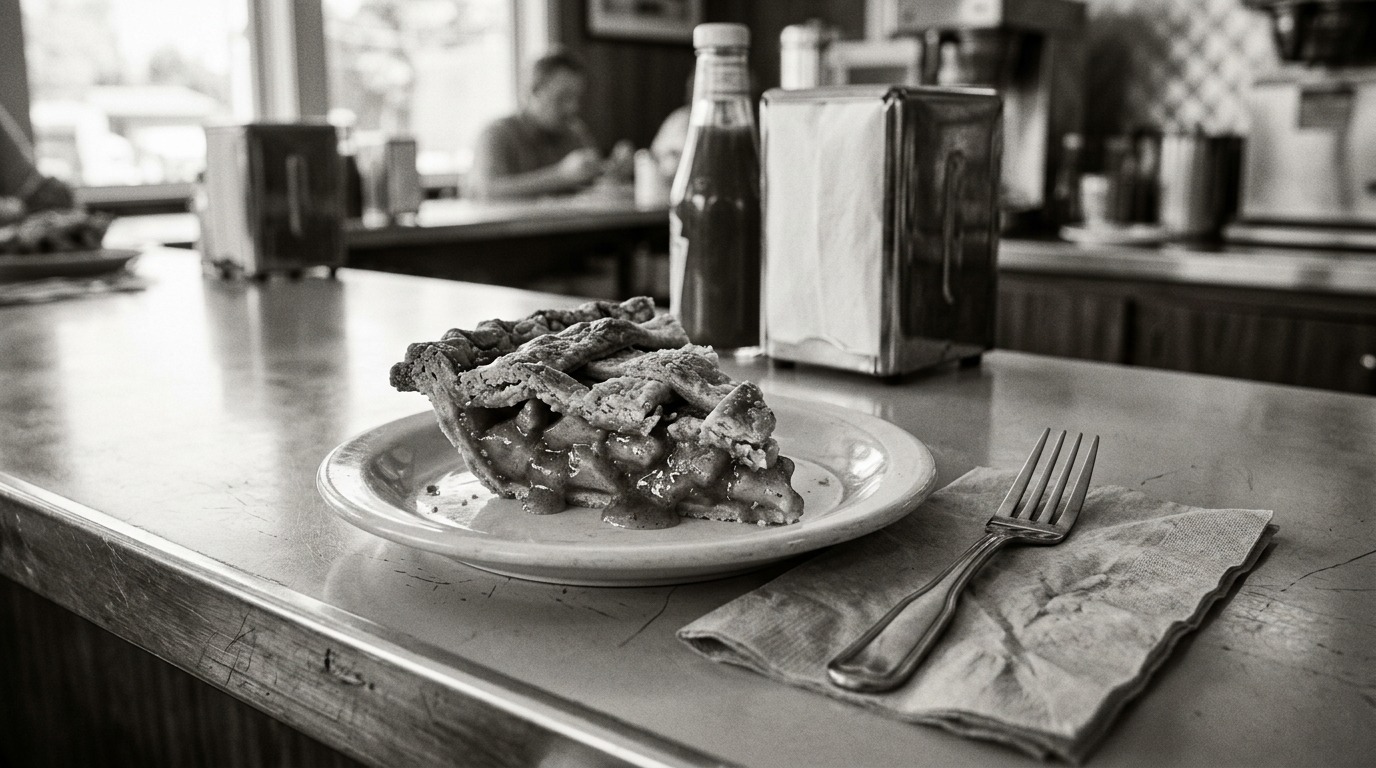
The pie at McDonald’s Bar-B-Q was the standard American diner dessert: a slice, on a plate, with a fork, in whatever flavors the kitchen had baked that morning. Apple was the constant. Sources mention pie generically rather than naming the full rotation, which suggests the offerings rotated seasonally – cherry in summer, pumpkin in fall, apple year-round, the way every roadside restaurant in 1940 worked. The slices were almost certainly bought in or baked off-site rather than produced in the McDonald’s kitchen, which had its hands full with hours of slow-smoking meat.
Pie is the item from the original menu that lasted longest. When the brothers killed the BBQ menu in 1948, pie survived the cut – one of just nine items kept on the new Speedee menu. The apple slice that would become the McDonald’s hot apple pie of 1968 traces a continuous lineage back to the 1940 pie offered at the carhop window. It is, in that sense, the only food item on this entire list that is still present on the McDonald’s menu today, more than eighty years later, even if the pie that emerged from the 1968 redesign as a deep-fried rectangular hand-pie bears almost no resemblance to a slice on a plate.
The brothers would not have recognised it. The lineage is real anyway.
Sundae
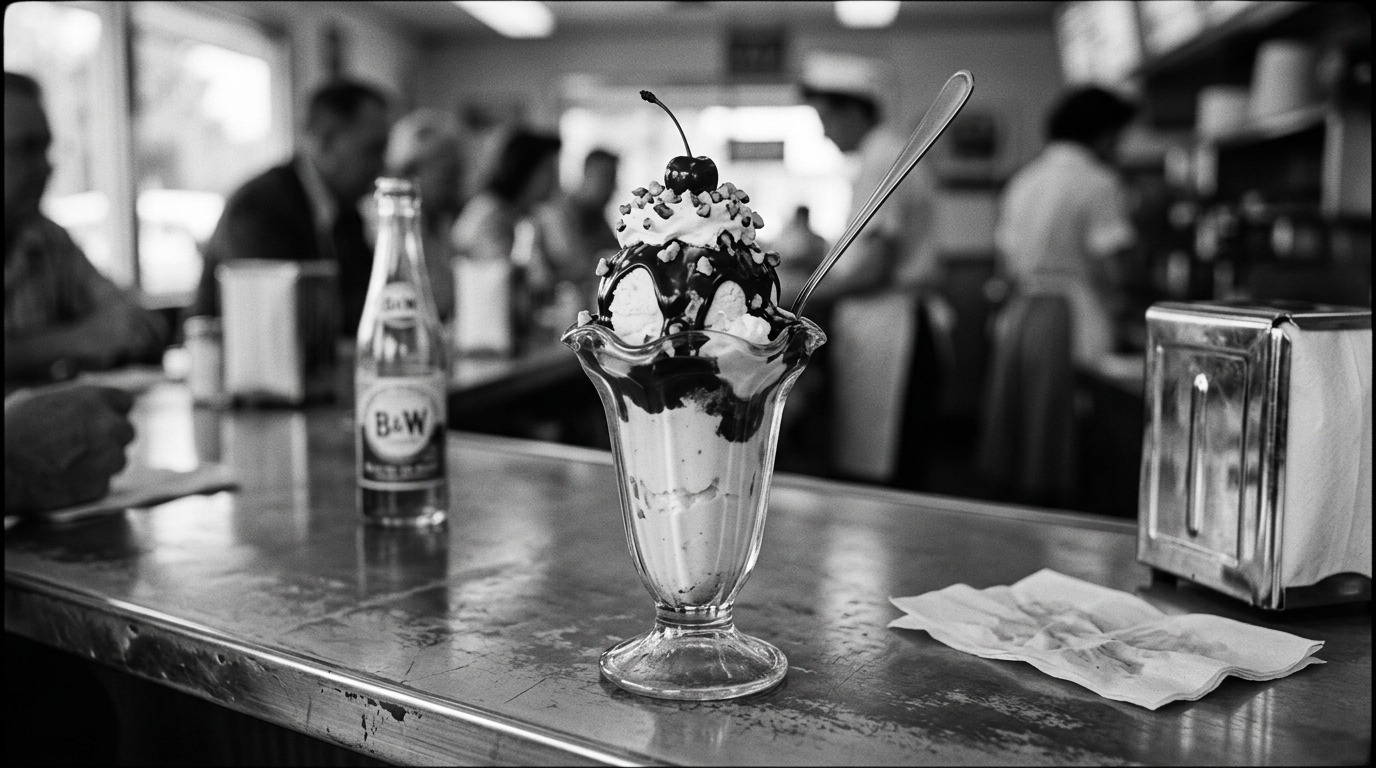
A sundae at McDonald’s Bar-B-Q was a real soda-fountain sundae: ice cream in a glass dish, topped with syrup, whipped cream, and a maraschino cherry, eaten at the carhop window with a long spoon. The whole apparatus – the metal sundae dishes, the syrup pumps, the whipped cream canisters – was standard soda fountain equipment of the era, and the brothers had installed it because every respectable drive-in in 1940 had a soda fountain. The sundae itself dated to 1892, when an Ithaca pharmacist invented the dish by pouring cherry syrup over ice cream on a Sunday afternoon. The spelling was changed to ‘sundae’ to avoid offending local Methodists who objected to naming a dessert after the Sabbath. None of this Methodist sensibility had survived the migration to California, but the dessert itself had.
The McDonald’s sundae was eliminated in 1948 along with the entire soda fountain apparatus, because the new Speedee model had no room for hand-built desserts that required a soda jerk’s attention. Ice cream did not return to McDonald’s until the company introduced soft-serve in the 1970s, at which point the sundae came back – on machinery the original sundae would not have recognised.
The 1940 version, glass dish and long spoon and all, has not been seen at McDonald’s since the carhops were fired.
Ice Cream Soda
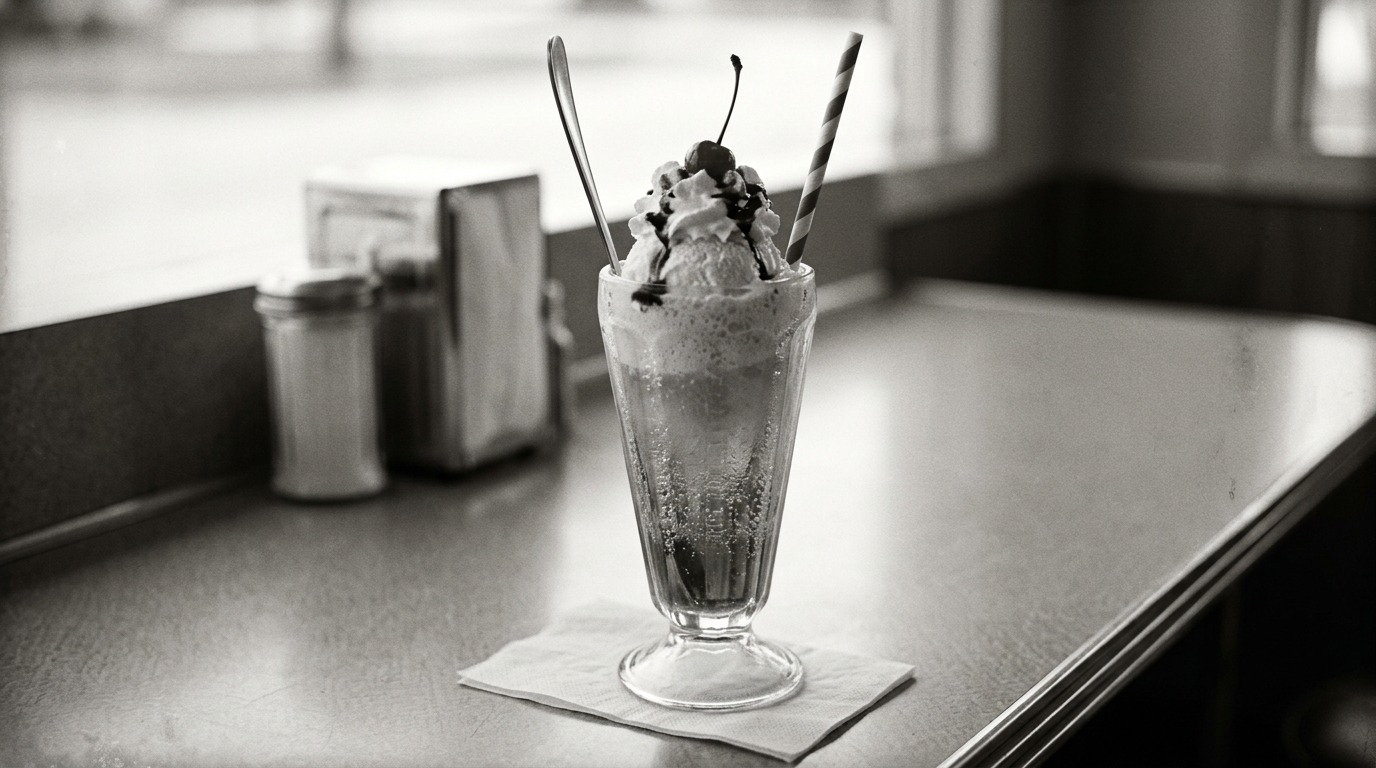
An ice cream soda is a separate item from a sundae, despite the modern tendency to conflate them, and the distinction matters for understanding what kind of restaurant the original McDonald’s actually was. A sundae is ice cream with syrup poured over it. An ice cream soda is a tall glass containing carbonated water, flavored syrup, and a scoop of ice cream, served with both a straw and a long spoon, the way a proper soda fountain prepared it. The two desserts coexisted on every fountain menu in the country, and they coexisted at McDonald’s Bar-B-Q.
The Daily Meal, citing earlier sources, names the ice cream soda specifically as the standard companion order for a McDonald’s PB&J sandwich. A 7-year-old getting a peanut butter and jelly with fries for lunch in 1944 would, often as not, have washed it down with a chocolate ice cream soda from the McDonald’s fountain. The bill for the entire meal would have come to roughly 40 cents.
The ice cream soda did not survive 1948. It has never returned. Of all the items on this list, it is the one most decisively at odds with the kind of restaurant McDonald’s would become – a slow, sit-with-it-and-stir-it dessert beverage, designed to be lingered over, served in glassware that required washing. It was the precise opposite of fast food.
Coffee
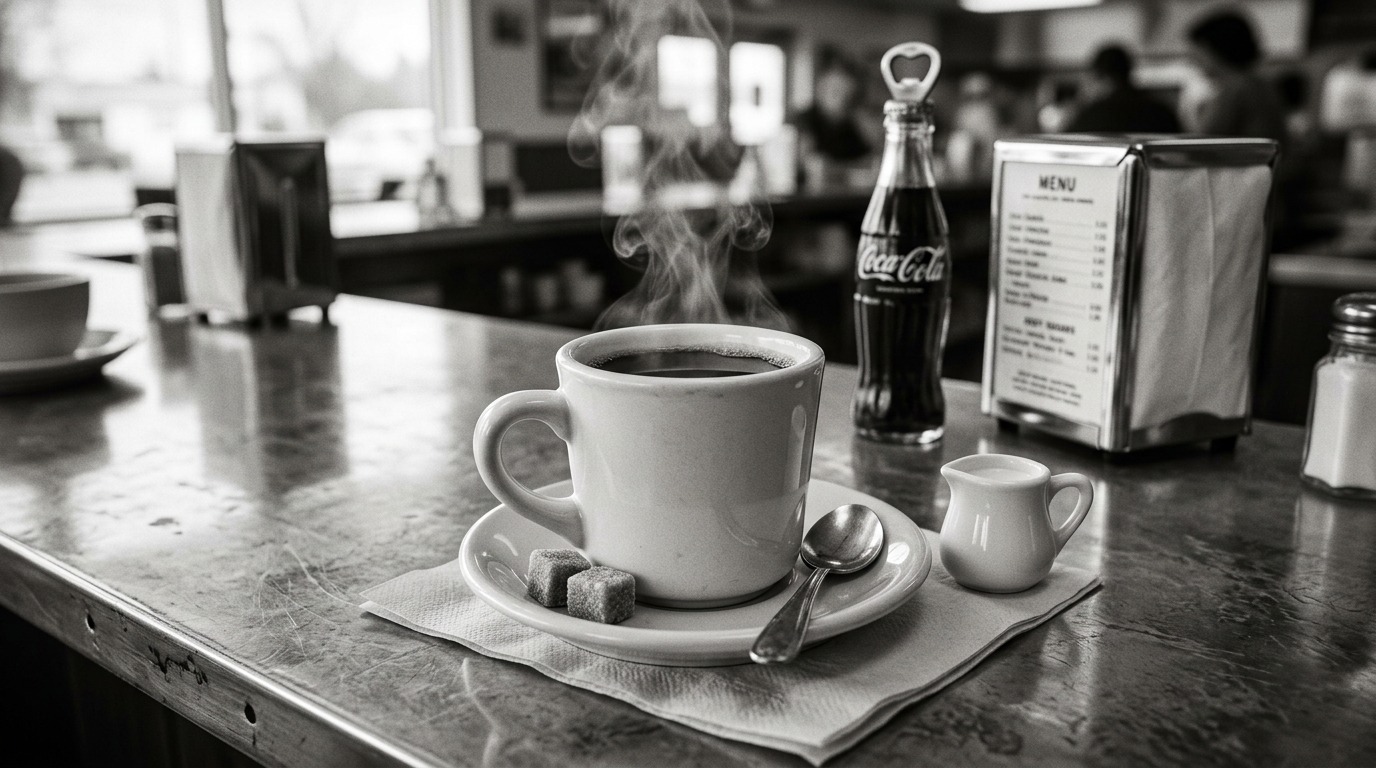
Coffee was the cheapest item on the McDonald’s Bar-B-Q menu at 5 cents, which means that during the entire BBQ era a customer could pull into the parking lot, order coffee, drink it, and leave for less than the cost of a postage stamp. It was the kind of item drive-ins kept at break-even prices because coffee customers were rarely just coffee customers – they would also order a slice of pie, a sandwich, something. The nickel coffee was the door-opener.
The coffee itself was almost certainly drip-brewed in bulk and held warm in a percolator behind the counter, served in a heavy ceramic mug at the carhop window. The brothers were not making the kind of coffee anyone today would consider remarkable; it would have been the standard 1940s American diner cup, strong enough to wake you up and weak enough to drink half a pot of. Patrick McDonald, the brothers’ father, had sold coffee at his original Airdrome stand in Monrovia in 1937. The McDonald family had been selling 5-cent coffee in some form for fifteen years by the time the BBQ menu was finalised.
The 1948 reset doubled the price to 10 cents. McDonald’s would never again sell coffee for a nickel. It is currently the only menu item the company sells for more than ten times its original price.
Coca-Cola
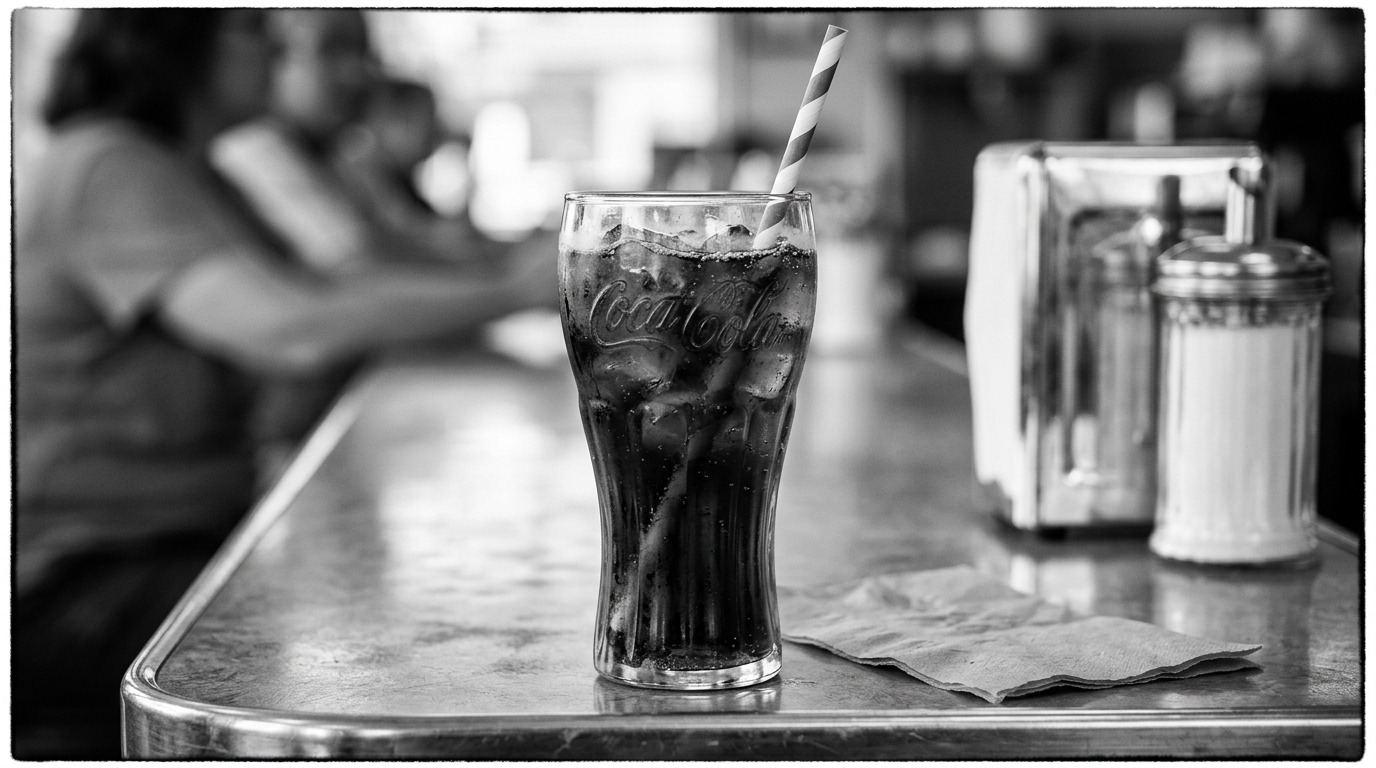
The Coca-Cola served at McDonald’s Bar-B-Q was bought off the local Coca-Cola bottler’s truck, the same as every other restaurant in San Bernardino. There was nothing special about the arrangement. The formal McDonald’s-Coca-Cola partnership – the famous one, the handshake deal between Ray Kroc and Coke executive Waddy Pratt that would eventually make McDonald’s Coke’s largest restaurant customer and earn its own dedicated division at Coca-Cola corporate – did not happen until 1955, when Kroc opened his first franchise in Des Plaines, Illinois. For the entire BBQ era, McDonald’s was simply a Coke customer.
The drink came out of a fountain in a paper cup with ice, the standard drive-in presentation. The brothers were not yet thinking about beverage strategy at any sophisticated level. Coke was on the menu because Coke was on every menu. It was the most popular soft drink in America, it had been since the 1920s, and putting it on your sign was the easiest way to signal that you sold cold drinks at all.
The relationship with Coca-Cola would, decades later, become so central to McDonald’s identity that Coke executives privately referred to the company as a country – listing the United States, Japan, Germany, ‘and McDonald’s’ as Coke’s biggest markets. None of that was visible in 1940. There was just a fountain and a cup.
Root Beer
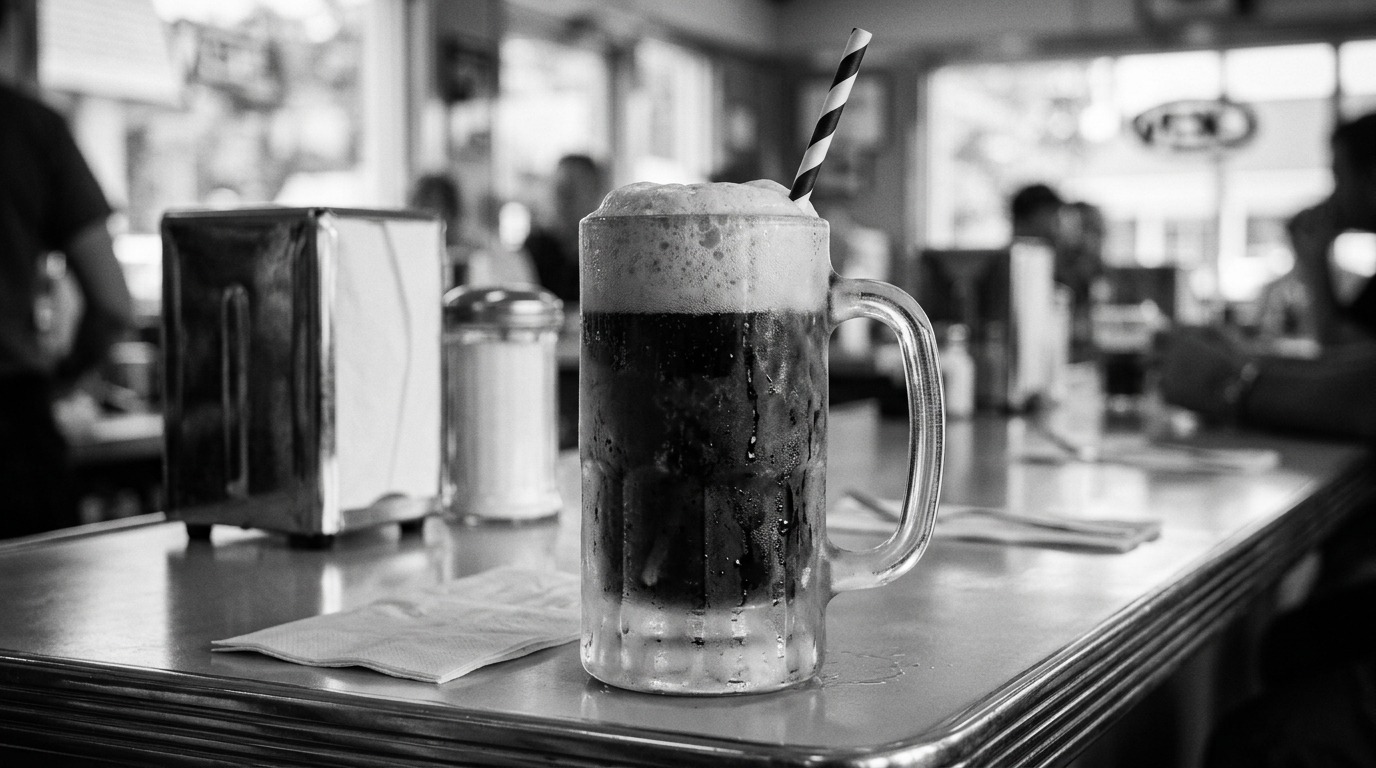
Root beer was the second of the McDonald’s fountain sodas, sitting alongside Coca-Cola at the same 10-cent price point and serving customers who wanted something sweeter and less acidic with their barbecue. In 1940 root beer was at the absolute peak of its American popularity – the A&W and Hires Root Beer chains were national operations, root beer stands dotted American highways, and a root beer float was the dessert most American children of the era could name first. The brothers were following the market.
The root beer at McDonald’s would have come from a fountain syrup, most likely Hires or a regional equivalent, mixed with carbonated water and poured over ice into a paper cup. There was nothing artisanal about it. It was a 10-cent drink served as quickly as the carhop could pour it.
What’s interesting about root beer’s place on this menu is that it survived the 1948 reset. When the brothers killed two-thirds of the menu and reopened with the streamlined Speedee model, root beer was kept – one of just three soft drink flavors in the new nine-item lineup, alongside Coca-Cola and an orange drink. It would not finally leave the standard McDonald’s menu until the late 20th century, when bottler contracts and changing tastes phased it out almost without anyone noticing. Root beer is still available at some McDonald’s locations as a secret-menu hack involving a vanilla soft-serve and a brown soda.
Root Beer Float
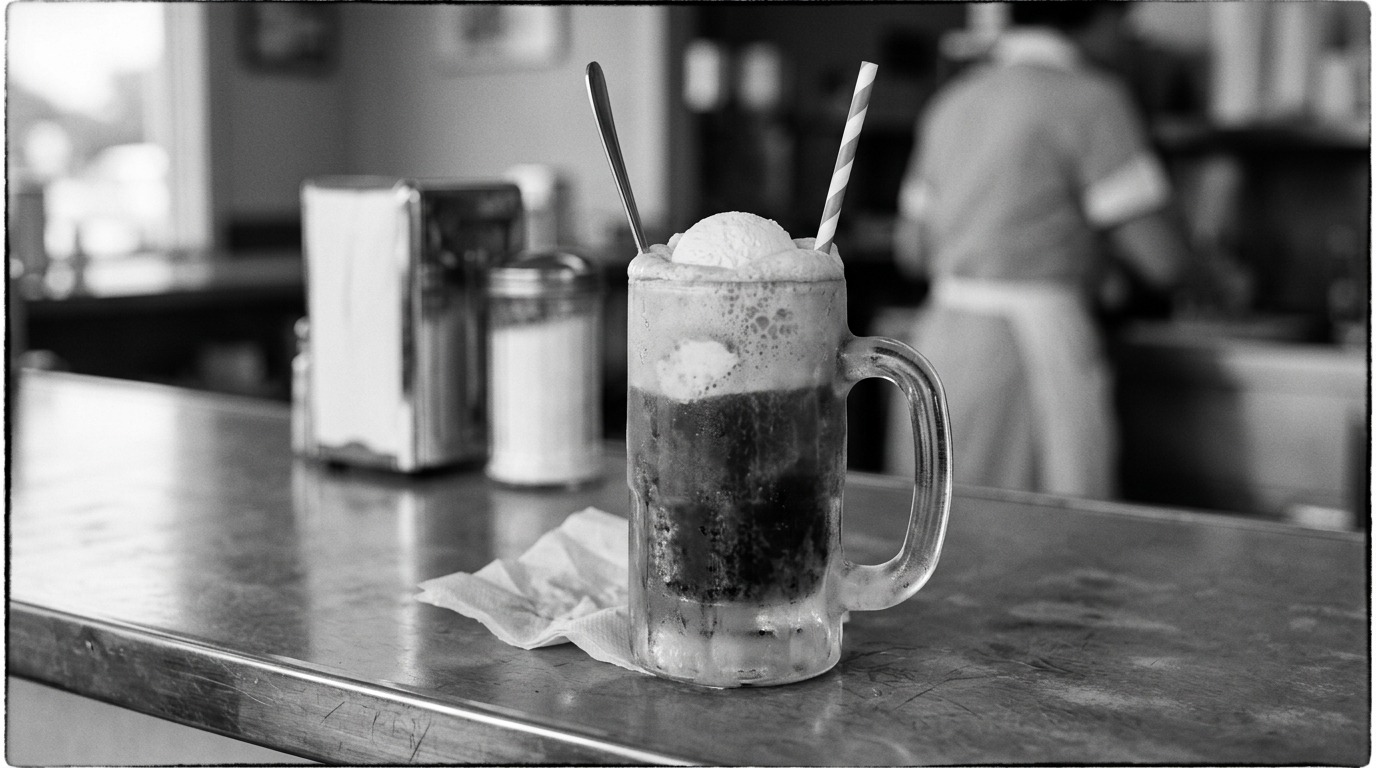
A root beer float at McDonald’s Bar-B-Q was the dessert order for the customer who wanted both a drink and ice cream in one glass: cold root beer poured over a scoop of vanilla, served in a tall fountain glass with a straw and a long spoon, the foam rising to the top as the carbonation hit the ice cream. The dessert had been invented in 1893 by a Colorado mine operator named Frank J. Wisner, who served the first one to his children on a moonlit summer evening. By 1940 the float was so widely understood as a fountain staple that calling it out on the menu was almost redundant.
The float at McDonald’s was, per The Daily Meal, one of the standard pairings for the children’s peanut butter and jelly sandwich. The image is hard to assemble in modern terms. A small child in the back of a 1944 Chevrolet, parked at the corner of 14th and E in San Bernardino, eating a PB&J off a tray hooked to the car window, drinking a root beer float through a paper straw, with a usherette-uniformed carhop standing nearby. Approximately none of these things would be true at McDonald’s today.
The float was eliminated in 1948 and has not returned in any official capacity. It can still be ordered as an unofficial hack at any McDonald’s that carries root beer, which is itself a vanishingly small number of locations.
Orangeade
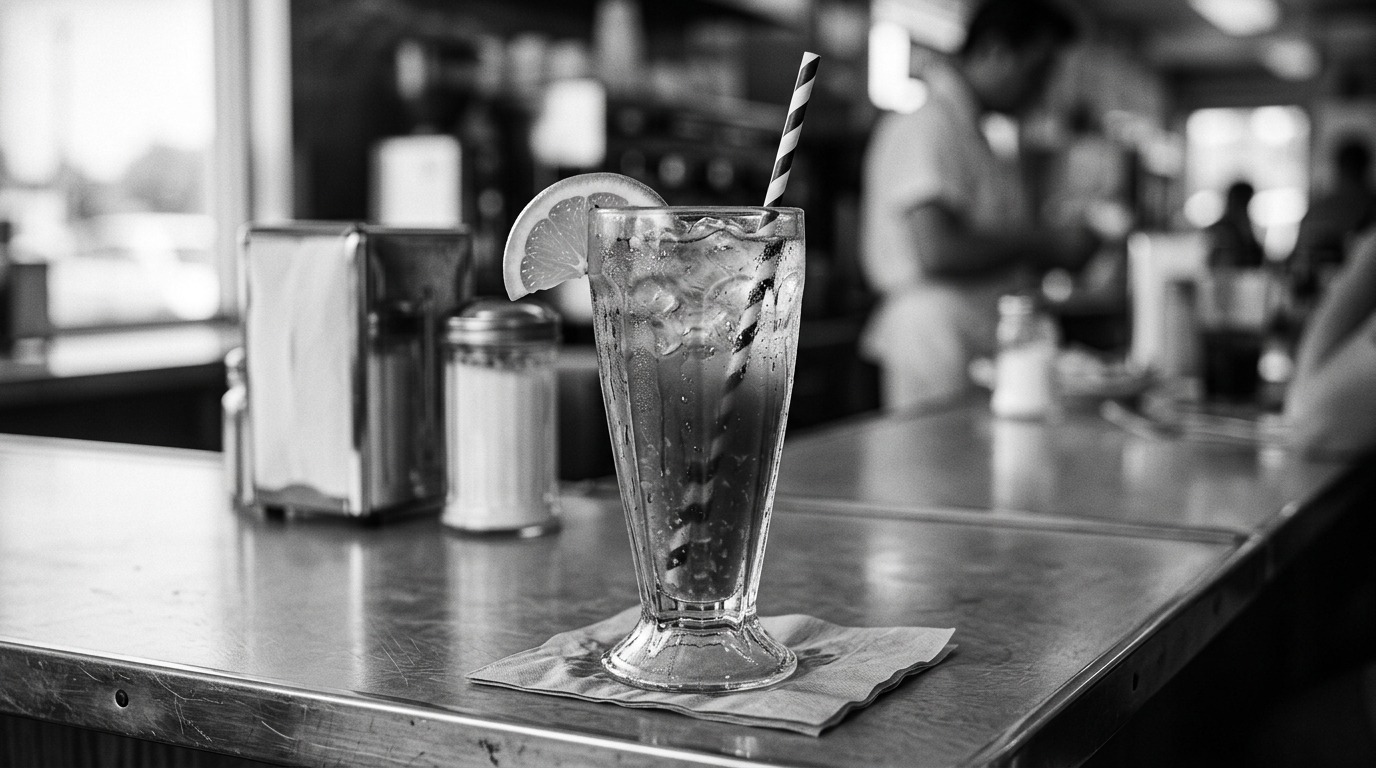
The orangeade at McDonald’s Bar-B-Q was a fresh-squeezed citrus drink that traced directly back to the brothers’ first business. In 1937, before there was a McDonald’s, Patrick McDonald had opened a stand on Route 66 in Monrovia called The Airdrome that sold orange juice for 5 cents a cup, with refills, made from fallen Sunkist oranges the family could buy cheaply from local groves. Dick and Mac inherited the formula when they took over the family food business and moved 40 miles east to open the BBQ drive-in. The orangeade went with them. The same Sunkist supplier, the same approximate recipe, the same wide-mouthed paper cup.
Southern California in 1940 was the world’s citrus capital. Sunkist alone moved tens of millions of oranges through Los Angeles County warehouses every year. Fresh orangeade at a roadside drive-in was so common that it was practically a regional marker – every California carhop served some version of it, often as an upcharge from plain water. The McDonald’s version had the slight authenticity advantage of having been the family’s original product.
The orangeade did not survive 1948 in its fresh-squeezed form. It was replaced in the Speedee menu by a generic ‘orange drink,’ which would eventually be replaced again by Fanta Orange after the 1955 Coca-Cola deal made Fanta the easier supply choice. Fresh-squeezed citrus has not been on the McDonald’s menu since.
Milk
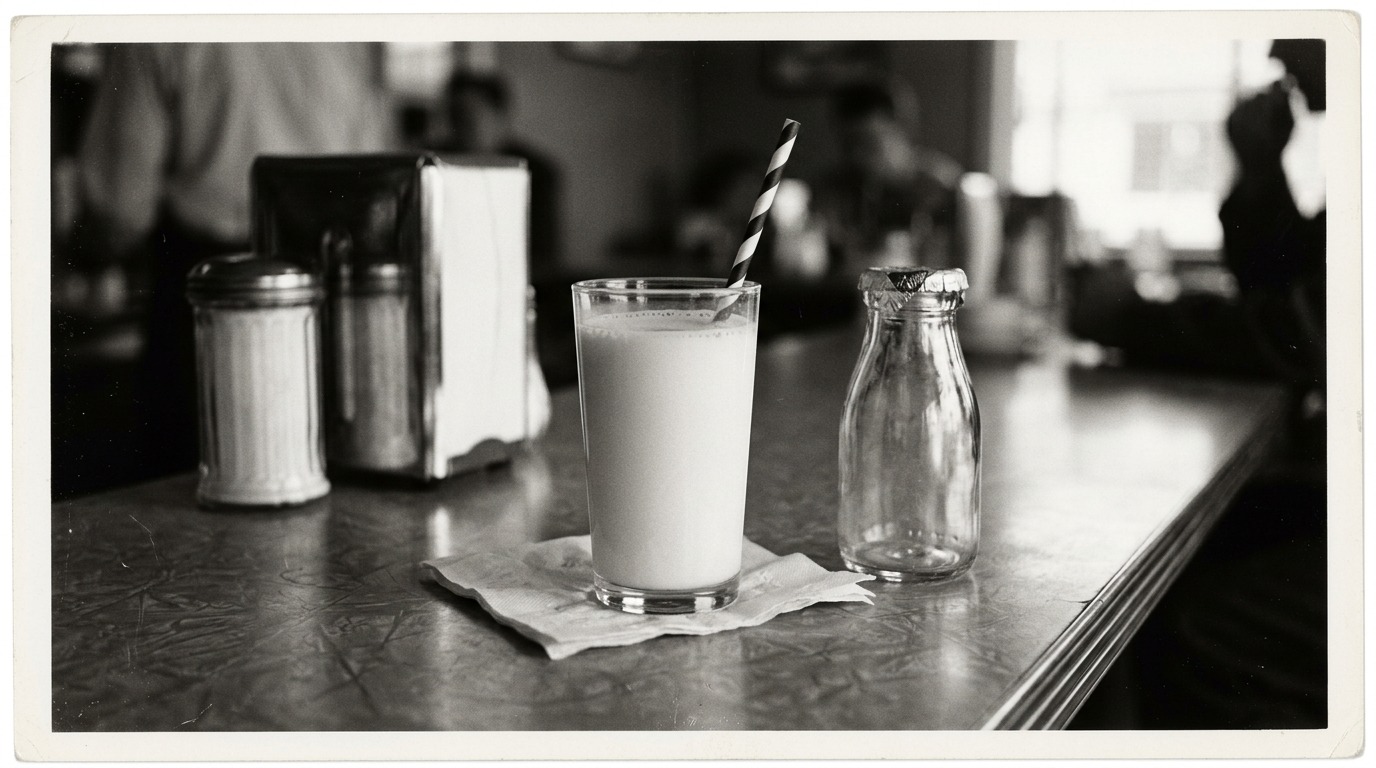
Milk at McDonald’s Bar-B-Q was sold in glass bottles, delivered fresh from regional Southern California dairies, served cold at the carhop window for the customers – usually parents – who wanted something to put in their children’s hands that was not loaded with sugar. It was the unglamorous beverage on the menu, the one nobody listed as a highlight, the one that mattered because every family-friendly drive-in in 1940 needed an option for the kids.
Milk’s place on this menu is essentially the same as its place on the McDonald’s menu today: a quiet, durable, almost-overlooked item that survives every renovation. The 1948 reset kept milk on. The 1955 franchise expansion kept milk on. The 1979 Happy Meal kept milk on as a juice alternative. The 2026 menu still has it, now in the small chocolate-milk cartons that come with kids’ meals. Milk is the second-longest-running continuously-available item on the McDonald’s menu, after coffee, which precedes it by roughly three years.
It is also the only beverage on the BBQ-era menu that came from a real ingredient that had to be refrigerated, sourced fresh daily, and rotated to prevent spoilage. Everything else – the Coke, the root beer, the orangeade syrup – was a concentrate or a bottle. The milk was actual milk, brought in from a real dairy, every morning. The brothers were running a more complicated supply chain than they probably needed to.
Malted Milkshake
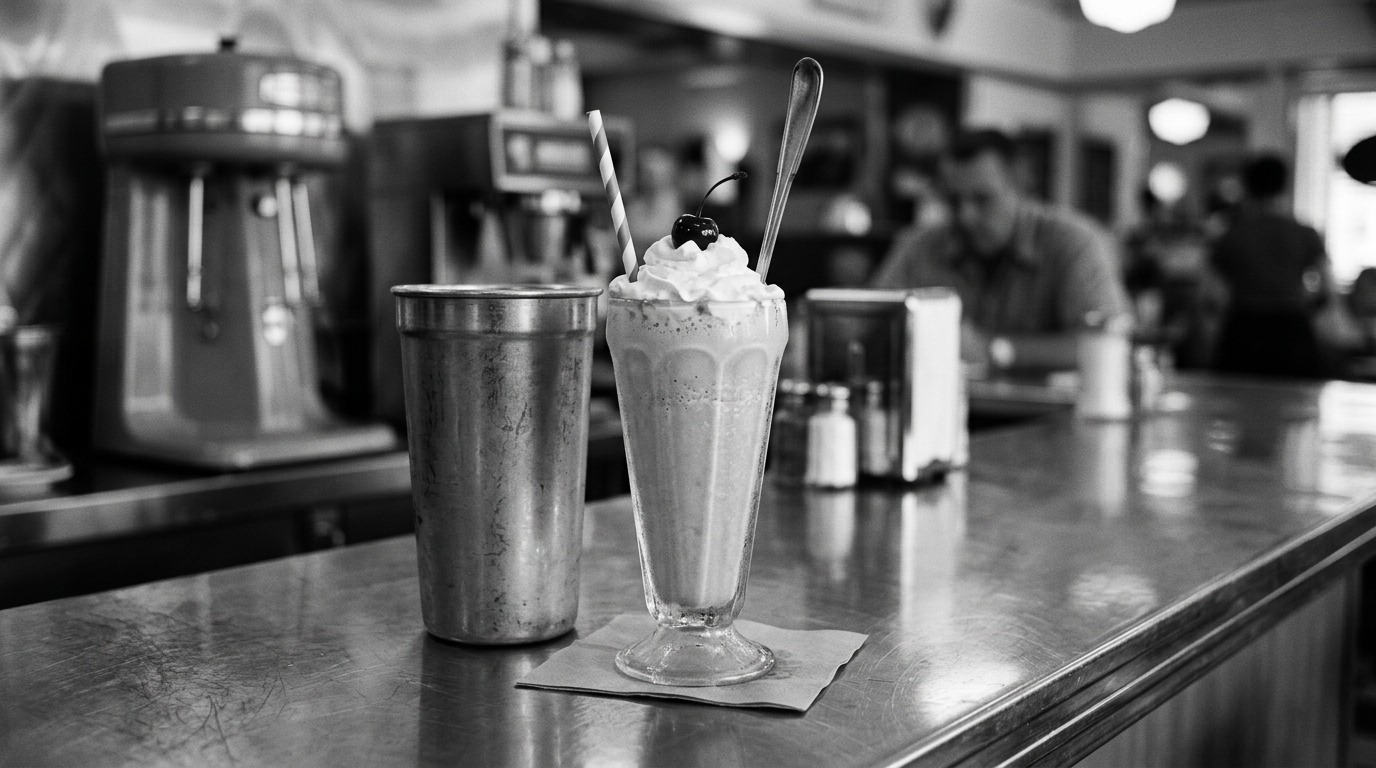
The malted milkshake closes out the original McDonald’s menu and is, in many ways, the item the entire restaurant would eventually be remembered for – though not in this form. The Bar-B-Q-era shake was a soda-fountain malt: milk, ice cream, syrup, and a spoonful of malted milk powder, blended in a steel canister on a single-spindle mixer, poured into a tall glass, and served with a straw. Period advertising called them ‘giant malts made with real milk,’ which was a meaningful claim in an era when many drive-ins were already cutting their shakes with powdered formulations.
The malts at McDonald’s were popular enough that the brothers eventually owned eight Multimixer machines from Prince Castle, capable of making 40 milkshakes simultaneously. That detail is the single most consequential fact in McDonald’s history. The eight-machine order was placed by Dick and Mac in the early 1950s, after the Speedee reset had already kicked their volume into orbit. The man who sold them the machines was a 52-year-old Illinois milkshake-mixer salesman named Ray Kroc, who could not believe one restaurant needed eight Multimixers and drove out to San Bernardino in 1954 to see why. He watched the operation for an afternoon. He proposed franchising. Six years later, he owned the company.
The malted milkshake, in other words, is the item that produced Ray Kroc. Make of that what you will.
In December 1948 the brothers shut the Bar-B-Q down and reopened with nine items - the menu that changed everything.
The franchise web they spun from this building grew to eight locations before Ray Kroc ever showed up.
Frequently Asked Questions
How much did food cost at the original McDonald’s?
The board’s feature order, a barbecue sandwich with french fries, cost 35 cents. Prices ran down to a nickel cup of coffee and up to two 60-cent dinners, the Barbecued Plate and the Hamburger Steak, both served on china with actual silverware. Nothing on the menu broke a dollar.
Did the original McDonald’s sell hot dogs?
Yes – hot dogs predate the hamburger in the family business. The brothers sold them at The Airdrome, the octagonal stand the McDonalds ran near the Monrovia airport from 1937, and kept them on through the barbecue years. Ray Kroc later banished the hot dog from the chain, reasoning that nobody could be sure what went inside one.
Were french fries on the original McDonald’s menu?
From the start – hand-cut in the kitchen and served as the routine side to the barbecue sandwiches rather than as an attraction. When the operation went walk-up in late 1948 the fries were briefly dropped in favour of potato chips, then brought back within a year once customers made their feelings known.
What was the Aristocratic Hamburger?
The hamburger, as billed on the 1940 menu board – a 25-cent sandwich the brothers dressed in a grand name so it could hold its own against the smoked meats. Stripped of the adjective and priced at 15 cents in the Speedee era, it became the item the entire company was rebuilt around.
Did McDonald’s really sell tamales?
It did – tamales smothered in chili, the standard mid-century presentation, and they ranked among the drive-in’s more popular orders. Tamale vendors had been fixtures of California street food since the 1880s, so a roadside stand carrying them in 1940 was ordinary practice, not a novelty worth advertising.
When did Ray Kroc buy McDonald’s from the brothers?
In 1961, for $2.7 million. Kroc had first driven out in 1954, a Multimixer milkshake-machine salesman curious why one hamburger stand needed eight of his five-spindle mixers, and he opened his own first franchise in Des Plaines, Illinois the following spring. Seven years after that visit, the founders were out.
Is anything from the Bar-B-Q era still on the McDonald’s menu?
A handful survives, mostly in altered form. Coffee and milk have never left, Coca-Cola still pours from the fountain, and the pie kept evolving – into the deep-fried hand pie of 1968, then the baked version of 1992. The fried original even returned for a limited run in the summer of 2026.
Sources
- McDonald’s Corporate History (corporate.mcdonalds.com)
- John F. Love, McDonald’s: Behind the Arches (Bantam Books, 1986)
- Smithsonian Magazine, ‘The Story of How McDonald’s First Got Its Start’
- Library of Congress, Inside Adams Blog: ‘McDonald’s Bar-B-Que?’
- The Henry Ford, ‘The First McDonald’s Location Turns 80’
- Historic Original McDonald’s Museum, San Bernardino, California
- The Vintage News, ‘The Oldest McDonald’s Restaurant’
- The Daily Meal, ‘McDonald’s Sold PB&J Sandwiches in the 1940s’