Every McDonald's Location That Existed Before Ray Kroc
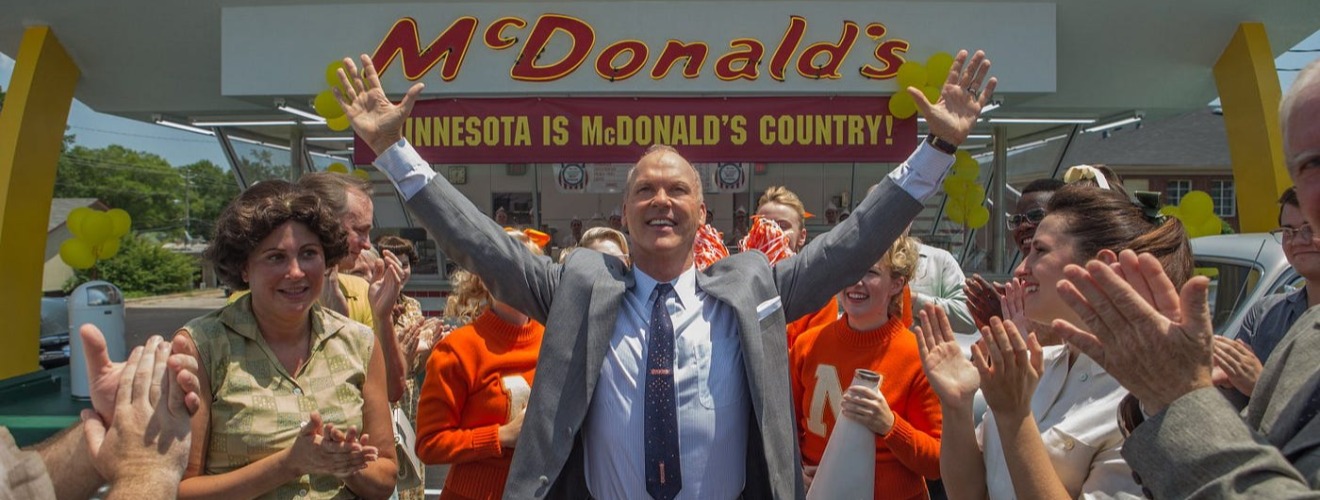
On April 14, 1955, Ray Kroc spent the night before his grand opening checking the temperature on his deep fryers in Des Plaines, Illinois. He was 52 years old and had just bet his life savings on a hamburger restaurant that opened the following morning to $366.12 in first-day sales. Most histories of McDonald’s begin here. Most histories are wrong by about fifteen years.
By the time Kroc opened the Des Plaines store, the McDonald brothers had already been in business for fifteen years and had personally franchised a handful of other restaurants. Some had Golden Arches. Some had been built before the Golden Arches existed. One of them was not called McDonald’s at all. They stretched from the Arizona desert to the Central Valley, were operated by a network of General Petroleum gasoline men and their relatives, and included exactly one franchise sold to a woman – a fact that has been quietly missing from official McDonald’s history for seventy years.
What follows is the full account of that first McDonald’s empire, start to finish. Each franchise in it was sold by Dick and Mac McDonald themselves, under their own arrangement, before Kroc’s company became the franchising entity. After Des Plaines, McDonald’s became something else – a corporate machine for selling franchises, real estate, and consistency. Before Des Plaines, it was just a New Hampshire family business in Southern California with the nine-item system that worked.
Eight McDonald’s restaurants existed before Ray Kroc opened his Des Plaines, Illinois store on April 15, 1955: the original in San Bernardino plus seven franchises – Phoenix, Downey, North Hollywood, Alhambra, Sacramento, Pomona, and Azusa – all open by September 1954. Four of those eight addresses still have an operating McDonald’s today.
McDonald’s – San Bernardino, California (1398 N. E Street)
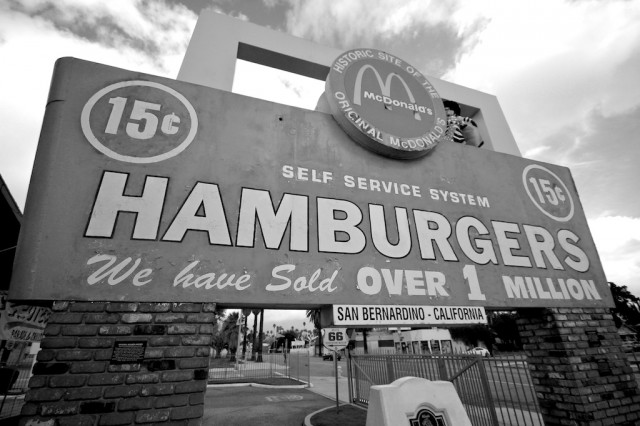
The first McDonald’s was not a hamburger stand. When Richard and Maurice McDonald opened their octagonal building at the corner of 14th and E Streets in San Bernardino on May 15, 1940, they called it McDonald’s Famous Bar-B-Q. The menu had twenty-five items, most of them slow-cooked over hickory chips imported from Arkansas. Carhops in skirts and majorette boots took orders from a parking lot that could hold 125 cars. None of this resembles anything you would recognize as McDonald’s today.
The transformation came eight years later. Going through their receipts, the brothers noticed something inconvenient: eighty percent of their sales were hamburgers, and the carhops and silverware were eating their profits. They closed the restaurant for three months, fired their twenty carhops, threw out the plates, and reopened on December 12, 1948 with a menu of nine items and a hamburger that cost fifteen cents. They called the new approach the Speedee Service System. It was, by any reasonable measure, the moment fast food began.
The 1948 building was demolished in 1953 and replaced with the first San Bernardino iteration of Stanley Meston’s red-and-white Golden Arches design. After Ray Kroc bought them out in 1961, the brothers lost the rights to their own name and were forced to rename the place The Big M. Kroc opened a competing McDonald’s around the corner and drove them out of business. The building was demolished in 1972.
McDonald’s – Phoenix, Arizona (4050 N. Central Avenue)
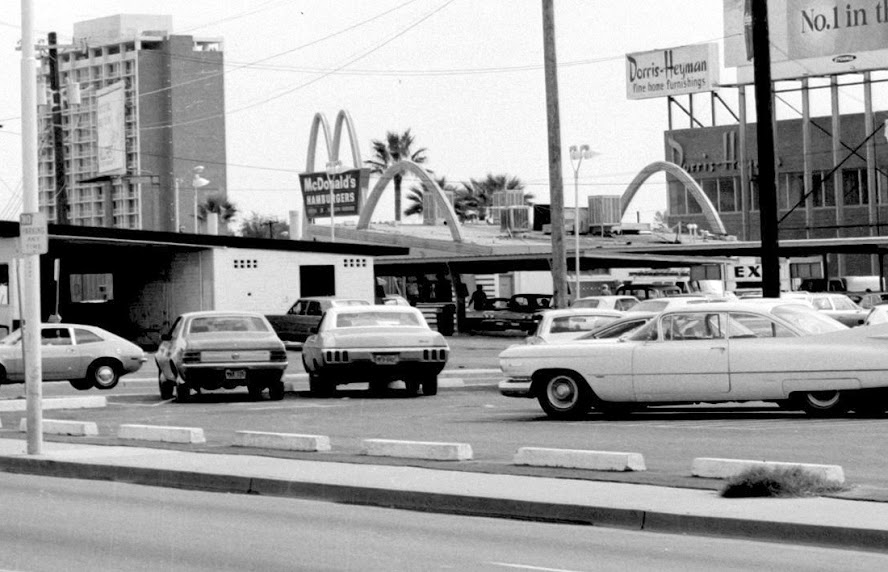
Neil Fox was a gasoline distributor for General Petroleum, and his family thought he had lost his mind. He had just paid the McDonald brothers a flat fee of $1,000 for a set of blueprints, an operating manual, a week of training in San Bernardino, and a recipe for hamburgers. For a hamburger stand. In Phoenix. His business partner Bud Landon’s first reaction, when Fox pitched the idea to him, was: ‘For a hamburger stand? Now I know you’re going crazy.'
Fox opened anyway, on May 8, 1953, at the corner of Central Avenue and Indian School Road. His was the first restaurant ever built using Stanley Meston’s red-and-white tile design with the two thirty-foot Golden Arches bursting through the roof. It was also the first time anyone had used the name ‘McDonald’s’ outside San Bernardino, a choice the brothers had not expected and did not initially understand. ‘What the hell for?' Dick McDonald reportedly said. ‘McDonald’s means nothing in Phoenix.' He was, briefly, correct.
The Phoenix restaurant operated for thirty-three years and outlived the original San Bernardino store, briefly becoming the oldest McDonald’s still in operation. It closed on June 27, 1986, to be replaced by a new corporate-built McDonald’s two blocks south. The building was demolished. Today the site is an Arby’s, which seems somehow worse than it being nothing.
McDonald’s – Downey, California (10207 Lakewood Boulevard)
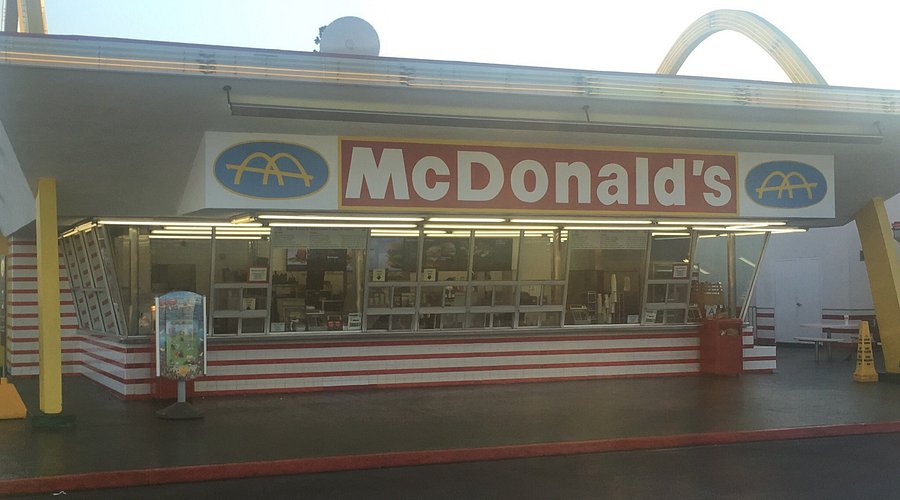
The oldest McDonald’s still in operation is in Downey, California, and it exists today because Roger Williams and Bud Landon were too stubborn to modernize. They bought the franchise from the McDonald brothers in 1953 – Williams was Neil Fox’s brother-in-law, Landon was Fox’s business partner, and both worked at General Petroleum, which is how everyone seems to have been related in the early McDonald’s story. They opened on August 18, 1953. Their franchise agreement was with the brothers, not with Kroc, which meant it never came under McDonald’s Corporation control until 1990.
For thirty-seven years they ignored the corporate playbook. The Big Mac was never on the menu. There was no drive-thru window, no indoor seating, and the building kept its original red-and-white tile and its two thirty-foot Golden Arches and its sixty-foot animated neon Speedee sign added in 1959. Customers walked up to a window in 1990 the way they had in 1953. McDonald’s Corporation, which had spent decades pressuring its franchisees to remodel, found this maddening.
They tried to demolish it in 1994, citing damage from the Northridge earthquake. The National Trust for Historic Preservation named it one of the Eleven Most Endangered Historic Places that year. After a two-year preservation campaign, McDonald’s restored the building and reopened it in 1996. It still serves the original fried apple pie, which otherwise survives only at McDonald's locations in Hawaii.
McDonald’s / Peak’s – North Hollywood, California (12919 Victory Boulevard)

Charles Cox paid the McDonald brothers their franchise fee, took their building plans, copied their operating system, and then refused to call his restaurant McDonald’s. He called it Peak’s. The arches came out slightly jagged due to a construction glitch, and Cox decided he liked them that way and kept them. From the moment it opened in October 1953 until 1965, the fourth McDonald’s restaurant ever built was not a McDonald’s at all, depending on how you count.
It is a strange detail that the McDonald brothers tolerated. The franchise agreement allowed franchisees to use the brothers’ name; it did not require them to. Neil Fox in Phoenix had volunteered to use the name. Cox declined. Why has been lost to history. Pop culture writer Chris Nichols has speculated that it had to do with the slightly mangled arches, but no one really knows. The brothers, for their part, were too busy making money to insist on a brand standard, which is the kind of decision that looks reasonable in 1953 and ruinous in retrospect.
Cox eventually relented and switched the sign to McDonald’s in 1965, four years after Kroc had bought the brothers out and corporate brand consistency had become non-negotiable. The original Peak’s building has since been demolished. A modern McDonald’s now operates at the same address, with arches that go up in a straight line.
McDonald’s – Alhambra, California (909 E. Main Street)
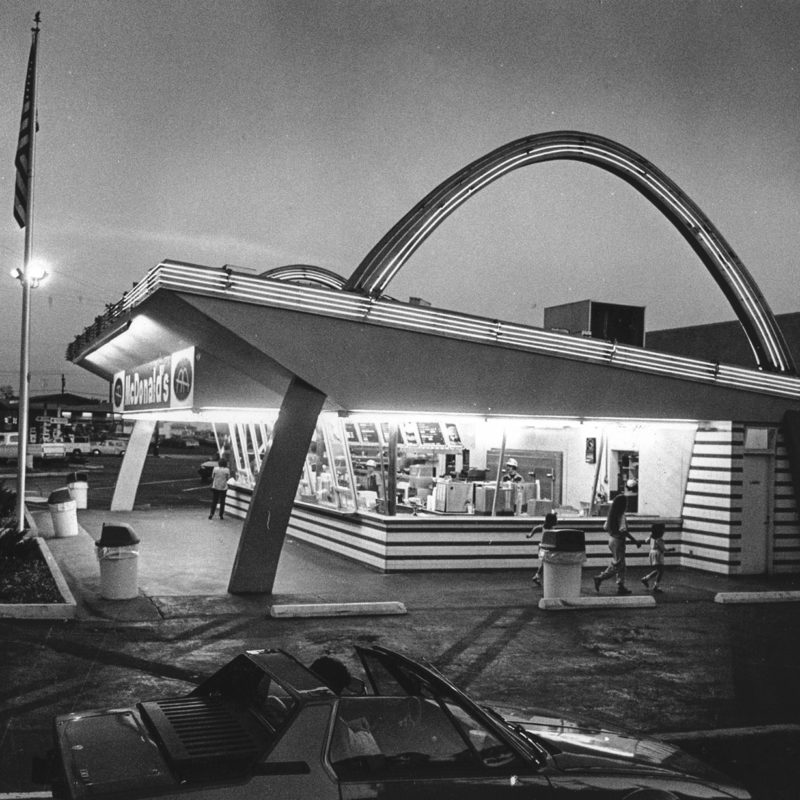
The fifth McDonald’s was franchised to a woman, which is not the kind of detail McDonald’s official history ever mentions. Her name was Harriett C. Charlson, and she shows up on every Alhambra city building permit as the owner of the property at 909 East Main Street. The permit for the steel arches went in on June 18, 1953. Certificate of Occupancy number 2489 was issued on September 1. McDonald’s corporate records, confirmed by direct phone call to their customer care center, list Charlson as the original franchisee. The restaurant formally opened on October 1, 1953.
The McDonald brothers’ early franchisees were otherwise a pipeline of General Petroleum gasoline men handing the opportunity to their relatives – Neil Fox in Phoenix, then his brother-in-law Roger Williams in Downey, then Fox’s partner in North Hollywood. Charlson was an outlier, and a successful one. Her restaurant operated for decades and produced enough revenue to be rebuilt rather than abandoned when McDonald’s eventually modernized the design.
The original 1953 building is gone. A current McDonald’s sits at the same 909 East Main Street address, the fifth pre-Kroc location to still occupy its original lot. None of the corporate signage acknowledges what happened there. McDonald’s, for whatever institutional reasons, has never publicly identified the first female franchisee in its history, even though her name is sitting in their own records.
McDonald’s – Sacramento, California (5425 Fruitridge Road)
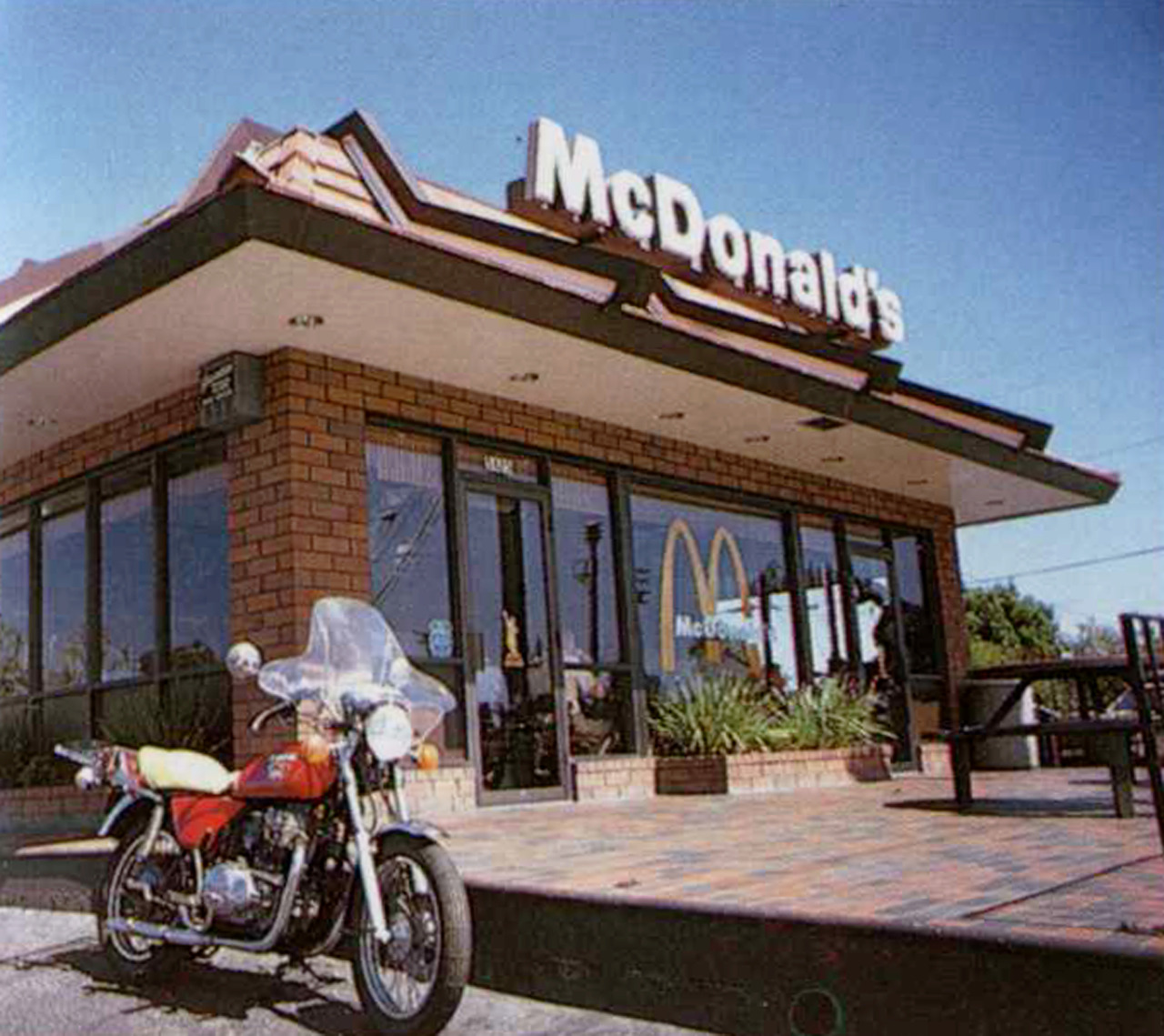
By early 1954 the McDonald brothers had four operating franchises clustered around Los Angeles and one in Phoenix, and they had begun looking north. Sacramento, four hundred miles up the Central Valley, was the farthest they had ever gone. The restaurant opened on Fruitridge Road near Stockton Boulevard in early 1954, and it was the sixth McDonald’s overall and the only one outside Southern California or Arizona at that point. It was, for a brief period, the northernmost McDonald’s in the world.
The original franchisee’s identity has not survived in any source available to a modern researcher. What is known is that the building was a standard Meston red-and-white Golden Arches stand, the same blueprint the brothers were licensing to everyone in those days. It served the same nine-item menu – hamburgers, cheeseburgers, three kinds of soft drinks, milk, coffee, potato chips, apple pie – that the brothers had perfected in San Bernardino.
The original building was demolished and replaced. A modern McDonald’s still operates at 5425 Fruitridge Road today, in roughly the same spot, though the structure is the corporate prototype that exists in essentially every American suburb. What makes the Sacramento location historically interesting is not what stands there now but what it represented in 1954: the moment the McDonald brothers tested whether their system would work somewhere they could not personally drive to and check on it.
McDonald’s – Pomona, California (1057 E. Mission Boulevard)
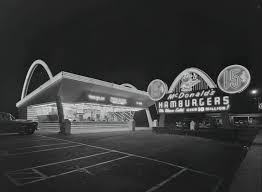
The Pomona Progress-Bulletin ran a full-page advertisement on September 3, 1954, announcing that day’s grand opening of a new hamburger restaurant on East Mission Boulevard. The headline boasted: ‘Our New Pomona Unit is the 7th in the McDonald system that will soon be coast to coast.' This was an optimistic phrasing, given that the McDonald system at that moment consisted of six restaurants between Phoenix and Sacramento, and the brothers had no concrete plans to go anywhere east of the Continental Divide. But the ad pinned down the date.
The Pomona restaurant operated as a McDonald’s for fourteen years and closed in 1968. The tops of the Golden Arches were sawed off the roof at some point afterward. The building has been a Star Taco, a Corvair junkyard run by a man who refused to give up his 120 collected cars until local authorities seized them, and since 2004, AMA Donuts. None of these tenants has done anything to restore the structure, but none has fundamentally altered it either.
The result is that the Pomona building is now the second-oldest surviving pre-Kroc McDonald’s. The Speedee sign with its double circles still stands out front, missing the neon character but otherwise intact. Architectural historian Alan Hess describes it in Googie Redux as ‘remodeled but still a recognizable example of the classic design.' It is, by some distance, the best-preserved 1950s McDonald’s other than Downey.
McDonald’s – Azusa, California (563 E. Foothill Boulevard)
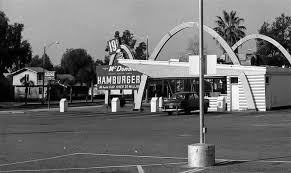
Two weeks after Pomona opened, the McDonald brothers franchised their eighth and final pre-Kroc restaurant. The Azusa Herald reported the grand opening on September 17, 1954, describing the new establishment on Foothill Boulevard as ‘the 8th in the McDonald system.' This was the last McDonald’s the brothers would open before Ray Kroc’s franchising company took over their nationwide expansion. By April 15, 1955, when Kroc opened his Des Plaines store outside Chicago, the Azusa restaurant was already serving its first wave of customers.
There is a small historical disagreement worth mentioning. One Wikipedia editor’s research compilation claims that Azusa, like the North Hollywood location, originally operated under the ‘Peak’s’ name. The contemporaneous Azusa Herald coverage refers to it as McDonald’s. So do the 1977 and 1979 photographs taken for the John Margolies Roadside America archive now held at the Library of Congress, which clearly show ‘McDonald’s’ signage. The Peak’s claim appears to be a researcher’s conflation with the genuine North Hollywood Peak’s situation. Make of it what you will.
The Azusa restaurant operated on Foothill Boulevard – a stretch of historic Route 66 – until 1984, when it closed and was demolished to make way for an expansion by neighboring Azusa Pacific University. The current Azusa McDonald’s at 219 South Azusa Avenue is a different building at a different address. The Foothill location is now a parking lot.
Each franchise served the brothers' stripped-down nine-item Speedee menu.
Frequently Asked Questions
What was the first McDonald’s restaurant?
McDonald’s Famous Bar-B-Q, opened by Richard and Maurice McDonald at 14th and E Streets in San Bernardino, California, on May 15, 1940. It was a carhop drive-in with a twenty-five-item barbecue menu, most of it slow-cooked over hickory chips, and it ran that way for eight years.
What is the oldest McDonald’s still in operation?
The Downey, California restaurant at 10207 Lakewood Boulevard, serving since August 18, 1953. It stayed outside McDonald’s Corporation control until 1990, the last restaurant in the system to hold out, and it still sells the original fried apple pie, which otherwise survives only at Hawaii locations.
What was the first franchised McDonald’s?
Neil Fox’s stand at Central Avenue and Indian School Road in Phoenix, which opened in May 1953. Fox paid the brothers a flat $1,000 for blueprints, a week of training, and the recipes, and his building – designed by architect Stanley Clark Meston – was the first ever built with the Golden Arches.
When did McDonald’s become a fast food restaurant?
On December 12, 1948, when the brothers closed for three months, fired their twenty carhops, and reopened around the Speedee Service System: nine menu items, no plates, and a fifteen-cent hamburger. The change came after they noticed eighty percent of their receipts were hamburger sales.
What happened to the McDonald brothers after Ray Kroc took over?
Kroc bought them out in 1961 for $2.7 million. The deal cost them the rights to their own name, so their first restaurant became The Big M – and a new corporate McDonald’s opened a block away and put it out of business. The building came down in 1972.
Do any of the original pre-Kroc buildings still exist?
Two. Downey’s original structure was restored after a national preservation fight in the mid-1990s, and Pomona’s 1954 stand at 1057 East Mission Boulevard – a donut shop since 2004 – keeps its sawed-down arches and Speedee sign. Pomona’s city council voted it a historic landmark in May 2026.
Who was the first woman to own a McDonald’s franchise?
Harriett C. Charlson, who held the Alhambra, California franchise that opened on October 1, 1953. Her name sits on the city’s building permits as the property owner, and McDonald’s own customer care center has confirmed her as the original franchisee. No earlier woman appears in any record of the system.
Which early McDonald’s didn’t use the McDonald’s name?
Peak’s, in North Hollywood. Charles Cox paid the brothers’ franchise fee and ran their system but kept his own name on the sign from 1953 until 1965, when corporate brand rules caught up with him. His arches came out slightly crooked during construction, and he decided he liked them better that way.
Sources
- McDonald’s Corporate History (corporate.mcdonalds.com)
- Alan Hess, Googie Redux: Ultramodern Roadside Architecture
- John F. Love, McDonald’s: Behind the Arches
- John Margolies Roadside America photograph archive, Library of Congress (1977 Azusa sign photograph; 1979 Foothill Boulevard photograph)
- Phoenix Magazine, ‘Mac Daddy’ by Keridwen Cornelius (August 1, 2016)
- PBS SoCal, ‘The Real McDonald’s: The San Bernardino Origins of a Fast Food Empire’
- Los Angeles Conservancy, McDonald’s Hamburgers preservation case file
- San Bernardino Railroad Historical Society