Every Nobel Prize Without Its Laureate
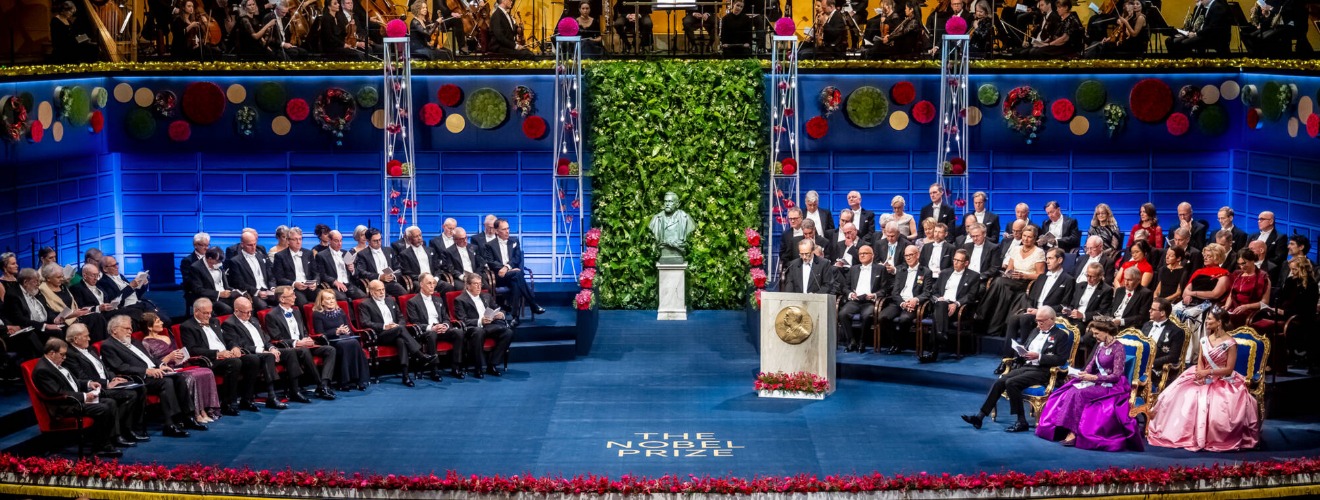
The Nobel ceremony has a script. The winners are announced in October, fly to Stockholm or Oslo in early December, are presented their medals by the king on the 10th, give a speech, attend a banquet, and go home with their diplomas. This is how it is supposed to work. The script has a way of breaking.
Some of those breaks were voluntary. Jean-Paul Sartre refused the 1964 Literature prize on principle, and his refusal letter arrived a month too late to stop the committee from picking him anyway. Le Duc Tho refused the 1973 Peace Prize because the war he had just negotiated an end to had not, in any meaningful sense, ended. Most of the other breaks were not voluntary. Carl von Ossietzky was in a Nazi concentration camp. Andrei Sakharov was at a Soviet dissident’s trial in Vilnius. Aung San Suu Kyi was under house arrest in Rangoon, where she would remain, off and on, for the next twenty-one years. Liu Xiaobo was in a Chinese prison, where he would die.
What follows is every laureate, in chronological order, who did not walk onto that stage on Nobel Day. One of them, in 2025, accepted and then handed the medal to someone else entirely. The Nobel Foundation has rules for all of this. The history is somewhat less tidy than the rules. The Pulitzer’s equivalent list runs to just three names.
Thirteen Nobel Prizes between 1925 and 2025 have gone to laureates who never collected them as intended: two were refused outright, four were declined on Nazi or Soviet orders, five went to winners imprisoned or kept from traveling, one to a playwright who stayed home, and one to a laureate who reached Oslo hours too late for her own ceremony.
George Bernard Shaw
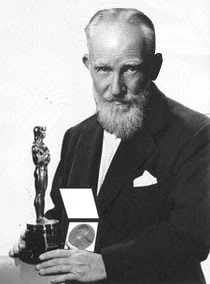
George Bernard Shaw heard the news that he had won the 1925 Nobel Prize in Literature and tried to refuse it outright. ‘I can forgive Nobel for inventing dynamite,' he said, ‘but only a fiend in human form could have invented the Nobel Prize.' This was Shaw’s standard mode of response to any official honor and would have ended the matter, but his wife Charlotte intervened. She argued that the award was less a personal compliment than a tribute to Ireland – Shaw was the second Irish laureate after W.B. Yeats – and that he could not credibly refuse it on those grounds. He relented on the prize itself.
He did not relent on the money. The 7,000 pound cash award, worth roughly half a million dollars in today’s terms, he flatly refused, with the unimpeachable explanation that ‘my readers and audiences provide me with more than sufficient money for my needs.' He then directed the funds toward establishing an Anglo-Swedish Literary Foundation to translate Swedish playwright August Strindberg into English. Strindberg had himself died without ever receiving a Nobel, which Shaw clearly considered a more pressing injustice than his own financial situation.
Fourteen years later, Shaw became the first person to hold both a Nobel Prize and an Academy Award, winning the 1938 Best Adapted Screenplay Oscar for Pygmalion. He described the Oscar as an insult.
Carl von Ossietzky
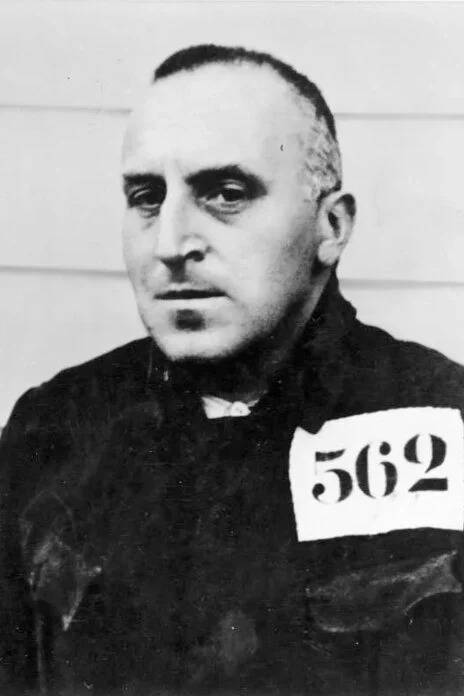
The Nobel committee announced no Peace Prize for 1935. The official reason cited unrest in Africa and political instability in Asia. The real reason was Carl von Ossietzky, a German journalist who at that moment was being beaten daily in a concentration camp called Esterwegen for the crime of having published, in 1929, an article revealing that the Weimar government was secretly rebuilding the Luftwaffe in violation of the Treaty of Versailles. The committee had been flooded with nomination letters and was paralyzed by Nazi pressure. They held the prize.
A year later, after Ossietzky had been moved to a Berlin hospital with tuberculosis, the committee retroactively awarded him the 1935 prize. A Red Cross representative who visited him described ‘a trembling, deadly pale something, a creature that appeared to be without feeling, one eye swollen, teeth knocked out, dragging a broken, badly healed leg.' Hermann Goring personally pressured Ossietzky to refuse. He refused to refuse. From his hospital bed he issued a statement accepting the award and gently noting that the Gestapo’s view of what constituted German society was not one he shared.
He was denied a passport and could not travel to Oslo. Hitler responded with a decree forbidding any German citizen from ever accepting a Nobel Prize. King Haakon VII of Norway, who had attended every previous Peace Prize ceremony, stayed home. Ossietzky died in police custody on May 4, 1938. He never saw his medal.
Richard Kuhn
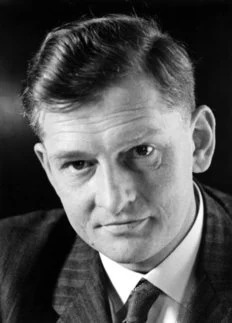
Richard Kuhn won the 1938 Nobel Prize in Chemistry for his work on carotenoids and vitamins, including the first crystalline isolation of riboflavin. He was Austrian-born, working in Heidelberg, and had been a childhood schoolmate of Wolfgang Pauli, who would later win the physics Nobel. Two years earlier, Hitler had issued the decree that no German citizen could ever accept a Nobel Prize, a direct response to Ossietzky’s award. Kuhn was now a German citizen, courtesy of the 1938 Anschluss that annexed Austria into the Reich.
Kuhn wrote a handwritten letter to the Nobel committee declining the prize. He described the awarding of the prize to a German as an invitation to violate a decree of the Fuhrer. Whether he believed this or wrote it under duress depends on which historian you ask. Kuhn had cooperated extensively with the Nazi regime, served as president of the German Chemical Society from 1938 to 1945, and would later be credited with the 1944 discovery of soman, a nerve agent developed for chemical warfare. He was not Ossietzky.
He finally received his Nobel diploma and gold medal in 1948, after the war. The 116,000 kronor in prize money had reverted to the Nobel Foundation’s reserve. In 2005, the German Chemical Society stopped awarding its Richard Kuhn Medal in light of his wartime conduct.
Adolf Butenandt
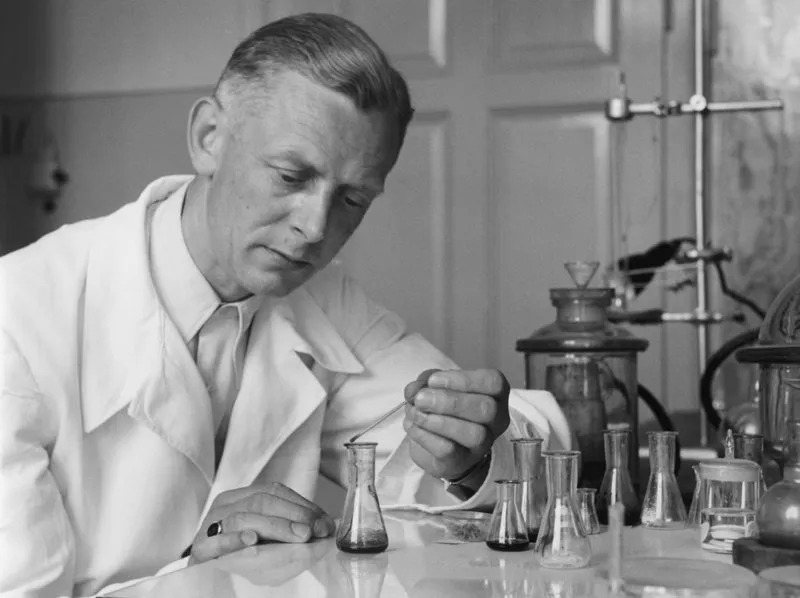
Adolf Butenandt’s research made the birth control pill possible. Between 1929 and 1934 he isolated, in rapid succession, the three sex hormones that would underpin nearly all subsequent endocrinology: estrone (from the urine of pregnant women, no less), androsterone, and progesterone. He shared the 1939 Nobel Prize in Chemistry with the Swiss chemist Leopold Ruzicka for synthesizing testosterone. He was thirty-six years old, director of the Kaiser Wilhelm Institute for Biochemistry in Berlin, and forbidden by Adolf Hitler from accepting his prize.
The Nazi decree barring Germans from any Nobel Prize, issued in retaliation for Ossietzky two years earlier, now caught Butenandt squarely. He declined the award on government instructions. After the war, in 1949, he was permitted to collect his diploma and gold medal at the Swedish Consulate in Frankfurt. The prize money had long since reverted to the Foundation.
Butenandt is more complicated than his fellow refusers. He had close working relationships with senior Nazi officials throughout the war, his institute received funding from the SS, and questions persist about whether his colleagues’ research involved samples from concentration camp victims. He never faced legal consequences and went on to serve as president of the Max Planck Society from 1960 to 1972. Of the three Germans Hitler stopped from accepting Nobels, he is the one whose refusal raises the most uncomfortable questions about what, exactly, was being refused.
Gerhard Domagk
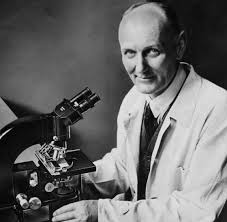
In December 1935, Gerhard Domagk’s six-year-old daughter Hildegard pricked her hand on a contaminated knitting needle and developed a streptococcal infection that quickly threatened to take her arm and then her life. Her father, a pathologist at IG Farben, had spent the last several years quietly developing an experimental compound called Prontosil that cured streptococcal infections in mice. He had not yet tested it on humans. In desperation he gave her a dose. She recovered completely.
The drug Prontosil became the first commercially available antibiotic, the founding member of the sulfa drug family, and the reason the U.S. Army’s wartime mortality rate from wounds dropped from 8.25 percent in World War I to 4.5 percent in World War II. Domagk was awarded the 1939 Nobel Prize in Physiology or Medicine. He wrote a polite letter to the Karolinska Institute thanking them and noting that he would need permission from his government before he could formally accept.
The Gestapo arrested him on November 17, 1939. They held him for a week, released him, then arrested him again. On November 28 they forced him to sign a prepared letter declining the prize. He is the only one of the three German laureates physically detained over the matter. He finally collected his medal and diploma in 1947, after the war, and delivered his Nobel lecture. The prize money was long gone. His daughter, by then, was an adult.
Boris Pasternak
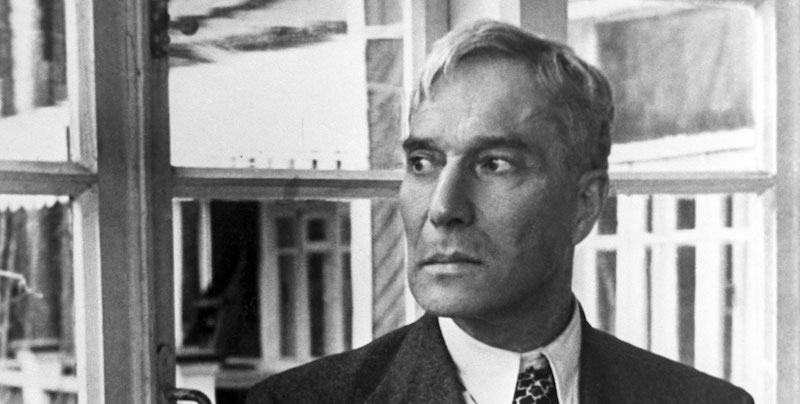
Boris Pasternak received the news of his 1958 Nobel Prize in Literature by telegram and replied immediately. ‘Thankful, glad, proud, confused,' he wrote. The Soviet government was none of those things. Pasternak had spent the previous year secretly smuggling his novel Doctor Zhivago to an Italian publisher, who had defied considerable Soviet pressure to publish it in November 1957. The book was banned at home. The Nobel was therefore interpreted in Moscow as a Western provocation, which it partly was – the CIA had separately arranged to distribute Russian-language copies of the novel to Soviet visitors at the 1958 Brussels World’s Fair, handed out from a hidden room in the Vatican pavilion.
The Soviet Union of Writers expelled him within days. Khrushchev personally directed the press campaign, in which Pasternak was compared unfavorably to a pig in front of twelve thousand people at the Moscow Sports Palace. He was told that if he traveled to Stockholm to accept the prize, he would not be allowed to return. Six days after the announcement, on October 29, 1958, he sent a second telegram retracting his acceptance.
He spent the remaining eighteen months of his life under harassment at his dacha in Peredelkino, never traveling abroad. His son Yevgeny finally collected the medal in Stockholm in 1989, after Gorbachev allowed Doctor Zhivago to be published in Russia. The book had taken thirty-one years to reach the country it was about.
Jean-Paul Sartre
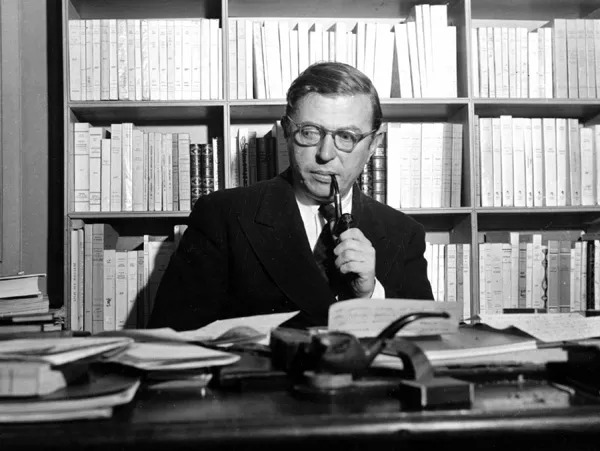
Jean-Paul Sartre had a habit of refusing things. He had refused the Legion of Honor in 1945. He had refused entry to the College de France. He had announced in advance that he would refuse the Lenin Prize if it were ever offered. So when he read in the October 15, 1964 issue of Le Figaro littéraire that the Swedish Academy was leaning toward awarding him the Nobel Prize in Literature, he immediately wrote to Stockholm asking to be withdrawn from consideration.
His letter arrived too late. The Academy had already met on September 17. By the time the committee opened Sartre’s letter, the decision was effectively final. They voted to award him the prize on October 22, fully aware he would refuse. He did refuse, the same day, in a statement that ran in Le Monde explaining his reasoning at considerable length: a writer who allowed himself to be transformed into an institution lost the independence required to do his work. He was particularly concerned that his future political commitments would be tainted by association with a Western literary establishment.
He also turned down the 250,000 kronor that came with the prize, which is roughly a million dollars in today’s money. Records later released after the customary fifty-year embargo confirmed what had been suspected: if Sartre’s letter had arrived three weeks earlier, the prize would have gone to someone else entirely. The committee was at least partly ambivalent about him to begin with.
Lê Đức Thọ
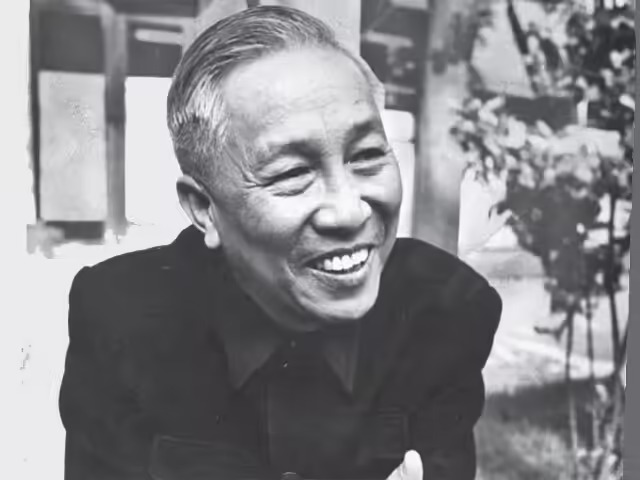
The 1973 Peace Prize is widely regarded as the worst in Nobel history. The committee gave it jointly to Henry Kissinger and Lê Đức Thọ for negotiating the Paris Peace Accords that January, which had ended American military involvement in Vietnam but had not ended the war. Two committee members resigned in protest. The New York Times ran an editorial calling it the ‘Nobel War Prize.' The satirist Tom Lehrer announced that political satire was now obsolete.
Lê Đức Thọ, North Vietnam’s chief negotiator and a man whose Communist Party nickname was ‘the Hammer,' declined the award by telegram. He cited the Christmas bombings of Hanoi that Kissinger had personally ordered the previous December, the ongoing violations of the ceasefire by both sides, and his view that what had been signed in Paris was a truce rather than a peace. He told the committee he would consider accepting the prize if and when actual peace were restored to Vietnam. It never was on terms he would have recognized. Saigon fell in April 1975. He died in 1990 without ever changing his answer.
In private he was reportedly more direct, calling the Peace Prize a ‘bourgeois sentimentality.' He remains the only person in history to have refused the Nobel Peace Prize. Kissinger, for his part, sent his prize money to charity, skipped the Oslo ceremony, and after Saigon fell, tried to give the medal back. The committee declined.
Andrei Sakharov
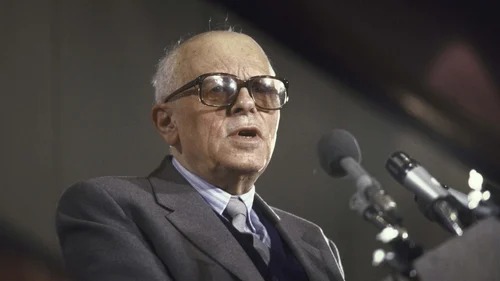
Andrei Sakharov was the father of the Soviet hydrogen bomb. He had designed the layered ‘sloika’ structure that gave the USSR its first thermonuclear weapon in 1953, won the Lenin Prize, and become at thirty-two the youngest person ever elected to the Soviet Academy of Sciences. Then he read the radiation data from his own tests, became convinced of what he had helped create, and spent the rest of his life campaigning against it. By 1975 he was the most prominent dissident in the Soviet Union and an international target of KGB harassment.
The Nobel committee awarded him the Peace Prize that October ‘for his struggle for human rights in the Soviet Union, for disarmament and cooperation between all nations.' The Politburo reacted with fury and denied him a passport. On Nobel Day, December 10, 1975, Sakharov was not in Oslo. He was in Vilnius, attending the trial of a fellow human rights activist named Sergei Kovalev who had been arrested partly for distributing Sakharov’s own writings.
His wife Yelena Bonner, who happened to be in Italy for treatment of a wartime eye injury and could therefore travel onward, delivered his Nobel lecture in Oslo on his behalf. He titled it ‘Peace, Progress, Human Rights’ and used most of it to read out a list of Soviet political prisoners by name, declaring he shared the prize with them.
Lech Wałęsa
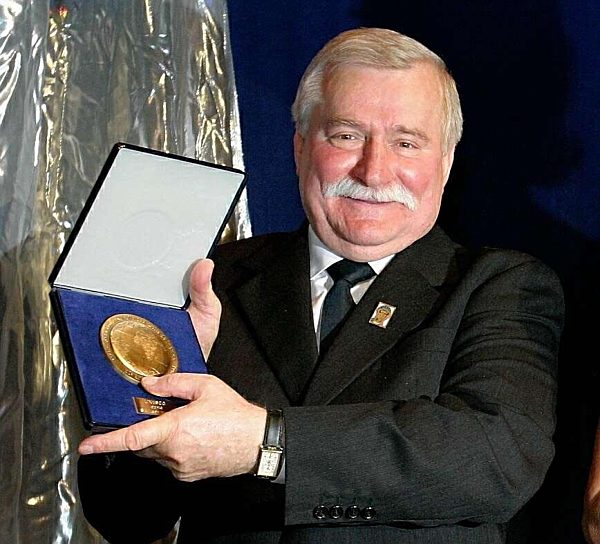
Lech Wałęsa heard the news of his 1983 Nobel Peace Prize from Western correspondents because Polish state media refused to report it. He had been released from internment under martial law eleven months earlier and was working at the Gdańsk Shipyard, ostensibly back to being an ordinary electrician but in reality directing the entirety of the now-banned Solidarity union from underground. The Polish government had been so determined to prevent his Nobel that they had fabricated documents the previous year claiming Wałęsa was a paid informant of the secret police and delivered them to the Norwegian Embassy in Warsaw. The committee had quietly disregarded them.
He could not travel to Oslo. The fear was not arrest but exile. The Jaruzelski regime was widely expected to refuse him re-entry to Poland if he left, removing him from the country entirely as a political problem. His wife Danuta and their thirteen-year-old son Bogdan went in his place and were given a standing ovation by an audience that included King Olav V. The $190,000 prize money Wałęsa donated to a Polish church fund for independent farmers.
Six years later, Solidarity won the partially free Polish elections of June 1989. Wałęsa was elected president of Poland in December 1990, having never once spent a night outside the country during the entire decade of his struggle. The documents alleging his collaboration with the secret police have continued to circulate. He has continued to deny them.
Aung San Suu Kyi
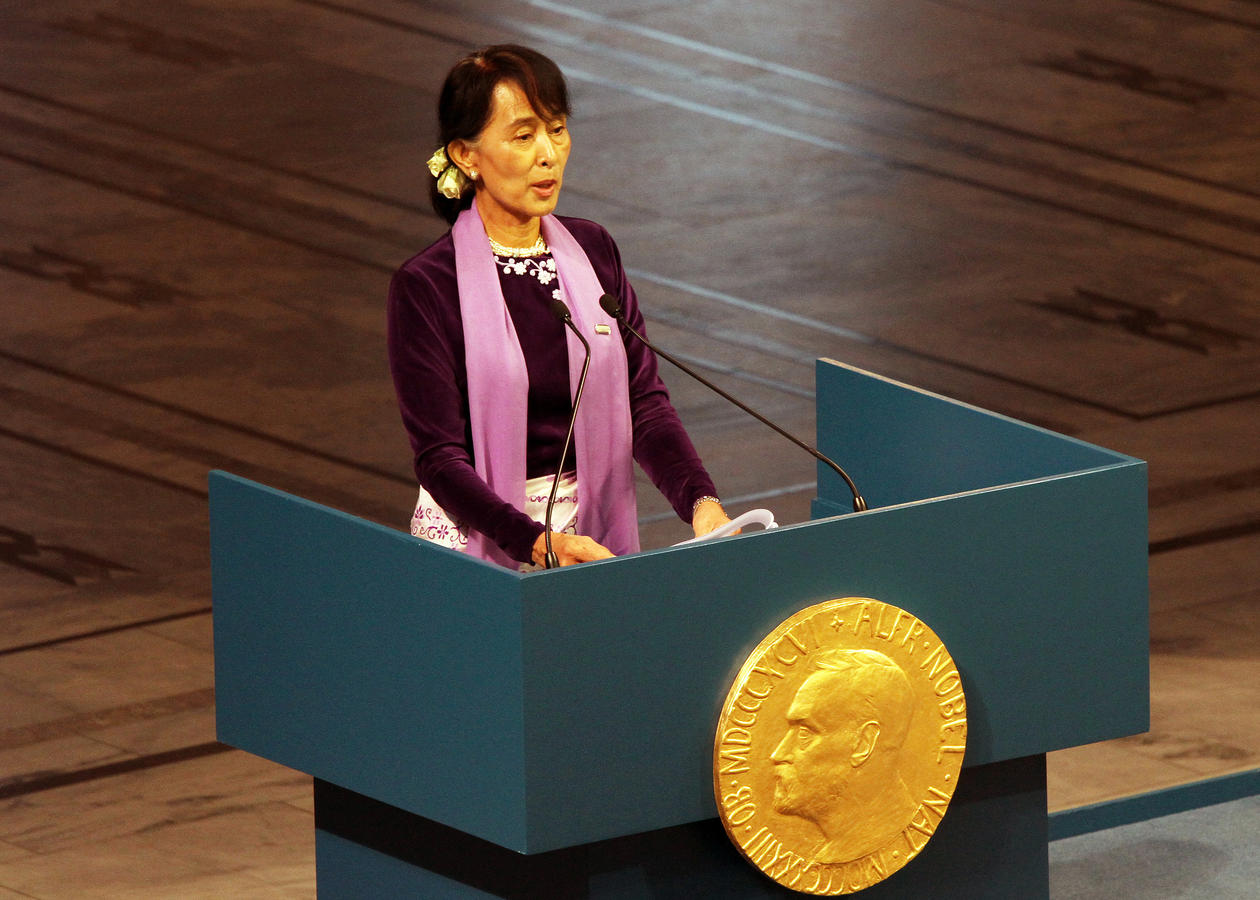
Aung San Suu Kyi was under house arrest at her home on University Avenue in Rangoon when she was awarded the 1991 Nobel Peace Prize. The Burmese military junta had refused to honor her party’s overwhelming victory in the 1990 election – the National League for Democracy had won more than eighty percent of the contested parliamentary seats – and had locked her in her own house instead. They offered to release her if she would agree to leave Burma. She refused.
Her husband Michael Aris and their two sons, eighteen-year-old Alexander and fourteen-year-old Kim, traveled to Oslo to accept the medal on December 10, 1991. Alexander delivered the acceptance speech. Suu Kyi herself spent the day in Rangoon as she had spent every day for two years, confined to her property, forbidden visitors. The $1.3 million prize money she eventually used to establish a health and education trust for the Burmese people.
In 1999, while she was still under house arrest, her husband was diagnosed with terminal prostate cancer in Britain. The junta offered to let her travel to him, knowing she would not be allowed to return. She did not go. He died in March without seeing her again. She remained under various forms of arrest for fifteen of the twenty-one years between her award and her release in 2010. She finally delivered her Nobel lecture in Oslo on June 16, 2012.
Liu Xiaobo
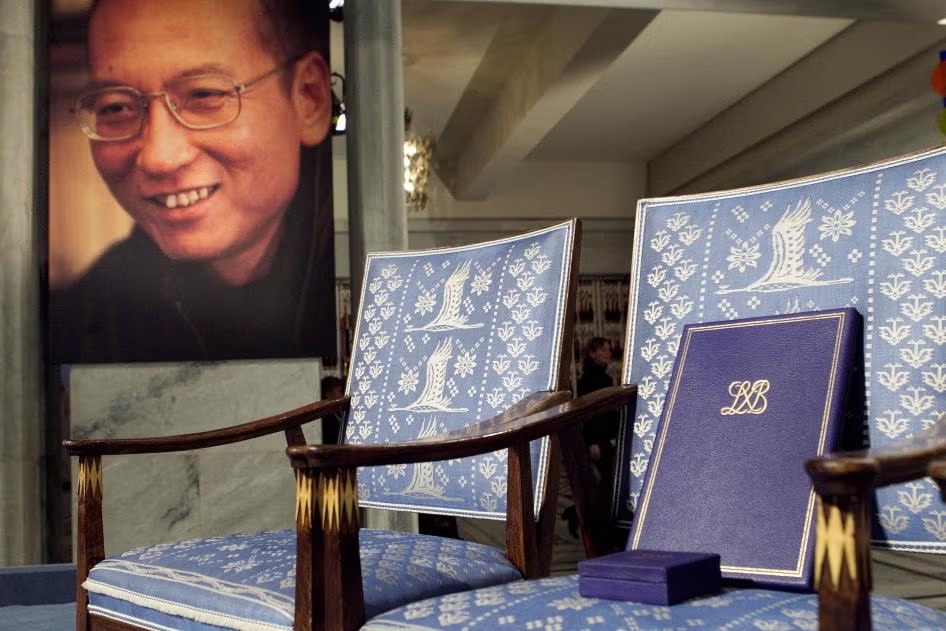
Liu Xiaobo learned he had won the 2010 Nobel Peace Prize when his wife Liu Xia visited him in Jinzhou Prison the day after the announcement. He wept and told her the award was for the dead of Tiananmen Square. He was serving the fourth of his four prison terms, an eleven-year sentence for his role in drafting Charter 08, a 2008 manifesto modeled on Czechoslovakia’s Charter 77 that had called for the abolition of one-party rule. The Chinese government had condemned the Nobel as ‘a farce’ and pressured nineteen countries into boycotting the Oslo ceremony.
Liu Xia was placed under house arrest the day of the announcement and was not permitted to travel. No family member or designated representative was allowed to accept the prize on his behalf. The committee improvised. On December 10, 2010, a chair was placed at the front of Oslo City Hall and the medal and diploma were laid on it. It was the first empty chair at a Nobel Peace ceremony since Carl von Ossietzky’s in 1936, and the actor Liv Ullmann read Liu’s essay ‘I Have No Enemies’ while the chair sat in front of her.
Liu Xiaobo died of liver cancer in custody on July 13, 2017, denied permission to seek treatment abroad. He never received the medal. He is the second laureate after Ossietzky to die in detention without it. His chair, as the Nobel committee put it, will forever remain empty.
María Corina Machado
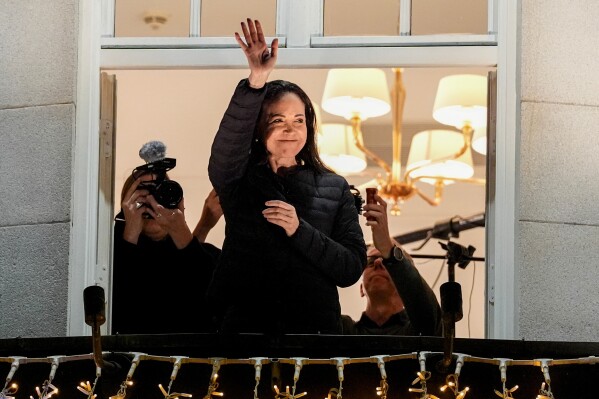
María Corina Machado had not been seen in public for eleven months when the 2025 Nobel Peace Prize was announced in October. The Venezuelan opposition leader had been driven into hiding by the Maduro regime after winning the opposition primary, being barred from the 2024 ballot, and watching the regime then claim victory in an election international observers concluded had actually been won by her chosen replacement, Edmundo González, by sixty-seven percent.
Her route to Oslo for the December 10 ceremony was extraordinary even by Nobel standards. According to The Wall Street Journal, a private operation code-named Golden Dynamite (a Nobel joke) extracted her from Venezuela in disguise across ten military checkpoints by land, then by fishing boat through ten-foot seas in the Gulf of Venezuela, then through Curaçao. The boat lost GPS. She arrived in Oslo too late for the ceremony itself. Her daughter Ana Corina Sosa accepted the medal at City Hall and read the speech her mother had written. Machado appeared on a balcony of the Grand Hotel that night to wave at supporters.
Five weeks later, at the White House on January 15, 2026, she handed the physical medal to President Donald Trump, framing the gesture as a Lafayette-to-Bolívar tribute and recognition of his role in the US military operation that had captured Maduro the week before. The Norwegian Nobel Committee clarified that while a laureate could physically transfer the medal, the honor itself remains nontransferable.
Frequently Asked Questions
Did Maria Corina Machado give her Nobel Prize medal to Donald Trump?
She did. At the White House on January 15, 2026, five weeks after the Oslo ceremony, Machado presented the gold medal to Trump in thanks for the American raid that had deposed Nicolas Maduro at the start of that month. The Nobel Institute had already answered the idea: a medal can change hands; the prize itself cannot.
Why did Jean-Paul Sartre refuse the Nobel Prize in Literature?
Sartre held that a writer must refuse to be turned into an institution, and that the prize had become a distinction reserved for the writers of the West and the rebels of the East. His refusals were consistent: the Legion of Honor in 1945, and, he added, the Lenin Prize had anyone offered it.
Who is the only person to refuse the Nobel Peace Prize?
Le Duc Tho, Hanoi’s chief negotiator, remains the only laureate to decline the Peace Prize. Awarded jointly with Henry Kissinger in 1973 for the Paris accords, he answered that he could consider the prize only once peace truly held in Vietnam. He died in October 1990, the condition unmet.
Why did Hitler ban Germans from accepting Nobel Prizes?
A decree of January 1937 forbade all German citizens from accepting Nobel Prizes – Hitler’s retaliation for the Peace Prize awarded to the journalist Carl von Ossietzky weeks earlier. It caught three scientists, Richard Kuhn, Adolf Butenandt, and Gerhard Domagk, who declined under duress and collected their medals only after the war. The money was gone for good.
What did the empty chair at the 2010 Nobel ceremony represent?
It stood for the 2010 Peace laureate Liu Xiaobo. With no family member permitted to collect the prize on his behalf, the committee laid the medal and diploma on an empty seat while the actor Liv Ullmann read his statement “I Have No Enemies” – the first time in 74 years the award was handed to no one.
Has anyone accepted a Nobel Prize but refused the prize money?
George Bernard Shaw did. He let the 1925 Literature award stand – it would not be lost on Ireland, he noted, which already claimed one Nobel prizeman in Yeats – while declining the money on the grounds that his readers paid him quite enough. The sum seeded a foundation for translating August Strindberg into English.
Did Boris Pasternak ever receive his Nobel medal?
Not in his lifetime. Pasternak, forced by the Soviet campaign against Doctor Zhivago to retract his acceptance of the 1958 Literature award, died in 1960. His son Yevgeny collected the medal at a Stockholm ceremony in December 1989, by which time the novel had finally been published in Russia.
Why did Lech Walesa miss his own Nobel ceremony in 1983?
Walesa stayed in Poland out of fear of exile, not arrest: the Jaruzelski government was expected to bar him from re-entering the country if he flew to Oslo. His wife Danuta and thirteen-year-old son Bogdan collected the prize for him, and the $190,000 went to the Catholic church’s fund for Polish agriculture.
Sources
- NobelPrize.org – official laureate facts pages, Nobel Prize Facts, Norwegian Nobel Committee statements
- Encyclopedia Britannica – ‘Who has refused a Nobel Prize?', ‘7 Nobel Prize Scandals’, individual laureate biographies
- TIME magazine – ‘Nobel Peace Prize for Carl von Ossietzky: The Tragic Story’, ‘Nobel Peace Prize Winner History: Why it Was Once Rejected’
- Smithsonian Magazine – ‘How Boris Pasternak Won and Lost the Nobel Prize’
- JSTOR Daily – ‘Why Boris Pasternak Rejected His Nobel Prize’
- Atomic Heritage Foundation – Andrei Sakharov biography and Nobel Peace Prize coverage
- Nobel Peace Center – laureate profiles, empty chair coverage
- Yale University Library digital collections – Le Duc Tho Nobel Peace Prize letter to Kissinger