Every Pitcher Who Gave Up a Milestone Home Run to Barry Bonds
There is a particular kind of fame reserved for the man who gives up a famous home run. He does not choose it, he cannot really prepare for it, and it tends to outlive everything else he did in the game. Al Downing won 123 games and pitched in three World Series across seventeen seasons, and he is remembered for one pitch he threw to Hank Aaron in April 1974. The pitchers who surrendered Barry Bonds’s milestone home runs all joined that small, involuntary fraternity, most of them for an afternoon’s work they would gladly have skipped.
Bonds hit 762 home runs, the most in the history of the sport, off more than 400 different pitchers over twenty-two seasons. The great majority of those men have been forgotten, as the people who give up home runs generally are. A handful of them threw pitches that became history instead. The record sits under the long shadow of the BALCO investigation and the steroid era, and the argument over the asterisk will probably never settle. The home runs happened anyway, and so did the men on the mound.
What follows is every man who threw one of those pitches, in the order the home runs were hit. One of them had a father who had once pitched to Aaron with the record on the line. Not one of them saw it coming.
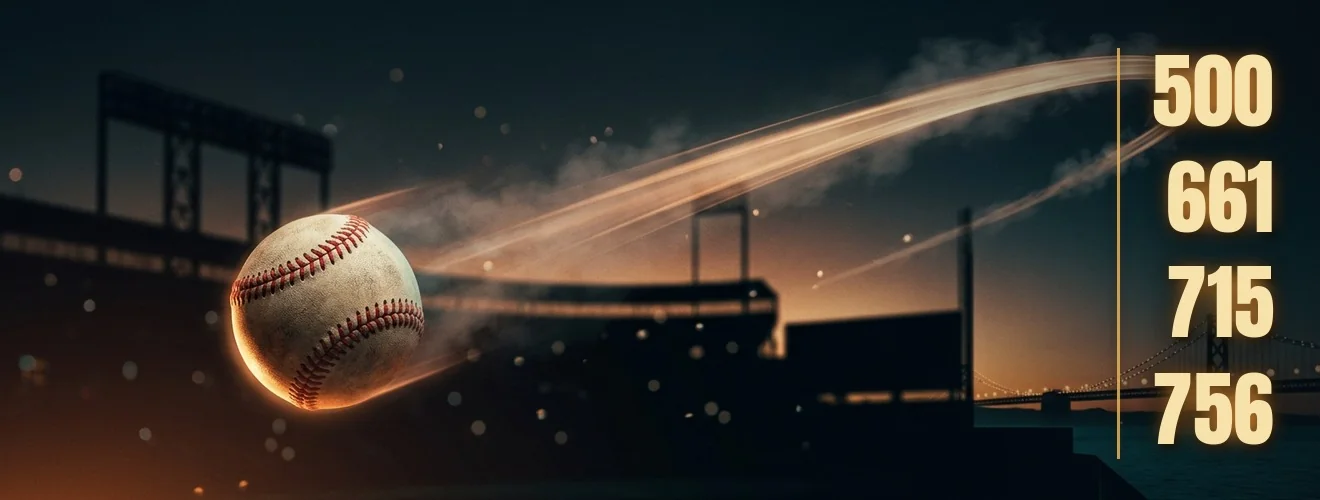
Ten pitchers gave up Barry Bonds’s milestone home runs: Craig McMurtry (his first, 1986), Terry Adams (500th), Chan Ho Park (71st and 72nd), Dennis Springer (record-setting 73rd), Kip Wells (600th), Ben Ford (661st), Jake Peavy (700th), Byung-Hyun Kim (715th), Mike Bacsik (record-breaking 756th), and Ubaldo Jimenez (762nd and last, 2007).
Home Run No. 1 – Craig McMurtry
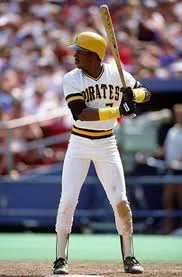
When Barry Bonds reached the majors at the end of May 1986, the consensus was that the Pirates had panicked. The Los Angeles Times laid out the prevailing wisdom plainly: Pittsburgh, in desperation, had called up the twenty-one-year-old son of Bobby Bonds before he was ready, and one hit in his first ten at-bats against the Dodgers seemed to settle the matter. Then the Pirates went to Atlanta.
On June 4, 1986, at Fulton County Stadium, Bonds went 4-for-5 with a double, four runs batted in, and, in the fifth inning with two outs and nobody on, a solo home run to left field off Braves reliever Craig McMurtry. Pittsburgh won 12-3. It was the first home run of a career that would end with 762 of them, more than anyone who has ever played the game, and on the night it happened it was worth a sentence or two in the recap.
McMurtry was a middle reliever, the kind of pitcher brought in to soak up innings once a game has gotten out of hand. He soaked up a piece of history instead. Nobody kept the ball, because there was no reason to. Bonds was a skinny rookie batting in the .220s, and the notion that this was the start of something was not yet available to anybody in the building.
Home Run No. 500 – Terry Adams
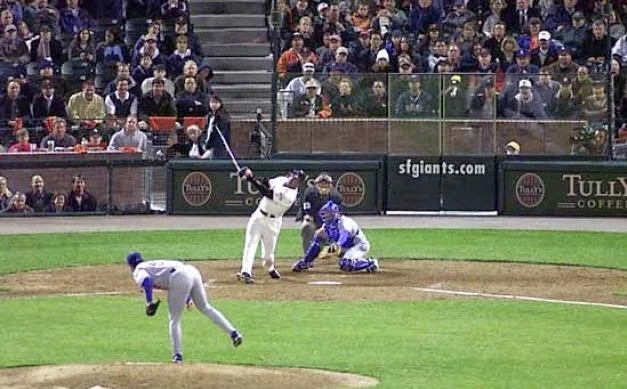
The ball that made Barry Bonds the seventeenth member of the 500 home run club did not land in the seats. It cleared the right-field wall at Pacific Bell Park and dropped into McCovey Cove, the slice of San Francisco Bay where kayakers wait in the water for exactly this, and a small flotilla converged on it.
It came on April 17, 2001, a two-run, go-ahead shot in the eighth inning off Dodgers reliever Terry Adams that put the Giants ahead for good. Bonds was thirty-six. Five hundred home runs is the number that has historically separated the very good from the immortal, and reaching it would be the crowning achievement of nearly any career.
For Bonds it was a way station. The 500th came in April of a season that would not end until he had hit 73, and over the course of that single year he passed ten men already inside the 500 club – Eddie Murray, Mel Ott, Eddie Mathews, Ernie Banks, Ted Williams, Willie McCovey, Jimmie Foxx, Mickey Mantle, Mike Schmidt, and Reggie Jackson – climbing from seventeenth on the career list toward the top of it. Terry Adams, a reliever who spent a decade bouncing between bullpens, had surrendered a milestone that for Bonds turned out to be a footnote to a far larger year.
Home Run No. 71 – Chan Ho Park
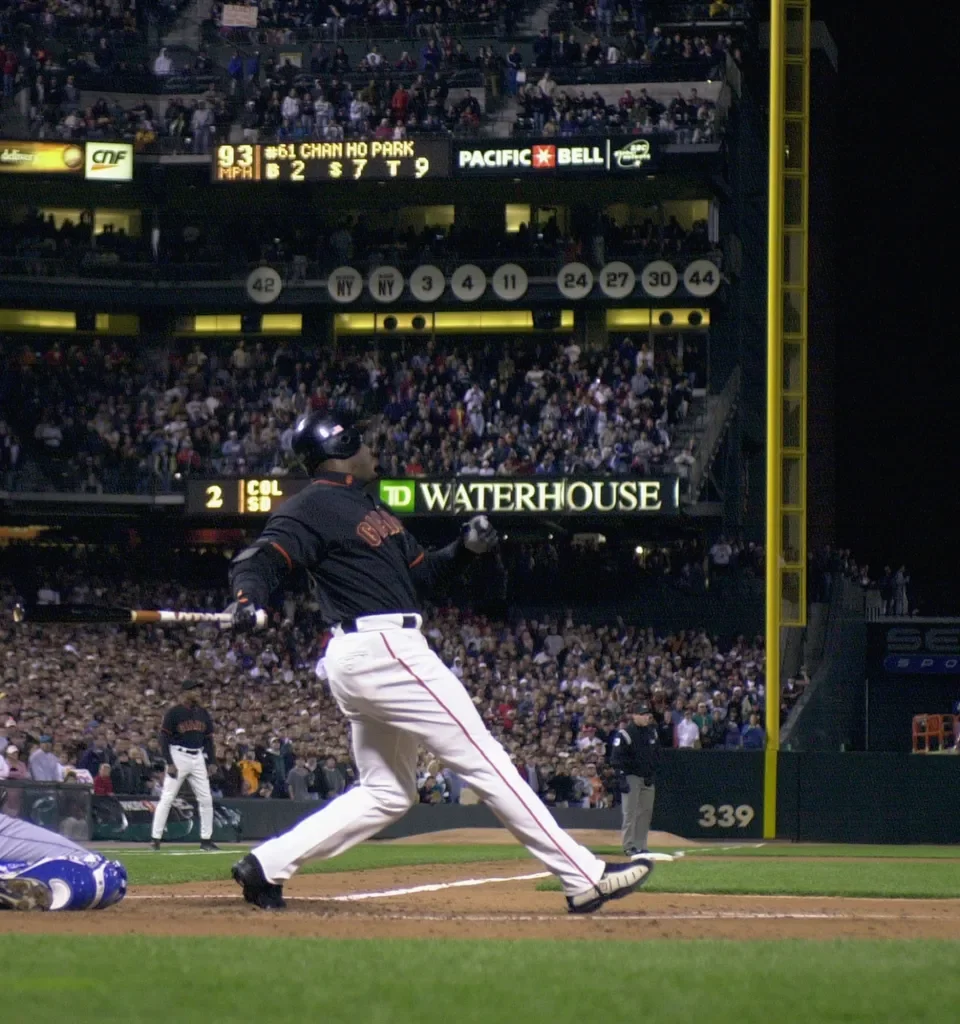
Chan Ho Park spent the evening of October 5, 2001, making the same mistake twice. In the first inning he threw Bonds a hittable pitch on a 1-0 count and watched it travel an estimated 442 feet to right field – the 71st home run of the season, one more than Mark McGwire had hit in 1998, and a new single-season record. The night before, in Houston, Bonds had tied McGwire at 70 off a rookie named Wilfredo Rodriguez, who would pitch in only a handful of major league games and own a permanent place in the story anyway.
Two innings later, Park did it again. With Bonds leading off the third, he served up another hittable ball, and Bonds hit his 72nd. By the fourth inning Park had finally learned the lesson everyone else had learned years earlier, and walked Bonds intentionally.
The game itself had been rescheduled from September 14, postponed after the September 11 attacks, and it ended with the Dodgers winning 11-10 and the Giants eliminated from the playoff race. After the record-breaker, Bonds ducked into the dugout to telephone his father, Bobby, who was at a charity golf tournament in Connecticut. Park had given up two home runs that rewrote the record book in the span of about forty minutes, which is a hard night to outrun.
Home Run No. 73 – Dennis Springer
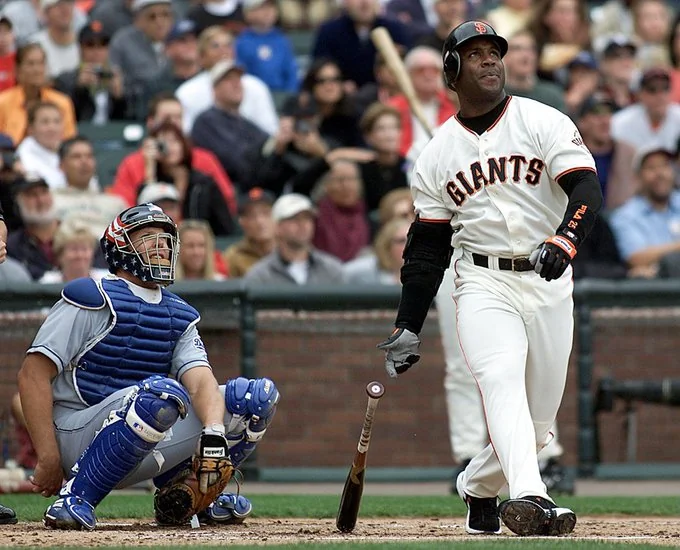
The pitch that produced the home run record nobody has matched since was a knuckleball – the slowest pitch in the game – thrown by a knuckleballer named Dennis Springer. On October 7, 2001, the final day of the season, Bonds led off the bottom of the first against him, worked a full count, and on the sixth pitch drove number 73 into the arcade above the right-field fence at Pacific Bell Park. The Giants won 2-1. The record has stood for more than two decades.
Springer was thirty-six and near the end of a modest career, which is fitting, because Bonds used the gentlest pitch in baseball to set its most violent record. The same season produced a .863 slugging percentage that broke a single-season mark Babe Ruth had held for eighty years, and a home run every 6.52 at-bats.
What happened to the ball afterward outlasted the game. A fan named Alex Popov got his glove on it; in the scrum that followed, Patrick Hayashi emerged holding it, and Popov sued. A San Francisco judge eventually ordered the two men to sell the ball and split the proceeds, and it fetched $450,000. The knuckleball is the gentlest pitch in baseball. The fight over the home run it gave up lasted fourteen months.
Home Run No. 600 – Kip Wells
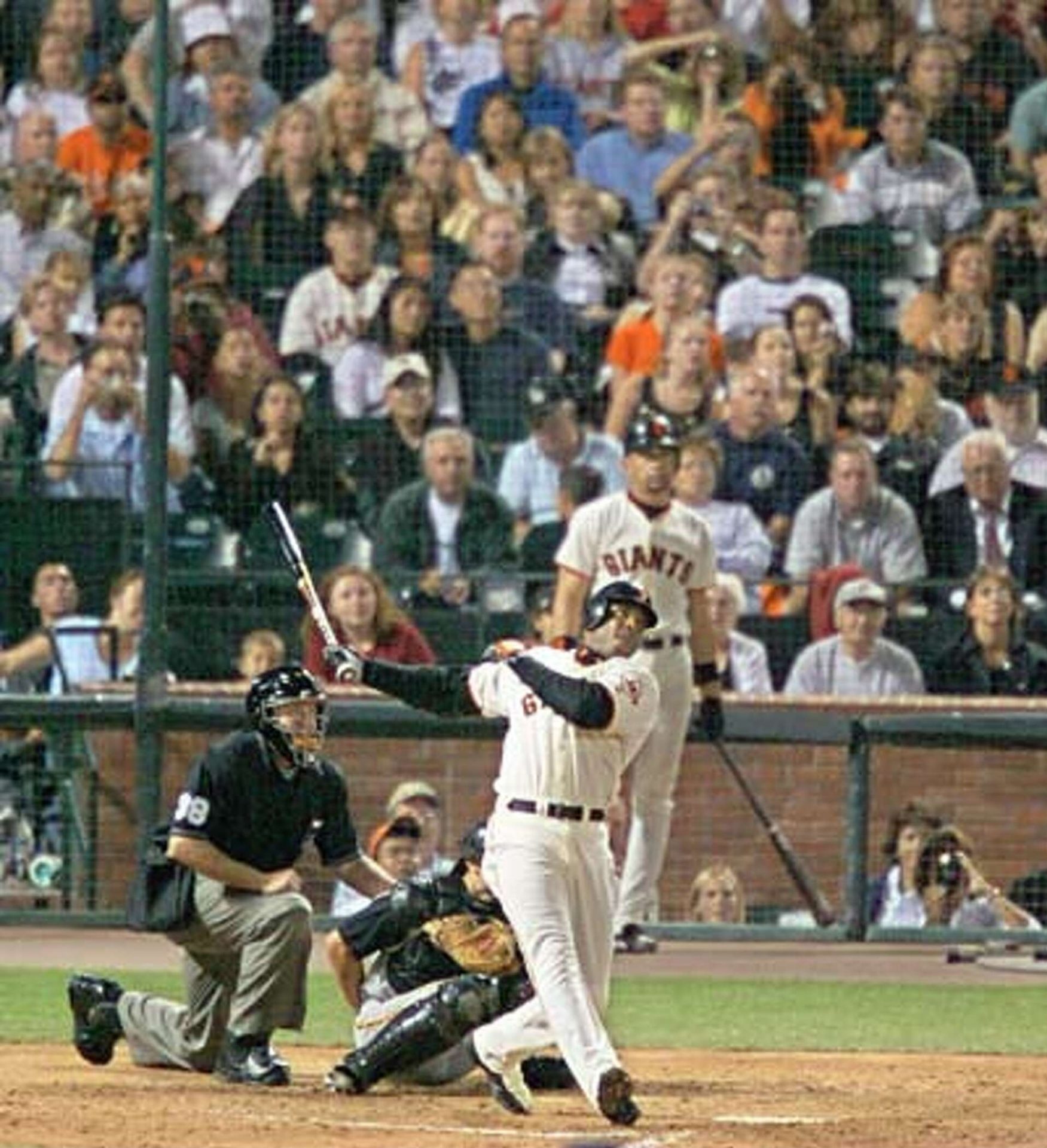
The Pittsburgh Pirates had Barry Bonds first. They took him in the first round of the 1985 draft, watched him win two MVP awards and three division titles, and then let him leave as a free agent after the 1992 season, unwilling to meet his price. Ten years later they got to watch him hit his 600th home run against them.
It happened on August 9, 2002, at Pacific Bell Park, a two-out shot in the sixth inning off Pirates starter Kip Wells. The home run made Bonds, at thirty-eight, the fourth man ever to reach 600, after Hank Aaron, Babe Ruth, and his godfather Willie Mays. It is the kind of company that ought to come with fireworks, and it did.
The detail the highlight reels tend to skip is that Pittsburgh won the game anyway, 4-3. Wells gave up the milestone and got the better of the night, which is a more interesting outcome than the alternative and one that suited a franchise that had spent the decade since Bonds left mostly losing. Bonds had become the player Pittsburgh could not afford, and the 600th was a message delivered to the only organization besides the Giants that ever employed him.
Home Run No. 661 – Ben Ford
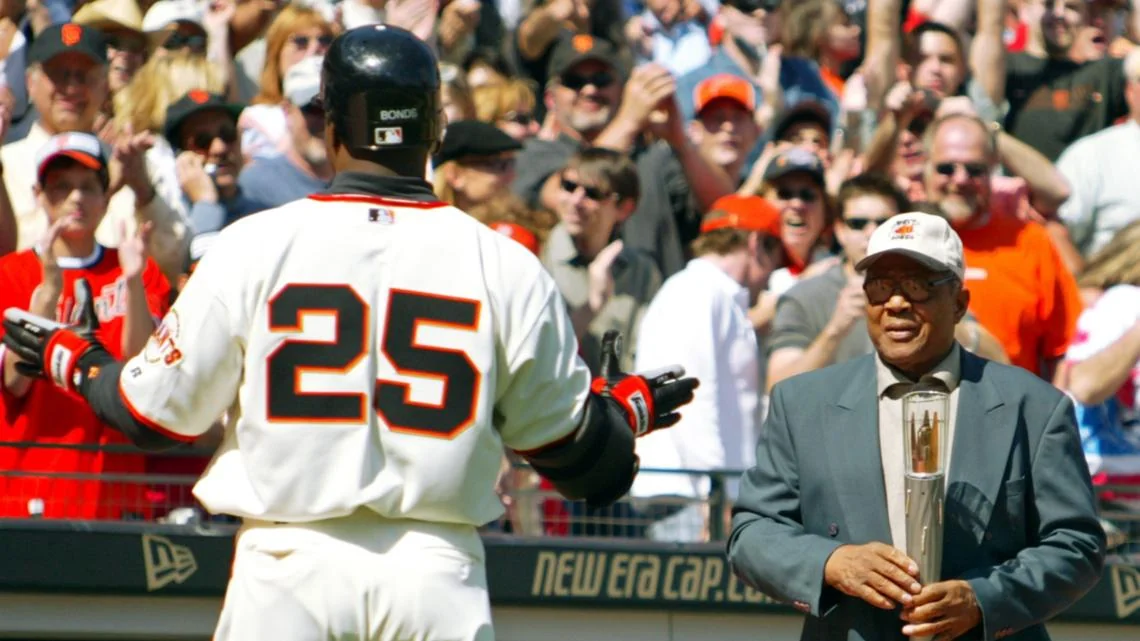
The day before Bonds passed Willie Mays, he tied him, and Mays walked out onto the field carrying a torch. It was a diamond-encrusted replica of the Olympic torch Mays had carried in the 2002 relay, inscribed with the numbers 660 and 661, and he presented it to his godson at home plate. Mays had been close to the Bonds family since Bobby Bonds debuted in the Giants outfield beside him in 1968. He did not appear to mind being caught.
The tying home run, number 660, came on April 12, 2004 off Brewers starter Matt Kinney, a 442-foot drive into McCovey Cove. The one that mattered came the next afternoon: number 661, a solo shot in the seventh inning off Milwaukee reliever Ben Ford, into the same water on consecutive days, in a 4-2 Giants win. It moved Bonds past his godfather and into sole possession of third place on the all-time list, behind only Ruth and Aaron.
Ben Ford pitched only briefly in the major leagues and is remembered, when he is remembered, for the one pitch that came between Willie Mays and the rest of baseball history. Mays, for his part, had handed over the torch a day early. He seemed to understand exactly what he was doing.
Home Run No. 700 – Jake Peavy
Jake Peavy was twenty-three years old and, by the numbers, the best pitcher in the National League the night he gave up Barry Bonds’s 700th home run. He led the majors that season with a 2.27 earned run average, the youngest pitcher to win an ERA title since Dwight Gooden in 1985, and he would go on to win the Cy Young Award and the pitching Triple Crown in 2007. He was not some batting-practice arm caught in the wrong place. He was excellent, and Bonds hit him anyway.
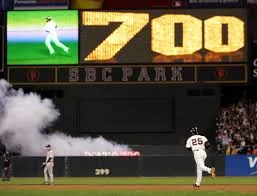
The home run came on September 17, 2004 at SBC Park, a 392-foot drive the opposite way to left-center on an 0-1 pitch, leading off the third inning of a 4-1 Giants win. It made Bonds the third man to reach 700, after Babe Ruth and Hank Aaron – the entire membership of the club at the time.
There was a kind of inevitability to the matchup. Bonds hit more home runs against the San Diego Padres than against any other team, somewhere near 80 over his career, which made the Padres reliable suppliers of milestones. Peavy was simply the best of them to draw the assignment, and one of the few men on this list whose greatest seasons were still in front of him.
Home Run No. 715 – Byung-Hyun Kim
Five years before he gave up the home run that passed Babe Ruth, Byung-Hyun Kim was crouched on the mound at Yankee Stadium with his head down, having just done the thing he would never escape. The South Korean submariner was the Diamondbacks’ 22-year-old closer in the 2001 World Series, and across Games 4 and 5 he surrendered back-to-back game-tying home runs in the ninth inning, to Tino Martinez and then Scott Brosius, with Derek Jeter’s tenth-inning walk-off in between. Arizona won the title anyway. Kim was remembered for the rest.
On May 28, 2006, by then pitching for Colorado, Kim threw the pitch Bonds drove an estimated 445 feet to center at AT&T Park for his 715th home run. It pushed Ruth out of the top two on the career list for the first time in roughly 85 years. The Giants lost; Bonds had wanted to hit it at home regardless, in front of a crowd that would cheer.
Bonds had tied Ruth eight days earlier in Oakland, leading off the second inning off Athletics left-hander Brad Halsey, the 420th different pitcher to give up a Bonds home run. Halsey died in a climbing accident in 2014, at thirty-three. The number had a way of attaching itself to people.
Home Run No. 756 – Mike Bacsik
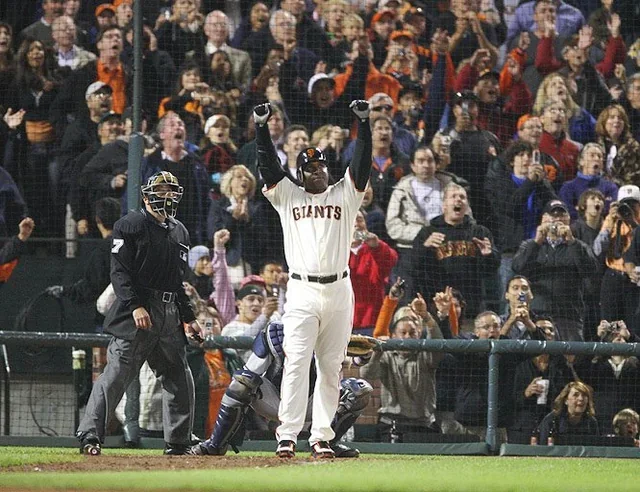
Mike Bacsik’s father had faced Hank Aaron too. In August 1976, a Texas Rangers reliever also named Mike Bacsik pitched to Aaron while Aaron sat on 755 career home runs – retiring him once on a flyout, then allowing an infield single. Nobody knew at the time that Aaron had already hit the last home run of his life, so the elder Bacsik never had the chance to give up number 756. His son got it instead, 31 years later.
On August 7, 2007 at AT&T Park, Bonds turned a full-count, 84-mph fastball from the younger Bacsik into a 435-foot drive to right-center, his 756th home run and the one that broke Aaron’s 33-year-old record. He had gone 3-for-3 against Bacsik that night. His seventeen-year-old son Nikolai, a Giants batboy, was bouncing on home plate before Bonds reached it; Mays removed his cap; a recorded message from Aaron played on the scoreboard; Bonds looked to the sky and thanked his late father.
Bonds had tied the record three days earlier in San Diego off Padres pitcher Clay Hensley. Bacsik, asked about his place in history, offered the only sane response available: had his father simply let Aaron homer back in 1976, the two of them would have given up 756 together.
Home Run No. 762 – Ubaldo Jimenez
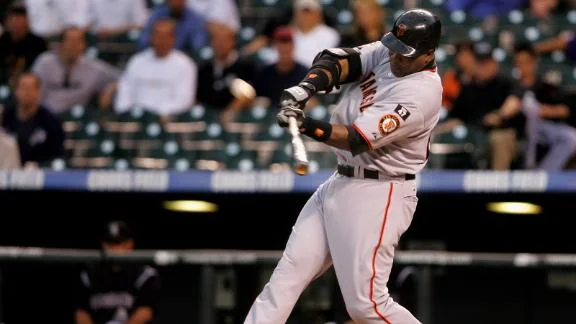
The most famous number in baseball belongs to a home run almost nobody was watching closely. By September 2007 Bonds had broken the record at 756, and each home run after that was simply the new total, so Major League Baseball had stopped slipping specially authenticated baseballs into his at-bats. That is how the ball that set the record at 762 – the number that has stood ever since – came to be unmarked, and how the 24-year-old fan who caught it, Jameson Sutton, later had to pass a lie-detector test to prove it was real.
It happened on September 5, 2007 at Coors Field, on the 12th pitch of the game: a 99-mph fastball from Colorado rookie Ubaldo Jimenez, lined into the left-center seats for a two-run shot with two outs in the first inning of an eventual 5-3 Giants win. Jimenez was no journeyman. He helped pitch the Rockies to the World Series weeks later and threw the first no-hitter in franchise history in 2010.
There was no ceremony. Bonds circled the bases of a road game that meant little while a handful of fans wrestled over the souvenir, and that was that. Sixteen days later the Giants said they would not bring him back. He never homered again, and the number simply stopped where it sat.
- SABR Games Project: Barry Bonds hits his 71st home run (October 5, 2001)
- MLB.com: Watch Barry Bonds hit his very first big league home run
- Baseball-Reference: Dodgers at Giants box score, October 5, 2001
- ESPN / AP: Bonds finishes remarkable season with 73
- ESPN / AP: Bonds hits No. 700 off of Peavy
- Sports Illustrated: Barry Bonds, Mike Bacsik, and No. 756, Ten Years Later
Frequently Asked Questions
Does Barry Bonds still hold the career home run record?
Yes, and it has not been seriously threatened. Alex Rodriguez retired with 696 and Albert Pujols with 703, the nearest anyone has gotten. Bonds has now held the career record for nineteen seasons, which is longer than he spent playing for the Giants.
Has anyone matched Bonds’s 73 home runs in a season?
No, and nobody has reached 70 since. Aaron Judge came nearest with 62 for the Yankees in 2022, an American League record, and Cal Raleigh hit 60 for the Mariners in 2025, the most ever by a catcher. Only Mark McGwire, with 70 in 1998, has finished a season within three.
Who gave up Barry Bonds’s 70th home run?
Wilfredo Rodriguez, a rookie left-hander for the Houston Astros, on October 4, 2001 at Enron Field. The ninth-inning drive tied Mark McGwire’s single-season mark with three games left. It was the second and last major league game Rodriguez ever pitched in, which is one way to be remembered.
Who caught the balls from home runs 660 and 661?
The same man. A software salesman named Larry Ellison – no relation to the Oracle billionaire – fished both out of McCovey Cove from his kayak on consecutive days in April 2004. He gave number 660 back to Bonds in exchange for signed memorabilia, then auctioned number 661 for about $17,000.
Who gave up home run number 714, the one that tied Babe Ruth?
Brad Halsey, a left-hander for the Athletics, on May 20, 2006 at the Oakland Coliseum, in the second inning of an interleague game. Halsey later joked about the specially marked baseballs used for Bonds’s at-bats, which carried a picture of Barry: “If you look into his eye, he winks at you.”
Who threw the pitch that tied Hank Aaron’s record?
Clay Hensley of the San Diego Padres, on August 4, 2007 at Petco Park – a former Giants draft pick who had served a fifteen-game minor league suspension for steroids in 2005. Bonds, chased for years by doping allegations, tied Aaron off him anyway.
What happened to the ball from Bonds’s 756th home run?
A 21-year-old New Yorker named Matt Murphy caught it during a layover on his way to Australia, then sold it for $752,467 to the designer Marc Ecko, who put its fate to an online vote. The voters chose an asterisk, and the branded ball went to the Hall of Fame.