Every Goal Pele Scored at a World Cup
In July 1950, a nine-year-old boy in Bauru watched his father cry as Brazil lost the deciding match of a home World Cup to Uruguay, and made him a promise: “Don’t worry, I will win Brazil the World Cup.” The boy was Edson Arantes do Nascimento, the father was a striker called Dondinho, and the promise turned out to be among the most thoroughly kept in the history of sport.
The scoring record he built while keeping it has a stranger shape than its reputation suggests. Popular memory files Pele as a machine that produced World Cup goals continuously for twelve years; the ledger shows nearly everything happening at the two ends, with a long valley in the middle where injuries wrecked one tournament and deliberate, referee-tolerated violence wrecked another. In between his teenage explosion in Sweden and his imperial farewell in Mexico, eight years passed in which he scored twice.
Below is every goal, in the order they went in – the dates, the minutes, the broken records, and the opponents who supplied them – along with the injuries and the near-misses that explain both the gaps and the fame. Some of the most famous moments of his four tournaments never crossed a goal line at all. They are here too, exactly where they belong.
Pele scored 12 goals in World Cup final tournaments, in 14 appearances: six as a teenager in Sweden in 1958, one in Chile in 1962, one in England in 1966, and four in Mexico in 1970. Every one came in open play or from a direct free kick; he never scored a World Cup penalty.
vs Wales, 1958 Quarterfinal – 66’
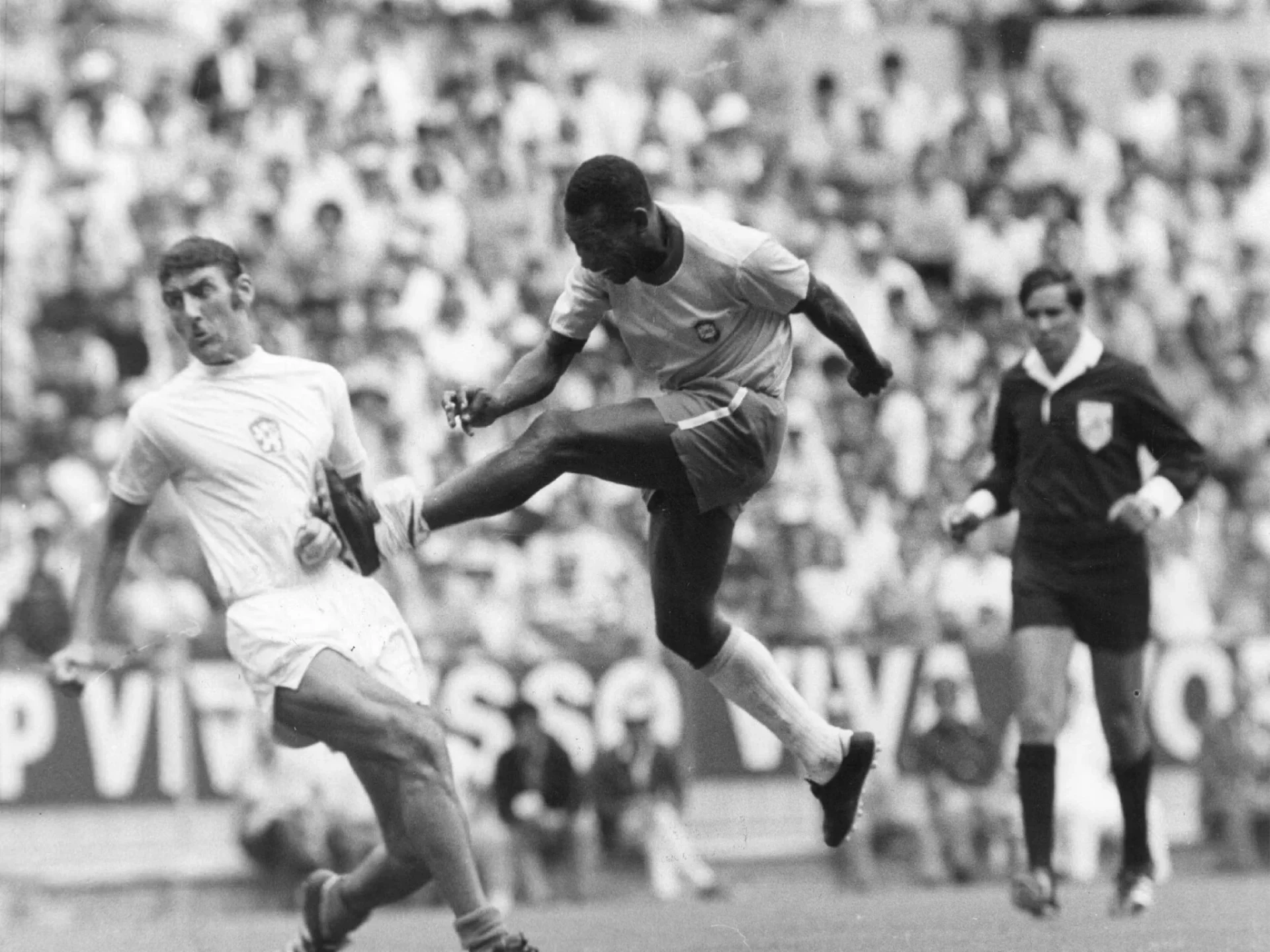
Pele called this the most important goal of his career, which is quite a verdict from a man credited with more than 1,200 of them. On paper it is nothing: a 1-0 win in Gothenburg on June 19, 1958, the narrowest scoreline of any World Cup match he played. Wales were at their first World Cup, without their best player – John Charles, injured in the playoff against Hungary that got them there – and they defended for 66 minutes with the patience of a nation that suspected it might never be back.
Then Didi headed the ball into the penalty area. Pele took it on his chest, flicked it over Mel Charles, John’s brother, and put the bouncing ball past Jack Kelsey into the corner. He was 17 years and 239 days old. No one younger has ever scored at a World Cup, and no one else has done it before turning 18 – FIFA re-checked the ranking during the 2026 tournament and the record sat exactly where he left it.
The match has acquired a second life in trivia: when Lamine Yamal and Pau Cubarsi started a knockout game for Spain in 2026, statisticians noted they were the first teenage pair to do it since Pele and Jose Altafini in this fixture, 68 years earlier. Wales did not qualify for another World Cup until 2022. Pele had a semifinal to get to.
vs France, 1958 Semifinal – 52’
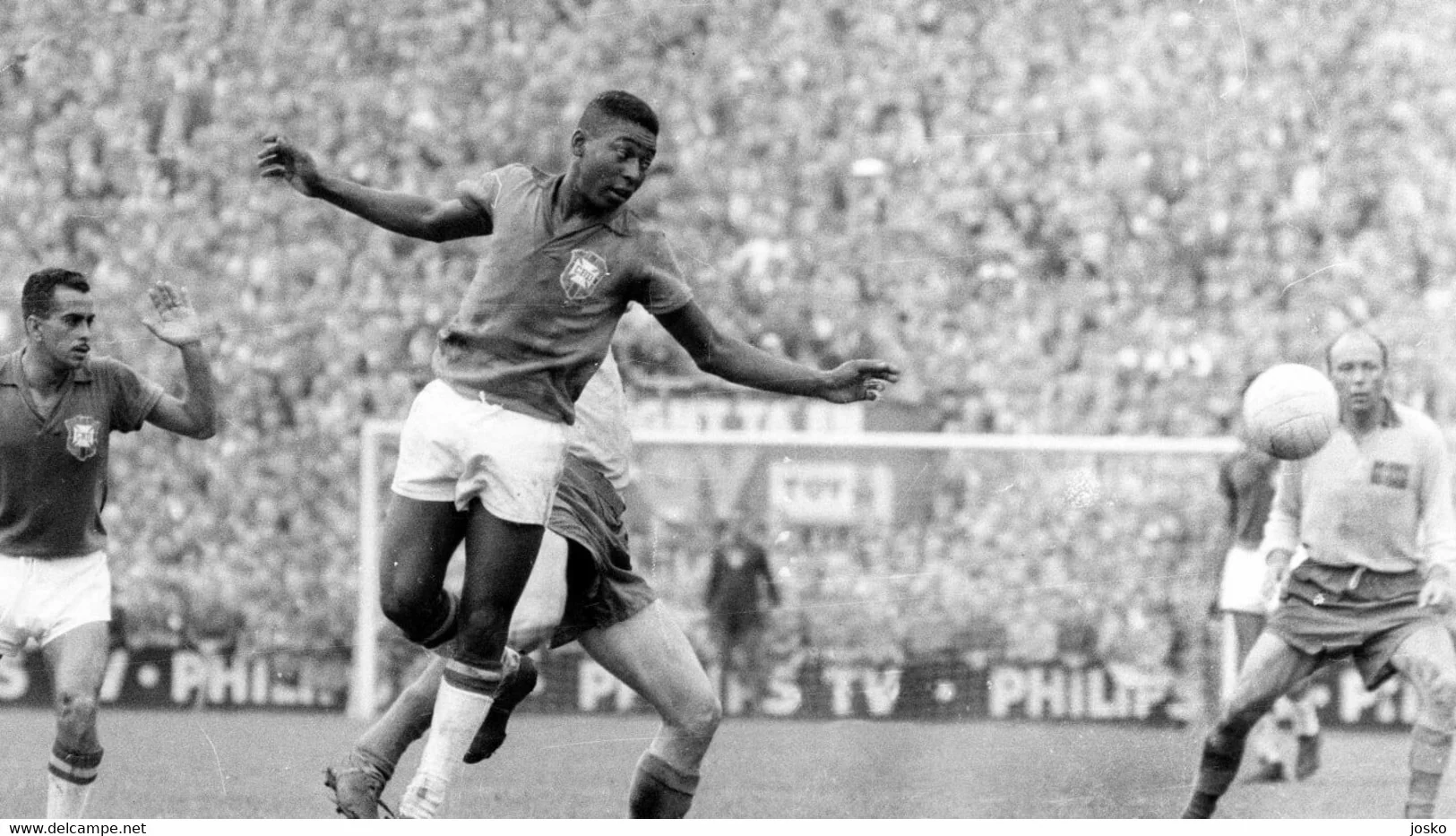
Robert Jonquet spent the second half of this semifinal limping up and down the French left wing, injected with painkiller at the interval, unable to run or properly kick. The French captain had fractured his fibula in a 35th-minute collision with Vava, and in 1958 there were no substitutes, so the finest defender in France remained on the pitch as a passenger. France – who had arrived in Solna having scored 15 goals in four matches – played the last hour effectively a man short.
The game had opened at a sprint. Garrincha picked off Jonquet’s short pass inside two minutes and Vava scored from the move; Just Fontaine equalized in the ninth, the first goal Brazil conceded in the entire tournament; Didi restored the lead from 22 yards while Jonquet was still off being treated. It was 2-1 at halftime and about to stop being close.
Seven minutes into the second half, Pele scored the first goal of the first hat-trick of his international career, and the semifinal quietly became a procession. The French kept attacking anyway, because attacking was the only thing their broken team was still equipped to do. Roger Piantoni eventually got them a second. By then Pele had three.
vs France, 1958 Semifinal – 64’
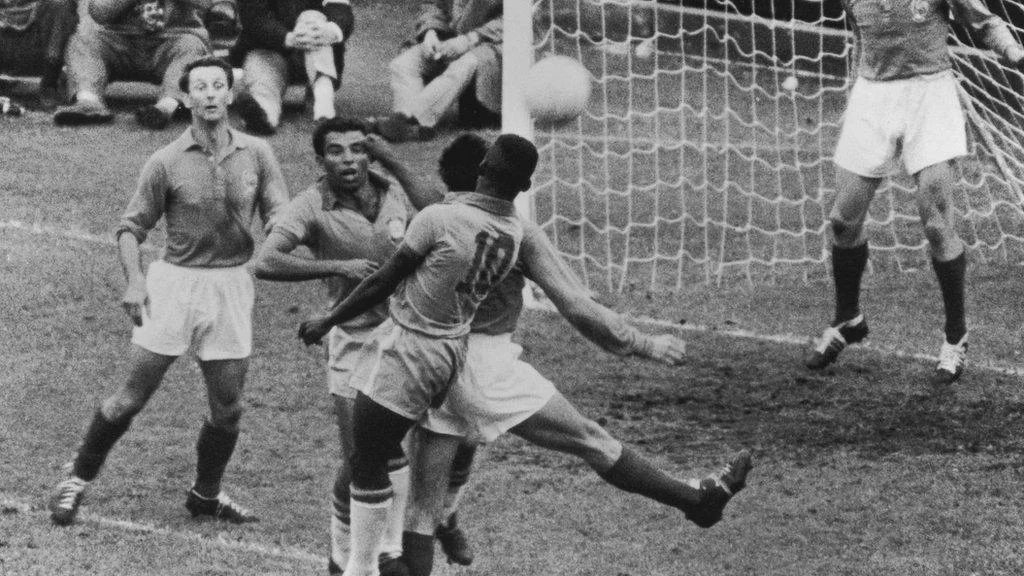
Thirteen goals is what Just Fontaine scored at the 1958 World Cup, in six matches, a single-tournament record that has now survived 68 years and every striker who has aimed at it. Fontaine scored in this semifinal too, early, and it bought France nothing at all. The man across from him was 17, would finish the tournament with less than half his total, and was about to make the afternoon his own anyway.
Pele’s second arrived in the 64th minute, with Brazil already 3-1 up and France reorganized around their injured captain. The hat-trick, start to finish, took him 23 minutes – all of it in one half, against opponents who had come into the game as the tournament’s highest scorers. Raymond Kopa, France’s Real Madrid playmaker, spent the second half watching the future arrive at speed.
Fontaine went to the third-place match carrying nine, added four more against West Germany, and went home with a bronze medal and the melancholy distinction of producing the greatest individual scoring tournament in World Cup history in the same summer somebody else became its story. The record has outlived him; Fontaine died in 2023, at 89, still the only man to score 13 times in one World Cup.
vs France, 1958 Semifinal – 75’
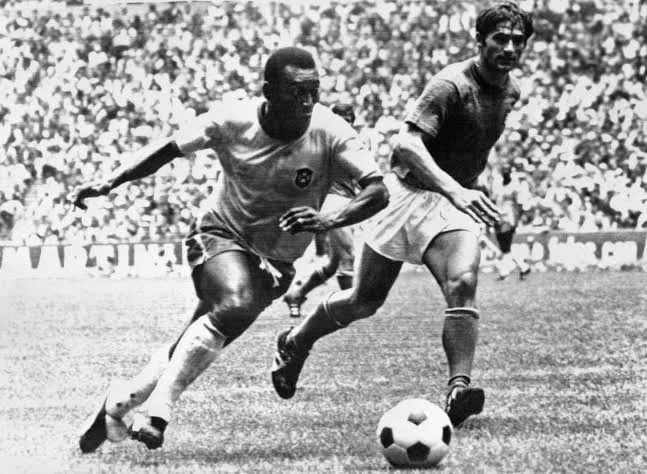
No player under 18 has completed a World Cup hat-trick, with one exception, and this is the goal that sealed it: the 75th minute in Solna, Brazil’s fifth, Pele’s third. He was 17 years and 244 days old. Sandor Kocsis, Just Fontaine, Gerd Muller, Gabriel Batistuta – the small club of men with two World Cup hat-tricks – were all in their twenties when they managed their first. Pele had been a professional for barely two years, and a Brazil international for barely one.
The scale of it has grown with time. Knockout-stage hat-tricks are rare – there have been 19 in the whole history of the tournament – and only two men, Geoff Hurst in 1966 and Kylian Mbappe in 2022, have scored one in a final. A semifinal hat-trick by anyone, of any age, remains one of the tournament’s rarest events; Pele’s came against the highest-scoring team in the field, five days before he played a final.
Asked about his 1958 records decades later, Pele said he had not been thinking about records at all, then allowed himself one prediction: “I think it will be very difficult for a 17-year-old to score a hat-trick in a World Cup semi-final.” No one has yet made him wrong.
vs Sweden, 1958 Final – 55’
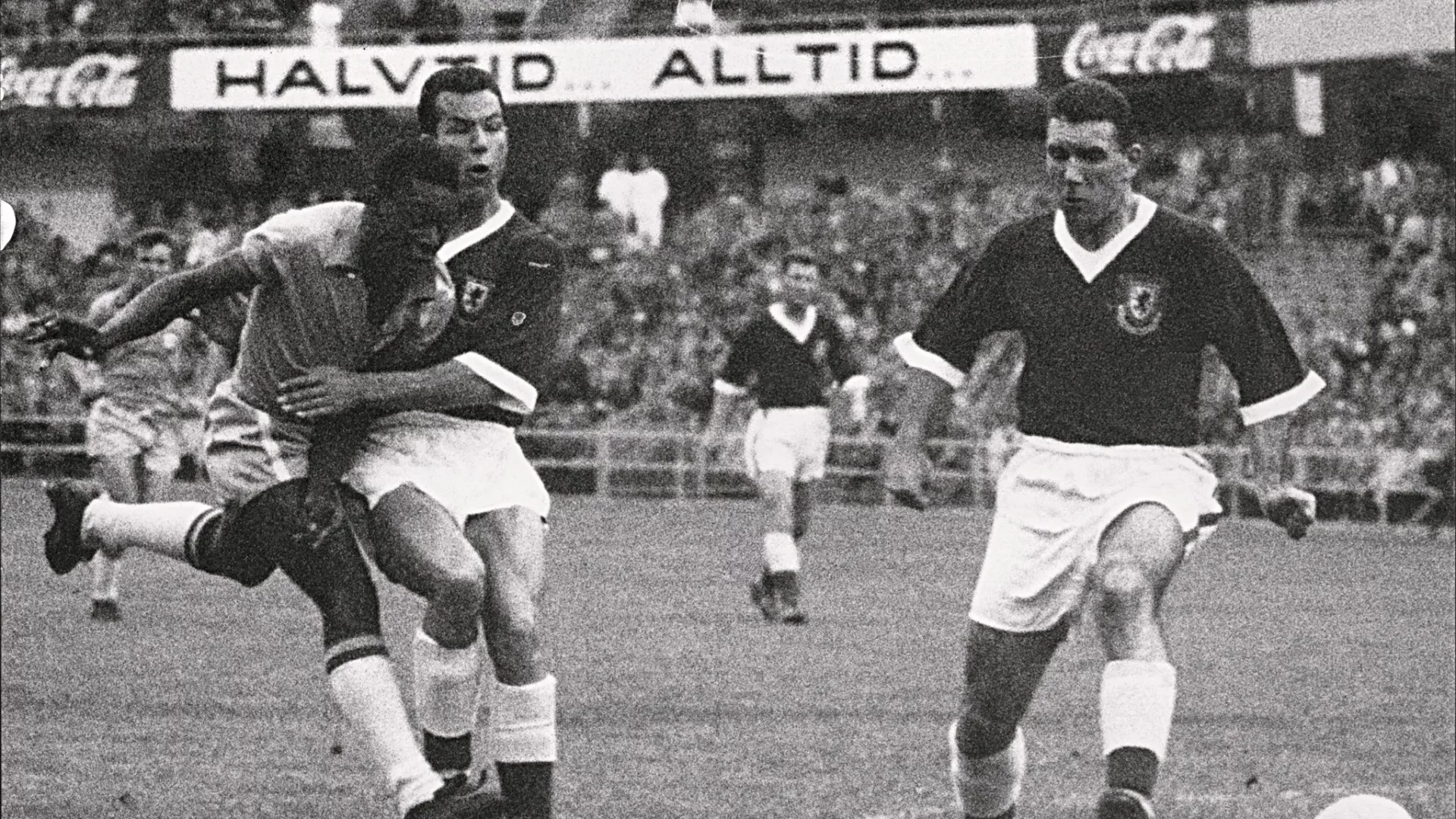
It had rained on Stockholm for twenty-four hours before the final, and the leather balls of 1958 soaked up water like bread in soup, which makes what happened ten minutes into the second half harder to explain rather than easier. A high ball dropped to Pele in a crowded Swedish penalty area. He brought it down, lifted it over the head of the defender Bengt Gustavsson, and volleyed it past Kalle Svensson as it fell.
Brian Glanville, in The Story of the World Cup, has him taking the ball on his thigh rather than his chest – accounts genuinely differ on the body part – before hooking it over his head, whirling round, and volleying, in Glanville’s word, “mightily.” Svensson, it should be recorded, was a firefighter who had needed time off work to play in the tournament. There are worse excuses for being beaten by one of the great World Cup goals.
The strangest detail is the crowd. Rasunda held 50,000 people, nearly all of them Swedish, King Gustaf VI Adolf included, watching the home team go 3-1 down in a World Cup final – and when the ball went in they celebrated anyway. With it Pele became, at 17 years and 249 days, the youngest man ever to score in the fixture.
vs Sweden, 1958 Final – 90’
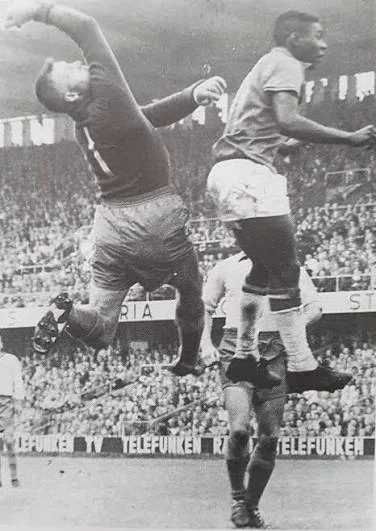
The final goal of the 1958 World Cup was a stoppage-time header, and it belonged, inevitably, to the 17-year-old. Pele rose in the box and nodded Brazil’s fifth over the line for 5-2, at which point Sigge Parling, one of the Swedes tasked with containing Brazil’s forwards, gave up in the most honorable way available. “After they scored their fifth goal, I didn’t feel like marking them anymore,” he said. “I simply wanted to applaud.”
The same final had already made Nils Liedholm – scorer of Sweden’s fourth-minute opener, at 35 years and 263 days – the oldest man to score in one; the fixture’s two age records were set 51 minutes apart and both still stand. When the whistle went, Pele fainted. His teammates revived him, the goalkeeper Gilmar propped him up, and the photograph of the boy weeping on Gilmar’s shoulder became the tournament’s defining image – a champion who looked, in the moment of victory, like someone receiving terrible news.
Back home, Sao Paulo greeted him with a banner reading “Welcome Pele: Son of Bauru, Champion of the World,” and Bauru itself presented him with a car. He could not drive. He gave it to his father, Dondinho.
vs Mexico, 1962 Group Stage – 73’
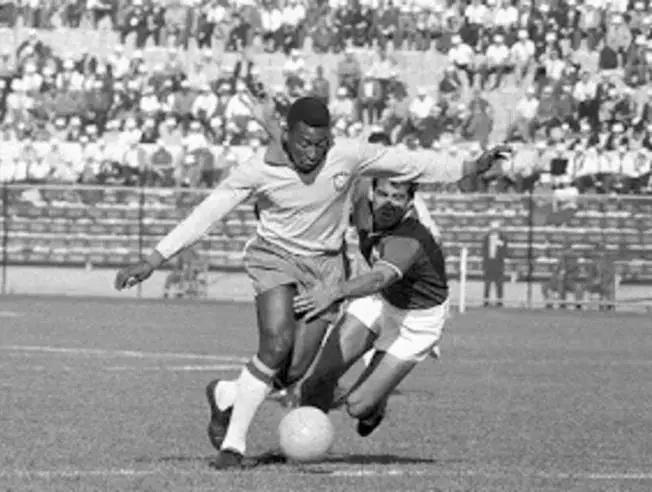
The 1962 World Cup was meant to be Pele’s, and for exactly one match it was. Brazil opened against Mexico in Vina del Mar on May 30, and he spent the afternoon making the case that he was, at 21, the best player alive: a first-half free kick against the woodwork, then a cross from the right for Zagallo to head the opener ten minutes after the break.
The goal came in the 73rd minute and was the best of the game. Pele picked the ball up, went past four Mexican defenders, and finished with his left foot from inside the penalty area – a goal that reads like a highlight reel even in the dry match reports. Mexico had lost to Brazil at the 1950 and 1954 World Cups by a combined 9-0, and this 2-0 defeat was, by their standards against Brazil, progress.
His tournament ended three days later, in the second group game, and he watched the rest from the sidelines. Brazil retained the trophy anyway. Under the rules of the era only players who appeared in the final received winner’s medals; FIFA amended the regulation in 1978 and worked backward, and in 2007 Pele finally collected his 1962 medal, 45 years after his team won it.
vs Bulgaria, 1966 Group Stage – 14’
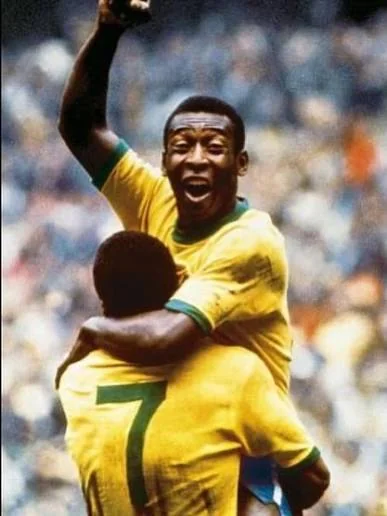
Dobromir Zhechev’s plan for stopping Pele was to kick him, early and often, and the first consequence arrived within a quarter of an hour. Fouled by Zhechev just outside the box, Pele took the free kick himself and drove it low and hard past the wall, just beyond the reach of Georgi Naydenov, to put Brazil ahead in the 14th minute at Goodison Park. Nobody had ever scored at three consecutive World Cups before.
The 2-0 win over Bulgaria turned out to be an album of endings. Garrincha doubled the lead in the second half with a free kick of his own, curled around the wall so improbably that Bulgaria’s Boris Gaganelov insisted no goalkeeper alive would have stopped it – and it was the only match in which he and Pele both scored, their 40th together for Brazil, and their last. Brazil never lost a game with the two of them on the pitch, a record now closed and permanent. Garrincha played once more, against Hungary, and never wore the yellow shirt again.
The kicking had a longer tail than the scoreline. Pele was fouled seven times at Goodison that day and limped away hurt, and a tournament that had begun as a title defense was about to become the roughest three weeks of his career.
vs Czechoslovakia, 1970 Group Stage – 59’
Shortly before halftime in Guadalajara, Pele collected the ball inside his own half, saw Ivo Viktor standing a few yards off his goal line, and hit a shot from around 50 meters that dropped just wide of the post with the goalkeeper backpedaling in something close to panic. It missed. It remains the most replayed moment of the match, which tells you something about a game in which Pele also scored.
The goal itself came in the 59th minute and was its own kind of exhibition: Gerson launched a long diagonal from deep inside his own territory, Pele controlled it on his chest with his back half to goal, turned, and finished for 2-1. Brazil had fallen behind after 11 minutes and needed a Rivellino free kick to level before the break; they finished 4-1, Jairzinho scoring twice.
It was Pele’s first World Cup match in four years, and it opened the most complete campaign any team has produced at the tournament: Brazil won all six games in Mexico, and Pele, restored and rested, had a hand in 14 of their 19 goals. The man who arrived at 29 was slower than the boy of 1958, and measurably more dangerous.
vs Romania, 1970 Group Stage – 19’
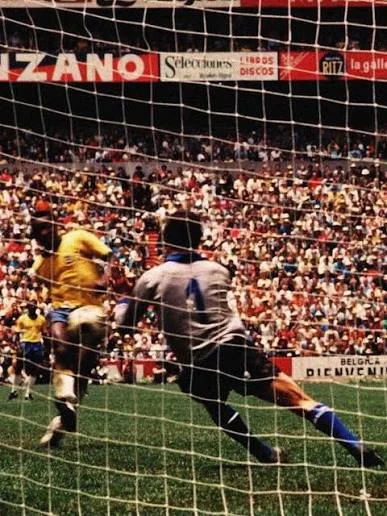
The free kick was struck with the outside of the right boot, which is not how anyone teaches it. Hit that way the ball swerves late and against expectation, and Pele’s 19th-minute effort bent around the Romanian wall and in before the goalkeeper had committed to a direction. Of his twelve World Cup goals, only two came from direct free kicks, and this was the second – the pair arriving four years apart, in consecutive tournaments, off entirely different techniques.
Brazil made several changes for the fixture on June 10, with progress from the group all but assured, and for a while it looked comfortable: Jairzinho made it 2-0 before Romania pulled a goal back. The margin never stretched beyond two, and the match stayed alive far longer than Brazil intended.
The outside-of-the-boot strike had been a Pele trademark since his Santos adolescence, but this is the only time he landed one at a World Cup, and he chose opponents making their first appearance at the tournament since 1938. Romania went home after the group stage and did not qualify again until 1990, by which point the man who had curled one past them had been retired from international football for nineteen years.
vs Romania, 1970 Group Stage – 67’
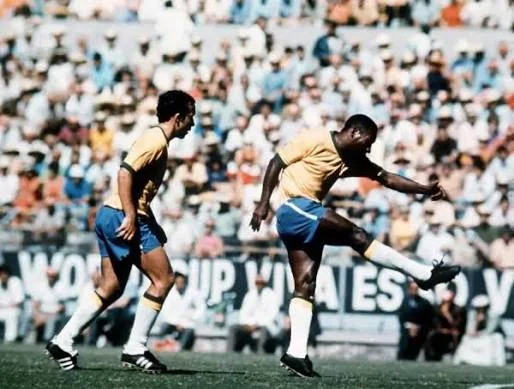
Somebody has to be the least remembered of Pele’s World Cup goals, and this is probably it: a 67th-minute second in a 3-2 group game already won and half forgotten, scored while the tournament’s attention drifted ahead to the knockout rounds. Even admiring retrospectives of Mexico 1970 tend to hurry past the Romania match on the way to grander material. The goal deserves better, because it turned out to be load-bearing. Emerich Dembrovschi scored for Romania in the 84th minute, which means that without Pele’s second, Brazil’s perfect tournament ends in a 2-2 draw with nobody remembering it as perfect at all.
It was also a quiet farewell to a particular kind of afternoon. This was the third and final World Cup match in which Pele scored more than once – the other two came twelve years earlier, in a semifinal and a final – and the only multi-goal game of the three that arrived in a group stage.
Brazil survived the last six nervous minutes, took the group with a maximum six points in the era when a win earned two, and moved on to Peru in the quarterfinals. Pele, who had scored three times in the group stage, did not score again until the final itself.
vs Italy, 1970 Final – 18’
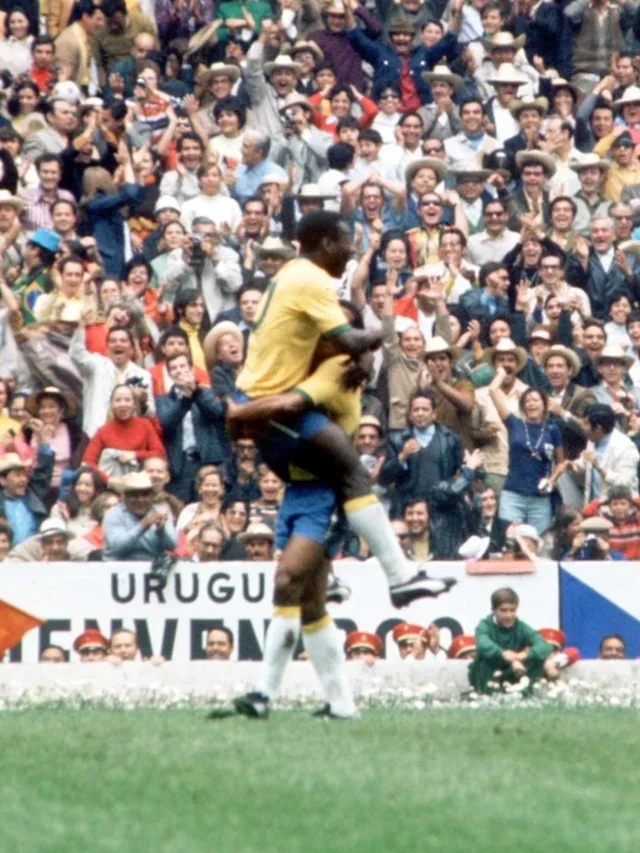
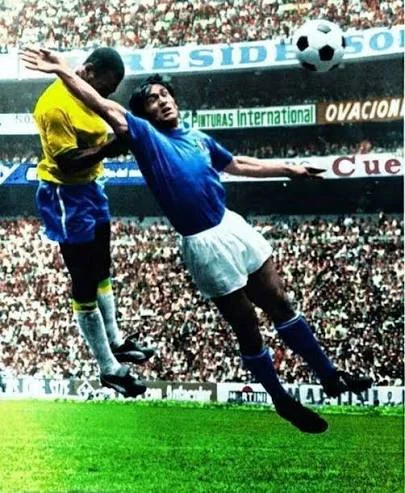
Tarcisio Burgnich prepared for the final by telling himself that Pele was made of skin and bones like everyone else. His verdict afterward, freely offered, was that he had been wrong. Eighteen minutes in, Rivellino swung a cross toward the far post and Pele climbed above Burgnich – one of the finest man-markers in Italy – hung there a beat longer than physics strictly allowed, and headed Brazil in front. The goal is credited as Brazil’s 100th in World Cup play, a piece of numerological tidiness the 1970 team seemed to produce without effort.
Roberto Boninsegna equalized before halftime. The second half went one way: Gerson beat the goalkeeper from distance, Jairzinho scored from Pele’s headed layoff, and then came the fourth – Pele holding the ball at the top of the box, letting the entire Italian defense gather in front of him, and rolling a no-look pass into the sprint of Carlos Alberto, whose finish gets replayed whenever the World Cup wants to advertise itself.
It was Pele’s final World Cup goal, in his final World Cup match, and the win gave Brazil the Jules Rimet Trophy outright. The trophy was stolen from the federation’s Rio de Janeiro headquarters in 1983 and almost certainly melted down for its more than three kilograms of gold. The afternoon it commemorated has proved considerably harder to dispose of.
Frequently Asked Questions
Did Pele score in World Cup qualifiers?
Yes – six goals, all in the 1970 qualifying campaign, the only one he played in. Brazil won all six qualifiers, scoring 23 times, and the last of them, against Paraguay at the Maracana, drew an official crowd of 183,341, still the largest ever recorded for a football match.
Why did Pele score only once at the 1966 World Cup?
He was targeted. Already hurt from the group opener, he sat out the second match, and on his return Portugal’s Joao Morais brought him down twice in one passage without a red card, leaving him hobbling on the wing. Brazil exited in the group stage, and Pele swore he would never play in a World Cup again.
Is Pele the only player to win three World Cups?
Yes. Pele won in 1958, 1962, and 1970; nobody else has won more than two. Zagallo, who played alongside him in the first two and coached him in the third, is the nearest thing to company – he became the first man to win the trophy as both player and manager.
What was Pele’s most famous near-miss at a World Cup?
The header Gordon Banks clawed away in the 1970 match against England. Pele joked about it forever afterward: “Today I scored a goal, but Banks stopped it.” In the semifinal against Uruguay he ran around goalkeeper Ladislao Mazurkiewicz without touching the ball, then pulled the shot just wide of the far post.
Did Pele play in the 1962 World Cup final?
No. He tore a thigh muscle attempting a long-range shot in Brazil’s second group match against Czechoslovakia and never returned to the tournament. Amarildo took his place, scored twice against Spain, and equalized in the final as Brazil beat the same Czechoslovakians 3-1 in Santiago.
How long did Pele’s World Cup scoring span last?
Twelve years and two days. His first goal came against Wales on June 19, 1958; his last came at the Estadio Azteca on June 21, 1970. Only Uwe Seeler managed the same four-tournament stretch in the same years; the two were the first men to score at four World Cups.