All NES Launch Titles
Early on the morning of October 18, 1985, several Nintendo employees were hiding behind pillars inside FAO Schwarz on Fifth Avenue, watching their first American customer approach the cash register. The display had been built the night before by Don James, a Nintendo of America designer who had personally hauled television sets up flights of stairs to set it up. The customer turned out to be a Japanese businessman who worked for one of Nintendo’s competitors. He bought a console and one of every game on the shelf beside it. Marketing manager Gail Tilden, sales head Bruce Lowry, and VP Ron Judy quietly slipped away to the Ritz-Carlton bar and split a celebratory bloody mary. It was one sale. They had no idea if there would be a second.
The Nintendo Entertainment System was not supposed to be a video game console. The 1983 video game crash had so thoroughly poisoned the American retail market that toy buyers refused to stock anything labeled as such. Nintendo had to disguise the system as a robotics toy – bundling it with R.O.B., the Robotic Operating Buddy, and the NES Zapper light gun – to get shelf space at all. The strategy was a controlled experiment in whether Americans would buy video games again. They would.
One note on the list that follows: the exact launch-day availability of Super Mario Bros. is the most contested piece of gaming history nobody can resolve. Some former Nintendo employees recall it arriving weeks later. The contemporaneous newspaper coverage and Nintendo’s own official release date say it launched with the system. The dominant scholarly consensus, including the current Wikipedia article and Frank Cifaldi’s investigative research, treats it as a launch title. We have done the same. The remaining sixteen games are not in dispute.
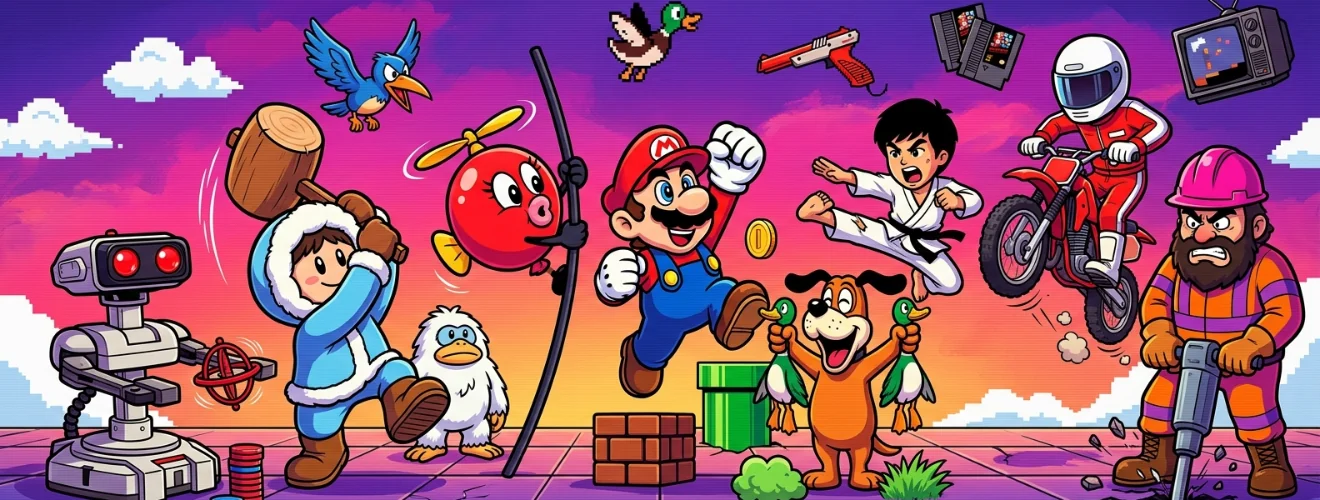
Seventeen games made up the NES launch lineup on October 18, 1985, when Nintendo test-marketed the console in New York City. Two of them shipped bundled with the hardware and the other fifteen sold separately. All seventeen were ports of Japanese Famicom releases issued between 1983 and 1985.
10-Yard Fight
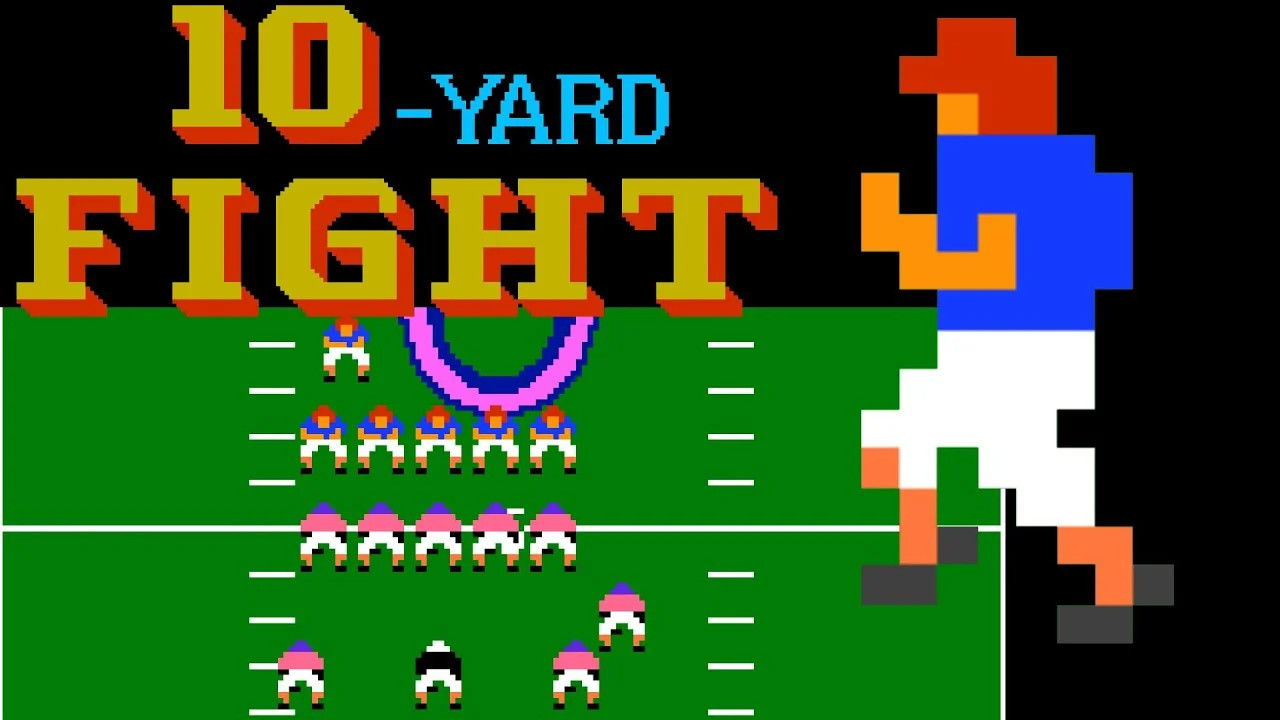
10-Yard Fight is the first American football video game ever made by a company that was not American. The developer, Irem, was based in Tokyo, where the sport ranks somewhere between curling and competitive eating in the national consciousness. The result is exactly what you’d expect from a Japanese arcade studio building a simulation of a sport they had largely encountered on television. There are no plays to call. The quarterback takes the snap and either runs the ball himself, hands off to the running back, or throws to a single long-distance receiver who signals he is open by waving his arms.
The game was first released in Japanese arcades in December 1983, then distributed by Taito in North America in early 1984, where it did well enough that Nintendo commissioned a port for the NES launch. The home version, developed by Tose, added two-player support and full defense – the arcade had only let the player attack. Along with Kung Fu, 10-Yard Fight was one of only two NES launch titles not developed by Nintendo itself. Both came from Irem.
The football is recognisably football in the way that a flick book is recognisably cinema. Your players run as if wading through pudding, the kickoff receivers march down the field in a tight circle until a defender breaks the formation, and the referee on a penalty call can outrun every man on the field. It got the job done, briefly, and then Tecmo Bowl arrived in 1987 and nobody played it again.
Baseball
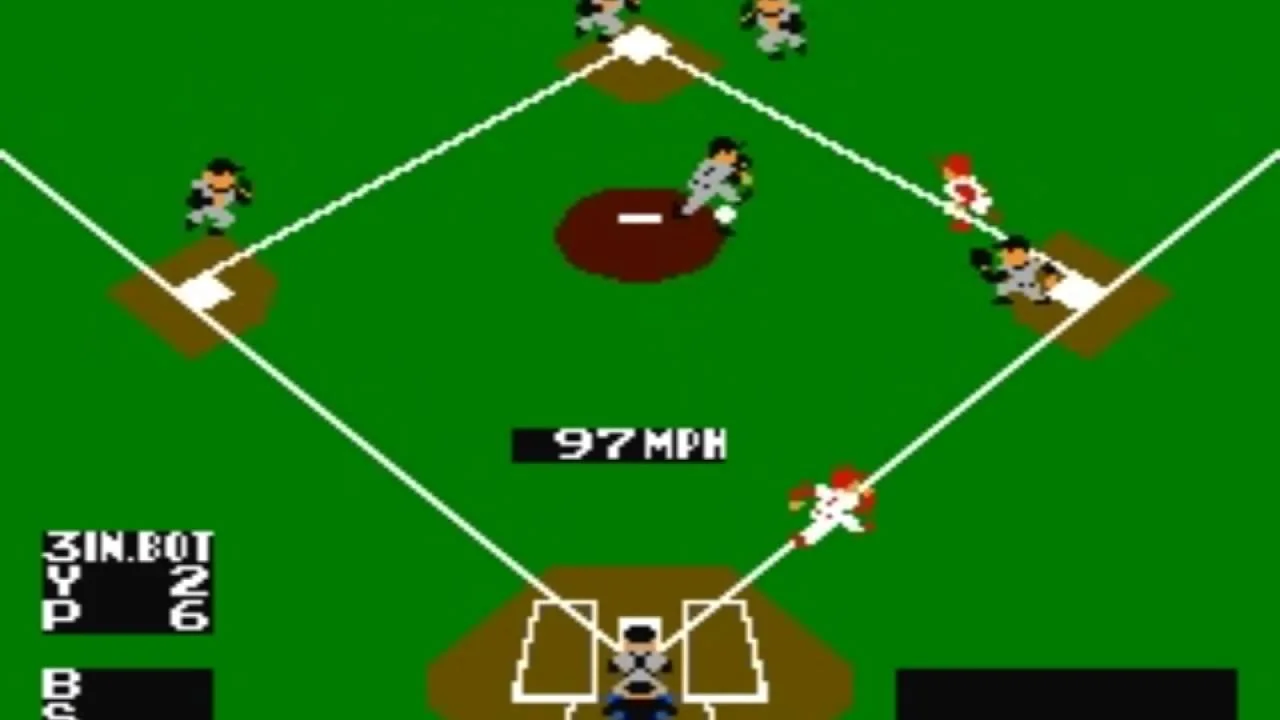
Shigeru Miyamoto wanted there to be a baseball game on the Famicom and so there was one. He took personal charge of the character design and the game design, recalling later that in 1983 he ‘personally really wanted there to be a Baseball game’ – which is the kind of executive autonomy that produces either masterpieces or vanity projects. Baseball is somewhere between. It launched on the Famicom in December 1983, four months after the console itself, and arrived in America two years later as one of the 17 NES launch titles.
The teams were a clever piece of licensing-free design: in Japan, their initials mapped to Central League clubs, and in North America, the same uniforms mapped to Major League franchises. Same game, different scoreboard. The only mechanical difference between teams was the colour of the uniforms. There were no player names because there were no player licences.
At the October 1985 launch in Manhattan, Nintendo arranged for actual Major League players to demonstrate Baseball on a large projection screen, playing the video game in front of crowds and signing autographs afterward. The choice was deliberate. Computer Entertainer would later report that the NES test launch had ‘heavily relied upon’ Baseball precisely because baseball, as a concept, was globally recognisable in a way that a flying red balloon-fish was not. The strategy worked. People understood it instantly, and a sport with no relevant licences sold a video game console.
Clu Clu Land
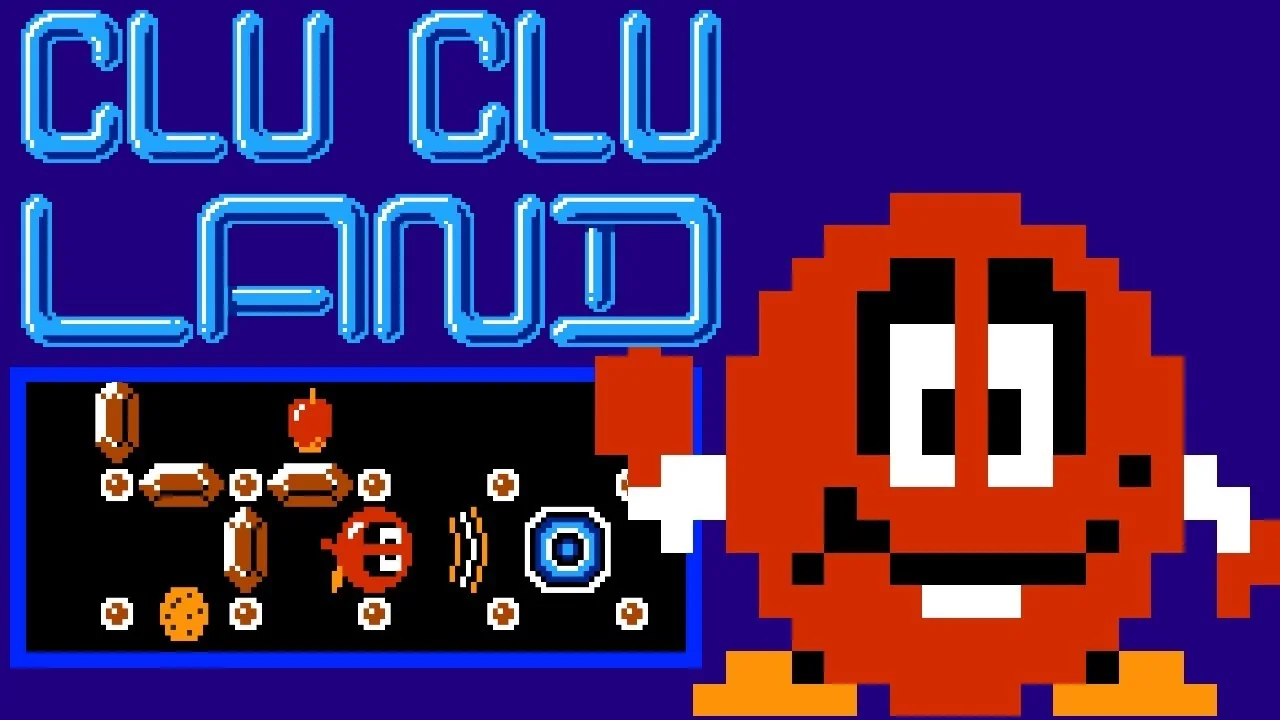
The protagonist of Clu Clu Land is named Bubbles. She is described in the manual as a fish, though she looks more like a red balloon with hands, a propeller on her head, and the navigation skills of a shopping cart with a bad wheel. She cannot move freely. She moves only by grabbing onto poles set into the maze floor and swinging around them, which is a control scheme that sounds elegant in theory and feels, in practice, like trying to parallel-park a yo-yo.
Bubbles’ job is to swim through underwater mazes uncovering hidden gold ingots by passing over them. The ingots, when fully revealed, form a recognisable shape – a butterfly, an eagle, a clock face. Sea urchins patrol the mazes and must be stunned with shock waves, then shoved into a wall to finish them off. Black holes generate more urchins and will suck Bubbles in unless she happens to be mid-swing on a pole at the moment of contact. There is also a timer, and it is not generous.
The game was designed by Makoto Kano at Nintendo R&D1, the same team responsible for most of Nintendo’s early arcade output. The Japanese title is Kuru Kuru Land – kuru kuru being an onomatopoeia meaning ‘around and around,’ which describes Bubbles’ entire method of locomotion. It is one of the more honestly named games ever published.
Duck Hunt
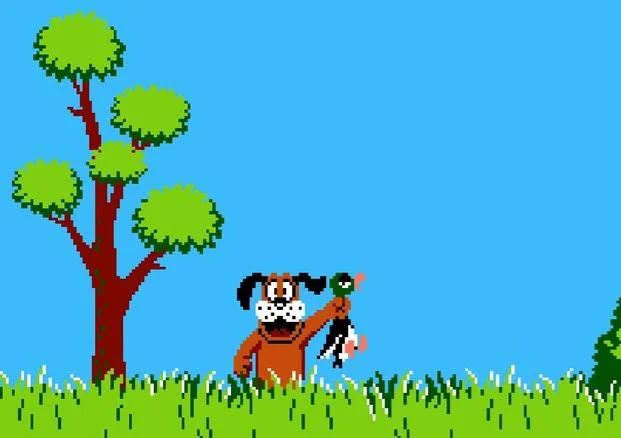
Duck Hunt is the second-best-selling NES game of all time, behind only Super Mario Bros. It has sold 28.31 million copies, almost all of them through being included free with the system. This is the kind of sales figure that makes any analysis of the game’s actual quality somewhat beside the point. People owned Duck Hunt because they owned an NES, and they owned an NES partly because Duck Hunt came with it.
Released in Japan as a Famicom title in April 1984, the game was directed by Shigeru Miyamoto and designed by Hiroji Kiyotake under producer Gunpei Yokoi – the man who would later invent the Game Boy. It was bundled with the NES Zapper as the central pack-in of the $179.99 Deluxe Set, alongside Gyromite and R.O.B. the robot. The player shoots ducks. That is the entire game. A dog flushes them out, you fire three Zapper shots per round, and either you hit them or they fly away.
If you miss, the dog appears in the foreground, holding up the escaped ducks, and laughs at you. Nintendo of America employee Jerry Momoda confirmed years later that the dog was deliberately made impossible to shoot. An entire generation of players reports trying anyway, often with the Zapper held inches from the screen. The dog remains, as far as anyone knows, the most disliked character in Nintendo history.
Excitebike
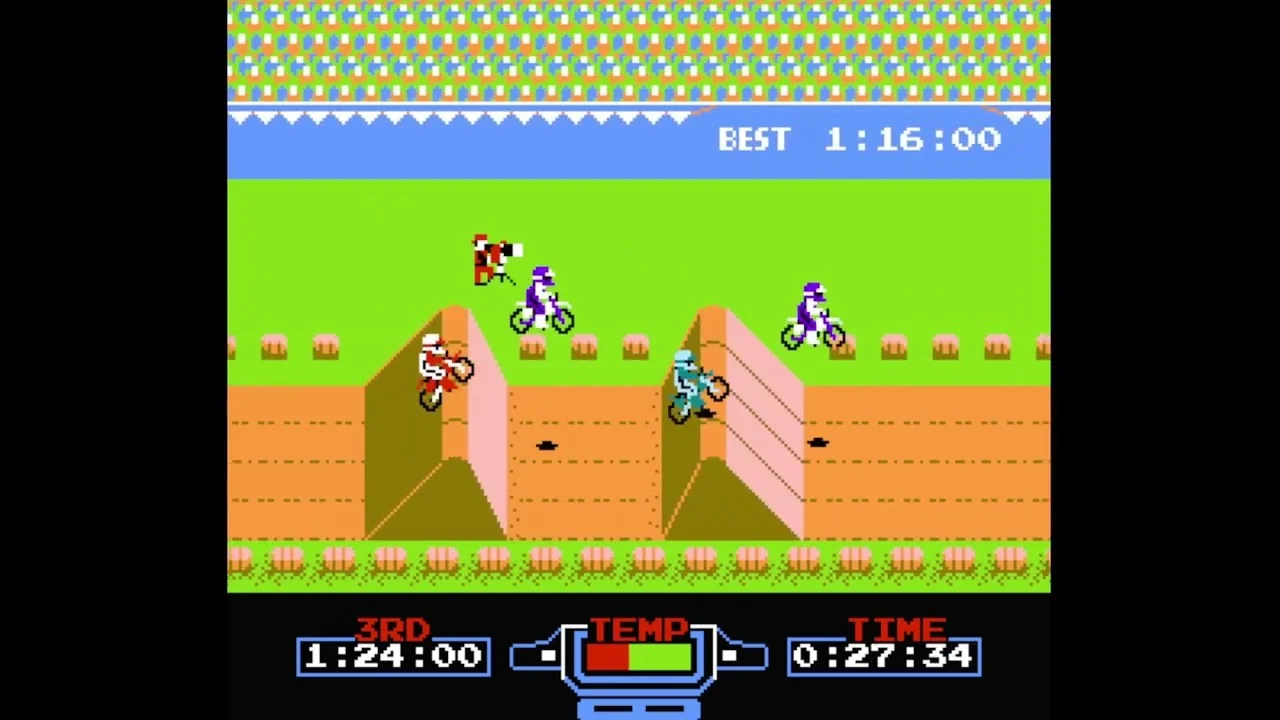
The most important thing about Excitebike is not the motocross, the track editor, or the satisfying way the rider crashes off-screen at high speed. The most important thing is what happened next. The smooth side-scrolling engine that Shigeru Miyamoto’s team developed for Excitebike was repurposed less than a year later for a different game entirely – a side-scroller about a small Italian plumber. Mario’s distinctive walk-to-run acceleration, the way he gradually builds speed rather than moving at a constant pace, originated in Excitebike’s motorcycle physics.
Released for the Famicom in November 1984 and the NES on October 18, 1985, Excitebike has five preset tracks and a Design Mode that lets the player build custom courses using 19 types of obstacles. The Japanese version included a save/load function that worked with the Famicom Data Recorder, an external cassette accessory. The American instruction manual carries one of the more honest disclaimers in gaming history: ‘Save and Load menu selections are not operable in this game; they have been programmed in for potential product developments.’ The save feature was there. It just had nothing to write to.
Players in 1985 spent many hours designing increasingly sadistic tracks for siblings to attempt, with no ability to keep any of them. The track save function in North America would not actually arrive until 2004, in the Game Boy Advance Classic NES Series, by which point most of the original players had children of their own.
Golf
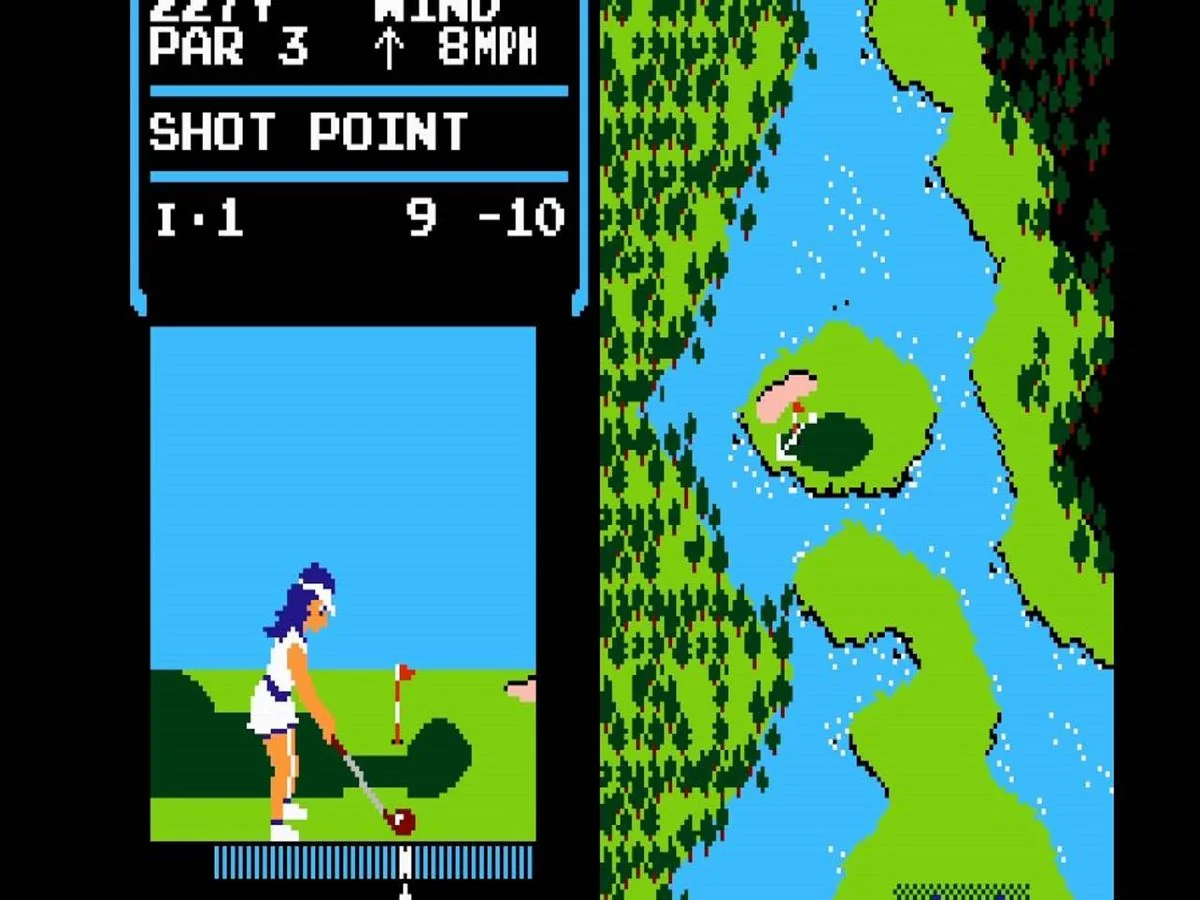
Golf was programmed by Satoru Iwata, who would later run Nintendo as president, oversee the launch of the Wii, and become one of the most beloved executives in Japanese corporate history. In 1984 he was a young programmer at HAL Laboratory, an external developer Nintendo used for technical work, and his contribution to the launch lineup of the NES was an 18-hole simulation with a swing-meter mechanic that would set the template for every golf video game made since.
The power-and-accuracy bar that Iwata designed – press once to start the swing, again at peak power, and a third time to time the contact – is now so universal in golf games that it is difficult to remember a time when nobody had thought of it. Golf invented it. Designer credits also went to Kenji Miki and Shigeru Miyamoto, who had a hand in the character design and game feel. The composer was Koji Kondo, the same man who would later write the Super Mario Bros. theme.
The game itself is genuinely difficult. The driver maxes out at just over 300 metres, and only four of the eighteen holes are short enough to reach the green in one shot. When Iwata died in 2015, Nintendo quietly hid the original Golf inside the firmware of the Nintendo Switch as an Easter egg, accessible only on the date of his death. Once Nintendo realised the tribute had been discovered, they removed it.
Gyromite
Gyromite is the game R.O.B. was built for. R.O.B. – the Robotic Operating Buddy, marketed in Japan as the Family Computer Robot – is a small grey plastic robot that sits next to the television, watches the screen for optical flash signals, and physically picks up plastic gyroscopes to place them on coloured buttons connected to a second controller. The buttons press the second controller’s A and B inputs, which in turn open or close the gates blocking Professor Hector’s path through his dynamite-strewn laboratory. This is the actual mechanism. It is not a metaphor.
R.O.B. was the entire reason the NES got onto American shelves. After the 1983 video game crash, retailers refused to stock anything labeled a video game console. So Nintendo built R.O.B., made him the headline accessory of the Deluxe Set, and sold the NES to American toy stores as a robotics toy that happened to play games. The strategy worked. Gyromite became R.O.B.’s pack-in title and the only game most R.O.B. owners ever played with him.
The game itself can be played without the robot, using a second controller pressed manually by the player. In two-player mode, this creates one of the most adversarial co-op experiences ever designed: the second player controls the gates and can simply refuse to open them, stranding the first player to be eaten by the lab’s roaming carnivorous lizards. They are called Smicks.
Hogan’s Alley
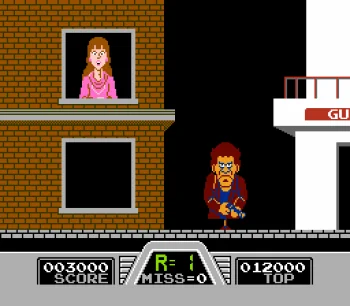
Hogan’s Alley was named after an FBI training facility in Quantico, Virginia, and the version people picture - the fake town with the barber shop and the motel - did not open until 1987. The game beat it by three years. What the game actually copies is the FBI Academy’s earlier Hogan’s Alley, finished in April 1954: a 120-foot facade of six house fronts with life-size photographic targets that popped up in the windows and doors, leaving the agent to decide whether the figure deserved shooting. Nintendo built a cardboard gangster, a cardboard bystander, and the same half-second problem.
The gameplay is straightforward. Three or five cardboard panels appear on screen and rotate to face the player. Some are gangsters, some are civilians, some are the police, and some are women in pink dresses. The player has a second or two to identify the gangsters with the NES Zapper and shoot only those. Hit a civilian and the counter ticks up; ten misses and the game ends. Three modes are available: a static shooting range, a scrolling city scene, and a trick-shot mode where the player bounces tin cans into slots for points.
The game design is unusually fair. Gang member C and the police officer use the same colour palette, and Gang A and the unarmed professor both wear dark trench coats, which means the player must learn to read shape and posture rather than memorise patterns. Shape recognition was not a typical NES skill.
Ice Climber
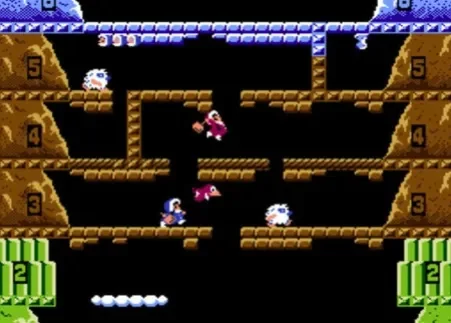
The yetis in the Western release of Ice Climber were originally seals. In the Japanese Famicom version, the creatures filling holes in the ice as Popo and Nana climb the mountain are clearly blue baby seals – small, round, vaguely cute, and very recognisably seals. When Nintendo prepared the game for Western release, someone in localisation pointed out that the climbers’ only weapon was a wooden mallet and the seals’ main behaviour was getting in the climbers’ way, and that this configuration of facts looked an awful lot like seal clubbing. The seals were redrawn as small white furry yetis. They were given a name: Topi.
The change is unique in NES history for being driven entirely by Western cultural sensitivity rather than any technical or licensing constraint. Decades later, when Popo and Nana appeared in Super Smash Bros. Melee, the Western version of the game still drew Topi as a yeti. The Japanese version still drew it as a seal. Nintendo has never publicly acknowledged the original change.
Ice Climber itself is a vertical-scrolling platformer with infamously unforgiving jump physics. The climber can launch into enormous vertical leaps but can barely move horizontally in midair, which makes the game’s ice platforms a sort of architectural cruelty. It was the first game programmed by Kazuaki Morita, who would later be a core programmer on most of the Zelda series. Everyone has to start somewhere.
Kung Fu
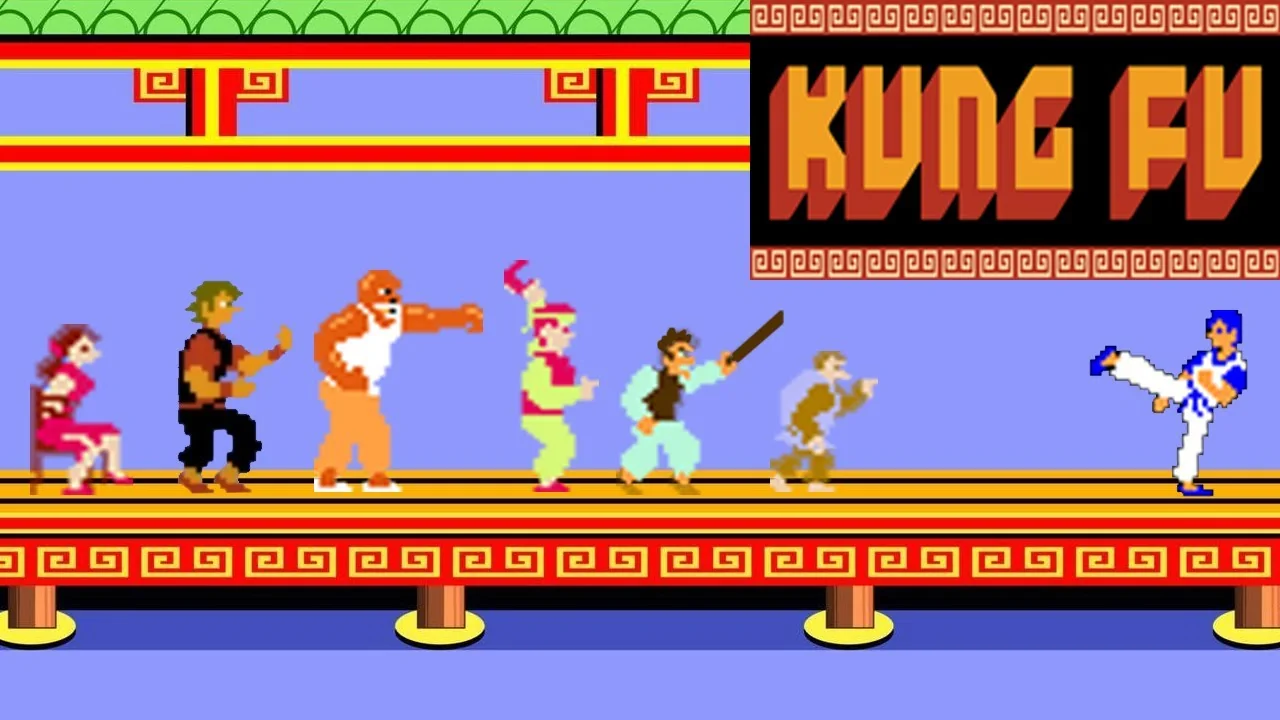
The Japanese release of Kung Fu is called Spartan X, which sounds like the codename for a Cold War defense initiative but is in fact the Japanese title of a 1984 Hong Kong action-comedy starring Jackie Chan, Sammo Hung, and Yuen Biao. The film, known in English as Wheels on Meals, follows two cousins running a fast-food van in Barcelona who get tangled up with the disappearance of a young heiress named Sylvia. Irem licensed the title from the film’s producers and built a side-scrolling beat-em-up around it. The video game ignores the plot, the van, Barcelona, and most of the cast.
What it kept was the protagonist’s name (Thomas), the heroine’s name (Sylvia), and a vague structural homage to Bruce Lee’s unfinished film Game of Death, in which a fighter ascends the floors of a pagoda defeating a different martial artist on each level. Thomas climbs five floors. The bosses include a boomerang specialist, a knife thrower, and a small acrobatic adversary the manual calls the Tom Tom.
Along with 10-Yard Fight, Kung Fu was one of only two NES launch titles not developed by Nintendo itself – both made by Irem. The NES port sold 3.5 million cartridges worldwide. Wheels on Meals, the film that gave the game its Japanese name, took a Spanish setting, a Hong Kong production team, and a Japanese gaming audience and combined them into one of the higher-grossing Asian films of 1984.
Pinball
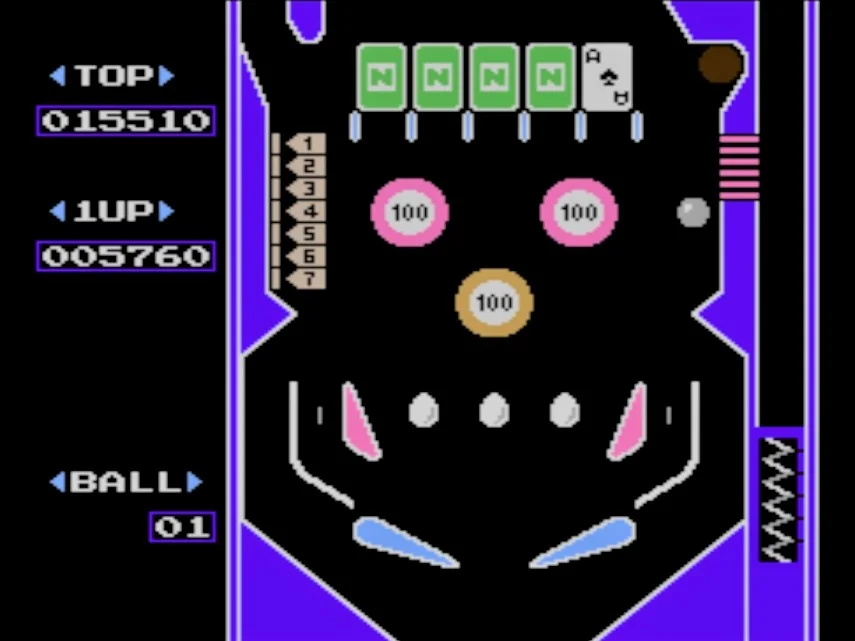
Pinball is the first video game Satoru Iwata ever shipped. Iwata, then a young programmer at the external developer HAL Laboratory, had spent the previous year working on a home conversion of the 1982 arcade game Joust that never made it to release. Pinball did. Released in Japan in February 1984 and brought to the NES in October 1985, it is a digital simulation of a two-screen pinball table, played by tilting the ball between an upper and lower playfield, both with their own flippers.
The hidden bonus stage is the part everyone remembers. Hit the ball into a specific upper-table hole and the game transitions to a third screen where Mario stands at the bottom holding a paddle above his head. A woman named Pauline – the heroine Mario rescued from Donkey Kong four years earlier – hangs in a cage at the top, dropped to a slowly disintegrating floor. The ball bounces between Mario’s paddle and the floor, knocking out tiles. The job is to clear the floor before she falls, then catch her safely on the paddle and walk her to an exit.
Pauline would not have another significant role in the Mario universe for another twenty-one years. She returned in 2006’s Mario vs. Donkey Kong 2, then became a major character in Super Mario Odyssey in 2017. Her career, like Iwata’s, started in Pinball.
Soccer
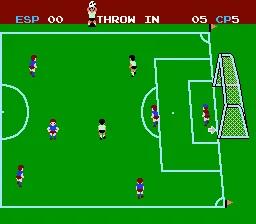
Soccer offers seven national teams: Brazil, West Germany, Spain, France, Great Britain, Japan, and the United States. The decision to include the United States as a soccer power in 1985 was, generously, aspirational. The American men had not qualified for a World Cup since 1950 and would not qualify again until 1990, by which point Soccer had been out for five years. The selection reflects a video game published in Japan, made by Intelligent Systems, and shipped to a country where the sport ranked somewhere below figure skating in cultural attention.
The game itself is a top-down vertically scrolling simulation with three half-lengths (15, 30, or 45 minutes), five difficulty settings, and the basics of association football: throw-ins, goal kicks, corner kicks, and penalty kicks. The music was composed by Koji Kondo, who would write the Super Mario Bros. theme later that same year. The producer was Masayuki Uemura, the engineer who had designed the NES hardware itself.
Soccer is the launch title most consistently dropped from incorrect retrospective lists. Several widely-cited 18-game lists – including Nintendo’s own internal Smash Bros. Brawl Chronicle – replace Soccer with Mach Rider or Donkey Kong Jr. Math, both of which arrived in 1986. The contemporaneous sources – the Macy’s launch ad, the warranty card, the in-store display photographs – all include Soccer. People simply forgot it was there.
Stack-Up
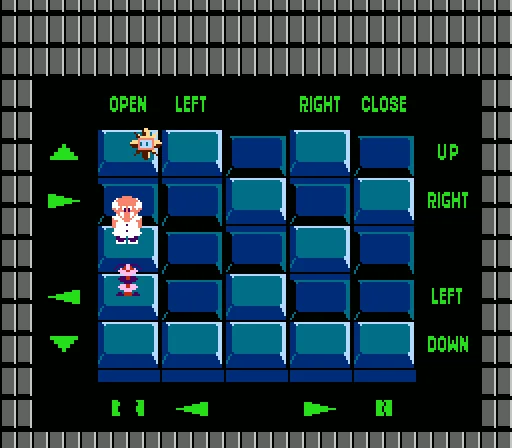
Stack-Up is the rarest of the launch titles. Unlike Gyromite, which came bundled with every Deluxe Set and therefore sold in the millions, Stack-Up was only ever available as a separate retail purchase, and the purchase came with a sprawling package of physical accessories. The cartridge alone was useless. The retail box also included R.O.B.’s plastic chips, the trays they stood in, additional limb attachments, and a binder of instruction cards. Complete copies of Stack-Up regularly sell for over $200 today.
The game itself is barely a video game. Three modes are available – Direct, Memory, and Bingo – and all require the player to issue commands that R.O.B. then physically executes in the room. In Direct mode, the player jumps on coloured platforms onscreen to send R.O.B. left, right, up, or down. The robot picks up a plastic chip and stacks it on a target. The player watches the robot do this in real time. The game is essentially a remote-control toy with a screen attached.
R.O.B. itself sold poorly enough that the entire Robot Series ended with these two titles – Gyromite and Stack-Up. Nintendo had not planned to build R.O.B. a third game and never did. Most R.O.B. owners played Gyromite a few times and shelved the robot permanently. Stack-Up’s poor sales mean far fewer copies were ever produced. Which is why surviving collectors now pay collectors-grade prices for what is essentially a robotic Simon Says.
Super Mario Bros.
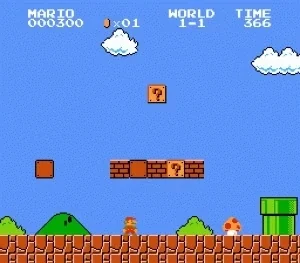
Super Mario Bros. was the best-selling video game in the world for nearly three decades, surpassed only by Wii Sports in 2009. It moved over 40 million copies, popularised the side-scrolling platformer, established Mario as Nintendo’s permanent corporate mascot, and is widely credited with single-handedly reviving the American home video game market after the 1983 crash. Whether it actually went on sale in the United States on October 18, 1985 is a question that nobody has been able to definitively answer.
Nintendo’s internal records say it launched with the system. The pre-launch Milwaukee Journal column on October 5, 1985 lists it by name. The NES launch display photograph shows an underwater level. The warranty card lists it. The U.S. Copyright Office filing is dated October 19. But Don James, who worked at Nintendo at the time, has said the game came out ‘about four months later.’ An anonymous Nintendo source told historian Frank Cifaldi the game’s internal ship date was November 17, 1985 – the same date as the first known Macy’s advertisement for it. The dispute will probably never be settled.
The game itself is the work of Shigeru Miyamoto and Takashi Tezuka, with programming by Toshihiko Nakago and Kazuaki Morita and music by Koji Kondo. The smooth side-scrolling engine had been built for Excitebike a year earlier. Mario’s name came from Mario Segale, the landlord of Nintendo of America’s Seattle warehouse. He was not asked.
Tennis
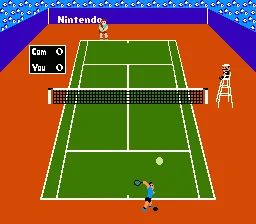
Mario is the chair umpire. He sits in his red overalls above the net, watches the ball travel back and forth between the two players, and issues calls in small speech bubbles. This was his first appearance in a sports game, though he was not yet famous enough to make the box art – the cover features two anonymous tennis players in profile, with no plumber in sight. Mario’s career as Nintendo’s universal cameo character had already begun, though, and he would continue showing up in unrelated games as a referee, a golfer, a demolition worker, and eventually a boxing umpire counting too slowly in Punch-Out.
The game was designed by Shigeru Miyamoto and developed by Nintendo R&D1 with Intelligent Systems, originally released for the Famicom in January 1984. The CPU is the only available opponent in singles mode. In doubles, two human players are forced onto the same team against two AI opponents – it is not possible to play two-player singles, or two-player doubles on opposing teams, or any configuration that lets humans actually compete against each other. The game’s idea of multiplayer is cooperation against the computer.
Miyamoto would later describe his early appearances of Mario as ‘Hitchcock cameos’ – the same character popping up across unrelated films, recognisable but rarely central. Tennis is one of the cleanest examples. Mario does nothing in this game except sit and watch. He still gets cover credit on every reprint since.
Wild Gunman
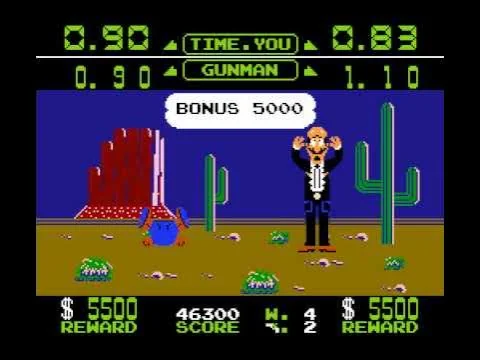
Wild Gunman started life in 1974 as an electro-mechanical arcade game built by Gunpei Yokoi, designer of the Game Boy. The original used two 16mm film projectors loaded with reels of footage showing American Wild West gunslingers walking onscreen, waiting for the player to draw and shoot. If the player was fast enough, the projector switched reels and showed the gunslinger falling. If not, it showed him firing back. This was eleven years before the NES existed. It is, by some measures, the first piece of full-motion video gaming in arcade history.
The NES adaptation, released in Japan in February 1984 and brought to America as a launch title, swapped the 16mm film for cartoon sprites and the holster-mounted toy gun for the NES Zapper. The gameplay logic was preserved. An outlaw appears, his eyes flash, a speech bubble reads ‘FIRE!!’ and the player has perhaps half a second to draw and shoot before he draws first. Three modes are available: one-on-one duels, two-on-one duels, and a saloon shootout where bandits appear in windows and doorways.
The original 1974 arcade cabinet is now so rare that in 2025 a YouTube enthusiast who had acquired only the film reels spent months reverse-engineering the entire cabinet from patents and photographs in order to play it. Nintendo had used Wild Gunman as the pack-in title for the Japanese Famicom Beam Gun. By the time it reached American shelves, it was a decade old.
Wrecking Crew
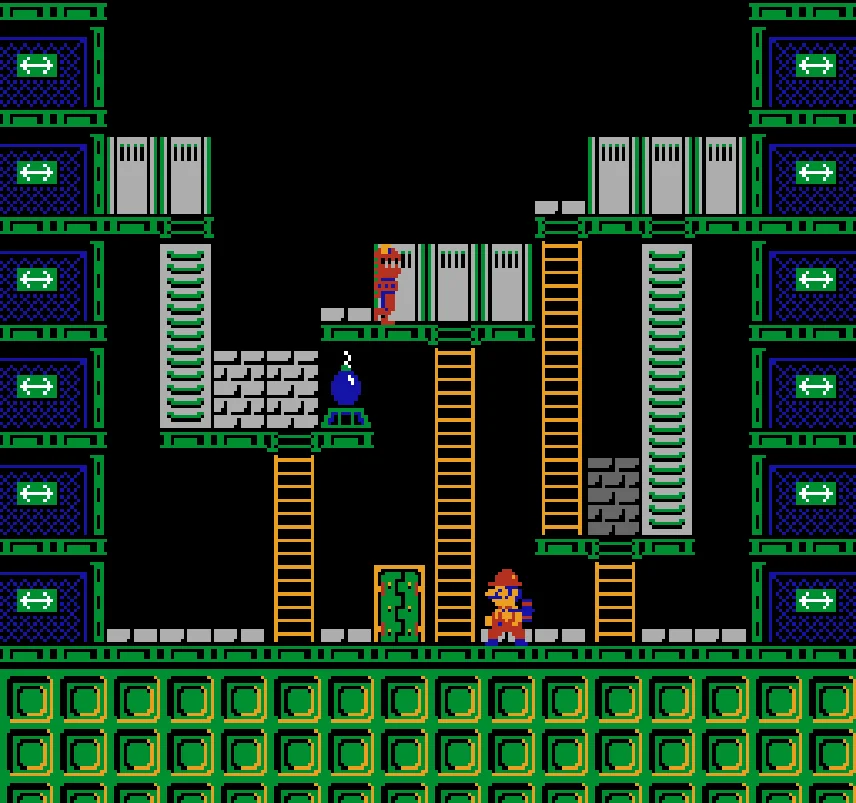
Wrecking Crew was Yoshio Sakamoto’s first job as a game designer. Sakamoto had been a pixel artist at Nintendo before being moved into design for a ‘puzzle action game’ centred on breaking walls. He went on to direct Metroid, Kid Icarus, and most of the Metroid series for the next forty years. Wrecking Crew was the warm-up.
The original game had no Mario in it. The protagonist was an unnamed man in overalls with a hammer, going about the business of demolishing 100 floors of construction site. Shigeru Miyamoto wandered through the department, saw the prototype, and suggested they use Mario instead – the rationale, as Sakamoto later recalled, being that Mario was ‘really easy to draw, and people recognize him.’ That casual decision is how Mario ended up in Wrecking Crew, which is how Wrecking Crew became part of the Mario canon, which is how Foreman Spike – the antagonist who chases Mario through the levels knocking down ladders – became Mario’s first proper recurring villain after Donkey Kong and Bowser.
The level editor lets the player design and play four custom courses, with the usual catch: the Japanese version saved them to a Famicom Data Recorder, an external cassette accessory. The North American manual carries the same hopeful disclaimer about save functions being ‘programmed in for potential product developments.’ This was the standard 1985 Nintendo formulation for: we promised this and it didn’t work out.
Nintendo would repeat the lean-lineup playbook with the Game Boy in 1989.
A decade later Sony crashed the party with the PlayStation’s 1994 debut.
...and Microsoft’s 2001 Xbox launch completed the set of console-war openings.
Frequently Asked Questions
Was Super Mario Bros. really available on NES launch day?
Probably, though nobody has proved it. Ed Semrad’s Milwaukee Journal column of October 5, 1985 previewed the console and named the game. Against that, an anonymous Nintendo source gave historian Frank Cifaldi an internal ship date of November 17, matching the first known Macy’s advertisement. Cifaldi called himself unsatisfied either way.
What came in the box with the NES in 1985, and what did it cost?
The $179.99 Deluxe Set held a Control Deck, two controllers, the NES Zapper, R.O.B. the robot, and cartridges of Duck Hunt and Gyromite. That price works out to roughly $540 today. A cheaper Control Deck bundle did not arrive until the national rollout in 1986.
Why do some lists say the NES had eighteen launch games?
Because they swap Soccer out and Mach Rider or Donkey Kong Jr. Math in. Both arrived in 1986 – Mach Rider not until August. Nintendo’s own Smash Bros. Brawl Chronicle repeats the error. The contemporaneous sources, including the Macy’s launch ad and the warranty card, all include Soccer.
Which NES launch title sold the most copies?
Super Mario Bros., with 40.24 million copies on the NES alone. It held the record for best-selling video game ever until Wii Sports passed it. Duck Hunt is second among the launch titles at more than 28 million, most of those given away inside the box.
Which NES launch games use the Zapper light gun?
Three: Duck Hunt, Hogan’s Alley, and Wild Gunman. Wild Gunman is the oldest idea on the shelf. Gunpei Yokoi built it in 1974 as an arcade cabinet that projected live-action 16mm film of a gunslinger, eleven years before the NES existed. The Zapper version swapped the film for sprites and kept the logic.
What does R.O.B. do, and which launch games use it?
R.O.B. watches the screen for flashes of light and moves plastic pieces in response, which the console reads as inputs on a second controller. Only Gyromite and Stack-Up ever used him. The accessory sold poorly once Nintendo no longer needed the disguise, and the Robot Series ended there.
Which NES launch games did Satoru Iwata program?
Two. He wrote Golf alone at HAL Laboratory and shared programming duties on Pinball, eighteen years before he became Nintendo’s president. Golf was the first golf game with a power-and-accuracy swing bar, now standard across the genre. Nintendo later hid it in early Switch firmware, reachable only on July 11, the date he died.
Were all seventeen NES launch games made by Nintendo?
No. Kung Fu and 10-Yard Fight began as Irem arcade machines, the only two launch titles whose originals came from another company. Nintendo published both home conversions – Shigeru Miyamoto directed the Kung Fu port, which sold 3.5 million cartridges. HAL Laboratory co-developed Golf and Pinball.