Every Pharaoh Whose Body Was Found in His Own Pyramid
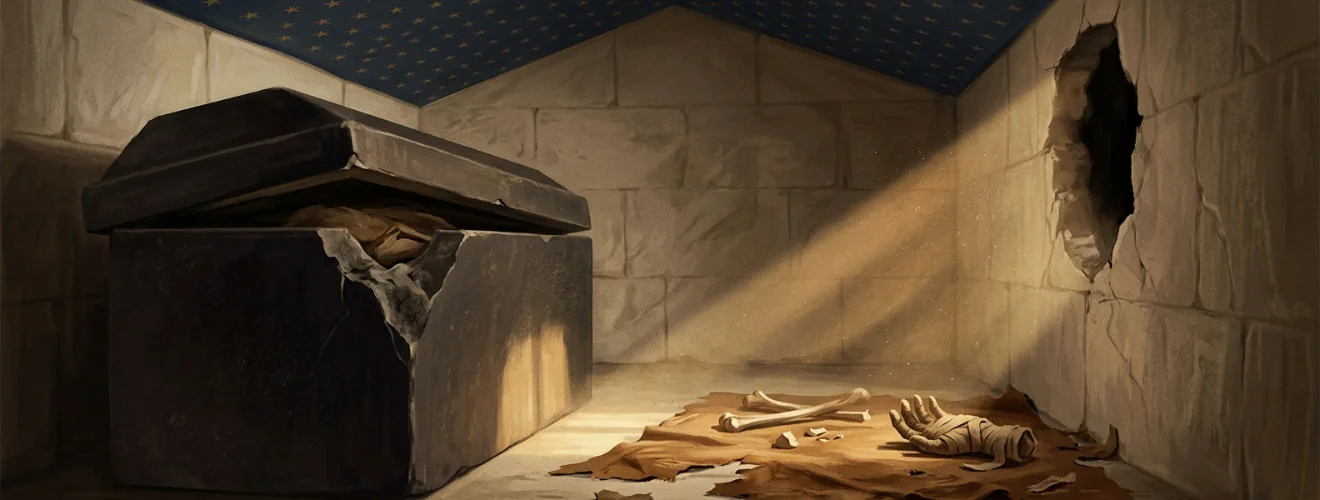
At the end of May 1934 Jean-Philippe Lauer slid feet first, arms raised above his head, through a robbers’ gap beside a granite plug of nearly 4 tonnes and dropped 2.70 m to the floor of the burial vault beneath Djoser’s Step Pyramid. In the dust, to his great astonishment, he found human bones, among them a well-preserved mummified foot. In 1935 he and the anatomist Douglas Derry announced that the bones were, in all probability, the remains of Djoser himself. They were not. When Eugen Strouhal’s team radiocarbon-dated them decades later, along with two pieces Battiscombe Gunn had taken from the same vault in 1926, the bones turned out to come from three to five different people buried between 907 and 153 BC, and the famous foot belonged somewhere between 907 and 757 BC. Not one piece could be matched to the king.
Djoser’s foot is a fair summary of the whole subject. Strouhal’s team observed in 2001 that most pyramids were robbed again and again, and that human remains turned up in them only exceptionally. What the robbers left behind tends to be a hand, a shoulder, an arm, a thigh bone, and even those have a way of wandering off. The same paper reported that the remains attributed to Unas, Teti, Pepi I and Merenre I could not be located in the collections that should have held them, and proposed re-examining them “if they were found.”
The pharaohs’ pyramids run from Djoser’s Step Pyramid in the Third Dynasty to the Kushite kings of the 25th Dynasty, who were buried under pyramids at el-Kurru and Nuri in what is now Sudan. Egypt was not the only one of the civilizations that built pyramids, but it is the one people mean when they ask who was inside. This list takes every pyramid built for a king in that span and asks a narrow question: was anything of the king found in it? Here a body means whatever part of him survived, from a whole mummy to a handful of fragments, and the kings run in the order they reigned. For most pyramids the answer is no.
Nine pharaohs have had remains found inside a pyramid built for them that no scientific test has shown to be someone else’s: Sneferu, Neferefre, Djedkare Isesi, Unas, Teti, Pepi I, Merenre I, Senusret II and Amenemhat III. As far as published work shows, only the Neferefre and Djedkare Isesi remains have been confirmed by anatomy and radiocarbon dating.
Sneferu
Sneferu built three great pyramids, which is two more than anyone can be buried in. Miroslav Verner puts the stone in Meidum, the Bent Pyramid and the Red Pyramid together at about 3.6 million cubic meters, a building record no later pharaoh overtook. Sneferu was never buried at Meidum, Verner says, and probably lay in the Red Pyramid at Dahshur, the oldest surviving true pyramid, named for the reddish limestone of its core.
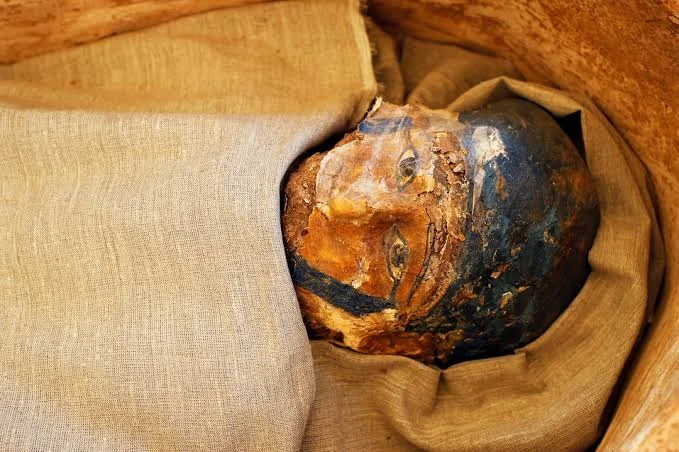
Fragments of a man were collected from the debris filling one of its chambers – the report names no finder and no date of discovery – and in 1951 the anatomist Ahmed Batrawi published them: pieces of skull, most of a jaw with its teeth, a hip bone, two ribs, a finger still clothed in dry skin, and a hollow mould of resin-soaked linen from a right foot. Under X-ray, two of the toes in that mould turned out to be dummies made of linen with no bone inside. Several of the real bones were charred, and Batrawi all but ruled out the embalmers. The man had been past middle age and rather small, and Batrawi concluded that the remains “most probably belonged to King Sneferu.” Mark Lehner is more cautious: whether they come from the royal mummy, he writes, has not been ascertained.
No radiocarbon date or second study has been published. The same debris also gave up part of a camel’s thigh bone, and nobody has claimed that for the king either.
Neferefre
Ludwig Borchardt gave up his trial trench into Neferefre’s pyramid about a meter short of a red granite portcullis and an ink inscription bearing the king’s name. Verner, whose Czech team found both, has wondered in print why Borchardt did not keep digging for at least another hour.
There was not much pyramid to find. Neferefre died young, after a reign of perhaps two years, and his tomb stopped at its first step and was hastily finished as a squat, square mound; a papyrus fragment from his temple suggests the builders simply called it the Mound. In the 1997-98 season the Czech mission cleared the burial chamber and found, among pieces of the red granite sarcophagus, five fragments of human remains and one of skin: part of the back of the skull, a collarbone, part of a shoulder blade, a fibula and a whole left hand, about 180 mm long and only 55 mm across the knuckles, its shrunken skin coated in black resin that had stained the nails. Eugen Strouhal’s anatomists read them as one man of 20 to 23, and a radiocarbon date of 2628-2393 BC on one fragment fitted the Old Kingdom burial. Two pieces from the antechamber, with no resin and no wrappings, were set aside as medieval intruders, a verdict one of them confirmed by dating to 1297-1421 AD.
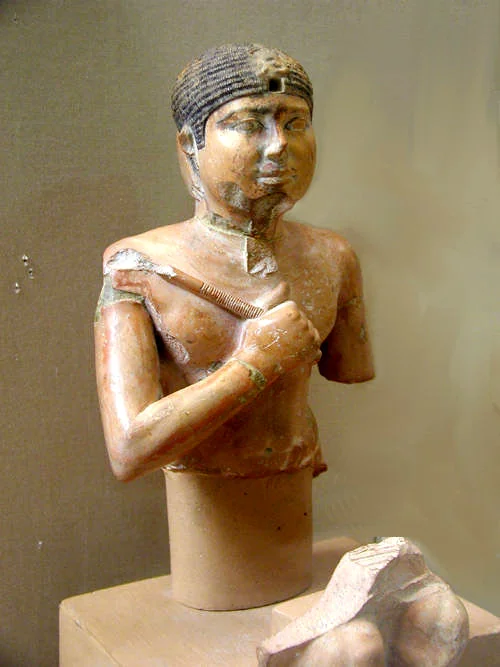
A limestone head from Neferefre’s temple shows a young, plump face. For once the portrait and the bones tell the same story.
Djedkare Isesi
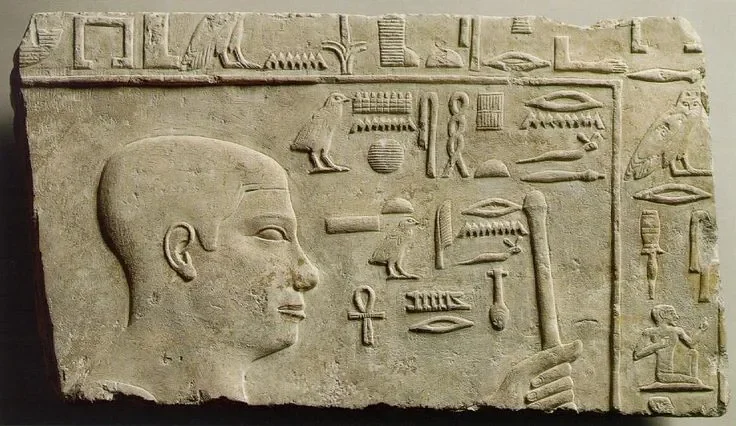
Haram esh-Shawaf, the Pyramid of the Sentinel, stands at the edge of the plateau above Saqqara village, and in the 1945-46 season the architect Abd el-Salam Hussein and the Egyptologist Alexandre Varille dug their way into it. Their excavation report was never published. What survives is the anatomist Ahmed Batrawi’s 1947 account of what they found dispersed across the burial chamber: about a dozen pieces of one mummified man, including the left side of his face still covered in muscle and skin, with the ear completely preserved, and a scalp of brown hair cut short, the longest hairs about three centimetres. Batrawi put him at about fifty; later work said fifty to sixty.
Proving who he was started with relatives. Two of his daughters, Khekeretnebty and Hedjetnebu, each titled king’s daughter of his own body, were found in tombs at Abusir in 1976 and 1987, and Strouhal’s team found the three of them clearly alike: slight build, short stature, blood group A. Idu, the scribe of the royal children, who was buried nearby and was probably their tutor, had blood group O and was anatomically unlike them. Radiocarbon dates on the linen wrappings and charcoal put the burial in the right age, if a century or more early, and the team pronounced the identification proven.
So the decisive proof came from a laboratory, with help from two daughters and a tutor who turned out to be no relation.
Unas
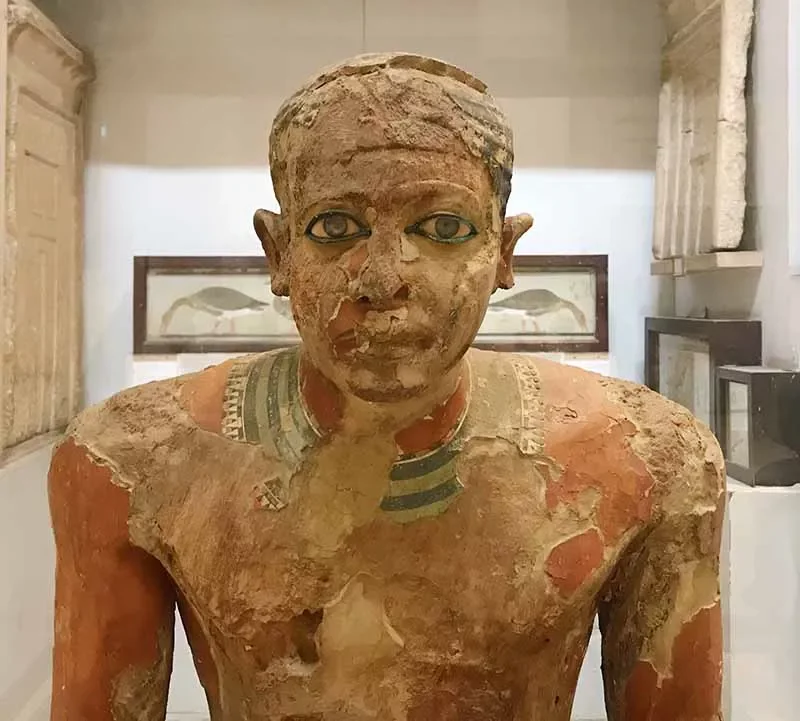
On 28 February 1881 Gaston Maspero’s workmen reached the burial chamber of Unas, the last king of the Fifth Dynasty, whose walls carry the earliest known Pyramid Texts. The robbers had been there first. Above the exit of their tunnel someone had written an Arabic name in red ink, and Maspero, guessing it might belong to Master Ahmed the carpenter who opened the Great Pyramid, put the break-in, if so, at around the year 820.
They had done a professional job. Their narrow, winding tunnel ran 8.32 m around the core, and rather than attack the three portcullises head-on they cut above each one. They tore the lid off the sarcophagus, dug a large hole in the floor for a treasure they never found, and left the mummy broken. Maspero listed what remained: an arm, a shin bone, pieces of skull and some ribs, with the linen lying about in bundles.
Pieces said to be his had a quiet afterlife. Ahmed Batrawi, giving the mummy of Pepi’s son a cursory examination at the museum in Cairo, was shown a few fragments labelled as Unas – an arm with its whole hand, and pieces of skull still covered in skin and hair – and described them in a short appendix in 1947. A 2011 survey of royal remains lists them as lost.
Maspero’s later searches turned up ox bones from the last sacrifice, a paint pot still filled with black, and a painter’s plumb line the workmen had forgotten.
Teti
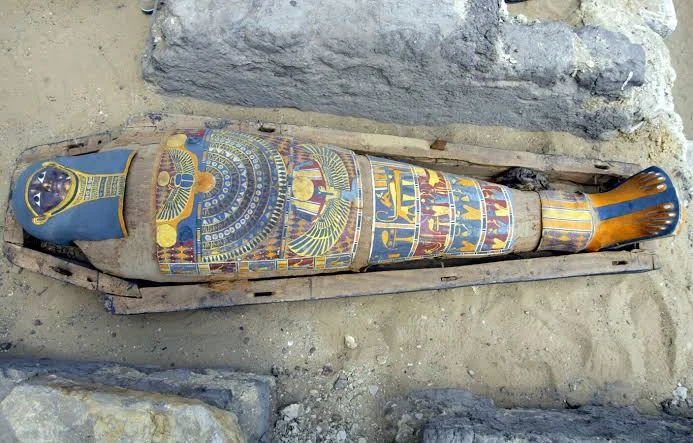
Teti’s robbers did not bother with the lid. Instead of lifting it or throwing it down, they broke off the south-east corner of the sarcophagus and pulled the mummy out through the hole. Maspero, clearing the chamber after them, recovered only “a shoulder and an arm, all blackened,” less carefully embalmed, he thought, than Unas. That one sentence is the entire anatomical record. No anatomist ever examined the pieces, and the sources cannot agree on where they went.
The robbers had worked for it. In most pyramids thieves tunnelled around the granite portcullises; here they went straight through all three, the thickest 0.84 m deep, by lighting a great fire against the stone, hammering off the scorched surface and starting again. Maspero found the granite still smoke-stained and concluded that they had time and security on their side. Inside, they smashed the north and south walls of the central chamber and the sarcophagus chamber with sledgehammers, leaving the great roof blocks held up only by sideways pressure, as if suspended in the air, and buried the sarcophagus chamber in rubble to within a meter of the ceiling.
Teti’s walls are covered in Pyramid Texts too, copied out by Maspero in March 1882. A corridor leading off the central chamber was already inscribed and apparently about to become a decorated room when the work stopped. Maspero blamed the king’s death. It did nothing to discourage his robbers.
Pepi I
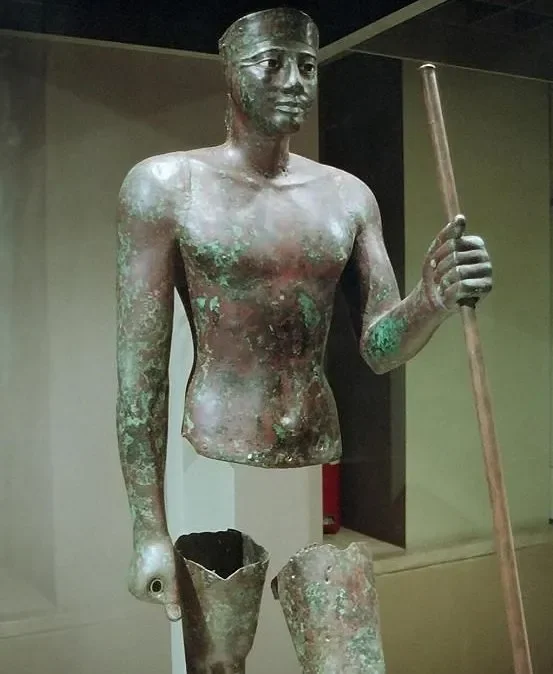
The name Memphis began as the name of this pyramid. Pepi I called his tomb Men-nefer-Pepi, which Lehner translates as The Perfection of Pepi is Established, and the short form Mennefer passed to the nearby capital and came down through Greek as Memphis.
The tomb was a ruin the locals called the Pyramid of Sheikh Abu Mansour, and when Antiquities Service workmen opened it in 1880 they found a corridor covered in hieroglyphs. Their director, Auguste Mariette, refused to believe it. He was so attached to what he called his theory of mute pyramids – pyramids carried no inscriptions and never had – that he decided this must be a large mastaba belonging to some private person. Only the discovery of a second inscribed royal pyramid at the end of December 1880 changed his mind.
Mariette, by then confined to his sickbed, sent Brugsch Pasha and his brother Emile, who visited on 4 January 1881 and found, in a heap of torn cloth and mummy bandages beside the sarcophagus, one carefully embalmed hand in complete preservation. Mariette died on 18 January. Decades later the French mission at Saqqara found a packet of viscera, presumably Pepi I’s, wrapped so tightly that it still held the shape of the alabaster jar it had once filled.
A 2011 survey reports the hand lost. As far as anyone has published, nothing from the tomb has ever been tested.
Merenre I
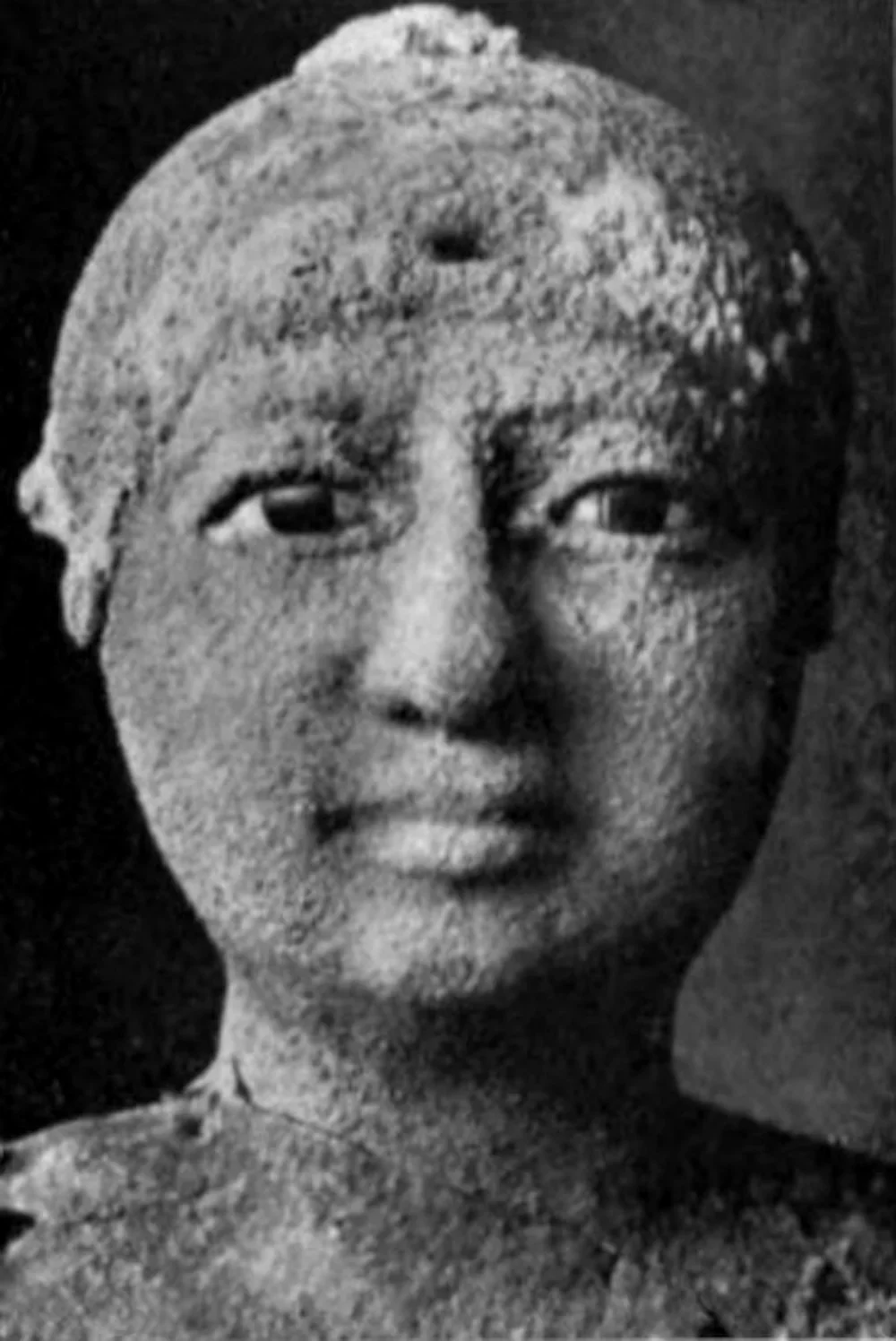
“Amazingly, it still contained a mummy,” Lehner writes of the sarcophagus in Merenre’s pyramid, and it did: a whole one, stripped completely naked by treasure-seekers, of what looked like a slender young man whose hair still hung in the braided side-lock of youth. The reis Mustafa, who opened the pyramid around the turn of 1880-81, lifted it out and laid it on a heap of stones. Maspero’s museum catalogue gave its length as 1.66 m and noted that the lower jaw was missing and a leg had come off in transport.
The transport is a story in itself. Maspero said only that the mummy reached the Boulaq museum after some comic incidents. The Egyptologists Ikram and Dodson later told the rest: with the railway out of action, the Brugsch brothers set off for Cairo carrying the body on foot, the coffin grew too heavy, and the mummy ended up broken in two.
Maspero’s 1883 guide called it probably the oldest mummy known. In 1924 the anatomist G. Elliot Smith and his co-author Dawson called it “evidently an intrusive later burial,” arguing from its embalming that it could be no older than the 18th Dynasty. Lehner wrote that it had not yet been properly studied, and no published work has settled the question with a radiocarbon date or a scan.
Strouhal’s 2001 list of remains not yet located includes Merenre’s, yet the mummy itself went from Cairo to the Imhotep Museum at Saqqara in 2006, braid and all.
Senusret II
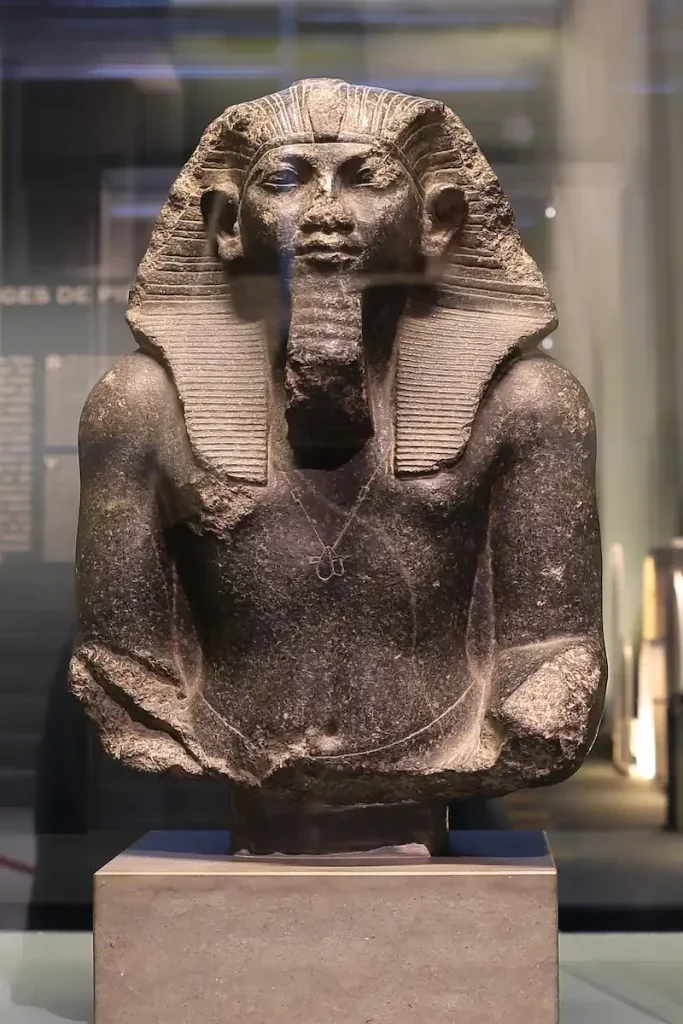
Guy Brunton managed to hold both opinions in a single paragraph. Writing up the 1920 season at Lahun, he described “a few human bones, including the femur” from the rock-cut offering chamber leading out of Senusret II’s sepulchre, judged from the thigh bone that they belonged to a full-grown man, and tall, and wrote: “It is impossible to say whether or not they are Senusert’s.” A few lines later he concluded that “the bones are probably those of the king.”
Getting in had taken some doing. Flinders Petrie spent months looking for the entrance without success, and it was a Mr Fraser, in charge of the site in Petrie’s absence, who cleared a shaft on the south side and found a doorway about 40 feet down. Petrie admitted that without that back way the pyramid would probably never have been opened. The red granite sarcophagus inside had no trace of a lid, coffin or mummy.
The 1920 clearance did better. Under some 6 inches of dust, within half an hour of starting there, the excavators brought out the gold uraeus from the king’s crown, inlaid with lapis lazuli, garnet, turquoise and carnelian, which Brunton believed was the only piece of regalia worn by an Egyptian king found up to then. A cowry shell was Brunton’s only sign of a later burial, which he thought most unlikely.
The uraeus went to Cairo and the bones to University College. Cairo got a piece of the crown. London got the king, probably.
Amenemhat III
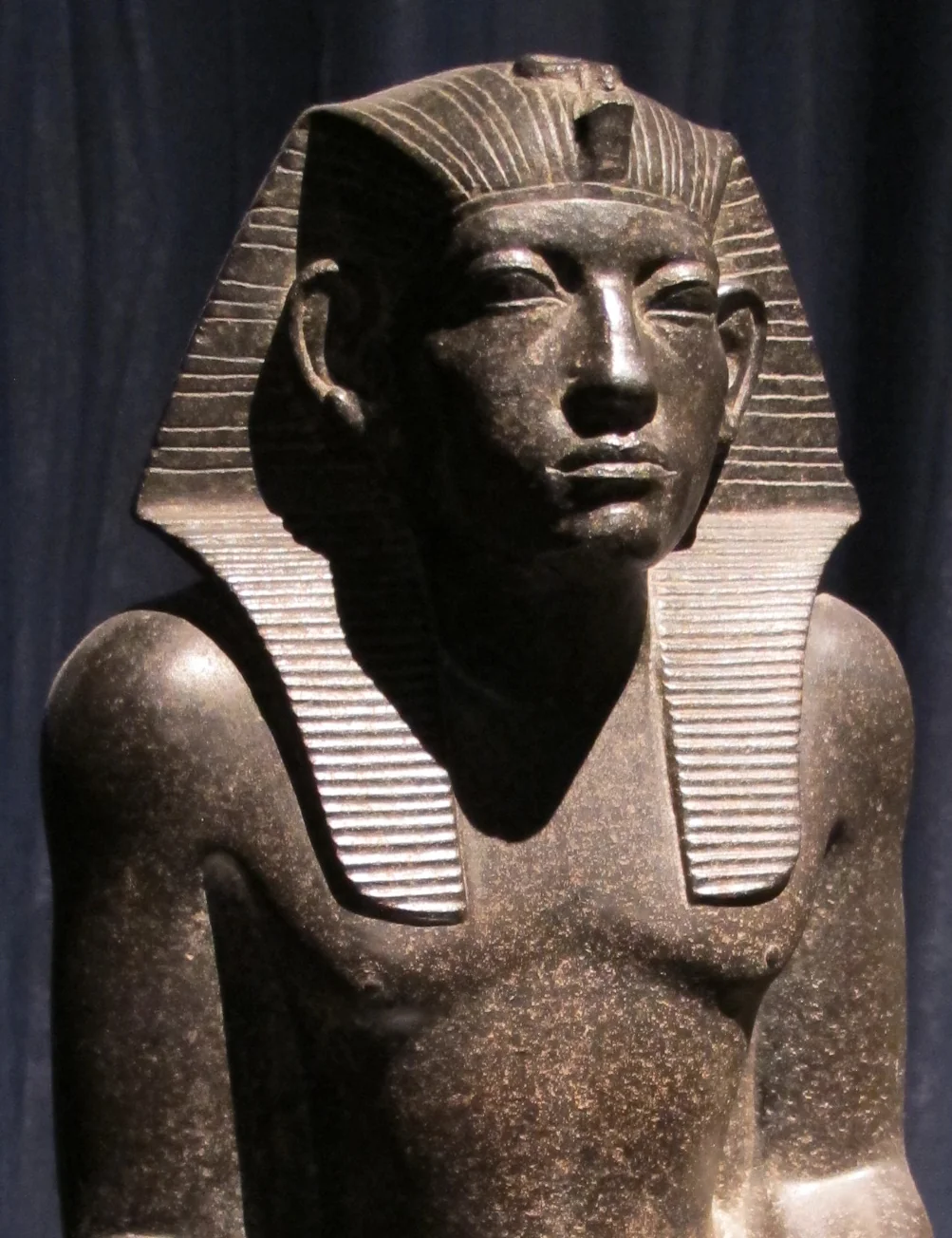
The first time Flinders Petrie tried to enter Amenemhat III’s burial chamber at Hawara, through a hole cut in the roof, he jammed tight at the shoulders and had to be dragged out by his legs. It was January 1889, and the king had worked hard to keep him out. His first pyramid, at Dahshur, had begun to sink and crack, so he built a second here and filled it with tricks: dead-end passages, routes hidden in the ceiling behind sliding quartzite slabs of some 20 tons, and a burial chamber carved from a single block that Petrie put at 110 tons. None of it worked.
A thin lad went down instead, feet first on a rope ladder into chest-deep water. Petrie could see two sarcophagi standing “rifled and empty”: the king’s, and a second one built in beside it for his daughter Neferuptah. He offered his lads half a piastre for every hieroglyph and a dollar for a cartouche, then groped through the flooded sarcophagi himself and found “some bits of bones, and much charcoal.” In a later book he called them “a few scraps of charred bones” from the actual bodies. He never said whose, or which sarcophagus held what. Dodson writes that the king’s body was burned and that Neferuptah’s had been moved to her own pyramid before her father died; Grajetzki doubts she was ever really buried here at all.
Nobody on record has studied the scraps, or said where they went.
Frequently Asked Questions
Was Menkaure’s mummy found in his pyramid?
No. In 1837 Vyse’s men found part of a skeleton in coarse yellow woollen cloth, beside fragments of a coffin lid naming Menkaure, in the pyramid’s upper entrance room. Radiocarbon dating put the body at 658-896 AD, and the British Museum dates the coffin to the 26th Dynasty. The king’s basalt sarcophagus was lost at sea off Spain in 1838.
What was inside Sekhemkhet’s sealed sarcophagus?
Nothing at all. Zakaria Goneim found a sarcophagus cut from a single block of alabaster in Sekhemkhet’s unfinished pyramid at Saqqara, its sliding end panel still sealed with plaster and what looked like a funerary wreath lying on top. When it was opened it was empty. The wreath, Lehner reports, turned out to be bark and decomposed wood.
Were any Kushite pharaohs found in their pyramids?
Not by this list’s rule. At el-Kurru a skull that Dixon, writing in 1964, called “probably that of King Shebitku” came from the descending shaft of his plundered pyramid, not its burial chamber. At Nuri the records for Taharqa’s pyramid, the largest there, disagree: Reisner reported bone fragments in 1918, while the final publication reportedly says “Burial. No trace.”
Which pharaohs were found in their own tombs but not in a pyramid?
Tutankhamun is the famous one. Closer to this list are Hor Awibre, whose skeleton, head still wrapped in a gilded wooden mask, de Morgan’s team found in 1894 in a shaft tomb beside Amenemhat III’s pyramid at Dahshur, and Senebkay, found at Abydos in 2014. Neither lay under a pyramid.
Why aren’t Tutankhamun or Ramesses II on this list?
Because after Ahmose I, who built the last known royal pyramid in Egypt at Abydos, New Kingdom kings were laid in rock-cut tombs in the Valley of the Kings. Many of their mummies were later hidden at Deir el-Bahari, a cache officials emptied in 1881, the same year Maspero opened the pyramid of Unas.
- Strouhal et al., “Identification of Royal Skeletal Remains from Egyptian Pyramids,” Anthropologie 39/1 (2001)
- Verner, Callender and Strouhal, Abusir VI: Djedkare’s Family Cemetery (Czech Institute of Egyptology, 2002)
- Maspero, Recueil de travaux, vol. 5 (1884): the pyramids of Teti and Pepi I
- Dixon, Journal of Egyptian Archaeology 50 (1964)
- British Museum: coffin of Menkaure, EA6647
- Penn Museum: discovery of the tomb of Pharaoh Senebkay at Abydos
- Encyclopaedia Britannica: Pyramid Texts