Every Royal Mummy in the Pharaohs' Golden Parade
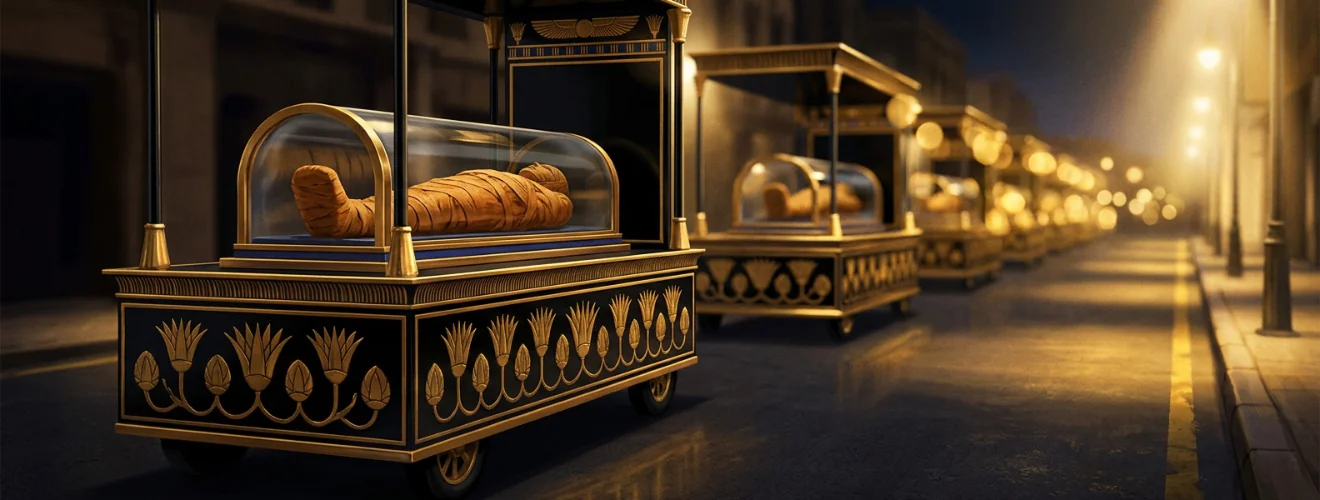
On the evening of Saturday 3 April 2021, a convoy of converted army trucks, painted black and gold and labelled in English, Arabic and hieroglyphs, pulled out of Tahrir Square in Cairo carrying the royal dead of ancient Egypt. The production designer, Mohamed Attia, explained that there had been no budget to buy or rent proper vehicles, so the army lent its lorries and the designers made them look the part. At the new national museum in Fustat, President Abdel Fattah el-Sisi was waiting, and 21 cannon shots greeted the arrivals.
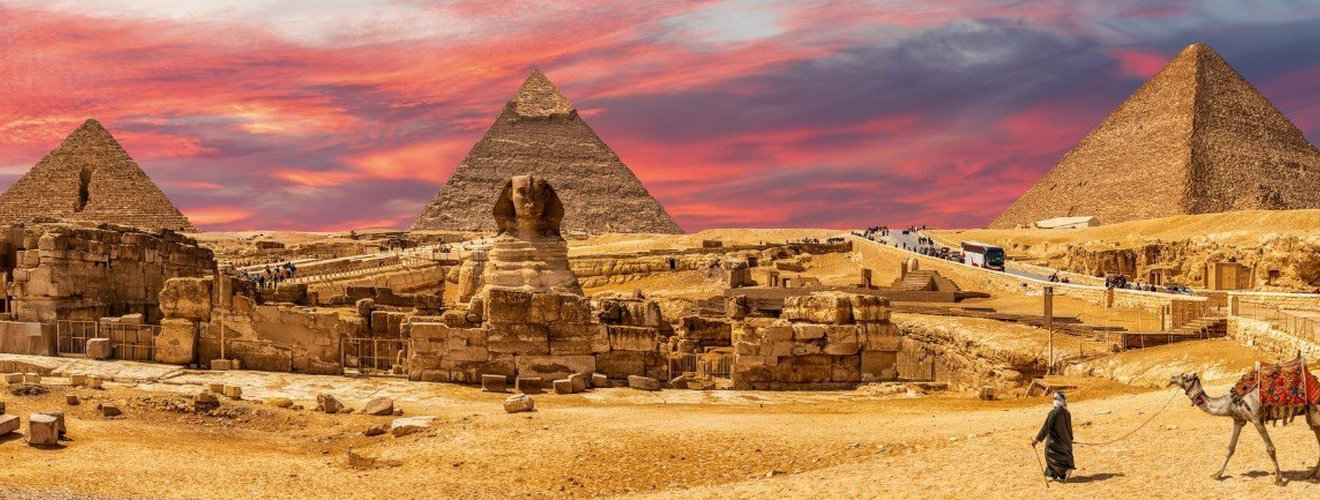
It was not their first move. Around 3,000 years earlier, with tomb robbery rampant, priests of the 21st Dynasty had gathered plundered kings out of their tombs, rewrapped them, written notes on the linen and hidden them in secret caches. The largest, at Deir el-Bahari, was found by the Abd el-Rassul family, who quietly sold from it until one of them led the authorities there in 1881. When those mummies went down the Nile by steamer, a journalist quoted by National Geographic described “women with disheveled hair running along the banks and shrieking the death wail.” Nearly all of the 22 on the trucks belonged to the age after the pyramids. The parade’s first passenger was the father of Ahmose I, whose pyramid at Abydos was the last royal one built in Egypt, and most of the kings who followed had their tombs cut into the cliffs of the Valley of the Kings instead, which is where Egypt’s long chapter among the civilizations that built pyramids closes.
What the parade carried, in other words, was a set of bodies that had been robbed, restored, mislaid, misread and argued over for a very long time. Some arrived bearing their killers’ wounds, several in coffins made for someone else, and a few under names that Egyptologists doubt. Here they all are, in the order they rode, with the strange specifics the official programme left out.
The Pharaohs’ Golden Parade carried 22 royal mummies, 18 kings and 4 queens, from the Egyptian Museum to the National Museum of Egyptian Civilization in Fustat on 3 April 2021. They rode in chronological order, from Seqenenre Taa II of the 17th Dynasty to Ramesses IX of the 20th. The 17 royal coffins moved separately, in July 2020.
Seqenenre Taa II
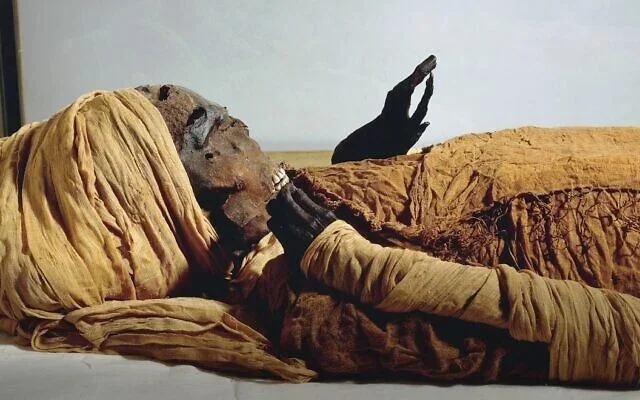
Leading the parade was a king who died violently and looks it. Seqenenre Taa II, a king of Egypt’s 17th Dynasty, rode in the first vehicle with a skull that carries wounds matching a Hyksos battle-axe and spearhead, and in 2021 a CT study by Sahar Saleem and Zahi Hawass found three further fractures on the right side of his head that earlier examiners had missed. His embalmers had filled them in with embalming material, apparently to make the dead king presentable.
He ruled Thebes while the Hyksos held the north. A later literary tale has the Hyksos king Apepi complaining that the hippopotamuses in a pool at Thebes were keeping him awake, which took remarkable ears, since his capital at Avaris lay some 644 km away. The war that followed was finished by Seqenenre’s sons, Kamose and Ahmose I. The scan added a darker detail: his hands are frozen in a spasm, yet his forearms carry no defensive wounds, which led the authors to propose that his wrists were bound and that he was captured before he was killed.
The same study challenged an old verdict that he had been embalmed in a hurry near the battlefield, arguing instead for a proper royal workshop. G. Elliot Smith, cataloguing the royal mummies in 1912, called him “the earliest mummy in the Museum the authenticity of which is beyond question”. It is a compliment that several of the people riding behind him would have been glad to receive.
Ahmose-Nefertari
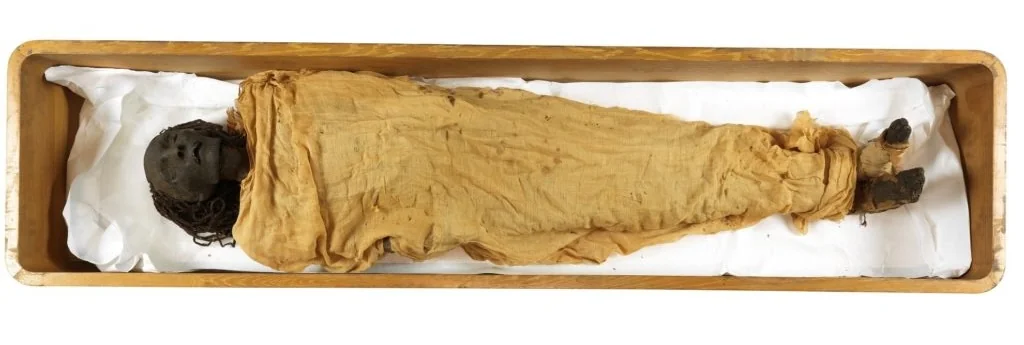
The coffin with her name on it was enormous, and when the cache was cleared it turned out to hold two bodies: a poorly preserved one with no coffin of its own, and, inside a smaller coffin packed with linen, a beautifully wrapped mummy that everyone took for the queen. In June 1886 the neat one was unwrapped in front of the Khedive Tewfik. A docket on its shroud named the dead king Usermaatre-Meryamun, better known as Ramesses III.
That left the other body, which Emile Brugsch had opened in September 1885 while Gaston Maspero was away and which, by Maspero’s account, began to rot as soon as it met the air and was buried provisionally. This unpromising candidate is the mummy traditionally identified as Ahmose-Nefertari, chosen more by elimination than by evidence. Smith catalogued it in 1912 as “The Mummy supposed to be that of Nofritari” and admitted “an element of doubt as to the identity of this mummy”. He also found that the woman was nearly bald, her scalp hidden under twenty strings of twisted human hair.
The queen herself is far better documented than her body. A daughter of Seqenenre Taa II and Queen Ahhotep, she married her brother Ahmose I and bore the future Amenhotep I. After her death she and he were worshipped together by the artisans of Deir el-Medina. Smith put the matter as fairly as anyone could: “If this is not Nofritari’s mummy, it certainly belongs to her time.”
Amenhotep I
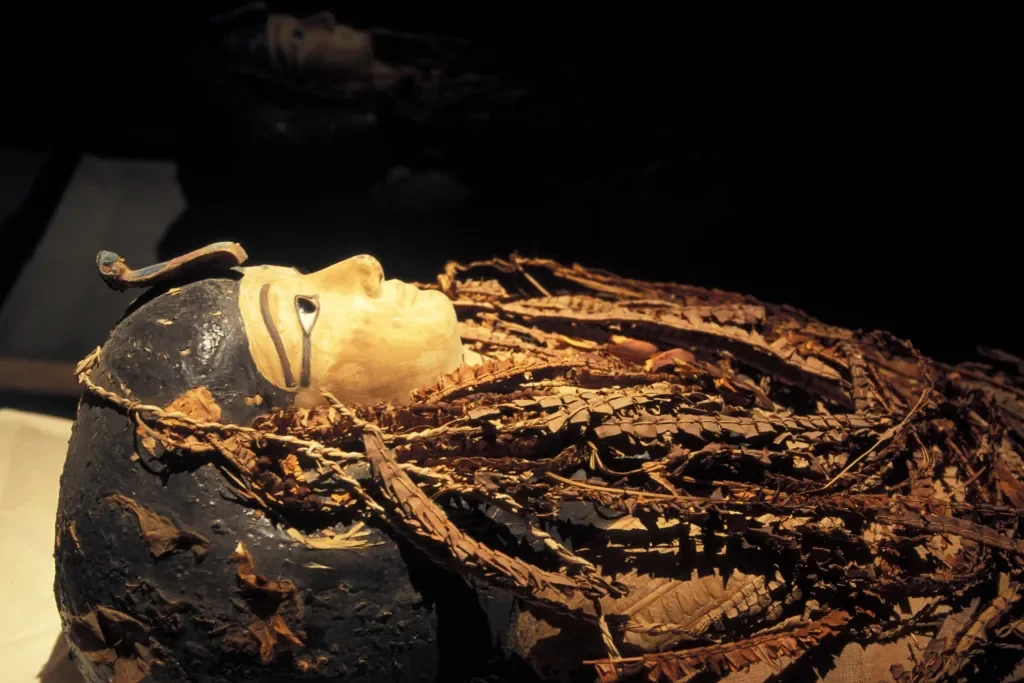
When Gaston Maspero’s team opened the coffin of Amenhotep I, they found a wasp. It had been drawn in by the smell of the flower garlands and shut inside by accident, and Maspero thought it was probably the only wasp mummy anyone had ever found.
The king himself was left alone. His wrappings were in perfect order, covered from head to feet in red, yellow and blue garlands and topped with a mask of painted wood and cartonnage with obsidian pupils, and Maspero could not bring himself to unroll them. That makes Amenhotep I one of the very few royal mummies never unwrapped by modern Egyptologists, a distinction he kept even when Sahar Saleem and Zahi Hawass finally looked inside, using a CT scanner mounted on a truck in the garden of the Egyptian Museum in May 2019.
The digital unwrapping, published in December 2021, found a man of about 35 with healthy teeth, 30 amulets and pieces of jewellery, among them a girdle of 34 gold beads. It also found that tomb robbers had broken his neck, hacked a hole in his abdomen and detached his left arm, and that two of his fingers had ended up inside his belly. Priests of the 21st Dynasty put him back together, fixing the head in place with a band of resin-soaked linen. “The priests of the 21st dynasty lovingly repaired the injuries inflicted by the tomb robbers,” Saleem said, which is a kinder review than most restorers ever get.
Ahmose-Meritamun
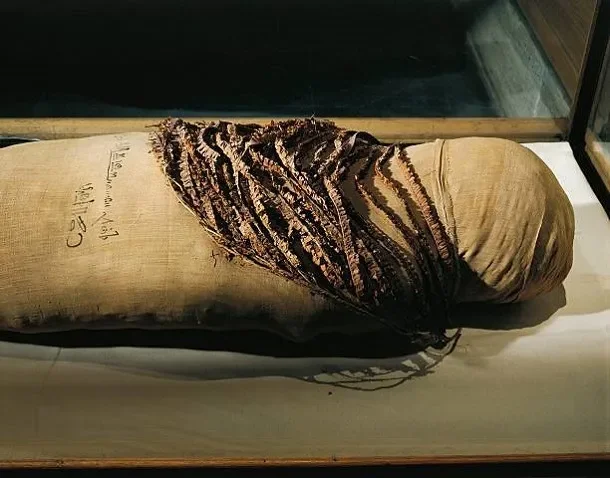
On 11 March 1929 Herbert Winlock of the Metropolitan Museum crossed a deep well inside a tomb at Deir el-Bahari on two beams and a board, on his hands and knees, and found a coffin with “a great placid face staring fixedly upward”. It was made of cedar, 313.5 cm long, and rows of nail holes showed it had once been sheathed in gold inside and out. Thieves had stripped the gold in antiquity, and Winlock judged that it had once been as rich as the outer coffin of Tutankhamun.
The queen inside had been robbed, rewrapped and filed. A docket across her breast reads “Year 19, Month 3 of Akhet, Day 28. On this day examination of the King’s Wife Meryet-Amun”, the paperwork of the priests who restored her burial. Winlock concluded she was a daughter of Thutmose III. Later scholars, on the evidence of her coffin’s style, usually identify her instead as Ahmose-Meritamun, sister and wife of Amenhotep I, which is how she came to ride fourth in the parade, directly behind her husband.
The tomb also produced an amphora holding the sediment of her beer, which was analysed in Berlin and gave its name to a yeast, Saccharomyces Winlocki. Winlock rewrapped her for the Cairo museum “with the garlands on her breast and the docket of the old inspectors written across her shroud.” It was, by his count, her third rest, and easily the best documented.
Thutmose I
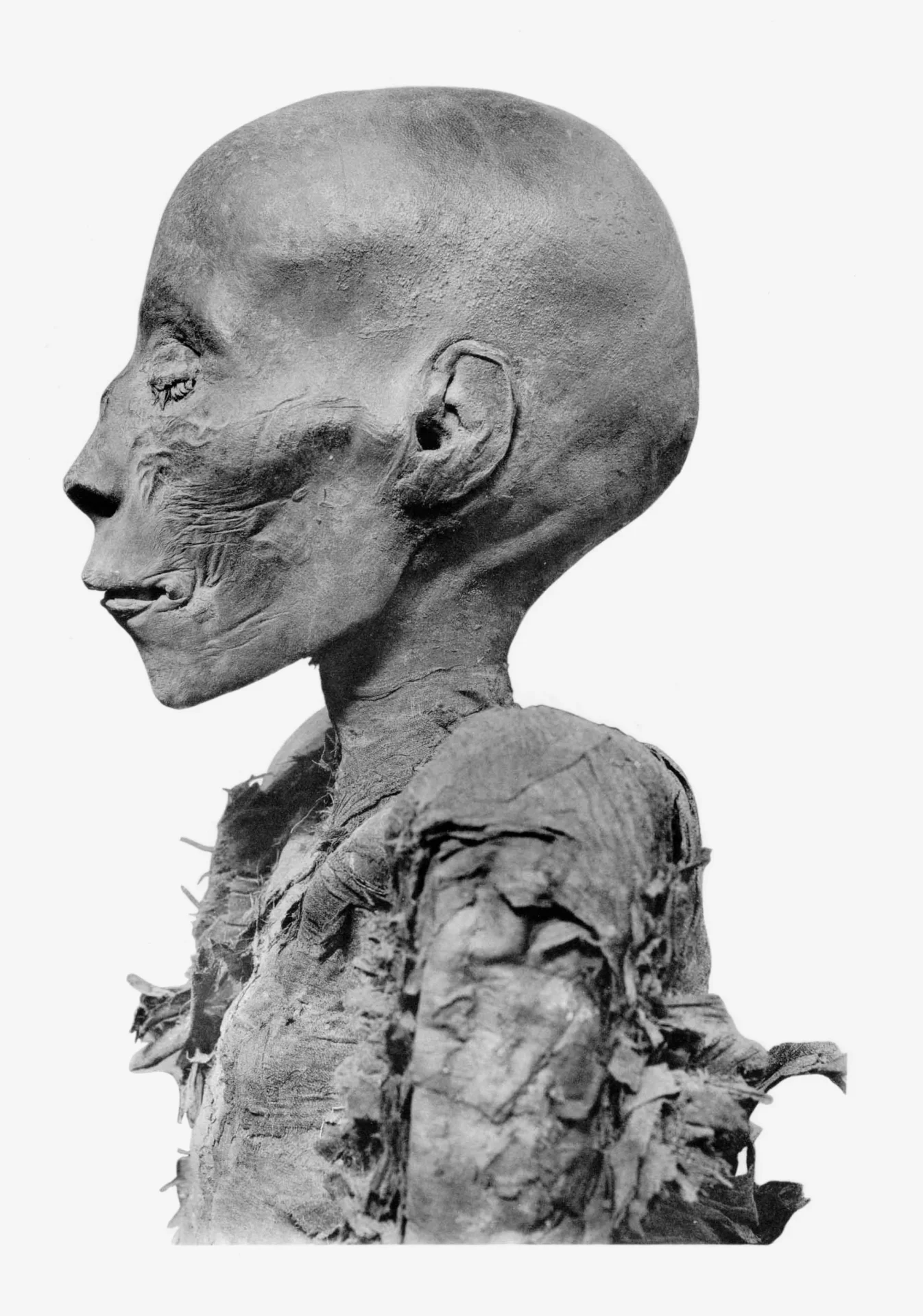
The body in the fifth vehicle was never labelled. Thutmose I’s own coffin had been taken over in antiquity by the priest-king Pinedjem I, and after the cache was revealed in 1881 Gaston Maspero went looking for its missing occupant. “I fancy that I have discovered it,” he wrote, of an unlabelled mummy, number 5283, whose head bore “a striking resemblance” to those of Thutmose II and Thutmose III. A family likeness became an identification, and the identification stuck.
Maspero read worn teeth as the mark of a man over 50 and saw in the mouth “an expression of shrewdness and cunning”. In 2007 Zahi Hawass had the mummy CT-scanned and found a man who died under 30, with a metal point, possibly an arrowhead, in the right side of his chest. The 2010 JAMA study of Tutankhamun’s family listed the body as “long considered an unidentified royal of the 18th dynasty”. The parade carried it under the old name anyway.
The real Thutmose I, probably a general who took the throne when Amenhotep I died without an heir, had his tomb cut by his architect Ineni, who boasted of inspecting the work “alone, no one seeing, no one hearing”. His daughter Hatshepsut later moved his burial into her own tomb and gave him a sarcophagus re-carved from one made for herself, inscribed “She made it as her monument to her father whom she loved”. The sarcophagus ended up in Boston. Where the father ended up is anybody’s guess.
Thutmose II
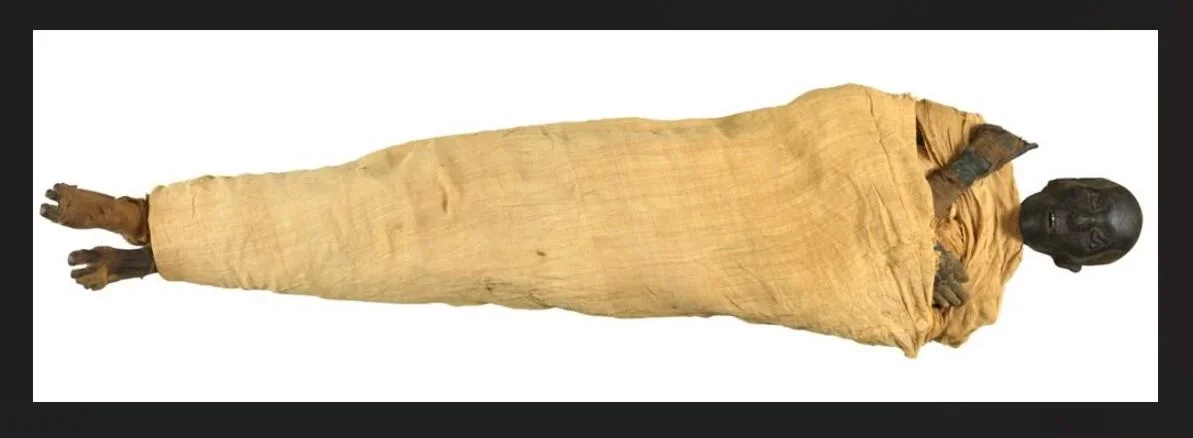
In February 2025 Egypt’s antiquities ministry announced that a flood-wrecked tomb in a remote wadi west of Luxor, known until then as tomb C4, belonged to Thutmose II. The British and Egyptian team that found its entrance in October 2022 had assumed it was the tomb of a royal wife until fragments of an alabaster jar named the owner: Hatshepsut, the inscription said, had made this monument for her brother. The tomb was almost empty. Flooding had wrecked it soon after the funeral, and the excavators think ancient officials carried the king and his goods away.
That raised an awkward question about the man in the sixth vehicle. The Cairo mummy rests on a single rewrapping label whose throne name is misspelled, and in 1909 the Egyptologist Daressy noticed that one sign had been written over an earlier one. In 1992 Wente and Harris suggested that the label had been altered from Thutmose I. Piers Litherland, who found the tomb, calls the evidence “pretty shaky”.
The body itself was butchered. G. Elliot Smith found the left arm broken off at the shoulder, the right arm chopped off just above the elbow and the right leg severed, all the work of ancient robbers, while Maspero described the skin as “scabrous in patches and covered with scars”. Litherland’s verdict on the label is the one that sticks: “It is only the fact that it has been repeated over and over again which has given it any weight.”
Hatshepsut
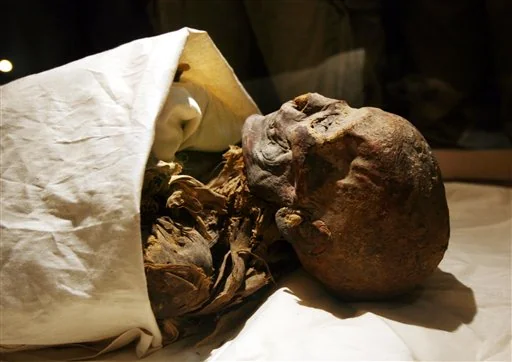
Howard Carter’s report on the little tomb later numbered KV60 is a model of understatement: “Nothing was in this tomb but two much denuded mummies of women and some mummied geese.” That was in 1903. One of the women lay on the floor, and when Donald Ryan recleared the tomb in 1989 he found her there and had a simple coffin made for her at a local carpenter’s shop.
On 27 June 2007 Zahi Hawass announced that the woman on the floor was Hatshepsut. The evidence was a single molar, found in a wooden box inscribed with Hatshepsut’s name from the Deir el-Bahari cache, which fitted a gap in the obese woman’s jaw. “We are sure, 100 percent now,” Hawass said. Others were less sure. National Geographic later observed that the scientists had “proved only that a tooth in a box belongs to a mummy”, the DNA work it reported had “shown nothing definitive”, and a German Egyptologist titled his rebuttal, in translation, “Hatshepsut’s mummy remains unknown”.
Hatshepsut ruled for about 22 years, counting her years as regent, and had herself carved in the king’s false beard and kilt. She was not the first woman to rule Egypt in her own right, since Sobekneferu had done it centuries earlier, but she is the one everybody remembers. The parade nonetheless counted her among its four queens, while the Egyptian Museum’s plaques had called her “Hatshepsut, the King Herself”. It is one argument about her that no tooth can settle.
Thutmose III
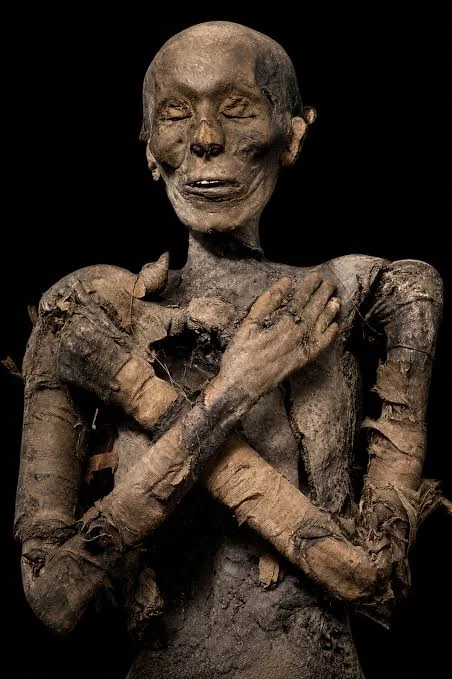
One of the great warrior kings of the New Kingdom was held together with what looked like oars. When robbers tore Thutmose III out of his coffin towards the end of the 20th Dynasty, they ripped off an earlobe along with its earring, hacked away his bracelets and left the body in three pieces. The restorers who reburied him, by Gaston Maspero’s account, compressed the remains “between four oar-shaped slips of wood, painted white”, three inside the wrappings and one outside.
It was an undignified end for a man later historians would call the Napoleon of Egypt, a label the American Egyptologist James Breasted used in 1914. NMEC credits him with at least 17 major military expeditions, carrying Egyptian power from the Euphrates to the Fourth Cataract of the Nile. At Megiddo he took his army through the narrow Aruna pass, against generals who preferred the safer roads, routed the Canaanite forces and then besieged the city for seven months.
He began as king in name only, a child with his stepmother Hatshepsut as regent, and NMEC counts his reign, joint years included, at 54 years. In the parade he rode eighth, directly behind her. G. Elliot Smith found the head broken off, all four limbs detached and each arm broken at the elbow, and Rudolf Virchow thought the mummy made “an almost youthful impression”, which is a generous thing to say about anyone who has been broken in three.
Amenhotep II
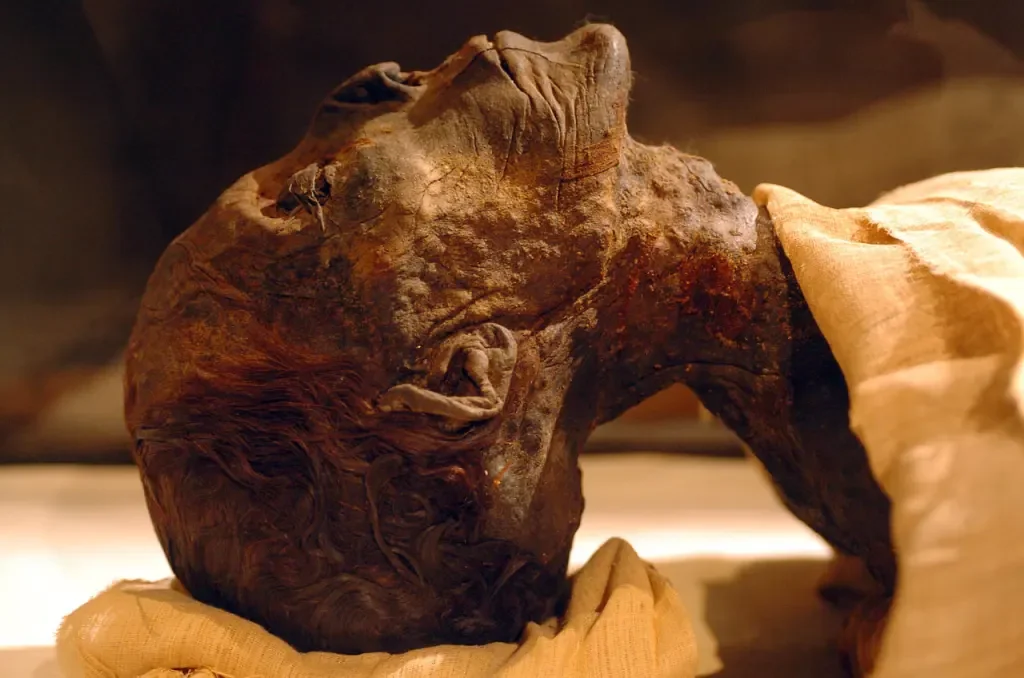
“There is not one who can draw his bow among his army,” Amenhotep II had carved in his third year, and he meant it as a boast rather than a complaint about recruitment. He also claimed to have shot an arrow through a copper target one palm thick and to have rowed faster and farther than 200 men of his navy. Egyptologists are sceptical. The bow, at least, was real: it was found in his tomb, inscribed “smiter of the Troglodytes, overthrower of Kush”.
When Victor Loret opened that tomb, KV35, in March 1898, he found the king lying in his own sarcophagus, while side chambers held other royal dead hidden there by ancient priests. Most of them were eventually taken to Cairo. Amenhotep II was left where he lay, which proved unwise. On the night of 24 November 1901 thieves forced the iron gate, ripped open his wrappings and stole a funerary boat from the antechamber. The guards said thirteen armed men with covered faces had overpowered them. Howard Carter came to suspect they had made the story up.
A rumour then reached Europe that the king had been destroyed, so Maspero re-examined him on 17 January 1902 and found leaves from his funerary crown still clinging to his hair. He was rewrapped, returned to his sarcophagus and given a lamp at his head. Not until 1931 was he removed to the Cairo museum for safekeeping, which by then had been the obvious idea for some time.
Thutmose IV
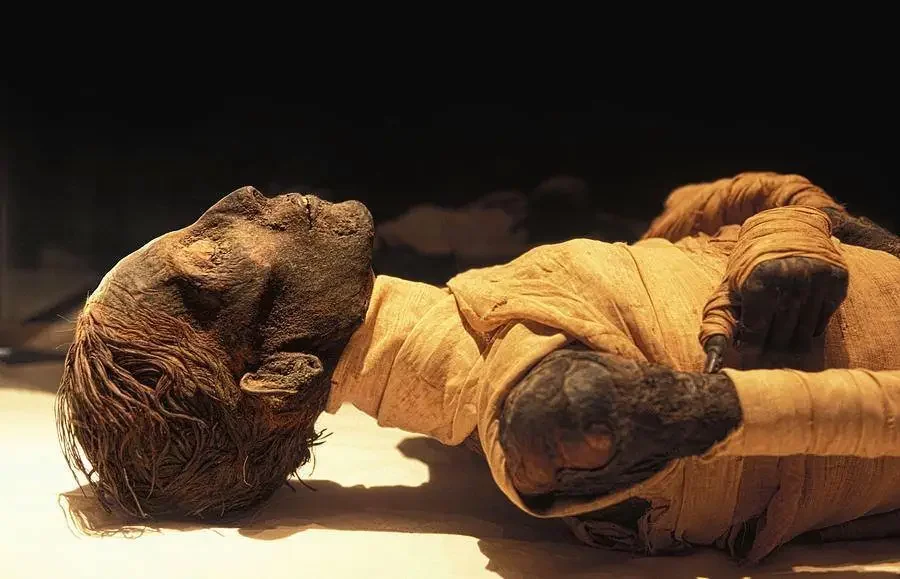
Five years before Howard Carter found the tomb of Thutmose IV, the king had already turned up somewhere else. Carter, digging for the American Theodore Davis, opened KV43 in January 1903 and found it thoroughly robbed in antiquity, its sarcophagus holding two wooden figures and nobody at all. Victor Loret had found the body in 1898, stored by ancient priests with other displaced royalty in Amenhotep II’s tomb.
The unwrapping was an occasion. At 2 p.m. on 26 March 1903, the mummy was opened in a gallery of the Cairo museum before an invited audience that included Lord and Lady Cromer. G. Elliot Smith wrote up the body as “extremely emaciated”, with a head of “very effeminate appearance” and ears “pierced like those of Ramses II”, and judged that the king had died in his 25th year. Eight years and several thousand skeletons later, Smith confessed that he was much less certain.
Thutmose IV is best known for a story he told about himself. The Dream Stele between the paws of the Great Sphinx describes a young prince, tired from hunting lions and shooting at a copper target, falling asleep in the Sphinx’s shadow and being promised the kingdom if he would clear away the sand. Some scholars suspect the tale was meant to justify a reign nobody had expected him to have. James Breasted judged that the narrative’s form “is that of a folk-tale”, which is a scholarly way of raising an eyebrow.
Amenhotep III
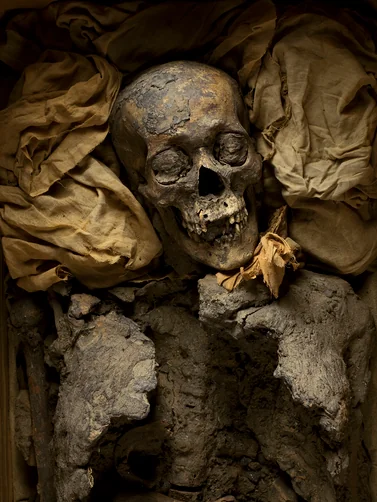
G. Elliot Smith unwrapped the mummy of Amenhotep III on 23 September 1905 and called it “a great disappointment to find only these broken and blackened bones to represent the body of Amenothes” the Magnificent. Ancient robbers had broken off the head and smashed away almost the whole front wall of the body. Inside the body cavity Smith found the leg bone of a fowl, another bird’s limb bone, a human great toe and a left ulna and radius.
The embalmers had done their best with what was left. To restore his lost bulk they had stuffed a resinous mass under the skin of his legs, arms and neck, a technique Smith thought was invented near the close of his reign. Smith also concluded that in his last years the king “must have suffered most acutely from tooth-ache and dental abscesses”. It was a painful finish to a reign of 37 or 38 years that left more surviving statues than any other pharaoh’s, over 250 of them by one count.
Whatever state the body was in, the name on it has held up well. Genetic testing published in 2010 showed the mummy to be the consort of Tiye and the grandfather of the boy king. His own tomb, WV22, robbed in antiquity, reopened to visitors on 4 October 2025 after more than 20 years of restoration. He was not in it. His mummy had been moved long before to the tomb of his grandfather, Amenhotep II.
Tiye
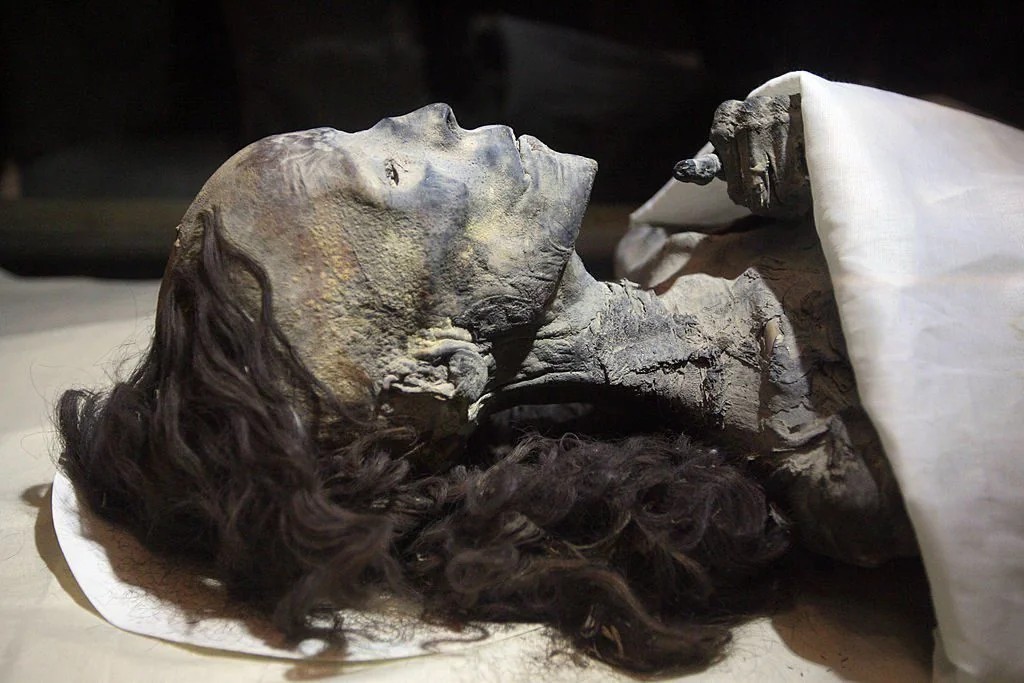
The mummy had no name, no coffin and no clothes. Victor Loret found it in 1898 in a side chamber of KV35, lying naked beside two other unwrapped bodies, a younger woman and a boy, and G. Elliot Smith catalogued it in 1912 simply as “The Elder Woman”. He admired her long, brown, wavy, lustrous hair, with no grey in it, and thought her face bore “an undoubted likeness to Nofritari”. He did not suggest who she was.
The answer came from her hair. Among the treasures of Tutankhamun’s tomb was a nested set of miniature coffins, the innermost inscribed with the name of Queen Tiye, holding a lock of hair, perhaps a memento of a grandmother. In 1976 tests showed that the lock and the Elder Lady’s hair matched. In 2010 a DNA study of Tutankhamun’s family found that the Elder Lady was the daughter of Yuya and Thuya, Tiye’s parents, and the mother of the man buried in tomb KV55. The geneticists used eight markers, fewer than a British or American court would want for a parentage case, though a 2016 review that pointed this out still basically supported the result.
Tiye herself was a commoner, in Britannica’s phrase “a shrewd and able woman”, who married Amenhotep III early in his reign, became the mother of Akhenaten and dealt directly with foreign rulers. In the parade she rode twelfth, directly behind her husband, identified by two different sciences and not a word written on her.
Seti I
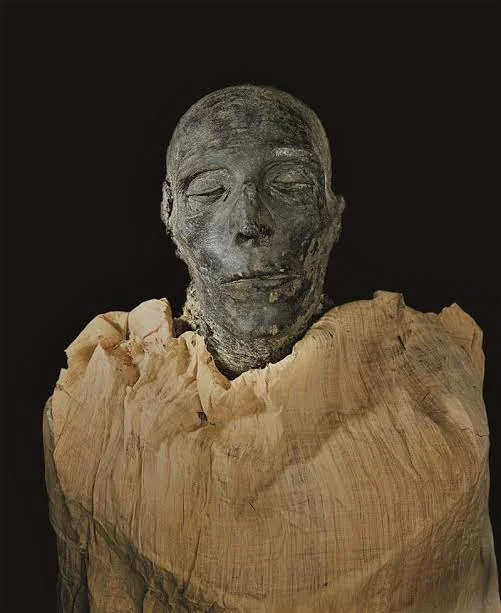
Sir John Soane paid 2,000 pounds in 1824 for the alabaster sarcophagus of Seti I, after the trustees of the British Museum decided it was too expensive, and knocked a hole in the rear wall of his house at 13 Lincoln’s Inn Fields to get it in. Giovanni Belzoni had found it in October 1817 in a tomb that the Soane Museum calls the largest and most elaborately decorated in the Valley at that time. The king himself was not at home.
Seti I’s body turned up in the Deir el-Bahari cache in 1881, and three ink dockets on his coffin record stages of the journey: a restoration of his burial equipment, a move to the tomb of a princess named Inhapy, after which the priest in charge testified that the body had suffered no damage, and a later transfer to the tomb of Amenhotep I. Robbers had been less considerate. They had broken the head off the trunk and smashed the front of the abdomen, yet G. Elliot Smith found in the face “one of the most perfect examples of manly dignity displayed in a mummy that has come down from ancient Egypt”.
Seti I was the father of Ramesses II and built a great temple at Abydos, where a carved King List shows the young prince Ramesses reading out the prayer to the royal ancestors. The list skips the Amarna kings. It also skips Hatshepsut, who rode six carriages ahead of Seti in the parade.
Ramesses II
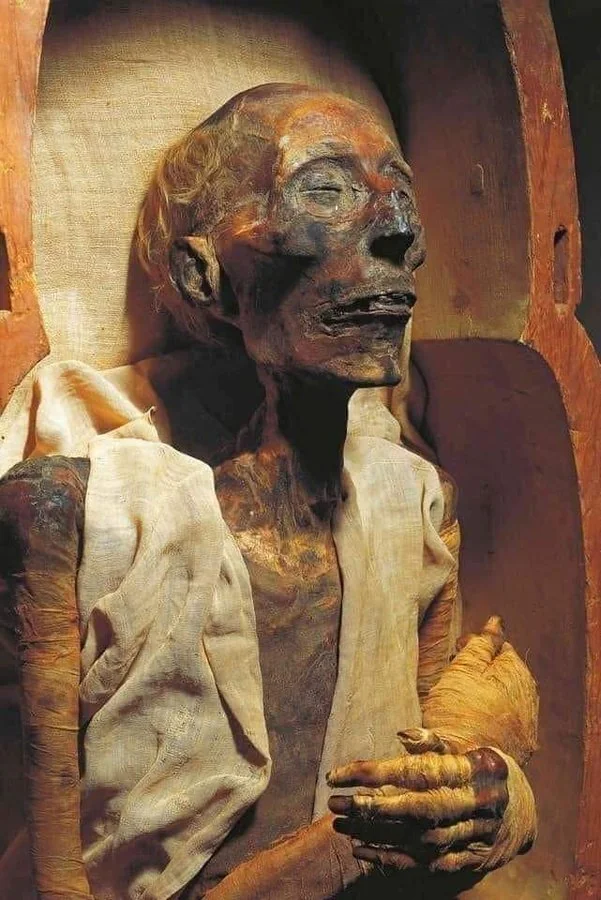
On 26 September 1976 Ramesses II landed at Le Bourget on a French military plane and was received with the full military honours that a living king would receive. A French researcher had found the mummy under fungal attack in Cairo, and over more than seven months in Paris he was studied at the Musee de l’Homme and irradiated, the AP reported, against 60 types of fungi and two strains of insects. He flew home on 10 May 1977.
He did not, despite one of the internet’s favourite stories, travel on a passport listing his occupation as “King (deceased)”. A Louvre specialist told AFP that the claim had no basis, and a possible seed is a 1985 report in which the archaeologist Christiane Desroches-Noblecourt wrote of needing a “passport” to bring the mummy out of Egypt. A Toulouse law professor added, helpfully, that French law requires no passport of the dead.
The king who ruled for 67 years by NMEC’s count and fathered around 100 children was found in the 1881 cache lying in a reused coffin that was never made for him. His identity rests instead on an ink docket on his shroud, read by Maspero on 1 June 1886, when he also noted a nose like a Bourbon’s. Paris had one more chapter in it. In 2006 a Frenchman whose father had been on the 1976 team offered strands of the pharaoh’s hair for sale online for 2,000 euros, and Egypt had them back by April 2007.
Merenptah
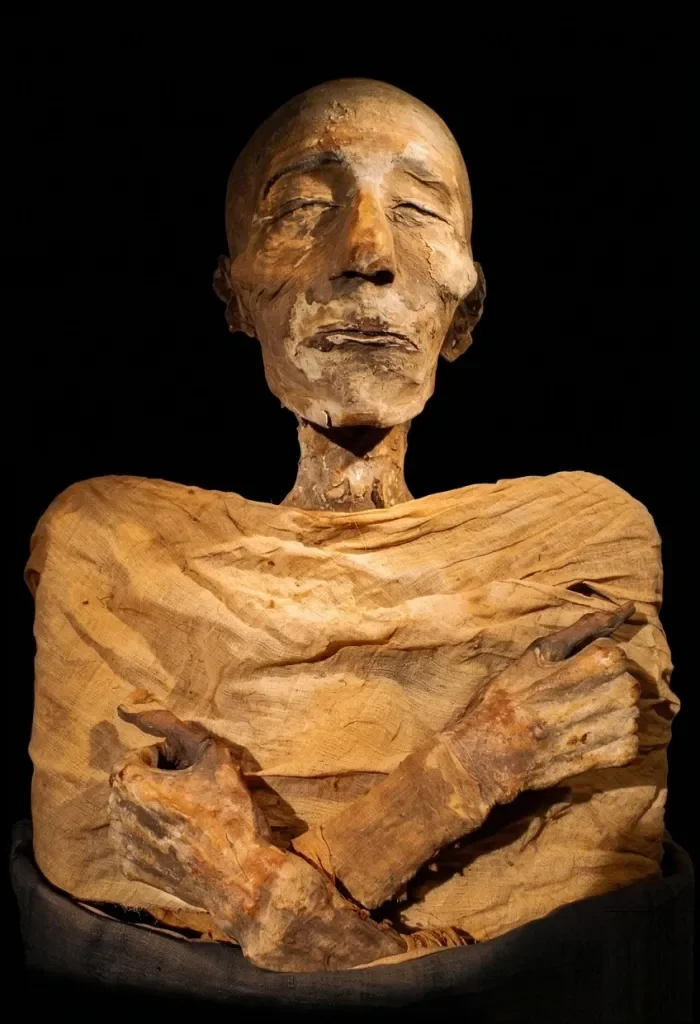
Merenptah’s best-known monument boasts of destroying a people who have rather outlasted him. The stele found by Flinders Petrie at Thebes in 1896, carved in the king’s fifth year, lists his victories in Canaan and announces that “Israel has been wiped out … its seed is no more”, which Britannica counts as the earliest-known reference to Israel.
He came to the throne late. Merenptah was the 13th son of Ramesses II, twelve of his elder brothers having died before him, and the Egyptologist Dodson notes that his accession gave the world its “first new king of Egypt for nearly seven decades”. In his fifth year he beat off a coalition of Libyans and Sea Peoples that attacked the Delta. When Victor Loret found the mummy in March 1898 in the tomb of Amenhotep II, it lay in the coffin trough of another king, Setnakht, and Loret, according to Maspero, first took it for the heretic pharaoh Akhenaten, until a cartouche written on the shroud settled the matter.
A tradition of the Alexandrian period made Merenptah the pharaoh of the Exodus, the one said to have perished in the Red Sea, and in 1909 a pathologist still titled his report on the king’s aorta “King Menephtah, traditionally regarded as the Pharaoh of the Exodus”. The body Smith examined belonged to a somewhat corpulent, almost completely bald old man with calcified patches in his aorta. Whatever carried him off, it was not youthful recklessness.
Seti II
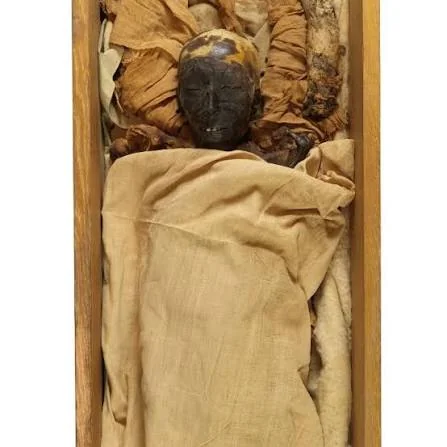
A single word of ancient ink is all that names the sixteenth mummy. It was found in KV35 in 1898, lying in a lidless coffin trough and labelled simply “Sethy”. Since the mummy of Seti I had been securely identified among the bodies hidden at Deir el-Bahari, this one was taken to be the second king of that name, Seti II, son of Merenptah. G. Elliot Smith, who unwrapped it in 1905, was not reassured by the face, whose features, he wrote, “recall in a striking manner those of the XVIIIth Dynasty”. Dodson concludes that the identification “must thus remain doubtful”.
The real Seti II spent his first years contending with a rival king, Amenmesse, who seized Thebes and, it appears, had Seti’s names erased from his unfinished tomb; Seti’s agents later carved them back. When he died in his sixth year, the chief policeman Nakhtmin brought the news to the royal tomb-builders with the words “The falcon has flown to heaven, namely Sethy; another has arisen in his place”.
His tomb, KV15, found a second career as Howard Carter’s laboratory for the treasures of Tutankhamun, and on 11 November 1925 the autopsy of the boy king was carried out inside it. The mummy labelled Sethy, meanwhile, had been rewrapped by ancient priests in two fine muslin shirts embroidered with Merenptah’s name. Smith handed them over to the museum’s conservator, and when he came to write his catalogue they could not be found.
Siptah
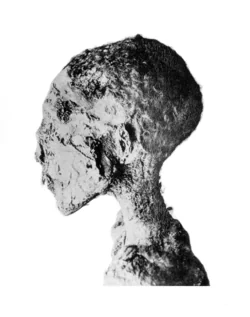
The chancellor Bay put Siptah on the throne as a boy and was not shy about saying so. A graffito at Gebel el-Silsila shows Bay standing behind the young king and calls him the man “who established the King in the place of his father”. It did not end well for Bay. An ostracon from the tomb-builders’ village records that in Siptah’s fifth year the scribe Paser announced: “Pharaoh, L.p.h., has killed the great enemy, Bay.” Work on Bay’s tomb stopped.
The king credited with that killing walked with difficulty. Siptah’s left leg was shortened and the foot locked pointing downwards, so that, as Dodson puts it, “only the king’s left toes will have touched the ground when he walked”. The cause is disputed. Smith described a clubfoot in 1912 without naming a cause, polio has frequently been alleged, Dodson thinks cerebral palsy more likely, and a paper published in 2021 called the disease of Pharaoh Siptah “elusive” in its title. His age at death is just as unsettled.
His body was recovered from the KV35 cache rather than from his own tomb, KV47. Plunderers had broken the right forearm, and the priests who rewrapped him splinted it with a rough piece of wood and a strip cut from a coffin. Egyptian theory held that the pharaoh, whatever his age or infirmity, was the ruler in whose name everything was done. In Bay’s case, that included his own removal.
Ramesses III
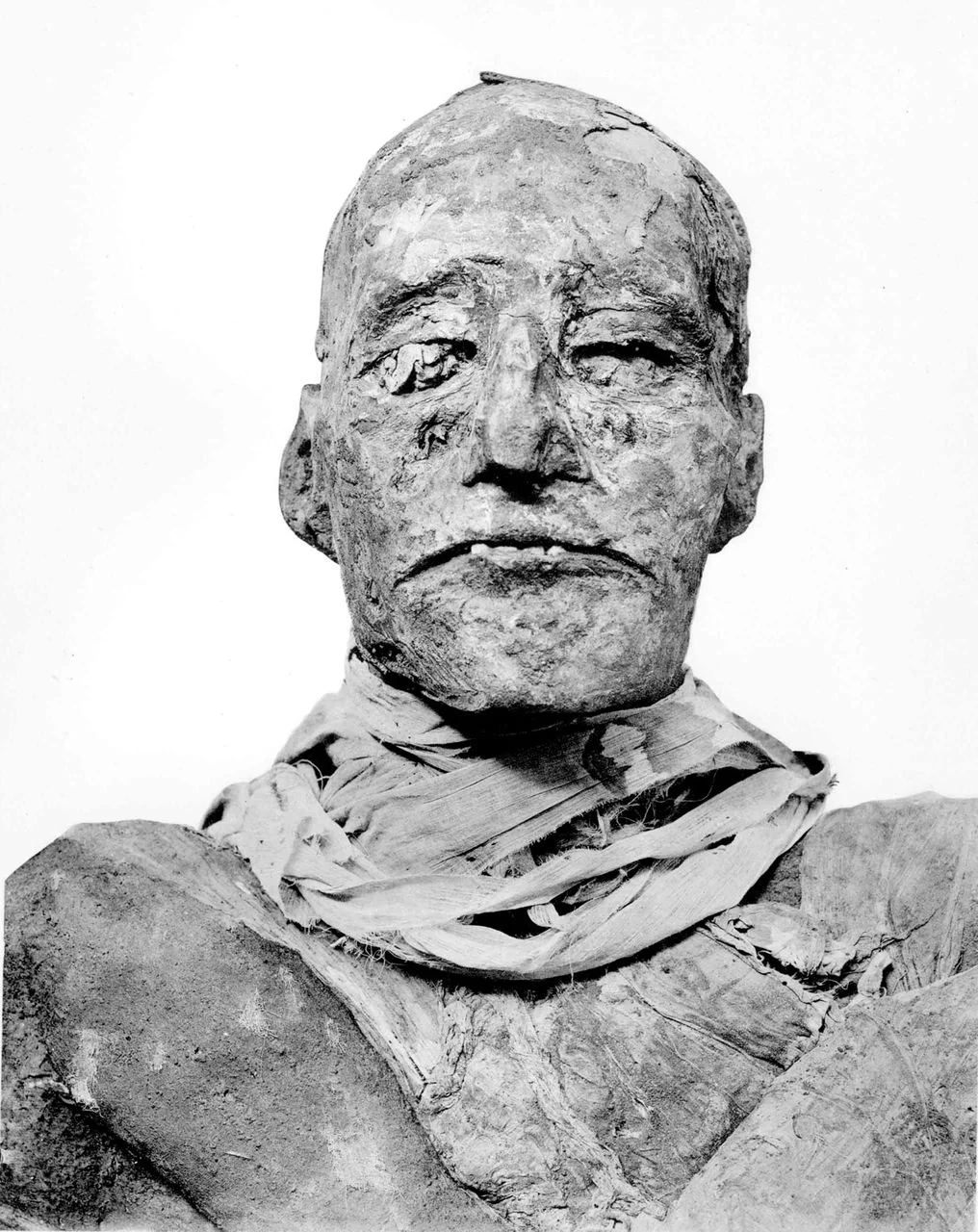
A deep cut across the throat, hidden for millennia beneath a thick collar of linen, revealed how Ramesses III probably died. In 2012 a team led by Zahi Hawass and Albert Zink reported in the BMJ that CT scans showed the wound, probably made by a sharp knife, with a Horus-eye amulet placed inside it by embalmers hoping to heal it. A later scan of his feet found the left big toe partly chopped off, likely around the time of death, and replaced with a linen prosthesis, which led Sahar Saleem to suggest more than one attacker.
The conspiracy, hatched in the royal harem, is known from the Judicial Papyrus of Turin, whose judges gave the guilty names of infamy such as Mesedsure, “Ra hates him”, and allowed most of them to take their own lives. The papyrus never explicitly mentions the king’s death. The 2012 study also found that an unidentified young man from the same cache, wrapped in a ritually impure goatskin, shared the king’s Y-chromosome haplotype, and proposed him as a possible candidate for Pentawere, the son the plot was meant to crown. Rome would later make a habit of this, as the list of every Roman emperor who was assassinated shows, but Ramesses III got there long before.
His was the neatly wrapped body found in Ahmose-Nefertari’s coffin, and the Fitzwilliam Museum says it was the model for Boris Karloff’s mummy in the 1932 film. If so, Karloff’s mummy was a probable murder victim.
Ramesses IV
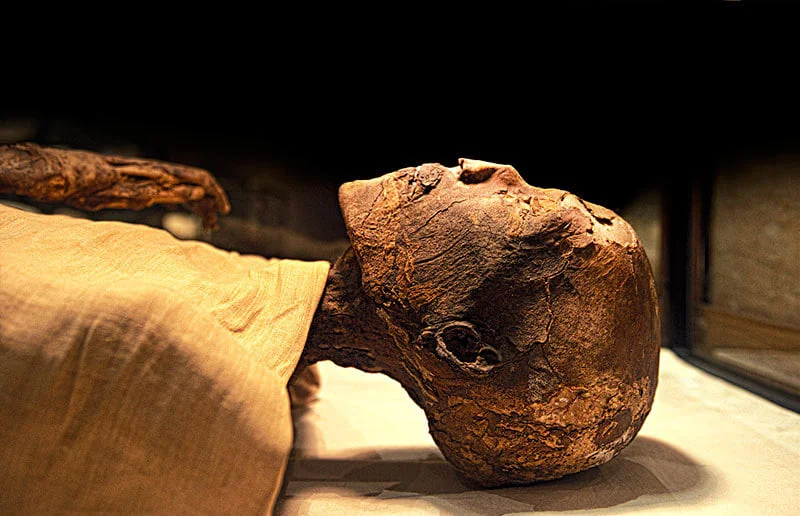
Two small onions served Ramesses IV as eyes. The embalmers pushed one under each eyelid. G. Elliot Smith, who found them when he unwrapped the king in 1905, reported that “the effect was more successful than one might imagine possible”, the light brown of the dried onion lending “quite a natural appearance to the whole face”.
Ramesses IV came to the throne after his father, Ramesses III, was murdered, and NMEC says he began his reign by punishing those who had orchestrated the assassination. In his third year an expedition to the quarries of Wadi Hammamat numbered 8,368 men, according to the rock stela that records it, and the scribes noted 900 more “who are dead and omitted from this list”. He doubled the work gangs at Deir el-Medina to 120 men to cut his tomb, KV2, and its plan survives on a papyrus in Turin, drawn by the scribe Amennakht. The museum notes that from the sarcophagus room onward the real tomb came out smaller than the drawing, presumably because the king’s sudden death forced a hasty finish.
On a stela at Abydos in his fourth year, Ramesses IV asked Osiris to “give me the great age with a long reign”. He got a little over six years. His mummy, stripped by robbers and rewrapped in rags, ended up in the KV35 cache, and the tomb that had been planned for a long reign was finished in a hurry and left without him.
Ramesses V
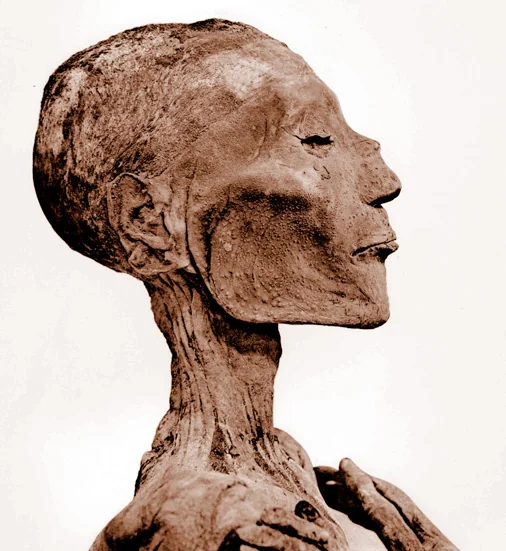
Egyptology’s most famous rash belongs to Ramesses V. When G. Elliot Smith unwrapped him in 1905, he found “a very well-marked papular eruption” on the face and lower body, which his colleague Professor A. R. Ferguson judged “highly suggestive of small-pox”. In 1980, the year the World Health Assembly declared smallpox eradicated, Donald Hopkins asked in the magazine World Health whether Ramesses V was its earliest known victim. A 2021 review pointed out that smallpox “has not been identified at a molecular level” in him, so the case rests on the look of the rash.
He had other troubles. Smith thought a greatly enlarged scrotum pointed to an inguinal hernia, and he found in the right groin a deep ulcer that might represent an open bubo. Robbers had sliced the tips off the fingers of his left hand. The priests who restored him did not even find him a coffin: he lay on a plain sycamore plank with no decoration or inscription, so no coffin name vouches for him.
Ramesses V ruled only about four years and, in AFP’s phrase, died without an heir to the throne. Even his funeral was late. An ostracon records that he was buried in the second year of his successor, Ramesses VI, long after the customary 70 days. The great document of his reign, the Wilbour Papyrus, is a land survey about ten metres long. Its subject, for the most part, is fields.
Ramesses VI
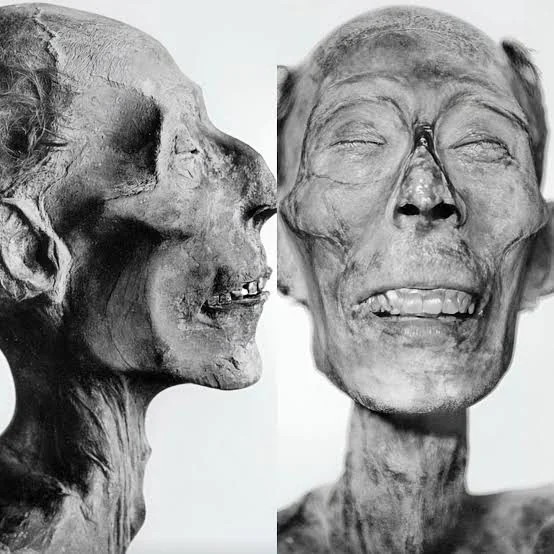
Ramesses VI was put back together with at least two hands that were not his. G. Elliot Smith, unwrapping him in July 1905, judged that none of the royal mummies, not even Amenhotep III’s, “was so severely maltreated”: robbers had literally hacked the head and trunk to pieces, and the priests who rewrapped the remains had to tie the fragments to a rough piece of old coffin to give them the form of a mummy. In the rags Smith found a woman’s right hand and the right hand and forearm of a man that “did not belong to this mummy”. The king’s own right hand was missing.
His coffin was borrowed as well, an anthropoid coffin made for a priest named Ra, whose name had been scratched out and the king’s written in ink. Robbers smashed his stone sarcophagus into hundreds of pieces, and when 250 fragments were reassembled in his tomb in 2004, the face had to be a cast, because the original had been in the British Museum since 1823.
Yet Ramesses VI did one boy king an enormous favour. His tomb, KV9, was cut close to the forgotten entrance of Tutankhamun’s, and the men who built it put up their huts over the spot, which helped keep it hidden. When Howard Carter cleared those huts in November 1922, he noted that they “evidently belonged to the workers employed for the construction of the tomb of Ramses VI”. On 4 November a workman found the first step down.
Ramesses IX
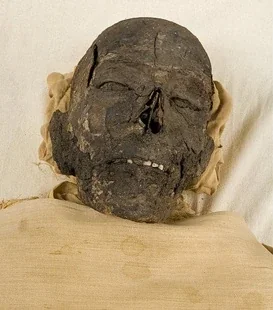
The last king in the parade reigned during a crime wave that, in the long run, saved most of the others. In Ramesses IX’s 16th and 17th years Thebes was gripped by a scandal over robberies in the royal tombs, recorded in the Abbott Papyrus, which reads as much like a political feud as a crime report: Paser, mayor of eastern Thebes, accused Pawero, the mayor of the west bank who was responsible for the necropolis, of letting the thefts happen, and a commission went to inspect ten royal tombs. NMEC says the robberies led, several generations later, to the decision to take the New Kingdom kings out of their tombs, restore them and hide them in caches.
Ramesses IX ended up in one himself. His body was found at Deir el-Bahari in 1881 in a coffin belonging to the priestess Neskhons, which had itself been made for another woman, Isimkheb, whose name was painted over. Even his identification is a matter of inference. A linen label names the king only as “Ra Khaemwaset”, which fits Ramesses IX or Ramesses XI, and IX is judged the likelier because an ivory box bearing his name lay in the same cache.
He ruled about 18 years and was first buried in KV6, a painted tomb opposite that of Ramesses II. In 2021 he rode last, behind the others, most of whom had survived because the problem his officials investigated was never solved.
Frequently Asked Questions
Where were the royal mummies in the Golden Parade found?
Mostly in two ancient hiding places. Ten of the 22 came from the royal cache at Deir el-Bahari (DB320), revealed to the authorities in 1881, and ten from the tomb of Amenhotep II (KV35), opened by Victor Loret in 1898. The remaining two came from elsewhere: Ahmose-Meritamun from her own tomb, TT358, and Hatshepsut from KV60.
Where can you see the mummies from the Pharaohs’ Golden Parade?
At Cairo’s National Museum of Egyptian Civilization (NMEC), whose Royal Mummies Hall opened to visitors on 18 April 2021, 15 days after the parade. NMEC says the hall displays 20 of the 22, 18 kings and 2 queens. Ahmose-Meritamun is not among them, and reports differ on which other mummy is kept out of view.
Are all the Golden Parade mummies correctly identified?
Not with certainty. Seven of the 22 carry a real doubt: Ahmose-Nefertari, Ahmose-Meritamun, Thutmose I, Thutmose II, Hatshepsut, Seti II and Ramesses IX. Most of these rest on a coffin, a linen label or a family likeness rather than on scientific proof, and in one case, Thutmose I, specialists broadly agree that the name is wrong.
Was there a pharaoh’s curse during the Golden Parade?
No, though social media said otherwise. In the days before the parade, posts blamed a pharaoh’s curse for the Ever Given’s blockage of the Suez Canal, a deadly train crash and a building collapse in Cairo. The archaeologist Zahi Hawass dismissed the idea to NBC News: “There’s no curse at all.”
Why were the mummies carried in nitrogen-filled capsules?
To protect them on the road. Each mummy travelled in an oxygen-free capsule filled with nitrogen, which shielded it from humidity, bacteria, fungi and insects, according to Mostafa Ismail, head of conservation at NMEC’s mummies laboratory. The vehicles that carried the capsules were fitted with shock absorbers to keep the journey smooth.
What song was sung at the Pharaohs’ Golden Parade?
A hymn to Isis, sung by the soprano Amira Selim in the ancient Egyptian language, to a score by the composer Hesham Nazih, conducted by Nader Abbassi. According to the Cairo University archaeologist Maisara Abdullah Hussein, who helped correct the singers’ pronunciation, the words came from a hymn on the gateway of the temple of Deir el-Shelwit near Luxor.
- The Pharaohs’ Golden Parade of 22 Royal Mummies – National Museum of Egyptian Civilization
- Royal Mummies Hall – National Museum of Egyptian Civilization
- Royal Mummies Transfer Parade – Cairo Governorate
- G. Elliot Smith, The Royal Mummies (Catalogue General of the Cairo Museum, 1912)
- Hawass et al., Revisiting the harem conspiracy and death of Ramesses III, BMJ (2012)
- Hawass et al., Ancestry and Pathology in King Tutankhamun’s Family, JAMA (2010)
- 22 Ancient Pharaohs Have Been Carried Across Cairo in an Epic Golden Parade – ScienceAlert (AFP)
- Egypt’s royal mummies are moving. It’s not their first road trip – National Geographic