Every Member of the First Baseball Hall of Fame Class (1936)
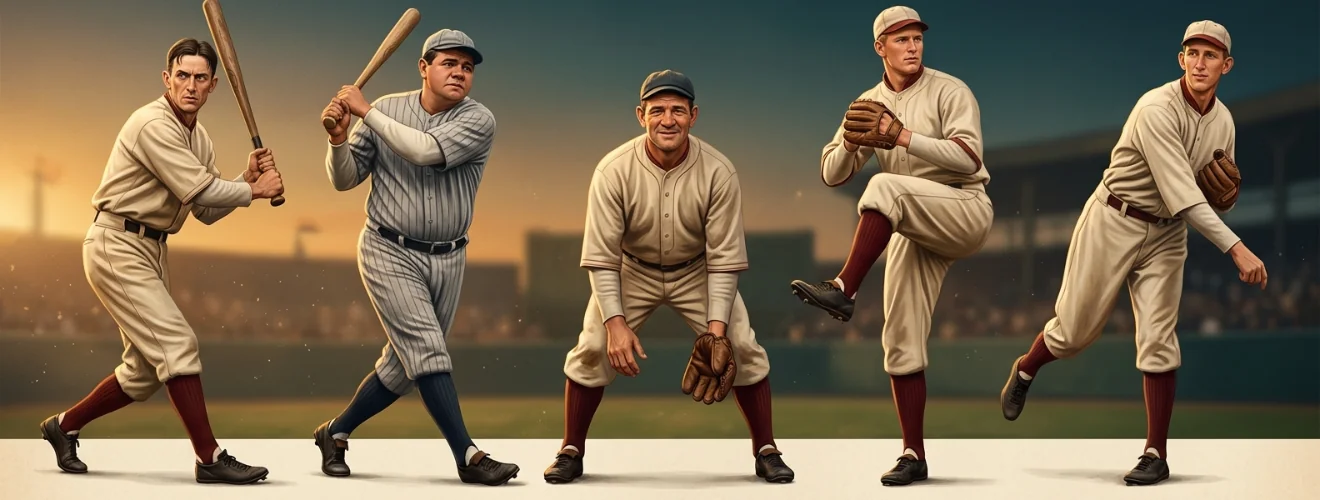
There was a second ballot in 1936, and it elected nobody. Alongside the writers choosing the modern stars, a panel of seventy-eight old-timers was asked to pick the great players of the nineteenth century, and the exercise fell apart – voters told to name five named ten, half-votes were handed out to sort the mess, and some turned in ballots laid out like an All-Star team, one man per position. Cap Anson and Buck Ewing led the wreckage at barely fifty percent. The committee enshrined no one.
The writers’ ballot went better, though not by as much as you would think. Two hundred twenty-six of them voted, each allowed up to ten names, and they narrowed the modern era down to five. What they did not produce was agreement. Not one of the five was named on every ballot, and the precedent stuck so hard that no player would be elected unanimously until Mariano Rivera in 2019, eighty-three years later.
The five are ranked here as the writers ranked them, by vote total, the only order the occasion actually produced. One thing worth holding onto: they were chosen in 1936, but the Hall of Fame had no building. The doors in Cooperstown did not open until June 1939. For three years, these were Hall of Famers of a Hall that did not physically exist – which, given who they were, nobody seems to have minded.
The Baseball Writers’ Association of America elected five players to the first Baseball Hall of Fame class in 1936: Ty Cobb, Babe Ruth, Honus Wagner, Christy Mathewson, and Walter Johnson. A separate committee weighing nineteenth-century candidates elected no one that year, leaving the founding class at exactly five.
Ty Cobb
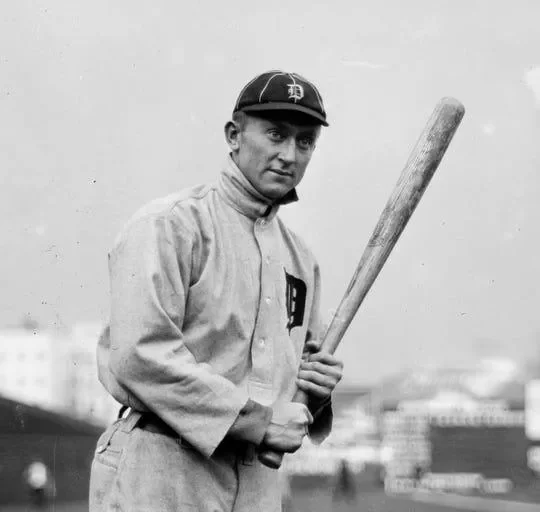
Three weeks before he played his first major-league game, Ty Cobb’s mother shot and killed his father on the family porch in Georgia, having mistaken him, she said, for a prowler. Cobb debuted for the Detroit Tigers on August 30, 1905, eighteen years old and grieving, and spent the next two decades playing as though the world owed him something. He hit .366 over twenty-four seasons, the highest career average in the major-league record book for nearly a century. It stood until 2024, when the Negro Leagues statistics were folded into the official record and Josh Gibson’s .372 moved quietly ahead of him.
Cobb won twelve batting titles, still the most anyone has managed, nine of them in a row. He retired in 1928 credited with more than ninety records and a reputation as the most combative man in the game. When the writers voted in 1936, they gave him 222 of 226 ballots, more than Ruth, more than anyone, and four of them still left him off – a small mystery no one has ever explained.
He was, fittingly, late to his own enshrinement. Held up by illness on the trip east, Cobb reached the 1939 ceremony just after the photograph of the inaugural class had been taken. The man who led the voting is the one man missing from the picture.
Babe Ruth

Before the home runs, Babe Ruth was a pitcher, and one of the best in the American League. He came up with the Boston Red Sox in 1914 out of a Baltimore orphanage, went 94 and 46 on the mound across his career, and in the World Series strung together twenty-nine and two-thirds consecutive scoreless innings – a record that lasted until Whitey Ford broke it in 1961. Ruth said he was prouder of that streak than of anything he ever did with a bat, which is a remarkable thing for the most prolific slugger of his era to admit.
The bat won out anyway. After the 1919 season the Red Sox sold him to the New York Yankees for $100,000 to help bankroll their owner’s theatrical ventures, and Ruth moved to the outfield, where he hit 714 home runs and made the game over in his image. In ten of his next twelve seasons he out-homered the entire Boston roster by himself.
When the writers voted in 1936, Ruth finished second, tied with Honus Wagner at 215. He had retired only the year before; he was the most famous athlete alive; and eleven men with a Hall of Fame ballot in front of them declined to write his name on it.
Honus Wagner

The most valuable baseball card in the world is a small, faintly blurred portrait of a man who tried to stop it from being made. The T206 Honus Wagner was printed in 1909 by the American Tobacco Company and pulled almost at once; fewer than sixty are known to survive, and a good one sold in 2022 for $7.25 million. Why Wagner killed it is still argued – the romantic version is that he refused to help sell cigarettes to children, the cynical one is that the company would not pay him enough. He chewed tobacco himself, which dents the halo a little.
The card has nearly swallowed the player, and the player was the finest shortstop the game had yet produced. Over twenty-one seasons, almost all with his hometown Pittsburgh Pirates, the Flying Dutchman won eight National League batting titles – a league record he shares with Tony Gwynn – and retired with 3,420 hits, a .328 average, and a resume that included every position on the diamond except catcher.
In 1936 he tied Ruth for second, 215 apiece. It is a strange afterlife for a man once rated the equal of Cobb: known to the wider world less for any of that than for a rectangle of cardboard he spent real effort trying to suppress.
Christy Mathewson
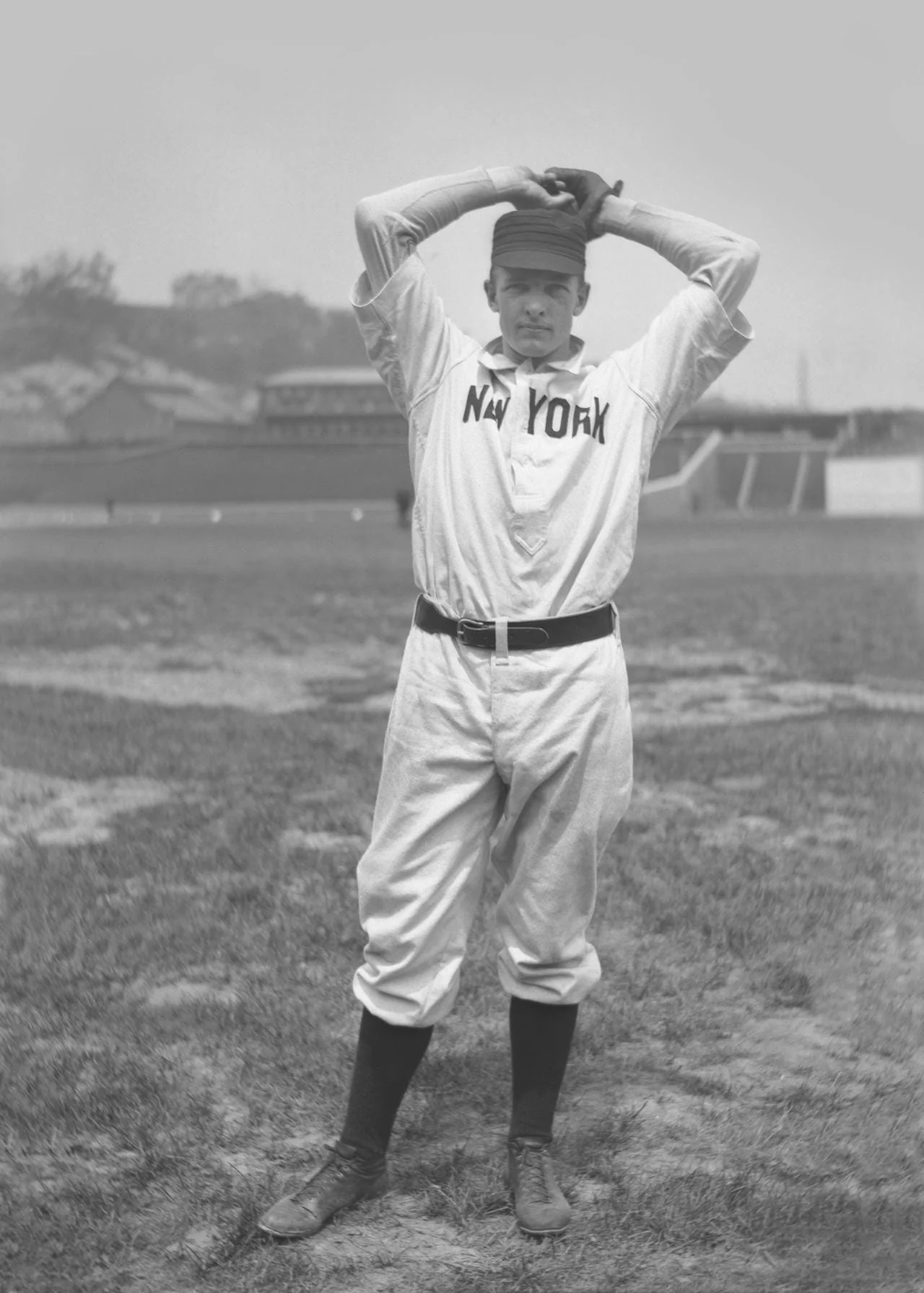
Over six days in October 1905, Christy Mathewson pitched three complete-game shutouts in a single World Series, holding the Philadelphia Athletics to fourteen hits and no runs across twenty-seven innings. No pitcher has done it before or since. He was twenty-five, a Bucknell-educated gentleman in an era when ballplayers tended to be neither, and he threw a pitch he called the fadeaway – the reverse-breaking ball later known as the screwball – with control so fine that catchers barely had to move their gloves.
Mathewson won 373 games for the New York Giants, still the most by any pitcher in National League history, tied with Grover Cleveland Alexander. They called him Big Six. He was devout enough to refuse to pitch on Sundays, and good enough that the refusal never cost him.
He never learned he had been chosen. In 1918 Mathewson joined the Army, was exposed to poison gas during a training exercise in France, and came home with ruined lungs. The tuberculosis that followed killed him on October 7, 1925 – the very morning that year’s World Series opened, so that players in Pittsburgh and Washington took the field in black armbands. He was forty-five. When the writers picked the first class eleven years later, Mathewson was the only one of the five not alive to hear it.
Walter Johnson
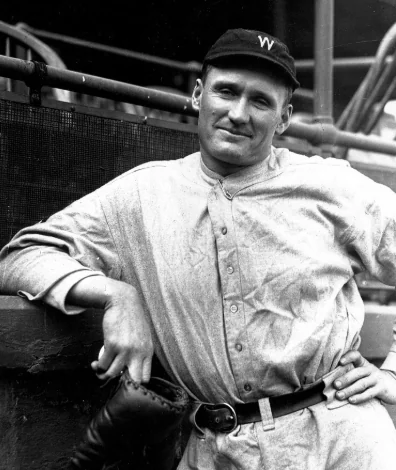
Walter Johnson drew the fewest votes of the five – 189, barely twenty above the line – which is faintly ridiculous for a man who still holds the record for shutouts and trails only Cy Young in career wins. He pitched all twenty-one of his seasons for the Washington Senators, a club that was dreadful for most of them, and won 417 games and threw 110 shutouts regardless. Both numbers look unreachable now; the shutout record has held for roughly a century with nothing in sight.
His fastball was the fastest anyone had seen. Ty Cobb, who crowded the plate against nearly everyone, said the first one Johnson threw past him hissed by like something dangerous – and Cobb worked out early that the big man was privately terrified of hurting somebody, so he stood closer than usual and dared him. Johnson struck out 3,509 batters, a record that would last more than half a century, until 1983.
For most of his career the rewards were thin. In 1924, his eighteenth season, the Senators finally reached the World Series, and Johnson – thirty-six by then – came on in relief to pitch the last four scoreless innings of a twelve-inning Game 7 and win it. He got exactly one championship out of twenty-one years. The records did better than the man: 110 shutouts, untouched for a century, and showing no sign of ever falling.
Frequently Asked Questions
Why did the first Hall of Fame class only include five players?
The original plan called for fifteen honorees before the Hall opened: ten players from the twentieth century, chosen by the sportswriters, and five from the nineteenth century, chosen by a separate panel. The nineteenth-century vote collapsed, so the group actually enshrined in 1936 held only the five names the writers could agree on.
Who received the most votes in the 1936 Hall of Fame election?
Ty Cobb received the most votes of the five, appearing on 222 of the 226 ballots cast, a rate of 98.2 percent. Babe Ruth and Honus Wagner tied for second at 215 apiece. Christy Mathewson followed with 205, and Walter Johnson barely cleared the bar with 189, nineteen more than the 170 required.
Does Ty Cobb still hold the record for the highest career batting average?
No. Cobb held the record at .366 for close to a century, but Major League Baseball folded Negro Leagues statistics into its official record book in 2024, and Josh Gibson’s .372 moved into the top spot. The change reordered several of the game’s oldest career leaderboards overnight.
How much has a T206 Honus Wagner card sold for?
The rarest examples have sold into the millions. A T206 Wagner, printed in 1909 and pulled from circulation almost immediately, fetched $7.25 million in a private sale in 2022, a record for a sports card at the time. Fewer than sixty copies are known to exist today.
Did the nineteenth-century players who missed out in 1936 ever make the Hall of Fame?
Yes. Anson and Ewing, who had tied atop that failed 1936 ballot, were both inducted in 1939, elected by a reorganized three-man committee alongside Charles Comiskey, Al Spalding, Old Hoss Radbourn, and Candy Cummings. The Hall needed three extra years to finish what the original panel had botched.
Was Cy Young part of the first Hall of Fame class?
No. Cy Young, still the career leader in wins with 511, received only 111 of 226 votes, just 49.1 percent, in the 1936 writers’ ballot. He was elected the following year, in 1937, alongside Nap Lajoie and Tris Speaker, who had also fallen short on the first try.