Every Hogwarts Ghost in Harry Potter Canon
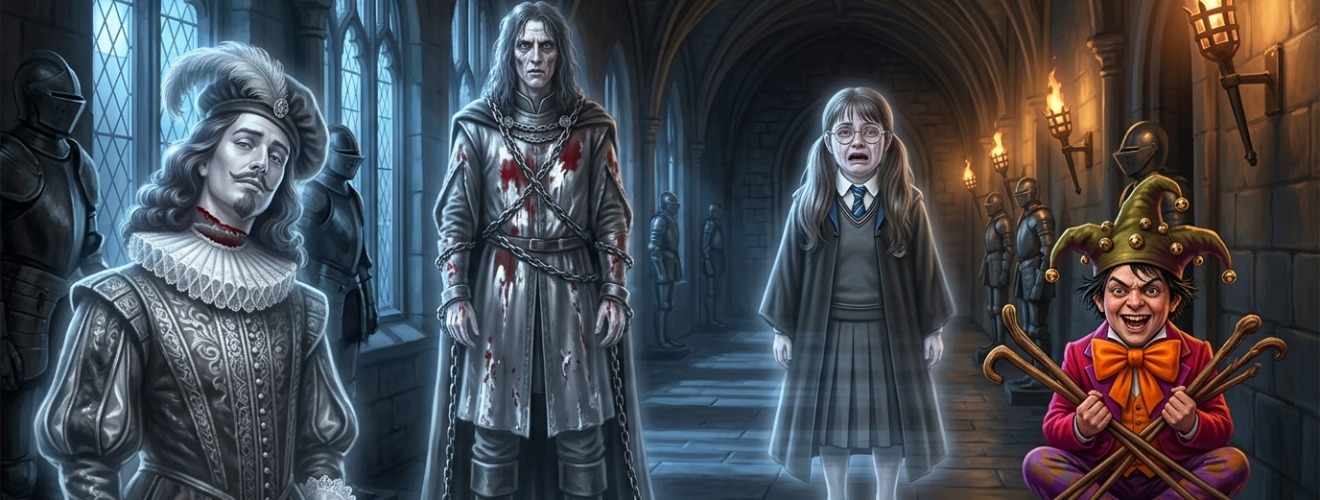
Hogwarts is, on the authority of J.K. Rowling herself, the most heavily haunted dwelling place in Britain. Given the competition on these islands, that is saying something.
Most of its ghosts are never named. They drift through the background of the story as descriptions rather than characters: a group of gloomy nuns, a knight with an arrow sticking out of his forehead, a ragged man wearing chains, a portly ghost who walks slowly through the buffet trying to taste the food. They attend parties. They decorate corridors. They contribute to the general chill of a thousand-year-old Scottish castle. But they are extras. The named ones are the cast.
What follows is every Hogwarts ghost with a name in canon, and one resident who could not reasonably be left off a list like this one. Some died in the tenth century. One died in a girls’ bathroom in 1943. One never lived.
They are taken here in the order the castle would most likely introduce them, which is the four houses first, then the ones who keep turning up.
Eight named ghosts appear at Hogwarts in Harry Potter canon, plus Peeves the poltergeist. Six live in the castle: house ghosts Nearly Headless Nick, the Fat Friar, the Grey Lady, and the Bloody Baron, alongside Professor Cuthbert Binns and Moaning Myrtle. Sir Patrick Delaney-Podmore and the Wailing Widow visit from outside.
Nearly Headless Nick (Sir Nicholas de Mimsy-Porpington)
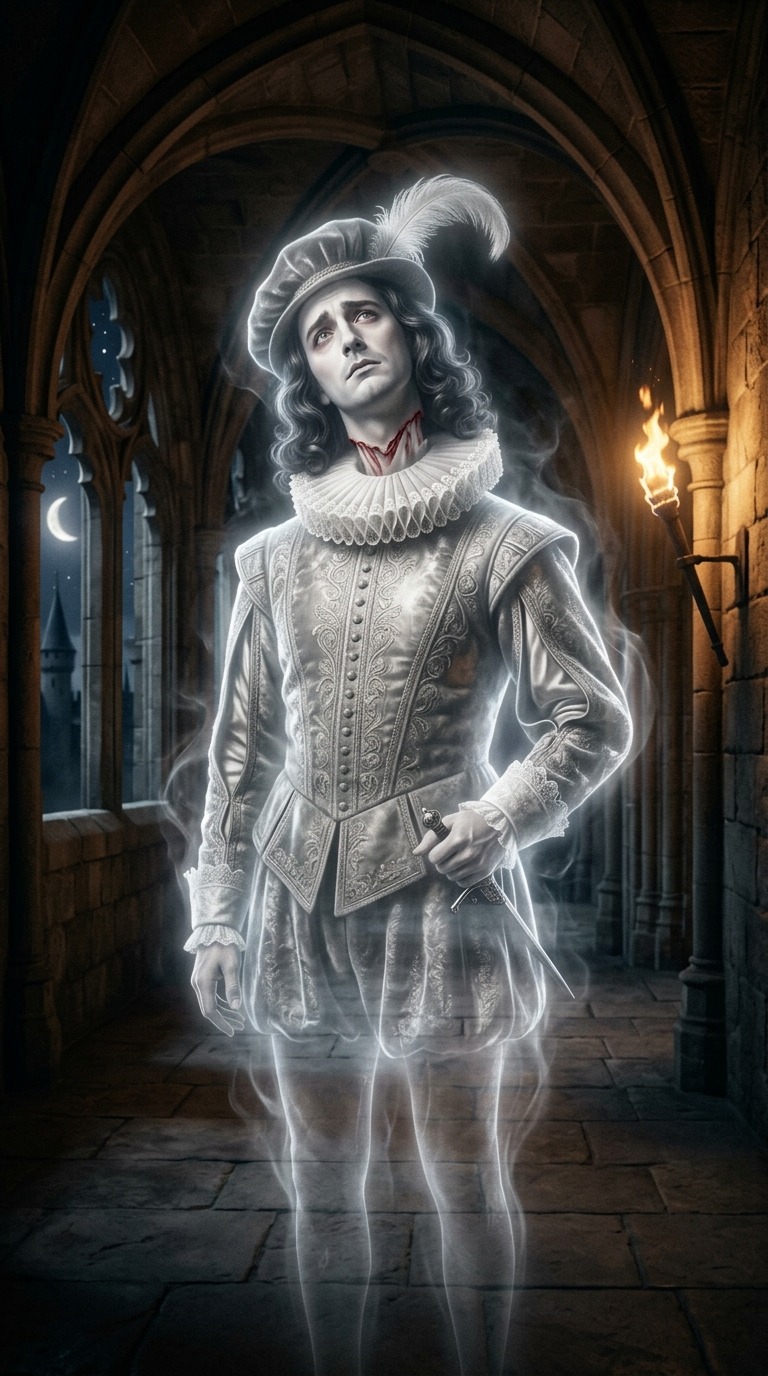
The Gryffindor house ghost was executed on the 31st of October, 1492, which makes his deathday neatly identical to the date on which, five centuries later, James and Lily Potter would be killed. He attended Hogwarts as a student, and at some point afterwards took up residence at the court of Henry VII, where he moved in the orbit of a lady-in-waiting named Lady Grieve. Attempting to magically improve her teeth, he instead caused her to sprout tusks. He was stripped of his wand and sentenced to death.
The executioner’s axe was blunt. Forty-five strokes later, Nick’s head remained attached to his neck by a half-inch of skin and sinew, which is why he is nearly rather than entirely headless, and which is also why the Headless Hunt keeps rejecting him. Sir Patrick Delaney-Podmore, leader of that group, maintains that a head still partially attached disqualifies the bearer from membership. Nick, five centuries on, still minds.
He is pompous, easily wounded, and deeply invested in the social hierarchy of the dead. He prefers his full title, ‘Sir Nicholas,’ which almost nobody uses. He wrote a ballad about his own execution. When Harry corners him after Sirius’s death to ask whether Sirius might return as a ghost, Nick explains, with real weariness, that becoming a ghost is not a reward but a consolation prize: a feeble imitation of life, chosen by wizards who were afraid.
The Fat Friar
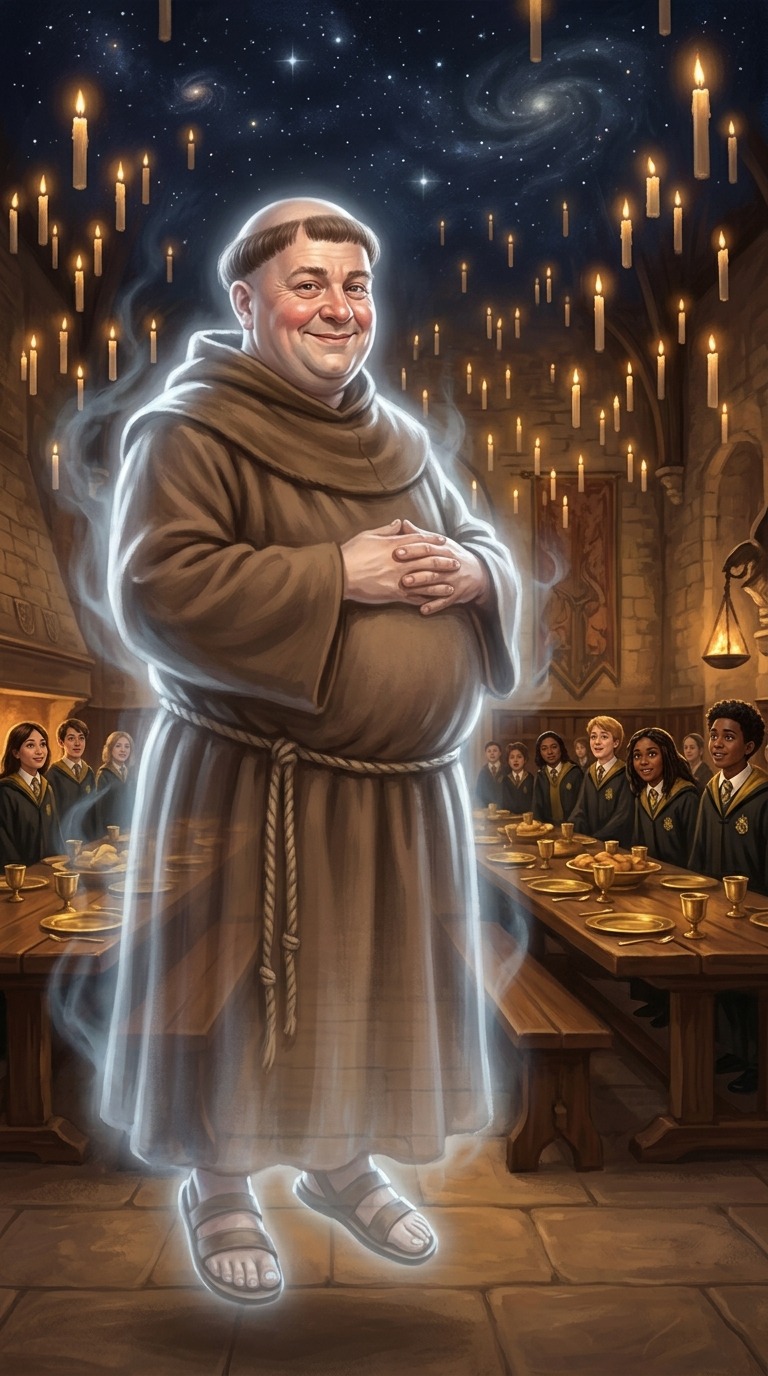
Hufflepuff’s house ghost was a tenth-century friar whose gentleness turned out to be a professional liability. He had a knack for curing the pox by poking the afflicted with a stick, and an even more unusual habit of pulling live rabbits out of the communion cup. Senior churchmen, unable to account for either trick and disinclined to try, had him executed. He has been cheerful about it ever since.
Of the four house ghosts, the Friar is by a long margin the most agreeable. He is the ghost who greets first-years at the sorting feast with an actual smile, who lobbies tirelessly at the ghost council for Peeves to be allowed a second chance, and a third chance, and a fourteenth chance, and who, per Rowling’s Pottermore writing, still nurses one small grievance from his living years: he was never made a cardinal. Everything else he seems to have let go.
He has no known first name. He has no given surname. He has no dramatic love affair, no betrayal, no unfinished business that anyone has ever been able to identify. He is simply a medieval clergyman who was killed for doing magic in front of people who did not know it was magic, and who then came back to work in a school. Among ghosts whose defining trait is regret, he is the exception. He appears to be genuinely pleased to still be here.
The Grey Lady (Helena Ravenclaw)
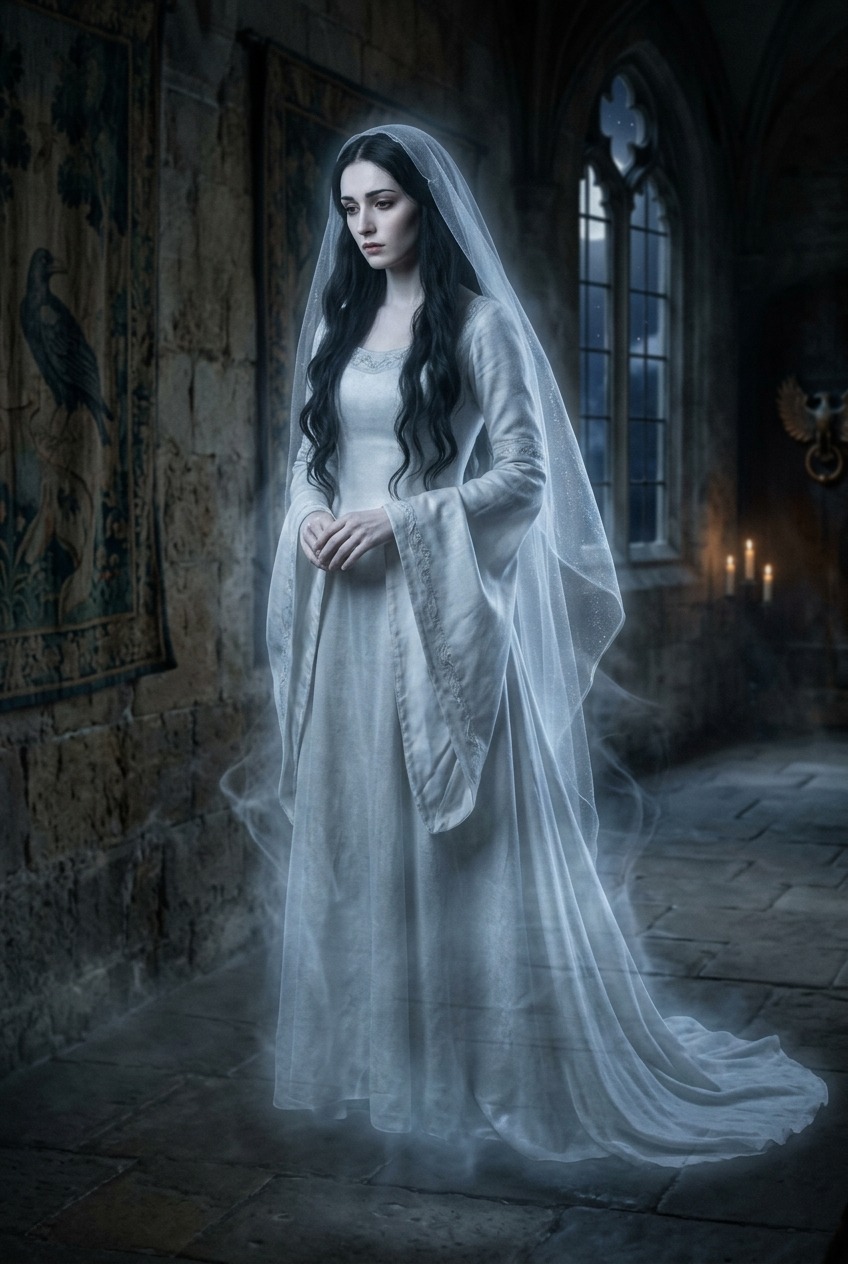
Harry passes the Grey Lady in the corridors for six years before he learns who she is. She is long-haired, beautiful, aloof, and the least talkative of the house ghosts. In Deathly Hallows, during the lead-up to the final battle, she tells him everything. She is Helena Ravenclaw. She is the daughter of Rowena Ravenclaw, co-founder of the school. And the story she has spent a millennium not telling is the kind of story that explains several other things all at once.
Envious of her mother’s brilliance, Helena stole Rowena’s diadem, an enchanted tiara said to enhance the wisdom of its wearer, and fled to a forest in Albania. Rowena, dying, sent the only person she believed could find her daughter: a man who had loved Helena and been rebuffed. When he caught up with her, Helena refused to return. He stabbed her. Then, seeing what he had done, he stabbed himself. The diadem remained hidden in a hollow tree in the Albanian forest where she died.
Centuries later, Tom Riddle charmed the story out of her. He found the diadem, turned it into a Horcrux, and hid it back inside Hogwarts. Helena tells Harry all of this in a single long conversation in a corridor, including the location. Her mother’s theft, her own murder, and the entire sixth Horcrux turn out to be the same story. She has been carrying it alone.
The Bloody Baron
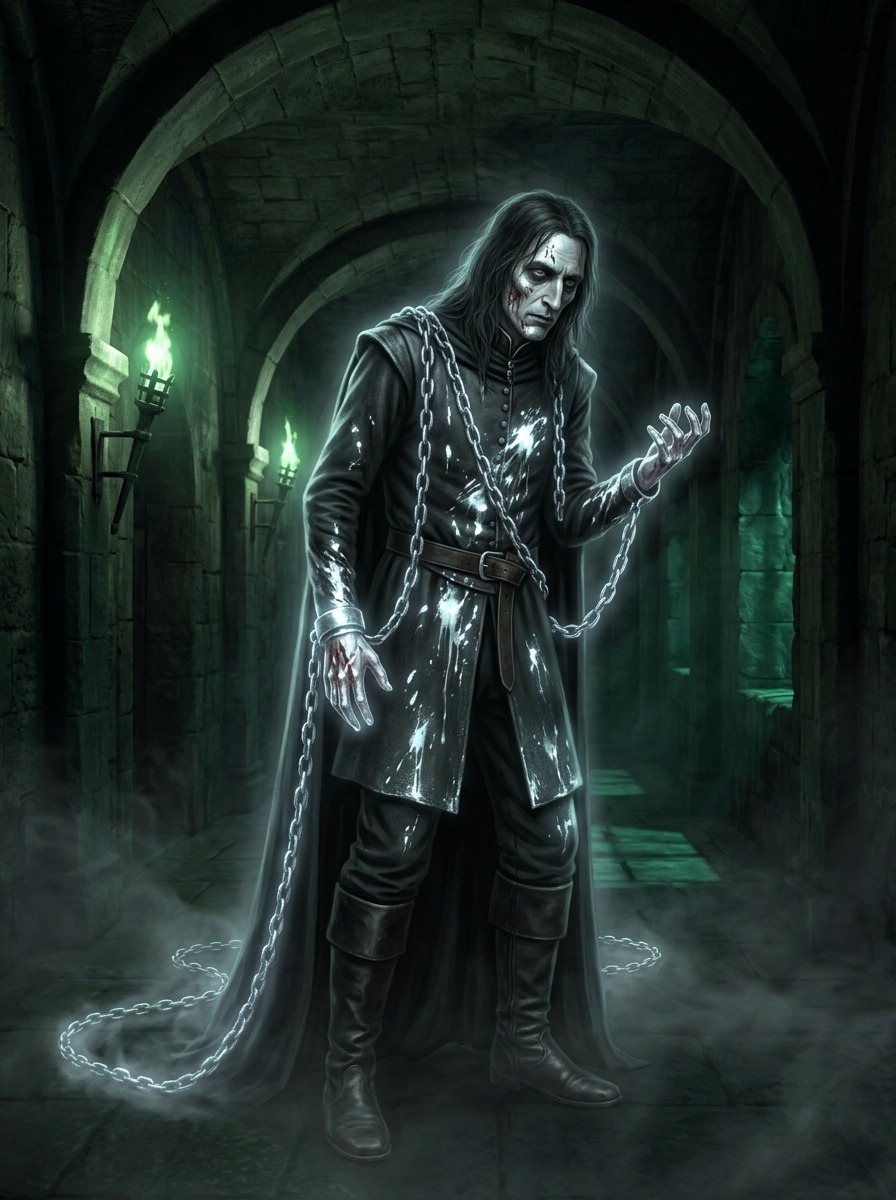
The man who killed Helena Ravenclaw is Slytherin’s house ghost. He is gaunt, silent, covered in silver bloodstains, and wrapped in chains he has worn for a thousand years as penance. Students of his own house avoid him. Other ghosts give him a wide berth. Even Peeves, who respects no one, is afraid of him, which makes the Baron the only functional check on the poltergeist’s behaviour in the castle.
His killing of Helena was followed immediately by his killing of himself, with the same weapon, in the same forest, in the same hour. Both came back as ghosts. Rowling’s rule for who stays is not about how you died but about what you cannot put down - fear, guilt, regret, an unwillingness to move on. Helena stayed for the theft. The Baron stayed for the murder, and the chains are what that looks like from outside. Helena, when she finally tells Harry the story, describes them as ‘an act of penitence,’ then adds, with a millennium of unresolved feeling behind it, ‘as he should.’
He appears very little in the books. A bloodstained figure at the Sorting Feast. A distant presence called upon when Peeves needs subduing. A silent rider in the corridors. For a character who drives the entire origin of the fifth Horcrux, he speaks, in seven novels, almost not at all.
Professor Cuthbert Binns
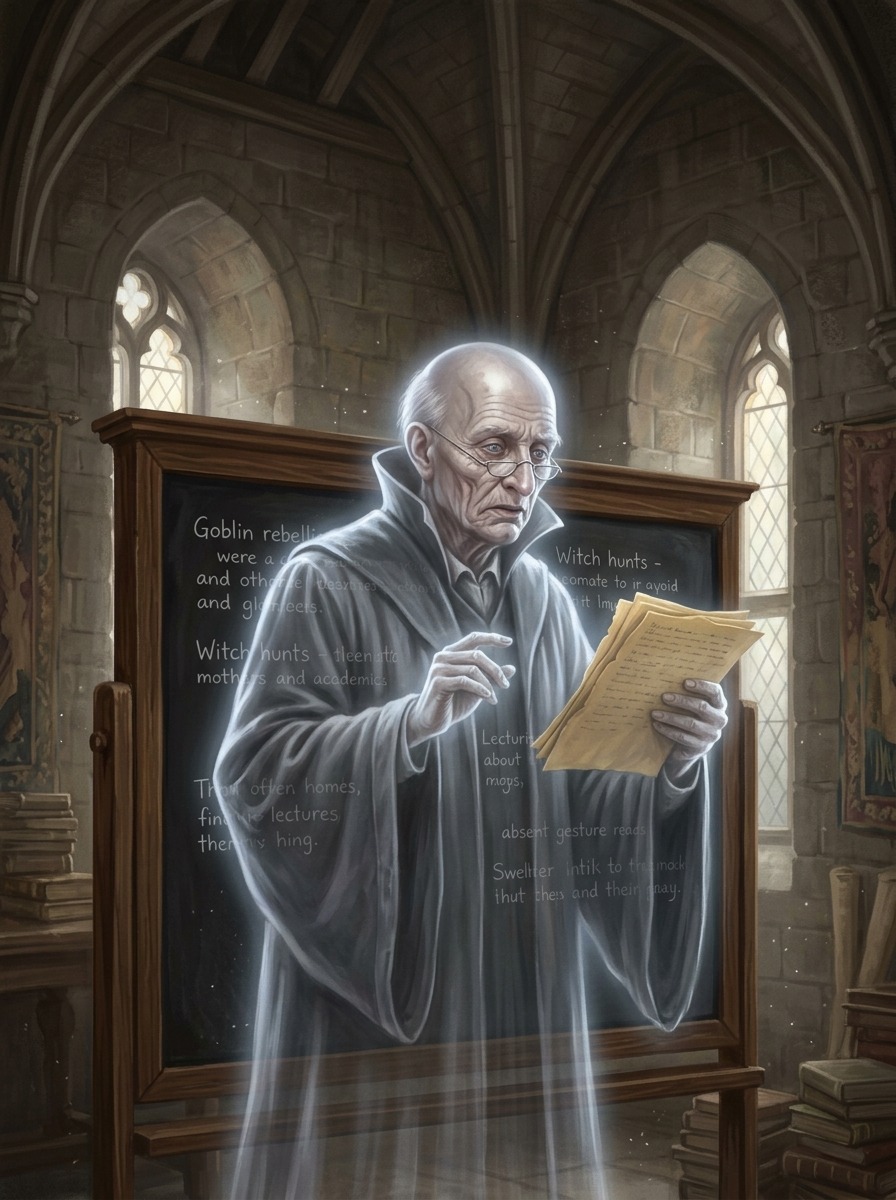
Binns is the only ghost on the Hogwarts faculty, and the circumstances of his transition into one are the kind of thing that happens only to people who were already halfway there in life. One evening, well into a great age, he sat down in front of the staff-room fire to rest. He fell asleep. He died. The next morning, at the usual time, he got up, left his body behind in the chair, and went to teach History of Magic. He has been teaching it ever since.
Whether he noticed what happened is a matter of some debate. Rowling has left the question open. He now enters the classroom by floating through the blackboard, which would seem difficult to overlook, but he has never acknowledged it, and he continues to lecture as if nothing has changed. His voice is described in the books as a flat drone like an old vacuum cleaner. He has difficulty remembering students’ names. He reads from notes that have not been updated in the memory of any living wizard.
In the entire seven-book series he deviates from his lesson plan exactly once, when Hermione persuades him to tell the class the legend of the Chamber of Secrets, which he does under protest because he deals in facts, not stories. The inspiration, Rowling has said, was one of her own university professors, who lectured with his eyes closed, rocking slightly on his toes.
Moaning Myrtle (Myrtle Elizabeth Warren)
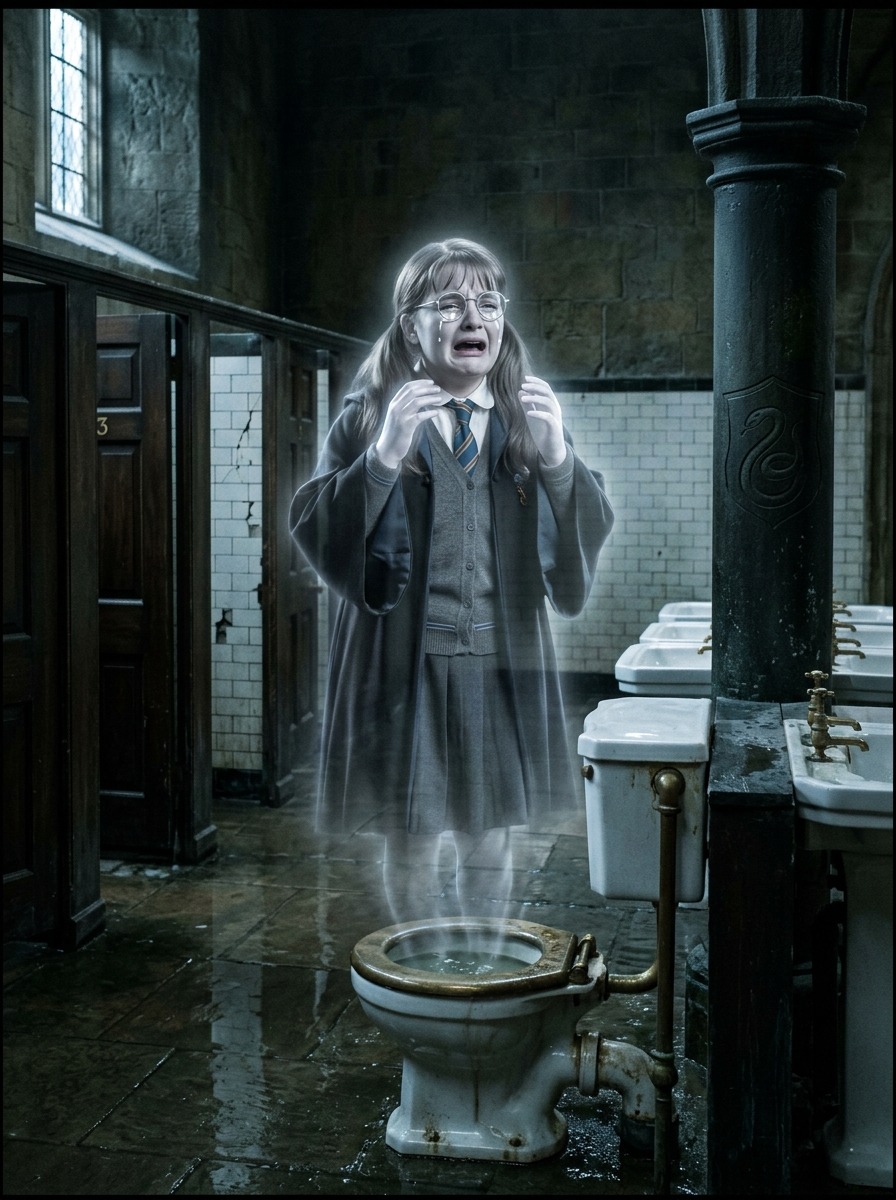
Myrtle Warren was a Muggle-born Ravenclaw student who died in a second-floor girls’ bathroom in June 1943. She had been hiding there, crying, because a classmate named Olive Hornby had been making fun of her glasses. She heard a boy’s voice. She opened the cubicle to tell him to go away. She saw a pair of enormous yellow eyes. She died instantly. Tom Riddle had opened the Chamber of Secrets; Myrtle was the Basilisk’s first kill, and the death he used to turn his diary into a Horcrux.
Her bathroom is also where the trio secretly brewed Polyjuice Potion in second year.
She spent her first few years of afterlife stalking Olive Hornby in what appears to have been genuine and unrelenting malice, eventually disrupting Olive’s brother’s wedding. The Ministry intervened and ordered her back to Hogwarts, where she has haunted the same bathroom for over fifty years. She is theatrical, self-pitying, jealous, and easily wounded, which Rowling has said was the point. Myrtle died at about thirteen and is still about thirteen. She has simply been thirteen for longer than anyone else.
She shows Harry the entrance to the Chamber in his second year, helps him solve the Triwizard egg clue in his fourth, and becomes Draco Malfoy’s reluctant confidante in his sixth, listening to him weep over a sink while he tries to work himself up to murder. She plays a larger and more consequential role in the series than any other Hogwarts ghost, including Nick.
Sir Patrick Delaney-Podmore
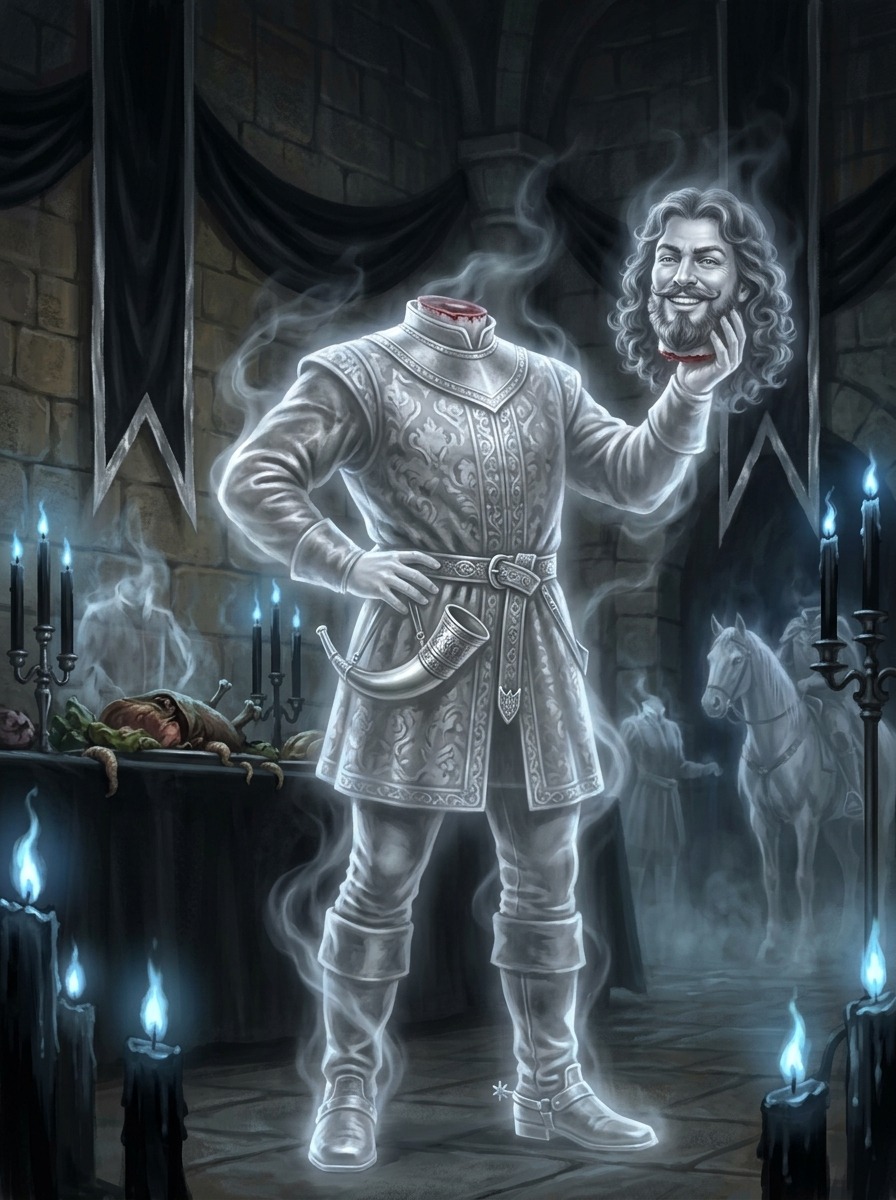
The leader of the Headless Hunt is not a Hogwarts resident. He is a ghost from elsewhere, a visitor, and the only reason he appears in the list at all is that he turns up at Hogwarts events often enough, and talks about himself loudly enough, to have become part of the furniture. He is also the reason Nearly Headless Nick is miserable.
The Headless Hunt is exactly what it sounds like: a mounted club for the properly decapitated, who ride through castles on ghostly horses and amuse themselves with games like Head Hockey and Head Polo, in which a severed head is passed around in place of a ball. Nick has been applying to join for five centuries. Sir Patrick has been turning him down for five centuries, on the grounds that Nick’s head is still attached to his body, which disqualifies him under the Hunt’s founding bylaws. Sir Patrick lets his own head roll off in front of Harry at Nick’s five-hundredth Deathday Party, partly to demonstrate the skill and partly, one suspects, to make a point.
The Deathday Party is almost certainly the high point of Sir Patrick’s social calendar, because he arrives to celebrate Nick’s anniversary, upstages him completely with the Hunt’s entrance, starts a game of Head Hockey halfway through Nick’s speech, and takes the crowd with him. He is an excellent example of the central Bryson-friendly truth about ghosts, which is that death does not improve anyone’s manners.
The Wailing Widow
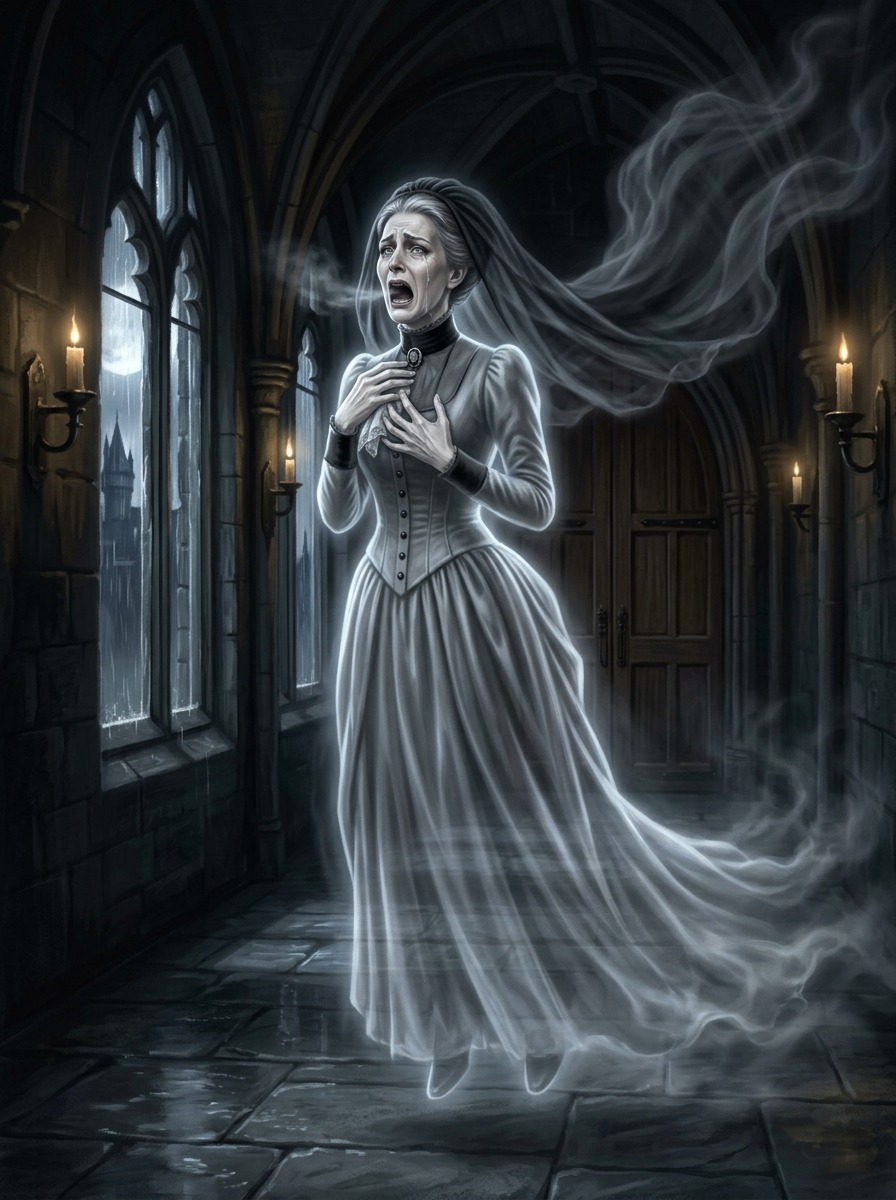
The Wailing Widow appears in a single chapter of a single book, is mentioned exactly twice, and is never given a full name, a first name, or any backstory whatsoever. She is a ghost from Kent. She travels to Hogwarts for Nearly Headless Nick’s five-hundredth Deathday Party. Nick, who has spent weeks planning the event and is monitoring the turnout with some anxiety, mentions her arrival to Harry with visible pride. ‘The Wailing Widow came all the way up from Kent,’ he says. This is as much as anyone ever learns.
She presumably wails. The Kent connection presumably matters to her. She is presumably a widow, though whether she died widowed or became widowed post-mortem is left entirely to the reader. What she does at the party, whom she speaks to, when she returns to Kent, and whether Nick writes her a thank-you note afterwards are all unrecorded.
She makes the list for one reason, which is that she is the only non-resident ghost in the entire series who travels to Hogwarts specifically because a Hogwarts ghost invited her. Every other named ghost either lives there or arrives as part of a group. The Wailing Widow came on her own, from Kent, for a man’s 500th death anniversary, because he asked her to. It is one of the more quietly touching details in Chamber of Secrets, and one that nobody who reads it quickly tends to notice.
Peeves
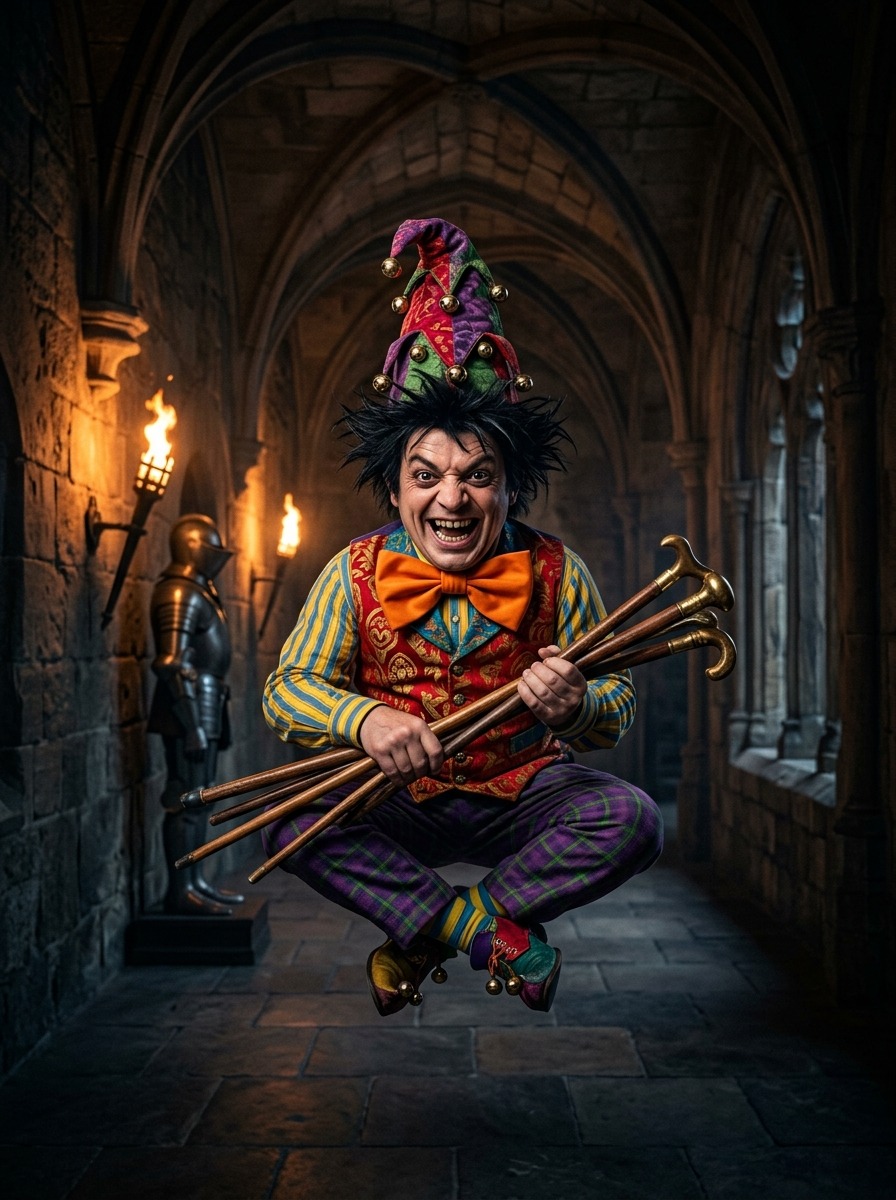
Peeves is not a ghost. This should be said first, because every source in the canon is unanimous about it and because it is the single most important piece of information about him. He was never alive. He did not die. He is, in Rowling’s own words, an ‘indestructible spirit of chaos,’ a poltergeist rather than a ghost, and he has existed in the castle since Hogwarts was built in roughly 993 A.D. The school, in this reading, spontaneously generated Peeves out of the concentrated mischief of its own adolescents, the way a swamp generates gas.
He is short, mean, airborne, and dressed in a belled hat. He throws things. He sings insulting songs. He floods bathrooms, unscrews chandeliers, pelts Moaning Myrtle with mouldy peanuts, and composes an extended poem during Chamber of Secrets called ‘Oh, Potter, you rotter.’ The only beings he consistently fears are the Bloody Baron and Albus Dumbledore. In Order of the Phoenix, when Fred and George Weasley flee Hogwarts on broomsticks and call out, ‘Give her hell from us, Peeves,’ he sweeps off his hat and salutes them. It is the first time Harry has ever seen Peeves take an order from a student.
He is included here because the Hogwarts ghosts, reluctantly and collectively, take responsibility for him. He attends their councils. He goes to Nick’s Deathday Party. Whatever he technically is, the castle clearly regards him as one of their own. Even Professor McGonagall, in the right circumstances, has been known to help.
Frequently Asked Questions
How many ghosts are there at Hogwarts in total?
About twenty. Philosopher’s Stone counts them at the Sorting Feast, when they stream through the back wall of the Great Hall, pearly white and slightly transparent, and glide across the room talking among themselves. The ghosts also keep a council of their own, which votes on whether Peeves may attend a feast.
Who is the Grey Lady in Harry Potter?
The Grey Lady is Helena Ravenclaw, daughter of the Hogwarts founder Rowena Ravenclaw. She stole her mother’s diadem, fled to Albania, and hid it inside a hollow tree. She kept the story to herself for a thousand years, then told Harry the whole of it in Deathly Hallows.
Why is Nearly Headless Nick only nearly headless?
The axe was blunt. It took forty-five strokes at Nick’s neck on 31 October 1492 and still left half an inch of skin and sinew holding his head on. He had been condemned after a spell meant to straighten a lady-in-waiting’s teeth gave her tusks instead.
How did Moaning Myrtle die?
A basilisk killed her in June 1943. Myrtle Elizabeth Warren, a Ravenclaw student, was crying in a second-floor bathroom when she heard a boy’s voice, opened her cubicle to tell him to leave, and met the creature’s eyes. Tom Riddle used the murder to turn his diary into a Horcrux.
Is Peeves a ghost?
No. Peeves is a poltergeist rather than a ghost, solid enough to throw things and unscrew chandeliers, which no house ghost can do. Rowling has said Dumbledore simply cannot get rid of him: “Peeves is like dry rot. You can try and eradicate it. It comes with the building.”
Why does the Bloody Baron wear chains?
They are penance for killing Helena Ravenclaw. He was sent to bring her home from Albania, stabbed her when she refused, then turned the blade on himself. Helena, telling Harry about the chains a thousand years later, calls them “an act of penitence” and adds, flatly, “as he should.”
Is there a ghost teacher at Hogwarts?
Professor Cuthbert Binns, who teaches History of Magic, is the only member of staff who is a ghost. He fell asleep in front of the staff-room fire at a great age, died there, and got up the next morning to teach, leaving the body in the chair.
What is the Headless Hunt, and why will it not let Nearly Headless Nick join?
The Headless Hunt is a riding club for fully decapitated ghosts, who play games like Head Hockey with a severed head in place of a ball. Its leader, Sir Patrick Delaney-Podmore, admits only huntsmen whose heads have parted company with their bodies. Nick has been applying for five centuries.
Sources
- J.K. Rowling, ‘Hogwarts Ghosts’ essay on Wizarding World / Pottermore
- Harry Potter and the Chamber of Secrets, Chapter 8 (‘The Deathday Party’) – primary source for Sir Patrick Delaney-Podmore, the Wailing Widow, and the assembled ghosts of Hogwarts
- Harry Potter and the Deathly Hallows, Chapter 31 (‘The Battle of Hogwarts’) – primary source for the Grey Lady’s identity as Helena Ravenclaw
- Harry Potter and the Order of the Phoenix, Chapter 29 – primary source for Peeves saluting Fred and George Weasley
- Harry Potter Lexicon
- The Harry Potter Wiki