Every Space on the Original 1904 Landlord's Game Board
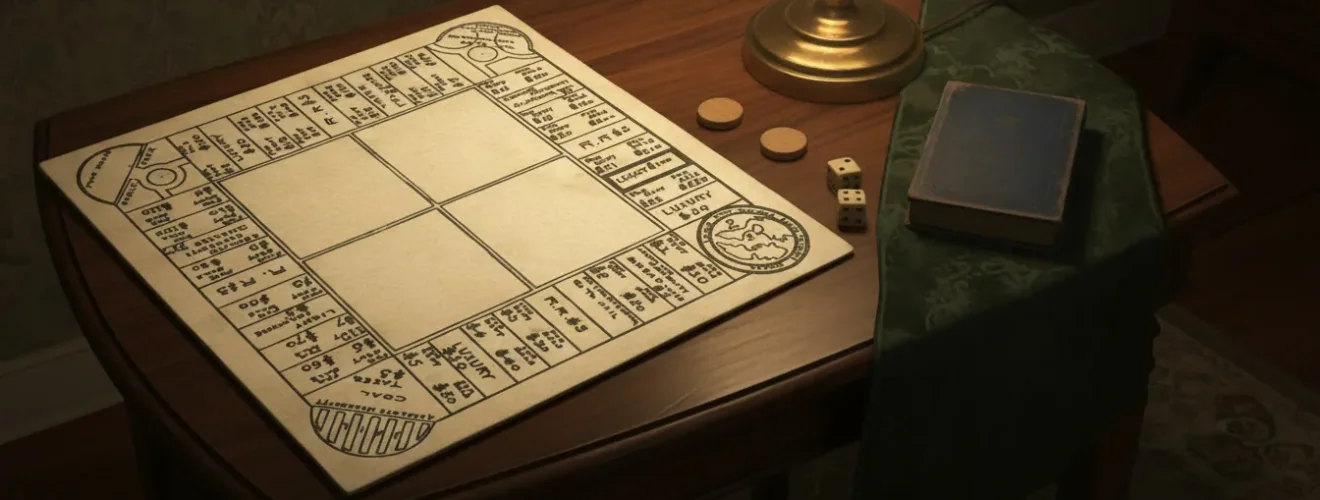
The 1940 census records Lizzie Magie’s occupation as ‘maker of games’ and her income from that trade as $0. She worked as a stenographer and typist at the Dead Letter Office in Washington, D.C., the depot for the nation’s undeliverable mail, and spent her own time inventing a board game meant to explain why the poor stayed poor. ‘In a short time, I hope a very short time,' she said, ‘men and women will discover that they are poor because Carnegie and Rockefeller, maybe, have more than they know what to do with.' The game was The Landlord’s Game, and the patent she won for it – No. 748,626, dated the fifth of January 1904 – carries a complete drawing of a board that millions of people would later swear they had played, under another name.
The family resemblance is not a resemblance; it is a skeleton. Parker Brothers’ game deals all 28 Monopoly properties and their real Atlantic City locations onto a frame of 40 spaces – 22 streets, 4 railroads, 2 utilities – and Magie’s drawing walks 40 spaces carrying 22 lots, 4 railroads and 2 franchises, 31 years earlier. Charles Darrow copied his version from her game’s descendants and sold it to Parker Brothers in 1935; the company also bought Magie’s patent – by then a 1924 successor to this one – for $500. Monopoly went on to sell 278,000 copies in its first year and more than 1,750,000 the next. Magie’s end of it stayed $500.
What follows is the 1904 patent board itself, space by space, walked in order from the starting corner. The patent never states the direction of play – there is no arrow on the board and no sentence in the rules – so the ascending lot numbers are the compass, and this walk follows them. No complete space-by-space accounting of the board seems to exist anywhere, which for the board Monopoly was built on is a strange kind of neglect. The walk starts where the wages are.
The board of Lizzie Magie’s 1904 Landlord’s Game patent (U.S. Patent 748,626, granted January 5, 1904) has 40 track spaces: 22 numbered lots, 4 railroads, 4 Absolute Necessity tax spaces, 3 Luxuries, 2 franchises, 2 No Trespassing spaces, plus Legacy, Mother Earth, and Public Park – 9 spaces per side between 4 corners.
Mother Earth (starting corner)
Every circuit of this board ends where it began, under a hand-drawn globe ringed by the legend LABOR UPON MOTHER EARTH PRODUCES WAGES. That, plus a small sideways numeral 2 the spec never explains, is the corner’s entire text. No dollar figure appears on it anywhere: the $100 in wages a player collects after passing the beginning-point lives only in the written rules, which is worth remembering the next time someone tells you this corner paid $200 for passing GO. Wrong board, wrong figure, right idea.
The pieces doing the passing were checkers. The specification lists four of them among the game’s implements, drawn on the patent’s second sheet as a plain disc, and the 1906 published rules still opened play with each player selecting one. Monopoly traded that modesty for die-cast battleships and top hats, then spent decades culling the herd – the Monopoly tokens that have since been retired include the iron, voted out in 2013 in favor of a cat. Magie’s players pushed a checker and, the spec says, performed ‘so much labor upon mother earth’ with every lap.
Each completed circuit is checked off on a tally-sheet, and the wages have a ceiling: after a player passes the beginning-point a fifth time, the pay stops, and the game itself ends the moment the last player crosses for the fifth time. A board with no finish line still manages to finish here.
Lot 1
Only one property in the whole rulebook gets called out by its number. The rent-splitting paragraph – a second arrival on an occupied lot pays the incumbent half rent – closes with a flat exception: ‘In case of lot 1 the player gets the whole rent.' Half of one dollar defeated even Magie’s appetite for fractions, so the tenant here keeps all $1 of it.
The cell prints FOR RENT $1 and FOR SALE $10, and those two figures legislate the entire property market. Every lot’s rent is its number and every sale price is ten times its rent, an unbroken staircase running from this cell to Lot 22’s $22 and $220. No exceptions, no names, no need for a rulebook page per property: the pattern is the whole system, and it starts at a dollar. The 1906 edition, for what it is worth, abolished the splitting rule this lot was the exception to – every occupant there simply pays what the space demands.
What Lot 1 cannot do is host the game’s first landing. Play opens beside it with a throw of paired dice, and a pair cannot roll a one, so the opening move of every game ever played sails straight past the board’s cheapest ground. The most affordable lot on the board is also, on turn one, unreachable – which seems about right for real estate.
Absolute Necessity – Bread
Double 1s, the smallest throw a pair of dice allows, carries the opening move exactly two spaces – onto a cell lettered ABSOLUTE NECESSITY / BREAD / TAXES $5. The earliest landing this game can produce is a bread tax.
Bread heads the specification’s list of life’s non-negotiables, ‘bread, coal, shelter, and clothing,' four spaces spread around the walk, each collecting $5 from whoever stops on one, each colored ‘preferably blue.' Then, mid-rule, the patent drops in its own footnote: '(This represents indirect taxation.)' A game that annotates its rules with economic theory is a game with an agenda, and the Public Domain Review names it – the design existed ‘to teach and proselytize the principles of Georgism.' The board grades you while you play it.
The $5 goes to the Public Treasury, the communal till, so a hungry player is at least funding the commons. Monopoly kept the compulsory-payment square and quietly dropped the philosophy behind it. Bread is also the only necessity among the nine cells of the board’s opening side; its classmate Coal takes the corner at the foot of the same side, promoted to real estate the others never got. Some charges on this board can be refused. A bread tax is not among them.
Lot 2
Between a bread tax and an order to jail sits two dollars’ worth of real estate. Lot 2’s neighbors preach at it from both sides – ABSOLUTE NECESSITY behind, NO TRESPASSING ahead – while the lot itself just prints FOR RENT $2 and FOR SALE $20 and waits for a tenant. On the board’s morality tour, this is the ground floor of honest landlording.
The specification colors the lots ‘preferably green,' marking the property class by eye three decades before Monopoly sorted its streets into color groups, and the green begins in earnest here: the right side is the board’s bargain aisle, lots 1 through 5 in ascending order as you walk. Lot 2 also splits cleanly, which matters in this rulebook: a second player stopping on an occupied Lot 2 owes the first exactly $1, half the printed rent, no fraction for the spec to adjudicate.
Whoever draws its ticket in the opening deal may buy the lot before the first throw, or return the ticket and take his chances on the walk. Either way the arithmetic stays gentle. One circuit’s wages buy the whole lot five times over – $20 against the $100 a single pass of the starting corner pays.
No Trespassing – Go to Jail (right side)
Sit in jail until you throw a double, or pay a fine of fifty dollars: the terms attached to this cell in 1904 are the terms Monopoly players are still negotiating today. Both exits survived, same $50 – Monopoly only added the Get Out of Jail Free card.
The cell reads NO TRESPASSING / GO TO JAIL, and the specification explains the crime: these spaces ‘represent property held out of use.' Walk onto idle land and you are the trespasser; the landlord is nowhere on the board, and you are in jail. The National Women’s History Museum notes the phrase was on Magie’s board three decades before Parker Brothers manufactured its game. No figure is printed on the cell – the fifty-dollar fine, like the wage, exists only in the written rules – and release comes with its own geometry: ‘When he comes out, he must count from the space immediately in front of the jail.'
There is no visiting on this board. Landing here is itself the offense, and the mercy Monopoly later extended to bystanders has no 1904 counterpart. Jail also polices the game as a whole: the Emergencies paragraph sends any player who ‘absolutely refuses to obey the rules’ to the same jail on the same terms. Magie wrote a rule for sore losers, and it is the jail rule.
R. R. (right side)
‘Gets a pass’ is the specification’s own phrase for what a double earns you here, and it means a literal railroad pass: the thrower may jump once from one railroad to the next, provided his ordinary move would carry him past one. Free transportation, with a catch worthy of an actual railway – ‘If he stops upon it, however, he must pay five dollars.' The ride is free only while it keeps you moving.
The fare is the whole business model. Nobody owns this railroad; every $5 collected here travels to the R. R. box at the board’s center, the house’s own railway account, and no rule exists for putting the line in private hands. R. R., the spec offers, ‘represents transportation’ – the entire explanation the class receives. This cell is lettered R.R.$5, and of the four railroad cells it is the only one whose lettering closes with a trailing period, a distinction visible at 600 dpi and cherished by approximately nobody since 1904.
A thoroughly unlucky circuit, stopping on the railroad of every side, hands the box $20 – a fifth of that circuit’s $100 wage gone to train fare. Transportation, as any reader of 1904 newspapers understood, adds up.
Lot 3
Half of three dollars is two dollars, at least on this board. When a second player stops on an occupied lot he owes the first ‘one-half of the rent,' and where the arithmetic breaks, the spec hands the odd fraction to the incumbent – so Lot 3’s tenant collects $2 of a $3 rent and the newcomer keeps the change. The 1906 edition scrapped the whole clause; in 1904 it was still doing its earnest best.
Until somebody buys it, though, Lot 3 earns for everyone. Rent on an unowned lot is paid into the Public Treasury – land income socialized until private hands arrive, the single-tax lesson running quietly under the walk. And the lot has a capacity limit: with two players already standing on it, a third whose throw lands here ‘cannot occupy it’ and must wait on the next space, counting his throw one less. A three-dollar patch of ground with a queue is its own kind of economics lecture.
The deed costs $30, under a third of a single wage circuit, and the ladder’s top lot costs more than two full circuits. Sixth cell of the side, first lot past the railroad, and the last point on the walk where everything still feels affordable.
Lot 4
Twelve tickets change hands before anyone moves. The game opens with all 22 lot tickets laid face down, players drawing in turn until 12 are taken, and every drawn ticket is an option on its lot – buy it on the spot, or toss the ticket back into the wages box. Lot 4 can therefore have a landlord before the first throw of the dice.
Ownership itself was the novelty. Historians of Monopoly credit Magie with introducing the idea of owning a space on a game board, and the mechanics debut here in their original form: $40 into the Public Treasury, a deed laid on the cell, and from then on every $4 stop is income for the owner. With Lot 3 it forms the walk’s first pair of adjacent lots, after an opening stretch that alternated property with a tax, a jail order and a train fare – seven steps out from the corner, dead center of the two-to-twelve range a pair of dice can reach.
At the final count the deeds come off and each owner is credited the full value of his lots, so a held Lot 4 hands its $40 straight back. The rents, it turns out, were the profit all along.
Luxury (right side)
Ten dollars of profit, guaranteed by Letters Patent. A player who stops here may pay $50 to the Public Treasury for a luxury ticket. The ticket ‘counts him sixty dollars at the end of the game’ – the board’s only purchase that promises to come back bigger than it went in.
It is also the board’s one refusable charge, and the refusal is priced: ‘The player may purchase the luxury or not, as he chooses or can afford; but if he does not purchase it he loses his move.' Decline the indulgence and the game takes a turn from you instead. The class is ‘preferably purple’ in the spec’s color scheme. Among the movable pieces of the drawing’s second sheet, the luxury tile appears as item 33, next to a specimen money chip that happens to be a $50 – the price of admission illustrated beside the goods. Two more Luxury cells wait deeper in the walk; this one, ninth space out, is the first temptation.
At the count-up the order is fixed – lots, then cash, then luxuries – and the patent pauses to coach the bookkeeping: ‘remember that each one counts sixty.' Magie, evidently, had met game players before.
Lot 5
Five dollars rents it and fifty buys it. Those happen to be the two sums this board charges for nearly everything else: $5 is the flat toll at every necessity, railroad and franchise, and $50 is the price of a luxury. Lot 5 is where the board’s standard charges settle down and become an address.
It closes the opening side – ninth of the nine cells between the starting corner and the coal corner – and it tops the side’s staircase of rents: $1, $2, $3, $4, $5, in walking order – the five cheapest lots on the board. By the pattern that governs all 22 lots, the rent figure is the lot’s number and the sale figure is ten times it, so the cell needs no name and carries none.
The $50 deed costs exactly a tenth of the $500 every player is issued at the start of the standard game. In the spec’s leaner variant, played without the opening ticket deal and a bankroll of just $100, the same deed swallows half the stake. Same cell, same figures; whether Lot 5 is pocket change or a plunge depends entirely on which economy Magie’s rules have dropped you into.
Absolute Necessity – Coal (corner)
Eleven spaces in, the walk makes its first turn, and the turn is a coal tax. Of the four necessities the specification names – bread, coal, shelter, and clothing – only coal was promoted to a corner: a full quarter-circle of board with ABSOLUTE NECESSITY lettered along its diagonal divider and COAL / TAXES $5 rotated to read across the cell. That makes it the only corner on the board with a dollar figure printed on it.
The outer half of the circle, the bulge beyond the track, is filled edge to edge with broad diagonal hatching – a drawn seam of coal, carrying no lettering at all, the only corner whose outer half is pure picture. The timing of the artwork was not subtle. Magie filed her application on March 23, 1903, exactly five months after the end of the great anthracite strike – 163 days, May 12 to October 23, 1902, a stoppage that threatened the winter fuel supply of American cities and drew the first neutral federal arbitration of a labor dispute. Every player who landed here in 1904 knew precisely what a coal bill felt like.
On the 1906 published board, a different layout, no space says COAL at all – the class there reads FOOD, FUEL, SHELTER, CLOTHING. Coal by name exists only on the patent. A quarter of the circuit done; three corners to go.
Lot 6
Around the corner, the numbers simply keep counting. Historians remember the Landlord’s Game as one of board gaming’s first continuous paths – no finish line, just circuits – and Lot 6 is where that idea first shows its face: the walk rounds the coal corner and the lot ladder resumes at $6 as though nothing had happened.
The cell prints FOR RENT $6 and FOR SALE $60, which gives Lot 6 a mild distinction: it is the only lot whose sale price equals what a luxury ticket redeems for at the final tally. It opens the bottom side, cheapest of the six lots there – the bottom and left rows carry six lots apiece against five each on the right and top. On an opening cast it can be reached only by a five and a six, the one combination of the pair that adds to eleven. Its $60 also pairs neatly across the corner: with Lot 5’s $50 it reaches the bank’s $110 collateral floor for a $100 loan exactly.
The endgame returns the favor of its position. A debt-clear player who has passed the beginning-point five times may walk the board in either direction, and for the reversed walker Lot 6 becomes the last lot before the coal corner – the exact mirror of its opening role.
Lot 7
No opening throw reaches deeper into the board than this. Lot 7 stands twelve steps from the starting corner, and only double sixes get there – the longest first-turn strike the dice allow, onto a cell lettered FOR RENT $7 and FOR SALE $70.
It is also the last ground for sale before the board changes its rules of acquisition. One step ahead sits Light Franchise, where title goes not to the highest bidder but to whoever stops there first, so Lot 7 marks the frontier of the ordinary property market: beyond it, for one cell, money stops mattering. Behind it, Lot 6 makes the second pair of touching lots on the walk, and past the franchise the bottom side returns to its habit of alternating lots with a fare and a tax. Thirteenth space of the walk, second rung of the bottom row, deep in what a 1904 player would have considered the mid-market.
At $70, the deed still cannot stand alone at the mortgage desk – the bank’s smallest loan wants $110 of ground behind it, a bar nothing this cheap clears without company. And the throw that reaches Lot 7 carries a footnote: double sixes sail past the right side’s railroad on the way, and a thrown double, by the railroad rule, earns a pass. The deepest opening strike on the board could have been a free train ride instead.
Light Franchise
Arrival is title here. The first player to stop on Light Franchise plants his charter on the cell and may tax every other player five dollars whenever they stop, for the rest of the game – and the acquisition is free. ‘It costs him nothing,' the spec says, and adds nothing to his score at the final reckoning either. No purchase, no auction, no deed: a public utility turned private tollbooth by pure footfall.
The patent calls its two franchises, light and water, ‘public necessities,' then hands each permanently to whoever happens across it first. They are ‘preferably yellow,' the last of the four class colors, and there are exactly two on the forty spaces – Light here at walk position 14, Water at position 28, fourteen steps apart. The charter itself appears on sheet 2 of the drawings as piece 32, a small tile sitting between the mortgage and the deed – paperwork for a property you cannot buy. Of the board’s flat five-dollar charges, only the franchise toll ends up in a player’s pocket.
No franchise ticket exists in the opening deal, so the race for Light Franchise begins with the game’s first throw. And unlike every deed on the board, the charter never comes off: the spec provides no way to sell, mortgage, or lose a franchise. Whoever gets there first is the light company forever.
Lot 8
‘The quickest way to accumulate wealth and gain power,' Magie told Single Tax Review readers in 1902, ‘is to get all the land they can in the best localities and hold on to it.' The board she patented two years later prices the lesson in ten-dollar steps, and Lot 8 sits mid-ladder: FOR RENT $8, FOR SALE $80, fourth cell of the bottom side, fifteenth space of the walk.
Its neighbors levy the same five dollars with very different manners. The bottom railroad’s fare falls due from the game’s first circuit, no owner required. The Light Franchise on the other side charges nothing at all until some first-arriving rival plants his charter, after which the identical $5 becomes that player’s private income. Lot 8 is the quiet ground between two tollbooths, one public, one waiting to be privatized.
The lettering carries its own small comedy: the bottom row’s figures print sideways relative to the patent page, because the lettering rotates around the track – to read Lot 8’s prices, you turn the sheet a quarter turn. At $80 the lot runs $30 short of the bank’s collateral floor and can never carry a mortgage alone. Held to the end, though, it credits back its full $80 at the count-up – a sixth of the $500 each player started with, earned one $8 stop at a time.
R. R. (bottom side)
Four identical railroads, and no two agree on how to spell themselves. This cell is hand-lettered R. R$5, period after the first R only; the right side’s reads R.R.$5 with both; the left and top settle for R.R $5, one period between the Rs. Three stylings across four functionally identical spaces – and none of them matches the specification’s own text, which prints ‘R. R.', space and both periods, at every appearance. Somewhere between the rules and the drawing board, consistency boarded a different train.
Magie had already published the economics of this cell in 1902, two years before the patent: rail users, she wrote, are ‘obliged to pay their fare, unless they are fortunate enough to possess a pass.' The patent then built both halves into the rules – the five-dollar fare and the thrown double that earns the pass. What the fare buys is passage and nothing else; the money goes to the railroad’s own box among the board’s center squares, not to the Public Treasury that collects the game’s taxes and rents, making this the one recurring charge paid neither to a player nor to the public till.
Second of the four roads, dead center of the bottom row between Lot 8 and Lot 9. For all its five-dollar menace, the cell is lettered more sparsely than any lot around it – no FOR RENT, no FOR SALE. There is nothing on a 1904 railroad to buy.
Lot 9
Single digits end here. Nine of the board’s lots price their rent in one figure, and after this cell – FOR RENT $9, FOR SALE $90 – the ladder turns over to $10 and never looks back. Seventeenth space of the walk, sixth cell of the bottom side, and the first ground a fare-payer reaches after settling with the railroad next door.
Both of its neighbors collect an unconditional five dollars, the railroad’s fare on one side and Shelter’s tax on the other, which makes Lot 9 and Lot 8 the matched pair of lots bracketing the bottom road – twin shelters of ordinary commerce between two obligations. A single circuit’s wage covers the deed outright with $10 to spare (the $100 being a figure of the rules, never of the board), yet at $90 the lot still falls $20 shy of the bank’s $110 collateral bar. Nine rungs up the ladder, and a lot alone still cannot carry a mortgage.
One mercy is built in. A landlord stopping on his own ground owes nothing – ‘of course he pays nothing,' the spec shrugs – so Lot 9’s $9 falls only on visitors. In the final count-up its holder banks $90 toward the sum of lots, cash and luxuries, by which time the wages that once bought it have stopped arriving at all.
Absolute Necessity – Shelter
When the game reached shops in 1906, Bread became Food and Coal became Fuel – but Shelter stayed Shelter, one of only two necessity names to survive the redesign untouched, even as the tax on all four doubled to $10 on that differently drawn board. On the 1904 patent the cell reads ABSOLUTE NECESSITY over SHELTER, with TAXES $5 tucked small beside the name.
It stands eighteenth on the walk, seventh cell of the bottom side, the third necessity a player meets after Bread on the right side and Coal at the corner. The four fall at walk positions 3, 11, 18 and 33 – gaps of 8, 7 and 15 spaces, nothing like the railroads’ metronomic spacing – so the shelter bill arrives on no schedule a player can plan around, which may be the most lifelike thing on the board.
The five dollars goes where the game’s taxes go, the Public Treasury, unlike the equal fare two cells back, which the rules hand to the railroad itself. And the payment buys nothing that lasts: no ticket, no credit, no line in the final tally. Rent ends, fares end, even the jail releases its prisoners, but shelter is owed every time you stop on it, whatever you own. Magie priced the roof over your head at five dollars, forever.
Lot 10
A week of Lizzie Magie’s own wages rented this lot. Its rent is ten dollars – the documented weekly pay she lived on as a stenographer – and its deed price is $100, the exact figure her rules pay for one full circuit of labor around the board (a figure of the written rules; the board itself never prints it). The cell, in other words, carries her own economy: a week’s pay to visit, a circuit’s labor to own.
This is also where the ladder crosses itself. FOR RENT $10 marks the board’s first double-digit rent, and that $10 equals the entire sale price of Lot 1 back at the start of the walk – a half-circuit of inflation, one dollar at a time. The deed swallows a fifth of the $500 each player is dealt at the start, and its $100 price sits at the bank’s exact lending unit while failing, by $10, to secure it – collateral must beat the loan, and Lot 10 lands precisely on it.
Shared occupancy splits the rent into clean fives, $5 from the second arrival to the first. Hold the deed to the end and the count-up returns precisely the $100 that one circuit’s wages once handed over. Land as a week’s labor, banked.
Lot 11
At the mortgage desk, this is where credit begins. The bank lends its $100 only against lots worth ‘at least ten dollars more,' and Lot 11 – FOR RENT $11, FOR SALE $110 – clears that bar with nothing to spare. Every cheaper lot on the board needs a partner to borrow against; this one qualifies alone, the cheapest self-sufficient collateral in the game.
It is the dearest lot on the bottom side and the last space before the board’s one free corner, with Public Park waiting next door – rent country on one side of the line, sanctuary on the other. At walk position 20 of 40 it closes the first half of the circuit, and the ladder’s geography turns out to be tidy: lots 1 through 11 line the right and bottom sides, the walk’s entire first half, while 12 through 22 wait on the climb home. The cheap half of the board is behind you at Lot 11; everything from here on costs more.
With Lot 10 it forms the bottom row’s second run of adjacent lots, a small stretch of uninterrupted rent between Shelter’s tax and the corner. Whoever holds the deed when the fifth circuit closes counts $110 in the final tally – top money on the bottom side.
Public Park (corner)
Halfway around the board, the game stops charging. The rule for this corner is a single sentence – ‘A player may stop in the “Public park” without paying anything’ – and the space itself is one of the patent’s celebrated anticipations: a Public Park on the board three decades before Free Parking existed to be compared with it.
The drawing gives the corner a double life. A straight diagonal band cuts the circle in two. PUBLIC and PARK sit lettered on the track half around a small inner circle, and along the outer crescent, beyond the band, arcs a second name: POOR HOUSE. Magie had promised exactly this to readers of the Single Tax Review in 1902 – a ‘nice little poor house off in one corner’ – and in her 1902 telling its resident might ‘tarry until he makes a lucky throw or until some friend takes pity on him.' The crescent sits off the walking ring entirely, past the band, a named place looking in on the park.
At 20 spaces out of 40 this is the walk’s halfway turn, diagonally opposite Mother Earth, flanked by the dearest lots of their rows so far – Lot 11 at $110 behind, Lot 12 at $120 ahead. When Smithsonian sketches this board for modern readers, it reaches for exactly two corners: ‘set between corners labeled “Go to Jail” and “Public Park.”' The punishment corner, and this one.
Lot 12
Rest ends one step past the corner. The first cell a player meets on leaving the free bench of Public Park is a rent demand – FOR RENT $12, FOR SALE $120 – and the game’s teaching engine turns back on: rent flowing to whoever holds a deed was the whole demonstration, a design built, as Wikipedia puts it, to show how rents enrich property owners and impoverish tenants. The park was the exception. This is the rule.
Lot 12 opens the left side’s run of six lots, numbers 12 through 17, a load matched only by the bottom row’s six, and it stands at stop 22 of the circuit, just past halfway. Its number carries a small coincidence the rules never remark on: twelve is the pre-draw’s stopping count, the deal ending the moment twelve of the 22 lot tickets have been taken – so a game’s worth of opening deeds and this lot share a figure.
Everything else about it is the class in miniature: preferably green, sold at the higher printed figure or rented at the lower, ticket in the face-down deal like the rest. A bare number is all the 1904 cell ever says of itself. Named streets belong to the published editions, whose top properties were Broadway, Fifth Avenue and Wall Street – this ground never got a name, only a price.
Luxury (left side)
A pair of aces – the shortest legal throw on the board – carries a player from the free corner straight onto this $50 temptation. Two cells into the left side, wedged between the $120 and $130 blocks, the board’s second LUXURY interrupts the lot ladder almost before the walk has resumed.
This is the middle luxury of three, at stop 23, after the right side’s and before the one waiting at the walk’s very end – three sides carry one apiece, and the bottom side alone offers none. The class kept its color through the redesign: ‘preferably purple’ in the patent, and dealt as a purple card in the 1906 edition. What inflated was the price. On that later, differently drawn board the indulgence cost $75 and counted $100 at the end – the 1904 version’s $50-for-sixty terms turned out to be the bargain era of luxury.
The drawing has its own quiet joke. The luxury ticket in Fig. 2, reference 33, is a plain tab lettered LUXURY with no figure on it anywhere – the sixty-dollar redemption lives only in the specification’s text, so the ticket that certifies the game’s shrewdest purchase is, on its face, blank. A player fresh from the park’s free bench can decline it, of course. The move that lands him at stop 24 will cost him a turn.
Lot 13
Thirteen outruns the dice. Two of them show at most twelve, so Lot 13 – FOR RENT $13, FOR SALE $130 – is the first lot whose rent exceeds anything a single throw of the pair can total. From here to the top of the ladder, the numbers on the ground beat the numbers in the shaker.
It stands third along the left side, stop 24 of the walk, a $130 deed queued directly behind a $50 indulgence, and thirteenth of the 22 by price – the second rung of the ladder’s upper half. Its odd rent quietly hands the incumbent the better half, $7 of the $13, under the fraction rule the board’s even lots never wake. And directly across the board, in the matching third-cell berth on the right side, sits Lot 2: a $20 deed staring at a $130 one, the same address at six and a half times the price.
What Lot 13 will never do is grow. When the deeds come off at the counting-up, it credits its holder the same $130 it cost, because lots appreciate nothing in this game – rent is their entire career. Only the luxuries come back bigger than they went in, and one of them is sitting next door, blank-faced, one step back down the walk.
Lot 14
One door from the fare stand, the left side offers its mid-priced ground: FOR RENT $14, FOR SALE $140, the last deed before the side’s railroad. A $140 investment with a $5 tollbooth for a neighbor sounds like a liability, but the geometry runs the other way – no mover leaving Lot 14 can be caught by that railroad, because the shortest throw is a two, which sails past the fare cell to Lot 15 or beyond. The train next door collects from everyone except the people who live here.
The cell sits at stop 25 of 40, five-eighths of the circuit out from Mother Earth, fourth cell of the left side and third deed of its six-deed run from $120 to $170, squarely in the ladder’s middle band. Its opposite number across the board is the right side’s mid-row No Trespassing cell, sitting in the identical fourth berth of its own row. Lot 14 faces one of the two spaces that send players to jail – honest rent staring down the room with no landlord.
And it earns its keep in a crisis. Mortgaged to the bank, the $140 deed covers the full hundred-dollar loan with $40 of headroom – a player one bad circuit from the poorhouse can still raise money here, which is more than the railroad beside it ever did for anyone.
R. R. (left side)
By 1906 this bare cell had four names to choose from. The patent letters it R.R $5 and nothing more; the published edition two years later dealt its railroad class out as the Royal Rusher, the Gee Whiz, the Shooting Star and the P.D.Q. – that last one an abbreviation of ‘pretty damned quick,' in circulation since about 1875 and by then exactly the sort of wink a board game could get away with. All of that flourish belongs to the 1906 board, a different layout. The 1904 drawing keeps its railroads anonymous, and unowned.
Third of the four roads, at stop 26 of 40, it sits in the exact middle of the left side with the $140 and $150 blocks for neighbors – a nickel toll islanded between the two dearest deeds yet seen on the walk. Its lettering shares the single mid-period styling with the top cell, one of the drawing’s three spellings of the same abbreviation, a drift catalogued in full back at the bottom road.
The fare, as everywhere, is five dollars, and in 1904 it enriched no one – the money went to the board, not to a player. On the 1906 layout the Royal Rusher earned somebody rent. This cell, in its patented lifetime, only ever collected a nickel for the house.
Lot 15
Fee cells bracket it. Lot 15 – FOR RENT $15, FOR SALE $150 – is one of only two lots on the board wedged between a railroad and a franchise, the R.R $5 at its back and WATER FRANCHISE $5 ahead; the other is Lot 8, holding the same office between the Light Franchise and the bottom rail. Everything beside this ground wants a flat five dollars. The ground itself wants thirty times that, and being a lot, it can actually be had.
It stands sixth on the left side at stop 27 of 40, fifteenth rung of the ladder, one of the 22 green cells sold at the top figure or rented at the bottom one. The deed prices out at a circuit and a half of the $100 wage – a sum the rules award for each pass of the beginning-point and the board itself never prints – which makes Lot 15 the point where a single lap of honest labor stops covering the ground underfoot.
Its mirror across the board is Lot 3, sixth cell of the right side, a $30 deed facing this $150 one – same berth, five times the money. The neighbors will take their nickels from everyone who stops. Lot 15’s landlord, once there is one, collects fifteen dollars a visit and lets the tollbooths keep the change.
Water Franchise
Its walk number doubles its twin’s. The board’s two franchise cells sit at stop 14 and stop 28, Light on the bottom side and WATER FRANCHISE $5 here on the left – fourteen stops apart on the 40-cell circuit, the pair filling the exact two-utility slot that Monopoly’s board hands to Water Works and Electric Company. The patent calls the two ‘public necessities.' It then awards each one to whichever player stops there first. Permanently.
The class is ‘preferably yellow,' completing the spec’s four-color scheme, and the 1906 rules likewise put their utilities on yellow spaces – though on that different board the business traded under names: the Soakum Lighting System and the Slambang Trolley, $50 to buy, $5 a stop to the owner, $25 once one player held both under a rule the 1906 text calls the municipal cinch. Monopoly rewired the arithmetic again, charging four times the dice throw, ten times with both utilities held – a long way from the flat five-dollar tax a 1904 charter-holder levies.
Beyond this cell only Lot 16 and Lot 17 stand between a walker and the corner that sends players to jail – the last free-to-claim business on the side, one first-arrival from becoming somebody’s waterworks. Soakum, at least, was honest about the rates.
Lot 16
Next door to the waterworks, the lots resume. Lot 16 – FOR RENT $16, FOR SALE $160 – neighbors one of the ‘two franchises: the water and the lighting’ that Magie herself counted for Single Tax Review readers in her Autumn 1902 description of the game, published two years before the patent was granted.
The cell holds the eighth space of the left side, stop 29 of the circuit, and its figures sit on the sixteenth rung of the ladder, exactly where the board’s pattern ordains them. Its $160 clears the bank’s collateral bar with $50 of room, and its ticket rides the face-down pre-draw with the other 21. With Lot 17 it forms the walk’s last pair of plain numbered ground before the No Trespassing corner: two honest rents, then the jail.
The economics next door make Lot 16 an instructive address. Its landlord, once deeded, collects $16 from every visitor; the franchise-holder one cell back collects $5 on the same terms – and only one of them had to pay for the privilege. On Magie’s board the waterworks went to whoever wandered in first, while the ground beside it cost honest money, which was, of course, exactly the sort of comparison she built the game to make you notice.
Lot 17
Seventeen dollars a visit tops the left side. Lot 17 – FOR RENT $17, FOR SALE $170 – is the ninth and final cell of the row, stop 30 of 40, and no deed on this side of the board carries a bigger figure. It is also the end of something: the last rentable ground before the corner ahead, where the board stops selling and starts sentencing.
The ladder’s logic holds to the top of the side – seventeenth rung, the arithmetic unbroken, green like its 21 siblings, ticket in the pre-draw with the rest. What sets the cell apart is not its arithmetic but its border. Alone among the left side’s nine cells, Lot 17 is bounded on one side not by a straight rule but by the sweeping arc of the corner device next door – the drawing curves the neighboring estate’s boundary right up against Lot 17’s doorstep, so the priciest lot on the side spends its whole existence pressed against the fence of something grander.
Whose fence, and why the grandest landlord on the board never collects a cent of rent, is the next space’s story. Lot 17 just holds the line: the final honest transaction of the left side, $17 at a time.
No Trespassing – Go to Jail (corner)
OWNER / LORD BLUE BLOOD / LONDON ENGLAND, reads the rim of this corner – three arcs of lettering curving over the only space on the 1904 board with a named proprietor. The cell inside the arc is lettered NO TRESPASSING over GO TO JAIL, and Magie explained the landlord in the Single Tax Review’s pages in 1902: the tract ‘represents foreign ownership of American soil,' and it was, in her telling, ‘the largest on the board.' Two tracts on her board were ‘neither for rent nor for sale.' This is the one with the name-plate.
His lordship had a future. When the Economic Game Company – formed in 1906 by Magie and fellow Georgists – published the game on its redesigned board, the rim caricature got a full estate: the 1906 rules name Lord Blueblood’s Estate, beside a second preserve belonging to one D. F. Hogg. The board letters him as two words, LORD BLUE BLOOD; her 1902 article and the 1906 rules both fuse him to Blueblood, the spelling his estate kept. The trespass rules are the mid-side cell’s, tract for tract; the drawing adds only a small plain circle with a center dot that the text never mentions.
Under the 1906 edition’s Single Tax rules, both estates end up ‘reserved by the Government for Free College sites.' Lord Blueblood, in the end, got expropriated by a rulebook.
Lot 18
Commerce resumes immediately. One space past a tract that could be neither rented nor bought, the board goes straight back to business at FOR RENT $18, FOR SALE $180 – and opens, in the same breath, the costliest stretch of the walk. All five of the board’s priciest lots, 18 through 22, line the top side, and Lot 18 is the doorman.
The figures keep the ladder’s lockstep two rungs from the top, and the class rules ride along as everywhere – green, top figure to buy, bottom figure to rent. What changes at stop 32 is the scale of the commitment: $180 asks more than a third of the $500 that opens a player’s standard game, for ground that returns $18 a visit. The bargain aisle of the right side is a full half-board away, in money as much as in distance.
In the endgame this cell sees traffic from both directions, since a debt-clear veteran of five circuits may come at it from the corner side or the Clothing side alike. At every other stage its position is simpler: first ground after the board’s grandest estate, priced accordingly. After the corner’s sermon on idle land, $180 of plain commerce. The board never moralizes for long.
Absolute Necessity – Clothing
Last of the staples, exactly where the sentence put it. The specification lists the necessities as ‘bread, coal, shelter, and clothing,' and the walk serves them in precisely that order – Bread at stop 3, Coal at 11, Shelter at 18, and Clothing here at stop 33, the list’s final item standing furthest along the board. Whether Magie sequenced her taxes deliberately, the patent does not say. The coincidence is exact all the same.
The cell is lettered ABSOLUTE NECESSITY over CLOTHING with TAXES $5 in smaller type beside the garment line, blue like its class, five dollars to the Public Treasury like the rest. It is the only necessity on the top side, and the left side carries none at all – so the last staple tax falls, a little pointedly, on the board’s costliest stretch, between the $180 and $190 lots, where a five-dollar shirt bill is the cheapest thing in the neighborhood.
Its $5 matches the figure lettered on the railroads and the franchises; the only smaller figures printed anywhere are the rents of Lots 1 through 4. And the geometry closes a loop the spec’s list opened: Bread and Clothing mirror each other across the board, each second from its corner, stops 3 and 33. The staples bracket the working board like bookends.
Lot 19
‘How the landlord gets his money and keeps it’ – that is what Magie promised her game would demonstrate, writing in 1902, and Lot 19 performs the trick in one cell. Unowned, its $19 rent flows to the Public Treasury and the whole table benefits. Deeded, the same $19 flows to one player, forever. Nothing about the ground changes. Only the name on the paper does, which was, of course, the entire lecture.
The cell prints FOR RENT $19 over FOR SALE $190, fourth rung from the top of the ladder, at stop 34 of 40 – third cell of the top side, with the Clothing tax at its back and Lot 20 ahead. That adjacency is rarer up here than it sounds: of the top side’s nine spaces, Lot 19 and Lot 20 are the only two lots that touch, the side’s one stretch of uninterrupted rent.
Its ticket rides the pre-draw like the rest, so the board’s fourth-priciest ground can be somebody’s before the first throw. And the spec has already written its ending. At the finish, lots, cash and luxuries are added together, ‘and the player who has the largest sum-total is the winner’ – Lot 19 entering that arithmetic at its full $190, wherever the deed has landed.
Lot 20
Two hundred dollars buys ground here, and from this cell to the end of the walk nothing sells for less. Lot 20 – FOR RENT $20, FOR SALE $200 – is the board’s third-priciest property, opening the final stretch at stop 35 of 40 with only Lots 21 and 22 above it on the ladder.
The arithmetic of the neighborhood is instructive. Its $20 rent is exactly four times the $5 fare at the railroad it abuts, so one landlord’s visit costs what four train stops would. The $200 deed, meanwhile, equals two full circuits of the $100 wage – a rules figure the board never prints – and two-fifths of the $500 opening stake, committed to a single cell. Up here the game has stopped being about pocket change; a player buying Lot 20 is making the kind of concentrated bet in land the whole design was built to interrogate.
Otherwise it is a lot like the other 21: green by preference, its ticket riding the opening deal, purchase money into the Public Treasury, deed down on the ground. Its distinction is purely positional. The board saves its most expensive ground for the final stretch before wages come due – and Lot 20 is the toll gate where the expensive part begins.
R. R. (top side)
Dead center of every side, one railroad. The four fare cells sit at walk positions 6, 16, 26 and 36 – the fifth cell of each nine-space row, ten paces apart the whole way around – and this one, mid-top between Lot 20 and Lot 21, is the last of them. The geometry outlived the game. Monopoly’s four railroads are, in Wikipedia’s words, ‘located in the center of each side of the game board,' which is to say: exactly where Magie parked hers in 1904.
The cell letters its fare R.R $5, in the same spelling as the left road, and the terms are the class’s usual – a flat five dollars for stopping, no owner anywhere to collect it. The railroads rank among the patent’s signature inheritances, alongside the jail order and the park, and they are the most conservative thing on the board: four identical cells, evenly spaced, doing in 1904 precisely what four identical cells, evenly spaced, still do on game boards more than a century later.
A player rounding the final corner meets it as the second-to-last obligation of the circuit, one $5 stop before the ladder’s two priciest lots. Monopoly renamed the streets, repriced the utilities, and reinvented the corners. The railroads it left dead center, one to a side, where they had always been.
Lot 21
Wedged between a fare stand and a windfall, the board’s second-priciest lot minds its own business. Lot 21 – FOR RENT $21, FOR SALE $210 – occupies stop 37 of 40, with the top railroad’s $5 fare on one side and, on the other, the black-framed space Magie called ‘one little black-bordered spot.' The walk through this stretch runs fare, rent, windfall: a nickel to the railroad, $21 to whoever holds this deed, then $100 for landing next door.
At the bank, Lot 21 is a precision instrument. The rules lend by hundreds against lots ‘the total value of which must be at least ten dollars more than is borrowed,' and $210 is to the dollar the minimum security for a $200 loan – the only single deed on the board that unlocks the bank’s second hundred exactly. The credit is not free. Every note behind a bank mortgage costs its owner five dollars in interest each time his wages arrive – a detail that turns the board’s grandest holdings into the leakiest.
With Lot 22 across the way, it brackets Legacy – the two steepest rents on the board standing on either side of the game’s one handout. That is either an accident of the numbering or the best joke on the board.
Legacy
‘One little black-bordered spot marked “Legacy”' – Magie’s own words, in the Single Tax Review of autumn 1902, for the strangest cell on her board. The patent drawing letters it LEGACY $100 inside a heavy solid black frame, and no other space on the 1904 board is drawn that way. The specification, which hands green to the lots, blue to the necessities, purple to the luxuries and yellow to the franchises, never explains the frame. It is simply there, black-bordered, exactly as she had described it two years before the patent issued.
What the space does is pay. ‘He gets one hundred dollars cash and a legacy-ticket,' says the rule – the only cell on the forty-space walk where landing puts money into a player’s hand rather than taking it out or leaving it alone. The printed $100 is the largest sum lettered on any non-lot space; the luxuries say $50, the necessities and railroads $5, and the corners, Coal’s tax aside, carry none. The legacy-ticket itself is real equipment, piece 34 on the second drawing sheet, a small rectangle lettered LEGACY.
And here is the joke the rules never acknowledge: the ticket is worth nothing. The counting-up adds three amounts – lots, cash, luxuries – and legacy tickets appear nowhere in the sum. The inheritance came with a certificate, and the certificate is a souvenir.
Lot 22
Twenty-two dollars of rent tops out the board. Lot 22 prints FOR RENT $22 and FOR SALE $220 – its $220 the largest figure lettered anywhere on the 1904 drawing – and its number is the game’s own count: ‘The lot tickets, twenty-two (22) in number,' says the spec, making this the highest card in the deal and the summit of the ladder that started at a dollar.
The summit is not cheap. At $220, the deed swallows 44 percent of the $500 opening stake – nearly half a player’s economy parked at stop 39 of 40, between the black-framed windfall and the final temptation. Both maxima on the board belong to this cell, the highest rent and the highest price, and the 1904 drawing spends not one word of flourish on the fact: no name, no ornament, just the biggest numbers on the sheet. Named streets were the 1906 edition’s idea, on its different board. The patent’s priciest ground is, and remains, simply ‘22.'
The ladder ends here in every sense. Past Lot 22 no ground on the walk is for sale at any price – the remaining spaces are a luxury stand and the wage-paying corner – so the last deed of the circuit is also the last piece of the board itself that money can own.
Luxury (top side)
Space 40 of 40 is a shop window. The walk’s final cell before the wage-paying corner is the last of the board’s three luxuries – indulgences a player ‘may indulge in or not, according to his inclinations or finances,' as Magie put it in 1902 – lettered LUXURY $50 in the same two spare lines as its sisters, ninth and last cell of the top side.
The offer is the standing one, $50 now against $60 at the reckoning, and refusal still forfeits the move. What position adds is timing. From this cell, any throw at all passes the beginning-point, so the walk’s last luxury is bought on the eve of a wage day – $50 out one space before $100 comes in, credit against tomorrow in its purest 1904 form. High living and trespassing cost the same on this board, fifty dollars each; only the luxury advertises its price, the fine being a creature of the rules alone.
The geography of the three luxuries is its own small commentary – one each on the right, left and top sides, none on the bottom – but the walk saves this one for last on purpose or not, and the effect is the same. The circuit ends not with a payday but a purchase decision. The wages sit one space further on, and Magie makes you walk past the till to reach them.
Frequently Asked Questions
Why isn’t the Poor House one of the 40 spaces?
Because no throw can land there. POOR HOUSE fills the outer crescent of the Public Park corner, beyond the diagonal band, off the walking track – a destination, not a stop: a broke player with nothing to borrow on goes there until his throws let him finish the round. The spec writes Poorhouse; the board letters POOR HOUSE.
Is there a Jail space on the 1904 board?
No. No cell of the 1904 drawing is lettered JAIL – the specification refers to a jail, and two spaces order players into it, but the board gives it no square of its own. A space actually lettered JAIL first appears on the 1906 published board, whose rules seat the freed player beside a named neighbor, Shelter.
Did the lots on the 1904 board have street names?
No. The 22 lots are bare numbers, 1 through 22, with no place names anywhere on the patent board. Names arrived with the 1906 published edition – Easy Street and Beggarman’s Court among them – but that board’s layout differs from the patent’s, so no 1904 lot maps to any 1906 name.
What sits in the center of the 1904 board?
Four squares lettered BANK, WAGES, PUBLIC TREASURY and R. R., each meant to hold a box for its funds – furniture for the game’s money, not landable spaces. The center also holds one of the drawing’s stranger marks: a serifed numeral 1 beside the R. R. lettering that the text, whose reference numerals run 24 to 36, never explains.
Could players buy the railroads in the 1904 game?
No. Landing on a railroad costs a flat $5 fare, kept by the board itself, and no rule allows anyone to own a line. Railroads became purchasable only in the 1906 edition, at $50 apiece, with fares that climbed to $10, $20 and $50 as one player accumulated two, three or all four.
- Monopoly Was Designed to Teach the 99% About Income Inequality – Smithsonian Magazine (Mary Pilon, 2015)
- Lizzie Magie, ‘The Landlord’s Game’, The Single Tax Review, Autumn 1902 (landlordsgame.info transcription)
- The Landlord’s Game 1906 Economic Game Company rules – landlordsgame.info
- Monopoly’s Lost Female Inventor – National Women’s History Museum
- The Landlord’s Game (1903) – The Public Domain Review