Every Colonial Capital of the 13 Original Colonies
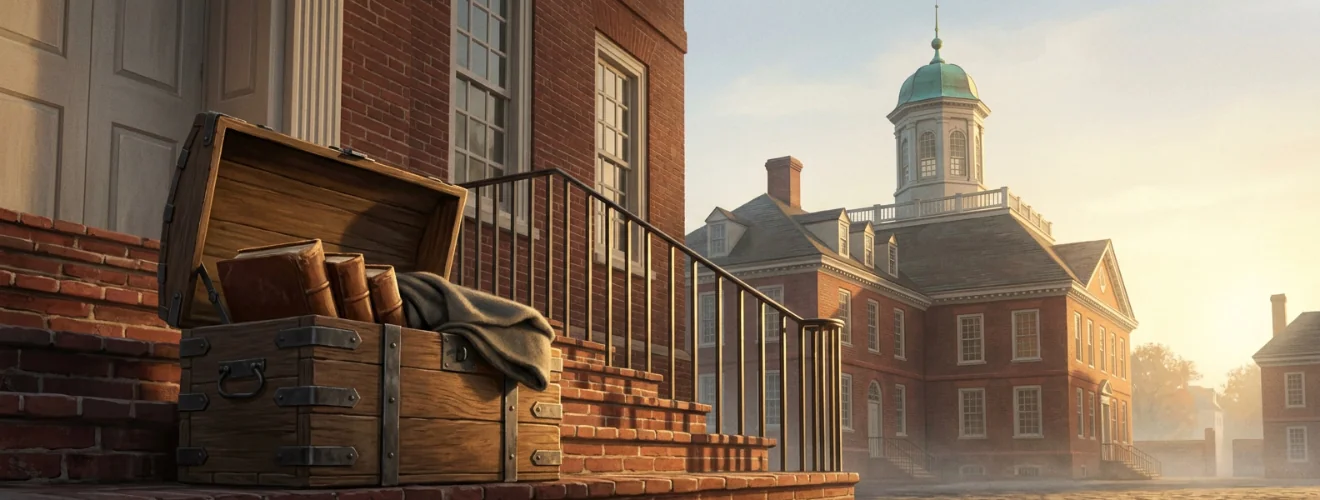
In the summer of 1630, keeping track of the government of Massachusetts Bay required, above all, a good boat. John Winthrop’s fleet dropped anchor off Salem in June; by August 23 his Court of Assistants was meeting in a house at Charlestown; on September 7 the settlement across the river stopped being called Trimountaine and became Boston; and by October 19 the General Court was sitting there instead. Four months, three towns. It set a tone.
The tidy assumption – one colony, one capital – survives contact with the actual records almost nowhere. Connecticut ran two capitals at once from 1701, dividing each year between Hartford in May and New Haven in October. New Jersey kept a matched pair, its government shuttling between Perth Amboy and Burlington. Rhode Island dispensed with a fixed seat entirely and rotated its Assembly through four towns, like a landlord keeping an eye on his properties.
What follows is every town and city where one of the thirteen original colonies kept its government, from the founding of Jamestown to July 4, 1776. The list runs north to south, New Hampshire down to Georgia, with each colony’s seats grouped together – a route that, fittingly for the subject, involves a great deal of moving around.
Twenty-four towns and cities served as capitals of the thirteen original colonies between 1607 and 1776 – the places where a colonial government kept its seat, not merely where it happened to meet. The span opens at Jamestown in 1607 and closes with the capitals those colonies held when independence was declared in 1776.
Portsmouth, New Hampshire
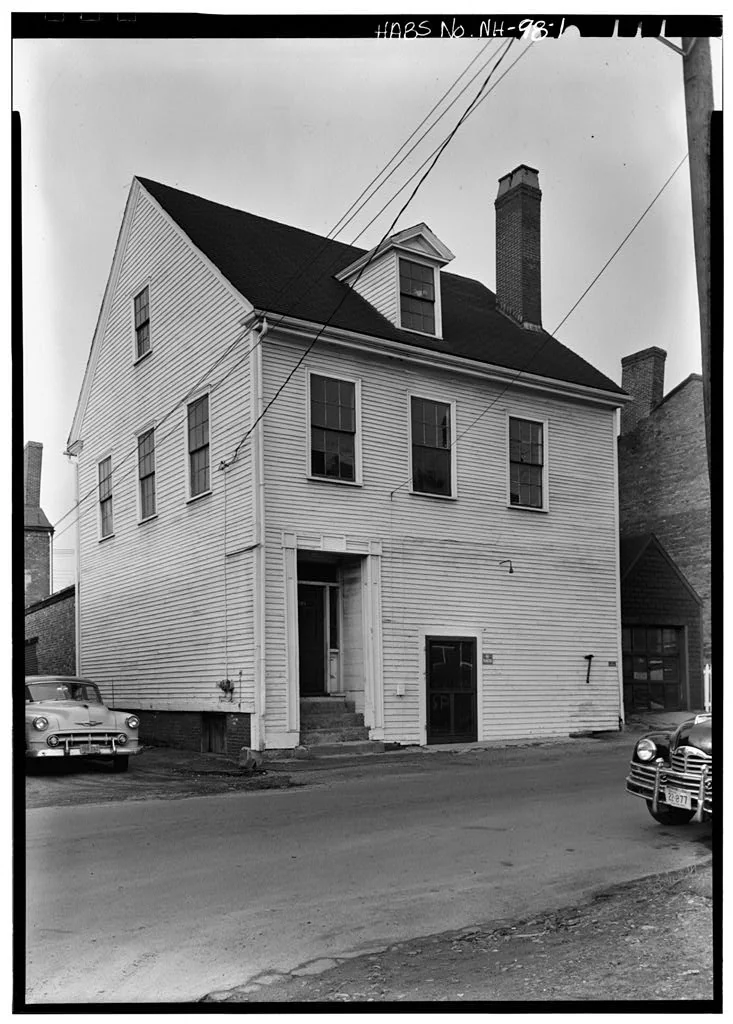
It took King Charles II exactly 3,438 words to give New Hampshire a government of its own. The commission he signed on September 18, 1679 separated the province from Massachusetts, and the original document – all of it – sits in the New Hampshire State Archives. The government it created sat at Portsmouth, which had begun in 1623 as a fishing settlement called Piscataqua, spent some decades as Strawbery Banke, and was incorporated under its present name in 1653.
The new province moved briskly. John Cutt, a wealthy Portsmouth merchant, took office as its first President on January 21, 1680, and the first Assembly convened that March, with a nine-man Council drawn from the four towns of Portsmouth, Dover, Hampton and Exeter. The town’s grandest stretch came under Benning Wentworth, who governed from 1741 to 1767, the longest tenure of any royal governor in the American colonies.
The awkward stretch came earlier. When the Dominion of New England collapsed in 1689, New Hampshire found itself without a working government and petitioned Massachusetts – the colony it had just been separated from – to take it back. Massachusetts obliged in March 1690, and the arrangement lasted until a new royal governor was commissioned on March 1, 1692. The Assembly at Portsmouth adjourned for good in the summer of 1775, and revolutionary government moved to Exeter – the province’s second-largest town, and far enough inland that the Royal Navy could not lean on it.
Salem, Massachusetts
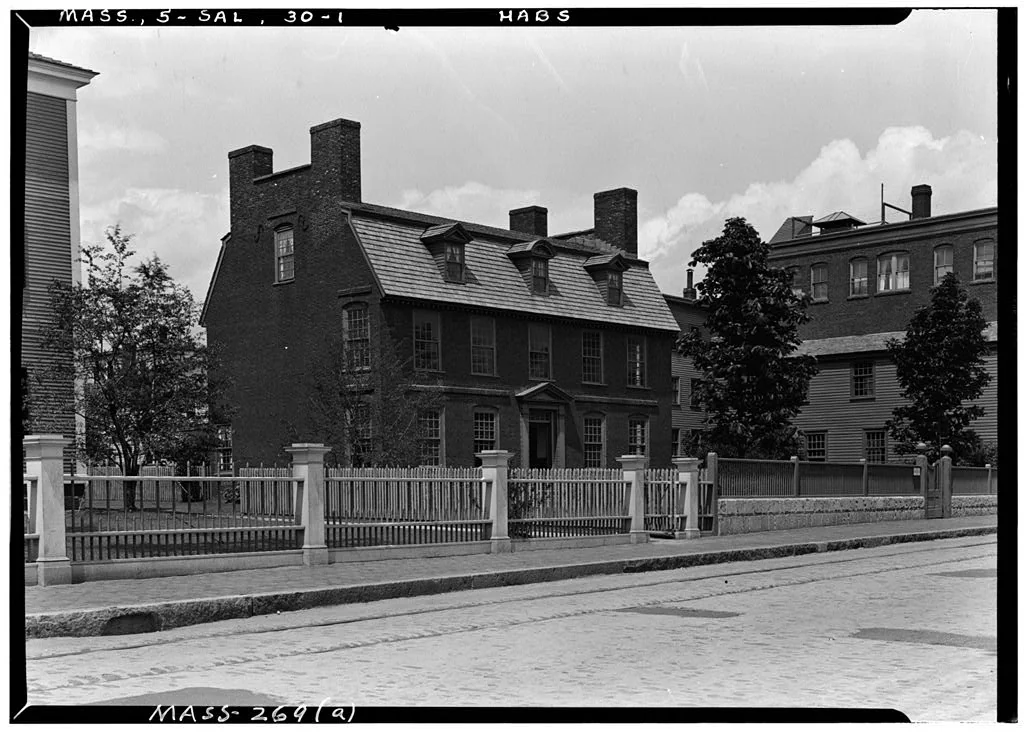
Salem’s claim to being Massachusetts’s first seat of government is a little soft around the edges; its claim on 1774 is not. The town was settled in 1626 by Roger Conant and a party from a failed fishing venture at Cape Ann, four years before Boston, on the site of the Indigenous village of Naumkeag. John Endecott arrived in 1628 with about 60 settlers for the Massachusetts Bay Company and governed locally until John Winthrop turned up in 1630 – at which point the government, like everything else, followed Winthrop south.
Salem’s second act was brief and consequential. In 1774 General Thomas Gage, the new military governor, moved the General Court from Boston to Salem. On September 1 he called for a session to meet on October 5; on September 28 he thought better of it and discharged the representatives. Some 90 of them met anyway, and on October 7 they resolved themselves into the Massachusetts Provincial Congress with John Hancock in the chair – a maneuver Essex Heritage calls essentially a coup d’etat, which left Gage’s royal government virtually powerless outside Boston.
By the following February, Salem was where the war nearly began: Colonel Alexander Leslie’s column and the people of Salem faced each other down at the North Bridge, in the standoff remembered as Leslie’s Retreat, which the city calls the first armed resistance to British authority, two months before Lexington and Concord.
Charlestown, Massachusetts
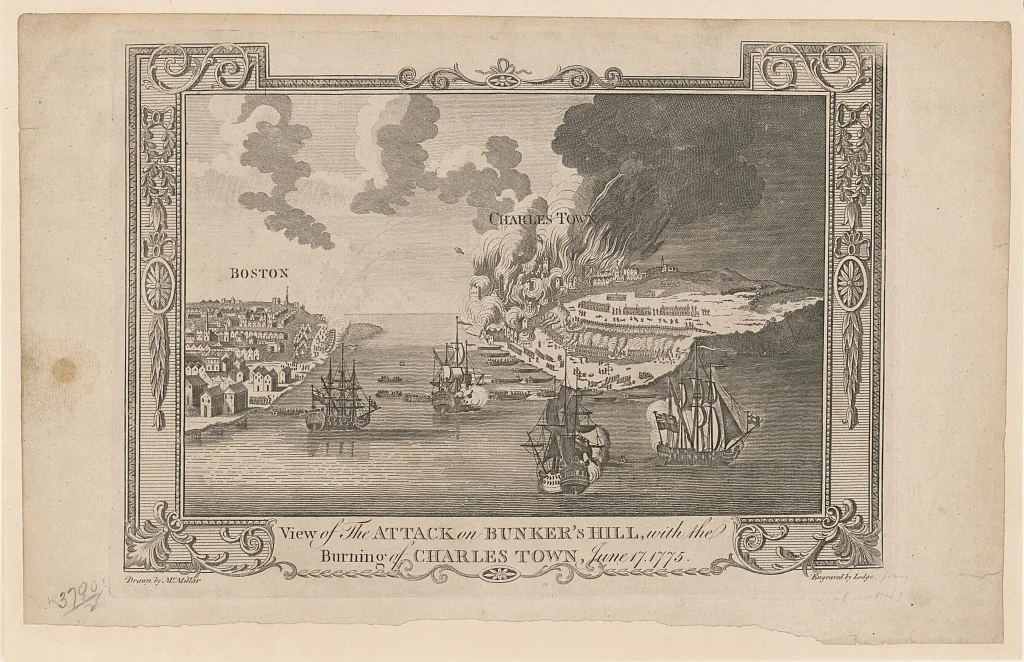
On August 23, 1630, in the Great House on the Mishawum peninsula, John Winthrop and his Court of Assistants held their first meeting in the New World, and for a few late-summer months the government of Massachusetts Bay was a Charlestown institution. The town was barely a year old. Thomas Graves had led about 100 settlers there in 1629, laid out the streets, and directed the building of the Great House, which did duty as Winthrop’s residence and the colony’s seat all at once. Winthrop himself arrived that July with 11 ships and roughly 1,000 Puritan settlers, and on July 30 the first signatures went onto the covenant that founded what became Boston’s First Church.
The problem was water. Charlestown had no source of fresh water adequate to support a large town, and by October the governor and most of the settlers had crossed to the Shawmut peninsula, taking the government with them.
The Great House had a long afterlife. The company sold it, and from 1635 it traded as the Three Cranes Tavern – the colony’s first seat of government finished its career serving beer – until June 17, 1775, when Charlestown burned under British cannon fire during the Battle of Bunker Hill. Archaeologists later recovered more than 100,000 artifacts from the site, and the tavern’s foundation stones sit beneath City Square, marking out the kitchen, the wine cellar, and the main hall.
Boston, Massachusetts
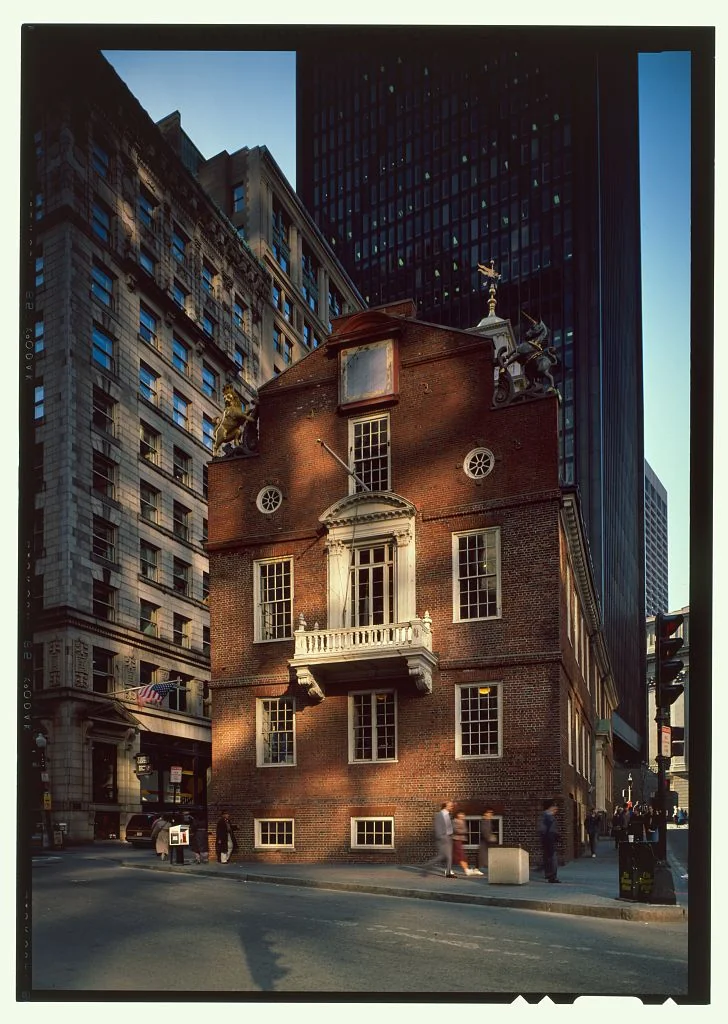
Between 1686 and 1689 Boston governed not just Massachusetts but a royal super-province stretching from New Hampshire to the Jerseys. The Dominion of New England, inaugurated in May 1686, put Massachusetts Bay, Plymouth, New Hampshire, Connecticut, and eventually New York and New Jersey under a single royal governor, Sir Edmund Andros, ruling from Boston. It lasted until April 18, 1689, when news of England’s Glorious Revolution arrived and Bostonians put Andros in jail.
Boston had held the seat of Massachusetts Bay since October 1630, when Winthrop’s settlers crossed from Charlestown in search of better water. The Old State House, built in 1713 and known then as the Town House, packed the Royal Governor’s Council Chamber, Representatives’ Hall, and the Supreme Judicial Court onto one upper floor; the Assembly that met there has been described as the most independent of the colonial legislatures. In 1766 one of the world’s first visitors galleries was installed in Representatives’ Hall, so citizens could watch the arguing.
The square beneath its balcony saw the Boston Massacre on March 5, 1770, when British soldiers fired into a taunting crowd, killing five men. On July 18, 1776 the Declaration of Independence was proclaimed from that same balcony, and the building’s royal symbols were destroyed the same day. The National Historic Sites Commission called it one of the most important public buildings in Colonial America.
Newport, Rhode Island
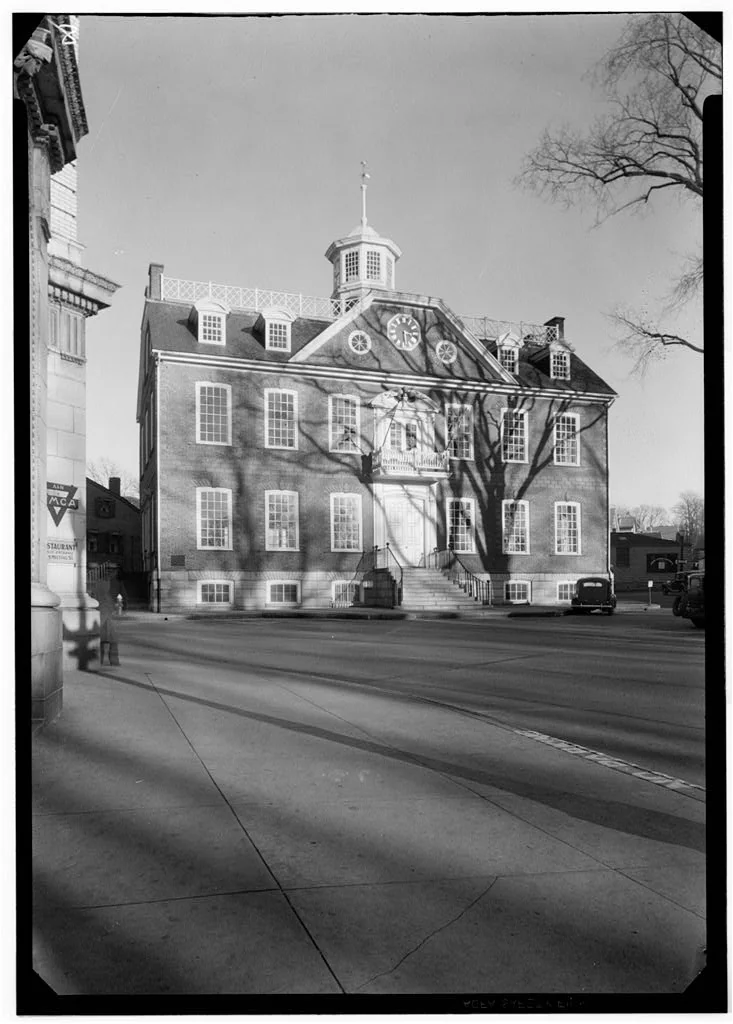
Rhode Island’s legislative year always began at Newport in May. That one fixed point anchored the strangest capital arrangement in the thirteen colonies: rather than choose a seat, Rhode Island deliberately distributed power by rotating its General Assembly among its county towns, and session records show Newport hosted 92 sessions between 1741 and 1776, more than any other stop on the circuit.
The town could afford the honor. Settled in 1639 by English colonists led by William Coddington and Nicholas Easton, Newport grew into one of colonial America’s great trading ports. The Colony House, built from 1739 to designs by Richard Munday, was the rotation’s principal statehouse and the colony’s ceremonial heart: the death of George II was proclaimed from its balcony in 1761, the repeal of the Stamp Act was celebrated in it in 1766, and in 1772 a royal commission sat in it to investigate the burning of the British cutter Gaspee. In 1764 Governor Stephen Hopkins and the Council ordered artillery to fire on the British warship St. John.
On July 20, 1776, Major John Handy read the Declaration of Independence from the Colony House’s front steps. Later that year a British fleet took the town and held it until 1779 – and the Assembly simply carried on in the mainland towns of its rotation. A capital that refuses to stay put is a hard thing to capture.
Providence, Rhode Island
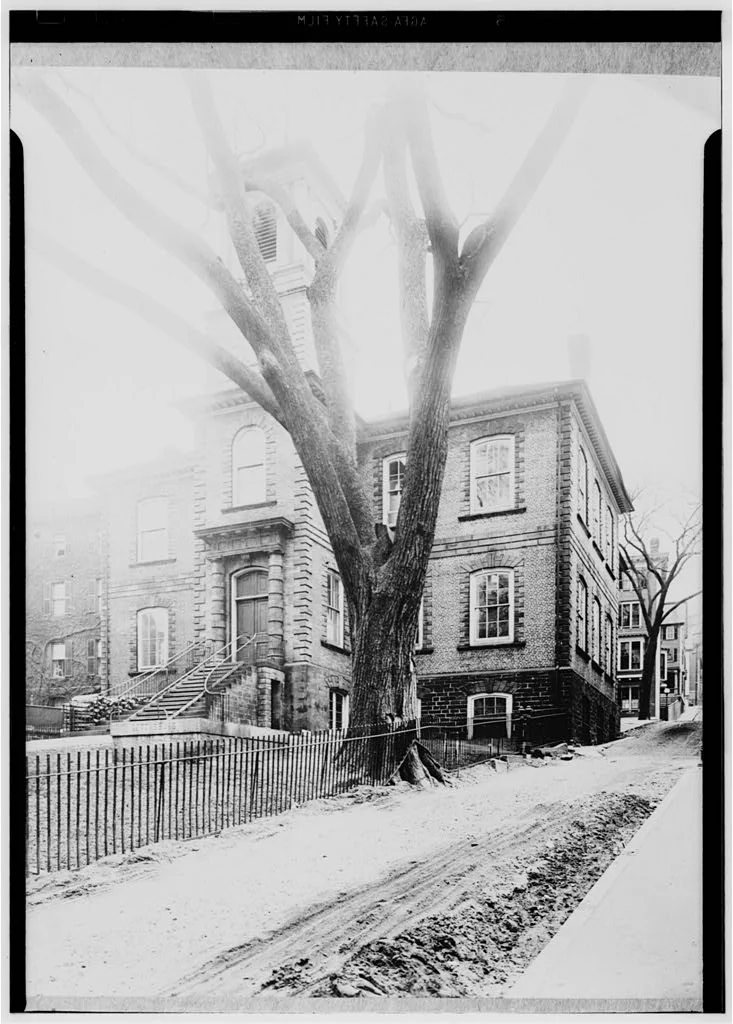
Roger Williams, banished from Massachusetts Bay for his unorthodox religious beliefs, founded Providence in 1636 on land granted by the Narragansett sachems Canonicus and Miantonomi, and named it for God’s merciful providence. It was the colony’s original settlement and its original seat. Providence governed itself from 1636 until a parliamentary patent united it with Portsmouth and Newport. Once the rotation era arrived it was the circuit’s second-busiest stop, with session records showing 37 sittings between 1741 and 1776.
The town’s statehouse went up on Benefit Street in 1760-62, modeled on Newport’s Colony House, and it was there, on May 4, 1776, that the General Assembly passed the Act of Renunciation, making Rhode Island the first of the thirteen colonies to renounce allegiance to the British Crown, two months ahead of the Declaration of Independence. The act repealed the statute securing allegiance to the king and rewrote the oaths of office to leave him out. In 1781 the building thanked General Washington for the war with a dinner and ball.
The Old State House stands at 150 Benefit Street, long since given over to Rhode Island’s historic preservation commission, and on May 4, 2026 it reopened after a 20-month restoration funded in part by a $500,000 Save America’s Treasures grant and a $750,000 National Park Service semiquincentennial grant – 250 years, to the day, after the Assembly inside renounced its king. Rhode Island has never been above a well-made anniversary.
East Greenwich, Rhode Island
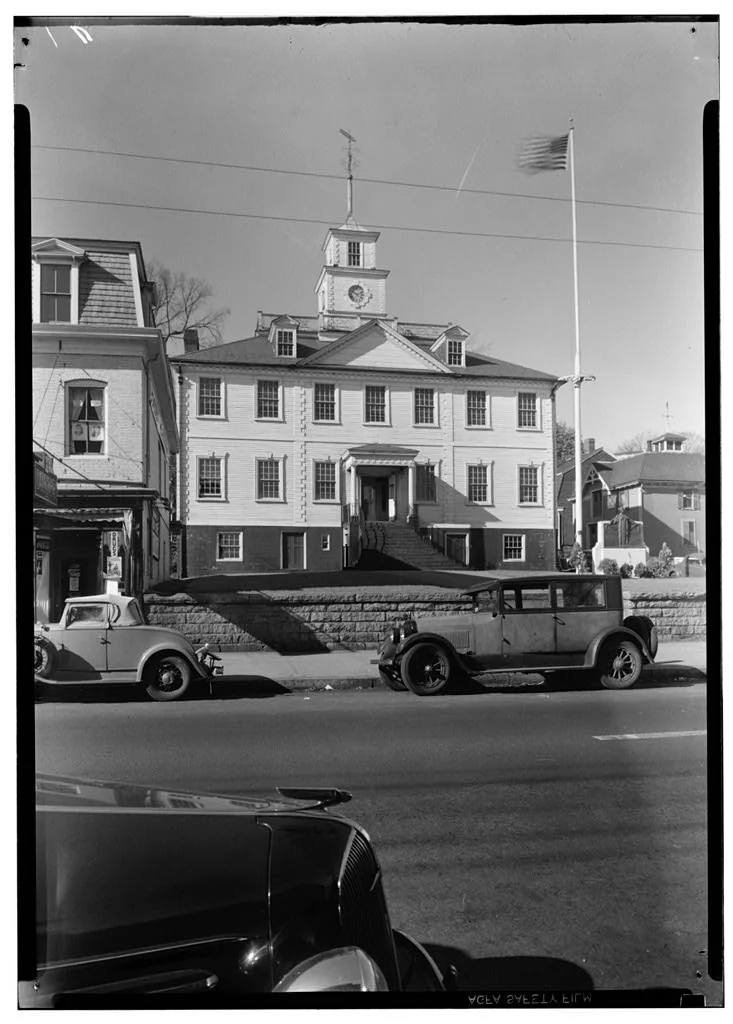
East Greenwich sat at the modest end of Rhode Island’s rotation. Session records show the Assembly met there 15 times between 1742 and 1776, the fewest of its four hosts. It carries a claim, all the same, to be where the American navy began. At the session that opened there in June 1775, the Assembly directed its committee of safety to charter two vessels and fit them out ‘to protect the trade of this colony,' the larger to carry eighty men and ten four-pounder guns, and named Abraham Whipple commodore of both. The Navy’s own reference dates the sloops Katy and Washington to June 15, 1775.
The town was a reward before it was a capital: incorporated on October 31, 1677, it was laid out on roughly 5,000 acres granted to 48 men for service in King Philip’s War, which makes it the eighth-oldest town in Rhode Island. It answered to the name Dedford from 1686 to 1689, lost its rural western half to West Greenwich in 1741, and got its promotion in 1750, when the act carving Kent County out of Providence County decreed that ‘East Greenwich shall be the county town.'
One caution: the Kent County Courthouse on Main Street, with its scalloped two-story Assembly Room, was built in 1804, a generation after the last colonial session. The town had been split in two the year before the Assembly first came, its rural western portion set off as West Greenwich.
South Kingstown, Rhode Island

The session header in the colony’s printed records reads like a stage direction: ‘at South Kingstown, the last Wednesday of October, 1741,' with Governor Richard Ward presiding. That was the Assembly’s first sitting in South Kingstown, and session records show 25 sittings there in all, usually in October, making the town the third-busiest seat on Rhode Island’s rotation.
Those sessions did not all happen under one roof. The court house started out at Tower Hill; when it fell into disrepair in 1752 the county seat moved to Little Rest, a village that would not adopt the name Kingston until 1826. That building decayed in its turn, and in June 1774 the Assembly told William Potter to advertise for whichever carpenter ‘shall appear skillful.' He got Caleb Westcott, who had already built several of the village’s best houses and modeled it on the Colony House at Newport.
It went up slowly: in June 1776 the Assembly was still paying to have it ‘glazed, painted and finished,' and by the time it was done the colony was a state. It survives as the Kingston Free Library. In June 2026 it displayed one of Rhode Island’s historic copies of the Declaration of Independence – a 1777 printing by Mary Katherine Goddard – upstairs in the room where the Assembly once sat, and about 200 people lined up on a Saturday morning to see it. Little Rest has always understood the value of hosting things.
Hartford, Connecticut
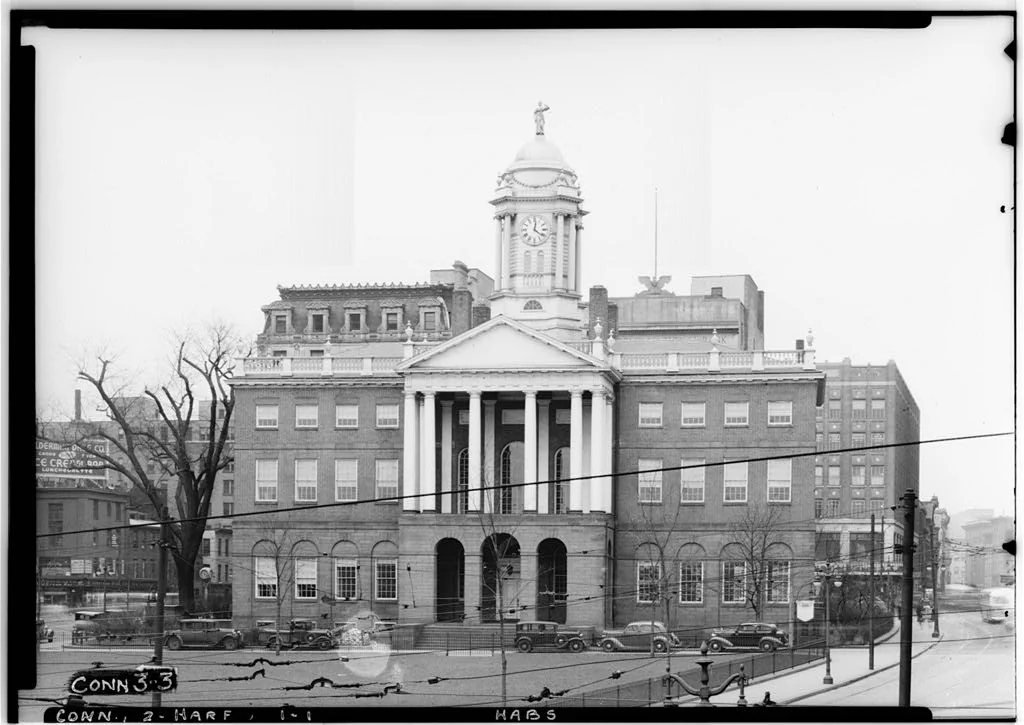
On the evening of October 31, 1687, in a Hartford meetinghouse, Sir Edmund Andros demanded the surrender of Connecticut’s royal charter of 1662. By legend the candles were blown out mid-argument, and when they were relit the charter had vanished, spirited away by Captain Joseph Wadsworth and hidden in a great hollow white oak. The Charter Oak stood until a storm brought it down on August 21, 1856; a monument went up on the spot in 1905, and the charter itself now sits in the Museum of Connecticut History, in a frame made from the tree’s wood.
Hartford had been running Connecticut for a long while by then. Settled in 1636 by Thomas Hooker, John Haynes and about 100 followers who walked overland from Massachusetts Bay, it hosted the adoption of the Fundamental Orders on January 14, 1639 – a preamble and 11 orders binding Windsor, Hartford and Wethersfield into one commonwealth, likely drafted by Roger Ludlow, the colony’s only trained lawyer. Connecticut thought well enough of the document to name itself the Constitution State in 1959.
Every session of the legislature met at Hartford until the act of May 8, 1701 kept only the May sitting there and sent October’s to New Haven. Hartford’s first purpose-built state house went up in 1720 and burned partially in 1783, after a watchman dropped a lighted candle. The two-capital arrangement outlasted the colony by a century: Hartford ended it by winning the vote of 1873, offering $500,000 and land Trinity College held.
New Haven, Connecticut
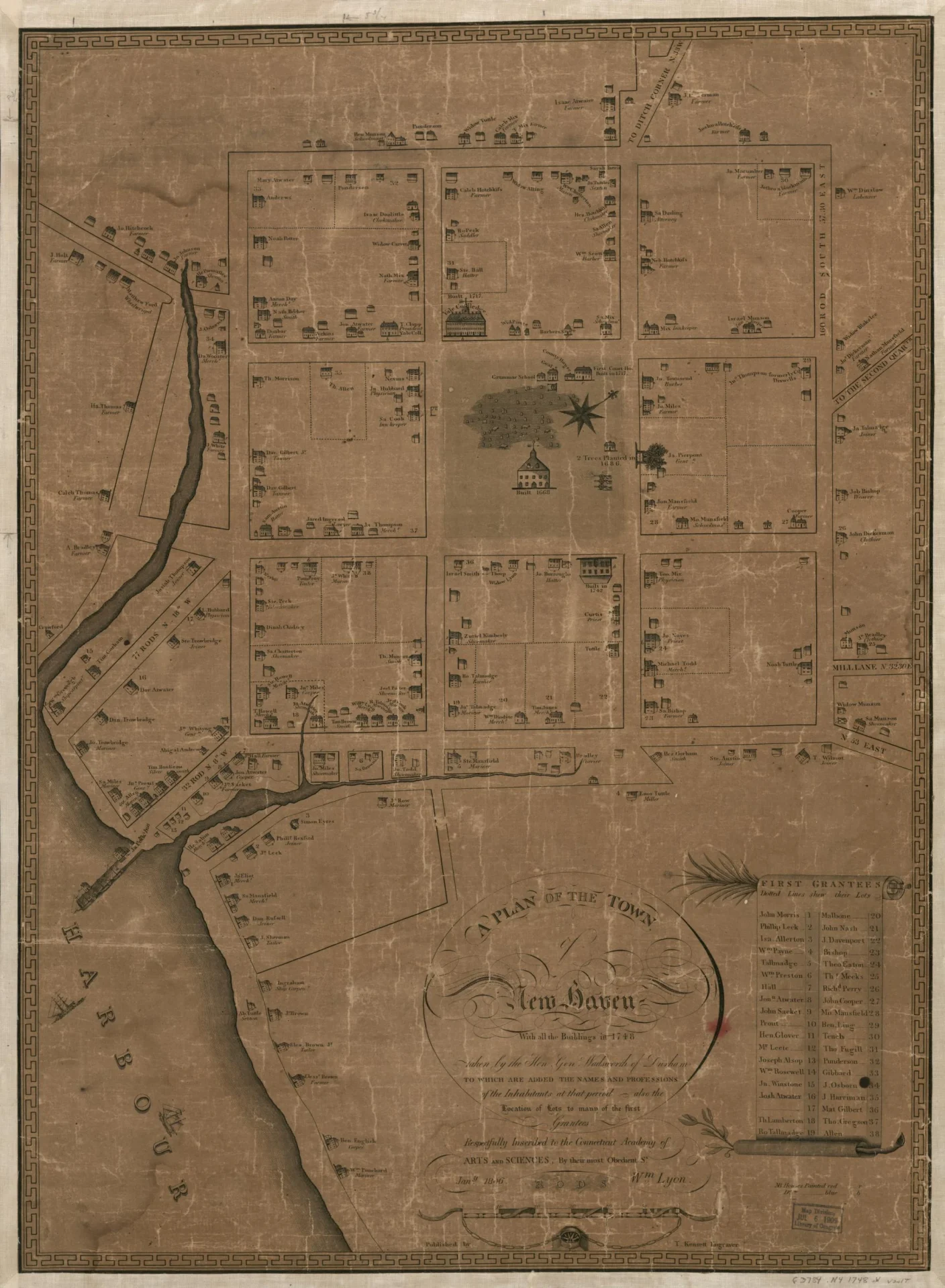
The first official act of Connecticut’s new October capital was to invent Yale. At the opening October session held there under the new two-capital arrangement, on October 9, 1701, the Assembly passed the Act for a Collegiate School, chartering a school ‘wherein youth may be instructed in the arts and sciences.' The school sat first at Saybrook; the trustees voted to move it to New Haven in 1716, and in 1718 it was renamed Yale College after Elihu Yale donated the proceeds of nine bales of goods, 417 books, and a portrait of King George I.
The town had been aiming high from the start. Settled in 1638 as Quinnipiac by Puritans under the Reverend John Davenport and the merchant Theophilus Eaton, and renamed in 1640, it was laid out on a nine-square grid around its Green – arguably America’s first planned town. It ran its own independent colony from 1643, with Eaton as governor until his death in 1658, and accepted absorption into Connecticut, reluctantly, in 1665. The 1701 act that made it a capital also priced the commute, allowing New Haven County deputies one day’s travel, Hartford’s two, and New London’s three, and required the colony’s record books to be carted down for every October sitting.
New Haven kept its co-capital status until 1874, the year of its final Assembly session. After an 1885 city council vote to be rid of it, roughly 3,000 spectators came to watch the statehouse come down.
New York City, New York
In August 1664, four English frigates carrying 450 fighting men under Richard Nicolls appeared off New Amsterdam. Peter Stuyvesant, outnumbered and pressed by his own settlers, capitulated on terms so generous they read like a lease renewal: the Dutch kept liberty of conscience in worship, their property, and a year and six weeks to leave if they preferred. New Amsterdam became New York, and the town began a run as a capital that would outlast the empire that named it.
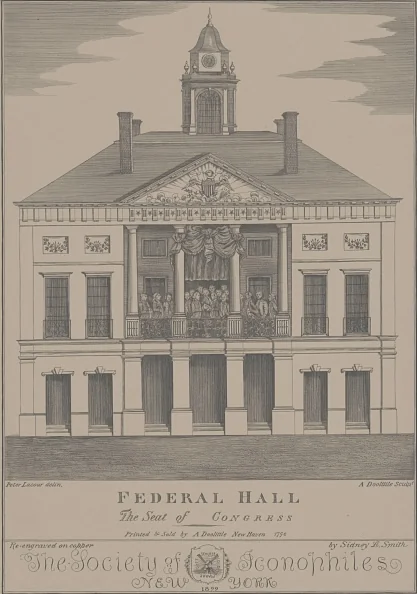
The colony’s first representative assembly met at Fort James in October 1683 under Governor Thomas Dongan and promptly passed the Charter of Liberties and Privileges, calling for basic rights such as trial by jury; England vetoed it. A 1691 law established a permanent assembly that met in the city until Governor Tryon dissolved it in 1776. From 1703 its home was the City Hall on Wall Street, where the printer John Peter Zenger was acquitted of libel in August 1735 after Andrew Hamilton argued that the truth is a defense against libel, and where the Stamp Act Congress gathered delegates from nine colonies in October 1765.
The same address had one more act. Remodeled as Federal Hall, it became what the National Park Service calls the first Capitol of the newly independent country, putting New York on the short list of cities that have served as the U.S. capital, and on its balcony, on April 30, 1789, George Washington swore the first presidential oath.
Elizabethtown, New Jersey
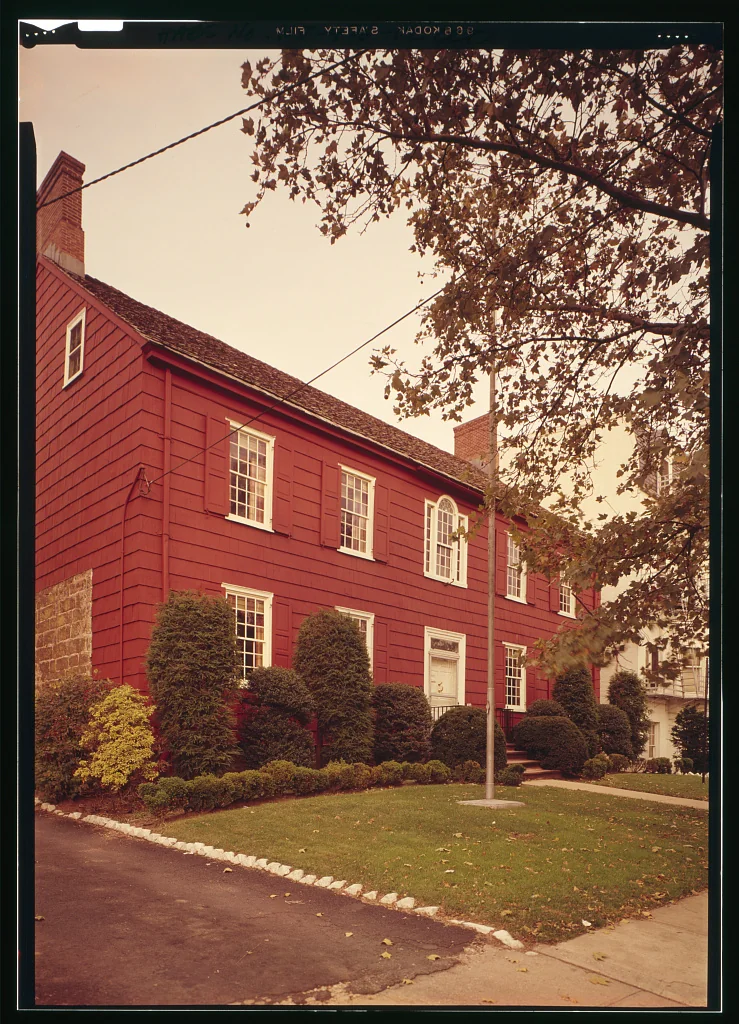
Government in the Jerseys began with a land deal. On October 28, 1664, a group of Long Island associates bought a tract of some 500,000 acres between the Raritan and Passaic rivers from the Lenape sachem Mattano, the payment including four hundred fathoms of white wampum. The purchasers made the claim stick by putting up at least four houses before April 1665. When Governor Philip Carteret arrived that August, he made the young settlement – Elizabethtown, named in all likelihood for Elizabeth, wife of proprietor Sir George Carteret, not for any queen – the capital of the province.
The first General Assembly met there in 1668, under a proprietary constitution with a notably modern clause: the Concession and Agreement promised that no qualified person would be ‘molested, punished, disquieted or called in question for any difference in opinion or practice in matte of religious concernments.' The assembly kept meeting at Elizabethtown until 1682, and the town lost its capital role for good when Perth Amboy took over East Jersey’s government in 1686.
Losing the government did not slow it down much. Elizabethtown was chartered as the free borough and town of Elizabeth in 1740. It saw four military engagements in the Revolution; some 6,000 British and Hessian troops occupied it in December 1776, close behind Washington’s retreating army, and the British burned its academy in 1780. Its most durable export came earlier: the classical school chartered there in 1746 grew into the College of New Jersey, today Princeton University.
Perth Amboy, New Jersey
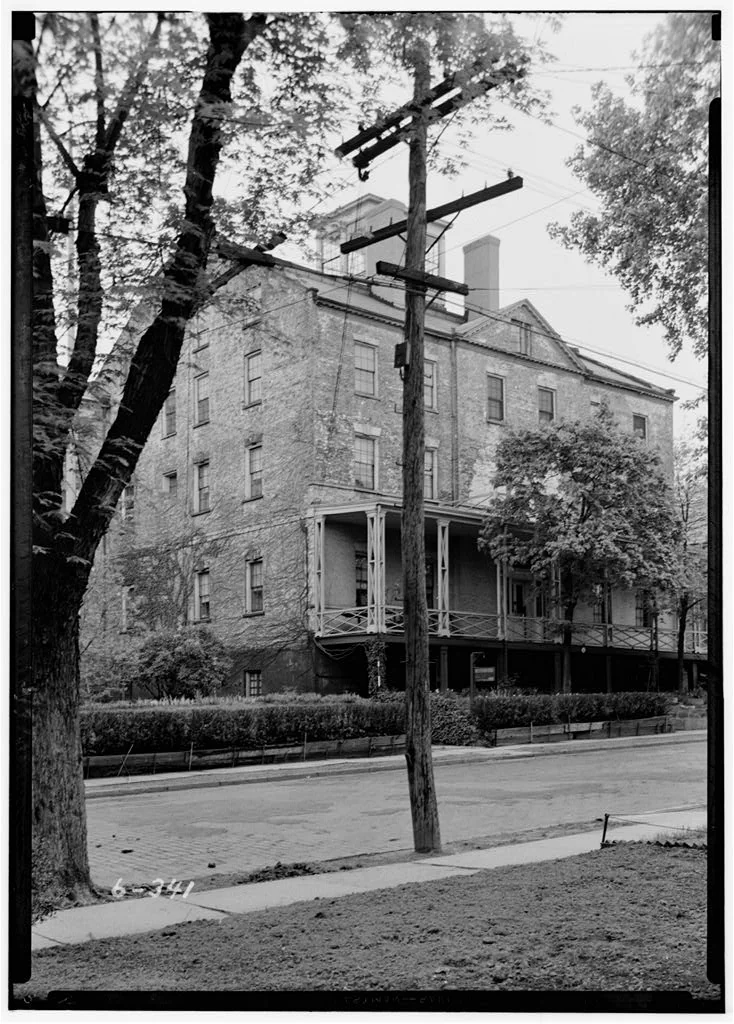
When the proprietors surrendered their governments to Queen Anne on April 15, 1702 – under a deed bluntly titled a surrender of their ‘Pretended Right of Government’ – the sensible move would have been to pick one capital for the newly unified royal colony. New Jersey picked two. Perth Amboy, capital of proprietary East Jersey since 1686, stayed on as seat of the eastern division while Burlington served the western, and the colony’s executive, legislative and judicial business simply traveled back and forth, with separate East and West record books for courts, land transactions, and estates. The royal assembly of twenty-four members, split equally between the divisions, rotated its meetings accordingly.
The town itself was a Scottish project, settled from 1683 under the proprietor Robert Barclay; the name splices James Drummond, 4th Earl of Perth, onto the Native American name Amboy. It was incorporated as a city in 1718, and between 1762 and 1764 it acquired a brick Georgian governor’s residence, the Proprietary House.
That house is where royal New Jersey ended. William Franklin – Benjamin Franklin’s son and the colony’s last royal governor – lived there from 1774 until he was placed under house arrest on January 8, 1776. The British held the town in 1776-77, and the Proprietary House is the only official royal governor’s mansion to survive anywhere in the thirteen colonies, a distinction with a permanently closed field of competitors.
Burlington, New Jersey
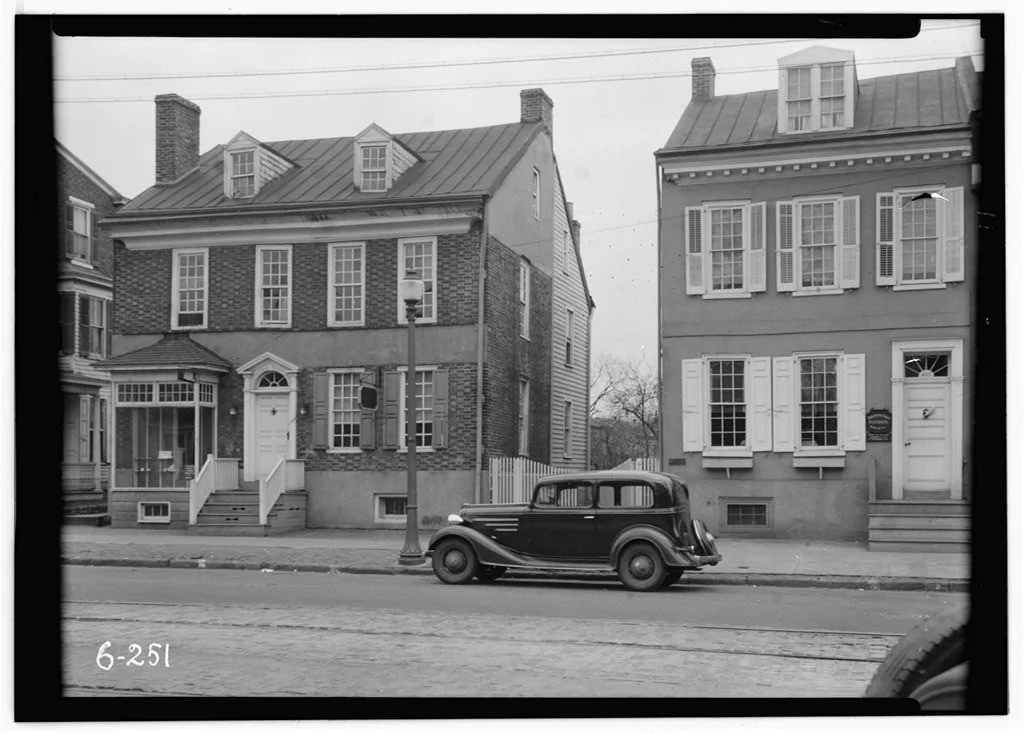
The ship Kent came up the Delaware in August 1677 carrying 230 Quakers, who drew their town lots that October and named the place New Beverly, then Bridlington, before settling on Burlington. Their West Jersey Concessions made the new colony an experiment in orderly self-rule: assemblies would be chosen by putting balls into ballot boxes rather than by ‘the confused way of cries and voices.' In 1681 Burlington became the capital of West Jersey. After the surrender of 1702 it carried on as the western seat of the unified royal colony, sharing the government with Perth Amboy for the rest of the colonial era.
Burlington’s biggest constitutional moment came at the very end of that run. On July 2, 1776 – two days before the Declaration of Independence – New Jersey’s first state constitution was adopted there, under the dateline ‘In Provincial Congress, New Jersey, Burlington. July 2, 1776.'
The two-seat habit proved stubbornly durable, surviving independence and statehood alike until November 25, 1790, when New Jersey designated Trenton its capital and the long shuttle finally stopped. Burlington took up trade instead, helped by steamboat service in 1788 and the railroad in 1834. It settled into being a river town with a remarkable back catalogue. The house at 457 High Street, now part of the county historical society’s campus, was the birthplace of James Fenimore Cooper, author of the Leatherstocking Tales – a writer born, fittingly, in a town that used to take turns being the capital.
Philadelphia, Pennsylvania
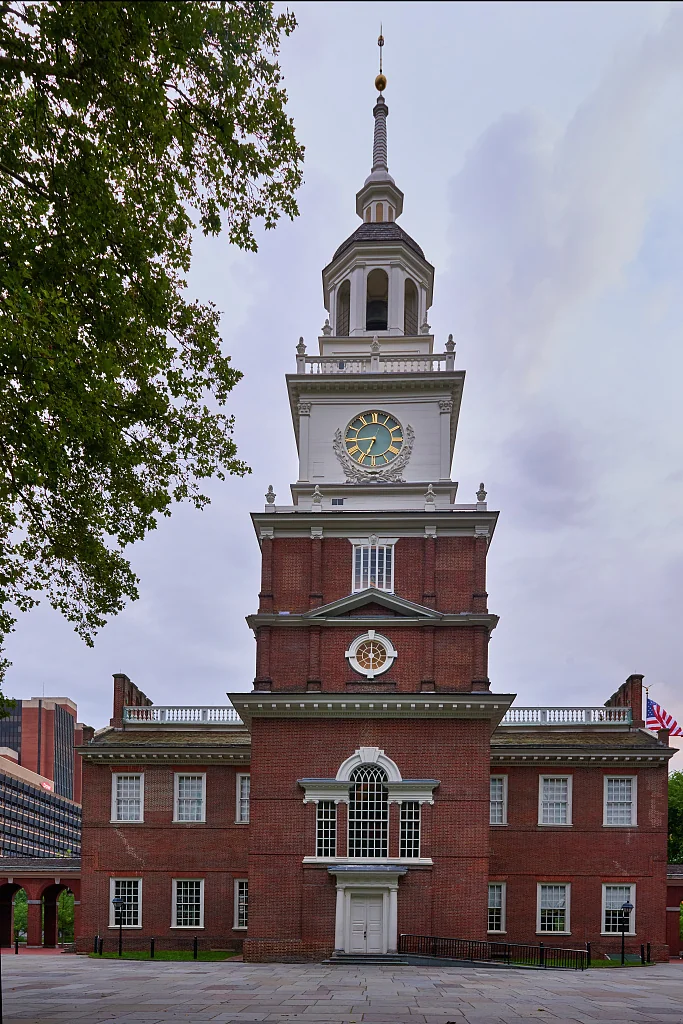
By the eve of the Revolution, Philadelphia held about 30,000 people, the largest city in mainland British North America and one of only four colonial cities – with Boston, New York, and Charleston – to top 10,000. Britannica goes further, ranking 1770s Philadelphia the third most important business centre in the British Empire, overshadowed only by Liverpool and London. William Penn received his charter in March 1681, arrived in 1682, and laid out his ‘greene Country Towne’ on a grid between the Delaware and the Schuylkill.
Philadelphia was Pennsylvania’s seat of government throughout the colonial period, and from 1732 it began building the place where the era would end. The Pennsylvania State House, a two-story red brick building with a central clock tower on Chestnut Street, originally housed all of the colony’s government; in 1774 it had the First Continental Congress for a neighbor, and in 1775 the Second appointed George Washington commander in chief. The Declaration of Independence was adopted there on July 4, 1776. It was signed there as well, which is how one house came to hold the story of every Founding Father who signed the Declaration of Independence.
The encore was the Constitution, debated and signed in the same building in 1787. That house is Independence Hall now, a UNESCO World Heritage Site, and Philadelphia went on to serve as capital of the United States from 1790 to 1800. Being a capital, it turned out, was a habit.
New Castle, Delaware
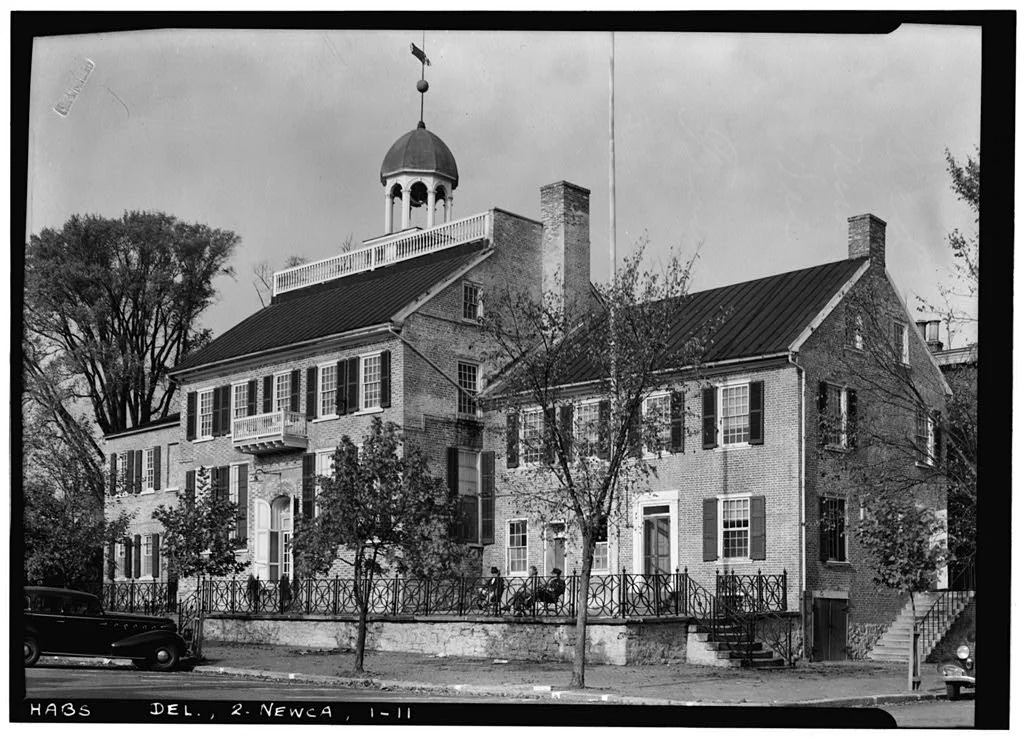
The whole northern border of Delaware is the arc of a circle with a 12-mile radius emanating from New Castle, first surveyed in 1701 – which makes it the rare colonial capital that doubles as a compass point. The town earned the promotion the hard way. Founded in 1651 as the Dutch Fort Casimir by Peter Stuyvesant, it was seized by the Swedes in 1654, retaken by the Dutch in 1655 and renamed New Amstel, then captured by the British in 1664 and renamed New Castle – alternately governed by the Dutch, Swedish, and British, changing hands five times in 31 years. William Penn took possession in 1682, the three lower counties having been granted to him by the Duke of York.
In November 1704 the first separate Assembly of the Lower Three Counties convened at New Castle, and the town remained the capital until 1776, its assembly meeting from 1732 in a courthouse built over the remains of a 1680s predecessor. That building’s Assembly Room produced one of the Revolution’s tidiest days of work: on June 15, 1776, thirteen delegates voted to separate from both Pennsylvania and Great Britain in a single sitting, creating the Delaware State. A convention at New Castle proclaimed the state’s constitution that September.
The seat of government moved to Dover on May 12, 1777, on the sound reasoning that a riverside capital was too easily captured. The courthouse carried on as a working court until 1881, unbothered.
St. Mary’s City, Maryland
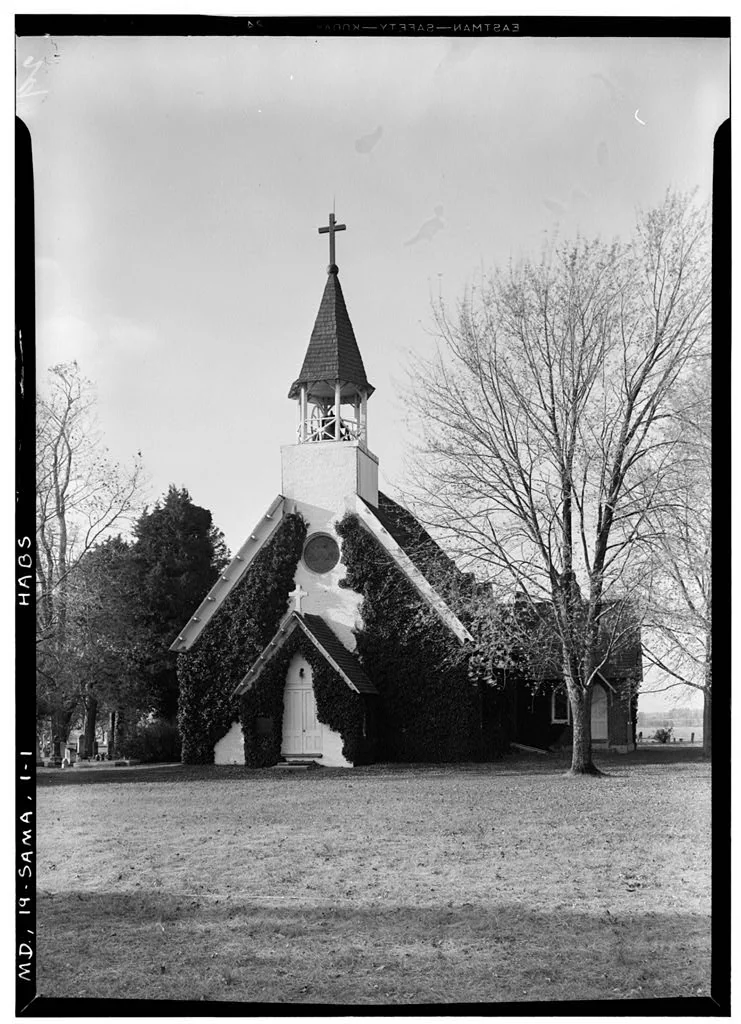
Two ships left Cowes on the Isle of Wight on November 22, 1633, carrying roughly 150 colonists to a province that did not yet exist. The Ark and the Dove made landfall at St. Clement’s Island, where Father White celebrated a mass of thanksgiving on March 25, 1634, kept ever after as Maryland Day. Governor Leonard Calvert then moved the settlement to a better site up the river and called it St. Mary’s City.
It was Maryland’s seat of government from the founding until 1694/95. The colonists put up a statehouse in 1676, and the colony’s business was done there until the province simply outgrew its own geography. St. Mary’s sat near the southern tip of St. Mary’s County, which grew steadily less convenient as Maryland’s population spread north, and in February and March of 1694/95 the government packed up its records and left.
What happened next was unusual even by colonial standards. The county seat followed the capital out the door, moving to Leonardtown in 1710, and the town effectively vanished. In 2021, after roughly fifty years of searching, archaeologists finally pinned down the 1634 fort and found it rectangular, about 104 by 58 yards, rather than the 120-yard square the governor had described. Historic St. Mary’s City is now an 800-acre archaeological park and living-history museum, complete with the Maryland Dove, a replica of the ships that brought the colonists.
Annapolis, Maryland
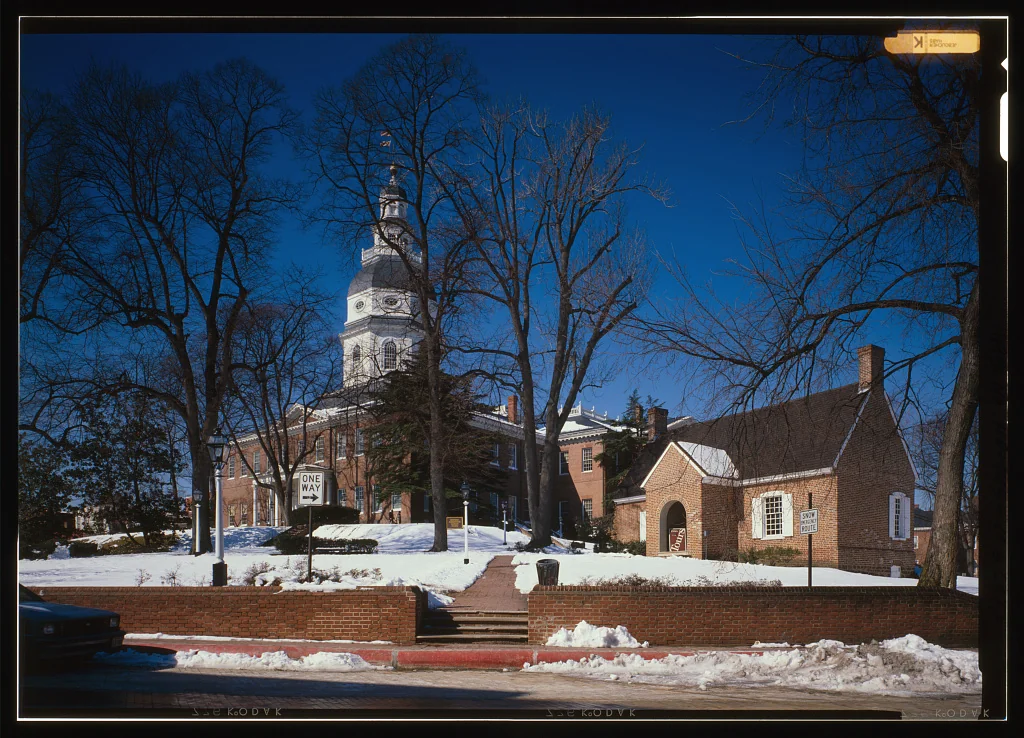
Francis Nicholson, the colony’s second royal governor, was handed a small tobacco port in 1695 and drew it a capital’s street plan. His modified baroque scheme gave the State House a public circle 528 feet across, set aside a smaller circle of 340 feet for the Anglican church, and ran radial streets outward from both – making Annapolis one of the first planned cities in colonial America. Anne Arundel Town had been designated the new capital the year before; in May 1695, after Queen Mary II died, it was renamed for her younger sister, Princess Anne.
The building at the center of Nicholson’s circle is the third one there. The first burned in 1704, the second was finished by 1709 and proved inadequate, and Governor Robert Eden laid the cornerstone of the present State House on March 28, 1772. Its dome is the largest all-wooden dome in North America, cypress beams held together with wooden pegs and iron straps, and no metal nails at all.
For one stretch it was also the nation’s capitol. The Continental Congress sat in the Old Senate Chamber from November 26, 1783 to August 13, 1784, and in that room Washington resigned his commission on December 23, 1783 and Congress ratified the Treaty of Paris on January 14, 1784. It is the oldest state capitol in continuous legislative use. The legislature never did leave.
Jamestown, Virginia
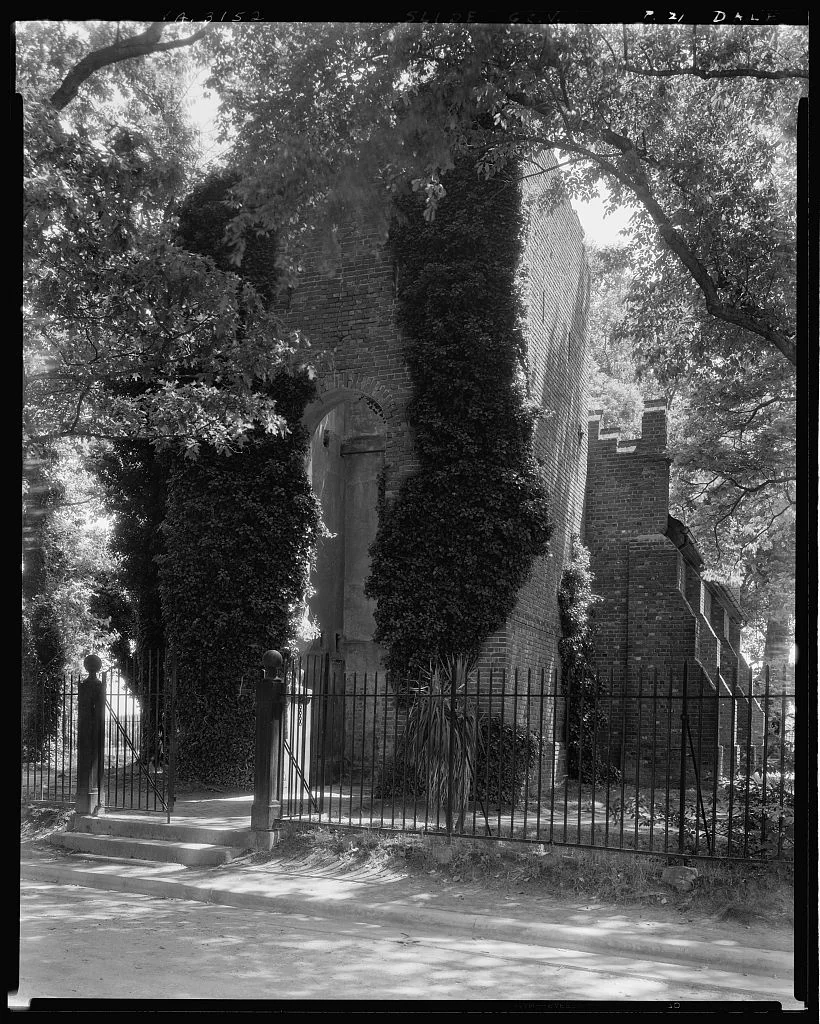
In 1607, 104 settlers who had sailed from London the previous December picked a site on May 13 and landed the next day, founding what became the first permanent English settlement in North America. It nearly did not last the decade. The starving time of 1609-10 cut roughly 300 colonists down to about 60 survivors, and the place stayed precarious for years afterward.
It was also the capital of Virginia from 1607 to 1699. On July 30, 1619 Governor Yeardley convened the first representative legislative assembly in English America, which met in the church because nothing else in town was big enough. The colony was never lavish about housing its government: the first statehouse was a private building bought for 15,700 pounds of tobacco, though the later State House complex did eventually sprawl to 23,000 square feet. Bacon’s followers burned much of it in September 1676, along with the church and sixteen to eighteen houses.
The end came in 1698, when the statehouse burned again. Most of the public records were saved. The capital moved to Williamsburg the following year, and Jamestown reverted to farmland – which is the only reason so much of it survives. Preservation began in 1893, when the Barney family gave 22.5 acres of the island, including the surviving seventeenth-century church tower.
Williamsburg, Virginia
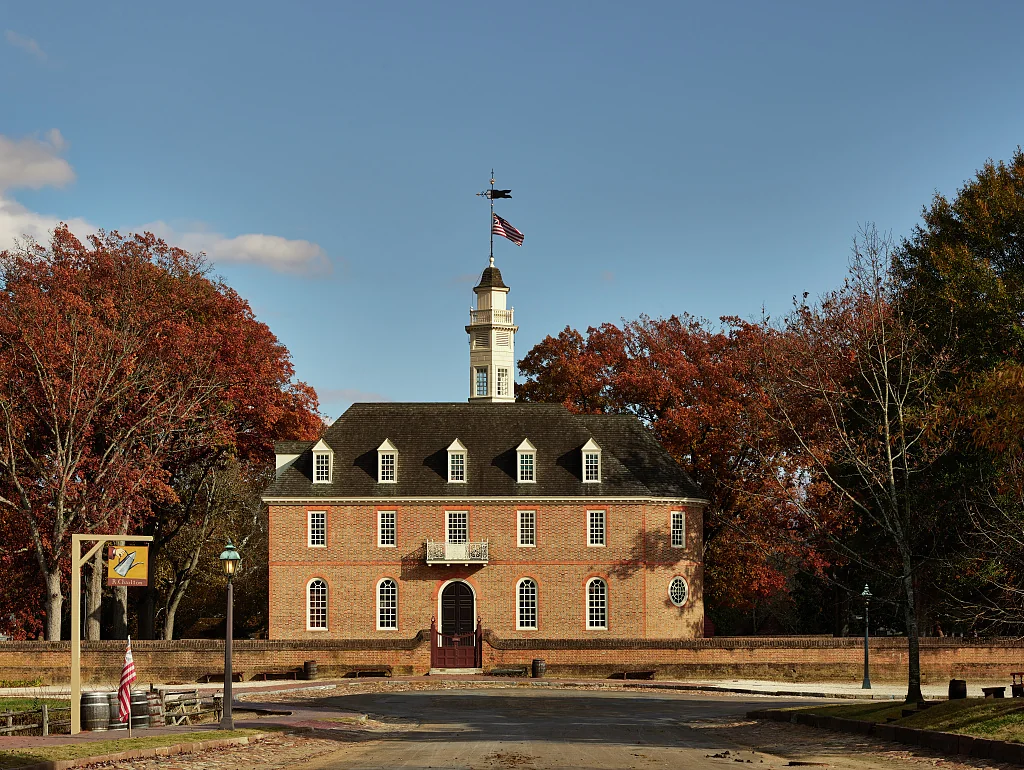
An act of the General Assembly on June 7, 1699 ordered ‘the Building of the Capitoll and the City of Williamsburgh,' which was a generous way of describing what already stood there. Middle Plantation was a modest inland settlement whose chief asset was the College of William and Mary, founded in 1693 and the second oldest institution of higher education in the country. The new name honored King William III. The legislature met at the college until the Capitol was ready in 1704.
What followed was a colonial capital built to be looked at. Duke of Gloucester Street was widened from a horse path to ninety-nine feet, running from the college to the Capitol, and the Governor’s Palace begun in 1705 was finally finished under Lieutenant Governor Spotswood in 1722. The Capitol burned on January 30, 1747; its replacement, done by 1753, housed the conventions that took Virginia out of the empire. On May 15, 1776 the convention meeting there urged the Continental Congress to declare independence.
In 1780 the government went inland to Richmond, safer and more central – one entry in the long history of every U.S. state capital that has been moved. Losing the government turned out to be the making of the place. Restoration began in 1926, and Williamsburg has been in the business of its own permanent past ever since.
Edenton, North Carolina
Fifty-one women signed their real names to a boycott. On October 25, 1774, led by Penelope Barker, wife of the province’s treasurer, they resolved to stop buying English tea and English cloth in support of the First Provincial Congress – one of the earliest public political acts by women in America. There was no tea party as such, and no gathering at Elizabeth King’s home; the resolution was a signed agreement, and it was mailed to England. London noticed. An account ran in the Morning Chronicle and London Advertiser on January 16, 1775, and a mezzotint that year, ‘A society of patriotic ladies, at Edenton in North Carolina,' set out to make the signers ridiculous.
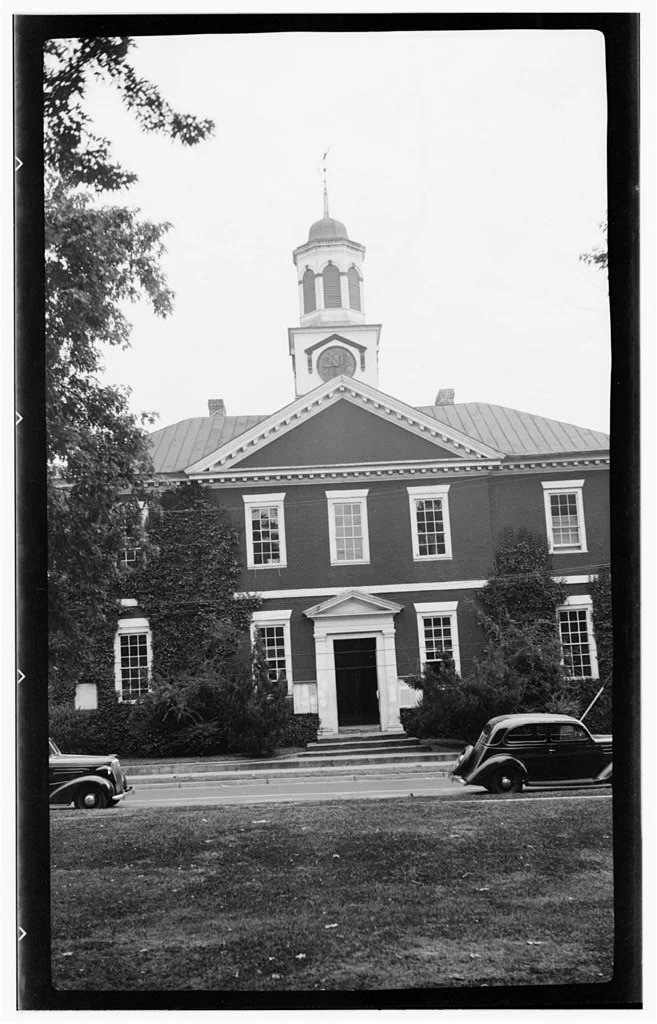
The town had been the colony’s working capital for a good while by then, in the loose way that colonial North Carolina did such things. The legislature convened there in 1708, came back repeatedly from 1725 to 1736, and Britannica dates the end of its unofficial capital role to 1743. Edenton itself was incorporated in 1722 and named for Governor Charles Eden, on ground settled about 1660.
The 1767 Chowan County Courthouse survives, a Georgian building thought to be the work of John Hawks and called the finest of its kind in the South. Its 1891 Seth Thomas tower clock stopped in 2021, and was coaxed back into running order in 2025.
New Bern, North Carolina
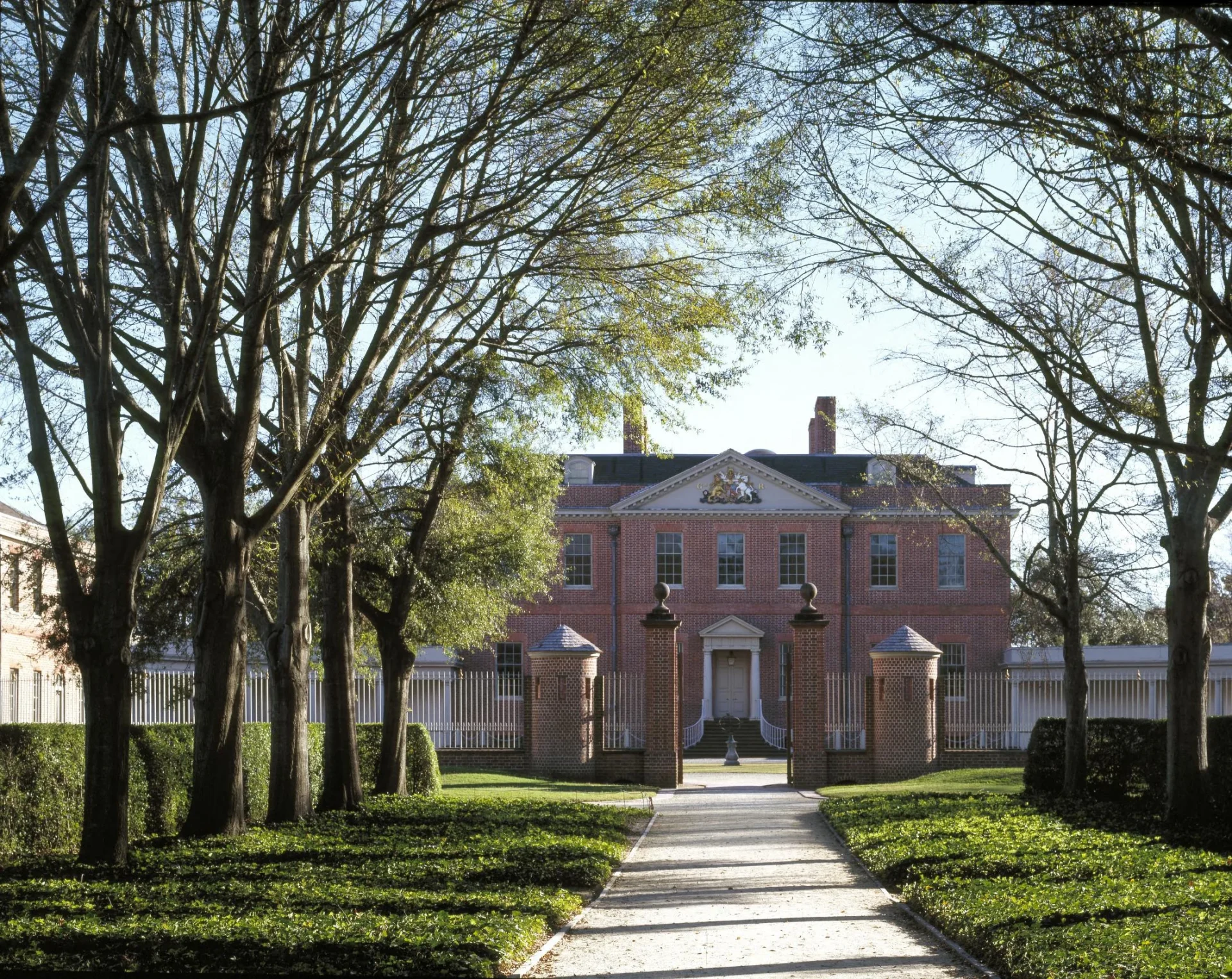
Fixing the capital of North Carolina took two tries and a dead rival. The legislature passed an act in 1746 making New Bern the permanent capital, and the royal government vetoed it. Governor Arthur Dobbs then spent 1758 promoting a purpose-built capital at Tower Hill on the Neuse, a town to be called George City, which NCpedia records as ultimately vetoed by the Privy Council. Only in 1766 did the Assembly settle the question by voting to build what became Tryon Palace.
The town was well suited to being chosen and then ignored. Swiss and Palatine immigrants under Christoph von Graffenried settled it in 1710 and named it for Bern, making it North Carolina’s second-oldest colonial town. The palace went up between 1767 and 1770 to designs by John Hawks, considered by many the first professional architect in America, and Governor William Tryon lived in it for just over a year before leaving for New York.
It did not last either. A fire started in the cellar in February 1798 and took everything but the kitchen and stable offices. The rebuilding came much later: a trust fund pledged in 1944, a state commission created in 1945, more than fifty buildings cleared off the site, and finally a public opening in April 1959, on the original design.
Charleston, South Carolina
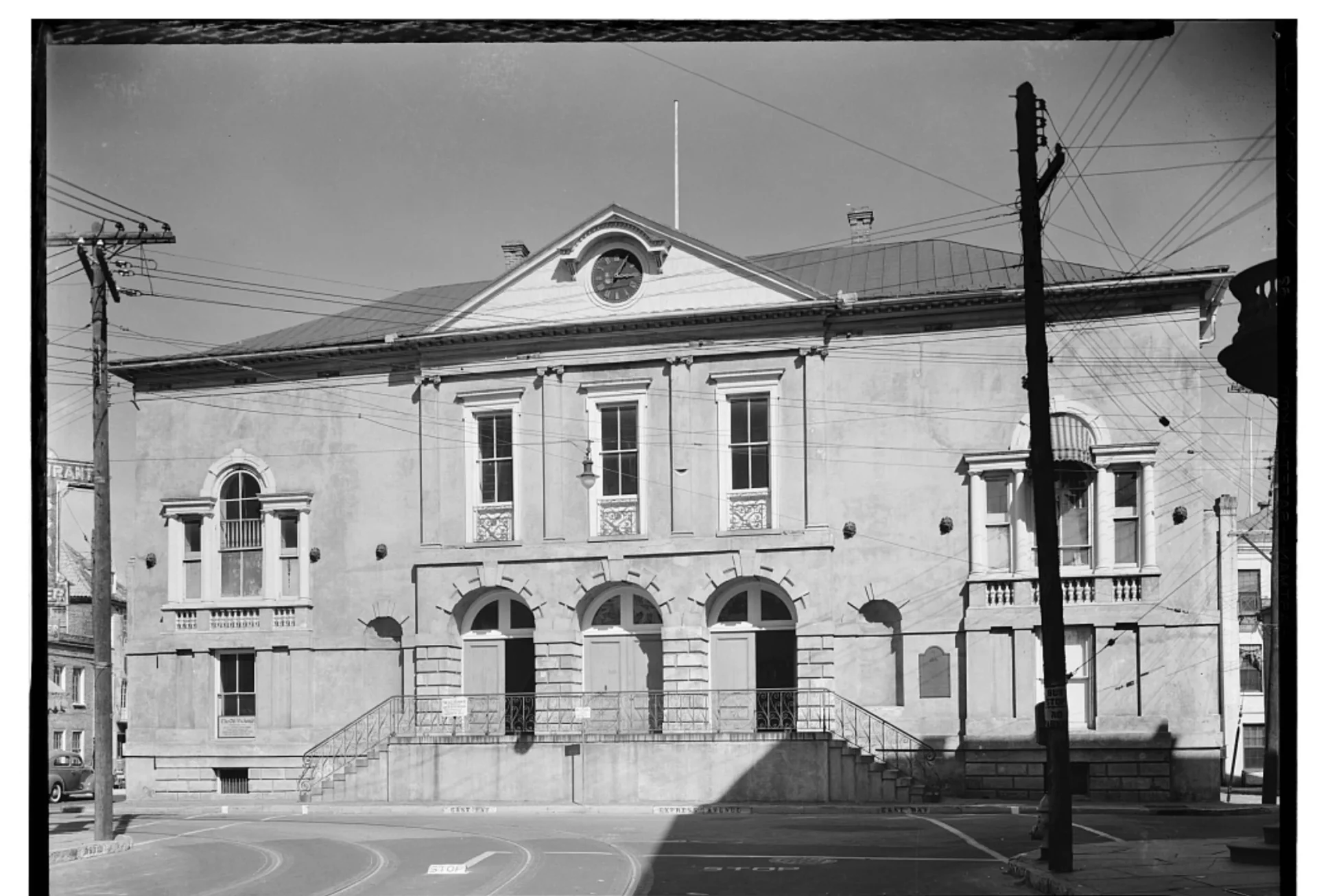
Three ships sailed from England in August 1669 with about 150 people aboard – the Carolina, the Port Royal and the Albemarle – and in early April 1670 the survivors settled on the west bank of the Ashley River at Albemarle Point. They named the place Charles Town for the king who had granted the province away. The site was defensible and damp and wrong, and by 1680 the settlers had shifted to the peninsula where the city stands now, by then home to nearly a thousand people.
From the first settlement Charles Town held the colony’s government, and for a time it held North Carolina’s as well. In 1691 the Lords Proprietors decided that the governor of Carolina would live at Charles Towne and appoint a deputy for the northern half, so from April 1692 to March 1712 the whole province – what is now two states – was officially governed from here. The arrangement only ended when Edward Hyde took the oath as governor of North Carolina.
After that Charles Town settled into being the commercial capital of rice and indigo, was reincorporated under its present spelling in 1783, and lost the government in 1790 when the legislature moved inland to Columbia. The 1670 landing site is a state historic park today, with eighty acres of gardens and a replica seventeenth-century trading vessel, the Adventure, that visitors can climb aboard.
Savannah, Georgia
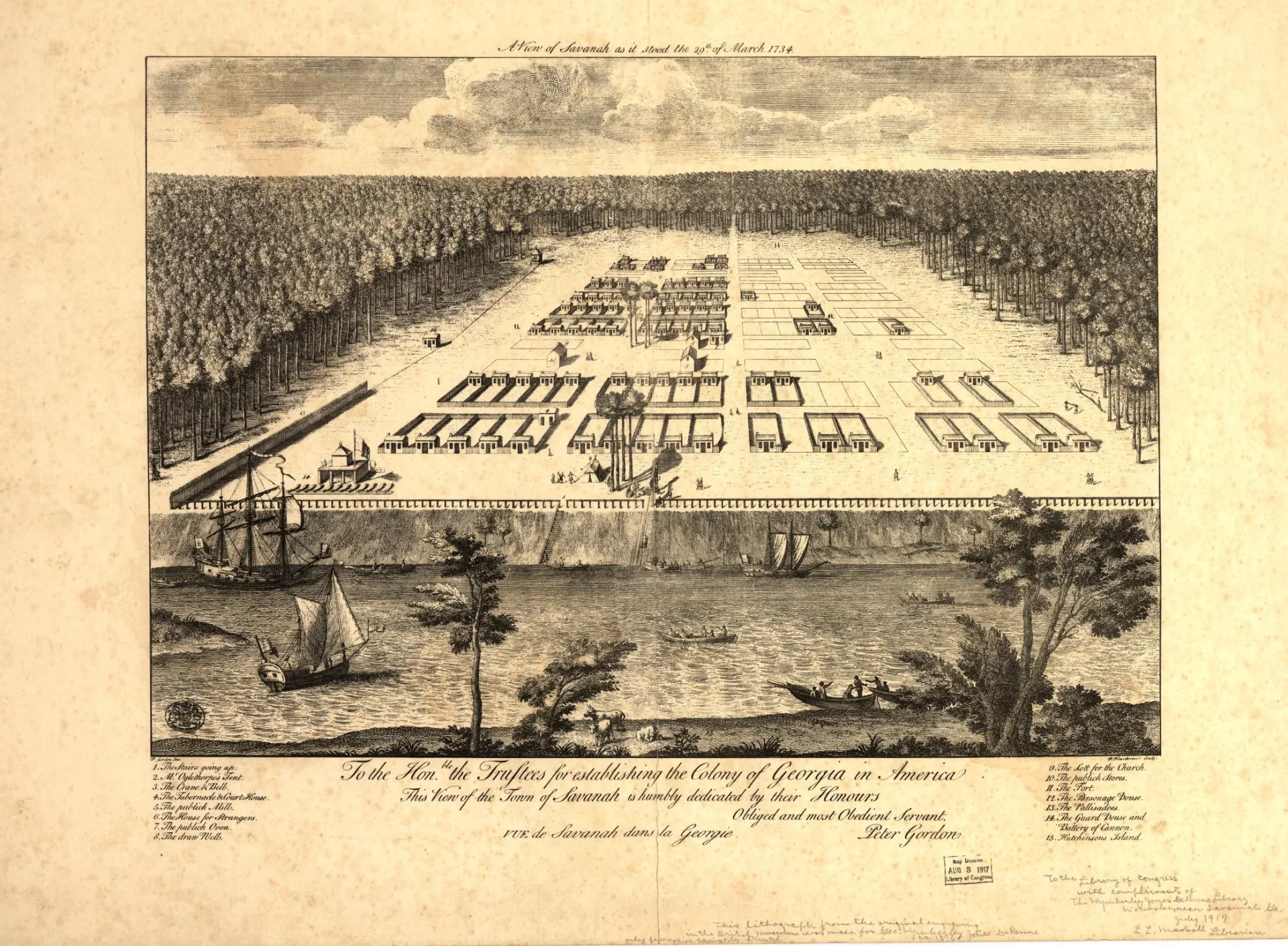
For twenty-one years, the real government of Georgia sat in a room in England. The colony’s 1732 charter vested power in a board of Trustees who never had to look at the place, and the arrangement held while James Oglethorpe and 114 colonists came off the ship Anne at Yamacraw Bluff on February 12, 1733 and started building. They had left Gravesend on November 28, 1732 and stopped at Charles Town on January 24, 1733, and they got their site by negotiating with Tomochichi, Mico of the Yamacraw, with Mary Musgrove interpreting.
Authority drifted across the Atlantic slowly. By 1743 Oglethorpe had gone home for good and the Trustees named William Stephens, who actually lived in Savannah, president of the colony, which is the point at which the town clearly became the center of government. Georgia’s first elected representatives met there in 1751. When the colony passed to the Crown in 1754, the Board of Trade formally declared Savannah the seat of government, and the first royal governor, John Reynolds, arrived on October 29 to bells and bonfires.
Oglethorpe’s contribution outlasted the Trustees, the Crown and everyone else. He laid the town out in wards around central squares, each about an acre; by the New Georgia Encyclopedia’s count twenty-eight wards were eventually created and twenty-two squares remain, while the National Park Service counts twenty-four.
Frequently Asked Questions
Which colonial capitals are still state capitals today?
Four of them. Boston houses the Massachusetts government, Providence the Rhode Island government, Hartford the Connecticut government, and Annapolis the Maryland government. The rest lost the job to inland or safer rivals, and in a few cases stopped being towns at all.
Was Bristol, Rhode Island, ever a colonial capital?
No. The National Register nomination for the Bristol County Court House records that the Assembly first met in Bristol in 1785, well after independence. Rhode Island’s colonial rotation ran through four towns and no more: Newport, Providence, South Kingstown and East Greenwich.
Which colonial capital served the longest?
Boston. Massachusetts Bay governed from there from October 1630 until royal government collapsed in 1774, a run of nearly a century and a half. There is no tidy closing date, because the government did not so much move as stop working.
Where did the colonies govern from in 1774 and 1775?
Wherever the crown’s writ did not reach. Massachusetts formed its Provincial Congress at Salem, then sat at Concord and Watertown; New Hampshire moved to Exeter; North Carolina’s first congress met at New Bern on August 25, 1774; Georgia’s gathered at Tondee’s Tavern in Savannah.
How many colonial statehouses are still standing?
Rhode Island’s preservation commission puts it plainly: the Providence Old State House is ‘one of just six surviving colonial-era state houses in America, three of which are in Rhode Island.' It does not name them, but only three of the state’s five will do: Newport, Providence and South Kingstown. East Greenwich’s dates from 1804 and Bristol’s from 1816.
- Bartlett, Records of the Colony of Rhode Island and Providence Plantations, vol. 5 (session index, 1741-1770)
- The Public Records of the Colony of Connecticut, vol. 4 (the 1701 two-capital act)
- Records of the Governor and Company of the Massachusetts Bay, vol. 1 (Charlestown and Boston, 1630)
- Maryland State Archives – the Maryland State House
- Historic Jamestowne – History of Jamestown
- Charlestown Historical Society – Historic Timeline
- New York State Archives – New York State Legislature
- Virginia House of Delegates – Virginia’s Capitols