
Every Game Dug Up From the Atari Landfill
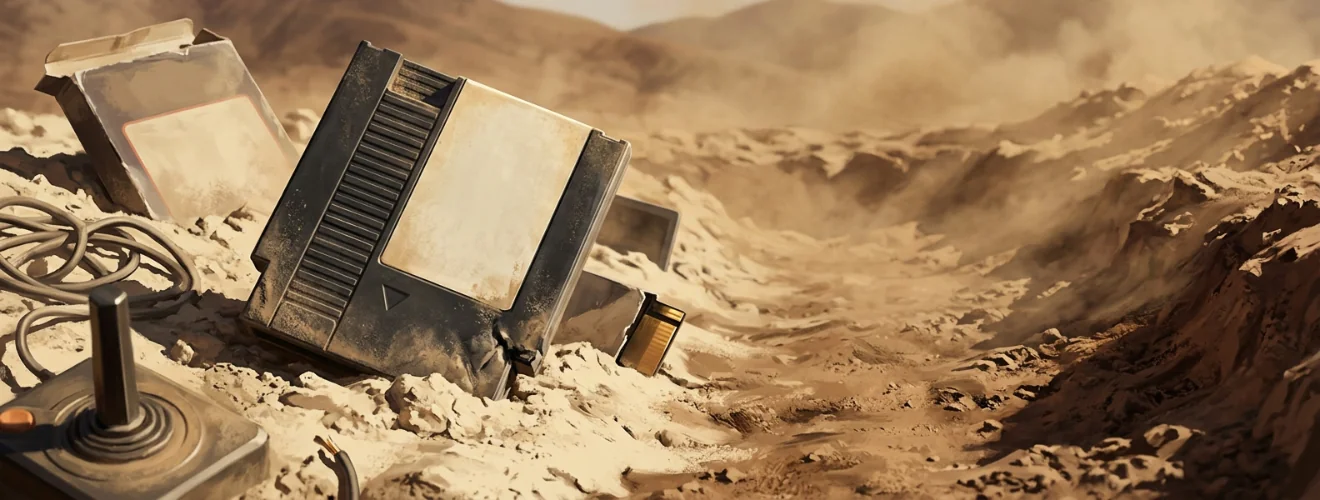
On the morning of Saturday, April 26, 2014, a backhoe began digging into the old city landfill at Alamogordo, New Mexico, while a sandstorm blew in “gusts of wind peaking at sixty miles per hour.” About 200 people had come to watch, and most of them gave up before the diggers struck anything worth seeing. After about four hours, the bucket reached the layer they were looking for. Video game cartridges began to come up out of the ground, crushed, dusty and occasionally still in their boxes, three decades after Atari had trucked them in from El Paso and left them there.
The legend said the hole was full of E.T. The Extra-Terrestrial, the game so often blamed for the industry’s collapse, and NPR described the dump that week as “rumored to harbor millions of copies of E.T.” What actually came up was a whole catalogue. Andrew Reinhard, the archaeologist leading the team, found far more than the legend promised: “much, much more than what we’d expected to find, thinking it would be mostly E.T.” The dig was filmed for a documentary made for Microsoft’s Xbox Entertainment Studios, so Atari’s burial ground was opened for the cameras of a company whose own Xbox launch titles had gone on sale on November 15, 2001.
Every copy was counted. Joe Lewandowski and Reinhard compiled the excavation manifest, a spreadsheet recording each title, its boxes and loose cartridges, and where every copy went afterwards, and the entries below follow it row by row, ranked by copies recovered. A game found for two different consoles appears twice, because the manifest lists it twice. None of it helped Atari in 1983. The market those cartridges had flooded only came back when Nintendo put the games that launched the NES on sale in New York on October 18, 1985.
The April 26, 2014 excavation of the landfill in Alamogordo, New Mexico, recovered 59 entries in its official manifest: 53 rows of Atari 2600 games and 6 of Atari 5200 games, covering 53 different titles and about 1,300 copies. Ranked by copies recovered, they run from Centipede, with 186, down to games represented by a single box or cartridge.
Centipede
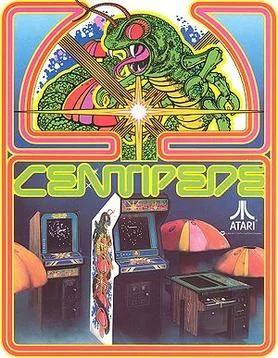
Nothing came out of the Alamogordo landfill in greater numbers than Centipede. The excavation manifest counts 186 copies – 179 boxes and 7 loose cartridges – and the city sold 150 of those boxes and every one of the cartridges. No source explains why Atari had so many on hand to throw away, and none ventures a guess.
The game began as a single sentence. Dona Bailey, the first woman programmer in Atari’s coin-op department, was paging through a ring binder of roughly 40 game ideas, most of them involving lasers, when she found a line about a segmented insect crawling onto the screen and being shot. She says she could see the whole game in her head. The arcade cabinet’s bright pastel pinks, greens and violets came from a technician fiddling with resistors behind the machine, and when he tried to put the colors back, she would not let him.
The home cartridge, programmed by Doug Macrae and Josh Littlefield, shrank the mushrooms to little square blocks and rewrote the plot for the living room. In the 2600 manual you are an elf named Oliver who has found a magic wand in an enchanted forest, and you get three wands instead of lives. Bailey had pushed for a trackball on the arcade machine because, as she told IEEE Spectrum in 1982, “I never could play Missile Command or Defender.” Both turned up in the same hole.
Defender (Atari 2600)
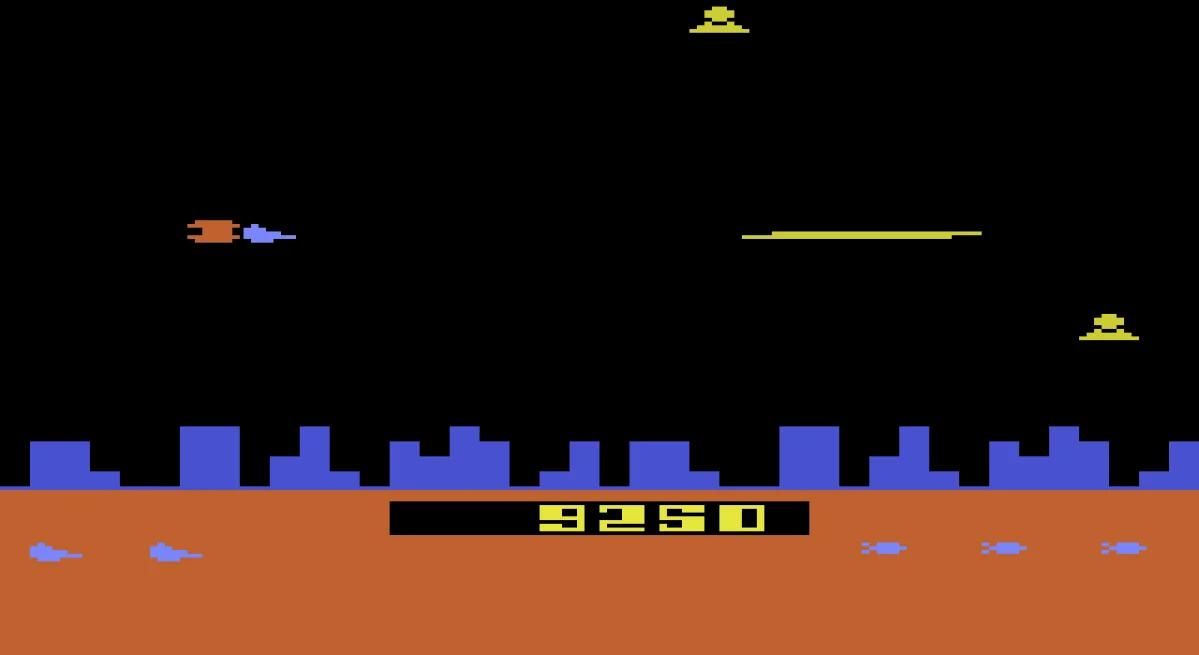
Atari’s manual for Defender opens with something close to an apology. The cartridge is “very similar” to the Williams arcade game, it explains, except that the Humanoids you are protecting cannot be killed by your own fire, the Landers can carry off only one at a time, and your ship “will always emerge from Hyperspace intact.” Then comes the line that gives the game away: “Such tragedies cannot happen in ATARI DEFENDER.”
The arcade machine had five buttons. The 2600 joystick had one, so programmer Bob Polaro made it do three jobs depending on where the ship was flying: lasers in open space, a smart bomb when you dropped down behind the city, Hyperspace when you pushed all the way to the top of the screen. The console could only move two objects of its own, Polaro explained, so he used one for every alien and the other for the ship. When you fired, the ship turned into the missile, which is why it blanks out every time you pull the trigger.
It sold anyway. Atari’s own ledger puts the 2600 Defender at 3,040,684 cartridges, and it was the company’s second best-selling home game of 1982, behind Pac-Man. The landfill gave back 169 of them, more than any game except Centipede. The manual adds that a Humanoid in trouble lets out a high-pitched chatter like an excited chipmunk, which is the sort of detail somebody at Atari clearly enjoyed writing.
E.T. the Extra-Terrestrial
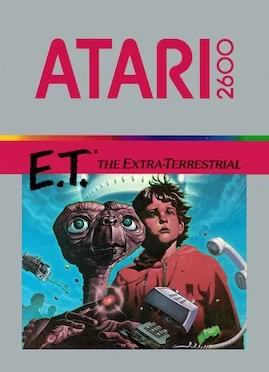
On July 27, 1982, Atari’s chief executive telephoned Howard Scott Warshaw and asked him to make the E.T. game in time for Christmas. The cartridge had to be finished by September 1. “That left five weeks to do it!” Warshaw said later. “Normally it’d be six to eight months to do a game, not five weeks.” He pitched Steven Spielberg an adventure about collecting the parts of an interplanetary telephone, and Spielberg’s response was to ask, “Couldn’t you do something more like Pac-Man?” Warshaw talked him out of it and flew home to build his own design.
What players remember is the pits. E.T. falls into them constantly and struggles to get out, and one 10-year-old told The New York Times the verdict plainly: “It wasn’t fun.” The BBC, AP and plenty of others have since named it among the causes of Atari’s collapse and the video game crash of 1983, which is a great deal of weight for a few kilobytes of code to carry.
The landfill was supposed to be full of it. The manifest records 125 copies, which puts E.T. third, behind Centipede and Defender. In December 2014 the Smithsonian’s National Museum of American History added a dug-up copy to its collection, and The Henry Ford took another. Warshaw, who watched it come out of the ground, has made his peace with the whole business. Having also made Yars’ Revenge, he says, he has “the greatest range of any designer in history.”
Warlords
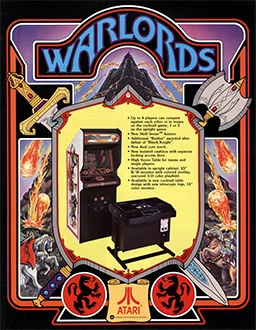
The arcade Warlords may be the rare coin-op game copied from its own home version. Carla Meninsky, who programmed the 2600 cartridge, put it bluntly: “I did the 2600 game before the coin-op game even existed!” Designer Roger Hector once said the opposite, and the arcade cabinet carries a 1980 copyright on a machine that only reached arcades in April 1981, so the argument has never quite been settled. Both versions are a castle siege by way of Pong and Breakout, with a fireball bouncing between four walled corners; in the arcade cabinet a dragon launches it.
The manual supplies a family feud to explain it. King Frederick had quadruplet sons, Dominick, Marcus, Felipe and Restivo, who fought over everything, so he banished them to a forbidden land, which they split into four equal sectors – “the first and last thing they ever agreed upon.” Up to four people can play with paddles, catching the fireball by holding the button and flinging it back at speed. A dead warlord’s ghost haunts the field and knocks the ball off course.
Warlords sold 1,788,462 cartridges by Atari’s count, a long way from a party game nobody wanted. The dig produced 122 copies, fourth on the manifest. The Space Gamer had warned readers in 1982 that for one or two players, “it’d be better to pass it up.” The landfill was not a four-player crowd.
Missile Command
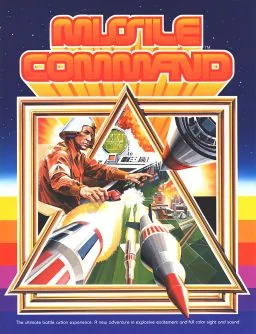
In the crunch to finish Missile Command, Dave Theurer worked weeks of more than 80 hours, and the game got into his sleep: he had a recurring nightmare in which he watched helplessly as nuclear missiles rained down from the sky. He insisted on two conditions. Neither side in the war would be named, and the player would only ever defend. When the last city falls, the arcade screen does not say Game Over. It says The End.
The 2600 manual had other ideas. It invents a war between two planets, casting the player as the guardian of Zardon, “the last of the peaceful planets,” against warrior aliens from Krytol, and assures you that Zardon “is truly a planet void of crime and violence.” It is a cheerful way to package a game about nuclear annihilation.
Rob Fulop wrote the cartridge, aiming for as exact a copy of the arcade game as he could manage, and hid his initials in it: lose a late round badly enough and the right-most city turns into the letters RF. Atari later acknowledged the trick publicly. The manifest records 105 copies, fifth among the dig’s titles, and the city sold most of them. Fulop’s reward for the conversion was, he says, a coupon for a free Safeway turkey. He left soon afterwards to co-found Imagic.
Star Raiders (Atari 2600)
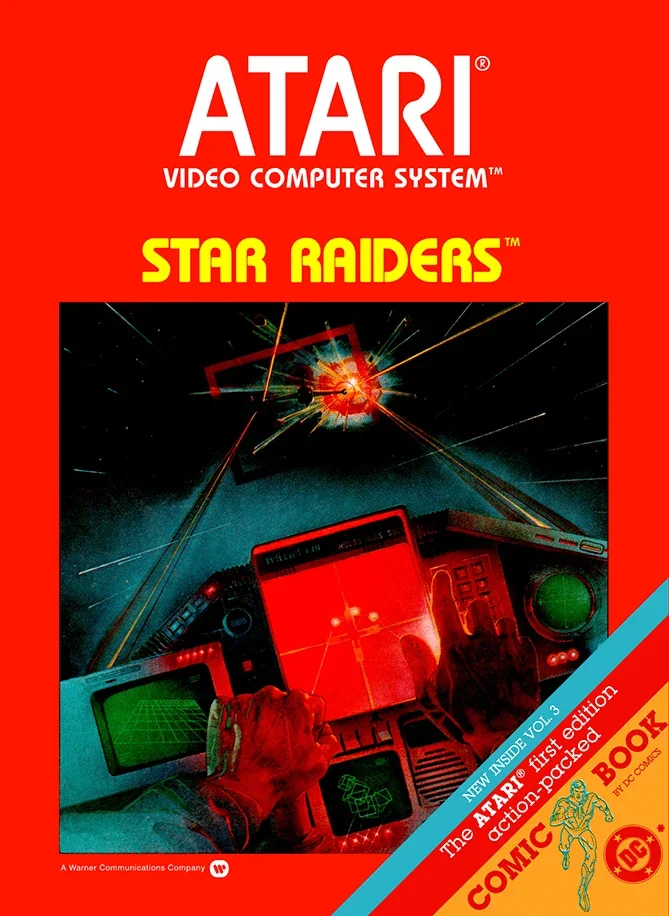
Plug the joystick into the left port, Atari’s instructions say, and a Video Touch Pad into the right: Star Raiders needed more hardware than the 2600 came with. The pad is a little keypad with a Star Raiders overlay, and its keys work the forward view, the galactic map, hyperwarp, the attack computer and the shields. The pad came in the box, which made the cartridge pricier than an ordinary 2600 game.
Carla Meninsky, who programmed it, had left Atari and been talked into coming back, and Star Raiders was the first thing she did on her return. The job was to squeeze Doug Neubauer’s celebrated computer game into a console, and things were lost on the way. The enemy Zylons became Krylons. The galactic chart shrank. Retro Gamer later called it a rather weak port, and one reviewer of the time told readers that Activision’s Starmaster was better.
The manual’s rating table has one joke left in it. It runs from Cook up through Scout, Pilot, Ace, Eagle, Star and Nova, then ends with “7+ ? (mystery rank),” which Atarimania says is ATARI. The landfill returned 87 copies, and the city sold 55 boxes and 21 cartridges. Alamogordo later gave The Henry Ford a video game pad along with its cartridges, though the records do not tie it to any particular game.
Swordquest
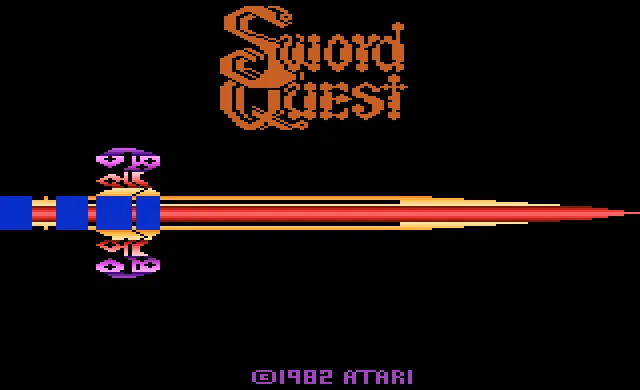
Atari once put up $25,000 worth of jewelry as the prize for solving a single video game. Swordquest was planned as a series of four cartridges, each tied to a treasure made by the Franklin Mint: the Talisman of Penultimate Truth, in 18-karat gold with 12 diamonds; the Chalice of Light; the Crown of Life; and the Philosopher’s Stone. Above them sat the Sword of Ultimate Sorcery, worth $50,000, for the winner of a grand final.
Each game came with a DC comic, and playing the cartridge turned up numbered clues such as 16-4, meaning page 16, panel 4, where a word was hidden in the artwork. Atari slipped dummy words in among the real ones. About 5,000 people entered the EarthWorld contest and only eight got it right. Stephen Bell won the Talisman and, by one account, had it melted down for about $15,000. Michael Rideout won the Chalice and says he keeps it in a safe-deposit box. The crash arrived before the fourth game, AirWorld, was finished, and the contest died with it.
The manifest’s row says only “Swordquest” and counts 66 copies. Andrew Reinhard, who catalogued them, said he was not sure which games they were. At least one was EarthWorld, because Engadget spotted it among the cheap lots when Alamogordo started selling on eBay. The Philosopher’s Stone and the Sword were never awarded, and nobody has seen either since.
Asteroids (Atari 2600)
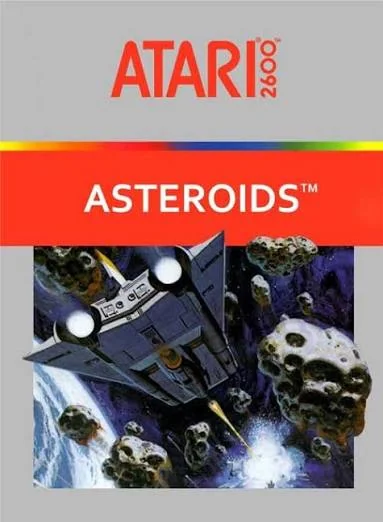
“It just… would… not… fit!” Brad Stewart was describing the weeks he and Bob Smith spent, after the 2600 Asteroids was finished, “using every trick we knew to try to get it into 4K.” They failed, so Atari doubled the cartridge to 8 KB with a technique called bank switching, and the cartridge is generally credited as the first 2600 game to use it. One tally of Atari’s figures puts its sales at 3,832,886.
Not everything that made it into the code made it onto the screen. The cartridge contains routines to draw your reserve ships, but they are switched off, and Stewart told Digital Press he had no idea why. The manual has its own housekeeping to do. It promises 66 game variations and notes that “The dark border on the left side of the screen does not interfere with game play. It is a programming characteristic of all ASTEROIDS cartridges.” Stewart’s explanation for that sort of quirk is disarmingly honest: “the eye ceases to notice them.”
The Henry Ford’s account of the dig names Asteroids among the first cartridges the team held up as they came out of the ground, alongside E.T. and Centipede. The manifest’s columns add up to 65 copies, though the row’s own total cell says 66. One of them sits on display at the Centre for Computing History in Cambridge, catalogued as a cartridge dug up in the New Mexico desert.
Phoenix
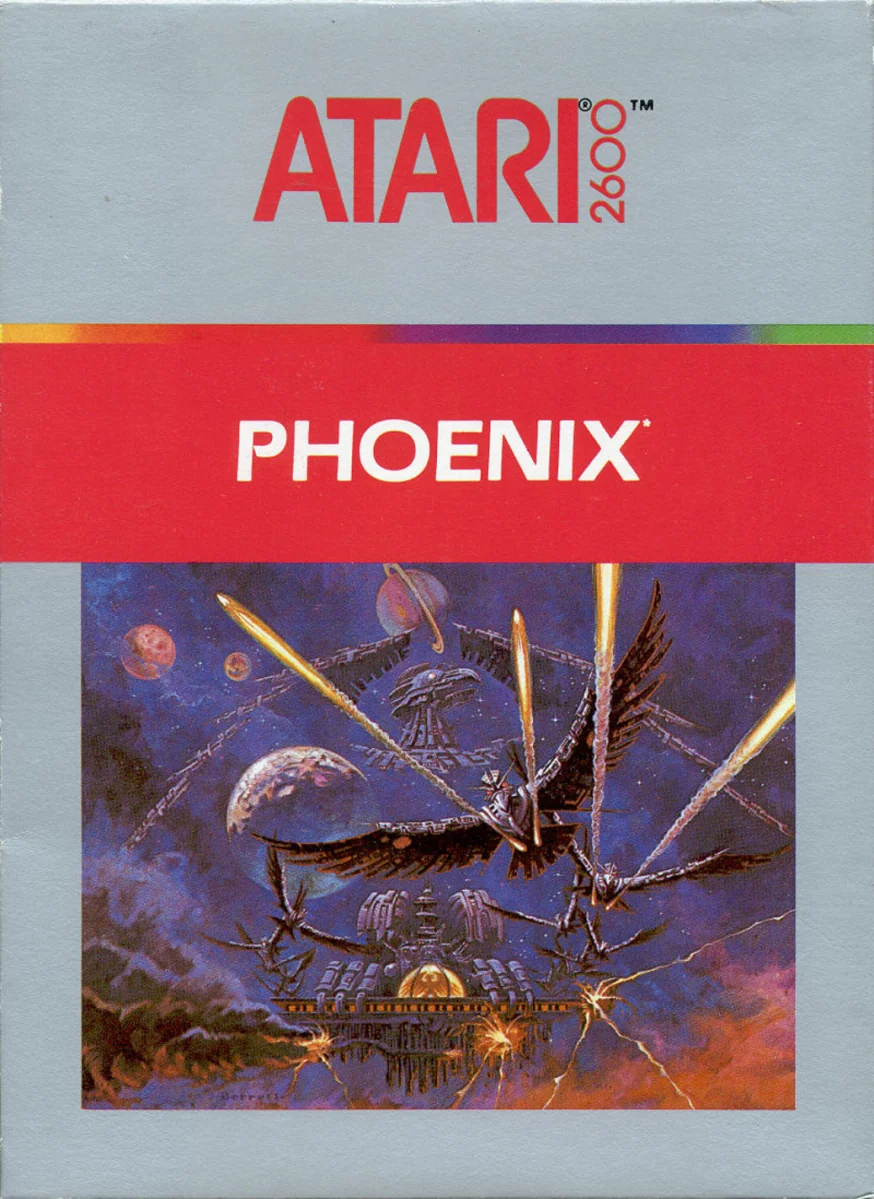
In June 1983 Electronic Games called the 2600 Phoenix “perhaps the finest invasion title ever produced for the 2600!” and meant every word. The cartridge is four waves of birds and then a mothership, whose rotating band of hull you have to chip through to shoot the alien pilot sitting inside. The arcade original is counted among the first shooting games with anything like a boss fight.
Atari’s manual decided the ancient legend needed an update. “Due to the effects of radioactive fallout on its nest,” it explains, “the Phoenix has unfortunately mutated into a bird of prey.” Wing one without killing it and it will regenerate. Your cannon has a force field that lasts for 1 1/2 seconds and then needs another 3 1/2 to recharge, during which time the birds take an interest.
The home rights were a near thing. Centuri, the American arcade licensee, decided at the eleventh hour to sell them to Atari instead of Coleco, and Atari was protective enough of its prize to sue Imagic over a mothership in the Intellivision version of Demon Attack. The cartridge itself came from General Computer Corporation. The manifest records 56 copies, 48 of them boxes, and the dig coverage gives Phoenix only a passing mention in an AP list. In the same review that crowned it, Electronic Games dismissed two other recent Atari releases as “video sleeping pills” – Yars’ Revenge and Demons to Diamonds, both of which were also waiting in the landfill.
Yars’ Revenge
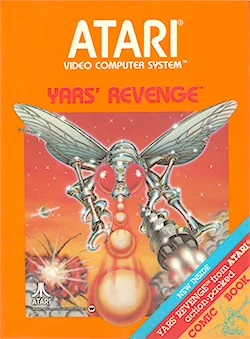
“Yar is Ray spelled backwards,” Howard Scott Warshaw explained, “and the game’s story takes place in the Razak solar system, which (backwards) is similar to Kassar.” Ray Kassar was Atari’s chief executive, and he had not been consulted. Warshaw told a friend in Marketing that Kassar knew about the name and liked it, reasoning that nobody in Marketing would ever ask Kassar about it. The story went round the company anyway.
It was Warshaw’s first game. He had been asked to port the arcade game Star Castle, decided it could not be done properly on the 2600, and pulled its ideas apart into something new: a fly-descended hero eating its way through a shield to reach the Qotile on the other side. The glittering band down the middle of the screen, the Neutral Zone, is the game’s own program code, laid out vertically and scrolling over itself. Atari worried that putting code on screen invited copying. Every box also carried a comic book, and Warshaw went on to make Raiders of the Lost Ark and E.T., so all three ended up in the same New Mexico hole.
The manifest’s columns count 51 copies, though the row’s total cell says 60, and the film company took 10 of the cartridges. Warshaw calls Yars’ Revenge the biggest-selling original game Atari ever made, a claim that rests on his word alone. On the code in the Neutral Zone, he was unrepentant: “if somebody could get the code from that, then they deserved it!”
Super Breakout
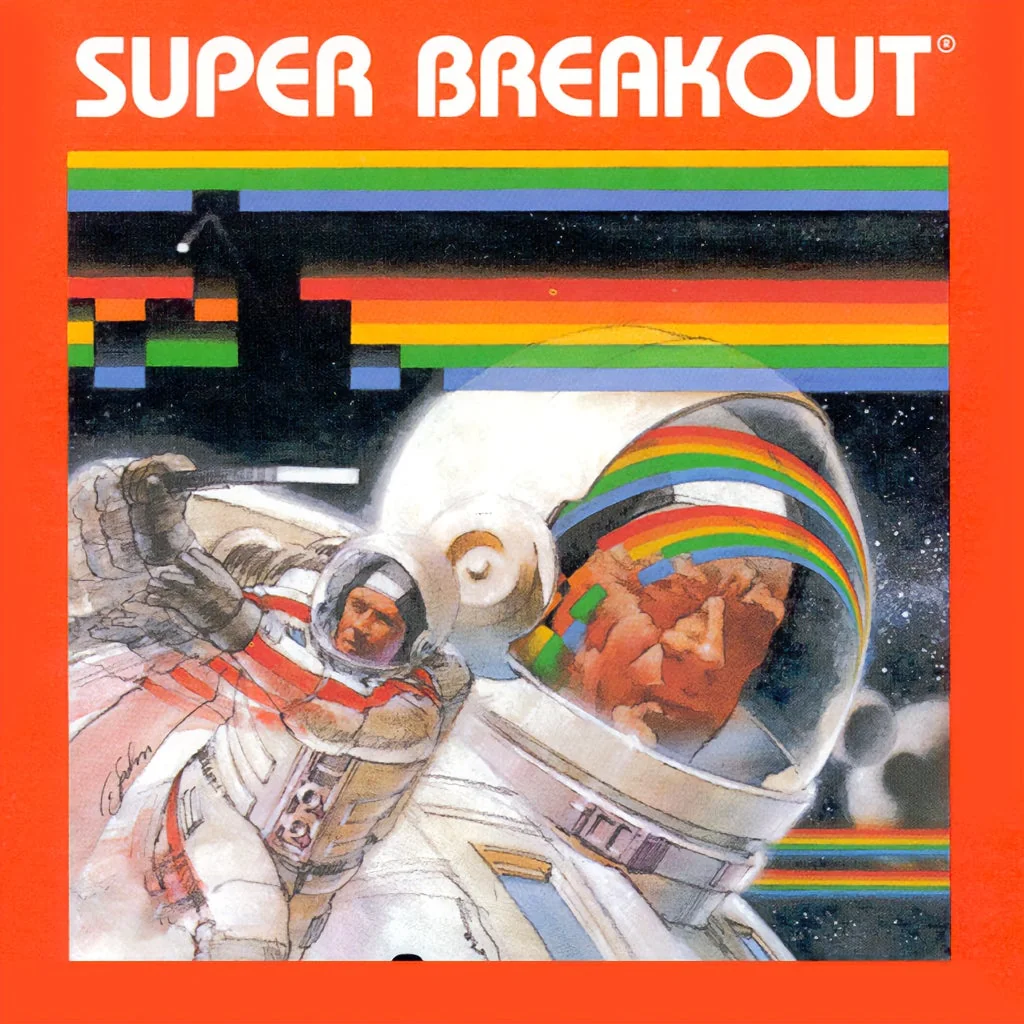
Sears got Super Breakout first. The cartridge reached the 2600 in October 1981 as a Sears Tele-Games exclusive and only appeared under Atari’s own label in January 1982, when the company’s press release promised “Sharper angles, double paddles, balls buried inside wall cavities and an encroaching wall.” That covers the three new modes nicely. Double gives you two paddles and two balls at once, Cavity hides extra balls in pockets inside the bricks, and Progressive marches the whole wall down the screen toward you.
The cartridge also plays a small lottery with its sound effects. There are eight of them, and the manual explains that “One of these eight sounds is randomly selected each time you begin a new game,” so a session might sound like a xylophone or a cracking whip depending on your luck. The manual itself skips the instructions to begin with a short story about a one-man space shuttle meeting a gigantic force field whose colors “are so bright, they’re almost blinding.” It is a brick wall. Atari never let a brick wall be just a brick wall.
The manifest’s columns count 47 copies, while the total printed on the same line says 39, one of several places where the sheet disagrees with itself. Super Breakout was not much of a seller in the city’s auction: 20 boxes and a single cartridge stayed in the column marked RETAIN, and the manual’s last word on the force field serves for the leftovers too: “It’s up to you.”
Raiders of the Lost Ark
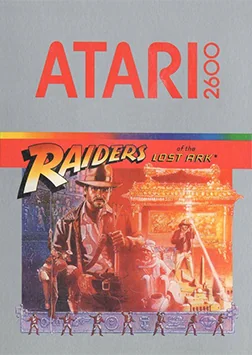
Two joysticks are required to play Raiders of the Lost Ark. The right one moves Indiana Jones; the left one only manages his inventory, a design Howard Scott Warshaw chose so players could carry more than the single item Adventure allowed. He came to regret it. “The only thing I regret about Raiders was incorporating the use of 2 joysticks,” he said. “It made it harder to play.”
It was Warshaw’s second Atari game and his first film licence, and he was flown to Warner Brothers to meet Steven Spielberg about it. The game moves the Ark to a random mesa every time you restart, so you have to buy a flute, blast your way into the right room, cross the mesa field with a grappling hook and dig with a shovel bought from the Black Market. Atari’s manual adds a hint that is really a wink: “There are unverified rumours of an extraterrestrial YAR flying near the Flying Saucer Mesa.” Warshaw confirmed the Yar is there, leading to his own initials. Spielberg liked the result enough to ask for Warshaw on E.T., which is a mixed blessing in hindsight.
The manifest records 29 copies, and the dig coverage never mentions a Raiders cartridge at all. The only Raiders item the 2014 coverage reported was paper: Richard Rothaus pulled out a boxed E.T., Andrew Reinhard wrote, “complete with instructions, catalogue, and Raiders of the Lost Ark insert.” Even underground, Raiders was advertising itself inside somebody else’s box.
Haunted House
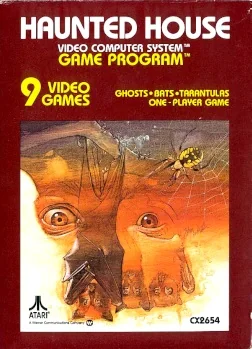
You are a pair of eyes. That is the whole player character in Haunted House, two eyes adrift in a dark mansion, and the only light comes from “an unlimited supply of matches” struck with the red button. Atari’s press release of January 1982 sent those “intrepid eyes” to find the three lost pieces of a silver urn, which the manual says broke “during the earthquake of 1890.”
The story belongs to Zachary Graves, a mean old man of Spirit Bay whose four-storey mansion was condemned after his death and whose ghost still wanders it. So do vampire bats and hairy tarantulas. When any of them touches you, you are “scared to death” and lose one of your nine lives, which is about the gentlest death in the whole landfill. Find the old man’s scepter and nothing can frighten you, unless you are playing one of the hardest variations, where the ghost ignores it. Programmer James Andreasen built the house from 24 rooms on four floors, and critics have since called it one of the earliest survival-horror games, a label genre scholars dispute.
The manifest counts 24 copies, the TOTAL cell agreeing with the columns, and no report from the dig names the game. The scoring rule is the best thing in the manual: “Your score is based on the number of matches you use during your search, and the number of lives you use.” The matches are unlimited. Atari rewarded you for not using them.
Berzerk
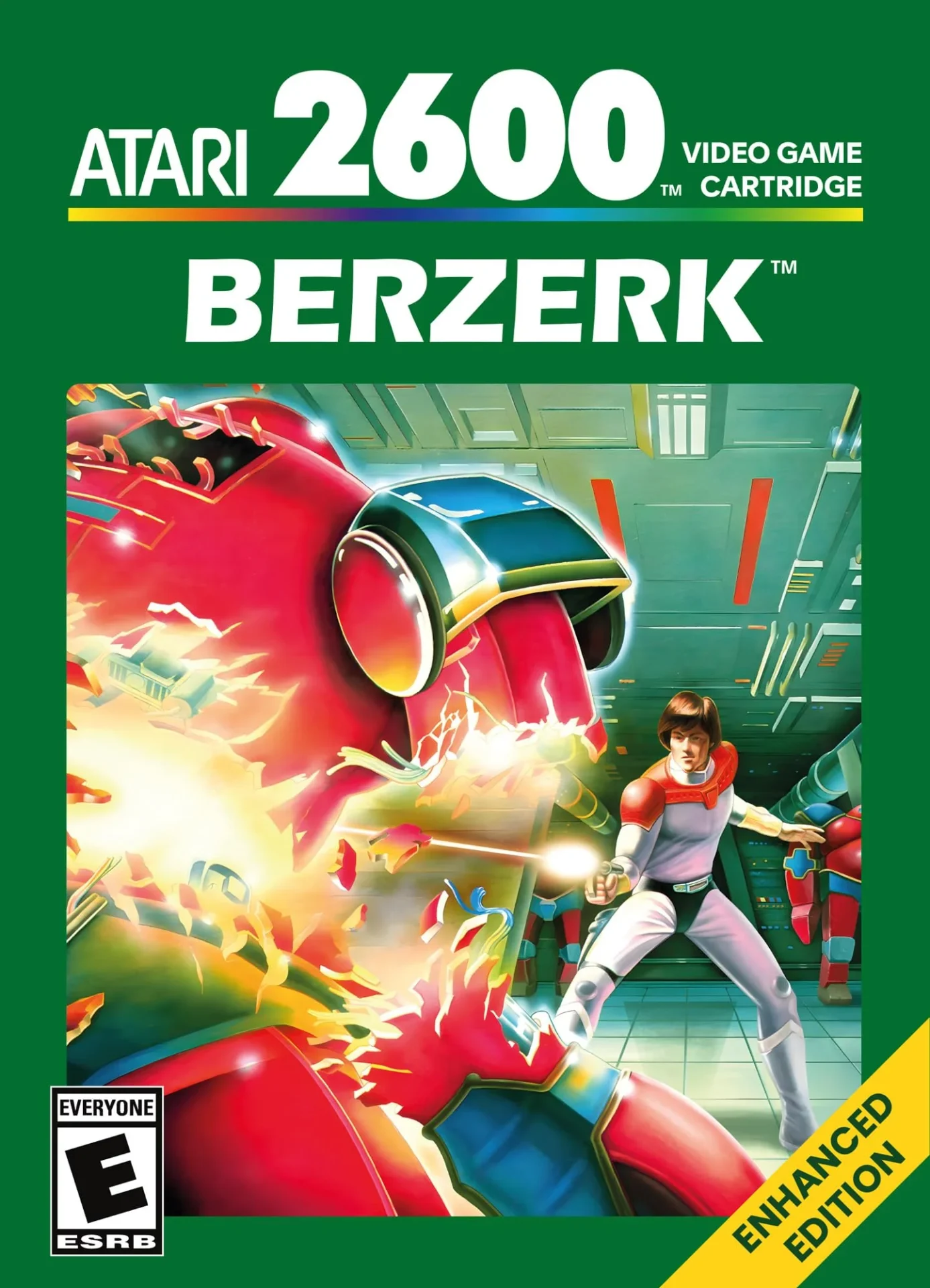
“Intruder alert! Intruder alert!” was the line that made the arcade Berzerk famous, along with “Chicken! Fight like a robot!” for players who fled a maze without clearing it. The 2600 cartridge, ported by Dan Hitchens, shipped without the voice. Home players had to make do with the robots’ silence and a grinning smiley face named Evil Otto.
Otto was named after Dave Otto, a colleague from designer Alan McNeil’s earlier job, and McNeil disliked the smiley’s cheery “Have a nice day” so much that his villain was built around it. Atari’s manual took the hint. Evil Otto is “the mad and merciless mind behind the robot gangs,” and once he catches you, “He will pound you to a lifeless pulp, grinning like a maniac all the while.” Atari’s internal figures put its 1982 sales alone at 1,798,773, so a great many living rooms heard that silence.
Berzerk also turns up in the first reports of the burial itself. In September 1983 Knight-Ridder reported that local kids had started “robbing the Atari grave,” and the cartridges it listed included E.T., Raiders of the Lost Ark, Defender and Berzerk. That was the 1983 scavenging, not the 2014 dig, which relies on the manifest alone: 22 copies by its columns, 20 by the row’s own total, and the box and cartridge split disagrees too. The manual’s summary of the whole predicament holds up. “It’s enough to drive you bonkers!”
Air-Sea Battle
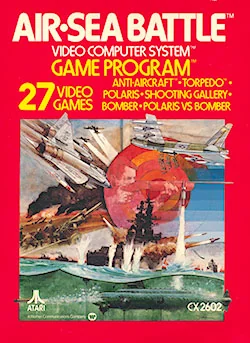
At Sears’ request, Larry Kaplan turned the dogs into rabbits. Sears sold Air-Sea Battle as Target Fun, the cartridge it packed with its own version of the console, and somebody there decided that a shooting gallery full of dogs was not the image Sears wanted. Kaplan swapped them out, and the manual makes the rabbit worth 3 points.
Air-Sea Battle was one of the nine cartridges Atari shipped in 1977 for its new Video Computer System, and it was Kaplan’s first game for the machine. The manual numbers 27 games across six families, from Anti-Aircraft and Torpedo to Polaris and Bomber, and every one of them ends after 2 minutes 16 seconds or when a player reaches 99 points. To get more on screen than the hardware was designed for, Kaplan found a way to move objects more than once in a single frame. The comb of smeared pixels along the left edge of the screen is the visible fingerprint of that trick, which went on to become a standard piece of 2600 programming.
The manifest records 17 copies, five boxes and 12 cartridges, and the city sold nine of the cartridges. None went to a museum. What the cartridge could not fit, in its 2 kilobytes, was a computer opponent with any sense. In the one-player games the computer simply fires nonstop, an arrangement Kaplan himself dismissed as silly.
Defender (Atari 5200)
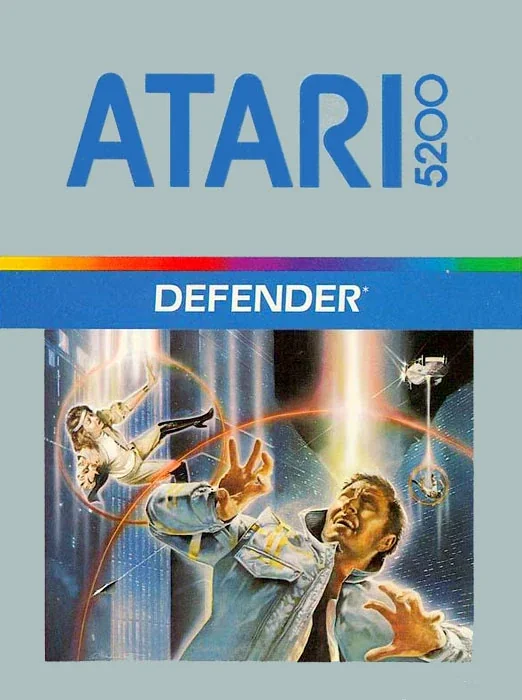
Williams Electronics was a pinball company with almost no video game experience when Eugene Jarvis started work on Defender in October 1979. It was his first video game, and he gave it a control panel with a two-way joystick and five buttons for thrust, reverse, fire, smart bomb and hyperspace. When it was shown to the trade, operators balked. “They were afraid of this game,” Jarvis said. “I guess it was all the buttons.”
The team very nearly had nothing to show. The evening before the trade show they realized the game had no attract mode and no high-score table, and the programmers split the jobs between them overnight. Operators feared the typical player would last a few seconds, and Softline later called it “one of the hardest arcade games ever developed.” By spring 1981 it had passed Asteroids as the top-earning arcade video game, Williams sold more than 55,000 machines, and in 2025 it entered the World Video Game Hall of Fame at The Strong.
The 5200 version, credited to Steve Baker, had to cope with a console whose joystick did not spring back to the center, a design Next Generation said rendered many games nearly unplayable. The manifest records 13 copies, 11 boxes and 2 cartridges, and every one sits in the RETAIN column: none was sold, filmed or sent to a museum. No source explains what 5200 games were doing in a landfill that Atari filled in 1983.
Breakout
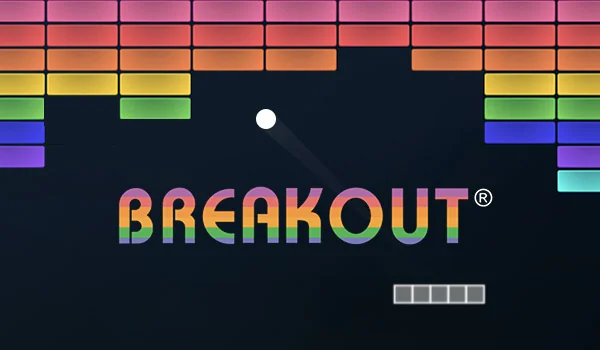
Atari offered a bonus for every chip an engineer could cut from the Breakout circuit board, because arcade games of the time used 100 or more. Steve Jobs took the job and brought in Steve Wozniak, and between them they built a working prototype in four days. Wozniak later said he received $350 as his half of what he understood to be a $700 fee, and only learned afterwards that the bonus had been $5,000 and that Jobs had kept it.
The design was so tightly packed that Atari could not manufacture it. Larry Kaplan called the Jobs and Wozniak approach “impossible to debug or produce,” and the production machine went out with about 100 logic chips, which rather defeated the point of the bonus. The arcade game launched in May 1976 with strips of colored cellophane stuck over a black-and-white screen.
The 2600 cartridge came in 1978 and was programmed by Brad Stewart, who won the assignment in a Breakout contest on the arcade machine. It trimmed the wall to six rows, supported up to four players on paddles, and added a variant called Breakthru, in which the ball smashes through every brick in its path instead of bouncing. Atari sold 1,650,336 copies to retailers between 1980 and 1983. The manifest records 12 dug up, and the film company took five of them. As for the contest, Stewart cleared the screen. His opponent, Ian Shepherd, missed the ball entirely.
Pac-Man
Atari manufactured about 12 million Pac-Man cartridges for a console with an installed base of roughly 10 million, and it sold about 7 million of them. The arithmetic was always going to end somewhere unpleasant. The cartridge went on sale in March 1982, and Atari followed up with a National Pac-Man Day that April.
What buyers saw was programmer Tod Frye’s best effort with almost nothing to work with. The 2600 had two movable objects, so Frye used one for Pac-Man and made all four ghosts share the other, drawing each ghost once every four frames and letting the glow of the television tube fill in the gaps. The ghosts flicker like a failing fluorescent tube. Atari’s manual called the dots “video wafers” and the bonus fruit a “vitamin,” and a reviewer reported that even Atari employees admitted “the VCS Pac-Man is a joke.”
“We did find a few Pac Man cartridges,” Andrew Reinhard wrote afterwards, “(I’d expected many, many more).” The manifest records 12. The character came out of 2014 in better shape than the cartridge did: in June of that year Nintendo announced Pac-Man as one of the third-party characters in Super Smash Bros., the same year his most notorious home version was dug out of the ground.
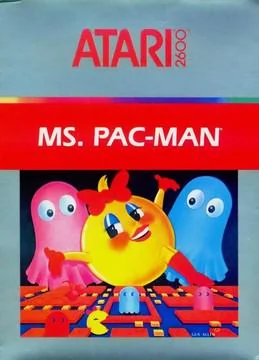
Ms. Pac-Man
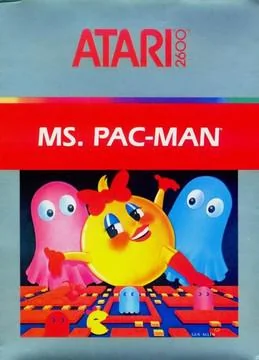
The company Atari once took to court ended up making the 2600 Ms. Pac-Man. General Computer Corporation, founded by MIT students, had sold an unofficial upgrade kit for Missile Command that drew a restraining order from Atari, and the dispute ended with GCC under contract to make games for Atari instead. By then GCC had also built Crazy Otto, a Pac-Man modification with new mazes, smarter ghosts and a hero with legs.
Midway bought it. Namco’s president looked at the new heroine and, as GCC’s Doug Macrae remembered it, said: “Love the concept, get rid of the hair.” The name went through Pac-Woman, Miss Pac-Man and Mrs. Pac-Man before settling on Ms., because the third intermission shows a stork delivering a baby to the happy couple. The 2600 cartridge, credited to GCC’s Mike Horowitz and Josh Littlefield, arrived in February 1983 on an 8 KB cartridge, twice the size of Pac-Man’s, and the ghosts barely flicker. One of them, in Atari’s manual, is called Sue.
Reviewers were relieved. Creative Computing Video & Arcade Games headed its review “THE KING OF VIDEO GAMES IS A WOMAN” and called the cartridge an amazing comeback for Atari after the disappointment of Pac-Man. The manifest records 11 copies, eight of them boxes. The same reviewer, Adam Thompson, closed with a line Atari’s marketing department could not have improved: “Not owning a Ms. Pac-Man cartridge is like not owning an Atari.”
Vanguard
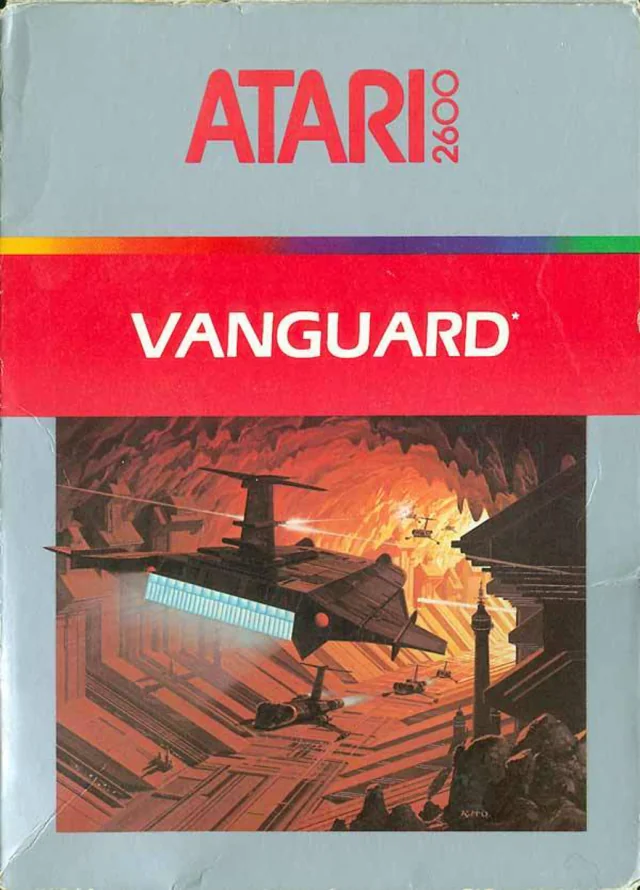
“Don’t fire at Paynes,” the manual warns. The Floating Payne is an enemy you cannot kill in the Striped Zone of Atari’s 2600 Vanguard, and it is named after the cartridge’s own programmer, Dave Payne. Being the programmer has its privileges.
The arcade original, from SNK, borrowed its music shamelessly: Jerry Goldsmith’s theme from Star Trek: The Motion Picture at the start and Freddie Mercury’s Vultan’s theme from Flash Gordon for the power-ups. It topped Play Meter’s American earnings chart in December 1981. The home version flies the same tunnels with a ship that carries 40 seconds of fuel and refuels by shooting things. Video magazine credited it with being the first game cartridge to let you continue after your last life, and the manual describes the 10-second CONTINUE? prompt that does it. It also has a soft spot for the Kemlus snakes, which you can ride for bonus points: they “are not very bright, but they figure this out after the third ride, so don’t try for a fourth ride.”
The manifest records 11 copies, five boxes and six cartridges, and nothing in the dig coverage mentions them. The manual’s story turns out to be oddly apt. It describes the crew working from “the flight log book we found in the Aterria excavations,” and one of them objects that “that book’s dated 1983.” So, as it turned out, was the landfill.
Space Invaders
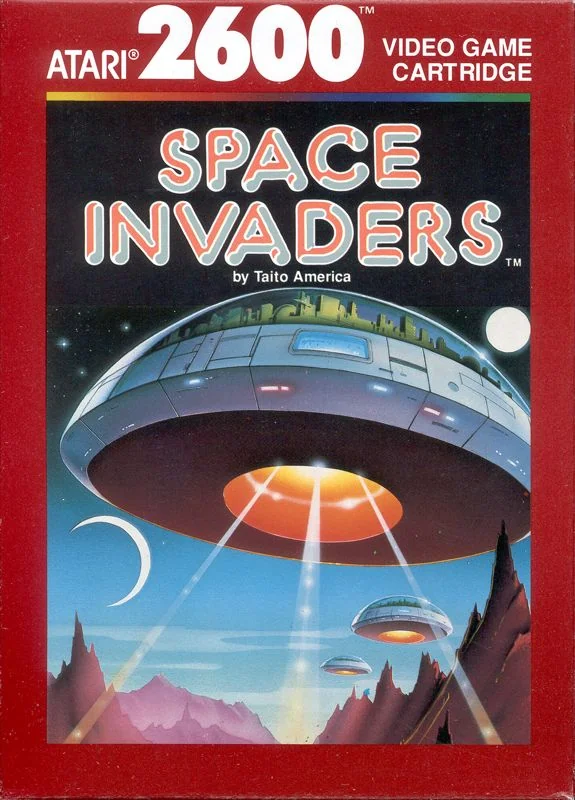
Rick Maurer could not find an artist to draw the aliens, so he sketched them himself on graph paper. His first version of Space Invaders for the 2600 came to 7 KB, and he spent about three months trimming it byte by byte until it fit a 4 KB cartridge. The home game has 36 invaders instead of the arcade’s 55, and three bunkers instead of four. Nobody minded.
Atari’s management had ignored the project until a Warner executive noticed Atari’s own staff queuing to play the arcade cabinet in the company’s test lab, at which point Ray Kassar secured the rights. It became Atari’s first licensed arcade conversion for the console, and Atari’s figures put its 1980 sales at about 1.3 million copies, the first cartridge to sell a million. The box promised “112 video games,” and it meant variations: moving shields, zigzagging bombs, invisible invaders. Atari ran a national championship that same year with about 10,000 entrants, and the winner, Rebecca Heineman, went on to become a game developer herself.
On the day of the dig, Xbox Wire listed Space Invaders among the games expected to be down there, and the manifest records 8 copies. None was sold; the film company took four. Maurer was paid a bonus for his work, either $3,000 or $11,000 depending on which account you read, for a game that earned Atari more than $100 million. He finished one more 2600 game and left the industry for mathematics.
Combat (first entry)
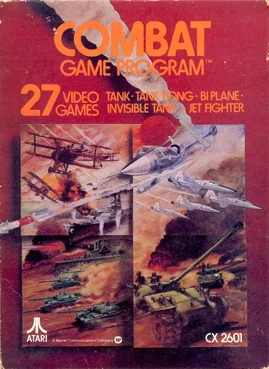
Combat came in the box. From 1977 to 1982, Atari bundled it with most of its consoles, so it was the first game a great many 2600 owners ever played, and the label promised “27 video games” for two players: tanks, tanks with ricocheting shots, invisible tanks, biplanes and jets. There was no one-player mode at all.
The tank games go back to an arcade machine called Tank, released in November 1974 by Kee Games. Atari had secretly set up Kee in 1973 to pose as a competitor, so that it could sell its games to a second set of distributors. The 2600 was more or less built around Tank. Warren Robinett remembered Atari’s hardware chief Jay Miner telling him the console was designed to do “Pong,” “Tank,” and “maybe a few other games,” and engineer Joe Decuir said Atari was determined the machine would display a decent tank game. Everything else the 2600 ever did was a bonus.
The manifest lists Combat twice, on separate rows, and nobody has explained why. This row, marked “Combat – No” for reasons that are equally unexplained, records 7 copies, 3 boxes and 4 cartridges, and every one sat in the RETAIN column. The scholar Nick Montfort has argued that by being packed with the console, Combat “helped to assert that play involving several people was the ordinary use of this system.” Seven copies of that argument ended up in a hole in the New Mexico desert.
Demons to Diamonds
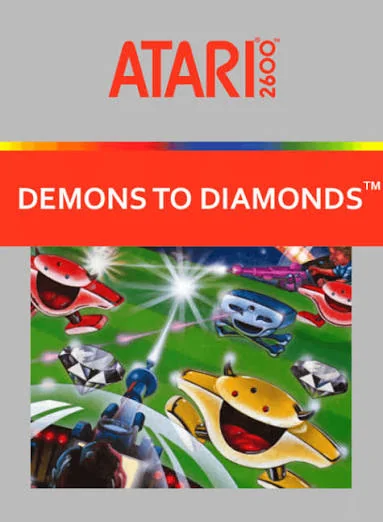
“Saturday at the Cosmic Carnival” is how Atari’s manual sets the scene: you and your best friend wander into a shooting gallery where a squeaking demon dares you to try your “laser-sharpshooting skills.” Shoot a demon the same color as your laser base and it turns into a pulsating diamond worth up to 80 points. Shoot one of the wrong color and it becomes a skull that fires back in both directions.
Atari’s manual says the game was “primarily designed for children in the 6 to 12 age range,” which prompted AtariProtos to ask the obvious question: “how many children’s games do you know with Demon in the title?” The cartridge was originally called Hot Rox, and was renamed shortly before its release in July 1982 for reasons nobody recorded. Nick Turner programmed it, and it is one of the few 2600 games built for two players at once, with one laser base at the bottom of the screen and the other at the top, each steered with a paddle and both firing at the same crowd of demons.
The manifest records 7 copies, one box and six cartridges, and marks every one RETAIN; no dig report mentions the game at all. AtariAge rates the Atari-label cartridge as common. The manual’s description of losing a life is the most memorable line in it: “A deep, reechoing doom bong sounds and everything on the screen momentarily stops.” It is a game for six-year-olds.
Asteroids (Atari 5200)
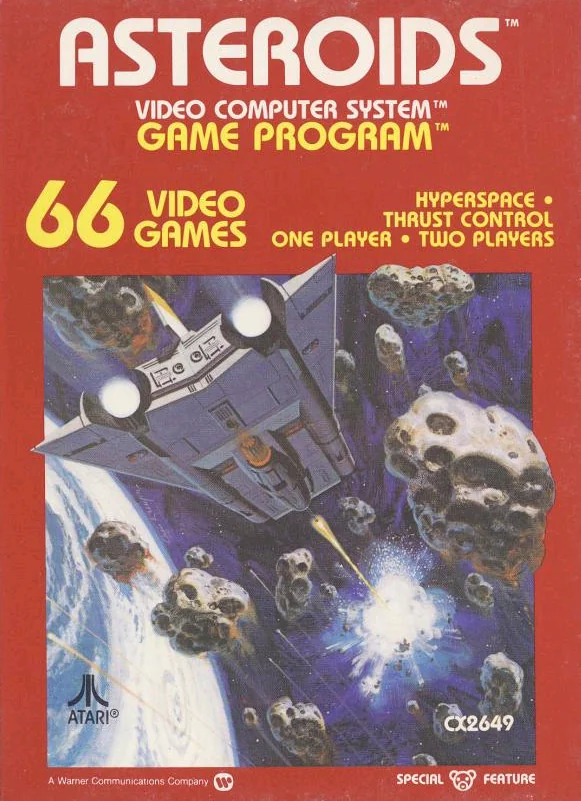
Six boxes and no cartridges. That is what the manifest files under Asteroids in its Atari 5200 section, for a game that was never released on the 5200 at all. The preservation site AtariProtos calls it “the only launch title never to be released,” and Atari had gone a long way before stopping. “Atari figured this problem out so late,” AtariProtos says, “that they had even made a production label and box.”
The problem, by most accounts, was the controller. The 5200 SuperSystem reached a handful of department stores in October 1982 at $299.95 with a 360-degree analog joystick with no springs to return it to the middle, which suits a racing game reasonably well and a spinning spaceship very badly. No Atari statement explaining the cancellation has been found, so the controller theory is the preservationists’ inference rather than anything the company admitted. The game itself was finished, or nearly: a prototype cartridge dated August 1982 survived, and the prototype archive Hidden Palace published a dump of it on July 3, 2023.
How six boxes of a cancelled game ended up in a burial of unsold stock is a question nobody has answered, and every possible explanation is guesswork. They sat in the RETAIN column, untouched by the eBay sale. AtariProtos had already offered the best summary of the game’s career: “Obviously Asteroids was just about ready to ship before they put the kibosh on it.” Atari then threw away the packaging anyway.
Combat (second entry)
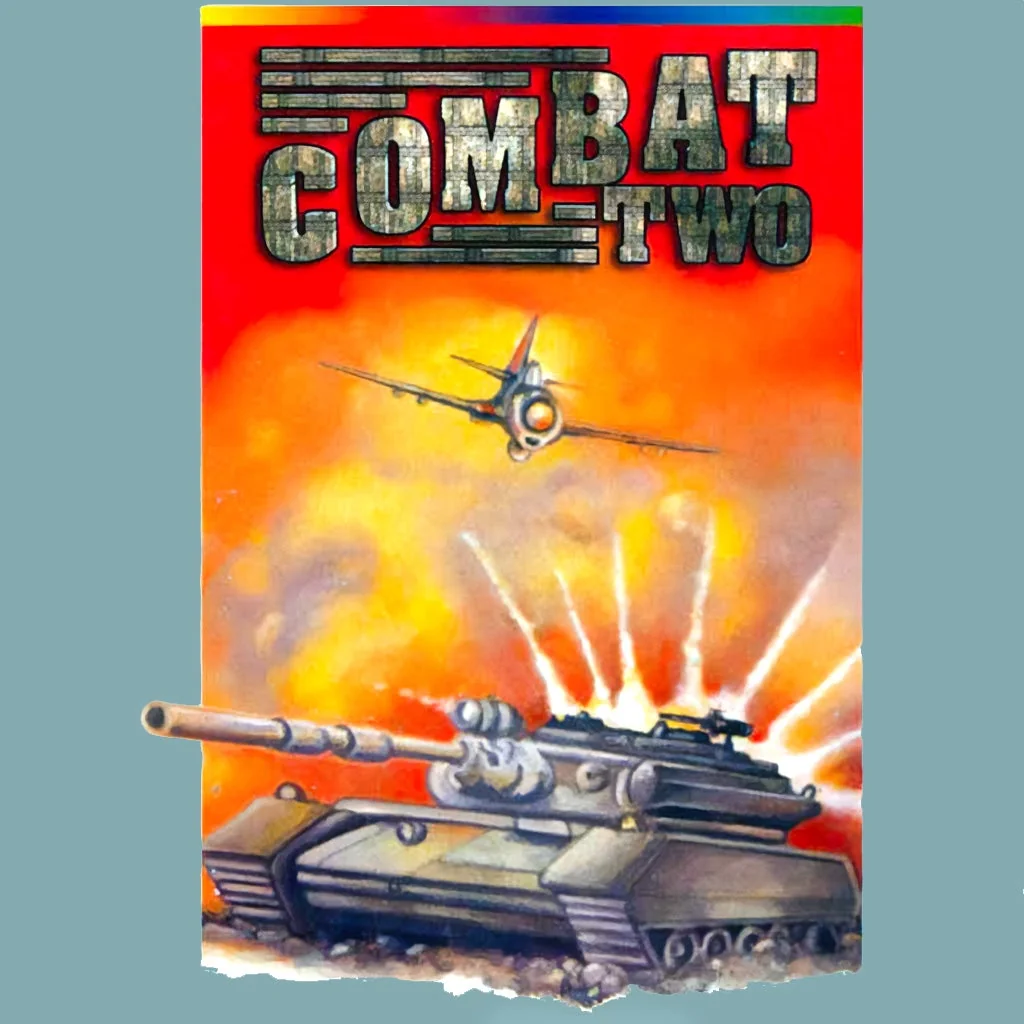
Joe Decuir, the hardware engineer who got Combat running, said he worked on it “mostly as a test case for the hardware” he was designing with Jay Miner. The idea was older still: Steve Mayer and Ron Milner of Cyan Engineering had sketched the console in December 1975, and the first program run on their prototype, later given to the Computer History Museum, was a forerunner of Combat.
Larry Wagner finished the game, and it changed shape as the hardware did. The ricocheting Tank-Pong mode came to him on his commute from Berkeley to Los Gatos. One variation, Billiard Hit, only scores if your shot bounces off a wall at least once before it hits the other tank, and another makes both tanks invisible until somebody fires or bumps into something. Wagner also folded in a version of Atari’s arcade Jet Fighter, which is why the cartridge has planes in it. Sears sold the same game as Tank Plus, and the Canadian chain Zellers sold it as Frontline.
The manifest’s second Combat row, titled plain “Combat,” records 6 copies: 2 cartridges sold, 3 in the column headed 2ND CHANCE and 1 box retained. By 1982 the game had already started to look its age. Ken Uston, as the historian Brett Weiss later quoted him, wrote that it was not fair to be too critical of a cartridge nearly five years old, which in an age of rapid computer technology “makes it almost an antique.” It was buried the following year.
Video Olympics
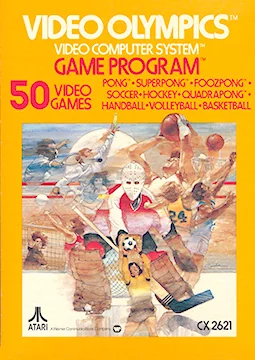
Nobody else at Atari was writing Pong for the new console, so in early 1977 the man who had helped design the hardware picked it up himself. Joe Decuir had built the 2600 with a ball object “pretty much just for Pong,” and he told his supervisor he could think of many variations. They agreed to stop at 50. Video Olympics fits all of them, from Pong to Foozpong, Hockey, Handball and Basketball, into a cartridge of 2 kilobytes.
It is the console’s family reunion with the game that founded Atari. Pong began at Andy Capp’s Tavern in Sunnyvale, California, where Al Alcorn’s prototype soon stopped working because its coin box was too full of quarters to accept any more. The home cartridge supports up to four players with two pairs of paddles, and its manual calls one mode, Quadrapong, “The king of Pong games!” In Robot Pong the computer takes the left paddle, and Video magazine called it astonishingly good. Decuir himself considers Foozpong basically unplayable, since too much happens too fast.
Sears sold the same cartridge as Pong Sports. The manifest records 6 copies of Video Olympics, six cartridges and not a single box, none of them sold. The game’s best review came from its own author. By his own account, in 1988 Decuir pulled his 2600 out of the garage so his 6-year-old son could play the handball games, gave himself a half-size paddle as a handicap, and within a few games they were evenly matched.
Adventure
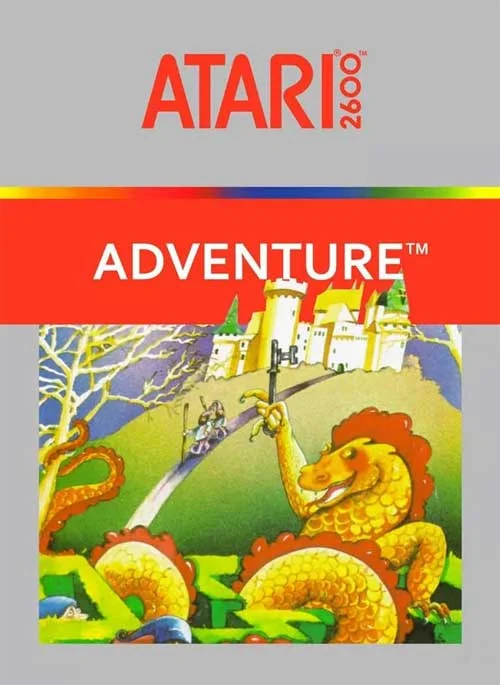
“It was a signature, like at the bottom of a painting,” Warren Robinett said of the secret room he hid in Adventure. Atari did not put programmers’ names on its boxes, so he built a hidden chamber that spelled out “Created by Warren Robinett,” told nobody, and handed in the finished program. When it was discovered, Atari left it in, because making a new ROM mask would have cost $10,000.
It was found by a 15-year-old from Salt Lake City, whose letter explaining how to reach the room arrived at Atari in 1980, after Robinett had left. The game itself was an attempt to squeeze the text adventure Colossal Cave, which Robinett had played on a mainframe at Stanford, into a cartridge of 4096 bytes. It has 30 rooms, a magnet, a bridge, three keys, a bat that steals things and three dragons that Robinett freely admits look like ducks. “If I ever do a sequel,” he told Wired, “it will be Return of the Duck Dragons.” The bat can pick up a dragon that has swallowed you and fly the pair of you around the kingdom, which Robinett says he never intended.
The manifest records 4 copies, and the film company took one of the cartridges. Robinett says the game sold a million copies. His own share was a salary of about $20,000 a year and no royalties, and in 2015 he added a final grievance: “they never even forwarded any fan mail to me.”
Maze Craze: A Game of Cops ’n Robbers
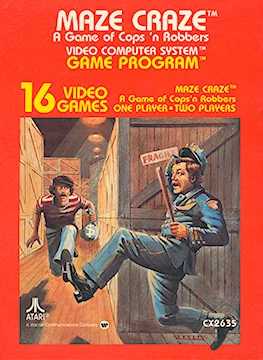
There is no score in Maze Craze, and that was deliberate. Rick Maurer, who wrote it, had spent about four or five months on a Space Invaders clone before shelving it, because nobody at Atari showed much interest and he could not cure the flicker. He turned to a maze game instead, inspired by one Mike Glass had made for the Fairchild Channel F. Then management discovered how many quarters the Space Invaders arcade machine was eating, and Maurer was sent straight back to it.
What he left behind is a race between two cops through a fresh random maze every game. While the console designs it, the screen fills with random flashes of color, and it checks that the maze can actually be finished. The manual lists 16 games at four speeds, the slowest labeled “calculatingly slow,” and four levels of visibility, which Atari Archive totals as 256 variations. In TERROR your cop cannot leave until robbers have knocked out your opponent, and in BLOCKADE you can drop a fake dead end to send the other player the wrong way.
Sears sold it as Maze Mania. The manifest records 4 copies, every one of them retained. Atari Archive calls it “arguably the best game of its type produced at the time,” which was not enough to keep it out of the landfill. Its manual is dated 1978, though the game reached the shops in 1980. Nobody at Atari seems to have been in a hurry.
Circus Atari
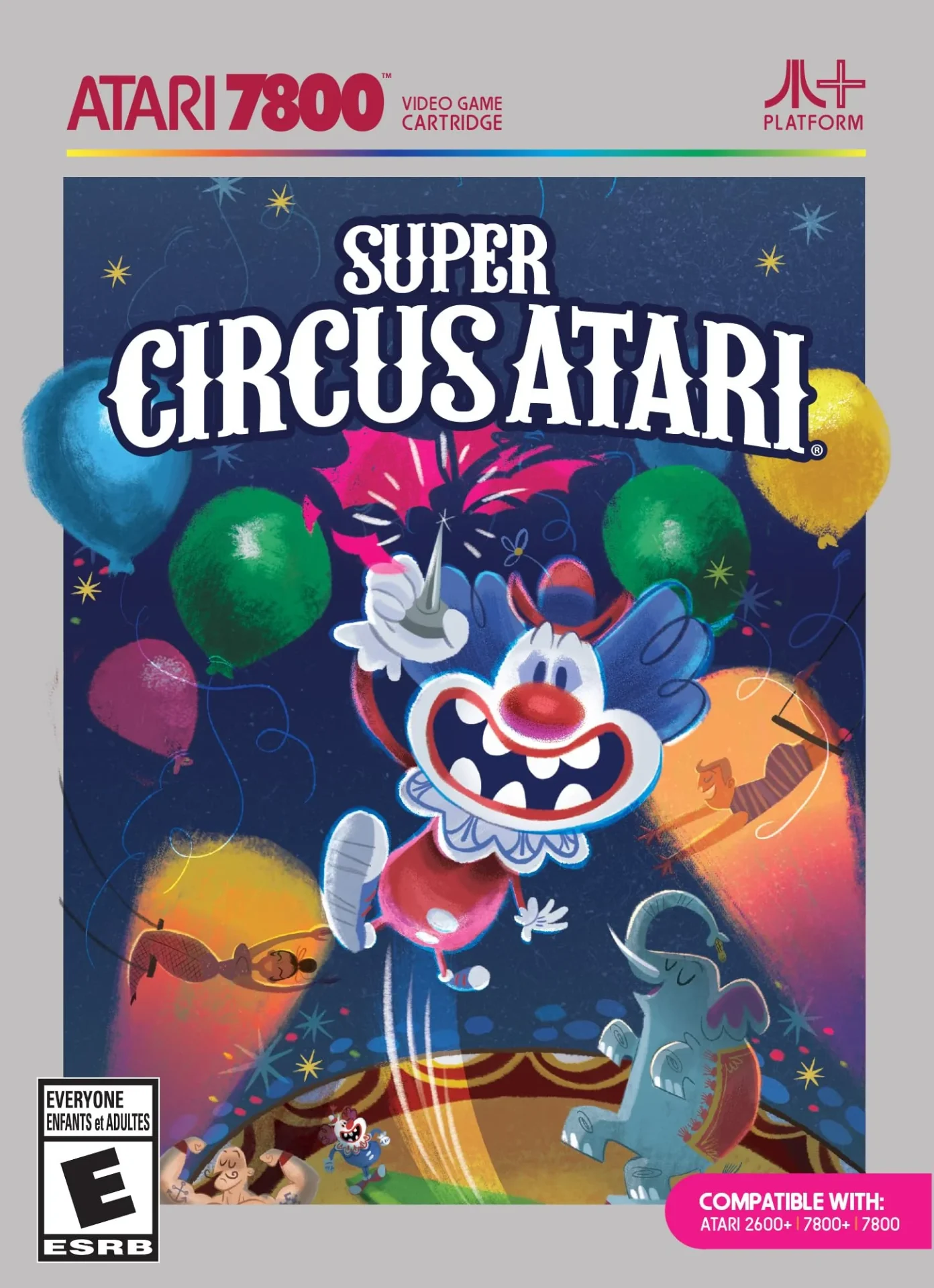
Exidy’s 1977 arcade game Circus was essentially Breakout with clowns, bouncing acrobats off a seesaw into rows of balloons, and Atari’s Circus Atari copied it straight back. Atari Archive calls the cartridge an unlicensed version of another company’s original; AtariProtos thinks a licence doubtful given the name change. Either way, the manual footnotes the Breakout and Breakthru trademarks as Atari’s own, which is a bold position for a clown game borrowed from a borrowed idea.
The manual’s instructions open with “POP! POP! POP! Pop the balloons and score points.” Red balloons are worth 10, blue 5 and white 2, and clearing the top row earns an extra clown. You slide the seesaw with a paddle and press the button to flip it in midair, a compromise for the lack of the arcade’s side platforms. The black blocks at the screen edges, where each new acrobat appears, are the same smear of hardware lines that disfigures other 2600 games, which programmer Mike Lorenzen bunched together and turned into the scenery. The arcade original had a stranger afterlife than the cartridge: its sounds opened Yellow Magic Orchestra’s debut album in 1978.
The manifest records 3 copies, two boxes and a cartridge, none of which the city sold. The main attraction is failure. Creative Computing Video & Arcade Games reported that players could barely score in early games, partly because it was hard and partly because of “how genuinely funny it is when the clowns splat on the ground.”
Indy 500
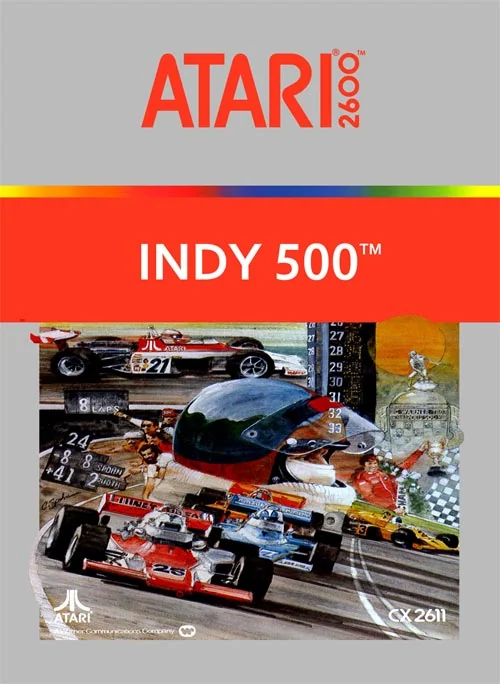
The knobs never stop turning. Indy 500 came with its own pair of driving controllers, which look exactly like Atari’s paddles but rotate endlessly in either direction, and the programmer, Ed Riddle, could not make the game work on ordinary paddles because they eventually hit their limit. Atari Archive reports that the extra hardware doubled the price at launch, $39.95 against $19.95 for a normal cartridge.
Riddle was not a programmer when a colleague asked him in 1977 whether he would like to make a game, and Indy 500 was, he said, “the first serious programming I had attempted.” He added a mode called Crash n’ Score whose manual header is simply “Score points by crashing!” Ice Race happened by accident. Riddle turned the angle, speed and slipperiness settings all the way up to see what would happen, and liked the result enough to keep it.
The manifest records 3 copies of Indy 500, loose cartridges without boxes, all held back from the sale. Bill Caraher, one of the dig’s archaeologists, noted that the assemblage included “a quite a few earlier games,” Indy 500 among them, and that none of the games worked when they were tried in a console. Riddle’s next idea never got that far. In Roach Wars, “The bugs would fire projectiles out of their butts to hit other bugs,” and it was dropped because, as he put it, “A lot of people would have negative associations with roaches.”
Star Raiders (Atari 5200)
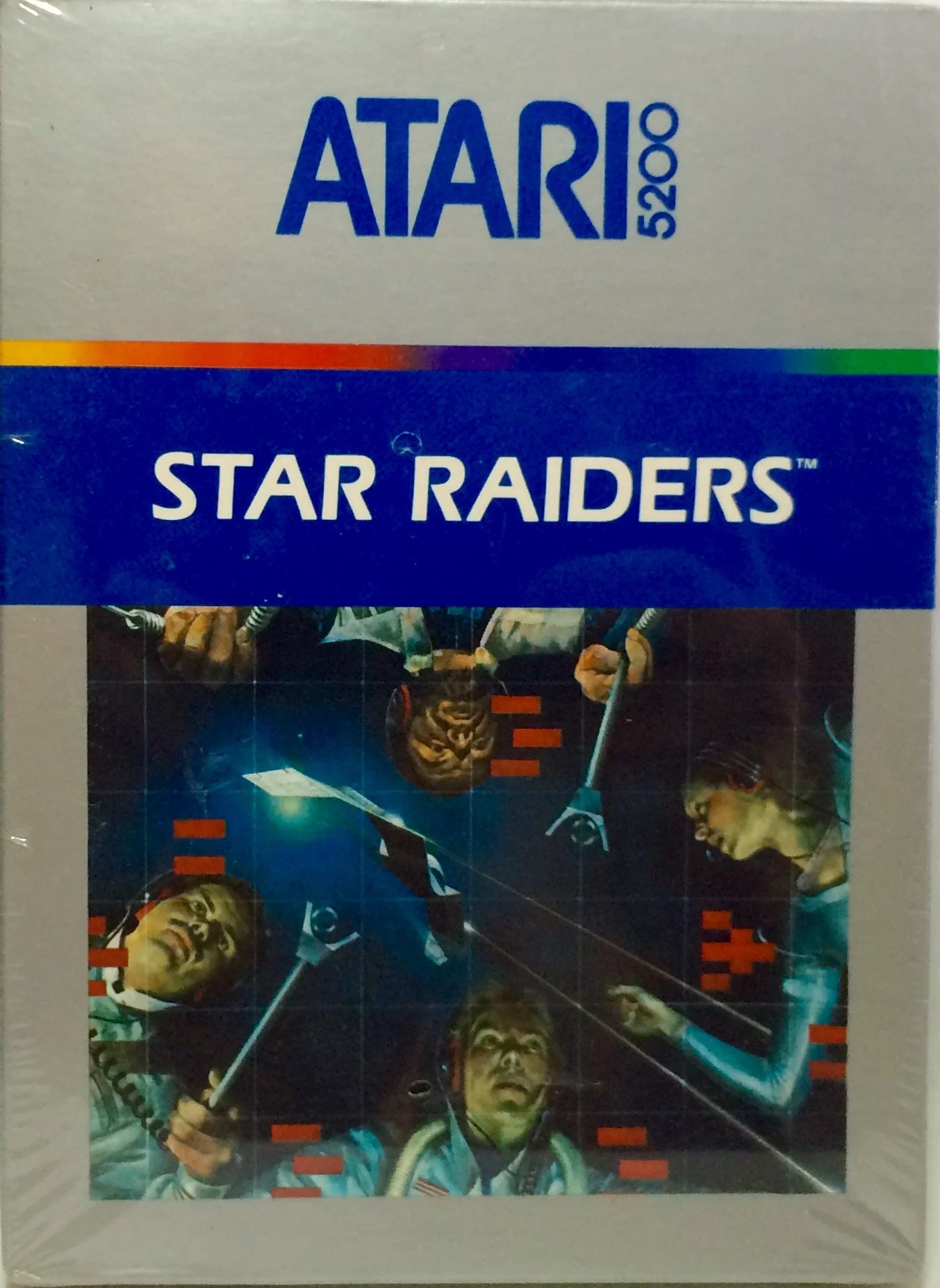
Doug Neubauer built Star Raiders in his spare time. He had designed POKEY, the chip that gave Atari’s computers their sound, and his supervisor let him make a game for fun. “I wanted to combine Star Wars with the text-based ‘Star Trek’ Game,” he explained, and the result was a first-person space battle that turned Atari’s home computer into a games machine, which was not what Atari had in mind. The Centre for Computing History calls it one of the killer apps for the Atari 8-bit computers, and says it put the company in a bit of a dilemma, since the computer was supposed to be for the home business market.
Neubauer refused to give it a numeric score. Instead the game hands out ranks, and poor play earns you titles like Galactic Cook and Garbage Scow Captain. He worked out the 3-D mathematics himself and admitted the weak spot: “my signed divide algorithms were terrible, and that’s why the game would slow down whenever there was an explosion.” The 5200 version moved all the ship’s controls onto the keypad in the controller, and its manual is written in the voice of a drill instructor, who at one point instructs the player to turn the shields on, “maggot.”
The manifest lists 3 copies of the 5200 cartridge, one box and two cartridges, retained by the city rather than sold. Atari paid its programmers no royalties, Neubauer included. The game sold computers by the thousand, and he left.
Video Pinball
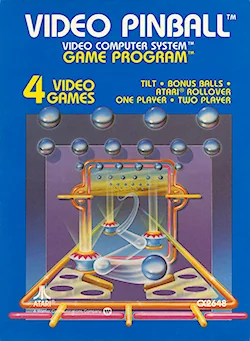
“How many of you out there have always longed to be a pinball wizard?” Atari’s manual asks, and then promises a game that “doesn’t have any idea what a quarter is.” The man who wrote it was not a pinball player. Bob Smith had walked into Atari with two children, no degree and a game he had already sold elsewhere, and was hired on the spot at the start of 1980. Video Pinball was his first assignment, so he spent long hours on Atari’s Superman pinball machine in the corporate game room, learning how the real thing behaved.
The ball moved so fast it could pass straight through a flipper without the hardware noticing, so he wrote his own collision detection in software. You nudge the table by holding the button and pushing the joystick, and if you overdo it the top of the screen turns red, the flippers freeze and the ball drains. A veteran of Atari’s coin-op division played the result and told him, “You know, this isn’t pinball, but it plays really well.” Smith said he settled for that.
It became his best-selling cartridge, about 2 million copies by his account, and he left Atari in 1981 to help found Imagic. The manifest records three cartridges, none of them sold. Smith, who died in 2023, also remembered a promise from an Atari executive that a 2-million seller would earn a creative retreat in Hawaii. “It never happened, so he owes me a trip to Hawaii.”
Basketball
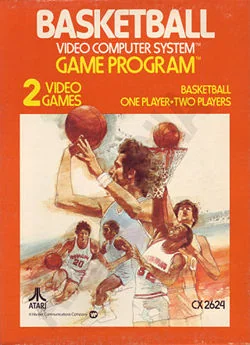
The closer the game, the better the computer plays. “The closer the score, the better his defense and he will make more offensive moves,” the manual warns, and it advises you not to fall more than eight points behind, because once he has let you back in, “his defense will tighten much sooner.” It was one of the first 2600 games to let one person play against the machine, and it plays like an opponent with a grudge.
Its programmer, Alan Miller, had one of his own. In early 1979 he decided he wanted credit for his game designs and some form of royalty, drafted a contract, and by the middle of the year Atari’s management had told him they would make no changes. Miller later said that he, David Crane, Bob Whitehead and Larry Kaplan accounted for about two-thirds of Atari’s cartridge sales. He left in 1979 to co-found Activision.
The game itself is one-on-one, viewed from an angle, and the manual asks you to “Visualize that you are sitting at center court about six rows back.” The clock runs down from 4:00, a long, high arching shot comes from releasing the button overhead, and “there is no ‘goaltending’ in this game.” Video magazine called it “the most exciting four minutes of one-on-one hoop action” its reviewers had seen. The manifest records 2 copies, a box and a cartridge, neither sold. Activision, the company Miller left Atari to start, took in about $158 million in 1983.
Canyon Bomber (first entry)
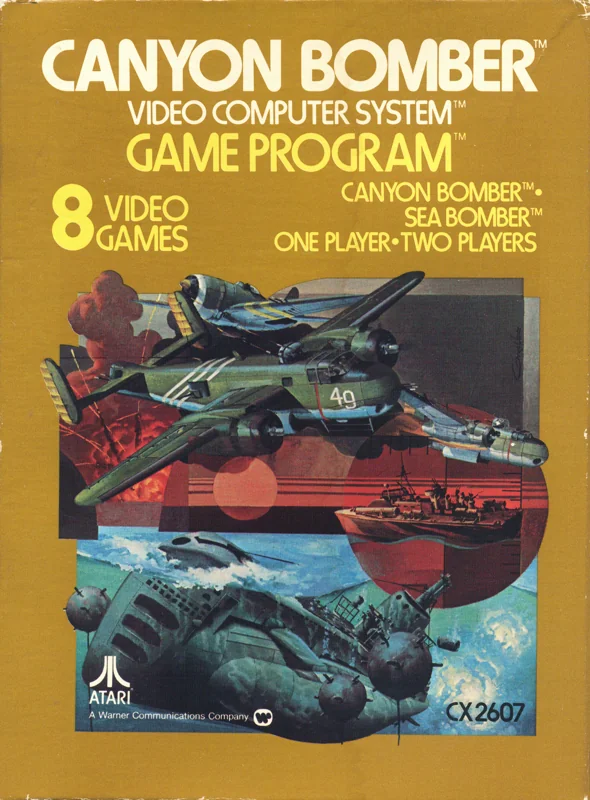
“Upside-down Breakout” was how the arcade designer described Canyon Bomber, and that is exactly what it is: a plane flies across the top of the screen and drops bombs into a canyon full of rocks, which crumble from the top down. The arcade version arrived in November 1977, and the first version needed 3K of memory. Because memory chips were expensive, the designer was asked to fit it into 2K, and did, and by Atari Archive’s account won a bet with a supervisor in the process.
David Crane converted it for the 2600, and the canyon became eight bars of bricks worth one to four points each, with the deepest bars paying most. Crane, trained in physics, first wrote several pages of gravity calculations to make the bricks fall properly when the ones beneath them were destroyed, found them too much for the console’s processor and boiled them down to about 10 lines. “This may not sound like much,” he said, “but it was quite an achievement.” The cartridge also carries Sea Bomber, a version of another Atari arcade game, so buyers got two coin-op conversions for the price of one.
The manifest has two Canyon Bomber rows, and this one, titled plainly “Canyon Bomber,” records 2 cartridges, both retained. Six misses end the game. It is played with a paddle controller, and the manual points out that during Canyon Bomber games the knob is inoperable. The only thing that works is the button.
RealSports Football
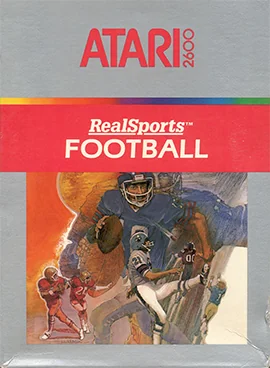
George Plimpton started it. Mattel hired the writer to appear in Intellivision advertisements that compared its sports games with Atari’s, and the message was unkind: “Game for game, feature for feature, I think you’ll find Intellivision is clearly superior.” Video Games magazine reported a pre-Christmas television campaign of “$6 million-plus.” Atari’s answer was the RealSports series, of which this was the third.
The manifest calls it “Football 82,” and it is a much more modern game than Atari’s earlier attempt. Rob Zdybel, credited in the manual with designing and implementing it, gave each side five players and a menu of plays called with the joystick: seven on offense, five on defense. Atari had apparently hoped for 22 players on screen, which Zdybel said was impossible if any of them were to move. The game is one 15-minute quarter, and the manual is admirably frank about what has been left out: “There are no time outs, no fumbles, no penalties, and no running out-of-bounds.” Football with all the irritating parts removed.
Atari’s television response featured a Poindexter lookalike calling himself “an intelligent consumer,” who concluded that “Nobody compares to Atari.” The dig turned up 2 boxes and no cartridges of this one, neither sold. The best line of the whole advertising war came from Plimpton himself, in the same Video Games article: “I must admit, I really don’t play any of the games much and I haven’t played Pac-Man at all.”
Galaxian (Atari 5200)
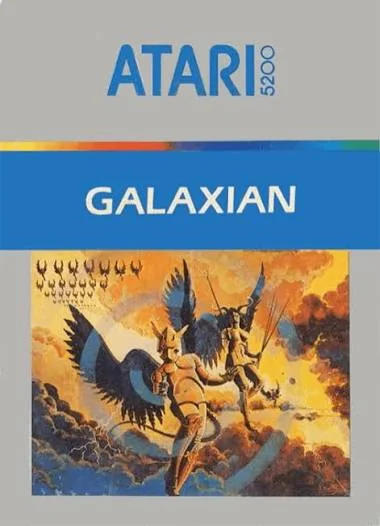
The manifest spells it “Gaaxicn.” There is only one cartridge in the Atari 5200 library that looks anything like that, Galaxian, model CX5206, so the identification rests on the spelling and nothing else.
The game behind the typo was a big one. Namco released Galaxian in Japan on September 15, 1979, and showed it to Midway, which had just lost its licence for Space Invaders and was glad of a replacement. The arcade machine was one of the first video games with RGB color graphics, and its fleets of aliens peel off and dive at you instead of shuffling across the screen. The 5200 cartridge, programmed by Joseph Tung, was among the console’s first games in late 1982. Its manual introduces the fleet by rank and color, blue Drones up to yellow Flagship Commanders, and teases a surprise past wave 10: “We won’t tell you what to expect.” AtariProtos says the surprise is a little Pac-Man, then the Atari logo, then Tung’s initials.
The manifest records 2 cartridges and no boxes, and like every 5200 row it is filed under RETAIN. Atari planned a 5200 version of the sequel, Galaga, and dropped it when the console failed to become the hit it wanted. The manual’s best moment is about loss. When you shoot down a flagship, “the rest of the fleet stops firing for a few seconds of mourning.” The manual suggests using the pause to shoot its escorts.
RealSports Tennis (Atari 5200)
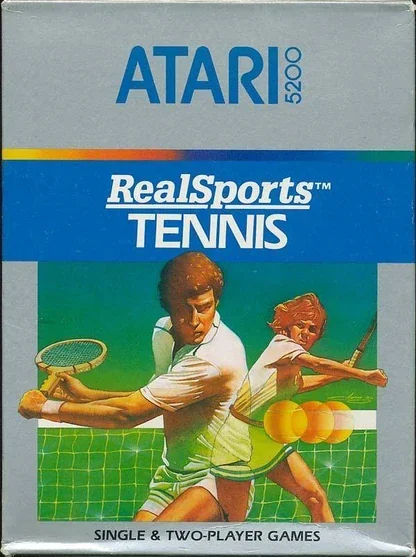
Tennis is all the title screen says. According to AtariProtos, Atari thought up the RealSports branding after the games were finished, so only the box and the manual call it RealSports Tennis, and the excavation manifest follows the screen. It is the only tennis cartridge made for the 5200, which is how the row is identified.
Even its date is disputed. AtariAge and Atarimania file it under 1986, but Atari Archive puts it in April 1983, and the cartridge’s own manual describes the Trak-Ball controller as “available in mid-1983,” which rather settles the matter. W. Sean Hennessy programmed it, and Wikipedia says Atari’s Director of Software, George Kiss, gave him the job knowing he was a tennis fan. Hennessy went on to port it to Atari’s computers, and the game was well enough received that, in his words, “After that they let me pick my own projects,” an unusual privilege for a new Atari programmer.
The manual takes the sport seriously, running through love, deuce and tie-breakers and closing with a glossary from ACE to VOLLEY. It lets each player type a name of up to seven letters into the scoreboard, and it warns that “the computer player can smash a lob so fast, you won’t be able to return it.” The manifest records 2 cartridges, untouched by the sale. AtariProtos, reviewing it, wished only for the grunting noises professional players make on television, then added helpfully: “You can even make the grunting noises if you want to.”
RealSports Volleyball
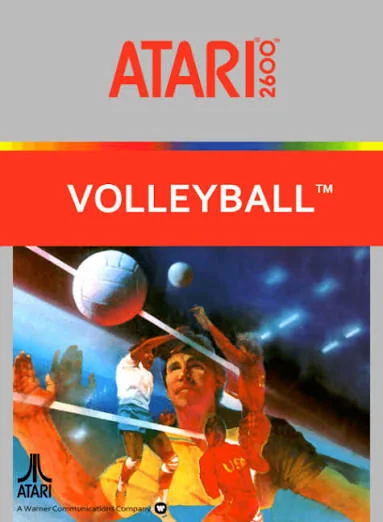
Leave the cartridge alone for long enough and the sun goes down. Its programmer, Bob Polaro, built in a sunset and, once the screen darkened, “a small shark would come out and go across the horizon.” Digital Press timed the wait at about 8 minutes. The manual handles nightfall with the seriousness of a coaching guide: the ball’s shadow is your reference point, and “Once the sun sets, the shadow disappears.”
Atari’s research methods for the game were enviable. AtariProtos says Polaro spent a day at the beach playing volleyball to get the mechanics right, and Polaro himself says Atari staff played on the company’s own sand court a couple of days a week. He recalled half a dozen suits filing into his lab to inspect the game while he sat there in a tank top, shorts and sandals, in a building he says was nicknamed the Country Club. The game was the second RealSports release, in November 1982, and The Video Game Update named it Best New Sports Game in its awards for 1982. Each team has two players who move in unison, and a game runs to 15 points.
Polaro had also programmed the 2600 Defender, so two of his games went into the landfill. The manifest records 2 cartridges of this one, both retained. The manual’s opening premise is a beach game between friends, with stakes that never change no matter what happens on the screen: “The team that loses buys lunch.”
23 Tele Games
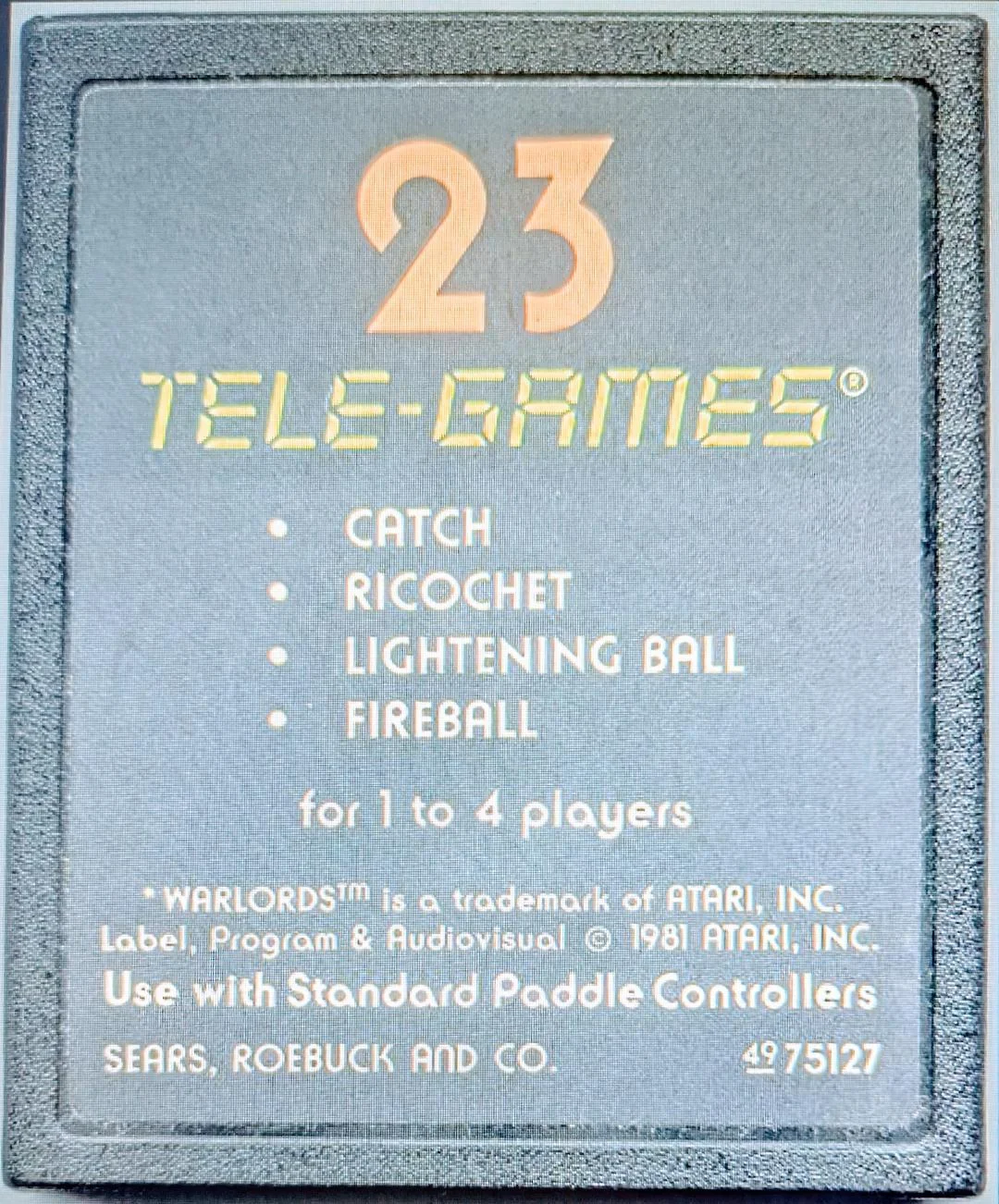
One row of the manifest names a brand instead of a game. Row 3 reads “23 Tele Games,” and it records a single cartridge, no box, retained by the city. Nobody knows what game is on it, and nobody knows what the 23 means.
Tele-Games was Sears. The department store promoted Atari’s home versions of Pong under that name from 1975 and later sold the 2600 itself under its own badge, along with cartridges that were almost all Atari games in different packaging. AtariAge counts only three Sears titles that Atari did not also sell, and Sears often renamed the rest: Air-Sea Battle became Target Fun and Video Olympics became Pong Sports. Sears’s text labels were black, with TELE-GAMES in large letters followed by a list of the games on the cartridge, so a box or cartridge could easily be read as “Tele Games” first and its actual title second. Some Sears labels printed the number of game variations, too, which is one of several possible explanations for the 23 and proves nothing.
This is the one row where the Sears name won. Sears copies are often harder to find than Atari’s because they were only sold at Sears, so the most anonymous entry in the dig may also be one of the scarcer ones. It should not be confused with Telegames, an unrelated company that later made 2600 cartridges of its own. The two names are one hyphen apart.
Backgammon
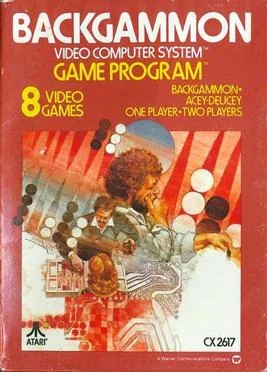
Acey Deucey, the manual explains, “was developed by members of the US Navy,” and the cartridge includes four versions of it alongside the ordinary game. Craig Nelson programmed it, and Creative Computing reviewed it in 1979, concluding that it “would be excellent for someone learning Backgammon and provides an interesting challenge for beginning to intermediate players.”
The cartridge takes gambling seriously. Its doubling cube can raise the stakes as high as 64, and in one-player games the computer decides whether to accept your double, and will quit rather than play on if it declines. You can dial in your own dice rolls with the paddle instead of letting the machine roll them, which seems to put a great deal of trust in the player. The manual is unusually honest about its own flaws. A section headed “Illegal Move” admits that in one particular situation the computer will let you make a move the rules forbid, and suggests starting over. It also offers a short history of the game, which it says has been played “for over 5,000 years.”
The manifest lists the row as “Backgammon – No,” one of five rows carrying a “No” that nobody has explained, and records a single cartridge, retained. The manual’s last piece of strategy may be the best advice in the landfill: if you are about to be gammoned, refuse the double and retire from the game.
Baseball
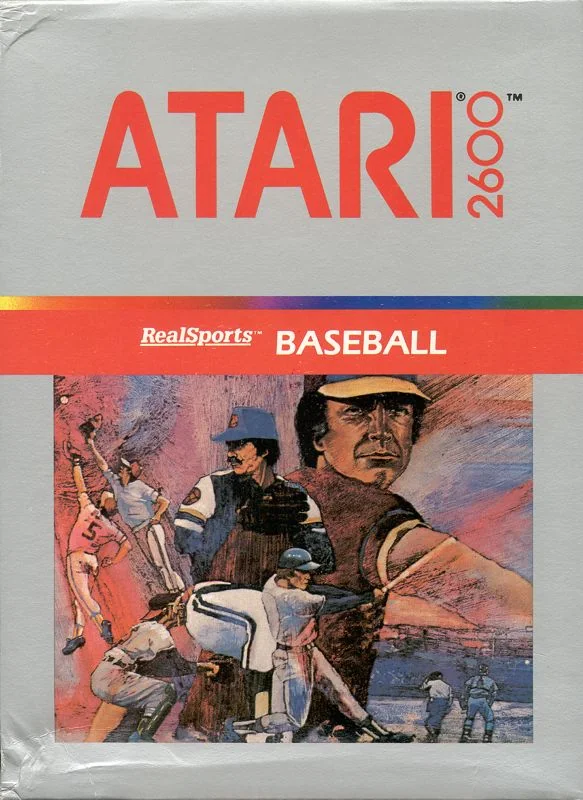
Atari never sold a 2600 cartridge called plain Baseball. That makes the manifest’s “Baseball” row a small mystery, because the word turns up on plenty of other people’s labels. Sears printed it on three different label designs, the German retailer Quelle used it, and later reissues of Mattel’s Super Challenge Baseball carried it too. The likeliest candidate is the Sears cartridge, which was Atari’s own Home Run under another name, but the manifest has a separate row for Home Run, and nothing ties this one to any particular game.
Baseball was a sore point for Atari in those years. Mattel built Intellivision advertisements around how primitive Atari’s sports games looked, and Intellivision’s own baseball game, designed by David Rolfe, became that console’s best seller at more than a million copies. Mattel’s M Network then brought a version of it to the 2600 as Super Challenge Baseball in mid-1982, selling Atari owners the game that had been used to mock them. Atari’s reply, RealSports Baseball, arrived in October 1982, programmed by Joseph Tung, who also wrote the 5200 Galaxian in this same landfill, and its television campaign was fronted by the Oakland Athletics manager Billy Martin.
Any of the three could be the cartridge in this row. The manifest records a single copy, retained, with no box to settle the question. It is a game whose name appears on so many labels that the one plain word identifies nothing at all, which takes some doing.
Bowling
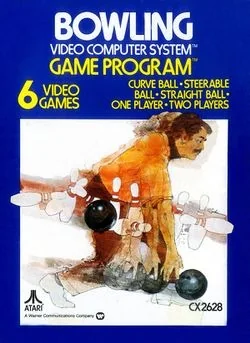
“A little man, which you can move up and down with a joystick” is how Creative Computing described the bowler in its 1979 review, and that is roughly the extent of him. He rolls a ball at ten pins. What happens next depends on the game variation: the ball curves on its own, goes perfectly straight, or can be steered up and down the lane while it rolls.
Larry Kaplan, one of Atari’s first programmers for the console, wrote it. The manual explains that a perfect game of 300 needs 12 consecutive strikes, marks a strike with an X and a spare with a slash, and warns that with the difficulty switch in the a position the computer makes strikes and spares harder to come by. When you get one anyway, Creative Computing reported, “a tune plays.” Kaplan’s career at Atari did not last much longer. After Bowling he was, in his words, “recruited to go on the road and sell computers to Sears. But I told the truth too often and left in August of 1979.” He went on to help found Activision.
The row is written “Bowling – No,” one of the unexplained marks scattered through the sheet, and holds a single cartridge that was kept back from the sale. Decades later an interviewer asked Kaplan what he remembered about making it. “Unfortunately, I don’t recall much specifically,” he said. “I was trying to get the physics correct.”
Canyon Bomber (second entry)
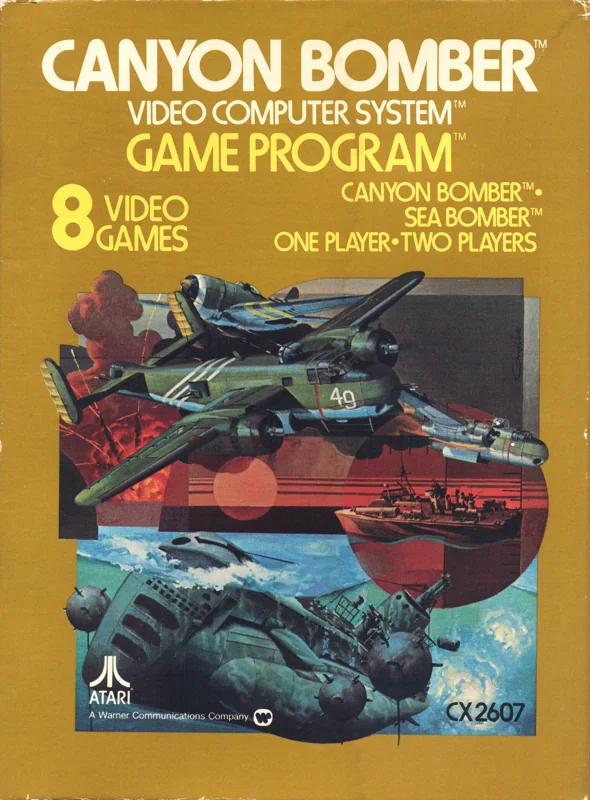
Half of this cartridge is a different game. Games 1 to 6 are Canyon Bomber, but Games 7 and 8 are Sea Bomber, a home version of Atari’s arcade game Destroyer, in which you drop depth charges on ships passing below. Atari Archive says the arcade game was originally called Depth Charge until Gremlin released a game with that title first.
Sea Bomber is also where the paddle finally earns its place. In the bombing half of the cartridge the knob does nothing, but at sea it moves a dashed depth indicator up and down the screen to set where each charge explodes. The deeper the ship, the more it is worth: 20, 30, 40, 50 or 60 points across five levels, with the game won at 1000. The difficulty switch is unusually perverse. In the a position you must wait for each bomb to run its course before dropping another; in the b position you may refire freely, and to compensate, the manual explains, the computer plays “on a more skillful level, and therefore will be more difficult to beat.”
The manifest’s second Canyon Bomber row is written “Canyon Bomber – No” with one cartridge, held back from the sale, which brings the game to 3 cartridges across two rows. Sears kept the name Canyon Bomber for its own version, and David Crane programmed both. In March 1983 the magazine Vidiot essentially called it coma-inducing. Later that year it went into a landfill in New Mexico.
Casino
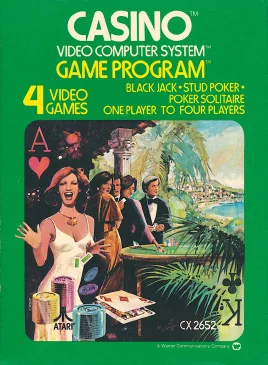
The highest possible score in poker solitaire is 3340. The Casino manual itemizes how to get there – 4 royal flushes, 5 four-of-a-kinds, 2 straights and a straight flush – in a game where you lay 25 cards into a grid and score 12 poker hands across its rows, columns and diagonals. It is a figure to admire rather than achieve.
Bob Whitehead programmed Casino after Atari’s 1977 Blackjack, which he had wanted to expand into other card games and had run out of time to do. The new cartridge adds what a real blackjack table has, insurance and splitting, plus five-card stud for up to four players with paddles. Each player starts with a bank of 1000 chips, blackjack pays 1 1/2 times your bet, and “you’ve broken the Bank if your score reaches 10,000.” The manual dispenses advice like a weary croupier: “Accepted Black Jack strategy is to STAY on 18, 19 or 20 points.” Whitehead was proudest of the display, reusing the console’s few movable objects to draw a row of sharp-looking playing cards.
To Sears customers it was Poker Plus. One cartridge came out of the ground, and the city kept it. Atari Archive’s verdict is the sort of praise a card cartridge learns to live with: “At the least, you won’t lose your shirt.”
Championship Soccer
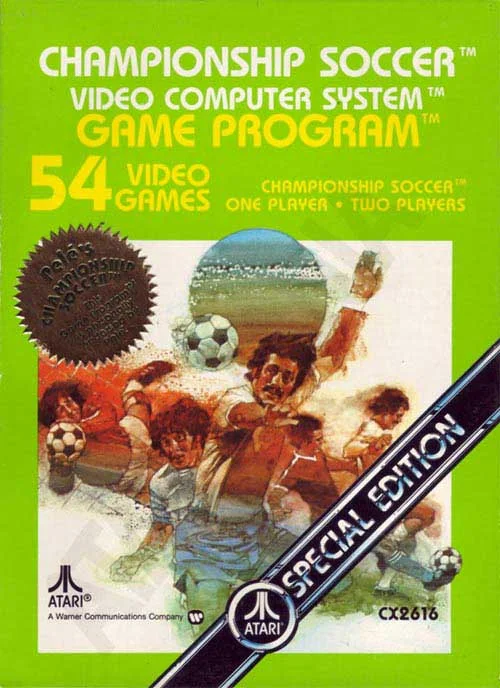
“CRASH” MORGAN, the galloping goalie, gets his nickname “because he is forever slamming into the goal posts.” The Championship Soccer manual introduces the whole squad like this. Nick Danger, the frantic forward, shouts “eat leather, chump.” Lumpy Duran is “without a doubt the clumsiest player in the world of soccer,” penalized twice for stepping on the ball instead of kicking it and finally “thrown out of one game for toe-kicking the referee!” The backstory came from the programmer, Steve Wright, who modelled it on Mad magazine.
Wright had joined Atari in September 1978 as a manager and was not a programmer. He taught himself assembly language, discovered there was no formal manual on programming the 2600, and wrote the one Atari used for years before turning to his soccer game. Each side has three fielders who move together plus a goalkeeper, and the defending team deliberately moves faster than the attackers, which, as the manual admits, gives defenders “an advantage.” The cartridge was announced for the fall of 1980, slipped, and arrived in February 1981 with 54 variations, half of them for one player.
The same cartridge was soon renamed, and the manifest lists that version on a separate row. This one, “Championship Soccer – No,” records a single cartridge, retained, and Sears sold the game simply as Soccer. The manual saves its finest tribute for the right back, Alexie Putsnowski, who “for three years in a row” has been voted the “least likely” player. He is on your team.
Codebreaker
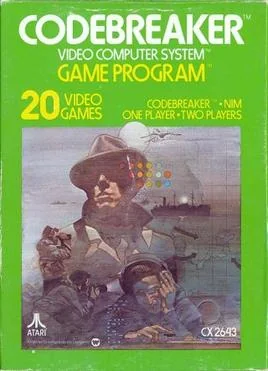
You cannot play Codebreaker with a joystick. “Use your Keyboard Controllers with this ATARI Game Program cartridge,” the manual begins, and the keyboard controllers were numeric keypads that Creative Computing described in 1978 as “exactly the same as a Touch Tone phone.” The cartridge is one of a handful built for them, and it splits into two logic puzzles: Games 1 to 12 are Codebreaker, Games 13 to 20 are Nim.
Codebreaker is Mastermind with numbers. A computer or a second player sets a secret code of three or four digits, you guess, and the screen tells you how close you came. The game’s ancestry runs back through Bagels, which David Ahl popularized in his book of BASIC games, to MOO, written for Cambridge University’s Titan mainframe in 1968. The difficulty switch simply sets how many tries you get, 8 or 12, and since your score is the number of guesses you needed, low is good. Nim has its own option, Misere, in which taking the last object loses. Whoever programmed the cartridge goes unnamed: AtariAge, Wikipedia, Atari Archive and the contemporary press all leave the name out.
The Sears version kept the name. The manifest spells it “Code Breaker” and records one box with no cartridge, retained by the city. It is a fitting artifact for a game about deducing what is hidden from you. The landfill returned the packaging and kept the contents to itself.
Football
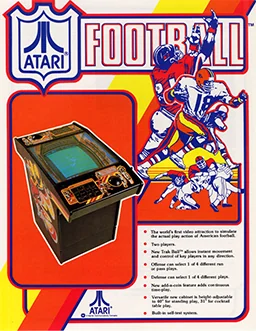
Two people are required. AtariAge lists the players for Football as “2 required,” and Atari Archive confirms the cartridge was built for a pair of humans, each secretly picking a formation with the joystick before the snap. The manual offers five offensive and five defensive formations, and adds a rule no real league has adopted: “Any player (including your opponent) is an eligible receiver.”
It took a while to arrive. Creative Computing told its readers in mid-1978 that “Soon to be released are Football and Basketball,” and Atari advertised the game in its catalogs that summer before shelving it until March 1979. Atari Archive reports that Bob Whitehead, who programmed it, simply noted that Atari was perfectly willing to sit on finished games until it liked the timing. Whitehead put more players on the field than the console could show at once by drawing a different one each frame, and he disliked the resulting flicker intensely. A touchdown is 7 points, a safety 2, and the clock counts down from 5:00 but runs only while the ball is live.
The cartridge sold 248,502 copies in 1980 by Atari Archive’s figures, and Sears did not bother renaming it. The manifest calls the row “Football 78,” a number nobody has explained, since this cartridge dates from 1979. One cartridge was found and kept. It went into the ground with its rule about eligible receivers intact.
Golf
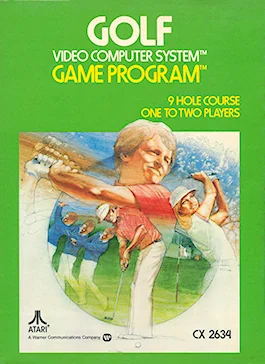
Mike Lorenzen’s first assignment at Atari was to copy somebody else’s golf game. He was sent out to play a rival’s version, believed to be Computer Golf for the Magnavox Odyssey 2, and told to implement it as closely as possible. He thought that “was surely immoral, if not illegal,” and decided instead: “I was not going to make a copy. I was going to make an enhanced version, a statement.”
The statement took six months or so of 100-hour weeks, much of it spent squeezing the program into 2 kilobytes, with “three or four days without sleep in the last big push.” What he produced was a nine-hole course with a par of 36, trees, water and sand traps, and a club that always points toward the ball. Hit into a sand trap and something odd happens: “It also becomes invisible when caught in a sandtrap. You can locate the ball by noting which direction the club is pointing.” Lorenzen was no golfer, but according to Atari Archive his father was, and as a boy he walked the rough looking for lost balls, paid between a penny and a dime depending on the brand. The ball that vanishes in the rough on the harder setting came from there.
Lorenzen went on to finish Circus Atari, which is also in the landfill. The manifest records a single Golf cartridge, retained. Atari Archive’s assessment of the whole effort was delivered with appropriate restraint: “it’s not too far above par.”
Home Run
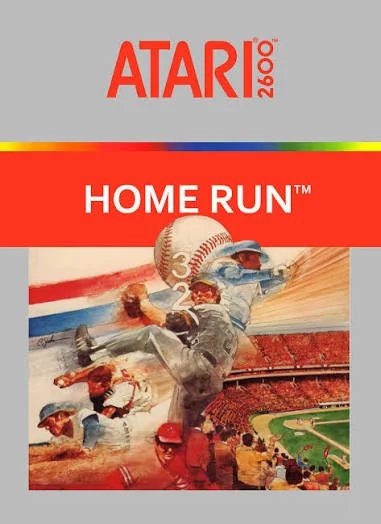
In Home Run, a home run is a matter of geometry. “The batter scores a Home Run by hitting the ball directly over second base,” the manual explains, provided the fielders do not stop it. There is no pitcher’s mound, because the pitcher is also the outfielder, and nobody throws to a base; fielders have to run down the base runners and tag them. Depending on the game variation a team has one, two or three fielders, drawn in turn on alternate frames, so they flicker.
Bob Whitehead programmed it, with Dave Rolfe also credited, and Whitehead admitted he was a sports fan who was never much good at playing sports. The cartridge reached stores in late 1978, and by 1980 it had become the competition’s favorite exhibit. Mattel compared it directly with Intellivision’s baseball in its fall 1980 advertising, an unusual thing to do to the market leader at the time. Electronic Games editors Arnie Katz and Bill Kunkel wrote that it “might more accurately be called ‘Video Stickball’.” Sears, untroubled, sold the same cartridge as plain Baseball, which is why the landfill’s separate “Baseball” row is so hard to pin down.
The manifest records a single Home Run cartridge, retained. Its marketing low point had come more than two years before the burial: around June 1981, Atari Archive reports, the company started trying to give Home Run away free to anyone who bought two other sports cartridges, Golf and Basketball.
Human Cannonball
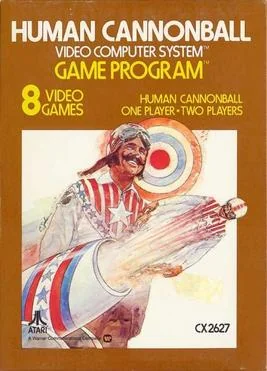
Nobody knows who programmed Human Cannonball. Wikipedia, AtariProtos and Atari Archive all say the author is unknown, and AtariAge’s staff field reads “(not available).” The idea, at least, has a parent: Cannonball, an arcade prototype from 1976 and the first game Owen Rubin designed at Atari, in which a little daredevil walked out, climbed into a cannon and flew at a hole in a wall. It apparently never went into production.
The 2600 version swaps the wall for a water tower. You set the cannon’s angle, anywhere from 20 to 80 degrees, and its speed, up to 45 miles an hour, then fire the man and hope. Creative Computing reported in 1979 that the cartridge was modelled on “Shoot,” an artillery game written by Art Luehrmann at Dartmouth. The manual is blunt about failure: “Otherwise he’ll end up flat as a pancake and you’ll end up with 0 points or a miss to show for it!” When he lands short, the daredevil says OUCH. AtariProtos felt he might have had something more interesting to say.
Sears sold it as Cannon Man, which AtariProtos counts among the hardest Sears cartridges to find. The game itself went the other way: Atari Archive tracks its price from about $20 in 1981 to around $5 in clearance by late 1983, and it was among the first games Atari discontinued. The landfill gave up one cartridge, which the city kept. Atari Corp.’s figures show 666 copies sold in 1987, and 24 of them came back.
Jungle Hunt
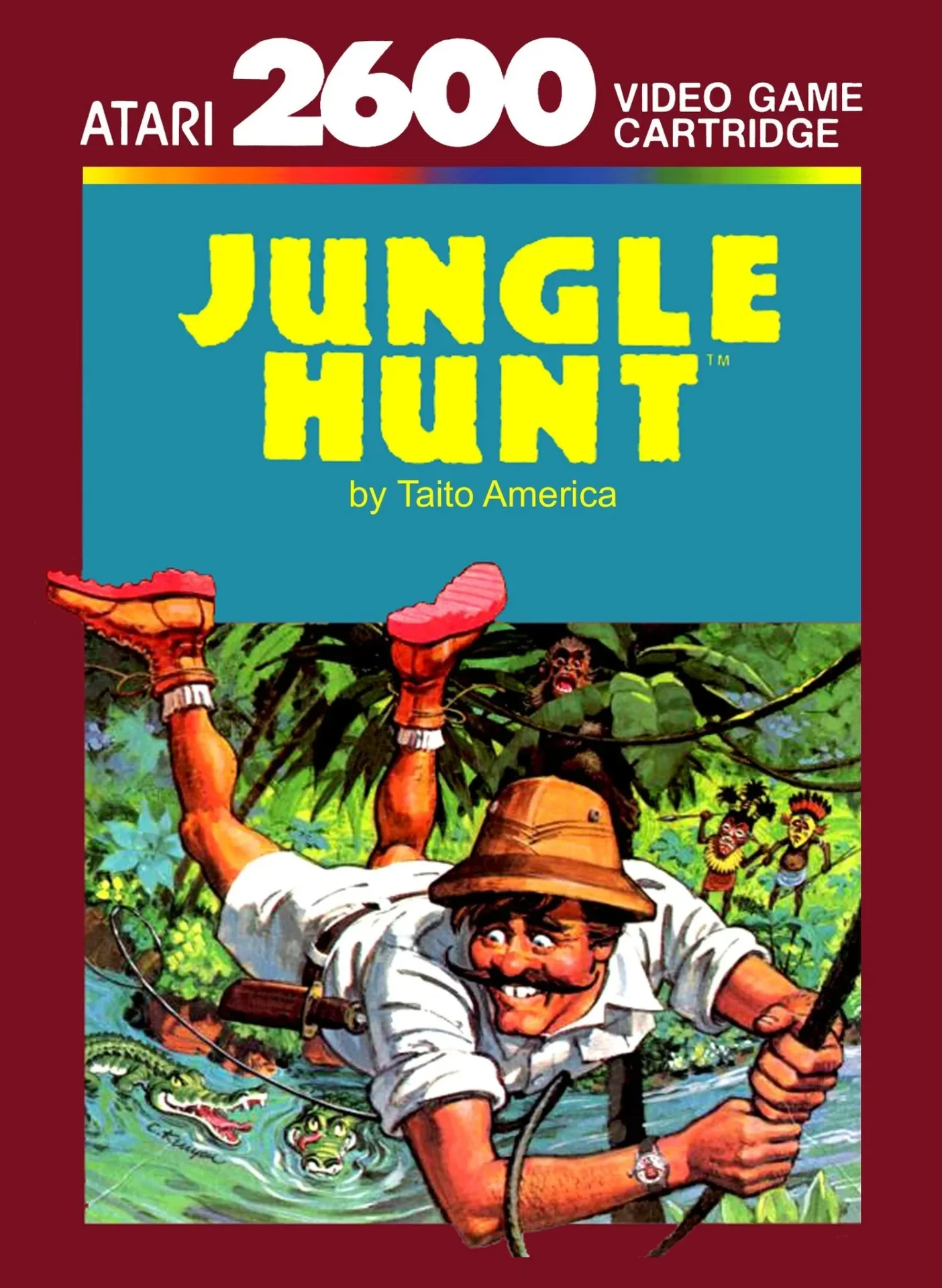
“Sir Dudley Dashly is the name, and big-game hunting is my game,” announces the hero of the 2600 Jungle Hunt manual, and he was only Sir Dudley because of a lawyer. The game began in Taito’s arcades as Jungle King, starring a vine-swinging hero who “wore only a loincloth” and gave out a good yell every so often. The estate of Edgar Rice Burroughs, which owns Tarzan, objected, and Taito changed the name and the man.
Video Games magazine reported the result in February 1983: the new hero “is mute, swings on ropes and wears an outfit more suited for Dr. Livingstone.” A Taito spokesman insisted nothing had been borrowed from Tarzan, while admitting the company “would have been in for a long fight” if it had refused. The 2600 version, programmed by Mike Feinstein and John Allred of General Computer Corporation, arrived in 1983 and gave the hero a title and a wife, Lady Penelope Dashly, who has been carried off by cannibals.
Getting her back takes four stages: swinging through the Deadly Forest, swimming Reptile River while stabbing crocodiles, dodging a landslide of boulders and jumping two spear-throwing cannibals. A crocodile with its mouth fully open is a special danger, since your knife “will be useless.” The manifest lists one loose cartridge, which the city held on to. The manual’s most practical tip is also its least heroic: “If you wish to conserve lives, simply avoid the crocodiles instead of stabbing them.”
Night Driver
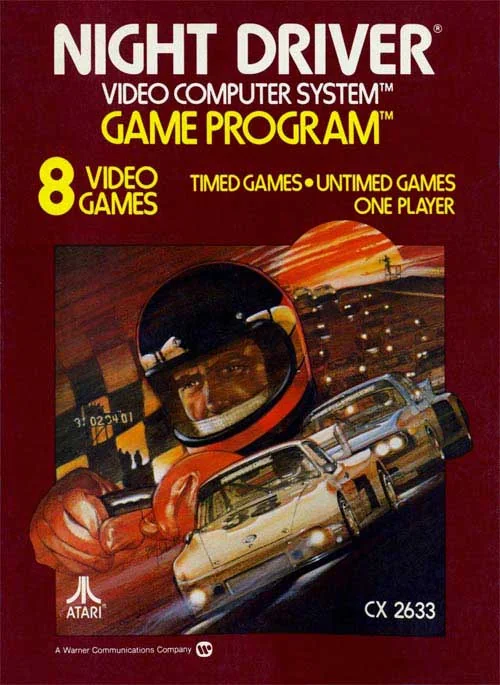
Dave Shepperd built the arcade Night Driver from a photograph. He was handed a piece of paper showing a game cabinet with a small portion of its screen visible, and never saw the original played. It turned out to be a German machine called Nuerburgring 1. Shepperd’s version, in production from October 1976, solved the hard part by not drawing it at all: the car’s hood was painted on a plastic overlay in front of the monitor, so the hardware only had to draw the road, as rows of white posts receding into the dark. Driving at night, Shepperd said, was the excuse for the minimal graphics.
The 2600 version was Rob Fulop’s first game for the console, and he added things the arcade machine never had: other cars to avoid, and houses and trees beside the road. The paddle controller’s knob is the steering wheel and its button the accelerator, and the manual warns that your “initial tendency will probably be to ‘oversteer’ the car.” It was a huge seller, close to 2 million copies by Atari’s figures.
The manifest records one Night Driver cartridge, without a box, and it never reached the auction. Atari Archive reports a scene from near the end of development that sums up the company of the time: a marketing executive asked Fulop where he had got the idea for the game, not realizing Atari already made a Night Driver of its own.
Outlaw
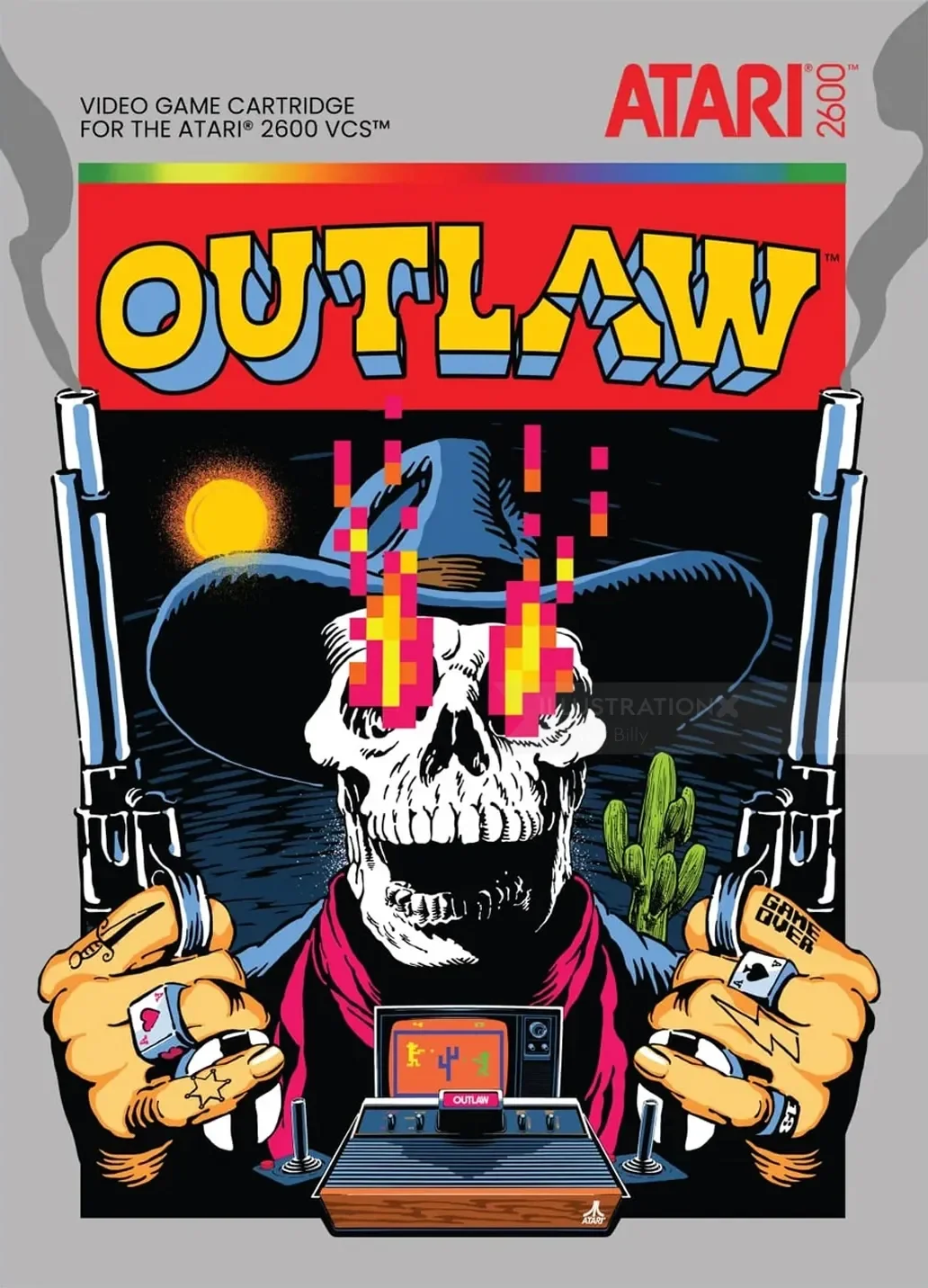
When a gunslinger is hit in Outlaw, he sits down. The manual says so, and it gives the whole Western the air of a long afternoon. Outlaw was David Crane’s first game for Atari, before he co-founded Activision and made Pitfall!, and he described it as a trial by fire.
Its ancestry runs through Japan. Taito’s Western Gun, designed by Tomohiro Nishikado, became Midway’s Gun Fight in 1975, and Crane set out to convert that. Atari Archive traces the line forward too: “Without Western Gun – which begat Gun Fight, which in turn begat Outlaw – we wouldn’t have Space Invaders.” Crane cut Gun Fight’s two joysticks down to one stick and a button, held to aim and released to fire, and built the obstacles from background graphics stored in memory, which is why you can shoot holes in them. The 16 variations put a cactus, a wall or a stagecoach between the duellists. Crane later said it sold over 500,000 copies. Sears sold it as Gunslinger.
The manifest records one Outlaw box and no cartridge. Atari reissued the game in 2023 on a new cartridge for its 2600+ console. The best review it ever received came from David Ahl of Creative Computing in 1978: “Warning: after a couple of glasses of wine, Chris Cerf and I went into fits of convulsive laughter playing this game and lost our ability to fire straight. This could happen to you!”
Pele’s Soccer
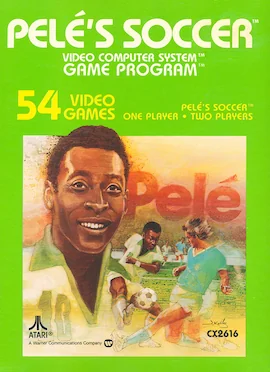
The man named on the box is not in the game. Pele’s Soccer is the same cartridge as Championship Soccer, model CX2616, with a famous name added. The first manuals simply carried the line “This Game Program is personally endorsed by Pele” on the cover, and later print runs moved his name into the title. The players in the manual are still the invented clowns of the original, and none of them is Pele.
The arrangement made corporate sense. Atari belonged to Warner Communications, and so did the New York Cosmos, the club Pele joined in 1975 after winning three World Cups with Brazil, in 1958, 1962 and 1970. He played his last game on October 1, 1977, an exhibition between the Cosmos and Santos. Atari Archive calls the cartridge one of the earliest video game licences built around a specific person, a sports star, and cites a trade-press item from April 1981 headlined “Pele to Tour Europe on Behalf of Atari.” Sears, for its part, ignored the endorsement entirely and sold the game as plain Soccer, with the original box art.
Pele’s Soccer is one of the few manifest titles named in dig coverage: in 2015 Joe Lewandowski listed it among the roughly 50 titles that came up. The manifest calls it “Pele Soccer” and records one cartridge, which stayed off the auction block. Pele died on December 29, 2022, at 82, with three World Cup winner’s medals and his name on a video game he never appeared in.
Qix (Atari 5200)
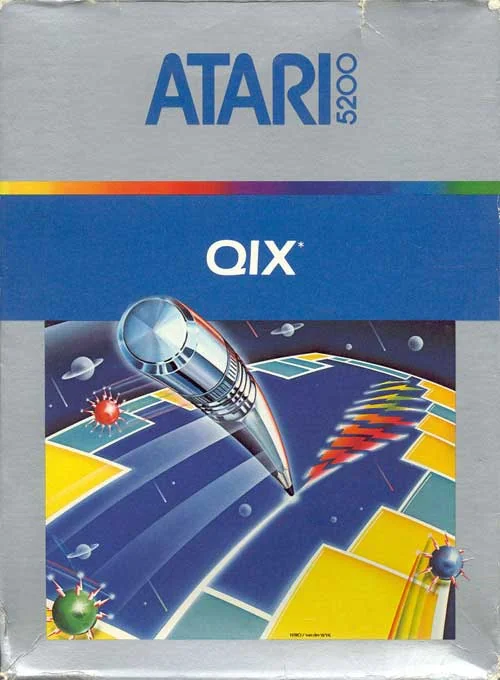
Randy and Sandy Pfeiffer, a husband and wife working for Taito America, designed the arcade Qix in 1981. By Randy’s account, relayed by a games historian who tracked him down in 2003, the Qix itself began as a programming demo, a jittering abstract shape, and Sandy suggested turning it into a game, “sort of like video-game etch-a-sketch.”
The object is to fence off the screen with lines while the Qix whirls about trying to touch them. The arcade game demanded 75 percent of the playfield, and the 5200 version lets you choose your target, from 50 percent at Novice up to 85 at Expert. Stop drawing halfway and “a Fuse appears where your Stix began,” crackling along the line toward you. The manual never tries to explain what the Qix is, preferring to call it “an erratic eccentric who strikes like lightning.” Electronic Games reported that it shot to the top of the charts on arrival and then faded, and a Taito creative director concluded that it had been “conceptually too mystifying for gamers.” The game’s name, Pfeiffer said in that 2003 account, came from his car’s licence plate, JUS4QIX.
The row is spelled “QIX,” sits in the 5200 section and holds one box, no cartridge, and nothing at all in its total column. The manual’s advice holds up for anyone who has ever played it: “you cannot destroy QIX, but you can outsmart it.” It also says, more bluntly, “You cannot be greedy.”
Sky Diver
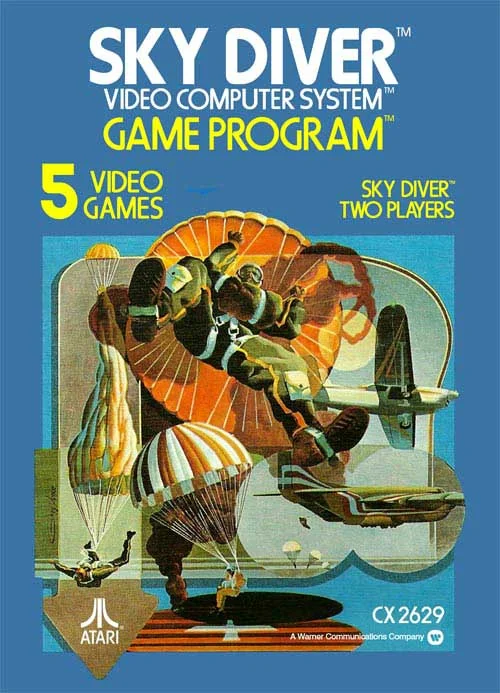
“THE LONGER YOU WAIT TO OPEN THE PARACHUTE, THE MORE POINTS YOU SCORE,” the Sky Diver manual announces in capitals, which is the whole game and also the problem. There is a point near the ground where the chute can no longer be opened. Land without it and you lose four points, along with whatever dignity the little jumper had.
The sound of that landing was made in a restroom. Programmer Jim Huether recalled going in with Owen Rubin, the arcade designer whose unreleased Cannonball later inspired Human Cannonball, and throwing “wet balled up paper towels at the wall,” recording the result and re-sampling it for Sky Diver. Huether had started the game before he knew Rubin had already made a Skydiver arcade machine, found out midway, played it, and borrowed the wind sock and moving landing pads. Huether later claimed it was the best-selling 2600 game until Space Invaders came out, a claim the surviving records do little to support.
Sears sold it as Dare Diver. The manifest spells it “Sky Driver,” a title that never existed for the 2600, and since no other game comes close, the identification is made by elimination. It records one cartridge, kept by the city. A missed landing leaves the jumper planted in the ground with only his head and arms showing, and Atari Archive admits the obvious: “It really shouldn’t be as funny as it is, and yet every time it gets a chuckle.”
Space War
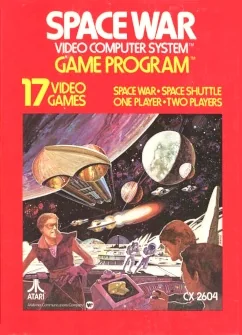
In 1962 Steve Russell and a few friends wrote Spacewar! on a DEC PDP-1 minicomputer at MIT, and The Strong museum has since concluded that “No game deserves more credit than Spacewar! for inspiring the modern video game industry.” Nolan Bushnell came across it at Stanford in 1970, built a coin-operated version with Ted Dabney called Computer Space, and then left to start his own company, which soon became Atari. The 2600 Space War is that company’s cartridge version of the game that started it.
It was announced at the January CES under the name Starship II and reached shops around October 1978. The cartridge has 17 games, seven of them duels between two Star Ships and ten of them Space Shuttle games in which you match speed with a floating module and dock with it. One duel adds a Space Sun that, the manual says, “exerts gravity during combat.” Nothing in space stops on its own, so the manual teaches flying like a driving lesson: “Just like learning to drive a car, it takes a bit of practice to learn how to control your Star Ship.” Sears advertised its version as Space Combat.
It was not one of Atari’s bigger releases. The company discontinued it at the end of 1980, and the landfill gave back one box and no cartridge, which stayed out of the sale. It was a quiet end for the game that, at one remove, had started the company that buried it.
Superman
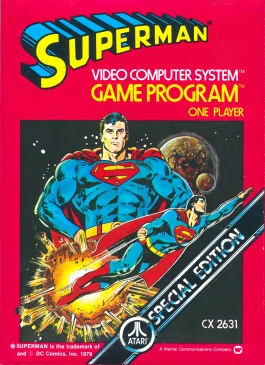
“You are Superman,” the manual begins. “Receiving a tip on a bomb scare, you rush to the Metropolis waterfront.” Lex Luthor blows up the bridge, his henchmen scatter across the city, and your job is to jail the crooks, rebuild the bridge, change back into Clark Kent and get to the Daily Planet “in the shortest amount of time.” A clock runs throughout, and Atari Archive calls it an early speedrunning game. Clark cannot die. He can only be slowed down.
Superman exists because Warner Communications owned both Atari and DC Comics. Atari’s marketing department wanted Warren Robinett’s half-finished Adventure turned into a Superman game, and, as Robinett told it, “my co-worker John Dunn volunteered to take my code and do the ‘Superman’ game, leaving me free to do the ‘Adventure’ game.” Dunn’s price was memory: he insisted on a 4-kilobyte ROM, twice what almost every earlier 2600 game had used. The result shipped in September 1979, months before Adventure itself. Lex Luthor’s Kryptonite satellites drain your powers, and only a touch from Lois Lane restores them.
The manifest calls the row “Superman 78,” for reasons the record never explains, and no source ties the number to the Superman film. It records one cartridge, retained. Dunn died in 2018. His manual ends the adventure on a note of perfect civic modesty: “Then you catch a subway to the Daily Planet and turn in your story.”
Video Chess
In 1977, the box Atari’s console came in showed a chess piece among all the kinds of games you could play. Atari had no chess game. When customers began calling to ask for it, marketing turned to the programmers, who mostly agreed it was impossible. “And thats all I needed,” Bob Whitehead said later. “The word impossible, it seems, has always been one of my igniters.”
Whitehead drew the board with a trick later called Venetian blinds, alternating the lines each piece is drawn on so that eight pieces can share a row; it is why the pieces look striped, and Atari later cited the technique when it sued Activision, the company Whitehead co-founded. Larry Wagner, by Atari Archive’s account, wrote the chess logic at home, testing it on five to eight boards set up for six months, and had all of 64 bytes for it. While the computer thinks, the screen goes blank and flashes colors so you know it has not died. On Level 7 the average thinking time is 10 hours a move. The story goes that a man in Florida sued Atari over the chess piece on the box; Whitehead says he does not remember any lawsuit.
The manifest records one Video Chess cartridge, retained. Wagner rated it a Class C program, “about the rank of an average tournament player.” In June 2025 an engineer named Robert Caruso set an emulated copy against ChatGPT, which, he reported, “got absolutely wrecked on the beginner level.”
Frequently Asked Questions
How many games did Atari bury in the Alamogordo landfill?
Nobody knows exactly. James Heller, the Atari manager who handled the disposal, told AP that 728,000 cartridges were sitting in the El Paso warehouse he had been told to clear. Lewandowski later estimated about 792,000 games in the ground, and The Henry Ford gives about 700,000. The 2014 dig took out a tiny fraction of any of those totals.
Why did Atari dump its games in New Mexico?
In September 1983 Atari was getting rid of unsold and returned stock from its operation in El Paso, Texas, and trucked it to the Alamogordo city landfill. The New York Times reported 14 truckloads of cartridges and computer equipment. Many of the games dug up in 2014 still had price tags on them, from Target and Wal-Mart according to Reinhard.
What happened to the Atari games after they were dug up?
Most were sold. The film company received 100, and by August 2015 the city of Alamogordo had sold 881 on eBay for $107,930, to buyers in 45 states and 14 countries. After costs, $65,037 went to the city and $16,529 to the Tularosa Basin Historical Society. The top bid in the city’s first batch, $1,537, was for a boxed E.T.
Which museums have games from the Atari landfill?
Several. By Andrew Reinhard’s account, the Smithsonian, The Henry Ford, The Strong National Museum of Play and VIGAMUS in Rome all accepted finds from the dig, and AP reported another destination in the Deutsches Filmmuseum in Frankfurt. Britain’s Centre for Computing History shows several dug-up cartridges, and the University of North Dakota’s own catalog lists a single excavated Centipede.
Were the Atari games buried under concrete?
Partly, and not neatly. Heller told AP he had concrete poured over the games after local kids got into trouble scavenging there; one of them, Armando Ortega, recalled sneaking in at night with flashlights. Raiford Guins, of the 2014 dig team, found the cement had been poured “not in any calculated way that resembled a layer or sealed crypt.”
Was anything besides games found in the Atari landfill?
Yes. Andrew Reinhard reported that “Atari 2600 consoles and controllers were part of the excavated rubbish,” along with instruction manuals and catalogues, and noted that “the cables to the controllers had been snipped before burial.” The dry landfill had preserved paper remarkably well. Guins described the finds as “more mummy than mulch.”
Why do some games appear twice in the Atari landfill list?
Because the manifest records them twice. Asteroids, Defender and Star Raiders turned up for both the Atari 2600 and the Atari 5200, which the sheet lists in separate sections. Combat and Canyon Bomber each have two 2600 rows that no source explains, and Championship Soccer and Pele’s Soccer are one cartridge sold under two names.
Who dug up the Atari landfill?
A film crew and a team of archaeologists. Fuel Entertainment secured the excavation rights in December 2013 with help from Joe Lewandowski, the landfill’s manager in the 1980s, who located the burial using old photographs. Reinhard’s team included Richard Rothaus, Bill Caraher, Guins and Bret Weber, and the documentary Atari: Game Over was released on November 20, 2014.
Sources
- Manifest of Excavated Atari Games (tDAR 459205), Joe Lewandowski and Andrew Reinhard, 2014
- Smithsonian National Museum of American History – From landfill to Smithsonian collections: E.T. the Extra-Terrestrial Atari 2600 game
- The Henry Ford – Atari Tomb
- Andrew Reinhard – excavation paper on the Alamogordo Atari dump (Zenodo full text)
- Xbox Wire – the Atari landfill dig, April 26, 2014
- NPR – E.T.’s home is found: trove of Atari games unearthed at landfill
- Atari Archive – Atari VCS game release dates
- AtariAge – Championship Soccer manual (Atari 2600)