Every Joe Montana Super Bowl Touchdown Pass
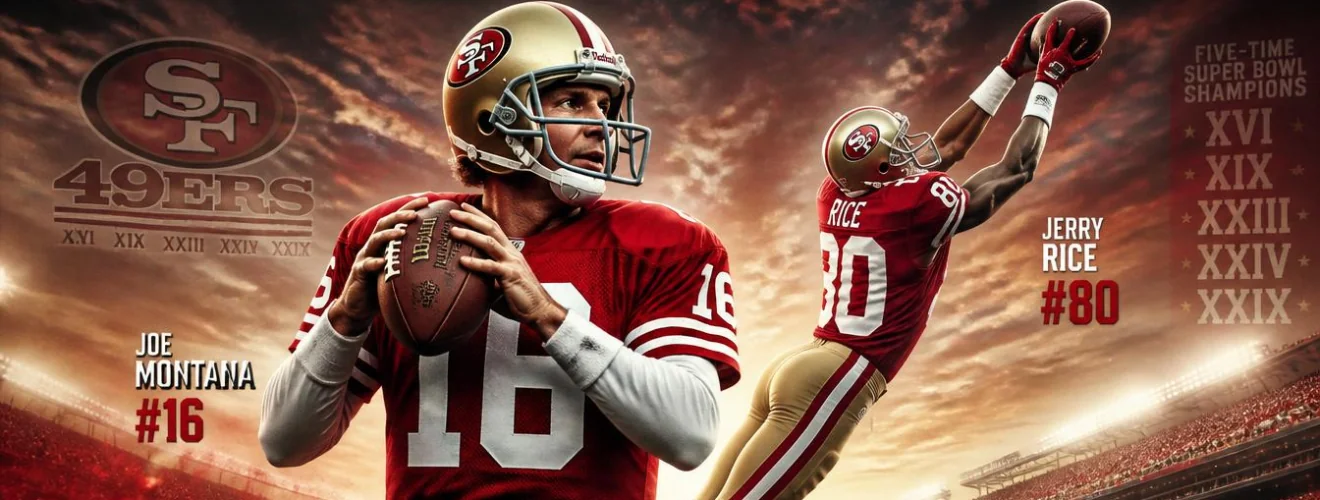
The most famous pass Joe Montana ever threw is not on this list. The Catch – the leaping, fingertip touchdown to Dwight Clark that beat Dallas – came in the NFC Championship Game, two weeks before Montana ever played a Super Bowl. The signature throw arrived early. The perfect record took longer.
Because that is what the Super Bowls got from him: across four of them, Montana threw 11 touchdown passes and not one interception. Tom Brady would eventually throw 21 Super Bowl touchdown passes, nearly double the total, but with six interceptions stapled alongside; Montana’s ledger has no debit column at all. Four starts, four rings, and a spotless sheet. Getting to him was just as hard: a quick release kept Montana upright where others went down, the opposite of the quarterbacks buried during Myles Garrett’s record-breaking 23-sack season decades later.
The throws arrived in a lopsided rhythm – one in XVI, three in XIX, two in XXIII, then five in a single evening in New Orleans – and they are all here, in the order they left his hand. He went into the Pro Football Hall of Fame on the first ballot in 2000, thirty-seven years after the doors first opened in Canton to a charter class of just seventeen.
Joe Montana threw 11 touchdown passes in Super Bowl play, all with the San Francisco 49ers, across four games: Super Bowls XVI (1982), XIX (1985), XXIII (1989) and XXIV (1990). San Francisco won every one of those games. This list covers each of the 11 throws in chronological order.
Earl Cooper – 11 yards, Super Bowl XVI
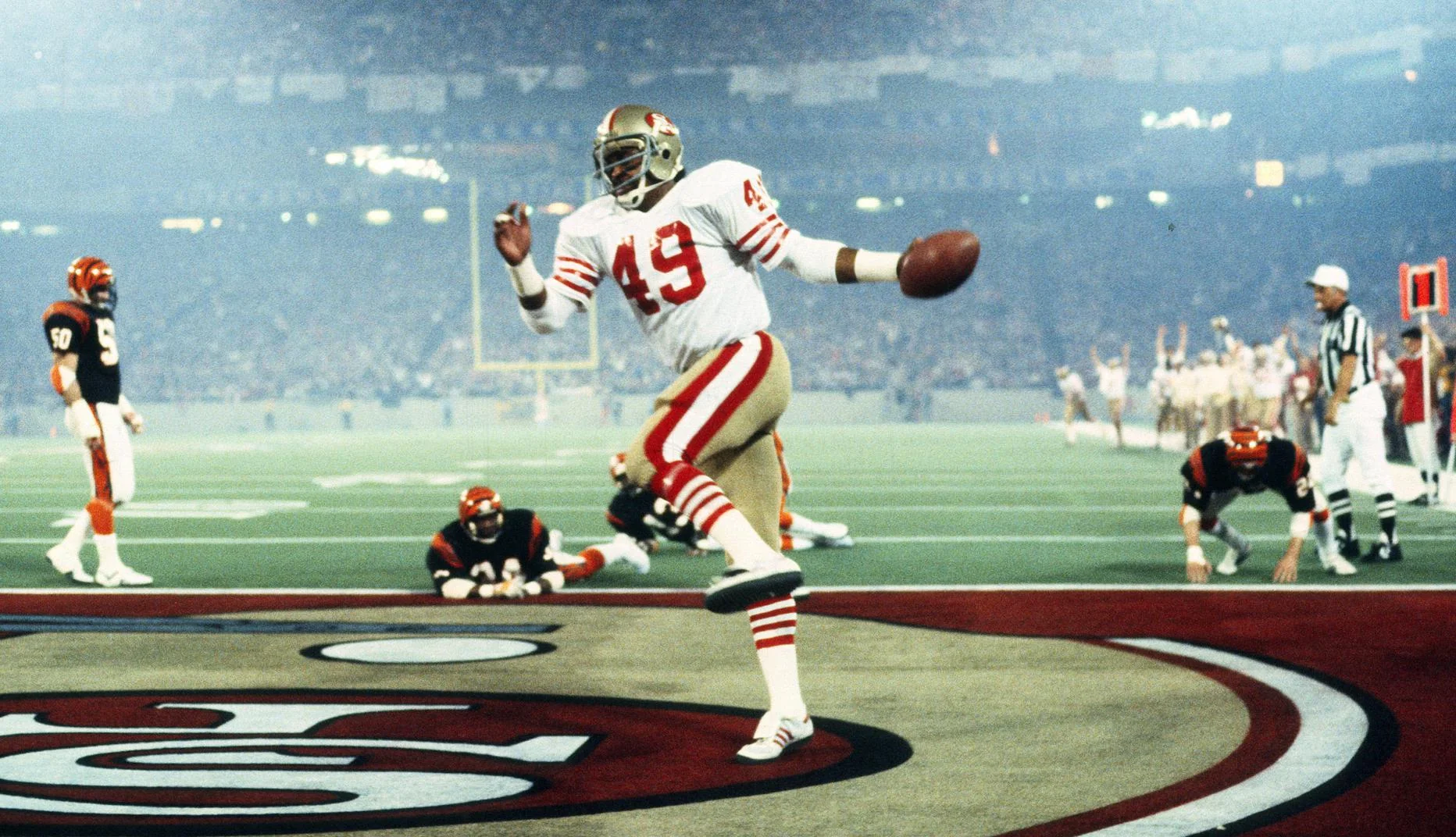
The cover of Sports Illustrated that week was not Joe Montana. It was Earl Cooper, frozen mid-celebration, spiking the ball into the Silverdome turf after the 11-yard catch that put San Francisco up 14-0 on Cincinnati.
The play itself was an antique. Bill Walsh had not called it in two years, then reached for it on the biggest afternoon the franchise had ever played. It capped a 92-yard march, the longest drive in Super Bowl history to that point, and it fueled a half the 49ers finished ahead 20-0 – the largest halftime lead the game had ever seen. The Bengals clawed their way to a 26-21 final, and no closer.
Cooper was no accident of history. San Francisco had taken him 13th overall in 1980, and as a rookie fullback he caught 83 passes – second in the entire NFL, an absurd figure for the position and the era. Super Bowl XVI turned out to be his last game as a running back; Walsh converted him to tight end before the next season, and he closed his career with the Raiders in 1986.
Montana threw for 157 yards that day and exactly one touchdown. Cooper’s spike made certain it was the one on every newsstand in America.
Carl Monroe – 33 yards, Super Bowl XIX
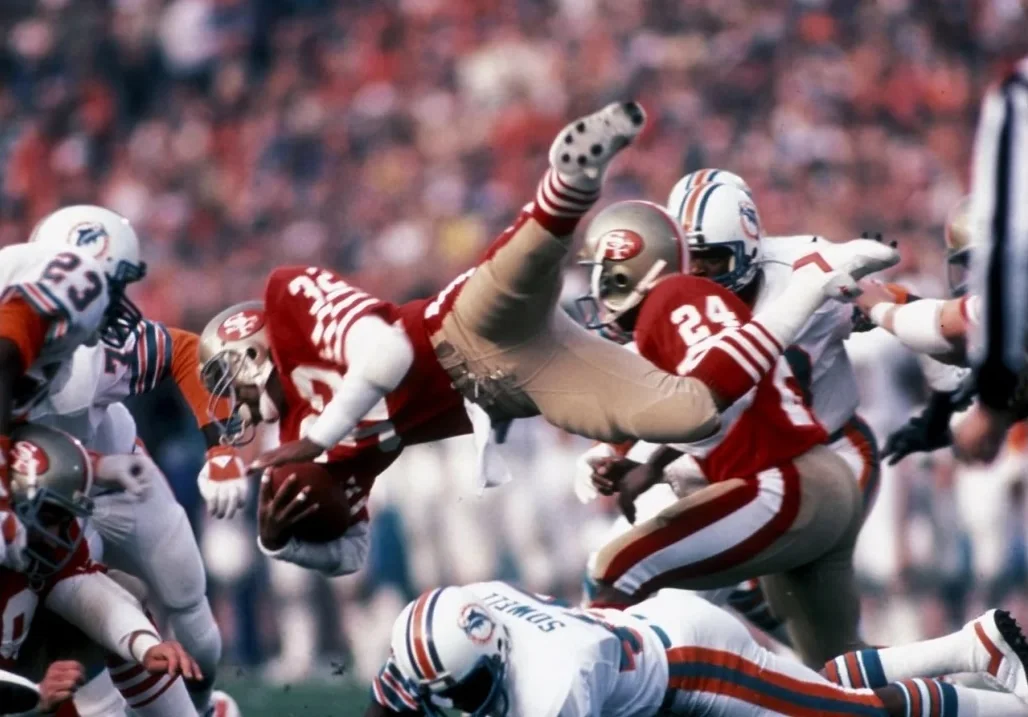
Carl Monroe made the 49ers as an undrafted free agent in 1983, stood five foot eight, and spent five seasons doing the unglamorous work of returning kicks – 43 games, every one of them in a San Francisco uniform. In the biggest game of his life, he got open.
Late in the first quarter of Super Bowl XIX, trailing Dan Marino’s Dolphins 3-0, Montana finished a 78-yard drive by finding Monroe for 33 yards and the game’s first touchdown. San Francisco led 7-3 on the way to a 38-16 rout, and Monroe’s full receiving line for the day reads: one catch, 33 yards, one touchdown. There are worse ways to spend a Super Bowl.
He was faster than his resume ever suggested. At Utah in 1982 he led the entire country in all-purpose yardage, 185.1 a game, and in kickoff-return average. In 1985 he averaged 26.5 yards a return, the best by any 49er since 1972.
Monroe died on April 26, 1989, of apparent heart failure. He was 29, and had just signed to play the coming season in Canada for the British Columbia Lions. ‘Carl was a courageous, determined and resourceful player,' Bill Walsh said that day. ‘We shall miss him very much.'
Roger Craig – 8 yards, Super Bowl XIX
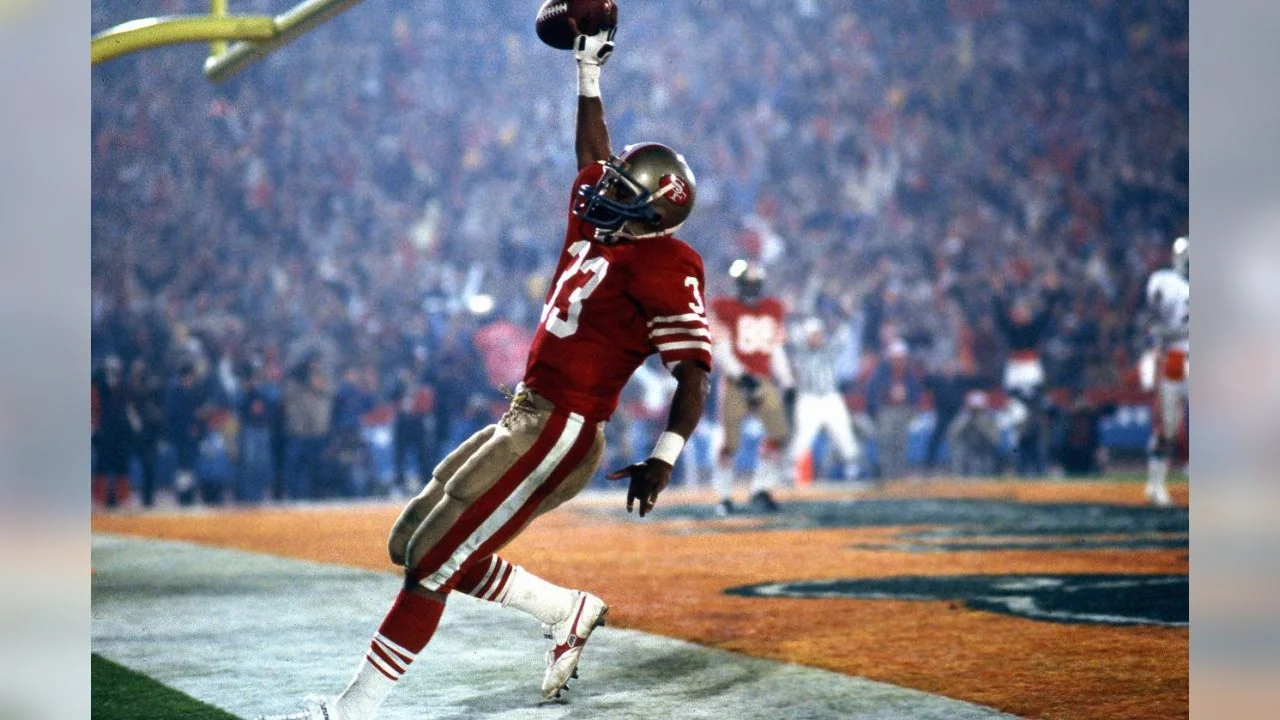
Miami had just gone no-huddle, five straight Marino completions, and taken a 10-7 lead when the game bent for good. Bill Walsh answered with a defense first – a 4-1-6 alignment with Keena Turner as the only linebacker on the field – and then with an offense. From the Miami 47, Montana scrambled for 19 yards, worked the ball to the 12, and flipped it 8 yards to Roger Craig. San Francisco led 14-10, and nobody ever led the 49ers again that afternoon.
The catch opened a run of touchdowns on consecutive possessions that turned a tense game into a 28-10 halftime score and made the fourth quarter a formality. By evening Craig’s stat line read 58 yards rushing and 77 more receiving on 7 catches, with 3 trips to the end zone.
He had arrived from Nebraska as a second-round pick in 1983, a fullback in name who caught passes like a receiver. The season after this game he proved the label meaningless for good, becoming the first player in NFL history to gain 1,000 rushing yards and 1,000 receiving yards in the same season.
The 8-yarder was the quietest thing Craig did all day. Quiet ones count the same.
Roger Craig – 16 yards, Super Bowl XIX
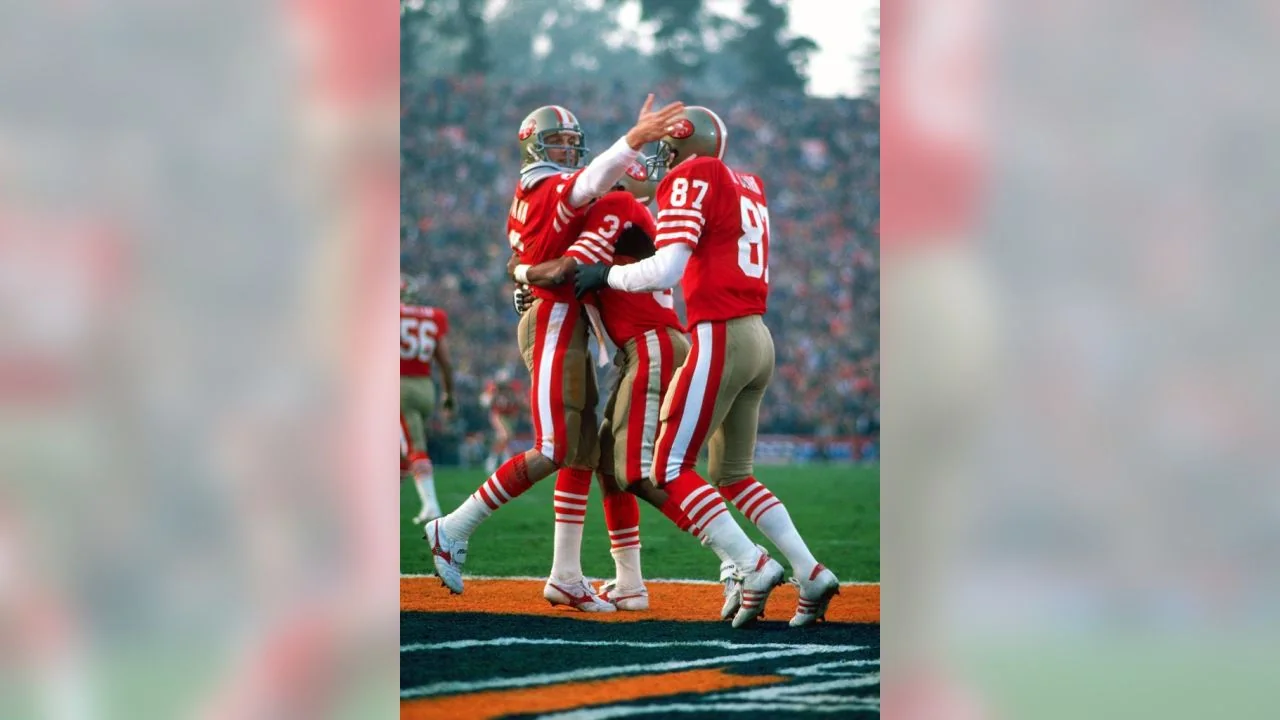
With more than a quarter of football still to play, the scoring was finished. Craig’s 16-yard catch – three plays after Montana hit Wendell Tyler for 40 yards and Russ Francis for 13 – made it 38-16, and both defenses locked the doors from there.
The number that mattered was three. No player had ever scored three touchdowns in a Super Bowl, and Craig now had them all in one evening: a run, a catch, and this catch. His two touchdown receptions tied a Super Bowl record of their own. Montana, for his part, finished with 331 passing yards, breaking Terry Bradshaw’s Super Bowl mark of 318.
Craig kept finding new versions of the trick. Four years on, against Cincinnati in Super Bowl XXIII, he became the first running back to gain 100 receiving yards in a Super Bowl, 101 of them on 8 catches, in a game San Francisco needed every last yard of.
Canton took its time about all this. The call finally came in February 2026, when Craig was elected to the Pro Football Hall of Fame with the Class of 2026, alongside Drew Brees, Larry Fitzgerald, Luke Kuechly and Adam Vinatieri. The record from this game had been sitting in the display case for 41 years, waiting for its owner to arrive.
Jerry Rice – 14 yards, Super Bowl XXIII

Through three quarters, Super Bowl XXIII was threatening to become the first one ever played without a touchdown. Five field goals had produced a 3-3 halftime score – itself the first tie at the break in Super Bowl history – and the defenses were winning every argument. Then Stanford Jennings returned a kickoff 93 yards for Cincinnati – the game’s only touchdown to that point – and the evening finally woke up.
San Francisco answered in four plays. Rice caught a short pass and stretched it into a 31-yard gain, Craig took the next one 40 yards on the first snap of the fourth quarter, and one play after Bengals cornerback Lewis Billups dropped a gift interception in the end zone – a catch that would have ended the drive on the spot – Montana found Rice from 14 yards out. The 85-yard reply tied the game 13-13, and Cincinnati’s escape hatch had just closed.
Rice’s whole evening ran like that. He finished with 11 catches for 215 yards – still the Super Bowl receiving record – and took home the MVP award. He also carried the ball once, for five yards, in case anything remained unproven.
Thirty-seven years later, the number 215 is still sitting in the record book, daring somebody.
John Taylor – 10 yards, Super Bowl XXIII
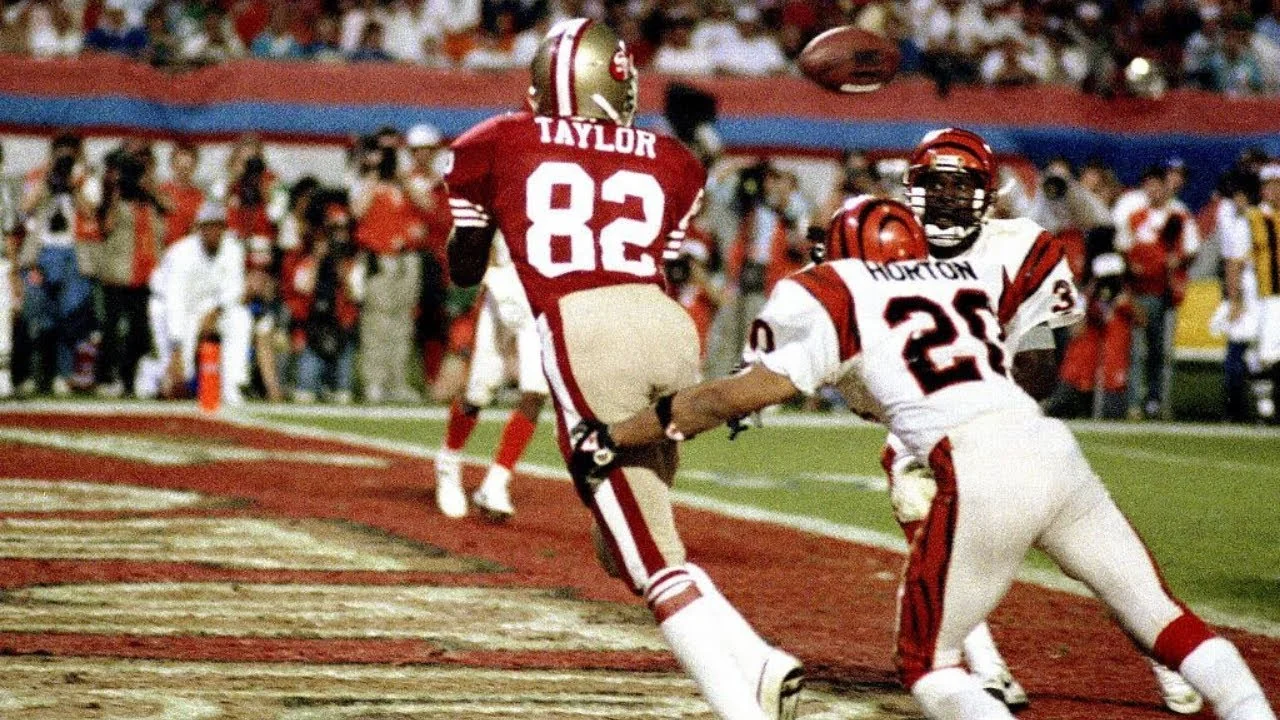
Backed up at their own 8-yard line, down 16-13 with 3:10 to play, the 49ers gathered for the biggest drive of their lives – and their quarterback peered into the stands. ‘Hey, isn’t that John Candy?' Montana asked his tightening huddle. It was. The linemen exhaled, somebody laughed, and the drive started rolling.
Eleven plays and 92 yards later, with the snap coming at 0:39, Taylor ran a post down the middle and gathered in the winning touchdown from 10 yards out. There were 34 seconds left. The final was 20-16, and Taylor’s receiving line for the entire evening reads: one catch, 10 yards, one championship.
It had nearly gone very differently. Earlier in the quarter Taylor fumbled a punt, and only Darryl Pollard’s recovery at the San Francisco 18 kept the season alive. Taylor spent the rest of the day quietly setting a Super Bowl record with 56 punt-return yards, an 18.7-yard average that was the highest the game had seen.
The catch has followed him ever since, in the pleasant way. In February 2026 he was back on a San Francisco stage beside Montana at a 49ers reunion billed as a Night of Champions, alongside Ronnie Lott and Tom Rathman. Some catches keep paying out for decades.
Jerry Rice – 20 yards, Super Bowl XXIV
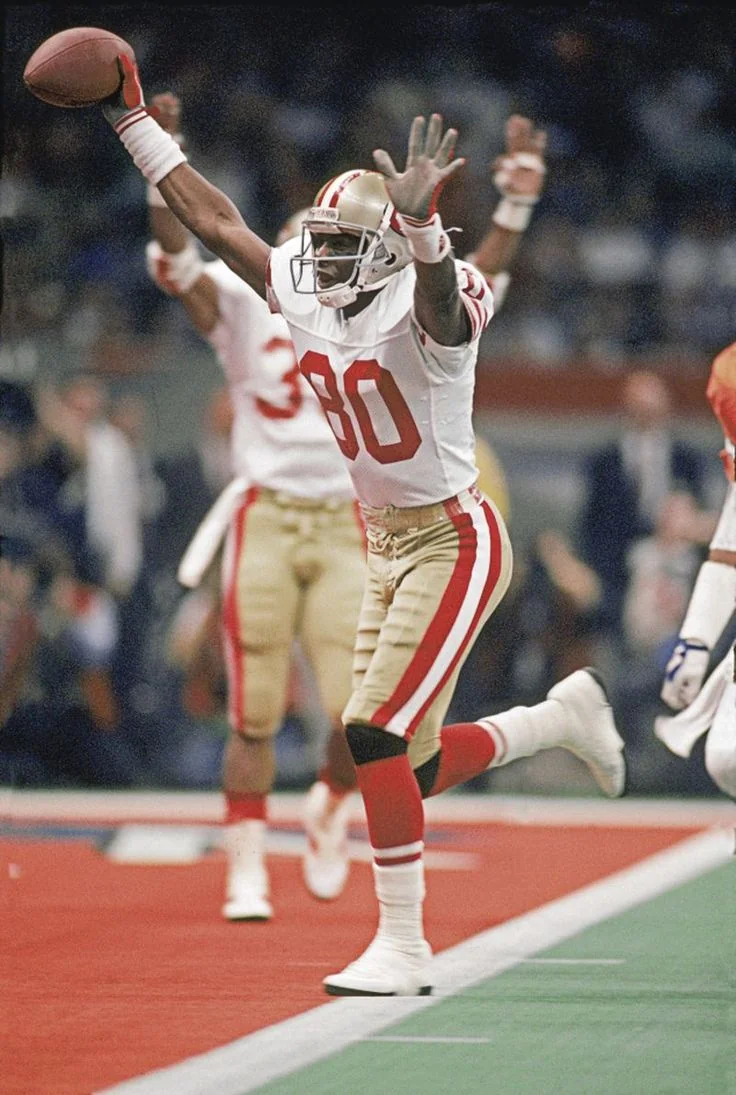
Denver’s opening possession lasted three plays. San Francisco’s lasted ten, covered 66 yards, and ended with Montana finding Rice from 20 yards out for a lead the 49ers never came close to surrendering.
The Broncos actually answered respectably – a 49-yard drive to David Treadwell’s 42-yard field goal, 7-3 – and that was the high-water mark of their entire evening. What followed was the most thorough dismantling the Super Bowl had yet staged: San Francisco scored on eight of its first 11 possessions, outgained Denver 461 yards to 167, and kept the ball for 39:31. Montana’s own line ran 22 of 29 for 297 yards, and he was excused before the fourth quarter needed him.
For Rice, the 20-yarder was a down payment. He finished the night with 7 catches for 148 yards and three receiving touchdowns, a Super Bowl record, which means this list will be visiting him twice more before the evening is over.
The 49ers had gone 14-2 and arrived in New Orleans chasing the first repeat championship since the 1970s Steelers. Denver had the AFC’s best record and John Elway in his prime. Three plays into the Broncos’ night, none of that appeared to matter, and nothing that happened afterward suggested otherwise.
Brent Jones – 7 yards, Super Bowl XXIV

Thirteen is a strange number to find on a Super Bowl scoreboard, and Brent Jones is the reason one appeared. His 7-yard touchdown came two plays after a 22-yard Rice catch reached the Denver 10, on a drive that had opened with a gift: Kevin Fagan jarred the ball loose from Bobby Humphrey, and Chet Brooks fell on it at the San Francisco 46. Then Mike Cofer pushed the extra point wide right. 13-3. It stood as the only mistake San Francisco made all afternoon.
Jones took the long road into that end zone. Drafted in the fifth round by Pittsburgh in 1986, he was cut after a single season and walked into 49ers training camp in 1987 as an afterthought from Santa Clara University, all of 40 miles down the road from where the 49ers played. He stayed 11 seasons, every one of them in San Francisco, and left with 417 catches, 5,195 yards, 33 touchdowns and four Pro Bowl selections.
The franchise eventually rounded the story off properly. In December 2025, thirty-five years and change after this catch, Jones became the first tight end ever inducted into the 49ers’ own Hall of Fame. The extra point stayed missed. Nobody appears to have held it against anyone.
Jerry Rice – 38 yards, Super Bowl XXIV
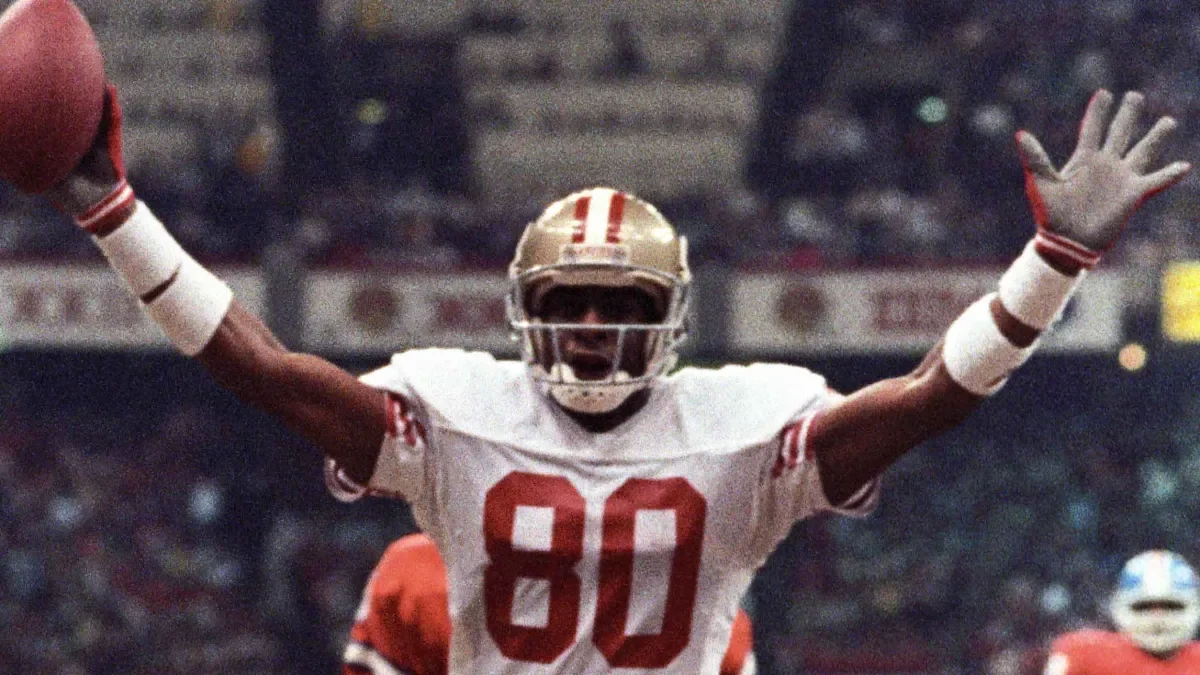
Two minutes from halftime, the game had gone briefly quiet – three consecutive possessions ending in punts, the score parked at 20-3. Then John Taylor – a man who will be closing this list out shortly – returned a punt 17 yards to the San Francisco 41, and the quiet ended in five plays.
The finish traveled 38 yards to Rice, the longest of all 11 Super Bowl touchdown passes Montana ever threw, and it sent the 49ers to the locker room ahead 27-3. The 59-yard reply had taken barely a minute of clock. It was San Francisco’s fourth touchdown of the half, with an entire second half still waiting, in a game where the Denver offense would manage 12 first downs from start to finish.
There was a certain mercy in the timing. A team down 20-3 at the break can still tell itself stories; down 27-3 to a defense that would pile up six sacks and four takeaways, the stories stop working. The 49ers’ sideline seemed to know it, and the Superdome crowd, heavy with San Francisco red, certainly did.
For Rice, it was two touchdowns down and one still to come. For Denver, it was the end of the portion of the evening that could reasonably be described as competitive.
Jerry Rice – 28 yards, Super Bowl XXIV

One play. San Francisco’s first drive of the second half lasted exactly one play. Michael Walter intercepted John Elway’s opening pass of the third quarter, and on the next snap Montana threw 28 yards to Rice for a 34-3 lead – a scoring drive with no middle to speak of.
The throw carried history in both directions. For Montana it was career Super Bowl touchdown pass number 10, moving him past Terry Bradshaw as the most prolific touchdown thrower the game had seen. Bradshaw had needed four full Super Bowls to collect his nine; Montana passed him with half of his fourth still to play. For Rice it was a third touchdown of the night, a Super Bowl record for a receiver, and it matched the three-score afternoon that only Roger Craig had ever produced. Craig had needed a run and two catches for his; Rice did it on catches alone, from 20, 38 and 28 yards.
Elway’s evening was meanwhile curdling into one of the grimmest lines in Super Bowl history: 10 completions in 26 attempts for 108 yards, no touchdowns, two interceptions, a 19.4 rating. San Francisco converted its final three takeaways into touchdowns while using four plays of offense in total.
Not a bad return on a one-play possession.
John Taylor – 35 yards, Super Bowl XXIV
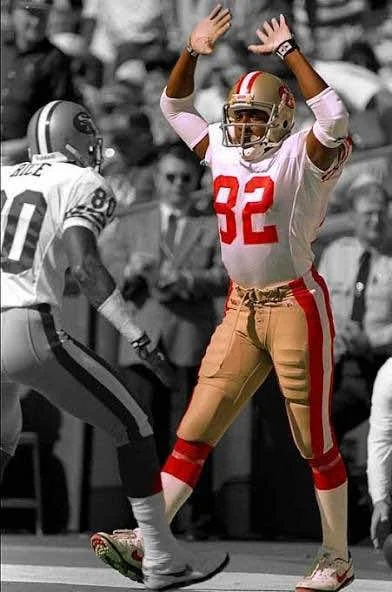
The last Super Bowl touchdown pass of Joe Montana’s life began with a small dishonesty. He pumped toward Rice – a fake Steve Atwater had every statistical reason to honor – then dropped the ball 35 yards downfield on John Taylor while the safety was still recovering. It was Montana’s fifth touchdown throw of the game, something no quarterback had managed in a Super Bowl, and the 11th of his Super Bowl career, which is where the number stopped for good.
The score came two snaps after Chet Brooks returned an interception 38 yards to the Denver 37, and it made the game 41-3 with five minutes barely gone in the third quarter. San Francisco had scored three touchdowns inside six minutes. From there the outcome required only paperwork: Steve Young eventually finished the night in relief, and the scoreboard settled at 55-10, still the most lopsided final in Super Bowl history, a margin nobody has threatened in the decades since.
Taylor’s quieter contributions ran to 3 catches for 49 yards, plus 38 more on punt returns. Montana collected his third Super Bowl MVP award and, with a quarter and a half of football left, was done throwing in Super Bowls forever.
Some careers end. That one concluded.
Frequently Asked Questions
Why isn’t The Catch on this list?
Because it was not a Super Bowl play. The Catch beat Dallas in the NFC Championship Game on January 10, 1982, with Dwight Clark rising in the back of the end zone. Montana’s first Super Bowl came two weeks later, against Cincinnati, and this list begins there.
Did Joe Montana ever run for a Super Bowl touchdown?
Twice. He scored on a 1-yard sneak in Super Bowl XVI, the first points of that game, and on a 6-yard run in Super Bowl XIX. Neither appears on this list, which counts only the touchdowns he threw, though both are in the same four box scores.
Who caught the most Super Bowl touchdown passes from Montana?
Jerry Rice, with four. Six different receivers account for the full set: Rice with four, Roger Craig and John Taylor with two apiece, and Earl Cooper, Carl Monroe and Brent Jones with one each. Five of the six were running backs, tight ends or converted returners rather than star wideouts.
Why didn’t Montana win MVP of Super Bowl XXIII?
Because his receiver had one of the great games in Super Bowl history. Montana passed for 357 yards, a Super Bowl record at the time, but the voters gave the award to Jerry Rice, whose receiving day set a record that has outlived nearly four decades of challengers.
What was Joe Montana’s passer rating in Super Bowls?
A combined 127.8, built on 83 completions in 122 attempts for 1,142 yards across the four games. His single best afternoon was Super Bowl XXIV, at 147.6. The number is doing quiet work: it includes not a single interception to drag it down.
How lopsided were Montana’s four Super Bowls?
San Francisco outscored its opponents 139-63 across the four games, winning by margins of 5, 22, 4 and 45 points. Only Super Bowl XXIII was truly close, decided on the final drive. The other three were settled well before the fourth quarter mattered.