Every Toy in Toy Story 5
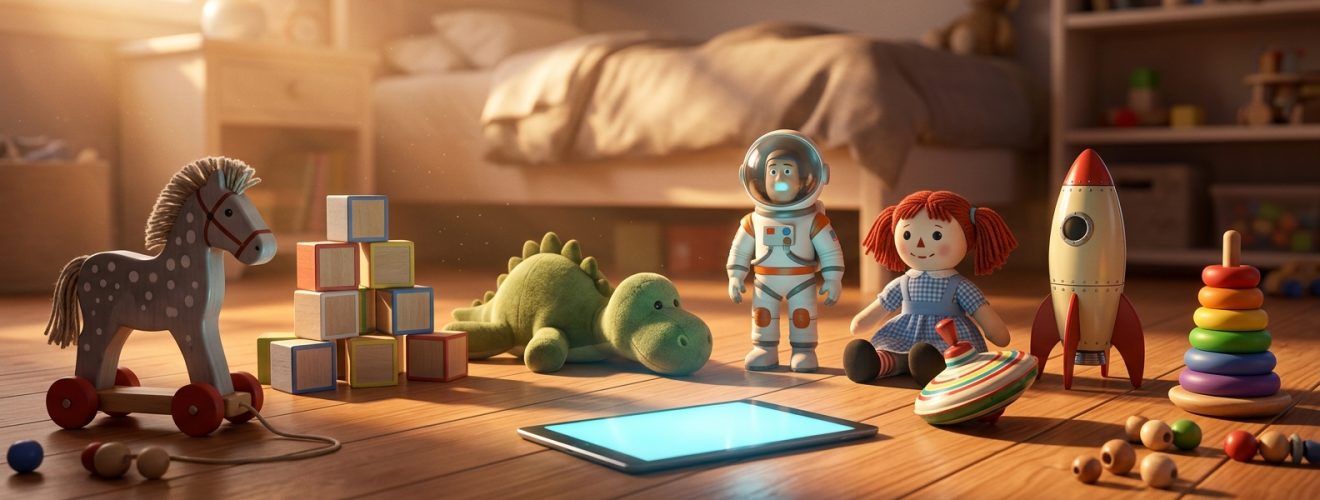
Toy Story 5 opens with a wedding. Bonnie, eight years old now, marries a plastic spork to a plastic knife named Karen Beverly, casts Buzz Lightyear as best man and a tyrannosaur as maid of honor, and has Jessie pronounce the couple husband and knife. For about ninety seconds the series behaves exactly as it has since 1995, which is to say a child is on the floor making toys do things and the toys are quietly thrilled to be there. Then the mail arrives.
What the mail brings is Lilypad, a frog-shaped tablet voiced by Greta Lee, and she is less a villain than a force of nature – a child’s first screen, dropped into one of the last houses on the block still holding out against screens. Underneath the toys-versus-tech setup sits the franchise’s oldest fear, the one Jessie has carried since Toy Story 2: a child grows up, a newer thing arrives, and the old thing ends up in a box. This time it is Jessie leading the resistance, and the two toys who have anchored these films for thirty years are content, for once, to follow.
The film is crowded, running from a cowgirl in crisis to a garden gnome among the forgotten to a pool flamingo slowly losing its air. The one item on this list that is not, strictly speaking, a toy is the thing the entire film is about.
Toy Story 5, the Disney and Pixar sequel released June 19, 2026 and directed by Andrew Stanton, features 30 toys, from franchise fixtures such as Woody, Buzz, Jessie, Rex, and Hamm to a full slate of new characters. This list covers every one, ordered by how much of the film each commands.
Jessie
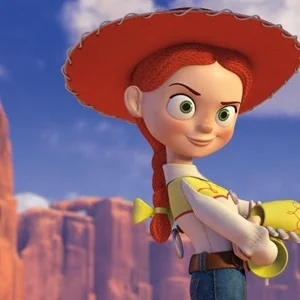
The cowgirl gets the lead this time. For four films Woody was the sun the series orbited and Buzz the bright thing beside him, but Toy Story 5 belongs to Jessie, the yodeling cowgirl Joan Cusack has voiced since 1999, and it belongs to her because of a wound the franchise handed her a quarter-century ago. In Toy Story 2 she arrived with a flashback and a song, “When She Loved Me,” written by Randy Newman and sung not by Cusack but by Sarah McLachlan, in which Jessie is loved by a girl named Emily and then quietly outgrown and left in a donation box by the side of a road. It remains the most quietly devastating thing the series has done, and it has defined her ever since.
Toy Story 5 simply makes that fear the plot. Bonnie is eight now and has a tablet, and Jessie spends the film convinced she is about to be donated all over again. The script then does something almost cruel and entirely earned: an elderly couple mistakenly returns Jessie and Bullseye to Emily’s old house, which is now home to a girl named Blaze. The toy most afraid of being left behind is dropped back at the exact address where it happened the first time. She finds her way out of it, which is the entire point of her.
Lilypad
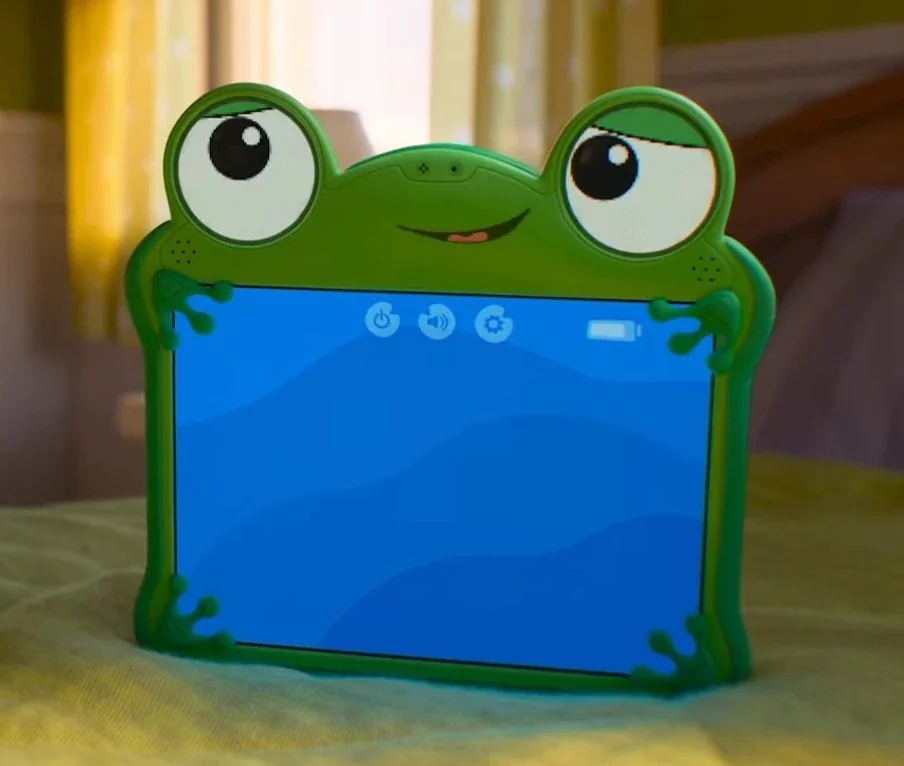
Bonnie’s parents held out for eight years. Every other kid on the block already owned a Lilypad – a frog-shaped smart tablet voiced by Greta Lee – and Bonnie’s parents had quietly refused to buy one, until the day a package arrives and her eyes go glassy. The design lifts so plainly from the real LeapFrog LeapPad, the learning tablet that has been pacifying toddlers since 1999, that Disney did the only sensible thing and licensed the character straight back to LeapFrog. The result is the Explore and Learn Lilypad, a working preschool tablet that went on sale in April 2026 for about twenty-eight dollars, two months before the film warning parents about this exact object reached theaters. The antagonist is for sale at Walmart.
Onscreen she is not malevolent so much as extremely good at her job, which is holding a child’s attention without interruption. She runs a social network called the Pond, hosts the group chat where the neighborhood kids bully Bonnie, and grasps the harm she has done only near the end, at which point she throws herself onto a donation truck out of guilt. She is also, briefly, the hero, handing the stranded Buzz Lightyear army the update that finally lets it fly. Her last act in the film is to compose a rap.
Woody
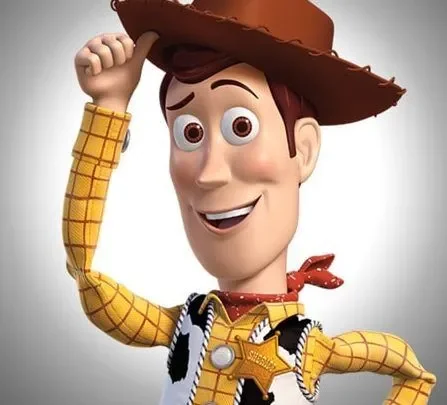
In the earliest sketches for the first Toy Story, Woody is the villain – a sarcastic ventriloquist’s dummy who torments the other toys until they rise up against him. He became a pull-string cowboy only because the dummy looked, drawing after drawing, deeply sinister, and the name survived the redesign as a nod to the Western character actor Woody Strode. Tom Hanks has voiced him since 1995, which works out to thirty years of being the most reliably decent toy in American film.
Toy Story 5 makes him, for the first time, a guest in his own series. Having left Bonnie at the close of Toy Story 4 to wander as an ownerless toy alongside Bo Peep, Woody turns up when Jessie calls for advice, helps run the rescue, and otherwise hands her the wheel. The film has quiet fun with his age. Bo colors in his bald spot with a brown marker during the credits, his stuffing has begun to sag and settle toward his boots, and Lilypad, scrolling his history, writes him off as Buffalo Bill. The toy who was nearly the bad guy, then spent three decades as the good one, spends this film a step back from the center, watching the cowgirl take point. He seems entirely at peace with it.
Buzz Lightyear
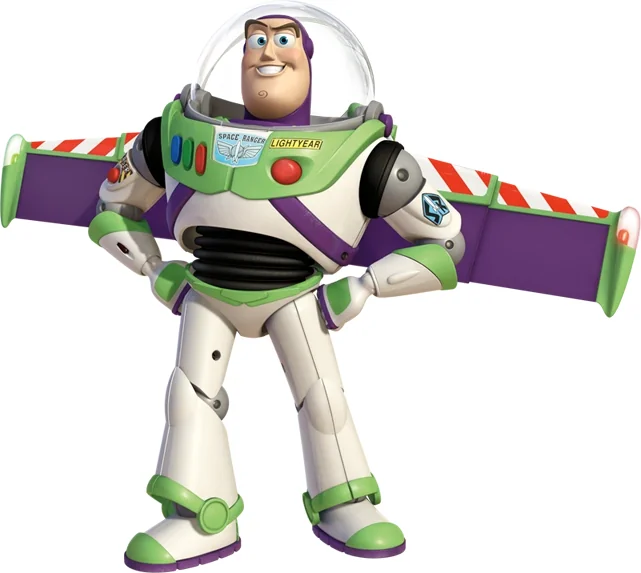
Before he was Buzz Lightyear, he was Lunar Larry. The character John Lasseter eventually arrived at began as Tinny, a one-man-band toy from an earlier Pixar short, then became a generic spaceman with the working name Lunar Larry, which everyone agreed was too silly to keep. The fix was to reach for the coolest astronaut name going, so Buzz is named for Buzz Aldrin, the second man to walk on the Moon, who got exactly no money for it and later pulled a Buzz Lightyear doll from behind a podium during a speech at NASA.
Tim Allen has voiced him since 1995, and the engine of the character has always been the gap between what Buzz thinks he is, a real space ranger, and what he is, a toy. Toy Story 5 runs that joke back at scale. A shipping container of new Hi-Tech Edition Buzz figures washes ashore, every last one convinced it is the genuine article on a genuine mission, precisely as the original was in 1995. Our Buzz, who made his peace with being plastic a long time ago, now has to talk an entire army of himself down out of the same delusion he once lived in. He is, in effect, arguing with his younger self, fifty times over.
Bo Peep
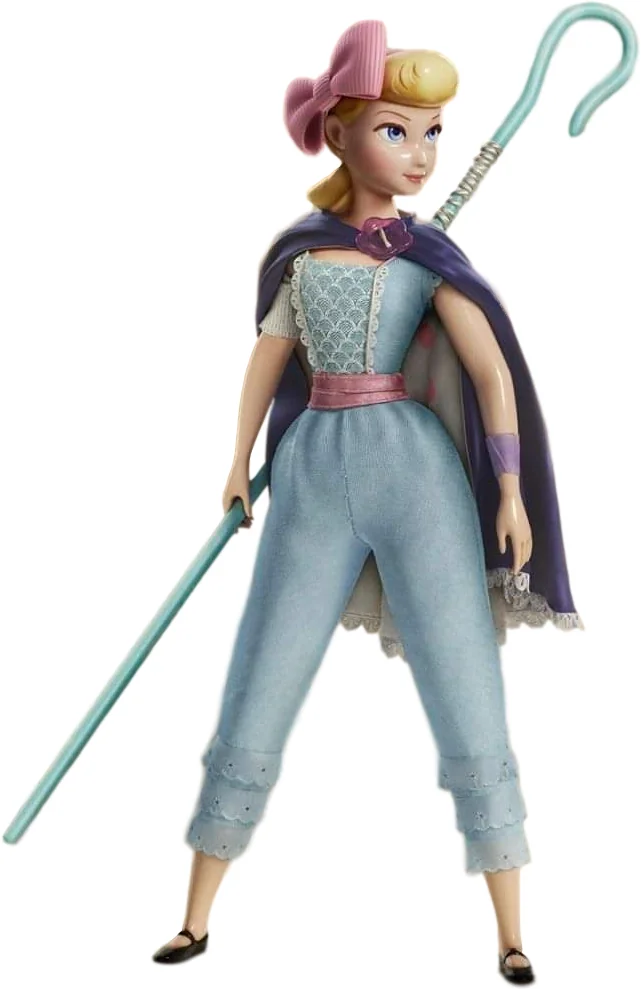
Bo Peep was never Andy’s toy. For two films she stood on the bedside lamp in the room of Andy’s baby sister, Molly – she and her three sheep, named Billy, Goat, and Gruff, were the lamp’s porcelain ornaments – and Andy borrowed her for play the way a child borrows anything not nailed down. Pixar wrote her out before Toy Story 3, partly because nobody could work out how a porcelain shepherdess would survive the film’s incinerator climax, and she disappeared from the series for two decades.
She returned in Toy Story 4 rebuilt from the ground up: chipped and cracked, free of the lamp, dressed to move, swinging her shepherd’s crook like a weapon, with a look the animators based in part on Rey from Star Wars. She had stopped waiting to be owned. In Toy Story 5 that reinvention finally pays off in plot terms, because Bo runs the toy-rescue squad, the crew that ventures out into the world to retrieve toys in trouble, and she is who Woody and Jessie lean on when things turn physical. The fragile lamp ornament who spent two films cast as the damsel now leads the rescues. It is the most complete turnaround anyone in the franchise has managed.
Forky
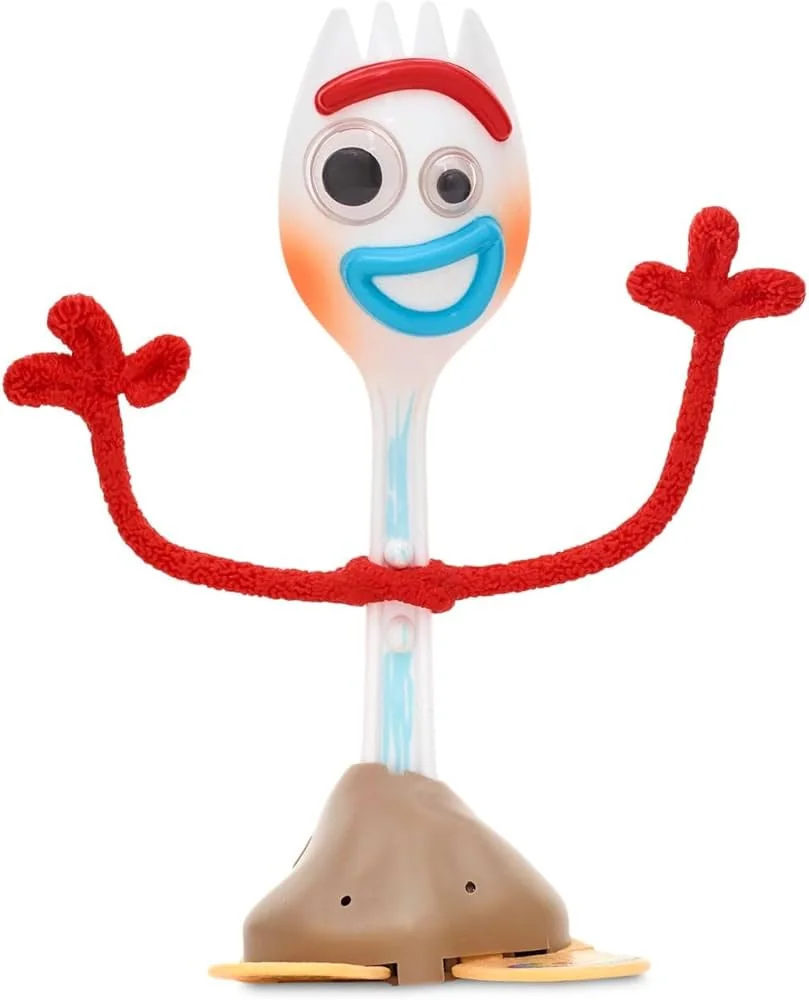
Bonnie made Forky on her first morning of kindergarten, out of trash. Sitting alone at orientation, friendless, she took a plastic spork, gave it pipe-cleaner arms, two mismatched googly eyes, broken popsicle sticks for feet, and a lump of clay for a mouth, then wrote her name on the bottom of one foot. Tony Hale voices the result, who spends most of Toy Story 4 in real existential distress – Forky does not believe he is a toy, he believes he is garbage, and he throws himself into every available trash can shrieking exactly that. Woody spent that film as Forky’s self-appointed minder, fishing him out of one bin after another.
The gag rests on a real question the series had quietly dodged for twenty-four years: if a toy’s purpose is to be loved by a child, what is a thing made of actual refuse and animated by that same love? Toy Story 5 answers by marrying him off. The film opens on Forky’s wedding to Karen Beverly, the plastic knife, and the spork who spent a whole movie certain he belonged in the bin begins the next one as a husband. Nobody explains how this is supposed to work, which feels correct.
Smarty Pants
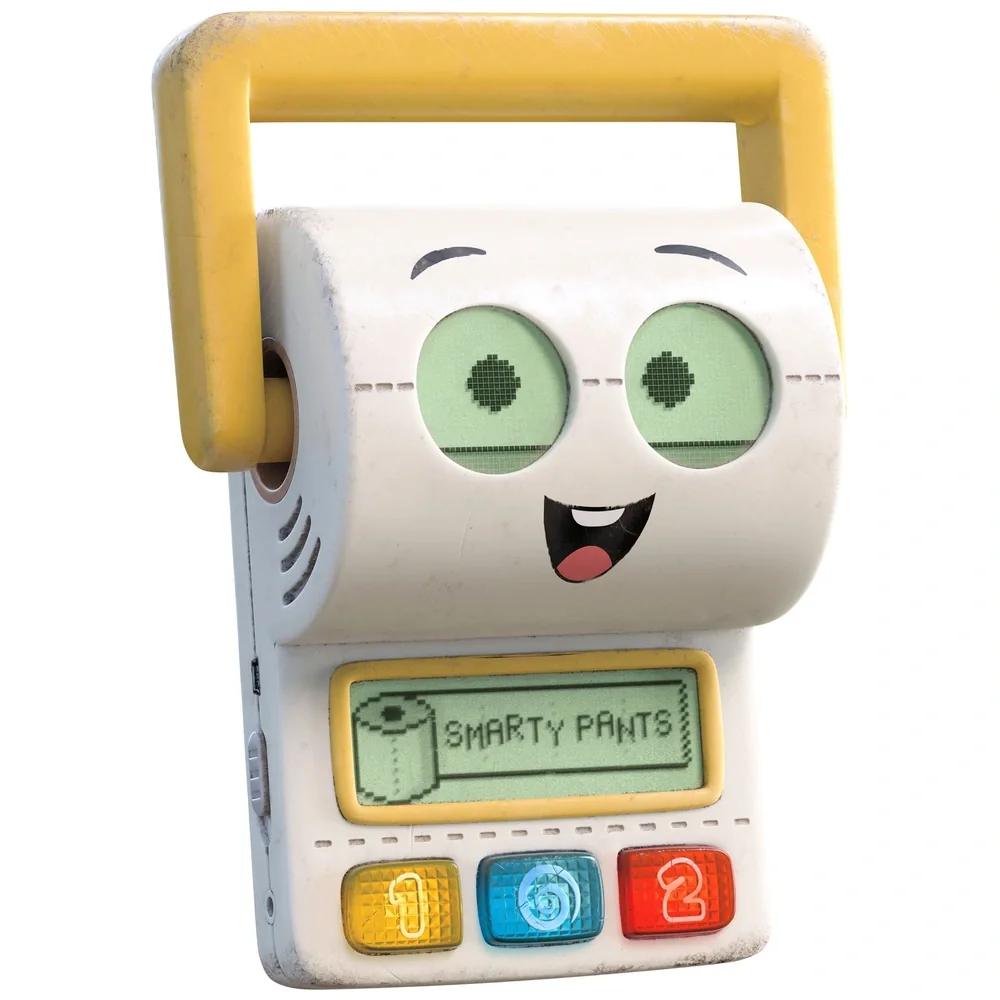
For years, Smarty Pants sat in a shed in sleep mode. He is a potty-training tech toy – an educational gadget with the silhouette of a toilet-paper roll, a snide motormouth personality, and the voice of Conan O’Brien – left switched off and forgotten in a backyard shed once his kid, a girl named Blaze, grew past needing him. When Jessie stumbles into that shed, Smarty Pants begs her for fresh batteries for himself and his fellow rejects, asking whether she knows what it is like to be shoved back into the dark forever.
It is a sharper line than a toilet-training toy has any business delivering, and it lands because it is aimed at the one toy in the building it would wound: Jessie, who has spent the entire franchise dreading exactly that. Smarty Pants and his shed-mates become her unlikely crew – recruited, recharged, and pressed into a rescue none of them volunteered for – and he proves the most useful of them. The animators handed him one detail worth the ticket on its own – in a playtime sequence he turns up with the same swooping red hair as the man voicing him. A potty-training toy with Conan O’Brien’s pompadour should not work as well as it does.
Atlas
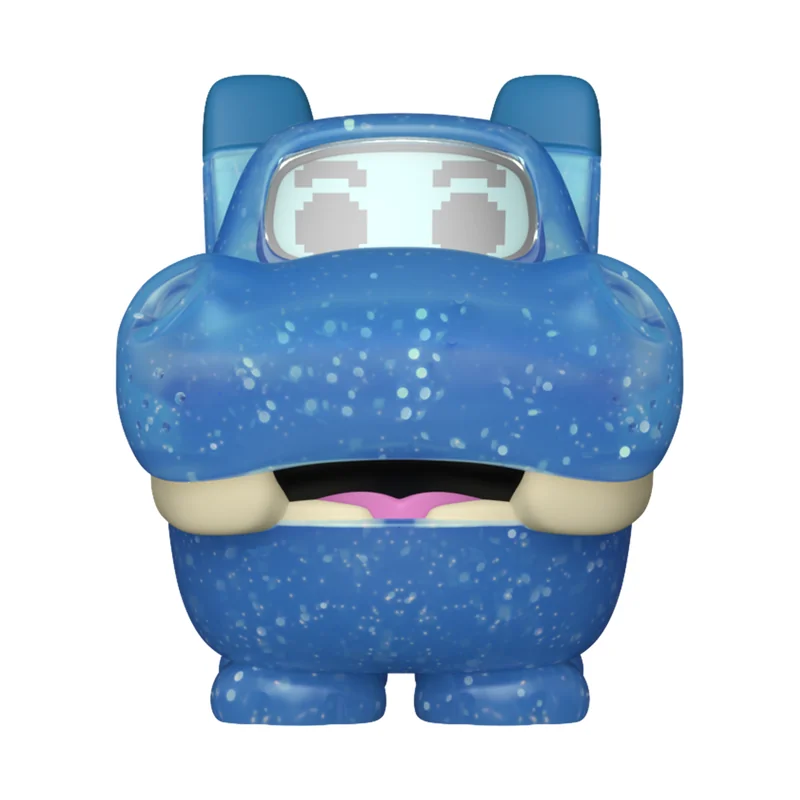
There is a toy hippo in this film who used to be a child’s GPS. His name is Atlas, he is voiced by Craig Robinson, and he is one of the dead gadgets Jessie brings back to life in Blaze’s shed alongside Smarty Pants – a bulky, outdated navigation toy from the brief window before every phone could find every street by itself. A standalone GPS is about the purest example there is of a gadget the smartphone made extinct, which is surely why the film reached for one. Robinson joins a quietly growing tradition of actors from the American version of The Office surfacing in Pixar films, a roster that already holds Phyllis Smith, Mindy Kaling, and John Krasinski.
Atlas earns his keep during the film’s biggest set piece. When Jessie has to wrangle the runaway army of Hi-Tech Buzz Lightyears, it is Atlas’s navigation, working in tandem with the camera-toy Snappy, that lets her herd and override them. A discontinued GPS, the sort of device that goes in a drawer the instant a better map exists, turns out to be the thing that saves the day, which is the whole argument of Toy Story 5 squeezed into one hippo. The film is not subtle about this. It does not need to be.
Snappy
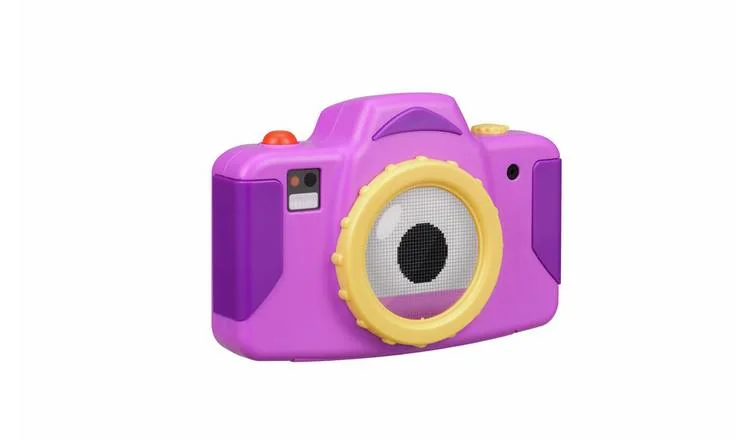
Of the three dead gadgets Jessie wakes up in Blaze’s shed, Snappy is the one happiest to be switched back on. She is a child’s camera toy, voiced by Shelby Rabara – the actor who played Peridot across Steven Universe – and she is wired for a single emotion, which is delight. “She’s just this excitable camera and she’s always there to help,” Rabara said at the premiere, and that is the entire character: a point-and-shoot from the last era when taking a photograph required a separate object built to do it.
She completes a small, sad league of obsolescence with the other two. Smarty Pants handled the potty training and Atlas handled the directions; Snappy handled the camera, back when catching a birthday or a day at the beach meant owning a dedicated machine for it, all of it since swallowed whole by the phone. The three of them become Jessie’s crew, and Snappy’s flash turns out to matter when the toys have to wrangle an army of malfunctioning Buzz Lightyears. The franchise has always been quietly about things outliving their usefulness and then finding it again somewhere unexpected. Snappy is that idea handed a shutter button and an unkillable good mood.
Hi-Tech Edition Buzz Lightyear
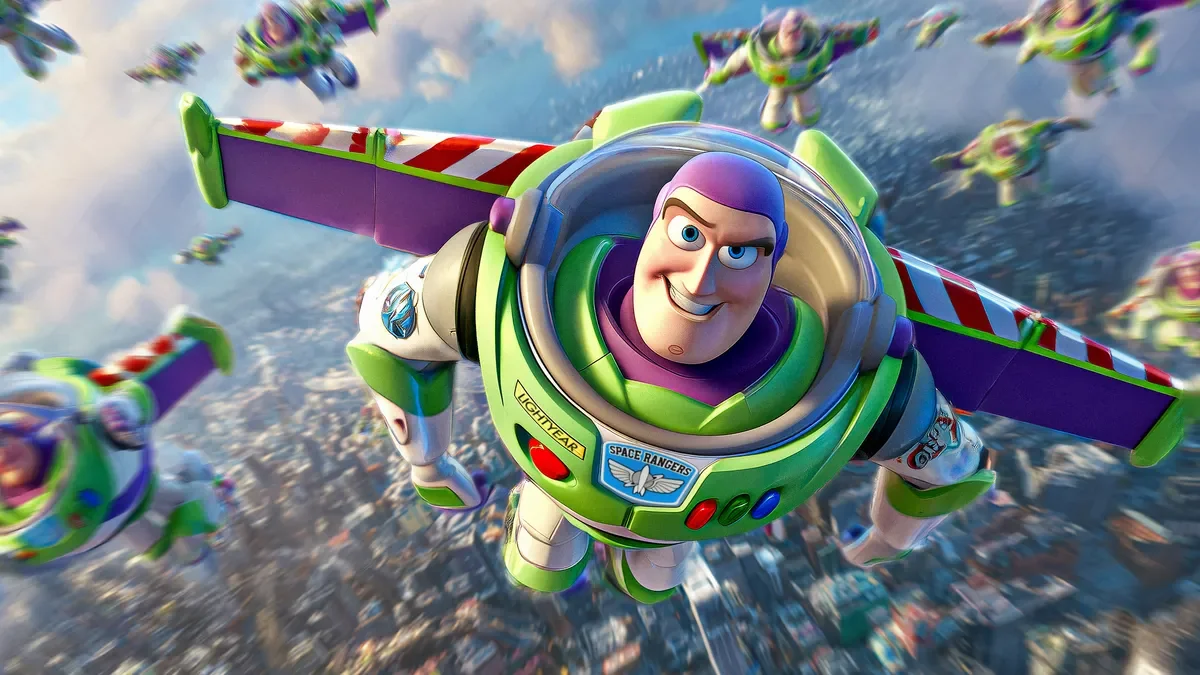
Fifty new Buzz Lightyears wash up on a beach. A shipping container goes overboard somewhere at sea, splits open, and deposits an entire production run of Hi-Tech Edition Buzz figures onto a deserted island, every one of them booted up in the exact state the original Buzz was in back in 1995 – certain it is a real space ranger on a real mission, with no notion that it is a toy. They set off across ocean and land in search of Star Command.
What they find is Jessie. Because she wears a gold sheriff’s star, the marooned Buzzes conclude she must be the Star Command they have been hunting for, and they fall in behind her, fifty identical action figures saluting a cowgirl rag doll. They turn out to be the cavalry. After Lilypad downloads a software update that unlocks their flight packs, the Buzzes fly the entire gang back across town for the film’s final reunion, with style. In the mid-credits they each drift down to a different lonely child on a playground, having finally absorbed the lesson the original Buzz needed four films to learn. Then a boy pulls a new Zurg toy from his backpack, fifty chest-plates flash red at once, and fifty voices scream in horror. Some lessons take longer.
Bullseye
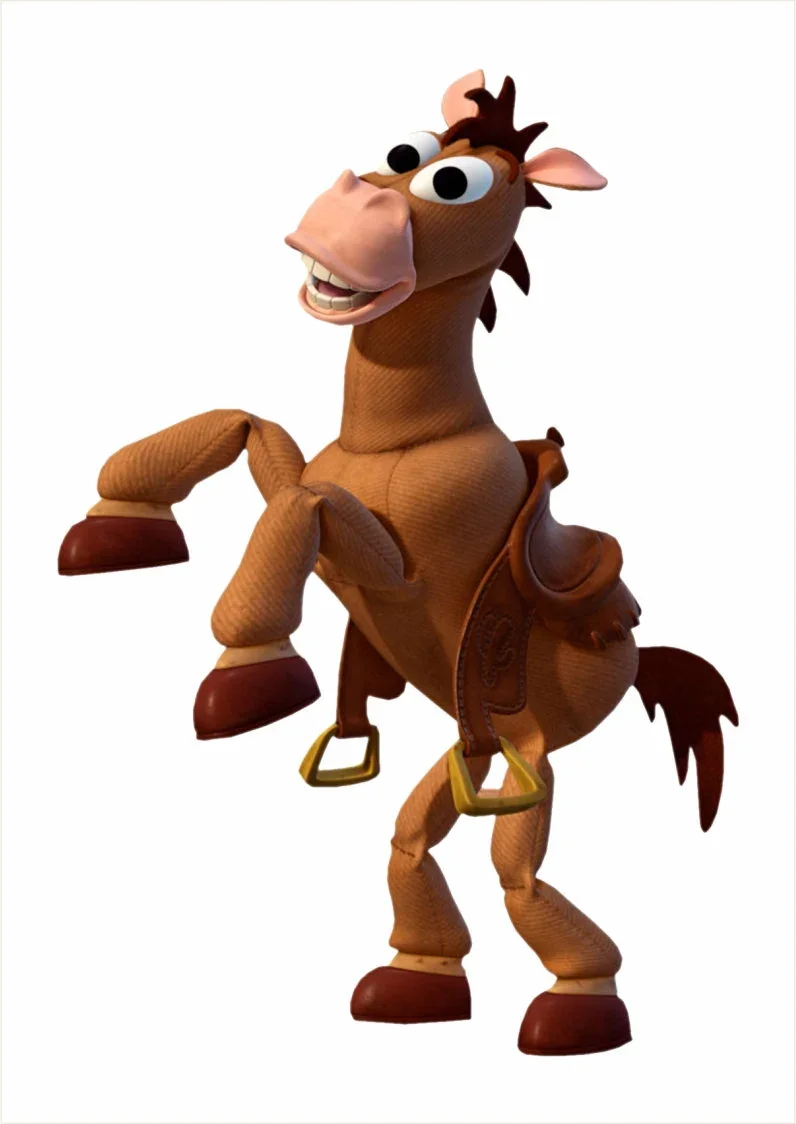
Woody’s horse is the only major Toy Story character who has never been given a line of dialogue. Bullseye arrived in Toy Story 2 as part of the Woody’s Round-Up set, the fictional 1950s television troupe that also produced Jessie and Stinky Pete, and from the start he communicated entirely in whinnies, whimpers, and the body language of an oversized puppy, his sound effects supplied by Frank Welker, who has been voicing cartoon animals since the 1960s. The silence was a decision. Bullseye was written with full dialogue in early drafts – the comedian Martin Short was reportedly lined up to provide it – until John Lasseter concluded the horse worked better mute.
For twenty-seven years that held. Toy Story 5 breaks it, sort of, and only on a technicality. During a playtime sequence, Blaze imagines a wicked version of the horse named Evil Bullseye, voiced in a single-scene cameo by Alan Cumming, who pointed out that the character had simply never had a voice before. The real Bullseye stays silent throughout. The first words ever spoken by Woody’s horse belong to an evil version of him who exists only inside a child’s head. It is a strange way to end a vow of silence, and a very Pixar one.
Karen Beverly
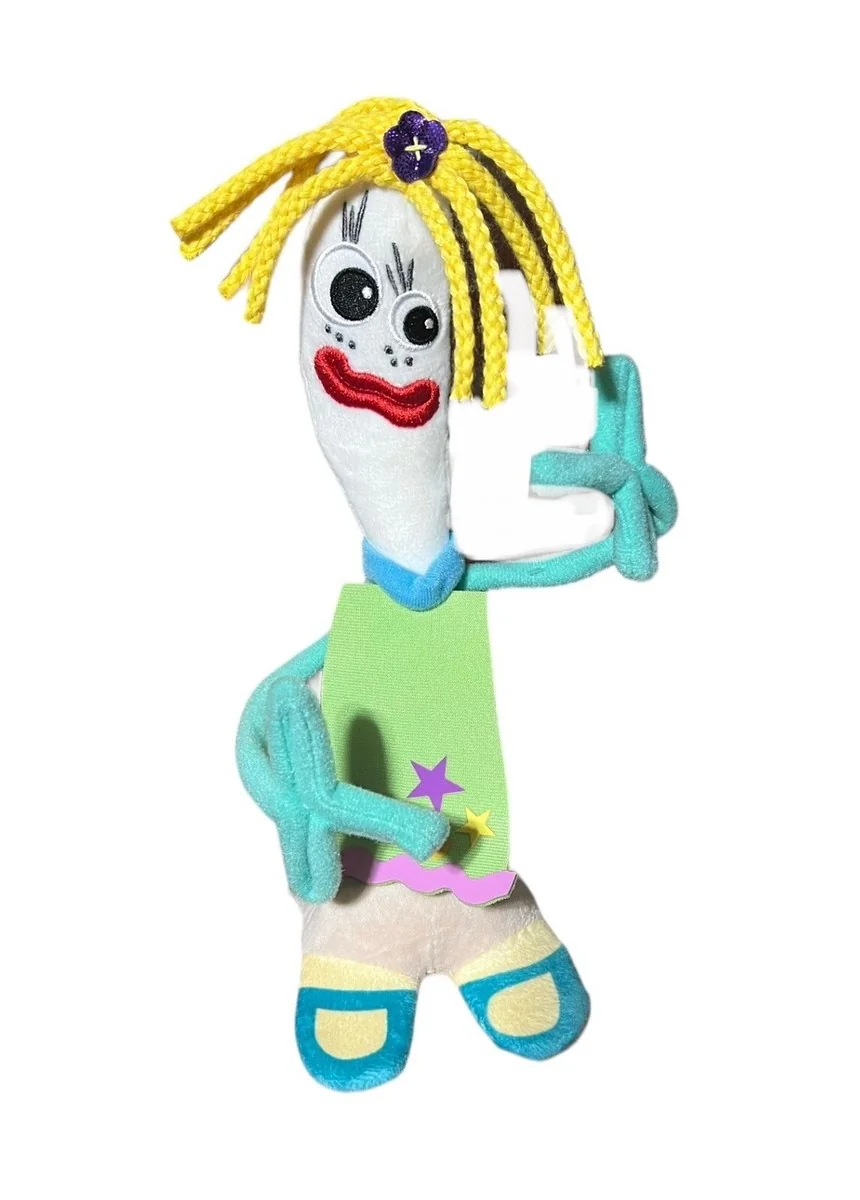
At the very end of Toy Story 4, after the credits, Forky works up the nerve to introduce himself to a fellow piece of homemade cutlery and meets Karen Beverly, a plastic knife that Bonnie made at school, voiced by Melissa Villasenor. It was a thirty-second joke, the kind of mid-credits throwaway nobody expects to see again. Pixar saw her again.
Toy Story 5 opens by marrying the two of them. Karen Beverly, who in the fourth film existed only to give Forky someone equally confused to talk to, is promoted to bride in the first scene of the next one, walking down a backyard aisle to become half of a lawfully wedded couple. She does not say much, on account of being a knife, but she is present for the entire ceremony and stays conspicuously thrilled by everything that happens, including the parts that go badly wrong. There is no deeper meaning to dig out here. A plastic spork married a plastic knife, the two of them built by a child out of craft supplies, and the most famous toy franchise on Earth chose to begin its fifth film with their wedding. Sometimes the toys just have a nice day.
Rex
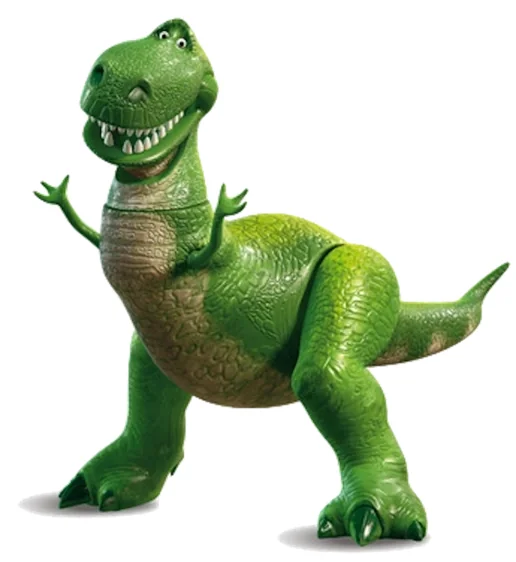
Rex worries. He is a plastic tyrannosaurus, a shade under a foot of him, and he has spent the franchise fretting that his arms are too short, his roar is not frightening, and his usefulness is nearly spent – which makes him, in a film openly about toys fearing obsolescence, almost too perfect to be true. Wallace Shawn has voiced him since 1995, bringing the same fluttering anxiety he brings to everything, and Toy Story 5 hands him the line that sums the entire movie up. When Lilypad arrives and playtime grinds to a halt, Rex wails, “Extinction! Not again!”
His other big moment is considerably more deranged. In the opening wedding, Bonnie casts Rex as the maid of honor, in a necklace and pink shoes, then decides he has been poisoned by the cake. Rex breaks out in purple spots and drops to the floor, and Buzz is dispatched to perform increasingly graphic chest compressions and a kiss of life while the other toys avert their eyes. It is the film letting an eight-year-old’s imagination run exactly as dark and silly as a real eight-year-old’s would. Rex, a dinosaur who lives in fear of extinction, spends his big scene playing dead.
Hamm
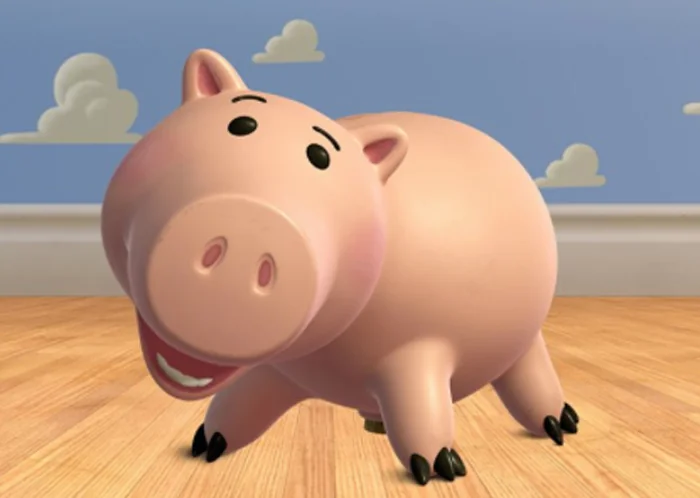
John Ratzenberger turns up in Pixar films the way an uncle turns up at family functions: dependably, in a supporting capacity, and usually with a comment. Before any of that he spent a decade as the know-it-all mailman Cliff Clavin on Cheers, a role worth two Emmy nominations. He has since voiced a character in nearly every feature Pixar has made – the Abominable Snowman in Monsters, Inc., the Underminer in The Incredibles, Mack the truck in Cars, Fritz in Inside Out – but his first and longest-running job there is Hamm, the wisecracking piggy bank he has played since the original Toy Story in 1995, more than two dozen times across films, shorts, and games.
Hamm is a piggy bank, which the films never let anyone forget; he has a cork in his belly and a coin slot in his back, and a recurring bit has him rattling the loose change around inside himself. In Bonnie’s playtimes he is reliably cast as the criminal mastermind Evil Doctor Porkchop. By Toy Story 5 he has settled comfortably into the role of the gang’s resident commentator, the one who supplies the dry remark while everyone else panics about the tablet. He has excellent timing and a low opinion of most new technology. The two facts are probably related.
Mr. Potato Head
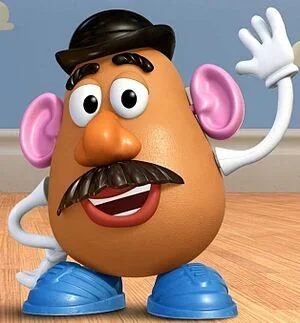
When Don Rickles died in 2017, Pixar had a problem it had never faced: one of its toys had lost its voice. Rickles had played Mr. Potato Head since 1995, bringing four decades of insult-comic timing to a plastic spud with detachable features, and he died before recording anything for Toy Story 4. Rather than recast or quietly retire him, the studio’s sound team spent months combing twenty-five years of archived recordings, outtakes, and even video-game lines, and with the blessing of Rickles’ family they reconstructed a performance out of words he had already said. Mr. Potato Head appears in Toy Story 4 entirely in salvage.
A whole new film could not be built that way. For Toy Story 5, Pixar held auditions and cast Jeff Bergman, the voice actor who inherited Bugs Bunny and Daffy Duck after Mel Blanc and after Henry Corden, a man whose entire career is stepping carefully into the shoes of the irreplaceable. Director Andrew Stanton said only that they found someone who sounded very close to the original. Mr. Potato Head still loses his pieces, still complains, still gets cast as One-Eyed Bart in the backyard. He sounds almost exactly like himself, which is the highest compliment available and a slightly haunted one.
Mrs. Potato Head
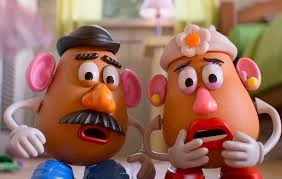
At the close of the first Toy Story, Mr. Potato Head learns that Andy’s baby sister Molly is getting a Mrs. Potato Head for Christmas, and spends the moment giddy at the prospect of a wife. She actually arrived in Toy Story 2, voiced by Estelle Harris, whose loud, fussing delivery – familiar to a different audience as George Costanza’s mother on Seinfeld – became as much a part of the character as the plastic lips. Harris played her through Toy Story 4, which turned out to be her final film role. She died in 2022, at ninety-three.
For Toy Story 5 the part went to Anna Vocino, the second half of a double recasting the film handles without comment, simply letting the Potato Heads carry on. Mrs. Potato Head spends this movie much as she spent the others, keeping track of her husband’s scattered pieces and worrying at the edges of the group, and she resurfaces in the closing credits as part of the toy chorus that performs Lilypad’s friendship rap. A character introduced as a Christmas present for a toddler in 1995 is, thirty-one years later, singing backup for a tablet. The franchise has always taken the long view.
Slinky Dog
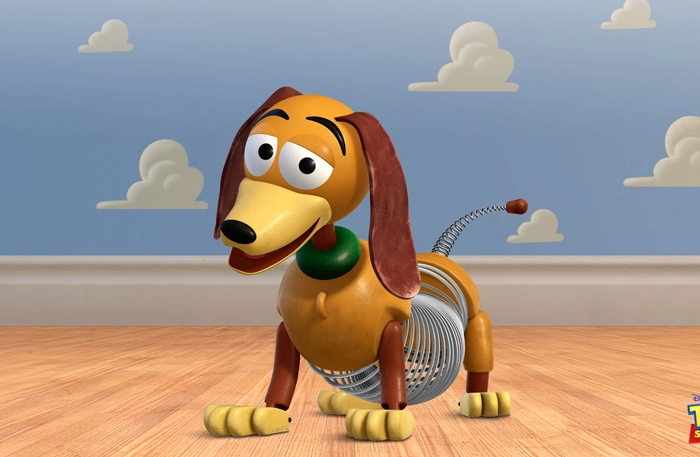
There is a real Slinky Dog, and there has been since 1952, when the James Industries pull-toy that gave the character its body and its name went on sale. Pixar’s version, redesigned by Bud Luckey – the same artist who shaped Woody – is a dachshund with wooden ends and a stretchable metal coil for a middle. For the first two films he was voiced by Jim Varney, the comedian behind Ernest P. Worrell, who poured a warm Kentucky drawl into a dog whose chief job was being loyal to Woody.
Varney died of lung cancer in 2000, a few months after Toy Story 2, at the age of fifty. He was the first member of the cast the franchise lost, and the studio’s answer set a template it would use again and again: rather than retire Slinky, Pixar searched for someone who sounded like Varney and found Blake Clark, who happened to have been Varney’s close friend. Clark has voiced Slinky from Toy Story 3 onward, including Toy Story 5, sounding so much like the original that most audiences never noticed the change. Two and a half decades later, the studio would face the same loss three more times in a single film. Slinky was the first goodbye.
Dolly
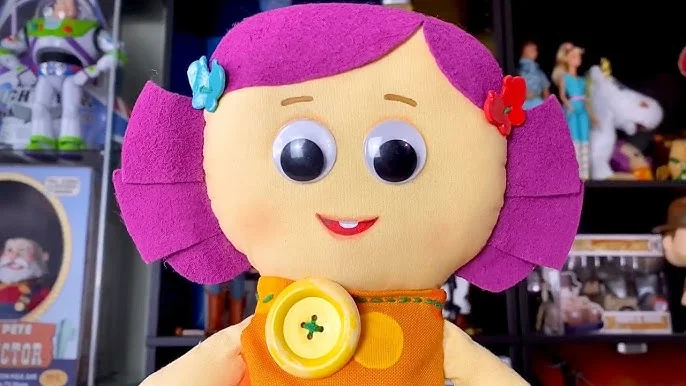
Like Woody, Dolly runs the room. She is a soft purple-haired rag doll with button eyes and an air of quiet authority, first appearing in Toy Story 3 as the unofficial leader of Bonnie’s toys, the one who organizes the others and keeps playtime from sliding into chaos. Bonnie Hunt voices her, bringing the dry, grounded warmth she is known for, which suits a character whose role is essentially middle management.
There is a quiet joke buried in the structure of it. When Andy gave his toys to Bonnie at the end of Toy Story 3, Woody – who had been the undisputed leader of his own household for the entire franchise – arrived in a room that already had one. Dolly was there first. She had her own system and her own hierarchy, and Woody, the most important toy in the world, was suddenly a newcomer reporting to a rag doll he had never met. Toy Story 4 sent Woody off to a different life partly because of this. By Toy Story 5 Dolly is still in charge, still keeping order, and she resurfaces in the closing credits as part of the chorus backing Lilypad’s rap. Leadership endures. So does the paperwork.
Trixie
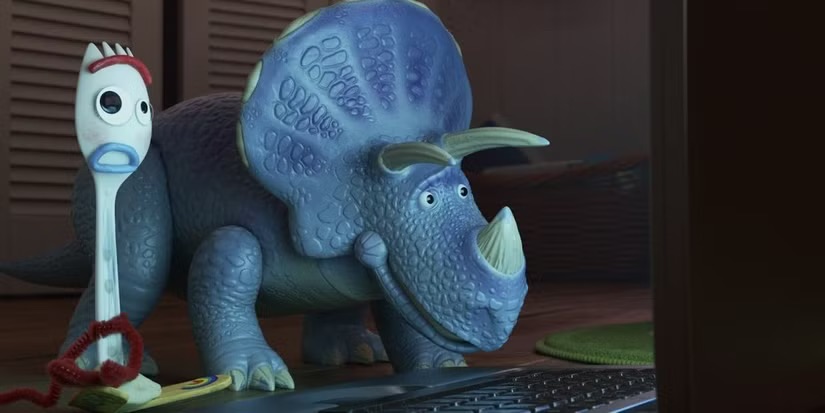
What does a toy triceratops do while her kid is at school? In Trixie’s case, she goes online. The funniest running gag in Toy Story 3 is that Trixie – a blue plastic triceratops, one of Bonnie’s toys, voiced by Kristen Schaal in her first Pixar role – spends her free time on the family computer, chatting with another dinosaur toy down the street under the username Velocistar237. When Woody stumbles onto the open chat window, Trixie dives for the keyboard to cover it, mortified, exactly like a teenager caught mid-message.
The detail has aged into something pointed. Toy Story 5 is a film about a tablet pulling a child away from her analog toys, built on the premise that screens and playthings are natural enemies. Trixie has been quietly bridging that gap since 2010. She is the one toy in Bonnie’s room already fluent online, already comfortable with a device, already living part of her life through a screen by choice. The first three letters of her name spell the dinosaur she is based on; the rest of her learned to type. In a film that treats screens as the enemy of play, Trixie is the toy who quietly made her peace with one fifteen years early.
Mr. Pricklepants
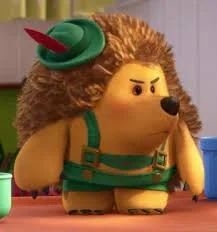
Of the several toys recast for Toy Story 5, Mr. Pricklepants is the only one whose original voice is still very much alive. The others changed hands because their actors had died. Pricklepants changed hands because Timothy Dalton, the fourth James Bond, simply did not return, for reasons nobody has explained, and the role passed to British actor John Hopkins. It is the one recasting in the film with no sad story attached, which is oddly fitting for its subject, the least sad toy imaginable.
Mr. Pricklepants is a plush hedgehog in lederhosen, an expensive German-made toy who has decided he is a serious actor. He arrived in Toy Story 3 as one of Bonnie’s toys, and his entire personality is theatrical gravity: he shushes the others for breaking character during playtime, lectures them about staying in the scene, and treats a child’s pretend tea party as if it were opening night at a national theater. Dalton, a genuine Shakespearean, played him with total commitment, which was the joke. Hopkins inherits a hedgehog who takes pretending more seriously than anyone takes anything. In Toy Story 5 he is mostly in the background, still treating every silent group scene as the role he was born to play.
Combat Carl
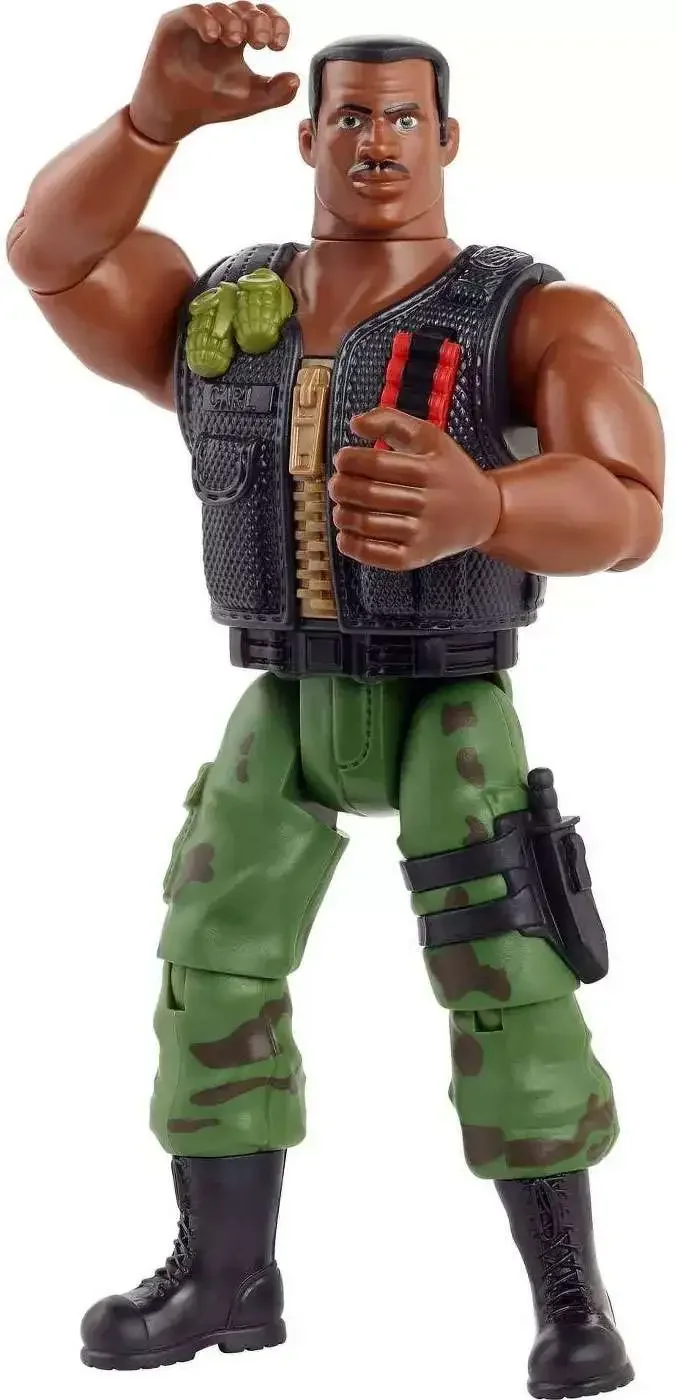
In the first Toy Story, the boy next door, Sid, straps a Combat Carl to a model rocket and blows him to pieces in the yard. That was the character’s entire role in 1995: a green military action figure, mute, used to demonstrate how cruel a child could be to a toy. Combat Carl sat dormant for years before Pixar brought him back as a speaking character in the 2013 short Toy Story of Terror! and again in Toy Story 4, and gave him the one voice the casting practically demanded – Carl Weathers, Apollo Creed himself, an action hero voicing an action figure named Carl.
Weathers died in February 2024. For Toy Story 5 the role went to Ernie Hudson, of Ghostbusters, and the handoff carried a private weight: Hudson and Weathers had been close friends for decades, and Hudson did not know he was stepping into his late friend’s part until after he had taken the job. He later said the not-knowing was probably for the best. Combat Carl, a toy who first existed to be destroyed, is now voiced by a man quietly carrying a friend he lost. The franchise keeps finding new ways to be about absence.
Duke Caboom
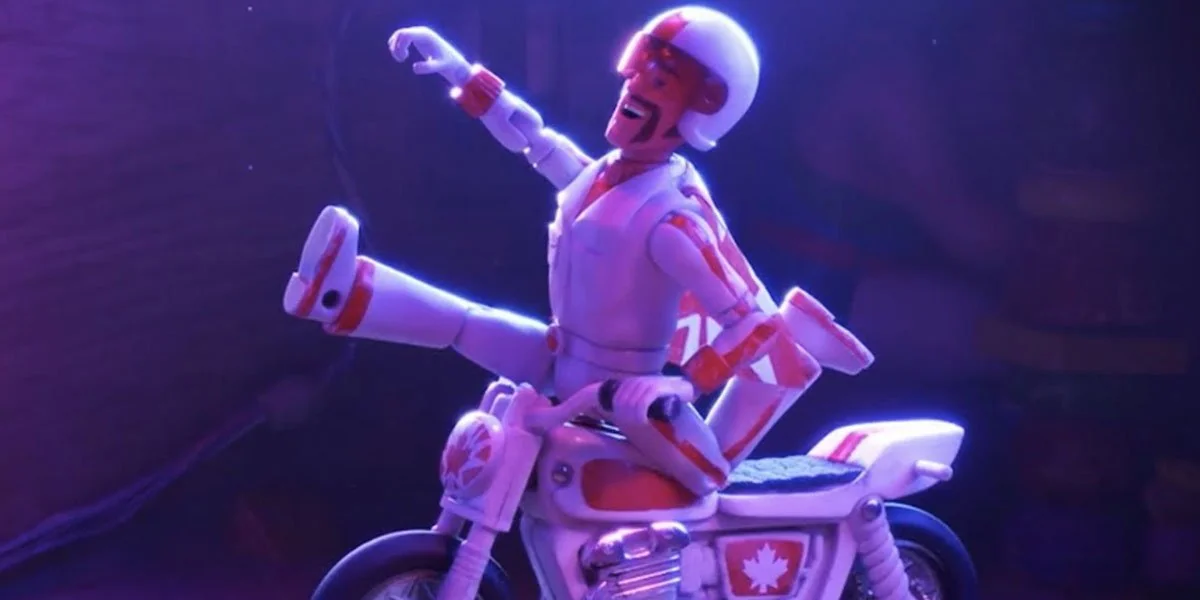
“Yes, I can-ada!” Duke Caboom shouts, striking a pose, because Duke Caboom strikes a pose before, during, and after nearly everything he says. He is a 1970s Canadian stuntman toy on a stunt-cycle, all swagger and confidence, modeled on the Evel Knievel figures of the era, introduced in Toy Story 4 as a member of Bo Peep’s lost-toy world. Keanu Reeves voices him, a piece of casting Pixar arrived at through a blind audio test of Canadian actors; the filmmakers picked the voice before they knew it belonged to Reeves, who reportedly leapt onto a table in Pixar’s atrium and struck poses to find the character.
Underneath the swagger is one of the saddest backstories in the series. Duke’s commercial promised stunts the actual toy could not perform, and when his kid, a boy named Rejean, unwrapped him and found he could not really jump, Rejean threw him away the same day. Duke has been performing confidence over that wound ever since. It makes him a precise little fable about the gap between what a toy is advertised to do and what it can actually do, which is, in a roundabout way, the entire anxiety of Toy Story 5. He returns to help Bo’s rescue crew. He still cannot land the jump, and he still tries.
Giggle McDimples
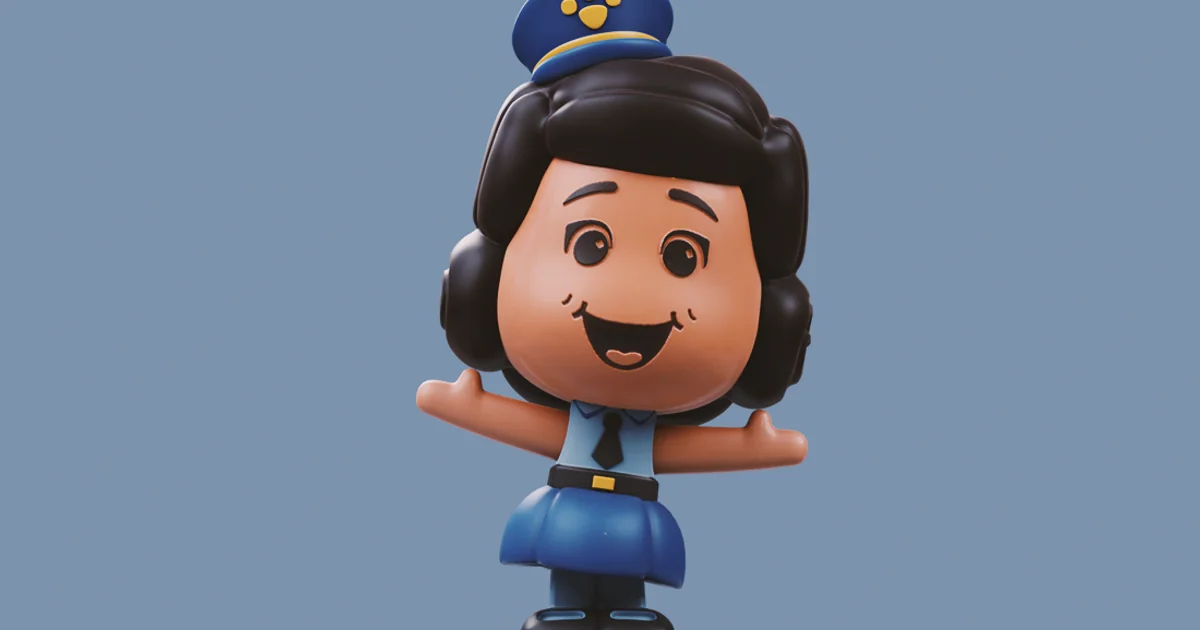
The smallest toy in the entire franchise is a police officer named Giggle McDimples. She is a miniature plastic figure modeled on the Polly Pocket playsets of the 1980s, small enough to perch on Bo Peep’s shoulder and ride there through most of Toy Story 4, voiced by Ally Maki. As a toy, she is the head of Pet Patrol for a tiny municipality called Miniopolis. Out in the world, she is Bo’s closest friend and her conscience – the director Josh Cooley called her Bo’s Jiminy Cricket – the small voice in her ear talking her through every decision.
Her size is played for both comedy and a low hum of menace. Cooley noted that a toy this small has, in her time, been stepped on, vacuumed up, and very probably lodged up a child’s nose. It is the kind of detail the franchise specializes in: the throwaway joke that doubles as a genuinely alarming thought about what the world is like for something an inch tall. In Toy Story 5, with Bo running the toy-rescue operation, Giggle is back at her post on the shoulder, advising. The biggest toys in the room keep making the speeches. The smallest one tells them what to do.
Ducky & Bunny
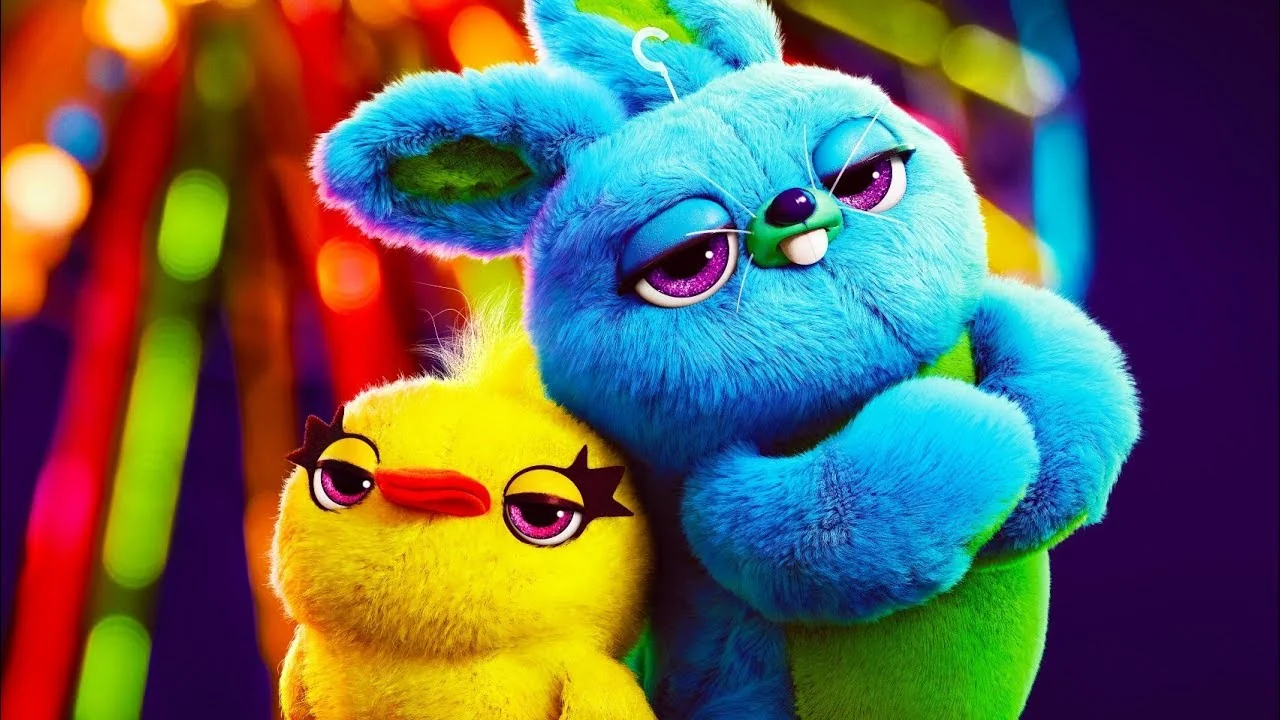
Two plush carnival prizes, a duck and a rabbit, share this single entry because they are physically sewn together at the hands and have been since the factory. Ducky and Bunny – voiced by Keegan-Michael Key and Jordan Peele, reunited from their sketch show – spend Toy Story 4 pinned to a prize wall at a carnival, attached to each other, waiting for a child to win them and never quite being won. Two inseparable toys, voiced by two inseparable comedians. The casting more or less wrote itself.
Their comic function is the plush rush, a recurring cutaway gag in which the pair imagine elaborate, usually unhinged schemes for getting what they want, rendered as little fantasy sequences before the film cuts back to two stuffed animals who have not moved an inch. They are loud, lazy, and gleefully unhelpful, which made them a highlight of the fourth film, where they spend much of their time tormenting a captive Buzz Lightyear strapped to their prize wall, and a fixture of Bo Peep’s world afterward. In Toy Story 5 they turn up again with the lost-toy crew, still attached, still scheming, still hanging back from the actual work. Some duos are built to share the spotlight. These two were built to share a seam.
Dr. Nutcase
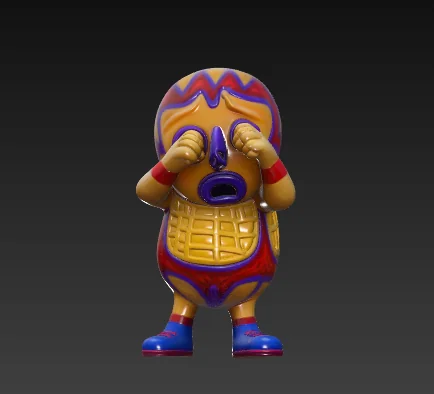
There is, in this film, a sentient peanut in a wrestling mask. His name is Dr. Nutcase, he is voiced by Matty Matheson – the chef and restaurateur who plays Neil Fak on The Bear – and he is a tiny plastic luchador, a peanut got up in the mask and posture of a Mexican wrestler, with one defining trait: he is terrified of technology. The toy-rescue squad finds him taped to an abandoned kite that has snagged high in a tree, quivering, having watched the modern world arrive and decided he wants no part of it.
He is the film’s thesis in peanut form. Where the other new toys try to adapt to the tech age, Dr. Nutcase is pure analog panic, a small wrestler who would sooner be lost in a tree than face a touchscreen. Matheson, a Canadian who came up making cooking videos for Vice and runs restaurants in Toronto, called the part a once-in-a-lifetime thing and admitted on Jimmy Fallon’s show that he was so thrilled he asked whether he was supposed to pay Pixar. A peanut, a luchador mask, and a phobia of the future. The Toy Story films have never lacked for specific ideas, and they were not about to start now.
Garden Gnome
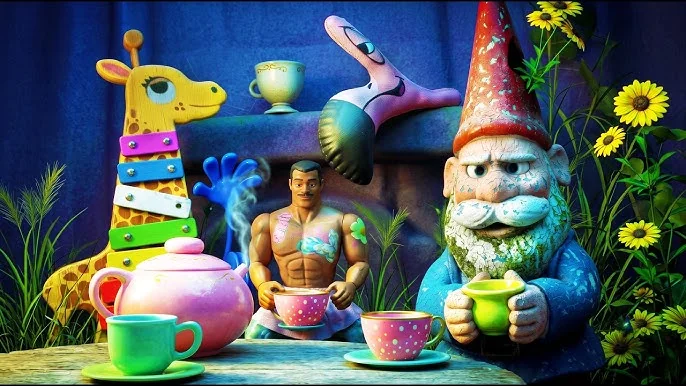
If you read all the way to the bottom of the Toy Story 5 voice credits, past Keanu Reeves and Conan O’Brien and Bad Bunny, you will find the garden gnome, and beside it a name most of the audience will not know: Jerome Ranft. Ranft is not really an actor. He is one of Pixar’s character sculptors, the people who turn a designer’s drawing into a physical clay model before it is ever animated – for Monsters, Inc. he reportedly sculpted Sulley more than thirty times before the monster was right. He has done this at Pixar since 1997, on A Bug’s Life, Toy Story 2, Finding Nemo, Cars, and most of the rest.
He voices the gnome, a weather-beaten lawn ornament parked among Blaze’s forgotten toys, and the casting carries a quiet weight. Jerome’s older brother was Joe Ranft, the Pixar story artist who voiced Wheezy and Lenny and Heimlich before he was killed in a car crash in 2005. In Finding Dory, Jerome took over one of Joe’s characters so the part could go on. So in a film loud with celebrity voices, the garden gnome in the corner belongs to the family that helped build the studio. It is the smallest part in the movie and not remotely the least meaningful.
Pizza with Sunglasses
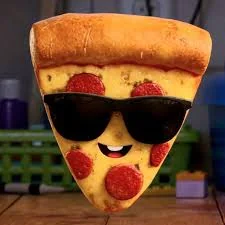
What does a six-time Grammy winner do for his Pixar debut? He plays a slice of pizza in sunglasses. Bad Bunny – Benito Antonio Martinez Ocasio, who headlined the 2026 Super Bowl halftime show and took Album of the Year at the Grammys that same month – voices a single-line cameo as Pizza with Sunglasses, an effortlessly cool slice living among the forgotten toys in Blaze’s abandoned backyard shed. Pixar sought him out after noticing how openly he loved the franchise, and once he was in the booth he improvised lines in both Spanish and English. Under the shades, he is one more abandoned toy hoping the kid who left him comes back.
There is an accidental poetry to the casting. The album that won him Album of the Year is titled Debi Tirar Mas Fotos, which translates roughly as I Should Have Taken More Photos – a record about memory and the things you wish you had held onto, dropped into a film about a tablet quietly replacing the moments a kid would otherwise have lived. Pizza with Sunglasses says almost nothing, then turns up in the closing credits to perform part of a rap. It is the single coolest a piece of leftover food has ever been allowed to be.
Inflatable Flamingo
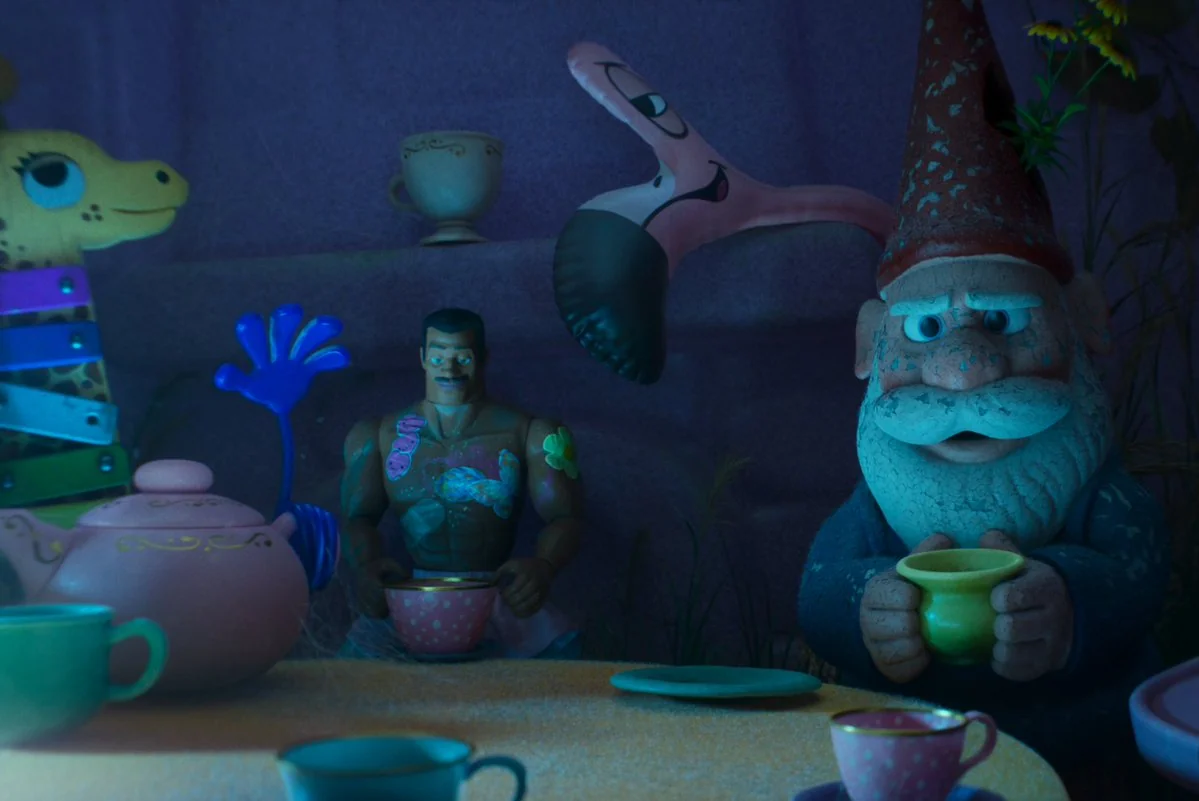
The least animate entry on this list is an inflatable flamingo. It does not speak, at least not in the version most people will see – a British radio presenter named Sian Welby voices it in the UK dub, which tells you roughly how much there is to voice. It is a pool-toy flamingo, the kind of thing that spends its summers half-deflated in a garage, and in Toy Story 5 it sits in Blaze’s pile of forgotten toys, waiting, like the rest of them, for a kid who has moved on.
Its presence on a list called every toy in Toy Story 5 is a small test of the word toy. A garden gnome is decoration. A tablet is electronics. An inflatable flamingo is, strictly speaking, a flotation device. The film keeps including these edge cases precisely because that is what a real child’s collection looks like – not a curated set of action figures but a drift of whatever happened to accumulate, the meaningful and the inflatable side by side. Pixar has always understood that a toy is less a category than a relationship: a thing becomes a toy the moment a child decides it is one, and stops being one the moment the child stops. The flamingo earns its place by being exactly the kind of thing nobody remembers buying and nobody quite gets around to throwing away.
RC
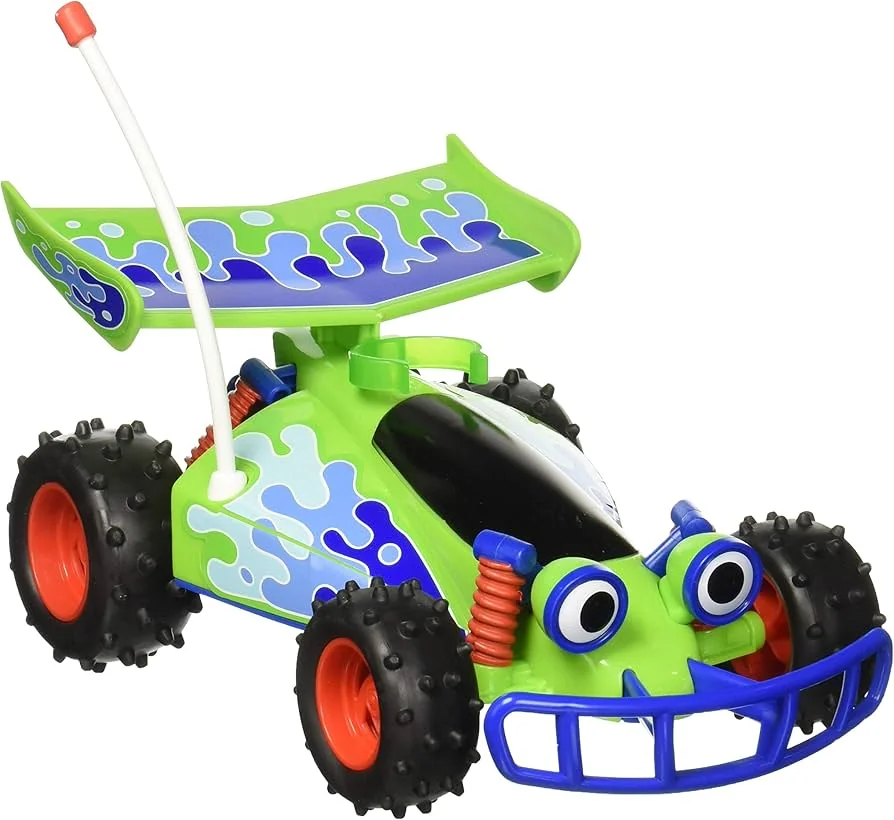
RC turns up in Toy Story 5 the way a forgotten toy turns up at the bottom of a box during a move – unannounced, and to a small ache of recognition. He appears in the end credits, in one of the playtime fantasies that Bonnie and Blaze dream up together, and longtime viewers will know him at once: the little red remote-control racer who has not had a real part in this series since the 1990s.
RC mattered once. In the first Toy Story he is the engine of the climax – Woody rides him to chase down the moving van, and when RC’s batteries die at the worst possible moment, the rocket strapped to Buzz’s back finishes the job. He never speaks. RC communicates entirely in honks and engine revs, and the other toys understand him perfectly, which was always the quiet charm of him. By Toy Story 3, Woody mentions in passing that RC was among the toys given away or sold off over the years, which is to say the franchise itself had let him go. So his return here, wordless, in the background of a child’s invented game, is the series quietly remembering a toy it had written off. Some toys get a proper farewell. RC just gets to come back.
Zurg
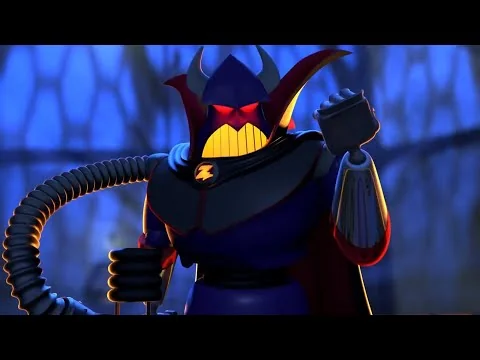
“We meet again, my son!” The last new voice in Toy Story 5 belongs to a villain who has not turned up in the main films since 2010. In the mid-credits scene, after the marooned Buzz figures have each finally found a child on a playground, a boy pulls an Evil Emperor Zurg toy from his backpack, every Buzz chest-plate flashes red, and fifty space rangers scream in unison while the children look on, baffled. It is a punchline sixteen years in the making.
Zurg was introduced in Toy Story 2 as the great enemy of the in-universe Buzz Lightyear mythos, a towering purple robot who, in the film’s finest gag, pauses a laser battle to inform a Buzz figure that he is, in fact, his father – a wholesale parody of The Empire Strikes Back, after which the two of them play catch. He was absent from Toy Story 4 altogether. Toy Story villains tend not to come back; Lotso and Gabby Gabby each turned up once and were never seen again, which makes Zurg, of all of them, the one the series could not quite let go. His return here is pure fan service, a wink rather than a threat, but it lands. The toys faced down a tablet for ninety minutes. The thing that finally makes them scream is somebody’s dad.
Frequently Asked Questions
Who are the new celebrity voices in Toy Story 5?
Newcomers include Conan O’Brien as the potty-training toy Smarty Pants, Craig Robinson as a talking GPS hippo named Atlas, Bad Bunny as the forgotten Pizza with Sunglasses, and Matty Matheson as Dr. Nutcase, a peanut in a luchador mask who is terrified of technology. Keanu Reeves returns as Duke Caboom.
Does Toy Story 5 have a post-credits scene?
Yes. In a mid-credits scene, the fifty marooned Buzz figures finally drift down to lonely children on a playground, then a boy pulls an Emperor Zurg toy from his backpack, every Buzz chest-plate flashes red, and the whole squad screams in unison. It sets up Zurg’s return.
Which Toy Story 5 voices were recast after the original actors died?
Three toys have new voices because their actors died: Jeff Bergman replaces Don Rickles, who died in 2017, as Mr. Potato Head, Anna Vocino replaces Estelle Harris, who died in 2022, as Mrs. Potato Head, and Ernie Hudson replaces Carl Weathers, who died in 2024, as Combat Carl.
Is Lilypad a real tablet you can buy?
Yes. LeapFrog released an officially licensed Explore and Learn Lilypad, a preschool learning tablet for ages three and up modeled on the character. It teaches letters and numbers, lets children send preset texts to Woody, Buzz, and Jessie, and became an Amazon bestseller around the film’s release.
Does Bullseye ever speak in Toy Story 5?
No. Woody’s horse Bullseye stays silent, as he has since Toy Story 2, communicating only in whinnies and whimpers. The film does hand a voice to Evil Bullseye, a villainous version of the horse that a child imagines during playtime, performed in a single-scene cameo by Alan Cumming.
Is Toy Story 5 a direct sequel to Toy Story 4?
Yes, though a loose one. Toy Story 5 largely skips the events of Toy Story 4 and returns to the metaphysical question of the first three: what makes something a toy? Its new conflict sets the analog toys against smart devices. It runs 1 hour 42 minutes, rated PG.
- Meet the Characters of Disney and Pixar’s Toy Story 5 – D23
- Toy Story 5 – Pixar Wiki
- Toy Story 5 Cast Guide – Variety
- Toy Story 5 Ending and Post-Credits Scenes Explained – The HoloFiles
- Toy Story 5 New Voices: Meet the New Characters – Parade
- Pixar Drops Final Toy Story 5 Trailer, Reveals New Guest Voices – Animation World Network