Every Named Animagus in Harry Potter Canon
One November morning in 1981, on his way to work, Vernon Dursley noticed a stern-looking cat watching his house. It was still on the wall that night, and it did not move until nearly midnight, when Albus Dumbledore arrived and spoke to it. He turned to smile at the tabby and found himself smiling instead at a rather severe-looking woman wearing square glasses “exactly the shape of the markings the cat had had around its eyes”. The series was one chapter old and had already shown its hand.
In Prisoner of Azkaban, Hermione explained the paperwork. The Ministry, she said, keeps a register of witches and wizards who can become animals, showing “what animal they become, and their markings and things”. She had looked Professor McGonagall up on it and found only seven Animagi this century. The register turns out to be the least interesting place to look. The Animagi who matter most in the books are the ones who never went near it: three of the boys who drew the Marauder’s Map, and a journalist with a taste for other people’s conversations.
What follows is every named Animagus in the seven novels and in Rowling’s own essays, in the order the books unmask them, followed by an Irish witch and a gerbil from her later histories of Ilvermorny and Uagadou. Trading cards and video games have added plenty of others. None of them rests on Rowling’s own words, and none of them is here.
Seven named Animagi appear in the Harry Potter canon of the seven novels and J.K. Rowling’s own writing. The novels reveal five: Minerva McGonagall, Sirius Black, Peter Pettigrew, James Potter and Rita Skeeter. Rowling’s histories of Ilvermorny and Uagadou add two, the Irish witch Morrigan and Adrian Tutley. Characters found only in fables, on cards or in games are excluded.
Minerva McGonagall
Of the five Animagi the novels name, only one did it by the book. Minerva McGonagall learned the transformation while still at Hogwarts, Rowling writes, under the guidance of her Transfiguration teacher, Albus Dumbledore, and her animal form, “with its distinctive markings (tabby cat, square spectacle-markings around eyes)”, was “duly logged in the Ministry of Magic’s Animagus Registry”. The rest skipped that step.
She went on to teach the subject herself and to run Gryffindor house, which gives her a place among every professor who taught at Hogwarts as well as here. In Prisoner of Azkaban she turns into the cat in front of Harry’s class, turns “back into herself with a faint pop”, and finds the room oddly unmoved: “Not that it matters, but that’s the first time my transformation’s not got applause from a class.”
Rowling’s account of her schooldays has a few things that never reached any register. The Sorting Hat spent five and a half minutes deciding between Ravenclaw and Gryffindor before it chose. She was a gifted Quidditch player, and a foul in her final year, in the Gryffindor against Slytherin match that would decide the Cup, left her with concussion, several broken ribs and “a lifelong desire to see Slytherin crushed on the Quidditch pitch”. The Ministry has the markings on file. That part it never asked about.
Sirius Black
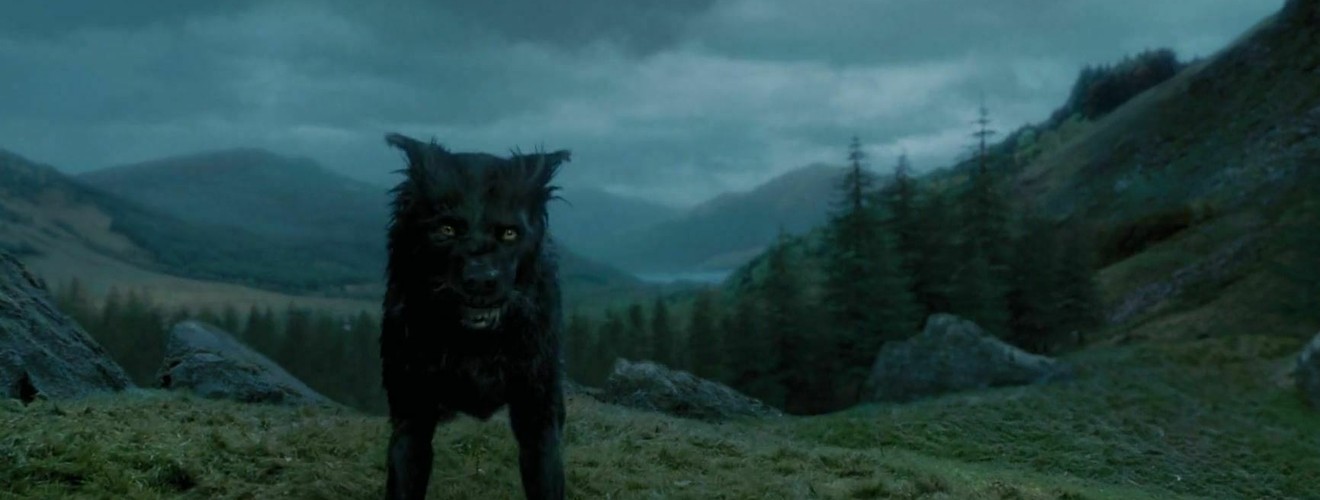
The first time Harry saw the dog, it was “the hulking outline of something very big, with wide, gleaming eyes”, watching him in the dark of Magnolia Crescent just before the Knight Bus arrived. Then Professor Trelawney read his tea leaves and announced “The Grim, my dear, the Grim!”, the giant spectral dog that haunts churchyards and foretells death. When the dog turned up in the top of the stands at a Quidditch match, Harry was fairly sure he was being haunted.
He was being visited. The dog was Sirius Black, who had spent twelve years in Azkaban and could transform in his cell whenever it got to be too much. As a dog his feelings were, he explained, “less human, less complex”, and the Dementors took the change for the madness everyone else in there was sliding into.
Getting into Gryffindor Tower took a cat. Crookshanks stole the passwords for him, as Sirius put it, “from a boy’s bedside table”, and the boy was Neville Longbottom, who had written down the week’s list and lost it, which is how one bad habit entered the record of every password used in the series. In Goblet of Fire, Sirius asked the trio to call him Snuffles. For a man who shares his name with the Dog Star, the brightest light in the Great Dog constellation, it was quite a comedown.
Peter Pettigrew
“An ordinary, common or garden rat like this can’t be expected to live longer than three years or so,” the witch at the Magical Menagerie told Ron, peering at a rat with a toe missing from its front paw. Scabbers had been Percy’s first. When Percy was made a prefect he got an owl, and Ron got Scabbers instead, which says something about the Weasley budget. By Lupin’s count it had been living as one for twelve years.
The missing toe was the clue. Peter Pettigrew had blown up a street, killing a dozen Muggles, cut off his own finger, faked his death and let Sirius Black take the blame, having spent the year before the Potters died passing information to Voldemort. Lupin and Black forced him back into his own shape, a change the book likens to “a speeded-up film of a growing tree”. In the next chapter he grabbed Lupin’s dropped wand, became a rat again and escaped.
He was back at his master’s side when Goblet of Fire opened, and in the graveyard at Little Hangleton, Voldemort remarked on his “curious affinity with rats”, used the Dark Mark on his arm to summon his followers – “The other arm, Wormtail” – and gave him a silver hand to replace the one he had cut off for the rebirth. The rat Percy handed down to his little brother had ended up among every confirmed Death Eater in the books.
James Potter
Remus Lupin was a werewolf, which puts his condition on the roll of every magical creature in the Harry Potter books, and it is the whole reason James Potter learned to turn into a stag. Rowling writes that the friends’ wish to help Lupin bear his lycanthropy led them to become “(unregistered) Animagi, so that they could keep him company without harm to themselves”. Lupin says when it happened: “Finally, in our fifth year, they managed it.”
James became a stag and took the name Prongs. Sirius and James, Lupin explained, “transformed into such large animals, they were able to keep a werewolf in check”, and the three animals let the boys roam the grounds by night undetected. The map they made opens with “I solemnly swear that I am up to no good”, a phrase that, Rowling notes, “in the case of three of the four makers, should be understood as a joke”.
James was long dead by the time his son learned any of this, which made the end of Prisoner of Azkaban stranger. Harry told Hermione he thought he had seen his dad. “Harry, your dad’s – well – dead,” she said quietly. Then a stag stopped on the bank of the lake, its hooves leaving no mark on the soft ground, and bowed its antlered head. “Prongs,” Harry whispered. Hermione was right. The stag was Harry’s own Patronus, in his father’s shape.
Rita Skeeter
“Attractive blonde Rita Skeeter, forty-three, whose savage quill has punctured many inflated reputations -” The Quick-Quotes Quill was writing about its owner, at the Weighing of the Wands, and the rest of Goblet of Fire ran much the same way. Dumbledore told her he had particularly enjoyed her description of him “as an obsolete dingbat”.
Her stories kept turning up things she had no obvious way of knowing, and Hermione was the one who worked out why. She caught a beetle listening from a window in the hospital wing, a beetle with markings that matched Skeeter’s spectacles, and kept it in a jar with an Unbreakable Charm on it until term ended. On the train home she announced that Rita Skeeter “is an unregistered Animagus. She can turn -”, pulled the small sealed glass jar out of her bag and finished: “into a beetle.” The price of the lid coming off was a year without writing anything.
The year did not stay entirely quiet. In Order of the Phoenix, Hermione and Luna Lovegood arranged for the out-of-work journalist to interview Harry for The Quibbler, and when Professor Umbridge banned the issue at Hogwarts, Hermione observed that banning it was the surest way to get the whole school reading. So the reporter blackmailed into silence broke it at the request of the girl who had blackmailed her. Rita, one imagines, did not find this as funny as everyone else did.
Morrigan
Not one of the seven novels mentions her; Morrigan lives in J.K. Rowling’s history of Ilvermorny, and only as an ancestor. That history, published on Pottermore on June 28, 2016, introduces the American school’s founder, Isolt Sayre, through her father: William Sayre “was a direct descendant of the famous Irish witch Morrigan, an Animagus whose creature form was a crow.”
That is the whole of what the history says about her. There is no date, no deed and no word on registration. What survives is the name. William nicknamed Isolt “Morrigan” for her affinity for all natural things when she was young, and Gormlaith, who raised her, insisted that a descendant of both Morrigan and Salazar Slytherin ought to associate only with pure-bloods. Isolt disagreed, disguised herself as a Muggle boy called Elias Story, sailed to the New World on the Mayflower in 1620, and founded a school.
The name was old long before any of them used it. Encyclopaedia Britannica counts the Morrigan of Celtic myth among a trio of war goddesses, the Morrigans, with Macha and a third sister whose name it glosses as crow. Rowling draws no line between the goddess and her witch. If the crow she gave her Irish Animagus is a nod to that old trio, she does not say so.
Adrian Tutley
Fourteen-year-olds who could turn at will into elephants and cheetahs caused, in J.K. Rowling’s account of the African school Uagadou, a near riot. “At a recent International Symposium of Animagi,” she writes, “the Uagadou School Team attracted a lot of press when their exhibition of synchronised transforming caused a near riot.” Many older and more experienced witches and wizards felt threatened. The complaint, though, came from one man.
It “was lodged with the International Confederation of Wizards by Adrian Tutley (Animagus: gerbil).” That parenthesis, published on Pottermore in January 2016, is everything Rowling tells us about him. She gives no age, no country, no word on whether he was registered or even in the room, and she never says he was one of those who felt threatened.
The school he objected to is the largest of all wizarding schools, at least a thousand years old, with no address but “Mountains of the Moon”. Its graduates are especially well versed in Astronomy, Alchemy and Self-Transfiguration, many spells there are cast simply by pointing a finger, and new pupils are chosen by Dream Messengers who leave a token, usually an inscribed stone, in a sleeping child’s hand. Against all that stood a gerbil and a formal complaint. Rowling does not record how the Confederation ruled, which is probably a kindness.
Frequently Asked Questions
Can you choose what animal you become as an Animagus?
No. Asked whether a witch or wizard can choose, J.K. Rowling answered, “No, you can’t choose. You become the animal that suits you best.” She added that after years of study a wizard might find they most closely resemble a warthog. The official Harry Potter site says the creature reflects an aspect of the person’s personality.
Is an Animagus form the same as a Patronus?
They can be, though not always. The official Harry Potter fact file says Animagi could sometimes find their Patronus matched their animal form. Minerva McGonagall is the clearest case: in Deathly Hallows she sends out “three silver cats with spectacle markings around their eyes”, the same tabby she becomes, markings and all.
What happens if an Animagus does not register with the Ministry?
It can mean prison. In Goblet of Fire, Hermione explains that an Animagus has to register with the Improper Use of Magic Office, recording the animal and its markings “so you can’t abuse it”. Rowling’s writing says the usual punishment for skipping that step is a stretch in Azkaban. Pettigrew’s absence from the register convinced Hermione he was no Animagus.
How do you become an Animagus?
Slowly. Rowling’s account starts with a Mandrake leaf held in the mouth for a month, from full moon to full moon; swallow it or remove it and you start again. Then come dew, an incantation and a wait for an electrical storm before a blood-red potion. Only around one witch or wizard in a thousand is thought to manage it.
Why aren’t Babbitty Rabbitty, Falco Aesalon or the video game Animagi on this list?
Fables, cards and games do not count. Babbitty Rabbitty does turn into a rabbit, but she is a character inside a fable in The Tales of Beedle the Bard. Falco Aesalon comes from a card tied to a video game. Cliodna and Morgan le Fay become birds only on trading cards, and the game characters exist only in games.
Are Draco Malfoy the ferret, Viktor Krum or Trevor the toad Animagi?
No. Draco was turned into a ferret by the man posing as Professor Moody in Goblet of Fire, which is Transfiguration done to him, not by him. Krum’s half-shark head was self-Transfiguration, and done badly. As for Neville’s toad, Rowling settled it on television: “Trevor really is just a toad.”
Are there Animagi in Harry Potter who are never named?
Yes, several groups. The register Hermione checked had six Animagi besides McGonagall “this century”, and the books never identify them. Rowling’s history of Magic in North America describes Native American Animagi, most of whom took animal forms “to escape persecution or to hunt for the tribe”, and the Uagadou teenagers who caused Adrian Tutley’s complaint are never named either.
- Harry Potter Lexicon – Animagus: the known Animagi and their chapter citations, the index consulted for every entry
- Harry Potter Lexicon – PA18: Moony, Wormtail, Padfoot and Prongs
- J.K. Rowling – Ilvermorny School of Witchcraft and Wizardry (Wizarding World)
- J.K. Rowling – Uagadou (Wizarding World)
- Encyclopaedia Britannica – Macha, Celtic war goddess (the Morrigans)