All 12 Men Who Have Walked on the Moon
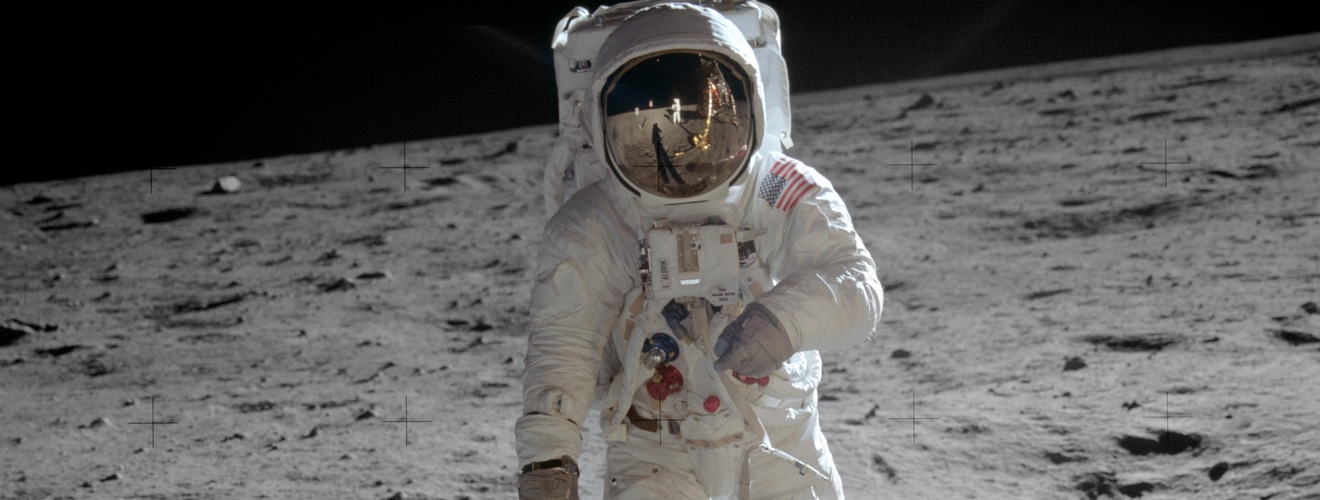
Everyone who has ever walked on another world did it while Richard Nixon was in the White House. The first bootprints went into the Sea of Tranquility in the summer of 1969; by the end of 1972 the last crew had climbed back up the ladder; and nobody has stood on another world since. What looked at the time like an opening act turned out to be the entire run.
For scale, consider the other direction. From the first descent in 1960 until 2019, exactly three people had reached Challenger Deep, the lowest point in any ocean on Earth. For decades, in other words, the Moon was the better-traveled destination. Every person who has reached the bottom of the Mariana Trench makes a longer list today, but that list did not pass this one until June 2020, and this one has the older membership and the better view.
The men themselves were a narrow sample: American military test pilots nearly to a man, with one geologist admitted at the very end. No dozen resumes ever diverged so thoroughly afterward. Here is each of them, in the order their boots first touched the surface, with the details the plaques leave out.
Twelve people have walked on the Moon, all of them American men, two per landing across the six Apollo landings: Apollo 11, 12, 14, 15, 16, and 17. The first steps came in July 1969, the last in December 1972, and no one has returned to the surface since.
Neil Alden Armstrong
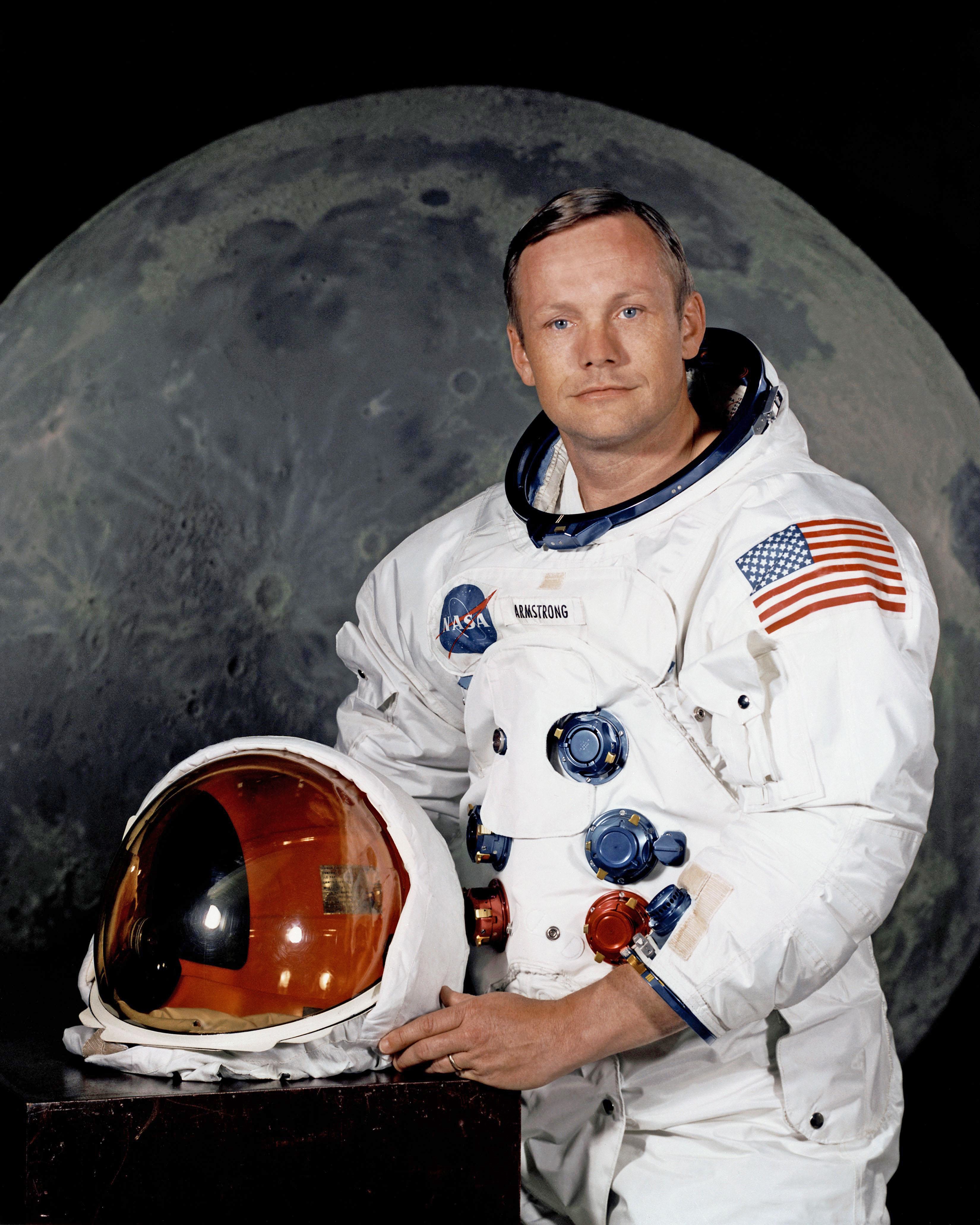
For eight years in the 1970s, the first man on the Moon taught aerospace engineering at the University of Cincinnati, where the department removed his name from his office door and the campus directory to throw off the autograph hunters. Gary Slater, a colleague there, taught beside him the whole time and admitted the two never once discussed Apollo. ‘I was not going to initiate that conversation,’ he said, ‘and he never mentioned that aspect of his career.’
That temperament was much of why NASA picked him. Flight director Chris Kraft put it flatly: Armstrong was the best choice because he had no ego. The record backed the judgment. As a test pilot he flew the X-15 rocket plane seven times, topping out at 3,989 miles per hour, and when a 1962 flight ballooned to 207,500 feet and drifted off course, ground control radioed ‘Hard left turn, Neil!’ and he glided the thing calmly back to a dry lakebed after 350 miles.
Armstrong stepped off at 10:56 p.m. EDT on July 20, 1969, and delivered a sentence the world memorized on the spot – missing, by his own lifelong insistence, one word: the transcript records ‘one small step for man,’ without the ‘a’ he swore he had spoken. He died on August 25, 2012, having described himself as a ‘white-socks, pocket-protector, nerdy engineer.’ He was not being modest. He was being precise.
Edwin Eugene “Buzz” Aldrin Jr.
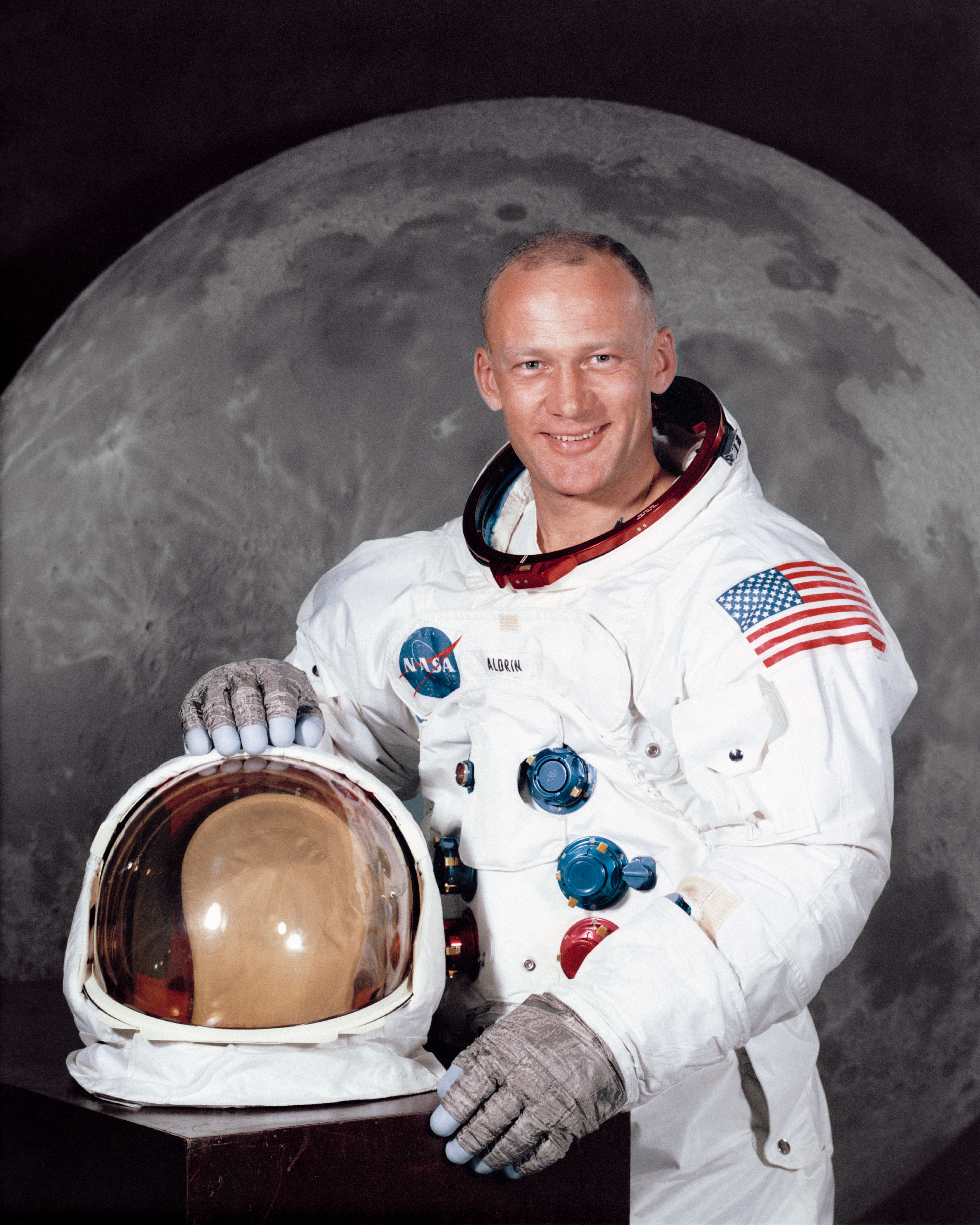
Buzz Aldrin’s mother’s maiden name was Moon. His own memoirs confirm it, as does her 1968 Associated Press obituary, and it is still not the most improbable line on his resume. In January 1963, MIT awarded him a doctorate for a 311-page thesis on orbital rendezvous – a problem NASA badly needed solved – and on Gemini 12 in November 1966 he put the theory to work in orbit, logging more than five hours outside across the flight.
At Tranquility Base he came down the ladder about 20 minutes behind Armstrong, pausing on Eagle’s footpad to pronounce the view ‘Magnificent desolation’ – a phrase he liked well enough to make it the title of his 2009 memoir. Before either man went outside, Aldrin privately took Communion inside the lunar module, with bread and wine supplied by his Presbyterian congregation in Texas; NASA, freshly sued over a Genesis reading broadcast by an earlier crew, had asked him to keep religion off the open channel. And since Armstrong held the camera for most of the moonwalk, nearly every clear photograph of a man standing on the Moon during Apollo 11 shows Aldrin.
In September 2002, a conspiracy theorist ambushed him outside a hotel and called him a liar to his face; Aldrin, then 72, punched him in the jaw, and the district attorney saw no reason to pursue it. He turned 96 in January 2026 – the oldest living astronaut, and still a poor man to ambush.
Charles “Pete” Conrad Jr.
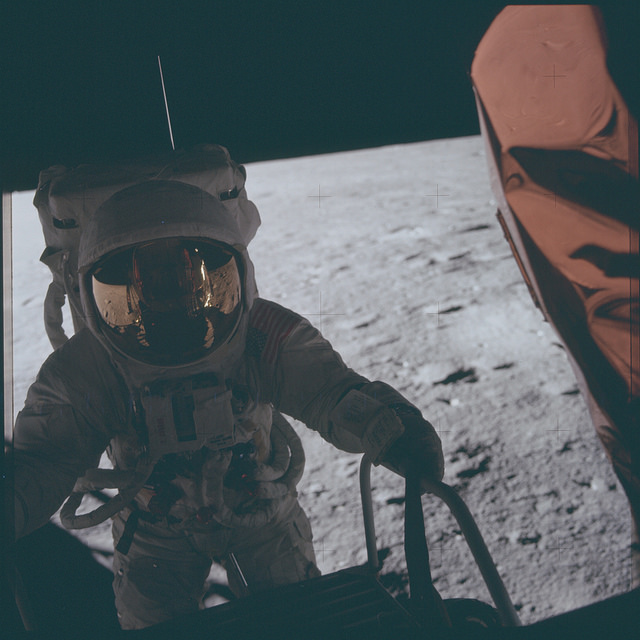
The third man on the Moon stepped off mid-wager. The Italian journalist Oriana Fallaci was convinced NASA scripted its astronauts’ first words, and Pete Conrad had bet her $500 that it did not, promising to deliver a line of his own invention. On November 19, 1969, he hopped off the ladder and made good: ‘Whoopee! Man, that may have been a small one for Neil, but that’s a long one for me.’ Conrad stood five feet six inches, several inches shorter than Neil Armstrong, which was the entire joke.
Behind the joke sat some of the program’s finest flying. Conrad set the lunar module Intrepid down a few hundred feet from Surveyor 3, the robot probe already waiting in the dust, close enough that he and Alan Bean strolled over and removed its camera for the trip home. Getting there had been livelier: their Saturn V was struck by lightning twice in the first minute of flight, and Conrad pressed on anyway.
He went on to command the first crew to live aboard Skylab, launched May 25, 1973, where he muscled a jammed solar panel loose during a spacewalk and saved the station outright. President Carter gave him the Congressional Space Medal of Honor in 1978, and across four flights he logged more than 1,200 hours in space. He died on July 8, 1999, after a motorcycle accident near Ojai, California. Nothing in the record shows Fallaci ever paid.
Alan LaVern Bean
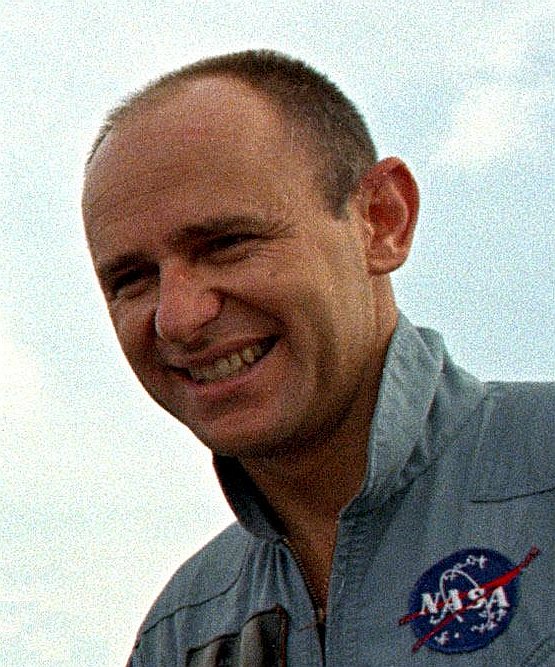
Almost no live television exists of anyone walking on the Ocean of Storms, and Alan Bean is the reason. Setting up Apollo 12’s color camera on November 19, 1969, he swung the lens across the Sun, burned out its imaging tube, and ended the broadcast on the spot. The fourth man on the Moon spent the rest of the mission working for an audience of nobody, which in hindsight suited him: he would spend the last half of his life trying to show people what it had looked like.
First came the conventional career – command of the second Skylab crew in 1973, a 59-day flight that more than doubled the standing endurance record. Then, in June 1981, after 18 years as an astronaut, Bean resigned from NASA to paint full time. He came to the easel with materials nobody else could supply. He clipped fibers from the mission patches he had worn on the lunar surface, still holding traces of dust, and worked them into his acrylics; he pressed his flown boots into the wet paint and struck it with a replica of the hammer he had used to drive the Apollo 12 flagpole. ‘A bit of magic,’ he called it.
Bean died on May 26, 2018, at 86, in Houston. His canvases remain rare things in art: landscapes carrying trace amounts of their own subject.
Alan Bartlett Shepard Jr.
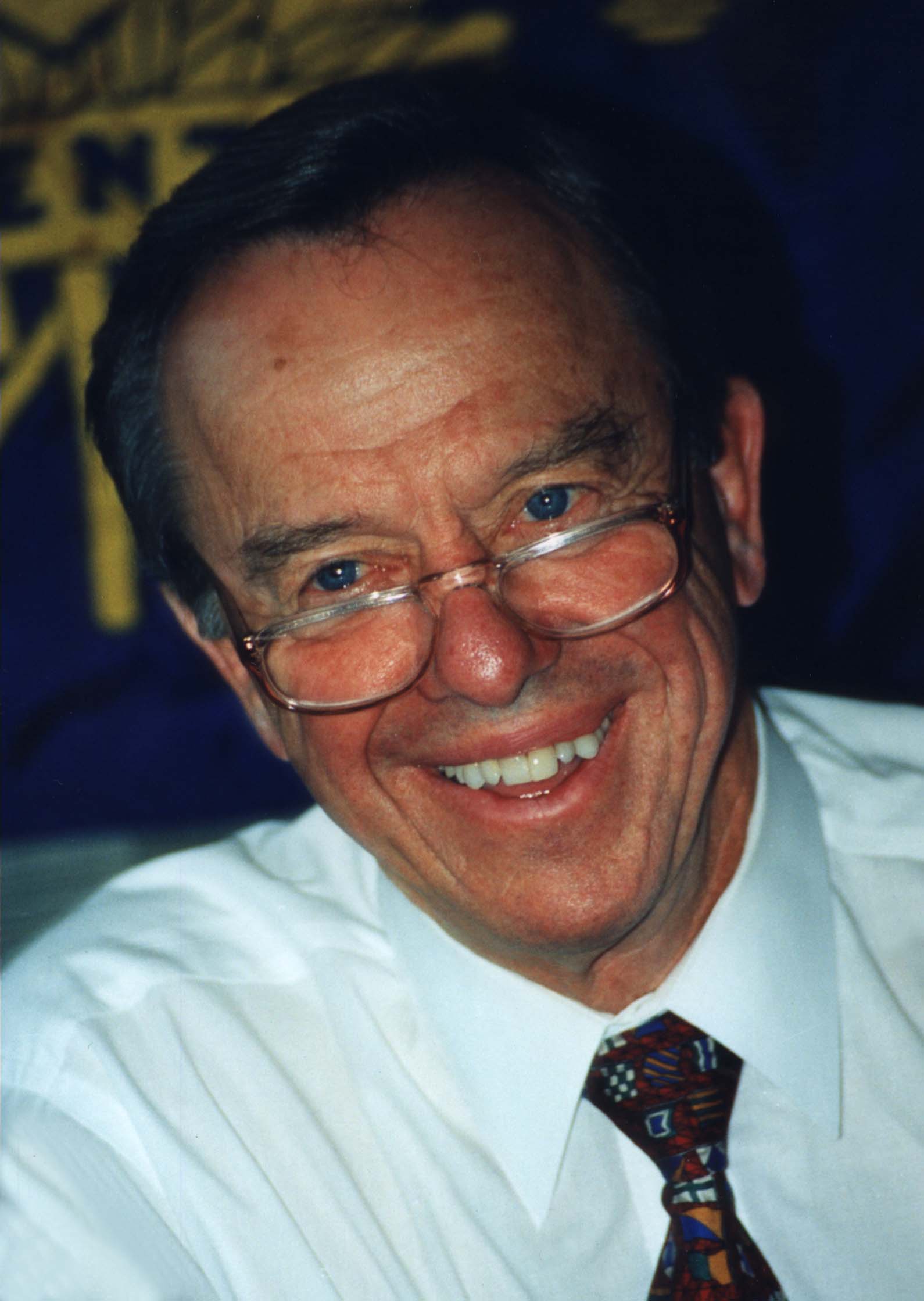
Nearly a decade separates Alan Shepard’s two entries in the record book, and he spent much of it medically forbidden to fly. The first American in space – a suborbital lob of 15 minutes and 22 seconds on May 5, 1961 – was diagnosed in October 1963 with Meniere’s disease, an inner-ear disorder that wrecked his balance. NASA grounded him, so he ran the Astronaut Office instead, assigning other men to missions he could not join.
The way back was surgical. In early 1968 a Los Angeles ear specialist, Dr. William House, implanted a small shunt to drain the fluid behind the vertigo, and on May 7, 1969, NASA restored Shepard to full flight status. Less than two years later he commanded Apollo 14, landing Antares in the Fra Mauro highlands on February 5, 1971, to become the fifth man on the Moon and, at 47, the oldest of them all.
The golf came on February 6, 1971, with a six-iron head fastened to a sample scoop, swung one-handed in a stiff pressure suit on live television. ‘Miles and miles and miles,’ he announced of his second shot. Shepard died in July 1998, the boast intact. In 2021 the USGA finally measured both drives against enhanced flight film and orbital imagery: about 24 yards, and about 40. Golfers have always estimated their distances generously. Shepard simply had the biggest course and the fewest witnesses.
Edgar Dean Mitchell
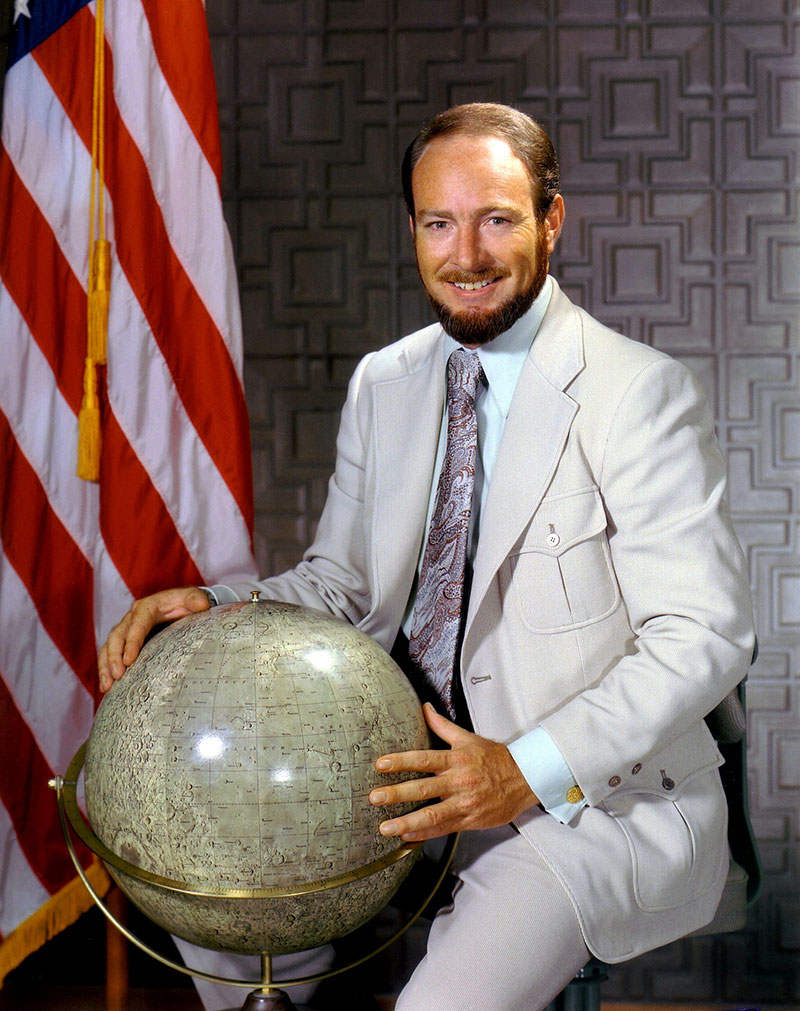
On the way to the Moon, Edgar Mitchell was quietly running telepathy experiments. Four times during Apollo 14 – twice outbound, twice coming home – he used scheduled rest periods to concentrate on tables of 25 random numbers he had mapped to Zener card symbols, transmitting them, he hoped, to volunteers back on Earth. He told no one aboard, Alan Shepard included, and the story surfaced only after splashdown. Mitchell published the results in the Journal of Parapsychology in 1971, unbothered by the general reaction.
The day job, meanwhile, went rather well. The sixth man on the lunar surface co-holds a record that still reads strangely: with Shepard he covered roughly 9,000 feet entirely on foot, dragging a two-wheeled equipment cart by hand, because Apollo 14 was the last landing before the rover arrived. The pair spent the trek hunting the rim of Cone Crater and never saw it. NASA’s own documentation puts them either 40 meters short or 50 to 75, depending on which NASA page you consult – a measure of how hard the featureless terrain made it to judge distance. Two years after coming home, Mitchell founded the Institute of Noetic Sciences to study consciousness full time, and he defended his convictions for the rest of his life. He died on February 4, 2016 – the eve of the 45th anniversary of his own landing.
David Randolph Scott
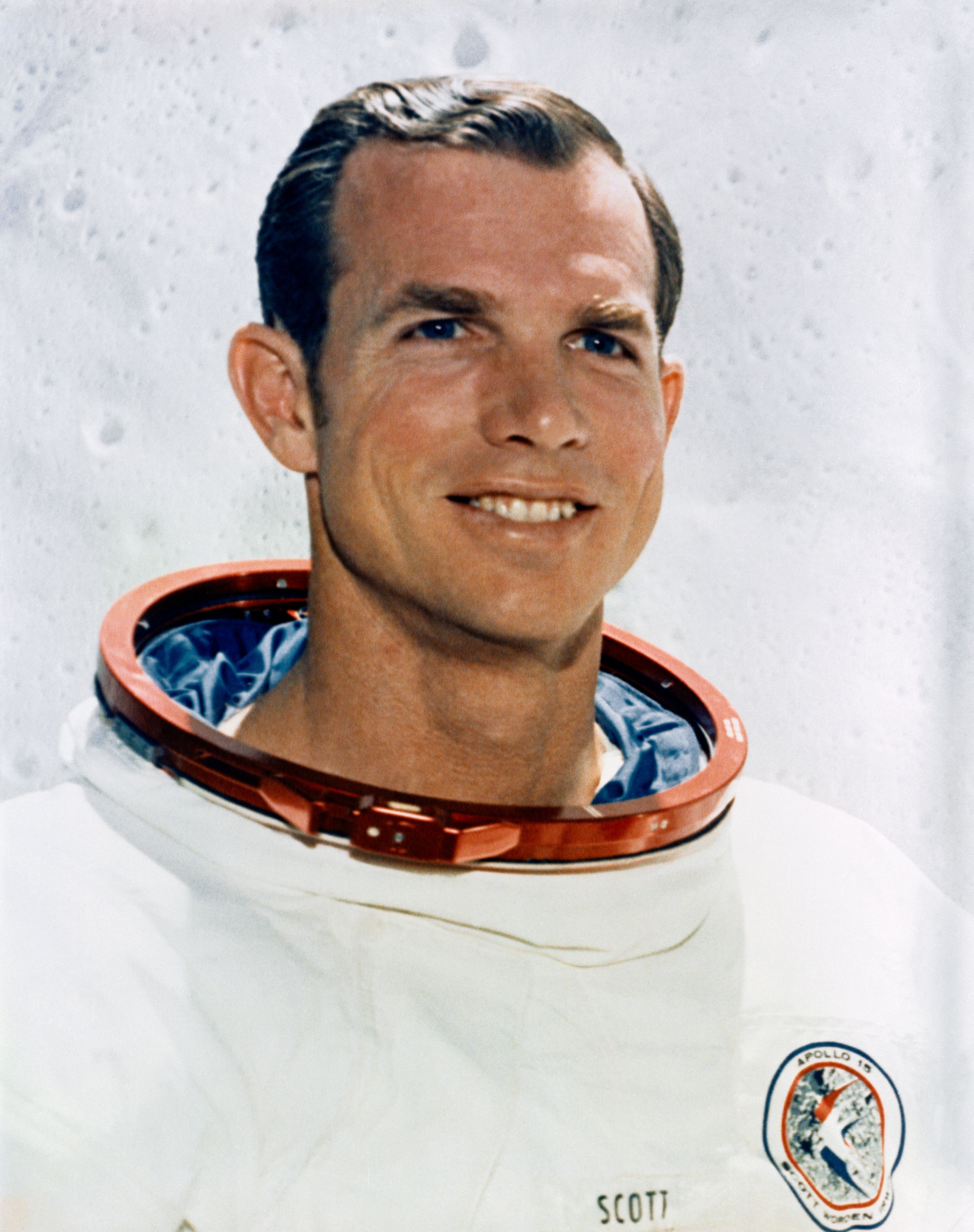
David Scott faced the television camera near the end of Apollo 15’s final moonwalk holding a geological hammer in one glove and a falcon feather in the other, and let go of both. They struck the dust together, exactly as Galileo had promised centuries earlier. ‘How about that,’ he told the audience. ‘Which proves that Mr. Galileo was correct in his findings.’
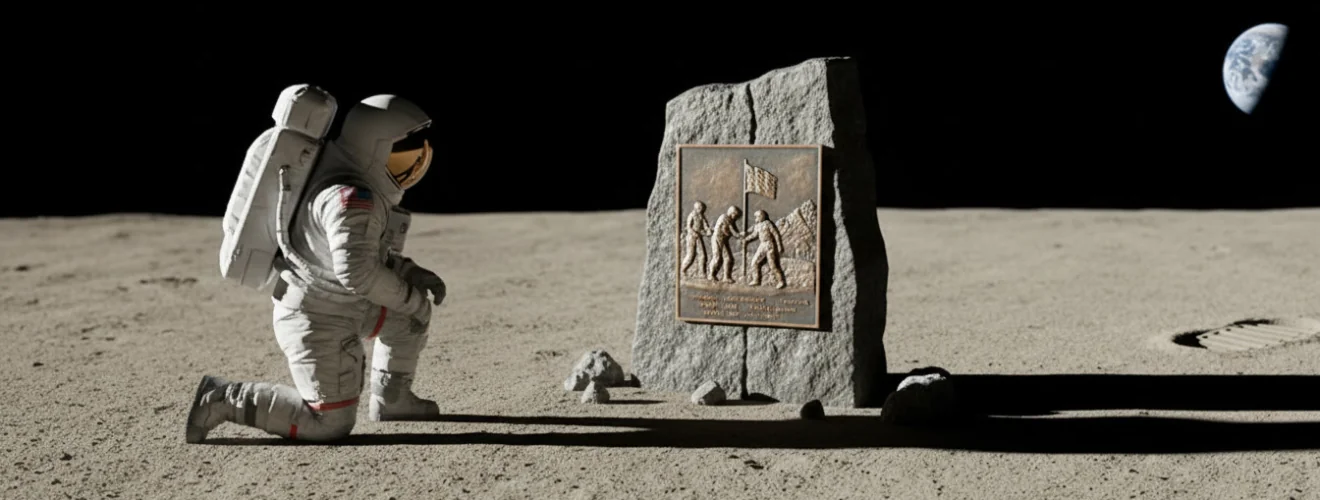
Scott commanded the mission that turned Apollo scientific – launched July 26, 1971, first to carry the rover – and opened it, two hours after touchdown, by photographing the site through the top hatch in the only stand-up EVA of the program. His quietest act mattered most. On August 2, 1971, without telling Houston, he set down a small aluminum figure and a plaque carrying 14 names – the American astronauts and Soviet cosmonauts who had died in the space race – and said nothing until the crew was safely home. The Fallen Astronaut is still there, its plaque carrying most of the names among every person memorialized on the Moon.
The same flight also carried about 400 unauthorized postal covers, sold through a West German stamp dealer at 7,000 dollars per astronaut. That story broke in June 1972; reprimands followed, and none of the crew ever flew again. The memorial, placed for nothing, has aged considerably better.
James Benson Irwin
Reporters called it the Genesis Rock: sample 15415, a fist of nearly pure anorthosite that Jim Irwin and David Scott collected at Spur Crater on August 1, 1971, initially dated to 4.1 billion years and celebrated as a surviving piece of the Moon’s original crust. Later reanalysis concluded it postdates that crust after all. The nickname stuck anyway, as nicknames do.
Irwin was the eighth man to walk on the Moon, and the Moon was harder on him than anyone told him at the time. Surface telemetry showed his heart slipping into bigeminy – an extra, abnormal beat shadowing every normal one – and flight surgeon Charles Berry conceded that if it were happening on Earth, ‘I’d have him in ICU.’ Mission Control decided the spacecraft’s pure-oxygen cabin and constant monitoring amounted to intensive care already, and the crew was told nothing. The cause was later traced to potassium depletion, and subsequent crews drank fortified orange beverages because of it.
Irwin resigned in July 1972 to found the High Flight Foundation, an evangelical ministry in Colorado Springs, and beginning in 1973 he led repeated expeditions up Mount Ararat in search of Noah’s Ark – one of which, in 1982, ended with a fall and a Turkish military helicopter evacuation. His heart failed for good on August 8, 1991, when he was 61. The Deseret News put it plainly: ‘He was the first to die of the 12 men who walked on the moon.’
John Watts Young
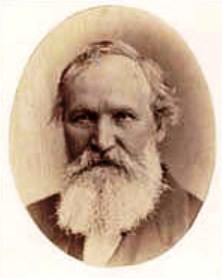
John Young smuggled a corned beef sandwich into orbit on March 23, 1965, in the pocket of his spacesuit, and handed it to a startled Gus Grissom mid-flight. The sandwich, from Wolfie’s, a delicatessen in Cocoa Beach, reached the House Committee on Appropriations, where one congressman priced it as a $30 million sandwich and NASA’s George Mueller promised Congress the agency had taken steps to prevent recurrence of corned-beef sandwiches in future flights. That sentence was entered, soberly, into the congressional record.
Young stayed 42 years at NASA and flew six times across three programs – Gemini, Apollo, and the shuttle. On Apollo 10 he orbited alone in the command module Charlie Brown while his crewmates rehearsed the landing below, radioing, ‘You will never know how big this thing gets when there ain’t nothing in here but one guy.’ Three years later came Apollo 16: he put the lunar module Orion down in the Descartes Highlands on April 20, 1972, stepped onto the Moon the next morning as the ninth of the twelve, and drove the rover 16.6 miles with Charlie Duke.
In April 1981 he commanded STS-1, the first Space Shuttle flight, launched 20 years to the day after Gagarin. He died on January 5, 2018, at 87 – the astronaut’s astronaut, in NASA’s own words. On the shuttle flight he commanded, corned beef was officially on the menu.
Charles Moss Duke Jr.
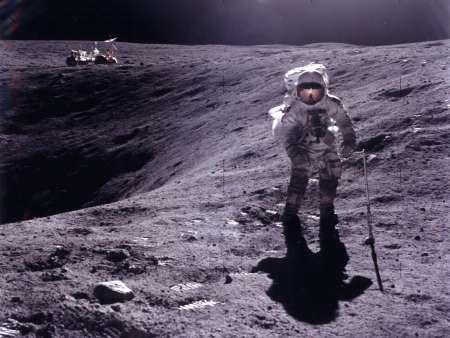
The voice that answered Tranquility Base belonged to Charlie Duke, and it briefly failed him. As CAPCOM for the Apollo 11 landing – requested personally by Armstrong and Aldrin – Duke radioed back, ‘Roger, Tranquility. We copy you on the ground. You got a bunch of guys about to turn blue. We’re breathing again. Thanks a lot,’ and he admitted later that his own reply ‘came out sort of like Twangquility’ instead of Tranquility.
His own path to the surface ran through a case of German measles. Three weeks before Apollo 13 launched, Duke – on the backup crew – caught rubella from a friend’s three-year-old son. Blood tests showed prime command module pilot Ken Mattingly had no immunity, and NASA pulled Mattingly one day before launch. The story ended generously: Mattingly, who never got sick, flew to the Moon two years later on Apollo 16, in the seat beside the man whose measles had grounded him. Duke himself went down to the surface as the tenth man on the Moon.
He left something there. Before the crew climbed out for the last time, Duke had packed a plastic-wrapped portrait of his family – himself, his wife Dotty, and their sons, then 7 and 5 – and he set it on the dust and photographed it lying there. Asked why, years later, he said it was ‘just to show the kids that I really did leave it on the moon.’
Eugene Andrew Cernan
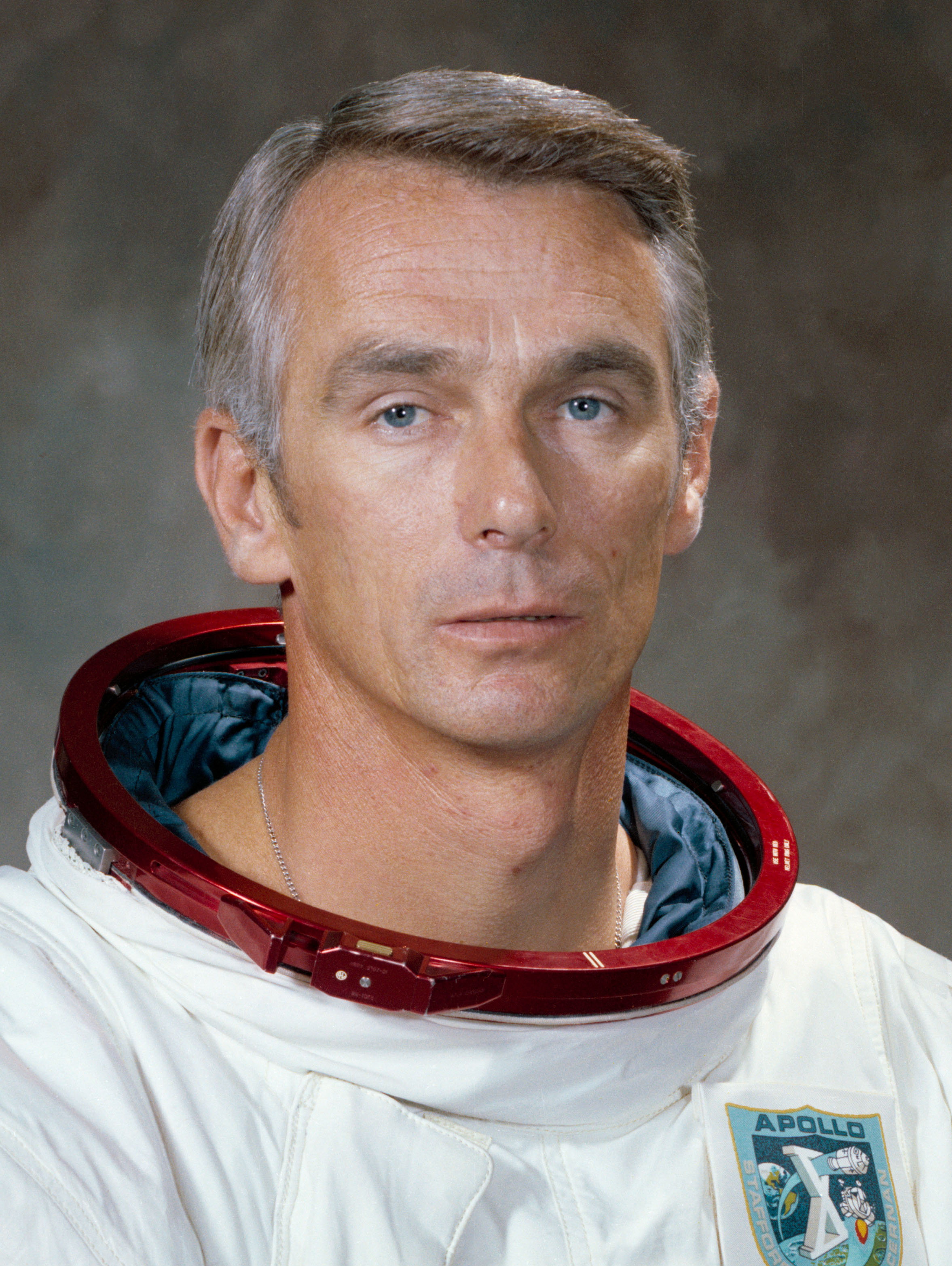
At 33 minutes past midnight on December 7, 1972, Apollo 17 turned night into day over Florida in the first night launch of American crewed spaceflight. Aboard were Gene Cernan, Ron Evans, Jack Schmitt, and the five pocket mice of the BIOCORE experiment, sealed in a locker of the command module America to test what cosmic rays do to living tissue – among the odder entries in every animal that has been sent to space. The mice orbited overhead while Cernan and Schmitt worked the valley of Taurus-Littrow below. Four of the five outlived the mission.
Cernan’s three excursions ran past 22 hours outside, and when they ended he was the last human on the Moon. His parting transmission has the cadence of a man who knew it: ‘we leave as we came and, God willing, as we shall return, with peace and hope for all mankind.’
One regret followed him home. At the boulder his photograph made famous, he had not thought to write his daughter Tracy’s name in the dust – ‘I wished I would have done something,’ he told Alan Bean afterward – and Bean, painter of lunar scenes, granted the wish the only way still available, on canvas, in 1984. The boulder has been called Tracy’s Rock ever since. Cernan died on January 16, 2017, at 82. The succession remains open.
Harrison Hagan “Jack” Schmitt
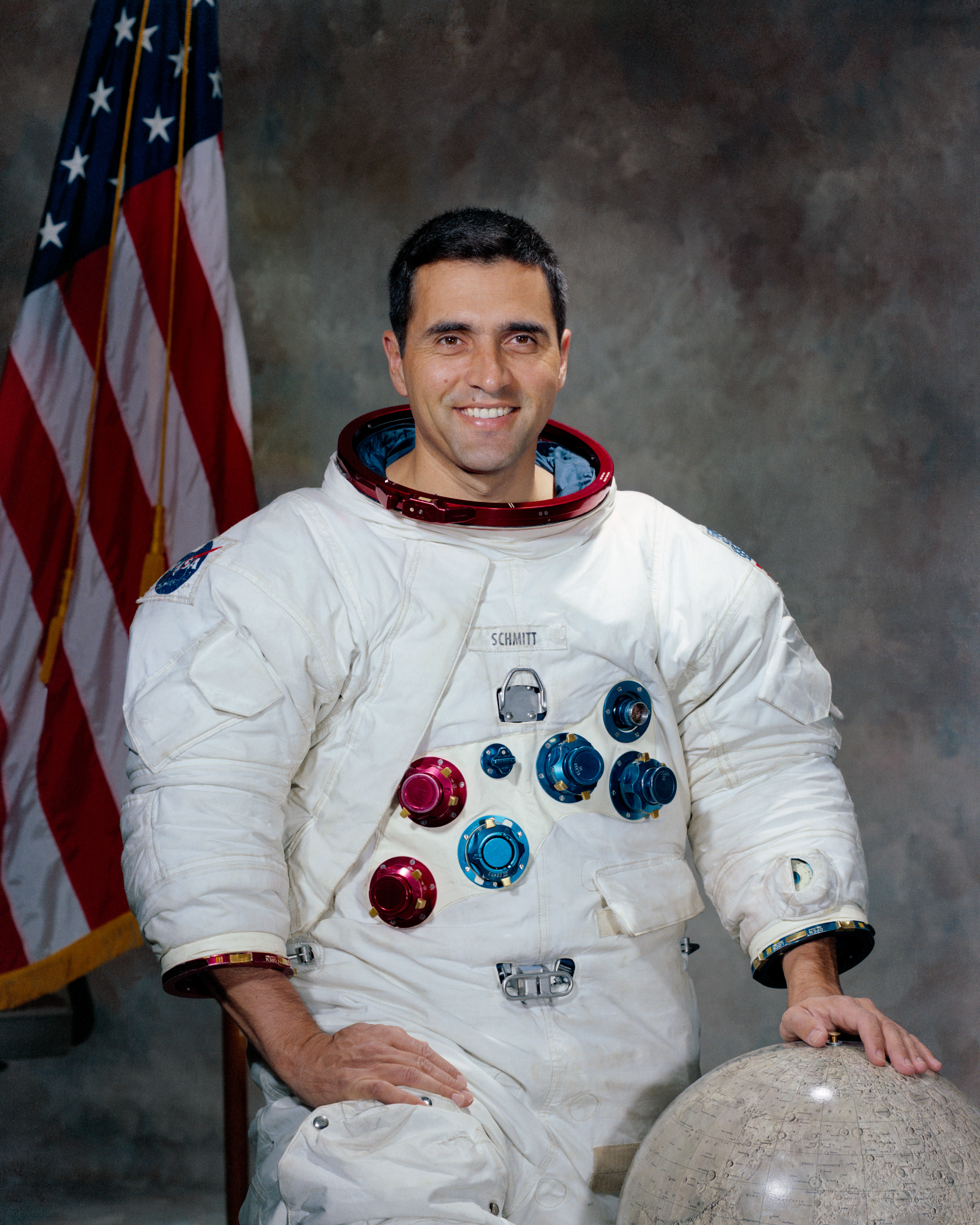
‘There is orange soil!’ Jack Schmitt shouted at the rim of Shorty Crater, and for once the exclamation was professional. Schmitt was the twelfth person to set foot on the Moon, and the only one who went up primarily to read the ground: a Caltech geology degree in 1957, a Harvard PhD in 1964, then the U.S. Geological Survey’s astrogeology branch in Flagstaff, before NASA took him in June 1965 in its first astronaut group open to scientists. The Smithsonian calls him ‘the only trained geologist to walk on the lunar surface.’
The orange soil rewarded him. Analysis published in Nature in 1973 showed it was tiny glass beads, 10 to 300 microns across, the spray of a volcanic fire fountain later dated to roughly 3.64 billion years ago – proof the Moon had once erupted like Hawaii. Schmitt paid for his samples in comfort: he reacted to the dust itself, reporting that the first time he smelled it ‘the inside of my nose became swollen,’ a complaint he called lunar hay fever. By the fourth exposure, he noted, the symptoms quit.
Home again, he swapped one strange institution for another, unseating incumbent Joseph Montoya in 1976 to serve as a U.S. Senator from New Mexico from 1977 to 1983. He later chaired NASA’s Advisory Council from 2005 to 2008, and he still consults on the Artemis return. The last man down the ladder is, decades on, telling NASA how to get back up it.
Frequently Asked Questions
Which of the men who walked on the Moon are still alive?
Buzz Aldrin (Apollo 11), David Scott (Apollo 15), Charles Duke (Apollo 16), and Harrison Schmitt (Apollo 17) were all living as of July 2026, each now in his nineties. Duke confirmed as much himself in a television interview that month, ticking off all four names.
Has anyone walked on the Moon since Apollo 17?
No. The closest anyone has come since is Artemis II, which flew Reid Wiseman, Victor Glover, Christina Koch, and Jeremy Hansen around the Moon in April 2026 without landing. NASA’s schedule, restructured in early 2026, now targets the next crewed landing for Artemis IV in early 2028.
How many Apollo astronauts flew to the Moon but never walked on it?
Twelve. NASA counts 24 American astronauts who made the trip from Earth to the Moon between 1968 and 1972, and exactly half never set foot on it – among them Apollo 10 commander Thomas Stafford, six command module pilots who kept lonely orbits, and the crew of Apollo 13, whose landing died with an oxygen tank.
Did anyone walk on the Moon twice?
Nobody walked twice. John Young and Eugene Cernan each made two lunar voyages, orbiting on Apollo 10 before landing on their second trips. James Lovell holds the reverse distinction: two voyages to the Moon, on Apollo 8 and Apollo 13, without ever setting foot on it – the only person to be dealt that hand.
Who was the youngest person to walk on the Moon?
Charles Duke, at 36 years and 201 days, when he stepped onto the surface on April 21, 1972. The record has stood ever since, and it cannot fall until a younger astronaut actually rides a lander down – which is not scheduled to happen for years yet.
- NASA – Moon Walkers
- NASA – The Apollo Program
- National Archives – Apollo 11 ‘The Eagle Has Landed’ transcript
- Apollo Lunar Surface Journal – Apollo 17 Station 6
- Smithsonian National Air and Space Museum – Buzz Aldrin’s Doctoral Thesis
- Lunar and Planetary Institute – Apollo 15 Samples
- USGA – The Story Behind Alan Shepard’s Lunar Golf Shots
- Britannica – Eugene Cernan