Every Hall of Fame Player Michael Jordan Played With
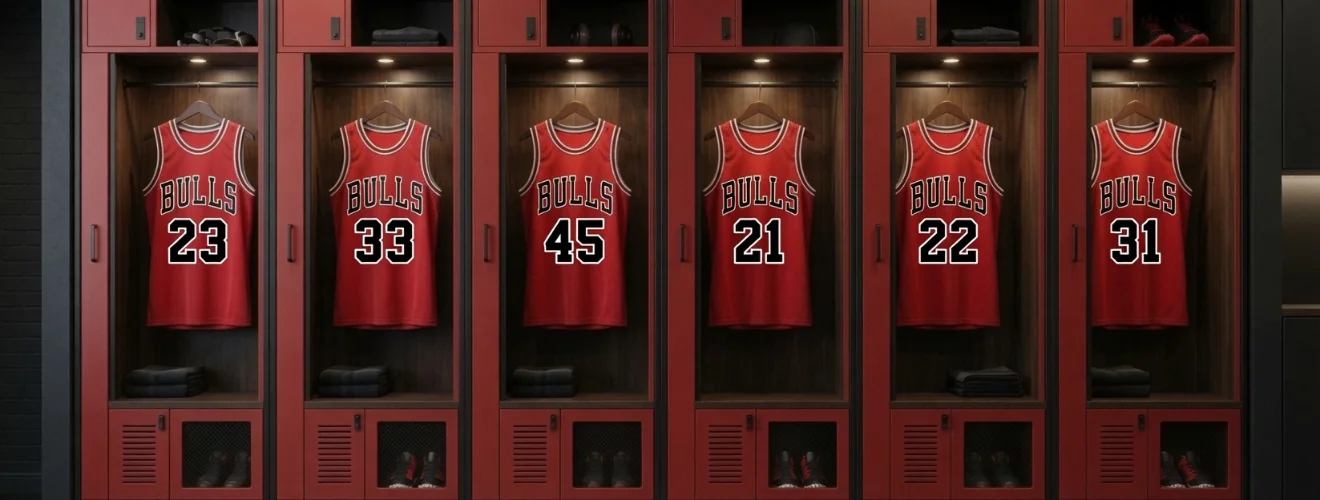
The standard answer is four. Ask a knowledgeable basketball fan to name Michael Jordan’s Hall of Fame teammates and you will hear Scottie Pippen, Dennis Rodman, Toni Kukoč, and Robert Parish. That is the dynasty core, plus the ancient center who turned up for one last ring. Some people stop at three. The honest list runs longer, and the two missing names are the interesting part.
Long before the championships, Jordan spent his early Bulls years on mediocre teams, and two aging Hall of Famers passed through Chicago while he was there. George Gervin, who had won four scoring titles, arrived in 1985 for his final NBA season. It was the same winter a broken foot wiped out most of Jordan’s schedule. Artis Gilmore, the most efficient shooter the league had yet produced, played 24 games in a Bulls uniform in 1987-88 before being waived. Neither contributed to anything that hung a banner, which is exactly why the popular lists drop them. But the question is not who helped Jordan win. It is who shared the floor with him, and by that measure both men count.
There is one more complication, and his name is Christian Laettner. He played beside Jordan for two seasons in Washington, and he is in the Hall of Fame. But he is in it only as one-twelfth of the 1992 Dream Team, enshrined as a group, never inducted as a player in his own right. That is a real distinction, and the reason he appears here once and then bows out. What follows is every Hall of Fame teammate Jordan actually shared an NBA court with, in the order they arrived, from a finger-rolling veteran in the autumn of 1985 to a 43-year-old collecting a fourth ring in 1997.
Michael Jordan played alongside six Hall of Fame teammates in his NBA career: George Gervin, Scottie Pippen, Artis Gilmore, Toni Kukoč, Dennis Rodman, and Robert Parish. Each was enshrined in the Naismith Memorial Basketball Hall of Fame for his own playing career, with inductions stretching from 1996 to 2021.
George Gervin
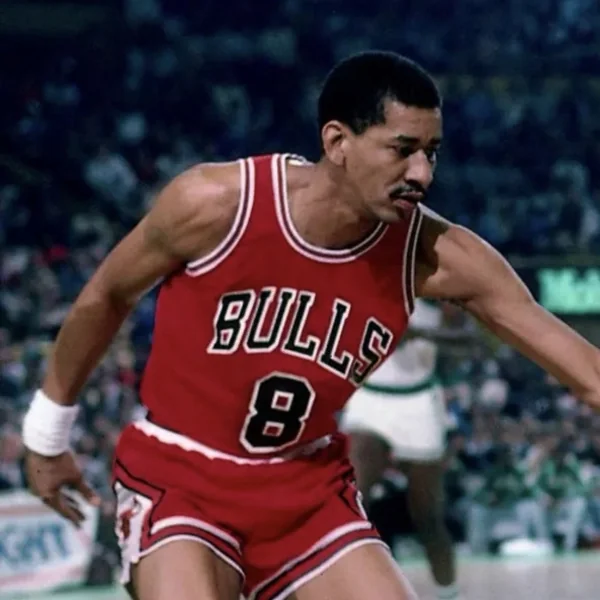
On the final day of the 1977-78 season, George Gervin scored 63 points to win a scoring title by seven-hundredths of a point. David Thompson had gone first that afternoon and dropped 73 to seize the lead; Gervin, told he needed 58 to take it back, went out and got more, finishing the year at 27.22 points a game to Thompson’s 27.15. It is still the closest scoring race in NBA history. Gervin was the Iceman, a four-time scoring champion who made the finger-roll famous and never once looked like he was trying.
None of that is why he belongs here. In October 1985 the Bulls sent David Greenwood to San Antonio for Gervin, who showed up in Chicago at 33 for what everyone understood was his last lap. He chose a peculiar season for it. Jordan broke a bone in his left foot in the third game and missed the next 64, not returning until March 14, 1986. For most of that winter the most dependable scorer on the Chicago Bulls was a finger-rolling veteran a decade past his peak.
When Jordan came back in March, the two shared a floor for a few weeks and a quick, doomed playoff sweep by Boston, and then the Iceman retired. He went into the Hall of Fame in 1996. He had been a Bull for precisely one year.
Scottie Pippen
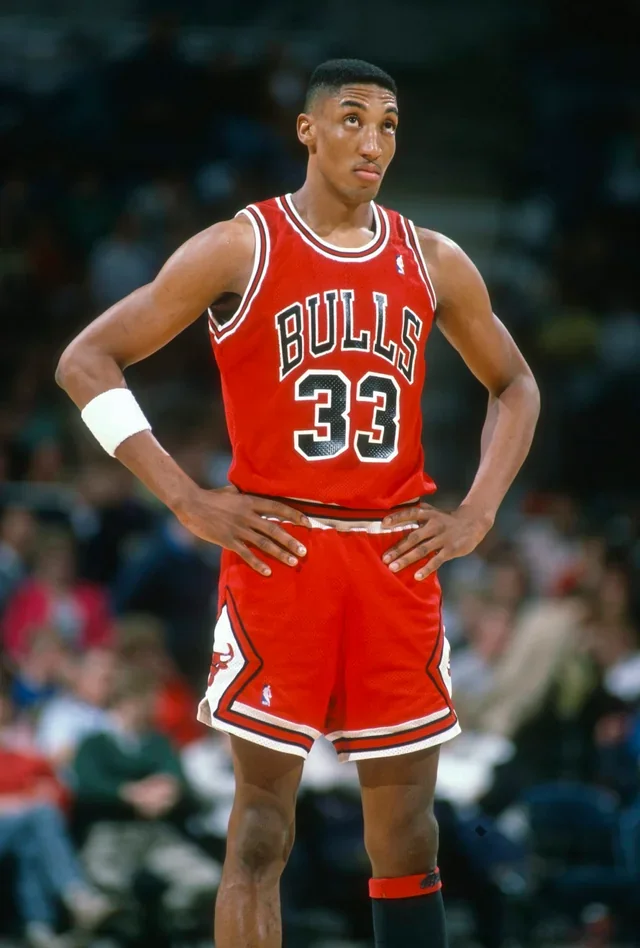
Scottie Pippen arrived at the University of Central Arkansas as the basketball team’s equipment manager. He was a 6-foot-1 guard out of Hamburg, Arkansas, with no scholarship offers, and the coach kept him around as a favor, handing out uniforms and towels with a loose understanding that he could try out if he got better. Then he grew. By the time he left he stood 6-foot-8, an entirely different athlete, and the most tantalizing prospect almost nobody had bothered to scout, because Central Arkansas played in the NAIA and the scouts were all looking somewhere else.
Seattle took him fifth overall in 1987, with the commissioner reading his name as Scott Pippen, and traded him to Chicago the same night, accepting the eighth pick, Olden Polynice, and a pair of future picks in return. It was one of the most lopsided swaps in league history. Pippen became the player who held the rest of it together, guarding the other team’s best scorer and running the offense whenever Jordan rested.
Six championships, and he never lost in the NBA Finals. He made the All-Defensive First Team eight times and, while still in his prime, was named one of the league’s fifty greatest players. The Hall of Fame inducted him in 2010. Seattle, for its trouble, got Olden Polynice.
Artis Gilmore
No one in NBA history had shot the ball more accurately over a full career than Artis Gilmore when he retired in 1988. He walked away having made 59.9 percent of his field goals, a 7-foot-2 left-hander who scored on dunks and soft hook shots and almost never forced a thing. At one stretch he played 670 consecutive games without missing one. They called him the A-Train, and for the better part of a decade he was simply immovable.
Chicago knew him intimately. The Bulls had taken him first overall in the 1976 ABA dispersal draft, ahead of Moses Malone, when his Kentucky Colonels folded, and he gave them six productive years before a trade to San Antonio. He came back to Chicago for a final stint in 1987, and that is what plants him on this list. For 24 games of the 1987-88 season the aging A-Train shared a locker room with Michael Jordan and a rookie named Scottie Pippen.
Then the Bulls waived him. He signed with Boston for the rest of that season, where his last job in the NBA was backing up a center named Robert Parish. Gilmore did not reach the Hall of Fame until 2011, twenty-three years after his final game, by which point the honor had begun to look less like recognition than a belated apology.
Toni Kukoč
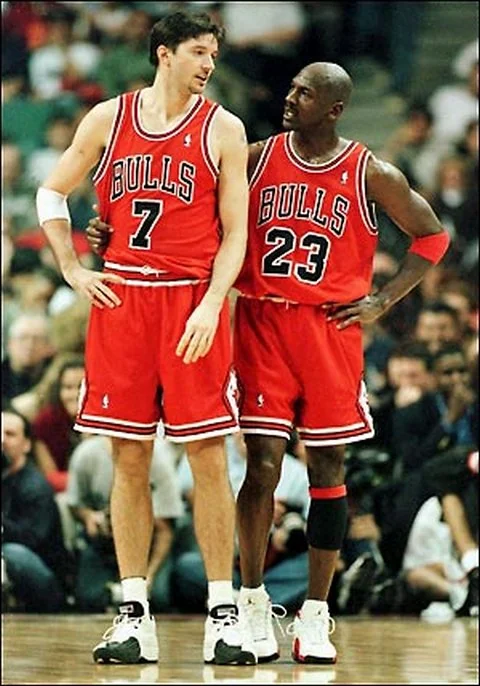
Toni Kukoč had been a Chicago Bull for a year and a half before he ever shared an NBA floor with Michael Jordan. He signed in 1993, the same autumn Jordan walked away to play minor-league baseball, so the Croatian spent his first season and a half as the focal point of a Jordan-less team and did not line up beside the man until Jordan returned in March 1995.
He had been a sore subject long before that. Jerry Krause drafted Kukoč in the second round in 1990, then courted him across Europe so rapturously that Jordan and Pippen took it as a personal insult. Krause had been skimping on Pippen’s contract partly to clear room for the Croatian. When the Dream Team drew Croatia at the 1992 Olympics, the pair took turns guarding Kukoč into the hardwood, holding him to 4 points on 2-of-11 shooting. They were not really playing against Toni Kukoč, Jordan explained afterward. They were playing against Jerry Krause in a Croatian uniform. In the gold-medal rematch a week later, Kukoč scored 16 and looked every bit ready for the NBA.
He won them over the hard way. Kukoč won Sixth Man of the Year in 1996 and three championships off the bench. In 2021 he was inducted into the Hall of Fame. His presenter, without any visible irony, was Michael Jordan.
Dennis Rodman
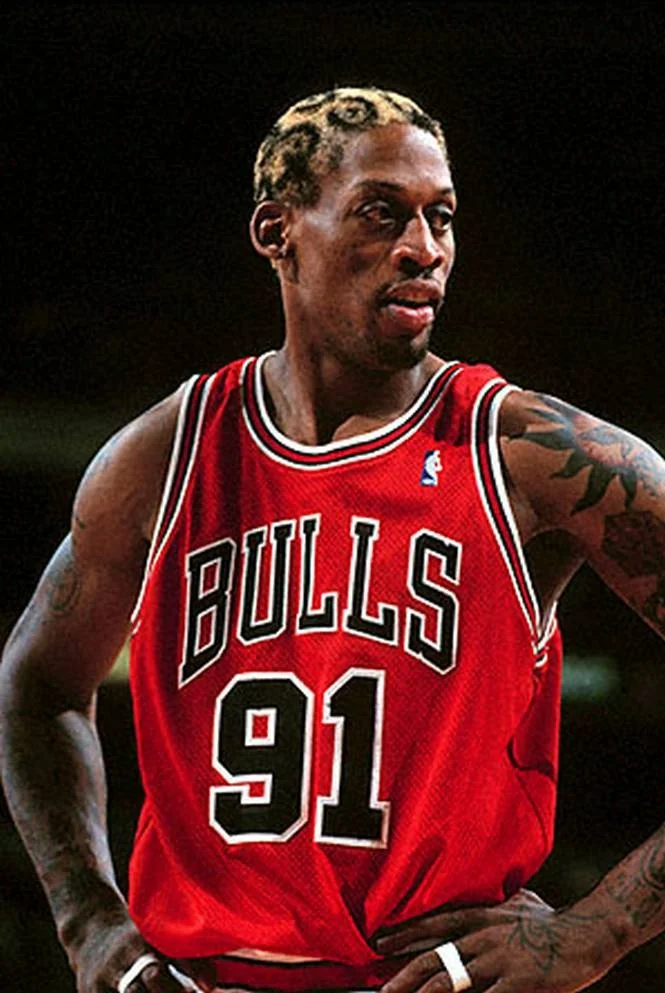
Before Dennis Rodman ever played a game for the Bulls, he had won two championships against them. He was the unhinged heart of the Detroit Pistons, the Bad Boys who shoved Jordan’s teams out of the playoffs three years running and won the titles in 1989 and 1990. He stood 6-foot-7, undersized for the work he did, and he rebounded like a man taking instructions directly from the ball.
Rodman later took the rebounding circus to Los Angeles for a brief 1999 stint alongside Kobe Bryant.
In October 1995 the Bulls traded their backup center, Will Perdue, straight up for him. There were no draft picks and no cash attached, just a reserve big man swapped for one of the league’s most disruptive forces. It was a heist. Rodman led the NBA in rebounding for seven straight seasons and anchored the 72-10 team of 1996, then added three titles in Chicago to the two he had won in Detroit.
He also kicked a courtside cameraman in the groin in January 1997, which cost him an eleven-game suspension and, eventually, a $200,000 settlement. He had earlier promoted his autobiography in a wedding dress, and he moonlighted, briefly and unsuccessfully, as a professional wrestler. The Bulls absorbed all of it, because somewhere between the dyed hair and the ejections was a player who would win five championships and, in 2011, be welcomed into the Hall of Fame, and who altered almost none of his behavior to do either.
Robert Parish
At 43, Robert Parish won his fourth championship ring. He had spent the previous two decades as the Chief, the quiet anchor of the Boston Celtics frontline that won three titles in the 1980s alongside Larry Bird and Kevin McHale. Freshly released by Charlotte, he signed with Chicago on September 25, 1996 to chase a fourth. He played 43 games for the 1996-97 Bulls, three of them as a starter, as the third-string center behind Luc Longley and Bill Wennington. The ring came anyway. He retired that summer and was enshrined in the Hall of Fame in 2003.
He was, even then, the most durable man the sport had produced. Parish played 21 seasons and 1,611 regular-season games, more than anyone in NBA history at the time, and he was still pulling down rebounds at an age when most of his peers had moved into broadcasting. The record stood for nearly thirty years.
It fell only this past March, when LeBron James finally passed it. Parish, told the mark was about to go, offered the kind of grace that does not always survive a long career. No player, he said, was more deserving of breaking it. He had carried that record since the spring of 1997 and gave it up without a flicker of complaint.
Frequently Asked Questions
Is Christian Laettner in the Basketball Hall of Fame?
Yes, though not the way the question usually means it. The Hall took in the entire 1992 United States Olympic team in 2010, and Laettner, the roster’s only collegian, went in with it. No committee has ever elected him for his NBA career. The College Basketball Hall of Fame admitted him separately in 2010, for Duke.
How did Scottie Pippen end up on the Chicago Bulls?
Through a draft-night trade. Seattle drafted him fifth in 1987, then shipped him to Chicago that same evening for Olden Polynice, the eighth pick, plus two future selections. The commissioner announced him as Scott Pippen, a fitting error for a prospect the scouts had overlooked at NAIA-level Central Arkansas.
What did the Bulls trade for Dennis Rodman?
Will Perdue, and nothing else. In October 1995 Chicago swapped its backup center straight across for a forward midway through seven consecutive league rebounding titles. Rodman repaid the gamble with three championship seasons, the 72-10 year of 1996, and one eleven-game suspension for kicking a cameraman.
Who broke Robert Parish’s record for most NBA games played?
LeBron James, in March 2026, when starting a Lakers game in Orlando made his 1,612th regular-season appearance. Parish’s 1,611, spread over 21 seasons, had led the all-time list for nearly three decades. James was 41 and in his 23rd season, and he broke the mark simply by showing up.
Did Michael Jordan and George Gervin actually play together?
Briefly, yes. Chicago acquired Gervin from San Antonio for David Greenwood in October 1985, then lost Jordan to a broken foot three games into the season. The pair overlapped only after Jordan returned in March 1986, sharing the floor for the closing weeks and a playoff sweep at Boston’s hands.
Who presented Toni Kukoč at his Hall of Fame induction?
Michael Jordan, co-presenting with Bulls chairman Jerry Reinsdorf, in 2021. The choice carried some history: at the 1992 Barcelona Olympics, Jordan and Scottie Pippen had made a project of shutting Kukoč down in the group stage, a grudge aimed at the Bulls executive courting him. Twenty-nine years later Jordan stood at the podium for him.
When did Artis Gilmore make the Hall of Fame?
Not until 2011, a full twenty-three years after his last NBA game. The numbers had been sitting there the whole time: the highest career field-goal percentage the league had recorded at his retirement, 59.9, and a streak of 670 consecutive games played. The voters took their time anyway.
- NBA.com – Legends profile: Artis Gilmore
- NBA.com – Top Moments: George Gervin and David Thompson battle for the 1978 scoring title
- Basketball-Reference – Artis Gilmore career stats and Hall of Fame profile
- Chicago Bulls official team history – Dennis Rodman
- CNBC – Scottie Pippen started out as a college equipment manager