Every Secret Character Unlock Method in Super Smash Bros History
In 1999, the official Super Smash Bros. website ran a technique column – 77 numbered entries, written by Masahiro Sakurai himself – and technique 20 addressed the players who kept losing to the game’s hidden challengers. Lose the fight, it explained, and the challenger comes back two CP levels weaker, and keeps weakening with every defeat after that. Then comes the advice, in translation: “So the best thing is not to give up.” The pages are still live on Nintendo’s servers, patiently explaining a Nintendo 64 game to nobody.
That column survives because the contest over who gets into Smash has always been the series’ underlying drama. The first game shipped with 12 playable fighters; Ultimate’s base roster runs to 74; and strewn along the road between them are the 29 characters Sakurai publicly considered and rejected, who never needed an unlock condition because they never got in. The ones who did make it were rationed out instead, hidden behind clears and countdowns and, in one case, a stopwatch reading.
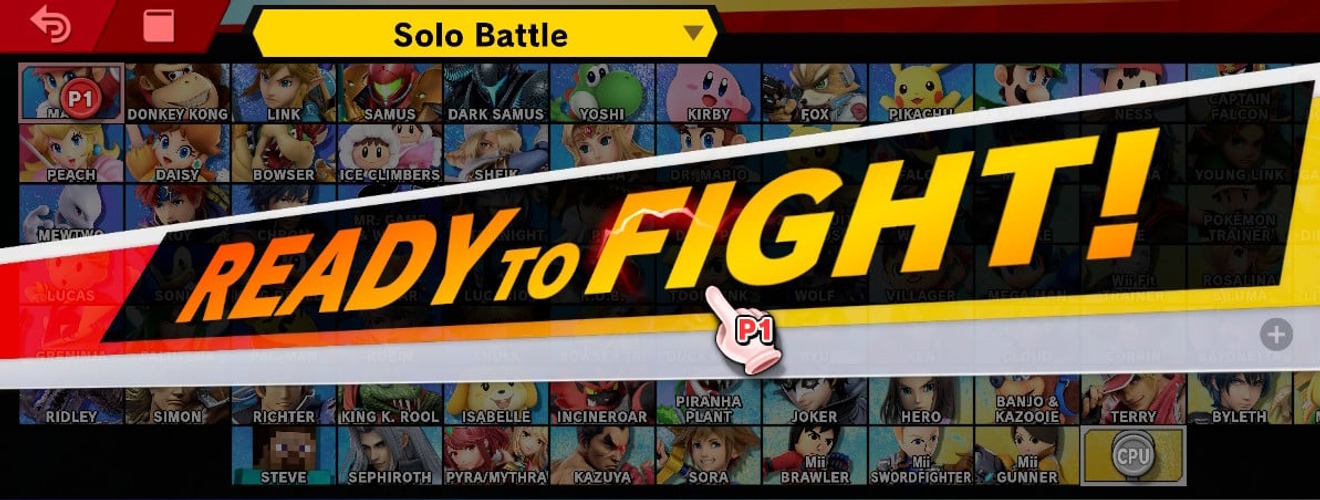
What changed, game by game, was the machinery. The original gave each hidden fighter a single road in; Melee added a second, Brawl a third, and Ultimate settled on three shared by everyone. Even the select screen kept score differently as the years went on – the 1999 game showed empty placeholder boxes so you could count what was missing, Melee kept placeholders for only some, and from Brawl onward there was nothing to count at all. What follows is every unlock method in series history, game by game, ending with the entry that locked away nearly its whole cast and advertised that as the main attraction.
The Super Smash Bros. series has set 104 secret-character unlocks across its five games: 4 in the 1999 original, 11 in Melee, 14 in Brawl, 12 across the combined 3DS and Wii U release, and 63 in Ultimate. The count covers each fighter once per game and excludes Mii Fighters and paid DLC.
Super Smash Bros. 64
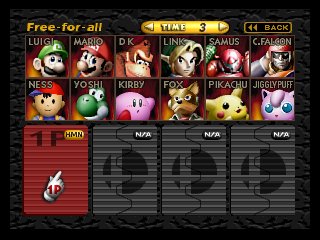
There are four hidden fighters in the original Super Smash Bros., and each can be reached in exactly one way. No match counter would ever summon them; it was the condition or nothing. The game arrived in Japan on 21 January 1999 at 5,800 yen before tax, and reached North America that April.
The four conditions form a neat ladder of ambition. Jigglypuff asks only that you finish the 1P Game once, with anyone. Captain Falcon wants the same run done in 20 minutes or less. Ness demands it on Normal or higher, with three lives or fewer and no continues. Luigi hides behind the bonus stages instead: Break the Targets, cleared with all eight starting fighters. Each challenger then waits on a fixed home stage – Luigi at Peach’s Castle, Captain Falcon on Planet Zebes, Ness in Dream Land, Jigglypuff in Saffron City – and the fight must be won, not merely reached.
Nintendo’s own technique column quietly gave the arithmetic away, noting that clearing the Bonus Stages with all 12 characters produces a combined total time. Twelve characters, eight of them starters; the other four were left for players to find, on a cartridge that never received a patch and never needed one.
Super Smash Bros. Melee
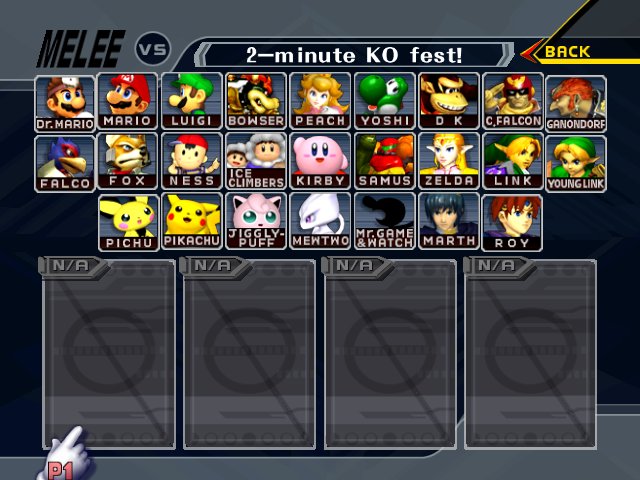
Melee invented the unlock ladder. On top of each hidden fighter’s own condition, the game kept a running count of completed VS matches and paid out challengers at fixed milestones, in a fixed order – Jigglypuff at 50, Dr. Mario at 100, up to Mr. Game & Watch at 1,000.
The conditions run from sensible to deranged. Marth sounds like a marathon – use all 14 starters – until you learn a single VS match with each is enough. Dr. Mario and Roy are guarded by the characters they copy, each demanding a no-continue run as Mario and as Marth respectively. Luigi answers to a stopwatch: clear Adventure Mode’s first stage with the clock’s seconds digit reading 2, defeat the Luigi who appears and Peach inside one minute, then finish the mode. Mewtwo simply wants your time – more than 20 hours of VS play, counted in player-hours, so two people playing for an hour bank two. He is the one Melee secret with no single-player route at all; the alternative is 700 or more matches.
Challenger fights normally start easy and stiffen with each unlock; SmashWiki records Melee’s ramp as reversed, so the resistance softens as you dig deeper. The game shipped on 21 November 2001 in Japan with 14 starters and 11 fighters in hiding. The last of those is always Mr. Game & Watch, whose condition demands a clear with all 24 other characters – nobody can reach him first.
Super Smash Bros. Brawl
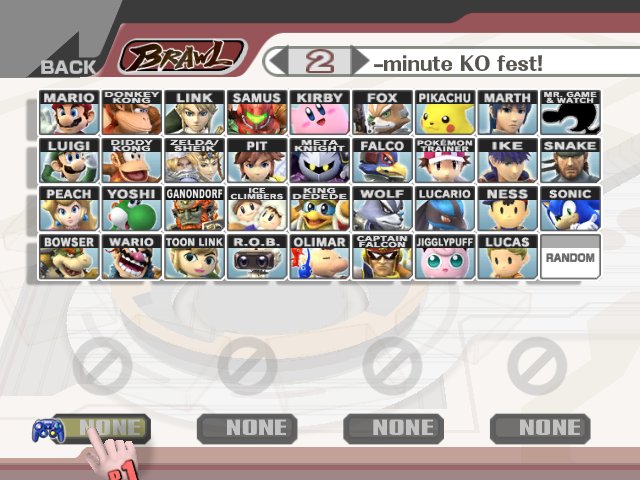
Only in Brawl can a fighter be unlocked without a fight of any kind. It runs through the Subspace Emissary, the story mode Sakurai’s DOJO!! blog introduced in August 2007, months before the January 2008 Japanese release. Fighters recruited there simply join, playable everywhere – no Challenger Approaching duel.
There are asterisks. Toon Link, Wolf and Jigglypuff sit behind secret doors that open only on replayed stages after the story ends, and each door leads to a one-stock battle you must win. The traditional machinery runs alongside: a VS ladder from 5 matches up to 450 that pays out in reverse, so later fighters must be freed before earlier ones will knock, plus per-fighter conditions, the strangest belonging to Solid Snake, who wants 15 matches played to completion on Shadow Moses Island, the stage from his own series. Snake and Sonic were the first outsiders in the cast, both locked at launch, and the line of 18 third-party characters ever added to Smash starts with them.
Brawl also debuted Assist Trophies – announced on the DOJO!! in July 2007 as Sakurai’s home for characters who could not quite make it as playable fighters. Six of its 27 were unlockable, Gray Fox arriving alongside Snake and Shadow alongside Sonic, a class that later swelled into every Assist Trophy in Super Smash Bros Ultimate. Sonic himself: more than 10 hours of cumulative VS play, on the same player-hours clock that ran Mewtwo’s twenty. The footnote survived the console change intact.
Super Smash Bros. for 3DS/Wii U
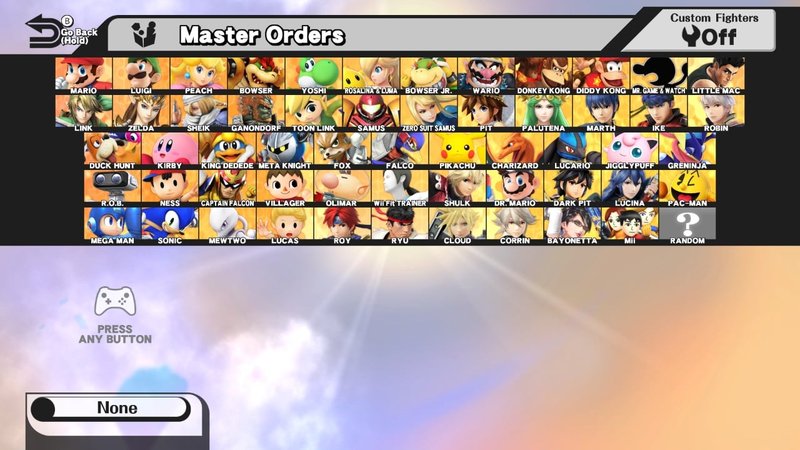
The secrets got out before the game did. On 19 August 2014, photographs of a content-evaluation build, Player 1 named ESRB0083, exposed the roster of Super Smash Bros. for Nintendo 3DS weeks ahead of its 13 September Japanese release: Bowser Jr., the Duck Hunt dog, Dark Pit and Shulk, plus returning veterans nobody had announced. Gameplay videos followed within days, and Nintendo of America pulled them for copyright; Shulk’s formal reveal came on 29 August. It remains the centrepiece of the 22 fighter reveals that leaked before Nintendo’s announcement.
The twin versions do not even share a secret roster. The handheld hides 12 fighters, the console 8, and the console’s set is a strict subset of the handheld’s – four of the 3DS’s secrets are simply starters on the Wii U. Of the eight hidden on both, seven answer to different conditions depending on the machine; the exception is Wario, who wants 100-Man Smash on either and saw no reason to elaborate. The 3DS summons a challenger every 10 matches, Ness at 10 to Jigglypuff at 120; the Wii U runs Falco at 10 to Duck Hunt at 100.
Nintendo kept up the discretion the leak had ruined. The official site published 45 character pages and skipped 11 fighters, all unlockable on the 3DS; Lucina was the only handheld secret with a page. Those promotions left the Wii U version the only game in the series where all twelve 1999 fighters are available the moment you switch it on.
Super Smash Bros. Ultimate
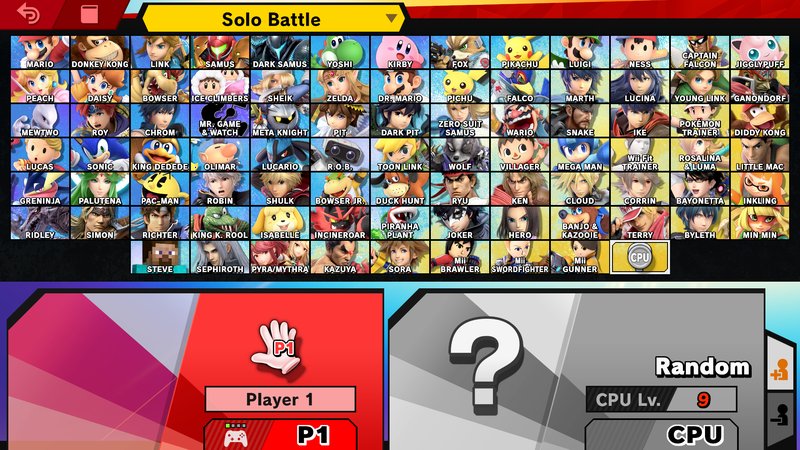
Ultimate opens with eight fighters – the same eight the series started with in 1999 – and it is the only Smash game ever to reuse a previous game’s starting roster. Everything else is locked: 63 fighters, setting aside the three Mii types, of a 74-strong base roster. The per-fighter riddles are gone; all 63 share the same three roads out.
A challenger can be triggered by finishing a VS match, a Mob Smash, a Home-Run Contest round, a Spirit Board fight or an exit from World of Light, though CPU-only matches never count. World of Light frees fighters one battle at a time, with one exception: Bowser, released only by beating Giga Bowser in the Molten Fortress. The Classic Mode route runs down eight unlock trees, one per starter, and by the Japanese wiki’s accounting Sonic alone appears on two of them.
The game arrived on 7 December 2018; after it, the whole idea of the secret character ended – not with a condition but with a price tag. The fighters added between January 2019 and October 2021 came as DLC, not as challengers; they have no unlock tree, and clearing Classic Mode with one restarts at the top of Mario’s. With Smash 4’s, they make up all 20 paid DLC fighters – and when Sora closed the roster in October 2021, Nintendo marked the occasion by citing more than 90 billion KOs since launch. The unlocking era ends where it began: eight starters, and everyone else earned.
Frequently Asked Questions
How long does it take to unlock every character in Smash Ultimate?
Nine hours and 40 minutes of cumulative waiting, on paper, per SmashWiki’s table, if you use timed challengers alone: a new fighter arrives every 10 minutes, with the first five duels exempt, until the 63rd, Palutena. The fastest verified full-unlock run on speedrun.com stands at 1 hour 35 minutes 25 seconds.
What happens if you lose to an unlock challenger in Smash?
In Ultimate, the fighter waits for you: the official How to Play page says “If you lose, don’t worry. You can try a rematch by selecting Challenger’s Approach under the Games & More menu.” In Melee, Brawl and Smash 4 there was no such menu: a beaten challenger left, returning only when summoned again.
Are the Mii Fighters unlockable characters in Smash?
No. They are created rather than challenged – SmashWiki notes the ability to make them in Smash 4 is granted from the beginning, so they cannot truly be called unlockable – though in Ultimate all three types can be awakened in World of Light, so a count that included them would read 66 rather than 63.
Which fighter has been unlockable in the most Smash games?
Jigglypuff, in five: the 1999 original, Melee, Brawl, the 3DS version of Smash 4 and Ultimate. Only Super Smash Bros. for Wii U put her in the starting lineup. Count individual versions instead and Falco and Mr. Game & Watch pull level – but no one passes her.
Why do the 3DS and Wii U versions have different unlockable fighters?
Because the Wii U version starts with a bigger roster. Ness, Jigglypuff, Ganondorf and Bowser Jr. must be unlocked on the 3DS but are available from the first boot on the Wii U, leaving the console version with noticeably fewer fighters left to hide.
- SmashWiki – Unlockable character
- Nintendo’s official Super Smash Bros. site (1999) – The Weakening Challenger
- Super Smash Bros. Ultimate official site – How to Play
- Smash Bros. DOJO!! – Assist Trophies
- Nintendo UK – Sora joins as the final DLC fighter
- Japanese SmashWiki – Hidden characters
- Kotaku – the 2014 ESRB roster leak
- speedrun.com – Unlock All Characters record