Every Member of the 1992 Olympic Men's Basketball Dream Team
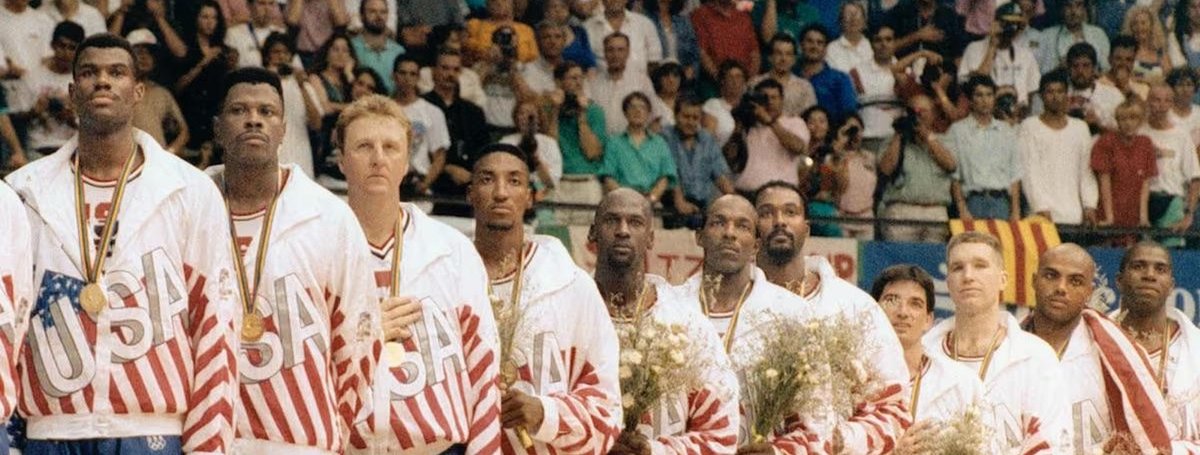
Borislav Stankovic spent a decade as a veterinary inspector of meat in Belgrade before he gave his working life to basketball. By 1976 he was secretary general of FIBA, the sport’s world governing body, a job he kept until 2002, and it was Stankovic who led the push to let NBA players into the Olympics. His case was blunt. “Our competition was closed to the NBA players, but no one else,” he said. “That seems immoral.”
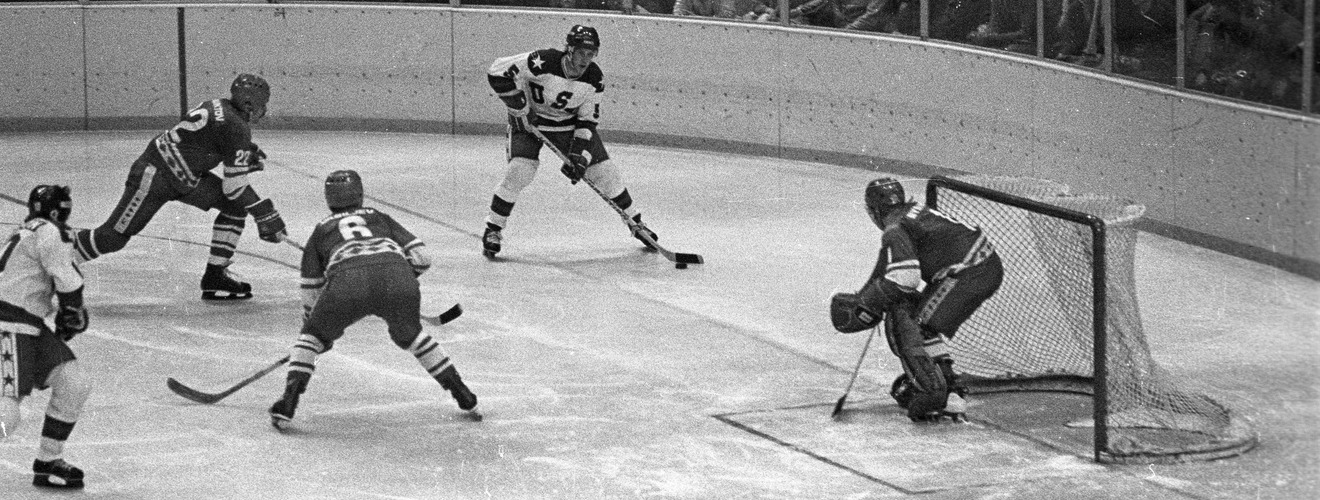
FIBA’s members changed the rule in April 1989, which the Basketball Hall of Fame calls “hardly earth-shattering news at the time of the announcement.” It should have been. Olympic basketball had kept out only NBA players, and so the Americans still sent college men, in much the spirit that had put a team of mostly college players on the 1980 Miracle on Ice roster. That had worked for a long time, and then in Seoul in 1988 it had not: the Soviet Union beat the United States in the semifinal, and the Americans went home with bronze.
The response arrived in Barcelona in the summer of 1992, with Michael Jordan, Magic Johnson and Larry Bird at the front of it, and the Olympic tournament turned into something closer to a tour. Opponents asked the Americans for autographs and posed for pictures with them, and FIBA says one Angolan player, guarding Jordan in the opener, looked over at his bench and asked a teammate to take a photo. It is not, on the whole, how a team sets about stopping someone. The twelve men who made the trip are below, and the order is the box score’s, not the poster’s.
Twelve players made up the 1992 U.S. Olympic men’s basketball team, the Dream Team, which won all eight of its games in Barcelona and took the gold medal. Chuck Daly was the head coach, with Lenny Wilkens, Mike Krzyzewski and P.J. Carlesimo as his assistants. The players are listed by scoring average at the Games, highest first.
Charles Barkley
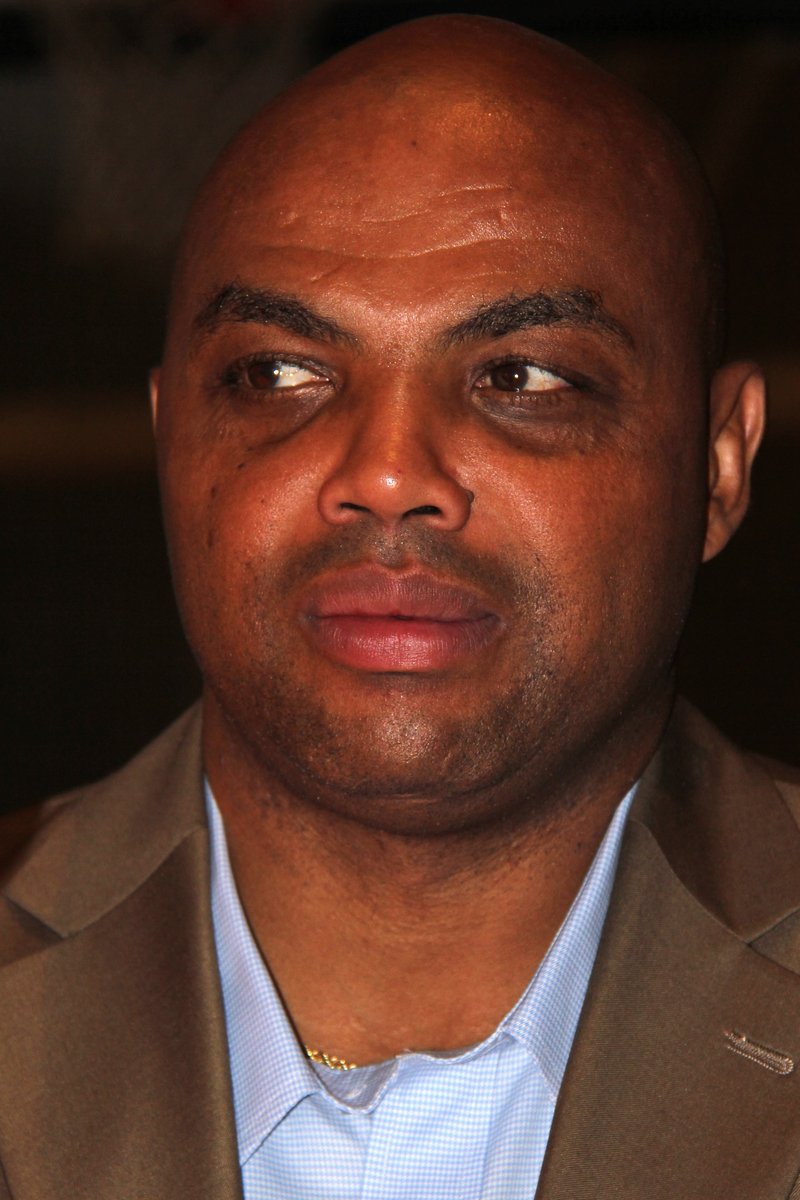
Twenty-nine points into an unanswered run against Angola, Charles Barkley drove for a layup, made it, and then walked over to Herlander Coimbra and planted an elbow in his chest. The referees called a foul, Angola made the free throw, and the streak stopped at 31. Coimbra, a 24-year-old whom NBC describes as an economics student giving away roughly 75 pounds to the man who hit him, finished the night with 4 points on 1-of-10 shooting. “He hit me; I hit him,” Barkley said afterward. The Baltimore Sun noted that NBC had reviewed the videotape and that no Angolan had come close to hitting him.
It did nothing to slow him down. Barkley led the Dream Team in scoring at 18.0 points a game, made 59 of his 83 shots, and went 7 of 8 from three-point range, which is a startling line from a man whose NBA career three-point percentage is .266. Against Brazil he scored 30 on 12-of-14 shooting, which stood at the time as the most points any American had scored in an Olympic game. He was a Phoenix Sun by then, traded June 17, 1992.
At night he walked Las Ramblas with a crowd in tow, signing as he went, and Sports Illustrated named him the “Wild Bull of Las Ramblas.” By the magazine’s account, leaving a bar off the boulevard at close to 4 a.m., he excused himself because he was playing golf in the morning with Payne Stewart. He shot 91. Stewart shot 66.
Michael Jordan
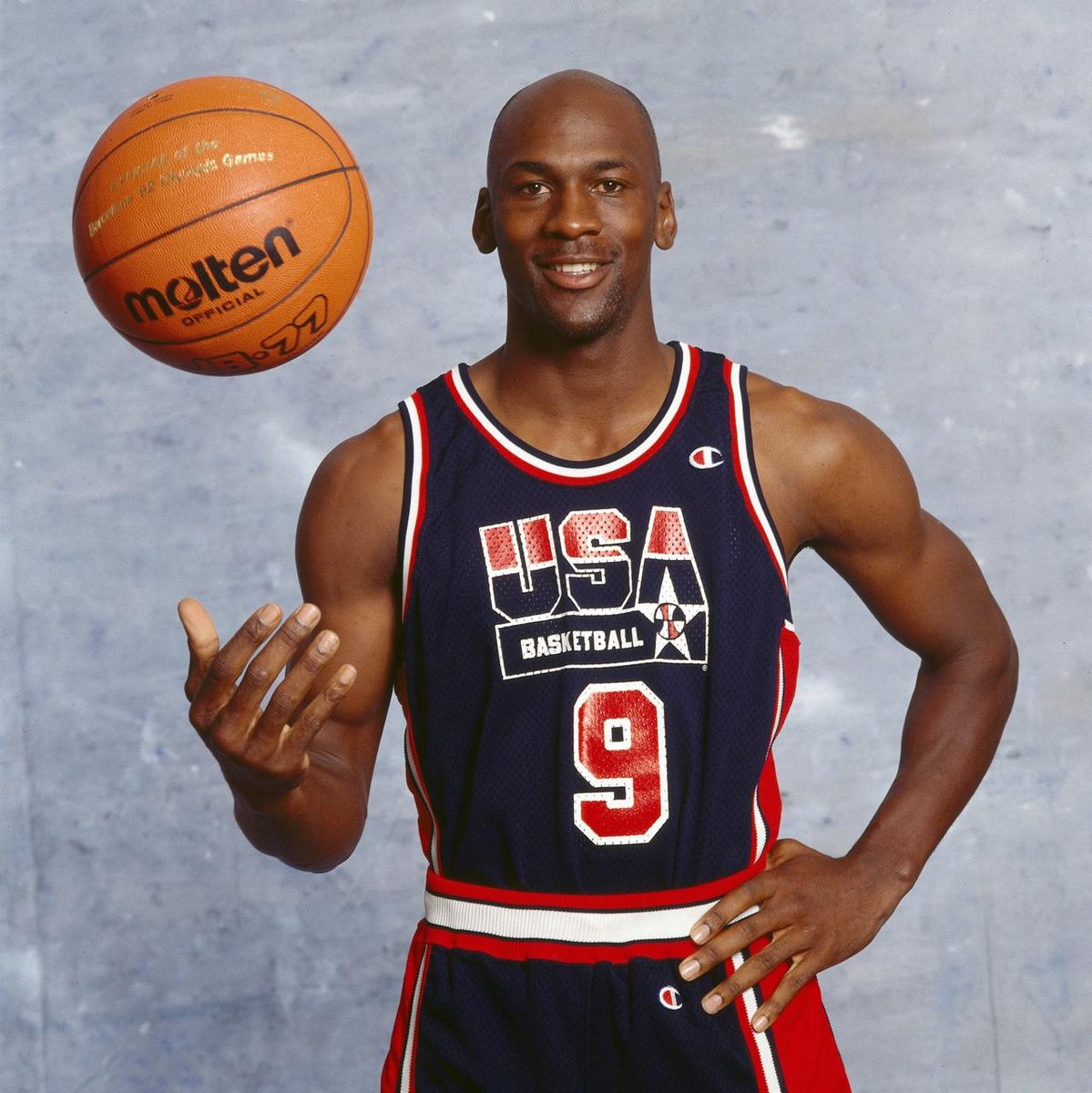
The one thing Michael Jordan would not do in Barcelona was stand on a podium dressed in Reebok. The official awards jacket carried a Reebok patch on the right shoulder, and Jordan, whose Nike endorsement deal the Baltimore Sun put at a reported $20 million, said for weeks that he would not wear it. When the team took the medal stand after beating Croatia 117-85 on August 8, 1992, every player had unzipped his jacket so the collar hid the patch, and Jordan, Barkley and Magic Johnson had American flags draped over their right shoulders.
On the court he was less of a soloist than his reputation suggests. He averaged 14.9 points, second on the team, but he was the only player to start all eight games and the one who stole the ball most often: 37 times in all, by Olympedia’s count, with eight against Angola and eight more the next night against Croatia, each a share of the U.S. Olympic single-game record. He also had 12 assists against Germany. He led the Americans with 22 in the final.
It was his second Olympic gold, after Los Angeles in 1984, and he came to Barcelona holding three MVP awards and two NBA championships. Asked about the medal-stand business, he put the team’s position plainly, as the Baltimore Sun reported it. “When you hire 12 Clint Eastwoods to come in here and do a job,” he said, “don’t ask them what bullets they’re putting in the gun.”
Karl Malone
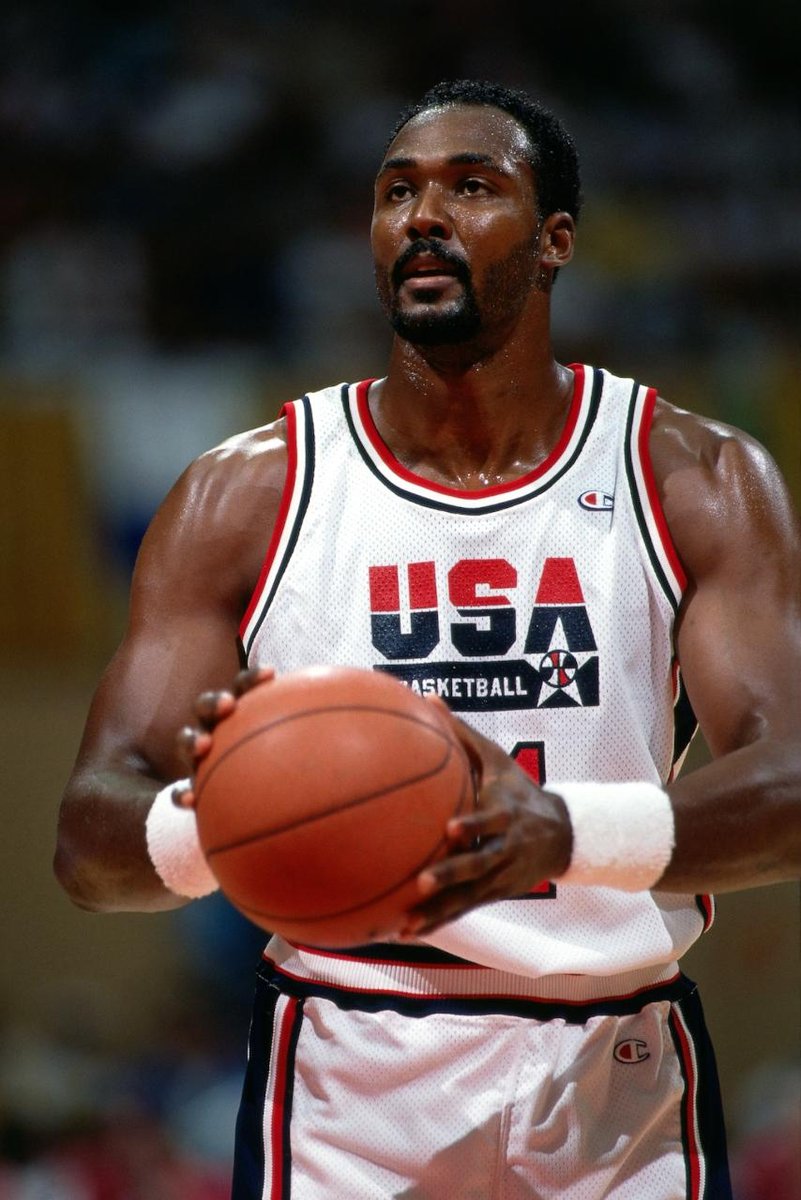
Karl Malone attempted 32 free throws in Barcelona and not a single three-pointer, which is about as complete a portrait of a power forward as two numbers can paint. He made 24 of the free throws, the most on the team, and averaged 13.0 points, third behind Barkley and Jordan, on 40-of-62 shooting. USA Basketball’s records also credit him with the Dream Team’s first Olympic point, a free throw 11 seconds into the opener, and its last, a jumper with 41.1 seconds left in the final.
His Utah partner was there too, in a manner of speaking. John Stockton played only four games and never started, so the Stockton-to-Malone act that had defined the Jazz could only be run in Barcelona from the August 2 game against Spain onward, and then only in short bursts. Malone did not seem to mind. Sports Illustrated found him attending the boxing, where he had become friendly with the lightweight Oscar De La Hoya and sat with De La Hoya’s family for his opening bout.
Malone never won an NBA championship. He made one last attempt in 2003-04, at 40, signing with the Lakers to play beside Kobe Bryant, Shaquille O’Neal and Gary Payton, a season that put him among the Hall of Famers who were Kobe Bryant’s teammates and ended with a knee injury and a 4-1 Finals loss to Detroit. He averaged 13.2 points that year, almost exactly what he had scored in Barcelona twelve years earlier.
Chris Mullin
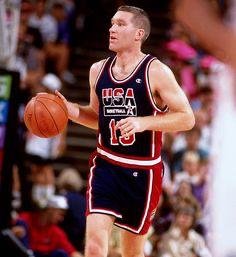
In 1984, as a junior at St. John’s, Chris Mullin won Olympic gold in Los Angeles on a team coached by Bob Knight, alongside Michael Jordan and Patrick Ewing. Eight years later the three were teammates again, and Mullin was the only one of them who scored more per game the second time around: 11.6 in 1984, 12.9 in 1992.
He was the purest shooter on a team made entirely of scorers. Mullin made 14 of his 26 three-point attempts in Barcelona, the most threes on the roster and the best percentage of anyone who took at least ten. His best night came in the quarterfinal against Puerto Rico on August 4, when he scored 21 on 8-of-10 shooting while Jordan went 1 for 11 and Barkley fouled out. At Golden State, once one third of the trio known as Run TMC, he had just completed his fourth straight season of at least 25 points a game, playing 41.3 minutes a night in 1991-92. In Barcelona he played about 21.5.
The Hall of Fame describes him as “the poster boy for gym rats everywhere,” a Brooklyn playground kid with a jumper that showed “no flaw, no variation.” Of Barcelona itself, though, the story he later told was about the traffic. By the last game, he recalled, the escort had grown from motorcycles to cars, vans and helicopters, and the team bus overtook the opposing team on the highway. “We drove right past them,” he said.
Clyde Drexler
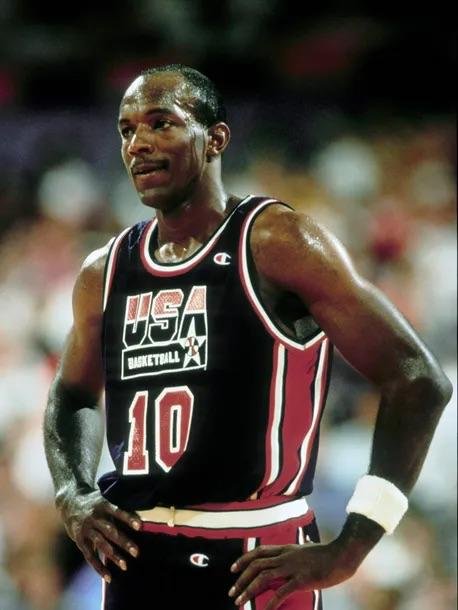
Clyde Drexler spent the spring of 1992 finishing second to Michael Jordan. Jordan won the MVP vote 900 points to 561, with 80 first-place votes to Drexler’s 12, and then Jordan’s Bulls beat Drexler’s Portland Trail Blazers 4-2 in the Finals, which ended on June 14. Jordan averaged 35.8 points in that series. Drexler averaged 24.8 on .407 shooting.
By then he had already been named to the same Olympic team. The first ten players had been announced on September 21, 1991, and Drexler and Christian Laettner were the last two, added on May 12, 1992; the AP noted that he “was miffed that he was not an original selection last year.” In Barcelona he averaged 10.5 points and had 20 steals, and against Spain on August 2 he made all three of his three-point attempts, which USA Basketball lists as the team’s Olympic single-game record for three-point percentage. In his other seven games he shot 3 for 18 from that distance. Against Brazil he managed 10 assists in his longest outing of the tournament.
His only NBA championship came later, in 1995, after a trade to Houston reunited him with his college teammate Hakeem Olajuwon. Back in 1992 he was still learning golf. Sports Illustrated, which had a writer in his Monte Carlo foursome before the Games, reports that he hit 300-yard drives that routinely finished 150 yards out and 150 yards to one side, and that Barkley called him Long and Wrong.
Patrick Ewing
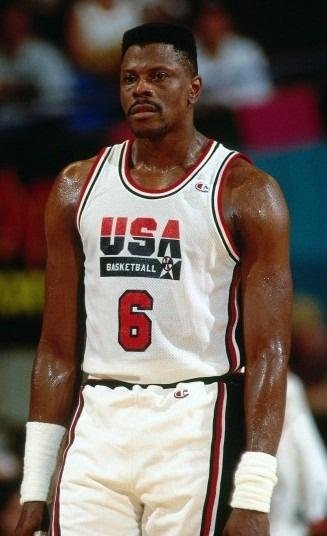
The first time Patrick Ewing played Michael Jordan for something that mattered, Jordan won. That was the 1982 NCAA final, which North Carolina won 63-62 over a Georgetown team with a freshman center from Kingston, Jamaica; it was Jordan, a freshman too, who hit the winning shot. Ewing won the national title two years later and that summer took Olympic gold in Los Angeles, with Jordan on his side for once.
He is the only one of the twelve Dream Teamers born outside the United States, and he arrived in Cambridge, Massachusetts as a boy who, the New Jersey Hall of Fame says, had excelled at soccer and cricket rather than basketball. In Barcelona he was the team’s enforcer near the rim, and not always a tidy one. He led the Dream Team with 15 blocks and tied Karl Malone for the most rebounds, 42, while playing only 17.5 minutes a game. He also fouled out twice: in the opener against Angola, after going 5 of 5 from the field, and again against Germany. Those were two of the team’s three disqualifications in the whole tournament. In the final he scored 15, behind only Jordan and Barkley among the Americans.
By the NBA’s account, his high school coach, Mike Jarvis, had once predicted that he would be “the next Bill Russell, only better offensively.” Ewing gave the Knicks fifteen seasons, reached the Finals twice and won neither, which is the part of the comparison Jarvis left out.
David Robinson
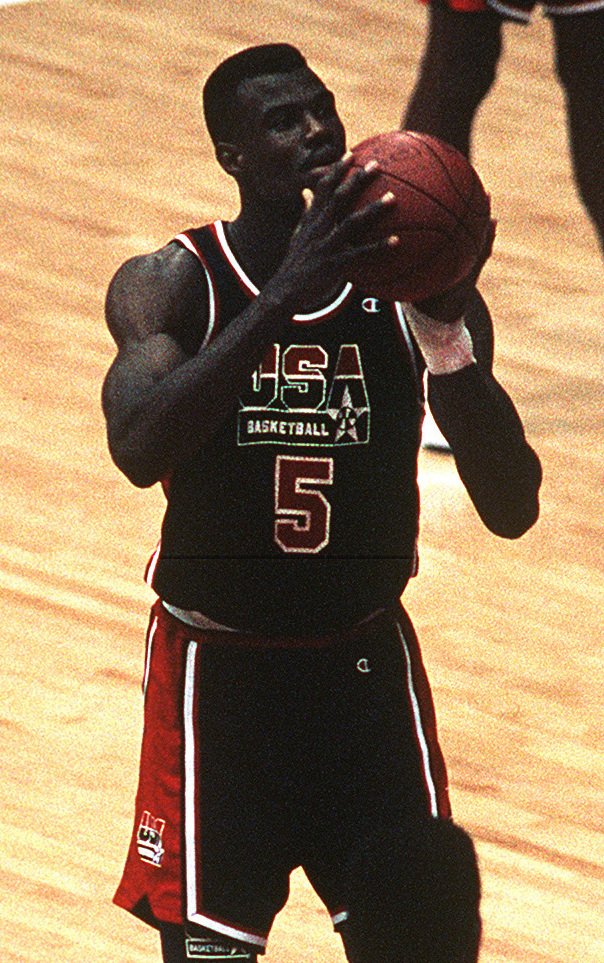
Four years before Barcelona, David Robinson lost an Olympic semifinal. On September 28, 1988, in Seoul, the Soviets won 82-76, and Robinson, the leading American scorer and rebounder that night with 19 points and 12 rebounds, had to settle for bronze. Olympedia notes that the two countries had not met at an Olympics since the 1972 final, which gave the evening a certain unwanted symmetry.
He was an amateur in Seoul for a reason most NBA stars never had to consider. The San Antonio Spurs had taken him first overall in 1987, but he owed the Navy two years of service, a figure the Naval Academy had cut from the usual five, and Basketball-Reference lists both of the next two seasons as “Did not play – military service (U.S. Navy).” The Academy also gave him his nickname, The Admiral. By the summer of 1992 he had caught up handsomely: Rookie of the Year, Defensive Player of the Year, and the 1991-92 blocks title at 4.5 a game.
In Barcelona he averaged 9.0 points and blocked 12 shots, rarely playing as much as 20 minutes; his busiest night was 21:51 against Puerto Rico, when he scored 14. His 27th birthday fell on August 6, which was also the day of the Olympic semifinal. The United States beat Lithuania 127-76. Robinson had 13 points and 8 rebounds. It was the second Olympic semifinal of his career, and the first one that went his way.
Scottie Pippen
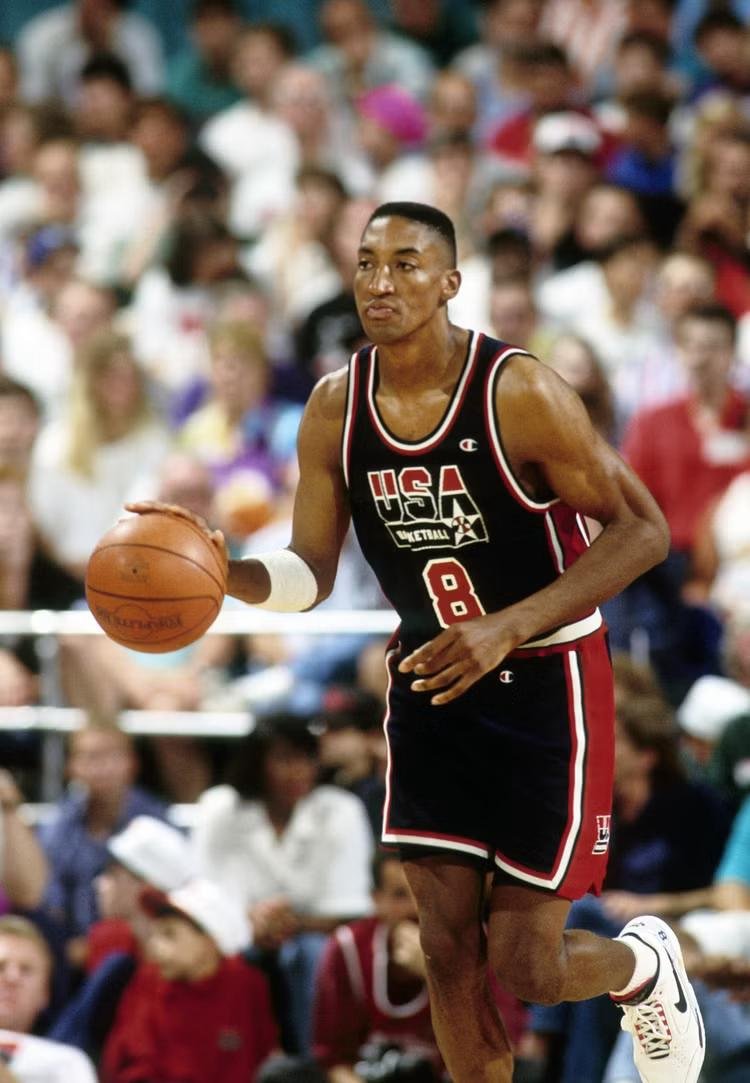
“I would have ordered him a big-screen TV,” Scottie Pippen told the Baltimore Sun, and the him in question was Jerry Krause, general manager of the Chicago Bulls. Krause had drafted Croatia’s Toni Kukoc in 1990 and spent the following seasons courting him, and NBC reports that Bulls management held off on renegotiating Pippen’s contract partly to keep money free for a Kukoc signing. Croatia was the Dream Team’s second opponent.
On July 27, 1992, Pippen and Jordan picked Kukoc up before halfcourt and rarely left his side. He finished with 4 points on 2-of-11 shooting and 7 turnovers in a 103-70 American win, while Pippen, who by the Baltimore Sun’s account started that night precisely to hound him, had 13 points, 9 assists and 5 steals. Jordan later explained the evening in a 2012 documentary: “We were not playing against Toni Kukoc. We were playing against Jerry Krause in a Croatian uniform.”
The rest of Pippen’s tournament was quieter and rather better than his reputation as Jordan’s sidekick allows. He led the Dream Team in assists with 47, ahead of Jordan’s 38 and Magic Johnson’s 33, and was second in steals with 23. Kukoc got a measure of revenge in the final, with 16 points and 9 assists, and finished the Olympics with 48 assists, one more than Pippen. He reached Chicago in 1993 and became a key role player on the last three of the Bulls’ championship teams. Krause, in the end, got his man.
Larry Bird
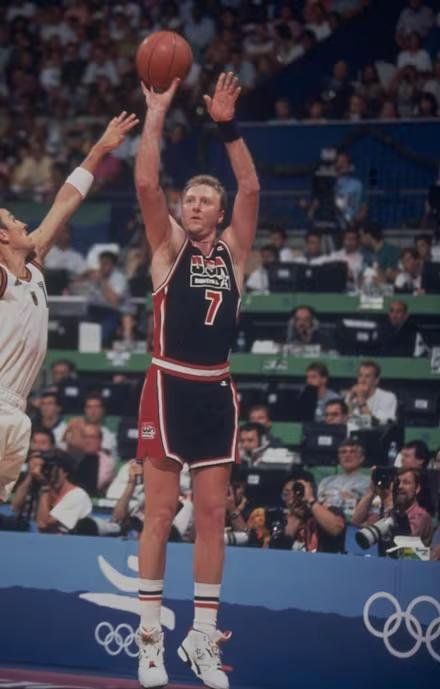
Larry Bird did not want to go. By the NBA’s account, he told Dave Gavitt, the Celtics’ president, that the 1992 Games should be “for the young guys,” and NBC reports that he changed his mind only after about two dozen phone calls from Magic Johnson. At 35 he was the oldest player on the team by nearly three years. His back was failing. He had played 45 of Boston’s 82 games in 1991-92 and missed most of the playoffs. At the Olympic qualifier in Portland he sat out the Canada game on June 29, 1992, and the AP found him on the floor, “a more comfortable position because of his perpetually injured back.”
Against Germany on July 29 he scored 19 on 7-of-11 shooting, the top American score of the game, and over the tournament he attempted 27 threes, more than anyone else on the roster, making 9. In the final he played 12 minutes and did not score, and afterward he said of the whole experience: “When you win by 50 every game, I think it takes away from it.”
Bird had spent all thirteen of his NBA seasons, and won three MVP awards, with the Boston Celtics, a franchise founded in 1946 for the Basketball Association of America and so one of the original NBA teams. His last field goal in an official game came with 1:20 left against Lithuania on August 6. He announced his retirement on August 18, 1992, ten days after the gold.
Magic Johnson
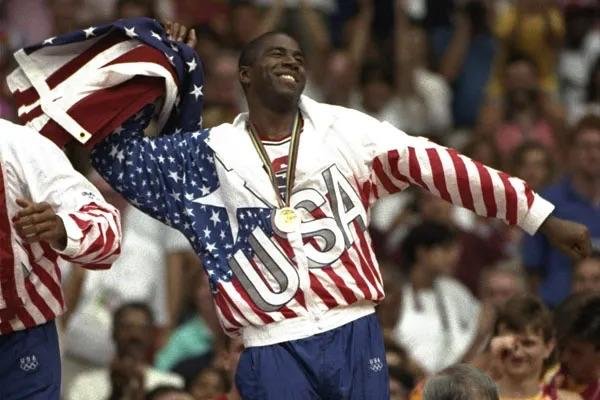
Three months after announcing that he had HIV and was retiring, Magic Johnson played in the 1992 NBA All-Star Game in Orlando and was named its MVP, with 25 points on 9-of-12 shooting and 9 assists in a 153-113 win for the West. The announcement had come on November 7, 1991; the game was on February 9, 1992. Basketball-Reference lists his 1991-92 season as “Did not play – illness (HIV).” Olympedia notes that his selection for Barcelona caused some controversy, because of worries at the time about transmission through contact on the court, “which proved to be unwarranted.”
He and Bird were the co-captains. At the opening ceremony of the qualifying tournament in Portland, the AP reported, Bird told him he should have the honor of carrying the U.S. flag, and he did. In Barcelona he had 10 assists in the opener, then hurt his knee in the first half against Croatia on July 27 and was helped off by Pippen and Mullin. The Baltimore Sun reported that an MRI was negative and the injury a strained muscle. He sat out the games against Germany and Brazil. He played six of the eight, averaging 8.0 points, and his 33 assists were third on the team.
His longest night was the last, 28:42 in the final, with 11 points and 6 assists. He already owned five NBA championships with the Lakers. Asked how the gold ranked, he said: “You can combine them all together, and it still wouldn’t rank with this.”
Christian Laettner
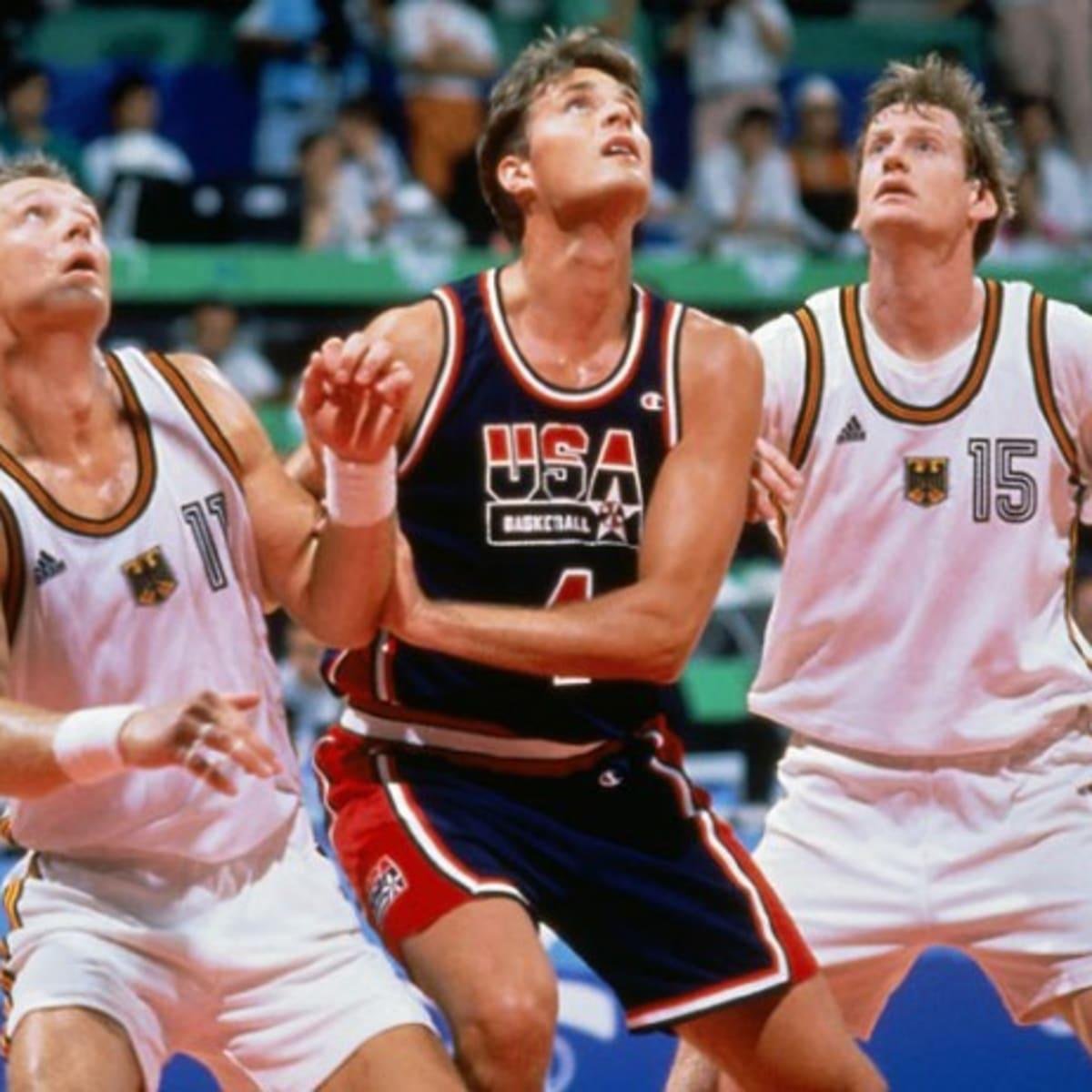
On March 28, 1992, in Philadelphia, Duke trailed Kentucky by a point with 2.1 seconds left in overtime. Grant Hill threw the ball the length of the court. Christian Laettner caught it, turned and shot at the buzzer. Duke won 104-103. He finished 10 of 10 from the field and 10 of 10 at the line. He scored 31. “I can’t believe it happened to me twice in a career,” he said, having beaten Connecticut with a buzzer-beater two years earlier.
He won the Naismith and Wooden awards that spring, Duke won its second straight national title, and NBC records that the last place on the Olympic roster “had to go to a collegian.” Laettner was the obvious choice; Shaquille O’Neal, NBC says, was upset but had one fewer year in college. A month before the Games the Minnesota Timberwolves drafted Laettner third overall, behind O’Neal and Alonzo Mourning, so he reached Barcelona as the team’s only college player and already a top-three pick.
He played 7.6 minutes a game, never started, and scored 38 points, though he made 18 of 20 free throws, the best percentage on the team. Later he spent two seasons as Michael Jordan’s teammate in Washington, a pairing that never got him onto the list of Hall of Fame players Jordan played with. Olympedia records that his run of clutch shots led one writer to call him one of the two luckiest people ever to live, “along with Ringo Starr.”
John Stockton
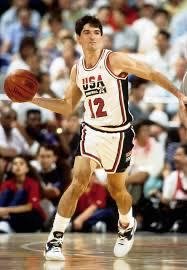
Michael Jordan broke John Stockton’s leg. It happened on June 29, 1992, early in a 105-61 win over Canada at the qualifying tournament in Portland. “I don’t really know what happened,” he said. “Michael was just coming across and he kneed me.” The X-rays showed an undisplaced fracture of the right fibula. The Baltimore Sun reported that if he could not recover, Chuck Daly would probably add a point guard from among Tim Hardaway, Mark Price and Isiah Thomas.
He recovered, more or less. Stockton missed the first four Olympic games and made his debut on August 2 against Spain, and in all he played four games and 29 minutes and 5 seconds, scoring 11 points. Six of his 8 assists came in 5:34 against Puerto Rico, a game in which he did not score. This from a man who had led the NBA in assists for five straight seasons through 1991-92 and who, when Basketball-Reference’s career lists were checked on October 4, 2026, stood first all-time in assists, with 15,806, and in steals, with 3,265.
The fame of his teammates had one advantage. Stockton could walk down Las Ramblas without being recognized, and the 2012 NBA TV documentary shows him filming fellow Americans and asking whether they had been watching the Dream Team, without their noticing that they were talking to part of it. On one walk, the Deseret News reported, tourists handed him their camera and asked him to take their picture with Charles Barkley.
Frequently Asked Questions
Who coached the 1992 Dream Team?
The head coach was Chuck Daly, who had won NBA titles with the Detroit Pistons in 1989 and 1990, and Barcelona made him the first coach to win both an NBA championship and Olympic gold. The Hall of Fame records that he never called a timeout there. Daly died in 2009; his assistant Lenny Wilkens died on November 9, 2025.
What was the Dream Team’s average margin of victory?
It was 43.75 points, from 938 points scored and 588 allowed over eight games, which Olympedia rounds to “just under 44 points.” The closest games were both against Croatia, by 33 in the group stage and 32 in the final. It was not an Olympic record: the 1956 U.S. team won by 53.5 a game.
Was the Dream Team the first Olympic basketball team with NBA players?
No. It was the first U.S. Olympic team of NBA stars, but seven men on six other rosters in Barcelona had played NBA games in 1991-92, among them Drazen Petrovic of Croatia, Sarunas Marciulionis of Lithuania and Detlef Schrempf of Germany. The 1989 rule change opened the Games to NBA players from every country at once.
Is the entire Dream Team in the Basketball Hall of Fame?
As a team, yes: the 1992 U.S. Olympic team was enshrined in the Naismith Hall’s Class of 2010, at a ceremony in Springfield, Massachusetts on August 13, 2010. As of October 2026, eleven of the twelve were in individually, all but Laettner, along with Daly, Krzyzewski and Wilkens. The U.S. Olympic Hall of Fame inducted the team in 2009.
Why wasn’t Isiah Thomas on the Dream Team?
The accounts disagree. NBC Sports notes that he was the only 1992 NBA All-Star starter left out of the first ten selections. Jordan said in a 2012 documentary that Thomas’s absence was “one of the stipulations put to me,” while the selection committee member Rod Thorn has said Jordan never raised Thomas with him.
Did anyone ever beat the Dream Team?
Not in a game that counted. USA Basketball reports that on June 24, 1992, in a closed scrimmage at UC San Diego, a Select Team of college players beat them 62-54, and that Daly erased the score before reporters came in. The Dream Team won the rematch the next day by 47 and every official game it played.
- Olympedia: Basketball, Men, 1992 Summer Olympics (rosters, results and player lines)
- Naismith Memorial Basketball Hall of Fame: 1992 United States Olympic Team
- USA Basketball: The Dream Team at 25
- FIBA: 90 years of Olympic basketball, from Berlin to the Dream Team
- Basketball-Reference: NBA and ABA career leaders in assists
- NBC Sports: How the 1992 Dream Team roster was selected
- Baltimore Sun: A very bad dream for Croatia’s Kukoc (July 28, 1992)
- Sports Illustrated Vault: Charles Barkley at the 1992 Olympic Games