Every Titan in Greek Mythology
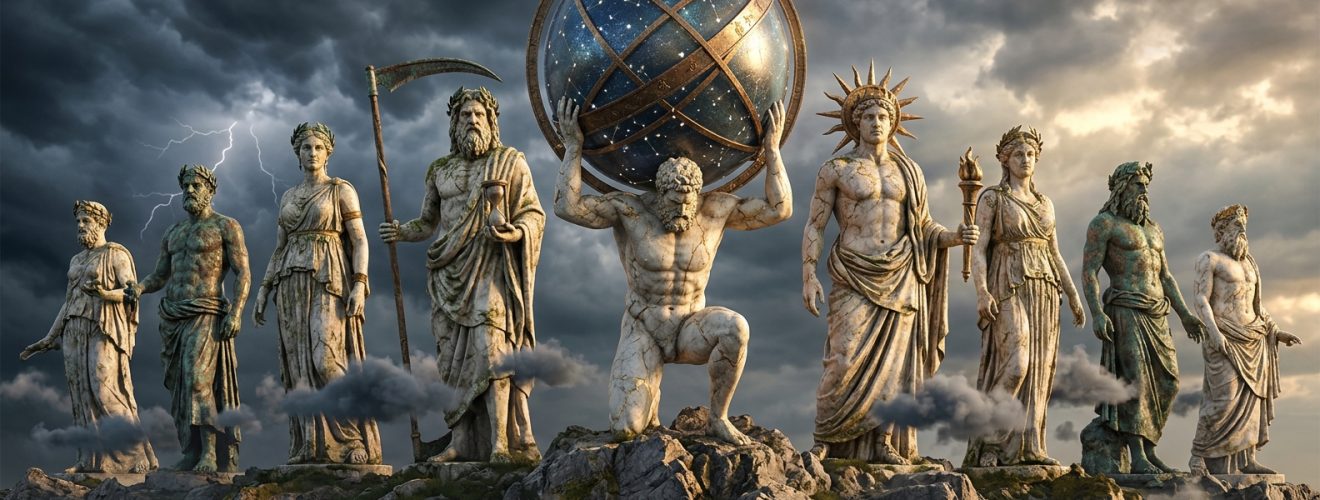
Hesiod names Heaven and Earth’s twelve children without calling them anything at all. The name arrives later, and as an insult. The children had turned on their father, and those sons, Hesiod says, ‘great Heaven used to call Titans (Strainers) in reproach, for he said that they strained and did presumptuously a fearful deed, and that vengeance for it would come afterwards’. In Greek it is a pun, titainontas for straining and tisin for vengeance, and it makes the most famous family name in mythology a piece of paternal abuse.
Nobody in antiquity agreed on who belonged to it. Apollodorus counts thirteen, slipping Dione in among the daughters. Diodorus counts eleven. The preface to the Fabulae of Hyginus, a damaged text, produces a roll of Titans that includes two of the Hundred-Handers and a Cyclops, and then files Coeus and Iapetus among the Giants. Theoi’s modern catalogue of Titans and Titanesses, counted name by name, comes to 44, a useful index of the confusion rather than an answer to it.
What follows takes the strict road. The first twelve entries are Hesiod’s, in his order, with Cronus last. After them come the figures a surviving ancient text actually calls a Titan – not a Titan’s daughter, not ‘Titanian’, but one of the Titans – each introduced by the line that does it. That rule keeps Atlas and Prometheus, admits an armed guardian in Arcadia and a son of Earth sheltered by the fig tree, and quietly retires several famous names who turn out, on inspection, to be only the children of Titans.
On the strict count used here, there are 22 Titans in the surviving ancient texts. Twelve are the children of Uranus and Gaia named in Hesiod’s Theogony 133-138, from Oceanus to Cronus. The other ten are figures an ancient author calls a Titan: Dione, Helios, Astraeus, Perses, Atlas, Prometheus, Pallas, Anytus, Syceus and Lelantus.
Oceanus
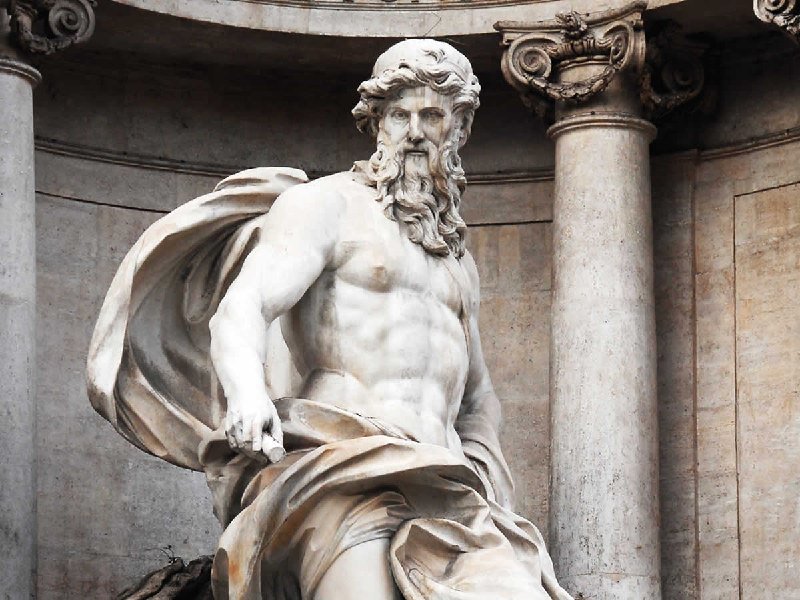
Homer twice calls Oceanus the one ‘from whom the gods are sprung’, which is a large claim for a figure who spends most of Greek myth lying around the edge of the world. In the Iliad he is literally the edge: Hephaestus sets ‘the great might of the river Oceanus’ around the rim of Achilles’ shield, and Aeschylus has him circling the whole earth with a ‘sleepless current’. Hesiod, more interested in family than geography, names him first of the twelve children of Heaven and Earth and credits him and Tethys with three thousand daughters and as many rivers.
He also had a gift for staying out of things. Apollodorus says the Titans attacked their father ‘all but Ocean’, and Hesiod never names him among the fighters in the war against Zeus. Two of his daughters did the politics for him. Metis became Zeus’s first wife, the wisest of gods and mortals, until Zeus put her in his own belly. Styx brought her children to Olympus the moment Zeus called for allies and became the oath the gods swear by – a tenth of her father’s water, Hesiod says, flowing through the dark.
In Prometheus Bound he arrives on a winged steed to advise his chained kinsman, explains that ‘it is most advantageous, when truly wise, to be deemed a fool’, is ignored, and leaves because his beast will ‘be glad to rest his knees in his stall at home’. It is the most sensible exit in Greek tragedy.
Coeus
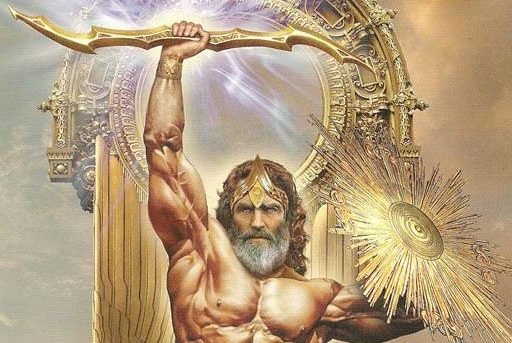
Niobe, outraged that anyone would prefer Leto to her, dismisses the goddess in Ovid as the daughter of Coeus – ‘whoever he may be’, in Melville’s translation. It is a cruel line, and not an unfair one. Coeus is second in Hesiod’s roll call of the twelve, and his only real appearance after that is a single line of romance: ‘Again, Phoebe came to the desired embrace of Coeus.’ The result was two daughters, and between them they are his entire reputation.
The first was Leto, ‘dark-gowned’ and ‘gentlest in all Olympus’, whom Hera hunted over the whole earth until she reached Delos and bore Artemis, who then served as midwife to her brother Apollo. The second, Asteria, escaped Zeus by flinging herself into the sea in the likeness of a quail. Hyginus says an island sprang up from her and was named Ortygia; Apollodorus says the city named after her was afterwards called Delos. Either way, both daughters end up on the same island, one fleeing a god and the other giving birth to two.
Ovid’s Titanida for Leto means a Titan’s daughter, a patronymic rather than a rank. The plain statement that Coeus was ‘one of the Titans’ turns up instead in an ancient commentator’s note on the first book of the Iliad, about as much attention as he ever got. Virgil files him among the brood Earth produced on the fifth day of the month, the day farmers were told to shun.
Crius
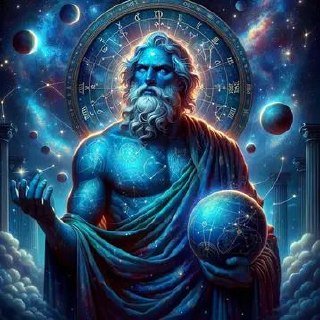
Crius has one of the thinnest files among Hesiod’s twelve. He gets his place in the roll call, a wife and three sons, and that is the whole of his personal mythology. The wife was Eurybia, a daughter of Sea and Earth whom Hesiod describes, without further explanation, as having ‘a heart of flint within her’. The sons were Astraeus, Pallas and Perses, and each of them did more with the family name than their father ever managed.
What Crius lacks in story his grandchildren make up for. Hesiod’s Pallas married the Oceanid Styx, and their four children were Zelus, Nike, Kratos and Bia – Rivalry, Victory, Power and Force, the personified muscle around Zeus’s throne. Nike, ‘trim-ankled’ in Hesiod, is Victory herself and takes her place among the Greek gods of war. Because their mother brought them over to Zeus first, all four were given a permanent address: ‘they dwell always with Zeus the loud-thunderer’.
Two of them open Aeschylus’s Prometheus Bound, bringing the captive Prometheus to be nailed to his rock. Kratos, Power, does all the talking, bullying a reluctant Hephaestus through the job and signing off with a pun on Prometheus’s name, which means forethought. Bia, Force, stands there through the entire scene and never says a word. It is hard to think of better casting.
Hyperion
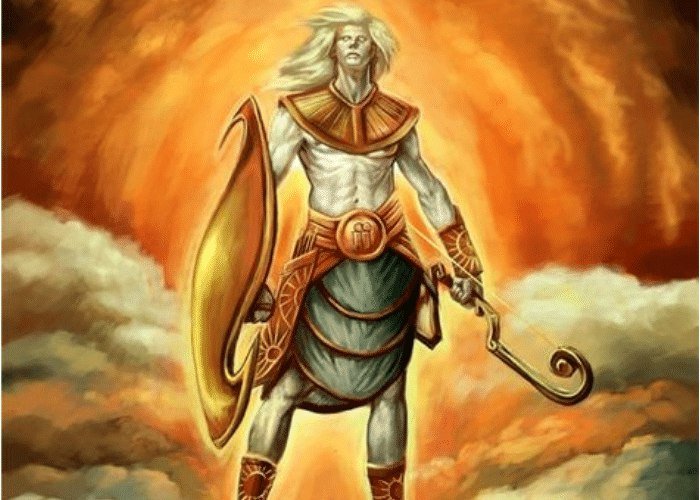
Hesiod is clear on the point: Theia lay with Hyperion and bore great Helius, clear Selene and Eos, the Sun, the Moon and the Dawn. Homer is not. In the Odyssey the Sun’s cattle are ‘the kine of Helios Hyperion’, and a few lines later a far-off people is divided ‘some where Hyperion sets and some where he rises’, as though the father’s name had simply been handed down to the son. Even his marriage is unsettled. Hesiod and Apollodorus give him Theia, the Homeric Hymn to Helios gives him ‘glorious Euryphaessa, his own sister’, and Hyginus gives him someone called Aethra.
His daughter Eos had the unluckiest love life in the family. She persuaded Zeus to make her mortal lover Tithonus deathless but forgot to ask that he stay young – ‘Too simple was queenly Eos,’ sighs the Homeric Hymn to Aphrodite. When old age arrived she laid him in a room and shut the shining doors, and ‘there he babbles endlessly’.
Diodorus, who preferred his gods to have been clever men, turned Hyperion into an early astronomer, the first to understand by observation the movement of the sun, the moon and the stars. The moon of Saturn that carries his name would have tested him. Discovered in 1848, it has a punched-in surface NASA compares to a sponge or a wasp nest, and it tumbles ‘unpredictably through space as it orbits Saturn’, which is no way for the father of the Sun to carry on.
Iapetus
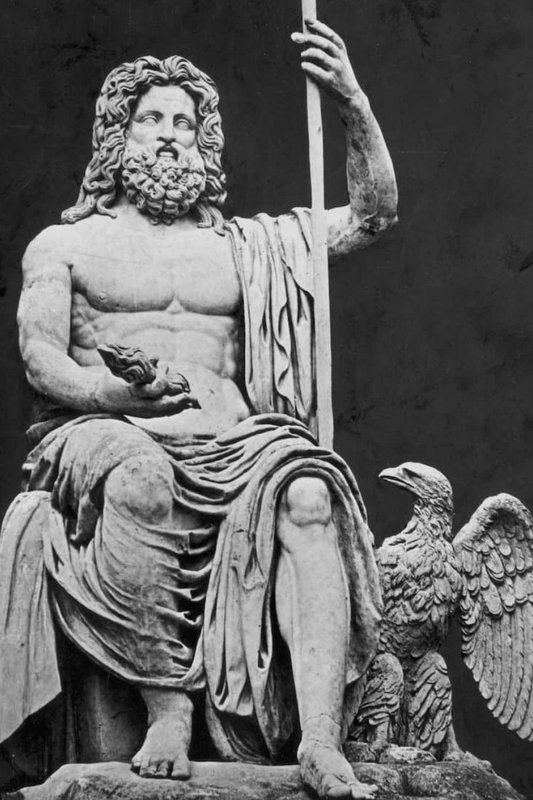
When Zeus tells Hera in the Iliad that her anger means nothing to him, even if it drives her to the lowest limits of earth and sea, he names the neighbours she would find there: ‘Iapetus and Cronos’, who ‘have joy neither in the rays of Helios Hyperion nor in any breeze, but deep Tartarus is round about them’. Cronus earned his place. Iapetus is harder to account for, since his most notable act in Hesiod is getting married.
His wife was the Oceanid Clymene – or Asia, if you prefer Apollodorus – and their four sons read like a catalogue of ways to annoy Zeus. Atlas ended up holding the sky and Prometheus chained to a rock, and both have their own entries here. Menoetius was struck with a thunderbolt for ‘mad presumption and exceeding pride’ and sent down to Erebus in Hesiod, Tartarus in Apollodorus. Epimetheus, the fourth, was the one who accepted Pandora. Prometheus had warned him never to take a gift from Zeus, and Works and Days records the outcome with admirable economy: ‘But he took the gift, and afterwards, when the evil thing was already his, he understood.’
Saturn’s moon Iapetus, discovered by Cassini in 1671, has a leading hemisphere NASA describes as ‘as dark as coal’ and a trailing one many times brighter, so Cassini could only ever see it on one side of the planet. A moon split cleanly between the bright idea and the regrettable one seems about right for that family.
Theia
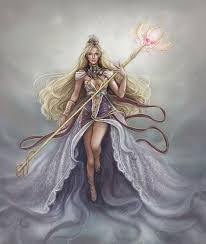
‘Mother of the Sun, Theia of many names, for your sake men honor gold as more powerful than anything else.’ Pindar opened a victory ode with that line, written for Phylacidas of Aegina, a winner in the pancratium, and it is the warmest thing any ancient poet says about her. Hesiod names her first of the six daughters of Heaven and Earth, marries her to Hyperion, and moves on. Diodorus, counting the Titans as six men and five women, leaves her out altogether.
Her children are the reason anyone remembers her. With Hyperion she bore Helius, Selene and Eos, and Selene, the Moon, came with the best story: she fell in love with the mortal Endymion, and when Zeus let him choose his fate, Apollodorus says, ‘he chose to sleep for ever, remaining deathless and ageless’. Apollonius Rhodius calls Selene ‘the Titanian goddess’, but his Greek word is an adjective, a family description rather than a rank, which is why the Moon herself is not on this list.
Modern science has been kinder to Theia than antiquity was. Planetary scientists gave her name to the body, roughly the size of Mars, whose collision with the young Earth about 4.5 billion years ago is thought to have produced the Moon. NASA, careful as ever, allows that it may have been ‘perhaps a series of objects’. So Theia is the mother of the Moon twice over, and in neither case has anyone actually seen her.
Rhea
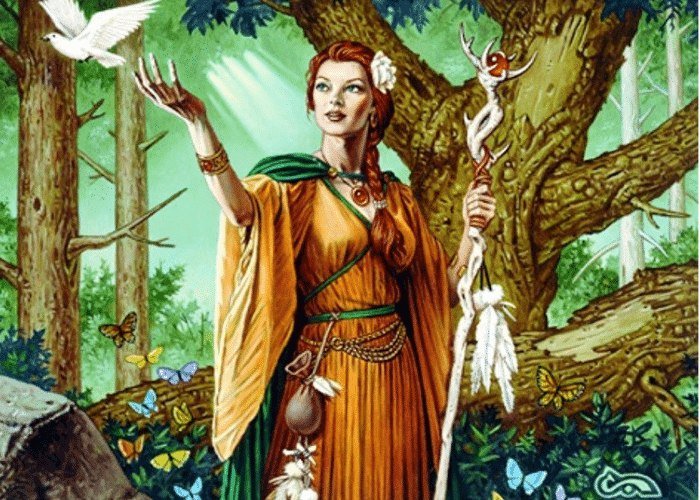
Five children went down Cronus’s throat, and Hesiod lists them in order of arrival: Hestia, Demeter, ‘gold-shod Hera’, Hades and Poseidon, each swallowed ‘as each came forth from the womb to his mother’s knees’. Earth and Heaven had told Cronus that a son of his would overthrow him. He took no chances. ‘Unceasing grief seized Rhea,’ Hesiod says, and when the sixth child, Zeus, was born, he was taken to Crete instead.
Who did the taking depends on whom you read. In the version everyone knows, Rhea wraps a stone in swaddling clothes and hands it to her husband, and Apollodorus tells it exactly that way. In Hesiod, read closely, it is Earth who receives the baby from Rhea, hides him in a cave and gives Cronus the stone. The birthplace is no more settled. Hesiod says Lyctus, Apollodorus says a cave of Dicte, and Callimachus, in his hymn to Zeus, throws up his hands: ‘debated is his birth’. Apollodorus adds the Curetes, clashing their spears on their shields so that Cronus would not hear the baby cry.
The Romans knew her as Ops, and she was closely associated with the Phrygian mother goddess Cybele. The stone did better than any of them. Zeus set it up at Delphi as a marvel to mortal men, and Pausanias found there a stone ‘of no large size’ said to be the very one, over which olive oil was poured every day and unworked wool laid at every feast.
Themis
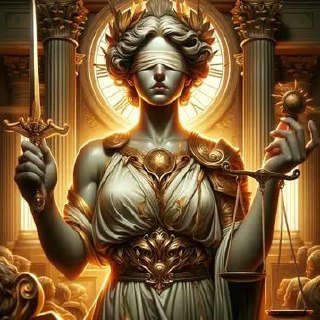
Hesiod gives the Fates two sets of parents and does not appear to notice. Early in the Theogony, Clotho, Lachesis and Atropos are daughters of Night, ‘who give men at their birth both evil and good to have’. Much later they are daughters of Zeus and Themis, and they ‘give mortal men evil and good to have’ – very nearly the same line, attached to a different mother. Themis at least came by the honour properly. She was Zeus’s second wife, after Metis, and also bore him the Horae: Eunomia, Dike and Eirene, Order, Justice and Peace.
Her name means something like divine law or custom, and the Greeks gave her work to match. Aeschylus opens the Eumenides with the Pythia’s prayer, which sets out the line of succession at Delphi: Earth first, then Themis, ‘the second to take this oracular seat of her mother’. In Prometheus Bound he goes further, making her Prometheus’s mother and adding that Themis and Earth were really ‘one form’ with ‘many names’.
When Zeus wants every god assembled in the Iliad, it is Themis he sends. She ‘sped everywhither’. Every river answered the summons except one. The absentee was Oceanus, which, given his record, is not much of a surprise.
Mnemosyne
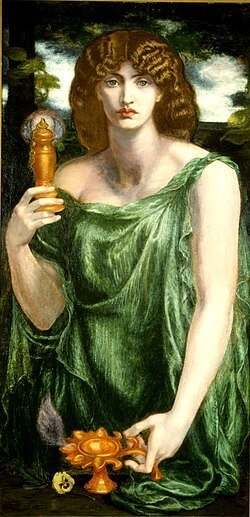
Anyone consulting the oracle of Trophonius at Lebadeia had to drink two waters before going underground. The first, Pausanias says, was ‘the water of Forgetfulness, that he may forget all that he has been thinking of hitherto’. The second was the water of Memory, ‘which causes him to remember what he sees after his descent’. Coming back up, he was set upon a seat known as the chair of Memory. The Greeks took remembering seriously enough to give it furniture.
Mnemosyne herself has a romantic part in Hesiod. Zeus lay with her for nine nights in Pieria, ‘and when a year was passed’ she bore nine daughters ‘all of one mind’: the Muses, Cleio, Euterpe, Thaleia, Melpomene, Terpsichore, Erato, Polyhymnia, Urania and Calliope. Hesiod liked the story enough to tell it twice. The Muses, he says, were born to be ‘a forgetting of ills and a rest from sorrow’, which is an odd thing to inherit from Memory.
The idea outlived the poem. The Getty Museum counts some 40 gold tablets of the kind it calls Orphic, most made between the fourth and first centuries BC, which gave their owners directions for the afterlife. One from Petelia warns against a spring ‘to the left of the house of Hades’ and sends the soul instead to ‘the Lake of Memory, cold water pouring forth’. A cold draught from that lake, as the Getty puts it, ‘staves off the oblivion that death is feared to bring’.
Phoebe

Phoebe gave Apollo the oracle at Delphi as a birthday present. That, at least, is how the Pythia tells it at the start of Aeschylus’s Eumenides: after Earth and Themis, ‘another Titan, child of Earth, Phoebe, took her seat here’ with Themis’ consent ‘and not by force’, and passed it on to Phoebus, ‘who has his name from Phoebe’. It is a tidy bit of family history, explaining at a stroke both the god’s oracle and his most famous name.
The family in question is hers. ‘Gold-crowned Phoebe’, as Hesiod calls her in the list of the twelve, bore Coeus two daughters, Leto and Asteria, and Leto in turn ‘bore Apollo and Artemis delighting in arrows’. Phoebe is therefore the grandmother of both twins, so the gift to Apollo kept the business in the family. Theoi notes that her name can mean bright, and is close to Greek words for prophecy and purification, which suits a goddess who once held Delphi.
Saturn’s moon Phoebe was discovered in August 1898 by the American astronomer William Pickering. It is dark, reflecting only 6 percent of the sunlight that reaches it, orbits the planet backwards, and is in NASA’s view ‘most likely a captured object’. It was the first target the Cassini spacecraft met on arriving at Saturn, on June 11, 2004. NASA’s own naming note, however, explains the name as ‘another name for the goddess that the Greeks called Artemis’ – the granddaughter, in other words, not the grandmother.
Tethys

In the fourteenth book of the Iliad, Hera tells Aphrodite she is off to the ends of the earth to visit Oceanus and ‘mother Tethys’, the couple who raised her, and patch up their marriage: ‘for a long time’s space they hold aloof one from the other from the marriage-bed and from love’. Homer notes that she says this ‘with crafty thought’. The visit is a cover story. What Hera actually wants is Aphrodite’s power of desire, so that she can seduce Zeus.
Tethys is the mother of the waters in Hesiod, bearing to Oceanus ‘eddying rivers, Nilus, and Alpheus, and deep-swirling Eridanus’ along with a ‘holy company of daughters’. Ovid gives her a walk-on part of her own. After Callisto and her son are set in the sky as the Bears, Juno goes down to hoary Tethys and old Oceanus and asks them to keep the stars of the Bear out of their waters, so that her rival may never bathe in the pure sea. The sea gods nodded.
Her name has done better on land than she ever did in myth. In 1893 the geologist Eduard Suess wrote of a vanished ocean, ‘This ocean we designate by the name “Tethys”’, and geologists have used it ever since. Saturn’s moon Tethys, discovered by Giovanni Cassini in 1684, carries a crater, Odysseus, that is ‘nearly two-fifths of Tethys itself’, and has a density 0.97 times that of liquid water – which, for the wife of Ocean, seems only right.
Cronus
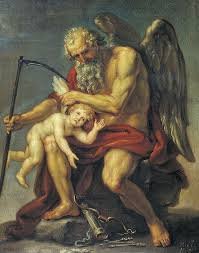
Hesiod calls him ‘Cronos the wily, youngest and most terrible of her children, and he hated his lusty sire’. Diodorus insists that ‘Cronus, since he was the eldest of the Titans, became king’. Diodorus’s Cronus simply becomes king; the deed belongs to Hesiod’s.
The deed was the castration of his father. Earth gave him ‘a jagged sickle’ and hid him in ambush, and when Heaven came to lie with Earth, the son reached out with his left hand, took the sickle in his right, and ‘lopped off his own father’s members and cast them away’. From the white foam that gathered around them in the sea grew a maiden, Aphrodite. Having overthrown his father, Cronus then spent the rest of his reign swallowing his children, since he had been told he was ‘destined to be overcome by his own son’. He was, of course.
Yet he was remembered fondly. Works and Days places the golden race of men in ‘the time of Cronos when he was reigning in heaven’, and he got real worship. At Olympia, Pausanias says, the Basilae, as they were called, sacrificed to him on the summit of Mount Cronius at the spring equinox. The Romans identified him with Saturn, whose Saturnalia ran from the 17th to the 23rd of December. In Athens his feast fell on the twelfth of Hecatombaeon, and Demosthenes mentions in passing that because of it ‘the Council therefore stood adjourned’.
Dione
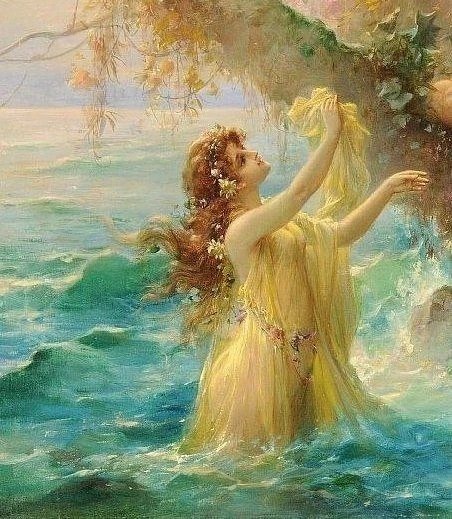
Apollodorus, listing the daughters Sky fathered on Earth, calls them ‘the Titanides as they are called’ and puts Dione among them, between Phoebe and Thia. That makes her a Titaness in his genealogy and something else entirely in Hesiod’s, where she is ‘lovely Dione’, one of the daughters of Ocean and Tethys. Neither author explains himself, and the two versions have sat side by side ever since.
Homer cared less about her parents than about her child. In the fifth book of the Iliad, Aphrodite, wounded by the mortal Diomedes, ‘flung herself upon the knees of her mother Dione’, and Dione comforts her with a list of gods who had suffered at mortal hands, as though misery shared were misery halved. Ares, she recalls, lay bound by the sons of Aloeus ‘in a brazen jar’ for thirteen months. Then she does something more useful than reminisce: she ‘with both her hands wiped the ichor from the arm; the arm was restored, and the grievous pains assuaged’.
At Dodona she was worshipped alongside Zeus himself. Strabo says the prophets there were originally men, and that ‘three old women were designated as prophets, after Dione also had been designated as temple-associate of Zeus’. Hyginus, for good measure, has two Diones: one among his Titans, the mother of Venus by Jove, and another who is a daughter of Atlas and the mother of Pelops. It is a name that did a great deal of work.
Helios
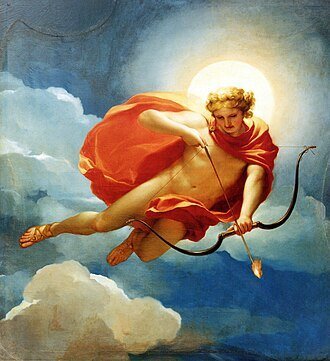
Servius, the ancient commentator on Virgil, explains that when the poet calls the Sun ‘titan’ he means it literally: the Sun was ‘unus de Titanibus’, one of the Titans, a son of Hyperion – and, Servius adds, the one who took no part against Jupiter. Elsewhere he cites a tradition: of all the Titans only the Sun kept from wronging the gods, and so earned heaven. His mother is Theia in Hesiod and Euryphaessa in the hymn that bears his name.
He is the god who sees everything, which made him a dangerous one to cross. On the island of Thrinacia he kept ‘seven herds of kine and as many fair flocks of sheep, and fifty in each’, animals that ‘bear no young, nor do they ever die’. When Odysseus’s starving crew killed and ate some of them, Helios threatened the gods that unless he was repaid he would ‘go down to Hades and shine among the dead’. Zeus, unwilling to lose daylight, smashed the ship with a thunderbolt instead.
Pindar says Helios was absent when the gods divided the earth, so ‘no one marked out a share for him’, and he chose instead an island he saw rising from the sea: Rhodes. Rhodes later raised the Colossus, a statue of the Sun by Chares of Lindus, ‘no less than seventy cubits in height’, which an earthquake threw down 56 years after it went up. Even on the ground, Pliny reports, ‘few men can clasp the thumb in their arms’.
Astraeus
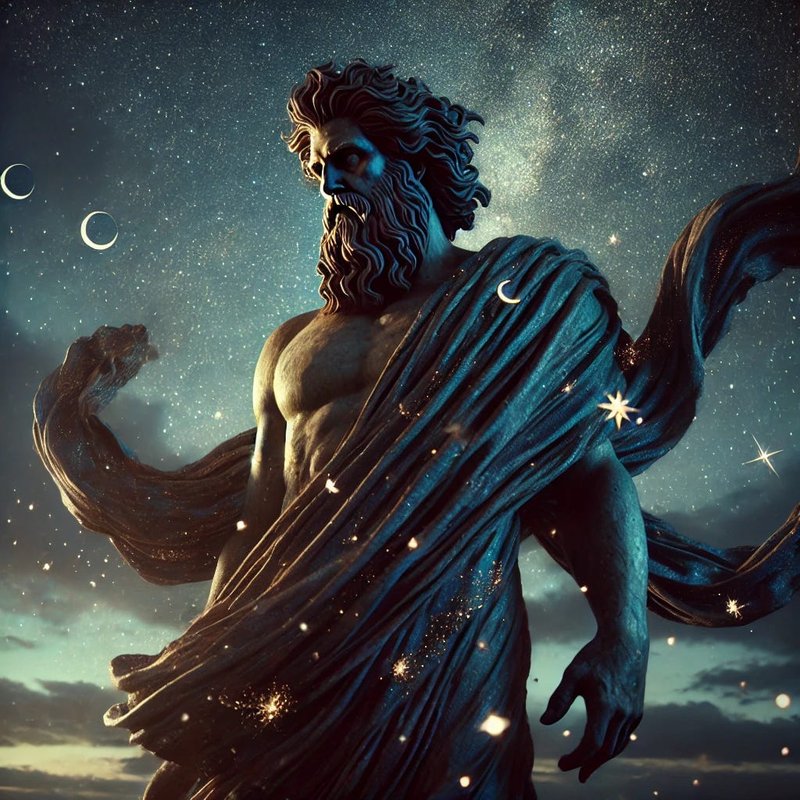
In the first book of the Aeneid, Neptune summons the winds Eurus and Zephyrus and rounds on them: ‘Tantane vos generis tenuit fiducia vestri?’ – has such confidence in your birth possessed you? Servius, glossing the line, explains what that birth was. ‘Astraeus enim unus de Titanibus’ – Astraeus was one of the Titans, one of those who took up arms against the gods – lay with Aurora, and from them the winds were born, ‘secundum Hesiodum’, according to Hesiod. Neptune, in other words, is reminding the winds that their father was a rebel.
Hesiod is indeed the source of the family. Astraeus was a son of Crius and Eurybia, and Eos the Dawn bore him ‘the strong-hearted winds, brightening Zephyrus, and Boreas, headlong in his course, and Notus’, and after them ‘the star Eosphorus’, the Dawn-bringer, together with the gleaming stars that crown the heavens. Hyginus, consulting a different family tree, lists Astraeus among the Giants instead, then gives him four winds by Aurora – Zephyrus, Boreas, Notus and Favonius, the last being the Roman name for the west wind and therefore Zephyrus a second time.
Nonnus, writing much later, turned him into a prophet. In the Dionysiaca Demeter hurries ‘to the house of Astraios the god of prophecy’ and finds him drawing figures in the dust, while his sons the Winds wait on her as servants and Zephyrus plays the pipes. Nonnus is unimpressed with that one: ‘a womanish Wind this!’
Perses
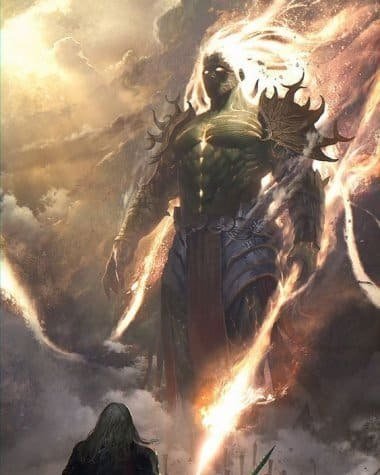
Servius, explaining Virgil’s Hecate, writes that ‘secundum Hesiodum Hecate Persi Titanis et Asteriae filia est’ – according to Hesiod, Hecate is the daughter of Perses the Titan and of Asteria. The grammar is not quite watertight, since Titanis could in principle attach to someone else, but the natural reading gives Perses the title, and Servius then complains that later writers ‘confused this genealogy’. He was not wrong about that.
Hesiod’s own Perses, Crius’s son by Eurybia, was ‘eminent among all men in wisdom’ and led Coeus’s daughter Asteria ‘to his great house to be called his dear wife’. Their child was Hecate, ‘whom Zeus the son of Cronos honored above all’, giving her ‘a share of the earth and the unfruitful sea’ and honour ‘in starry heaven’. Hecate’s portfolio in the Theogony is wonderfully broad: she sits by kings in judgement, gives fishermen a good catch, is ‘good in the byre with Hermes to increase the stock’, and serves as a nurse of the young.
The confusion Servius complained of was real, because Greek myth had far too many men called Perses. Diodorus has a Perses who was a son of Helios and king of the Tauric Chersonese, whose daughter Hecate ‘first of all poisoned her father’. Hesiod addresses Works and Days to a Perses who, he says, ‘seized the greater share’ of their inheritance. And Herodotus has yet another, a son of Perseus, from whom, he says, ‘the Persians took their name’.
Atlas
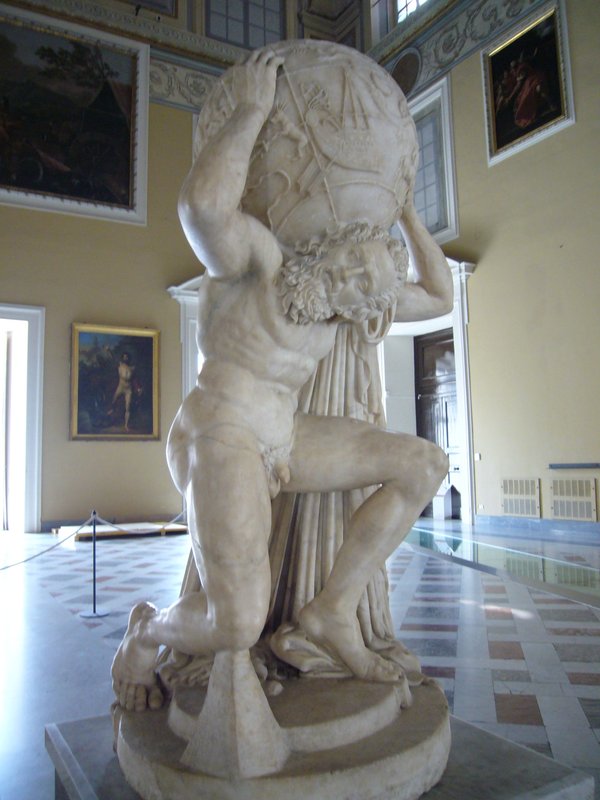
The best-known Titan owes his title to a passage nobody can quite read. In Prometheus Bound the chorus sings of ‘one other Titan god’ they have seen in torment – ‘Atlas, pre-eminent in mighty strength, who moans as he supports the vault of heaven on his back’ – but the Greek of those lines is so damaged that editors print it between daggers. The cleaner witness is Hyginus, who says that after the war Zeus put the vault of the sky on ‘Atlas, who had been their leader’. So the most famous Titan earned the job by running the losing side.
Hesiod places him ‘at the borders of the earth before the clear-voiced Hesperides’, holding up the wide heaven ‘with unwearying head and arms’. Apollodorus has him fetch three of the Hesperides’ apples for Heracles while Heracles holds the sky, then announce that he will deliver them himself. Heracles agrees, asks Atlas to take the sky back while he puts a pad on his head, and walks off. Ovid has Perseus turn him to stone with the Gorgon’s head, so that Atlas, as big as he was, became a mountain, and Herodotus reports a real mountain that the locals called ‘the pillar of heaven’.
His name ended up on books of maps, though perhaps not on purpose. Gerardus Mercator’s Atlas appeared at Duisburg in 1595, and according to National Geographic the name referred to King Atlas, a mythical African monarch said to have invented the first celestial globe.
Prometheus
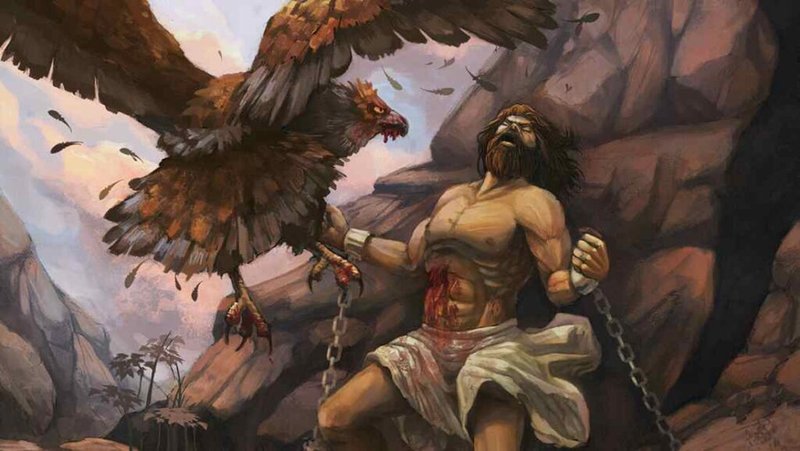
At least three ancient authors call Prometheus a Titan in so many words, one of them twice, and Aeschylus, who made him famous, is not among them. Sophocles has a local at Colonus describe ‘the fire-bearing god, the Titan Prometheus’. Euripides uses the phrase twice, once for a figure on a warrior’s shield and once for the god who helped deliver Athena ‘from the crown of Zeus’s head’. Valerius Flaccus has Jupiter order Hercules to rescue ‘Titana’, the Titan, from the dreadful bird. Prometheus Bound, by contrast, treats ‘the Titans, children of Heaven and Earth’ as a group its hero once tried and failed to advise.
His crimes, in Hesiod, were two. At Mecone he divided an ox, wrapping the good meat in a paunch and dressing up ‘the white bones’ in ‘shining fat’ for Zeus, who remarked, ‘how unfairly you have divided the portions!’ Then, when Zeus withheld fire, Prometheus stole it ‘in a hollow fennel stalk’. The punishment was a chain and an eagle ‘which used to eat his immortal liver’, which grew back each night by as much as the bird had eaten in the day, until Heracles killed the bird. Apollodorus adds that Prometheus had made human beings in the first place, out of water and earth.
At Panopeus, Pausanias was shown two stones the colour of clay that ‘smell very like the skin of a man’. The locals said they were what was left over after Prometheus finished making the human race.
Pallas
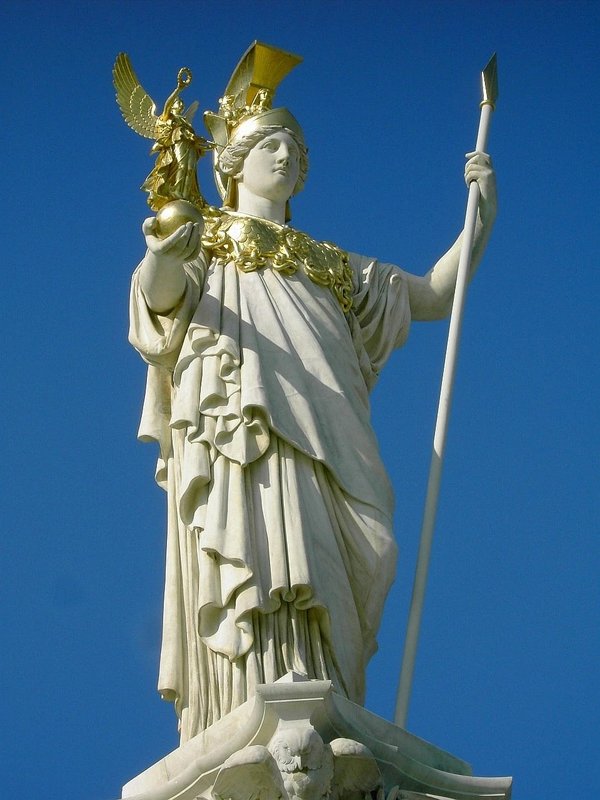
When Pausanias asked how the town of Pellene got its name, the townspeople told him it came ‘from Pallas, who was, they say, one of the Titans’. The Argives, he adds, think it came from Pellen, an Argive, son of Phorbas. That is the whole of the evidence. Pausanias gives this Pallas no parents, no deeds and no description, and passes the claim along as hearsay, which is exactly what it is.
Hesiod does have a Pallas, a child of Crius who married Styx and fathered Victory and her siblings, and the modern reference site Theoi treats the two as one and the same. No ancient text says so. It may be true, but it is an inference, and the Pellenians did not make it for us.
The name was a crowded one. Apollodorus has a Giant called Pallas whom Athena ‘flayed’ in the war against the Giants, using ‘his skin to shield her own body in the fight’. He also has Pallas the daughter of Triton, raised alongside Athena, who was about to strike her in a quarrel when Zeus interposed the aegis; startled, Pallas ‘fell wounded by Athena’, and the grieving goddess made a wooden image of her, the Palladium. Athena herself is ‘Pallas Athena’ in Hesiod. Whatever the Titan of Pellene did, he was never going to be the most famous Pallas in the room.
Anytus
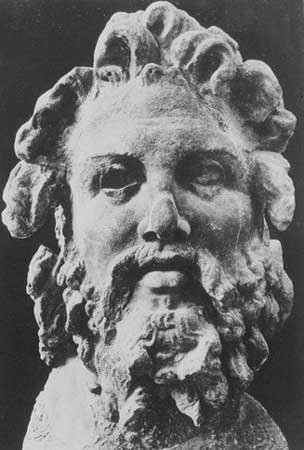
The National Archaeological Museum in Athens has a marble head labelled ‘the Titan Anytos’, which is more than most Titans can show. It came from the sanctuary of Despoina, the Mistress, at Lykosura in Arcadia, and Pausanias, who described the group there, supplies the Titan line: ‘By the image of the Mistress stands Anytus, represented as a man in armour. Those about the sanctuary say that the Mistress was brought up by Anytus, who was one of the Titans, as they are called.’
The group was the work of Damophon of Messene, and the museum describes it as a composition 6 metres tall, pedestal included. Demeter and Despoina sat enthroned together, and throne, footstool and goddesses were, Pausanias says, ‘all made out of one piece of stone’. Artemis stood beside them ‘wrapped in the skin of a deer’, holding a torch in one hand and two serpents in the other, with a hunting dog lying beside her. Anytus, armed, stood on the other side as the guardian who had raised the goddess. The museum dates his colossal head to 190-180 BC. Britannica, less committed, calls him ‘the giant Anytus’.
The Arcadians, Pausanias says, worshipped the Mistress ‘more than any other god’, and he would not write her true name down: ‘the real name of the Mistress I am afraid to write to the uninitiated’. Her foster-father’s name, by contrast, is carved into the record, which is more than he could have expected.
Syceus
According to one ancient source, the fig tree exists because Earth needed somewhere to hide her son. Athenaeus, in his long dinner-party compendium, reports that ‘Sykeus, one of the Titans, was pursued by Zeus and taken under the protection of his mother, Ge’, and that she sent up the plant for him. The Greek word for fig is syke, and the city of Sykea in Cilicia, Athenaeus adds, was named after him.
The chain of authority is long and slightly frayed. Athenaeus is quoting Tryphon’s History of Plants, and Tryphon is quoting a Farmer’s Handbook, a Georgikon, by Androtion. Earlier in the same book, though, Athenaeus credits the same book to ‘Androtion, or Philippus, or Hegemon’, which suggests nobody was entirely sure who wrote it, and Yonge’s 1854 translation names the source as ‘Dorion’, a name the Greek does not support. Even the Titan’s own name is uncertain: the Greek gives it only in a form translators have turned into Sykeus or Sukeas as they saw fit.
In the same discussion Athenaeus quotes one Pherenicus for a rival explanation, deriving the fig from Suke, a daughter of Oxylus and one of the Hamadryad nymphs. He also preserves the most durable thing the fig ever produced. Exporting Attic figs, he reports, was once forbidden, and the men who informed on smugglers were the first to be called sycophants.
Lelantus
One poem is the whole of the ancient record. In the 48th and final book of the Dionysiaca, written by Nonnus of Panopolis in Egypt in the 5th century AD, we learn that the huntress Aura’s father ‘was ancient Lelantos the Titan, who wedded Periboia, a daughter of Oceanos’. No earlier text names him, no text gives him parents, and he never speaks or acts. He exists so that his daughter can be a Titan’s child.
The daughter’s story is one of the grimmest Nonnus tells. Aura, a companion of Artemis, mocked the goddess’s body while they bathed, and Artemis asked Nemesis to punish her. Nemesis agreed, though she refused to turn the girl to stone, reasoning that ‘her father Lelantos might blame me when he heard’ – the only moment in literature when Lelantus matters to anyone. Dionysus then made a stream of wine pour from a rock, waited until Aura had drunk and fallen asleep, bound her, and raped her.
Aura woke ‘maddened by what she saw’. She later bore twins, killed one and ate him, and Artemis carried off the other, Iacchos. At last Aura leapt into the river Sangarios, and Zeus turned her into a fountain. Her father, whose name was one reason for Nemesis’s single hesitation, is not mentioned again.
Frequently Asked Questions
Who won the war between the Titans and the Olympians?
Zeus and the Olympians won. Hesiod says the Titans fought from Mount Othrys and the gods from Olympus for ten full years with neither side ahead, until the Hundred-Handers Cottus, Briareos and Gyes joined Zeus and launched three hundred rocks, one upon another, overwhelming the Titans with their missiles.
Where were the Titans imprisoned after the war?
In Tartarus, beneath the earth. Hesiod measures the depth with a falling anvil: dropped from heaven, a bronze anvil would fall nine nights and days and reach the earth on the tenth, then take as long again to reach Tartarus. Poseidon fixed bronze gates on the prison, guarded by the Hundred-Handers.
Are Leto, Selene and Hecate Titans?
Not in the strict sense; all three are daughters of Titans. Ovid calls Leto ‘Titanida’, a Titan’s daughter, and uses the same word family for Diana, Pyrrha and Circe. Apollonius calls Selene ‘the Titanian goddess’, an adjective. Hesiod gives Hecate a portion ‘among the former Titan gods’, a place among them rather than the title itself.
Where do the Titans first appear in Greek poetry?
In Homer, according to Pausanias: ‘The first to introduce Titans into poetry was Homer’. He means the oath in the Iliad where Hera swears by ‘all the gods below Tartarus, that are called Titans’. Pausanias adds that Onomacritus later borrowed the name and made the Titans the authors of the sufferings of Dionysus.
Were the Titans ever set free?
Some poets thought so. Pindar writes that ‘immortal Zeus freed the Titans’, and the chorus of Aeschylus’s lost Prometheus Unbound was made up of Titans, whose greeting to Prometheus survives in Cicero’s Latin. A passage of Works and Days outside the standard line count has Cronus ruling the islands of the blessed, released from his bonds.
Why are Achilles’s horses called Titans?
A fragment of Diodorus says Xanthus and Balius, the horses of Achilles, ‘were formerly Titans’ who had come to the aid of Zeus and later asked to change their shape. The story is known only from the commentary of Eustathius on Book 19 of the Iliad, so it rests on a single line of transmission.
What is named after the Titans?
Saturn’s moon Titan, discovered by Christiaan Huygens on March 25, 1655, and the element titanium, which Martin Heinrich Klaproth named in 1795 after ‘the Titans, the sons of the Earth goddess’. NASA notes that Titan is ‘larger than even the planet Mercury’. Several more of Saturn’s moons carry the names of individual Titans.
- Hesiod, Theogony (trans. Hugh G. Evelyn-White), Perseus Digital Library
- Titanes: the Titan gods, Theoi Greek Mythology
- Apollodorus, Library, Book 1 (trans. James G. Frazer), Perseus Digital Library
- Saturn’s moon Phoebe, NASA Science
- Golden Tickets to the Underworld, J. Paul Getty Museum
- Atlas, National Geographic Education
- Hellenistic Period collection, National Archaeological Museum, Athens
- Damophon, Encyclopaedia Britannica