Every Horcrux Voldemort Created (and How Each Was Destroyed)
A book in the Hogwarts library called Magick Moste Evile brings up Horcruxes in its introduction and then declines to go on: “Of the Horcrux, wickedest of magical inventions, we shall not speak nor give direction.” That is roughly the wizarding world’s official position on the subject, and the schoolboy Tom Riddle got round it the way clever pupils always have, by asking a teacher. In the memory Horace Slughorn eventually gave up to Harry with the help of Felix Felicis, Riddle wonders aloud whether a wizard might split his soul into more than one piece, and Slughorn erupts: “Seven! Isn’t it bad enough to think of killing one person?” Riddle appears to have been satisfied with the answer.
The price of each Horcrux is a murder, which rips the soul apart so that a fragment can be sealed inside an object, and Dumbledore’s reading of that memory was that Riddle meant to make six of them and keep the seventh piece for himself. Only one of the six stayed close to him. He entrusted the diary to Lucius Malfoy and the cup to Bellatrix Lestrange, both of them Death Eaters named in the Harry Potter novels, buried the ring in what was left of his grandfather’s hovel, left the locket in a sea cave and the diadem in a room at Hogwarts, and kept only the snake where he could see her.
What follows is every Horcrux in the order it was destroyed, from a diary stabbed with a Basilisk fang in the Chamber of Secrets to a snake beheaded during the Battle of Hogwarts. The roster comes from the seven novels alone. Where Rowling supplied a detail afterwards – the name of a victim, a ruling on what counts – the page says so, because the books are quieter on those points than the internet is.
Voldemort made six Horcruxes on purpose – Riddle’s diary, Marvolo Gaunt’s ring, Slytherin’s locket, Hufflepuff’s cup, Ravenclaw’s diadem and Nagini – and a seventh, Harry Potter, by accident. Quirrell’s possession and the fragment Voldemort kept in his own body are not counted here. All seven were destroyed within the seven novels, and this list runs in the order they fell.
Tom Riddle’s Diary
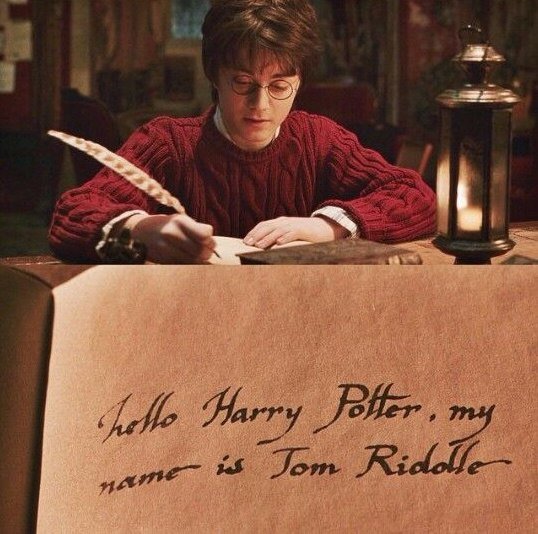
Lucius Malfoy kept it for years before he found a use for it, and the use he found was Ginny Weasley. Voldemort had entrusted the diary to Malfoy, who slipped it into her Transfiguration textbook. The book looked blank. Write in it, though, and Tom Riddle as he had been at Hogwarts wrote back. “Little Ginny’s been writing in it for months and months, telling me all her pitiful worries and woes,” the thing inside it later taunted Harry, and through her it reopened the Chamber of Secrets and loosed the Basilisk on the school.
It was, Dumbledore told Harry years afterwards, a Horcrux, made after Myrtle Warren was killed by the Basilisk in a bathroom; Rowling has said it was Myrtle’s death that made it. The fragment of Voldemort preserved inside was the boy Riddle had been, and it took a fang from the Basilisk itself, one of the magical creatures in Harry Potter, to finish him. Harry drove the broken, poisoned fang into the pages. The ink spewed out, and with it went the Dark enchantment.
The remains went back to Malfoy. Harry handed him the stained and torn remnants and used them to trick him into freeing his house-elf, Dobby, which means Malfoy went home that day short one Horcrux and one servant.
Marvolo Gaunt’s Ring
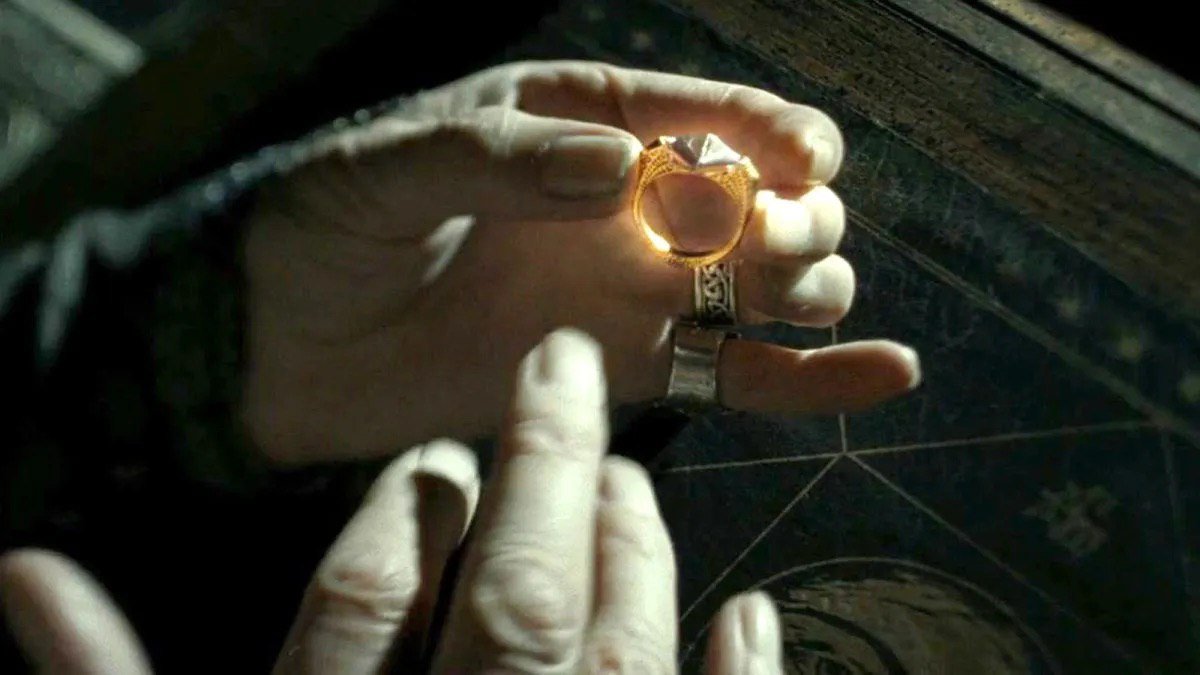
A withered hand, Dumbledore told Harry, “does not seem an unreasonable exchange for a seventh of Voldemort’s soul.” He said it lightly. He had tried the ring on, and the curse Voldemort left in it blackened and burned his right hand and gave him, as Harry later learned, less than a year to live. Dumbledore took the ring back to his office and destroyed it with the sword of Gryffindor anyway. “The ring is no longer a Horcrux,” he reported, as if noting the weather.
It was a clumsy thing, made of what appeared to be gold and set with a black stone, and Marvolo Gaunt, who waved it in a Ministry official’s face, believed the mark on the stone was the Peverell coat of arms and that the ring had been in his family for centuries. It passed to his son Morfin, and Tom Riddle stole it on the night he murdered his father and grandparents in Little Hangleton – a maid found all three Riddles dead – and framed Morfin with a false memory. Rowling has said the murder that made it a Horcrux was his father’s. Voldemort then hid the ring in the ruins of the Gaunt house, where Dumbledore found it.
The stone was the Resurrection Stone, one of the Deathly Hallows. Dumbledore left it to Harry inside a Golden Snitch, and its last use was to call up James, Lily, Sirius and Lupin as Harry walked into the forest to die.
Salazar Slytherin’s Locket
In a sea cave, behind a door that opened only for blood and across a lake full of Inferi, the locket sat in a basin of potion that could not be touched, Vanished, Transfigured or Charmed. It had to be drunk. Voldemort had first come there as an orphanage boy, when he terrorised two other children; he came back with Kreacher, made the house-elf drink the potion, dropped the locket in the basin and left him to die.
The locket, heavy gold with an ornate serpentine S, had been Merope Gaunt’s; she pawned it to Borgin and Burkes while pregnant, Hepzibah Smith bought it, and Riddle stole it when he murdered her. Rowling has said the killing behind it was a Muggle tramp’s. Kreacher had escaped when Regulus Black summoned him home. Regulus went back and drank the potion himself. The Inferi dragged him under while the elf carried off the real locket, leaving a fake and a note: “it was I who discovered your secret.” The fake is what Dumbledore and Harry found. The real one passed from Kreacher to Mundungus Fletcher to Dolores Umbridge, from whom the trio stole it at the Ministry.
“I’m going to ask it to open, using Parseltongue,” said Harry, which puts a hissed command among the passwords used across the Harry Potter series. It opened, and Ron took the sword of Gryffindor to it, finishing what Kreacher, on Regulus’s orders, had tried and failed to do.
Helga Hufflepuff’s Cup
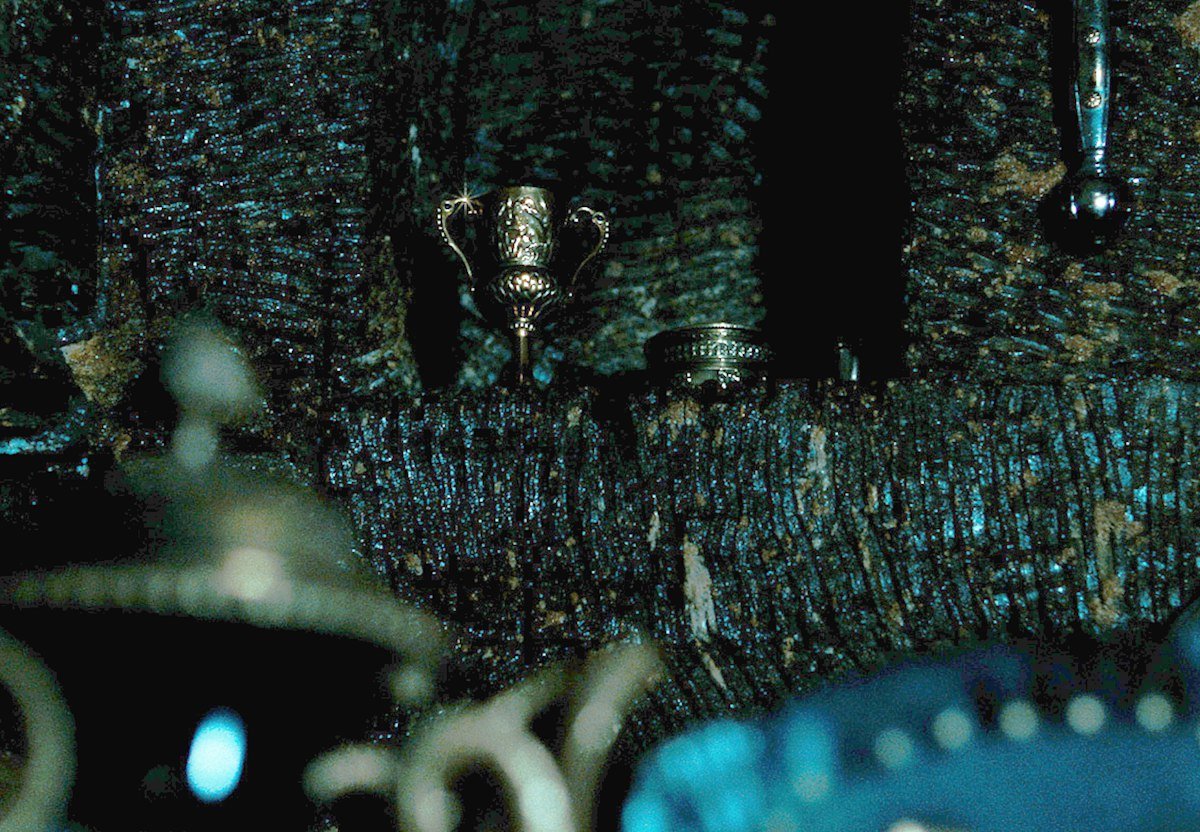
“A badger,” murmured Voldemort, examining the engraving upon the cup. “Then this was...?” He knew perfectly well. Hepzibah Smith, a very old and very rich collector who had befriended the young man from Borgin and Burkes, was showing off: Helga Hufflepuff’s own cup, small and golden with two finely wrought handles, handed down in her family “for years and years,” with all sorts of powers she admitted she had never tested thoroughly. Days later she was dead, and her house-elf Hokey remembered poisoning her mistress’s cocoa. She had done no such thing. Riddle put the memory there.
The scene survives in Hokey’s memory, which Dumbledore showed Harry – one of the memories viewed in the Pensieve during their lessons – and in it Riddle is also shown Slytherin’s locket. Both vanished with her. Rowling has said the cup became a Horcrux with Hepzibah’s murder, and Voldemort handed it to Bellatrix Lestrange, who locked it in her family’s vault at Gringotts behind a dragon.
Getting it out took Griphook, Hermione disguised as Bellatrix, Ron under a false name, the Imperius Curse on the bank’s staff and, on the way out, the dragon, which they freed. The cup was destroyed during the Battle of Hogwarts by Hermione, with a Basilisk fang fetched from the Chamber of Secrets and Ron beside her, and the novel reports it after the fact: Hufflepuff’s cup ends its story offstage, told by the two people who did it while Harry was busy elsewhere.
Rowena Ravenclaw’s Diadem
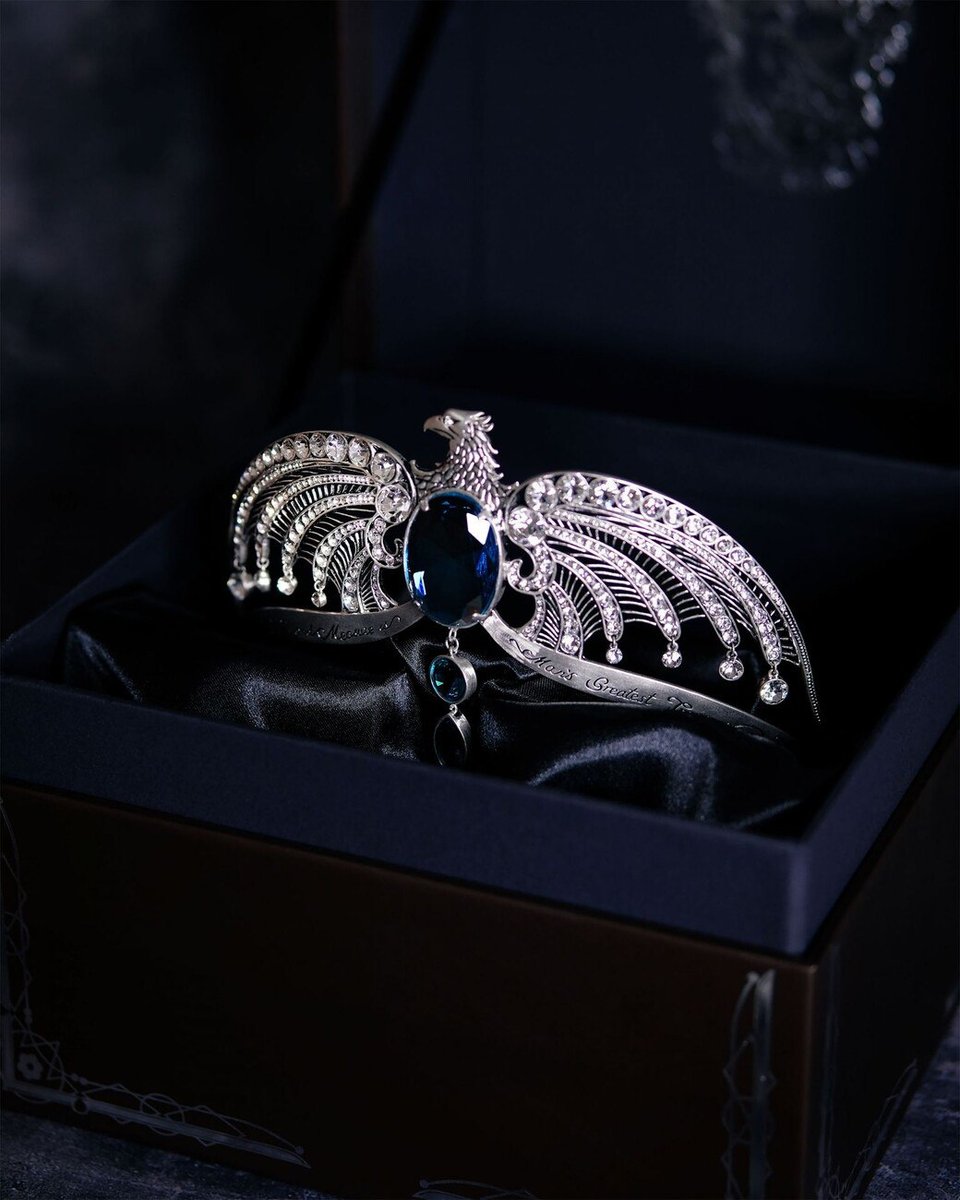
“Wit beyond measure is man’s greatest treasure,” says the inscription, in tiny letters Harry could just make out through the soot. It had been lost for centuries because Rowena Ravenclaw’s daughter stole it. “I stole the diadem,” Helena Ravenclaw told Harry. “I sought to make myself cleverer, more important than my mother. I ran away with it.” She ran to Albania and hid it in a hollow tree, and the man her mother sent to bring her home killed her when she refused, then killed himself in remorse. He haunts Hogwarts now as the Bloody Baron.
So does she. Helena is the Grey Lady of Ravenclaw House, one of the ghosts of Hogwarts, and a young Tom Riddle charmed her into telling him where the tree was. He fetched the diadem; Rowling has said the murder behind it was an Albanian peasant’s. Then he carried it back into the castle on the same visit in which he asked Dumbledore for a teaching job, and left it in the Room of Requirement among the junk. Dumbledore never learned what it was.
Harry found it as the Battle of Hogwarts began, and Vincent Crabbe destroyed it, along with himself, with Fiendfyre he could not control. It came out still hot, blackened with soot, and a bloodlike substance, dark and tarry, seemed to be leaking from it. Of everyone who might have ended a piece of Voldemort’s soul, the one who managed this piece was a Death Eater’s son.
Harry Potter (Accidental Horcrux)
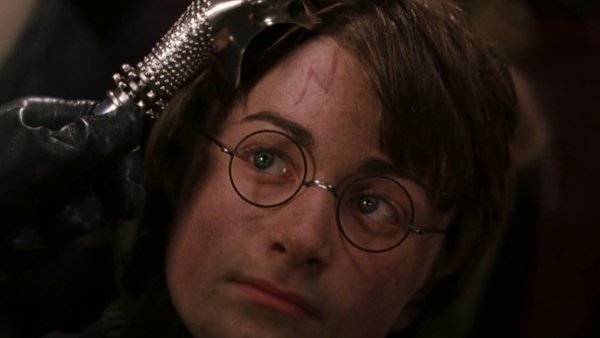
On the night of October 31, 1981, in a borrowed cottage at Godric’s Hollow, Voldemort killed James and Lily Potter and turned his wand on their son. The curse rebounded. What it did to Voldemort is the plot of the series; what it did to the baby is this entry. Rowling has described a soul so destabilised by repeated splitting that the backfiring curse split it again, and the loose fragment “flies off and attaches to the only living thing in the room.” Nobody performed a ritual. Nobody meant it. Rowling’s own phrase for the result is “the last and unintended Horcrux.”
Dumbledore worked it out and told Snape, in the memory Snape died to pass on: a part of Voldemort’s soul had attached itself to Harry, and as long as Harry lived, Voldemort could not die. It explained the scar, and it explained why Harry could see through a snake’s eyes. It also meant that Harry had to die. Harry read the memory, understood, and walked into the Forbidden Forest to let it happen.
Voldemort obliged. Harry woke somewhere that looked like King’s Cross and met what remained of the fragment that had lived in his head, now powerless. Voldemort had destroyed his own Horcrux with his own curse, and he never knew he had done it.
Nagini
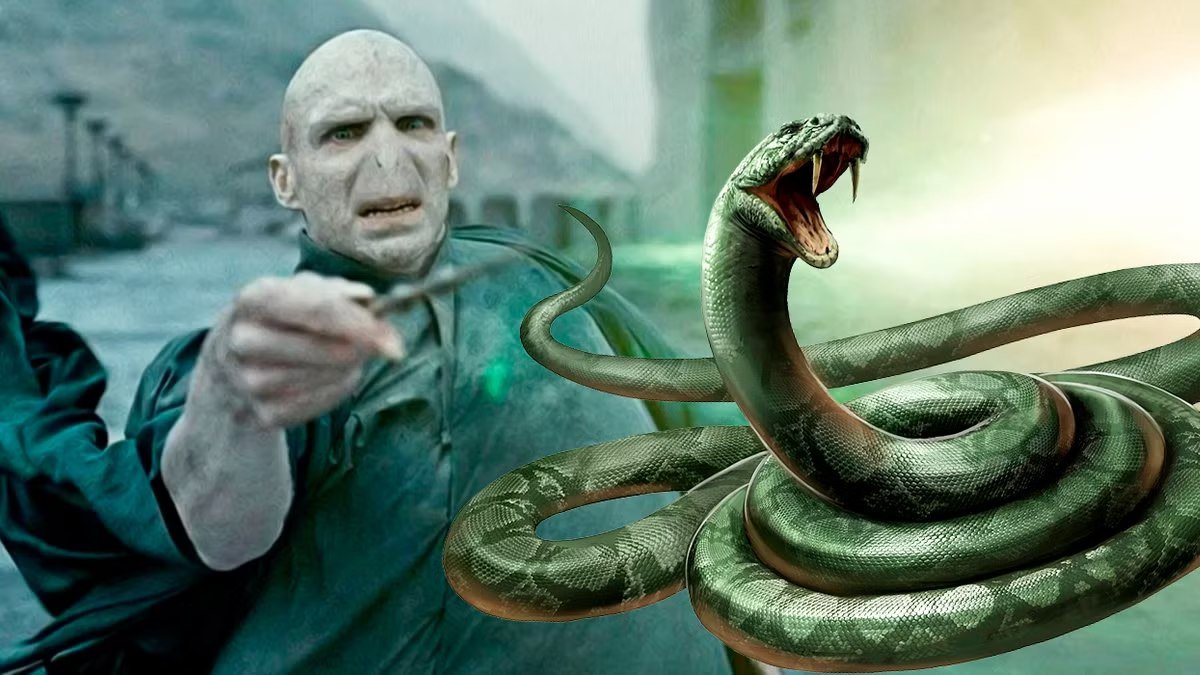
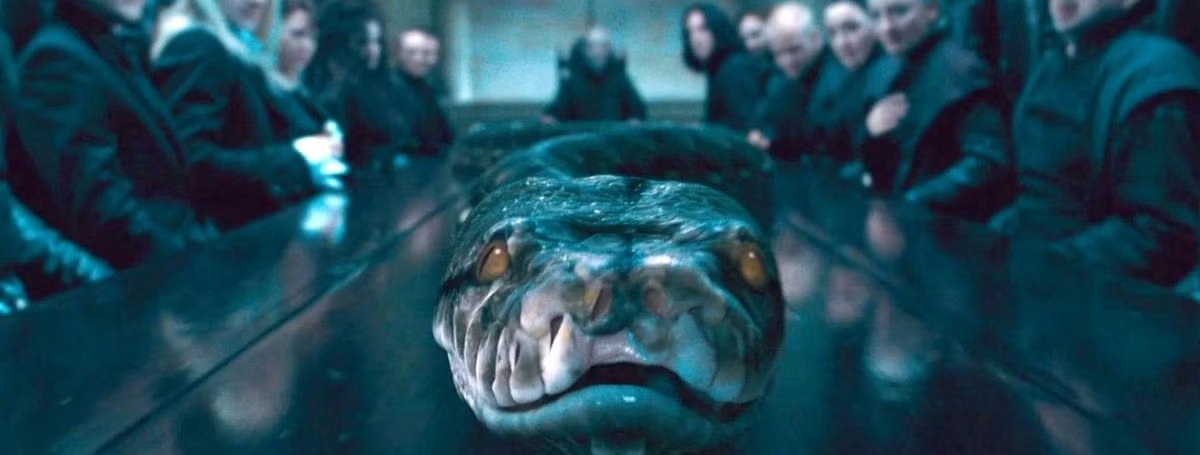
Voldemort never hid this one. The others were hidden away; Nagini stayed at his side, which is why she keeps turning up. She is there in the opening chapter of Goblet of Fire, eating the body of Frank Bryce, the Riddles’ gardener. She is there being milked to keep her master alive: “You will milk her before we retire, Wormtail,” says Voldemort, then a thing living off her venom. “I will need feeding in the night.”
She attacked Arthur Weasley outside the Department of Mysteries while Harry watched from behind her eyes. She waited for him inside the corpse of Bathilda Bagshot at Godric’s Hollow, hissing a language he only realised afterwards was Parseltongue. Dumbledore thought Voldemort had made her a Horcrux after using her to kill Frank Bryce; Rowling has said the murder was Bertha Jorkins’s, once Voldemort had a body again. Either way, Wizarding World’s official site has her as the last one he made, and by the end he was keeping her inside “a starry, transparent sphere somewhere between a glittering cage and a tank.”
On his way to the forest Harry told Neville that if he got the chance he should “Kill the snake.” Neville did, with the sword of Gryffindor, which he pulled out of the Sorting Hat after Voldemort had jammed the hat on his head and set it alight. Voldemort had, in effect, handed over the sword himself.
Frequently Asked Questions
Why do some sources say Voldemort’s soul was in eight pieces, not seven?
Because Harry was an accident. Dumbledore’s theory in Half-Blood Prince was that Riddle planned six Horcruxes, giving him a seven-part soul with the seventh piece kept back. Asked about it in a 2007 Bloomsbury webchat, Rowling said Voldemort “accidentally broke his soul into eight parts, not seven”: the six Horcruxes, the fragment in Harry, and the one he kept.
Was Harry Potter really one of Voldemort’s Horcruxes?
Not by Rowling’s definition. On PotterCast in December 2007 she said she thinks “by definition, a Horcrux has to be made intentionally,” and that Voldemort’s over-split soul shed a fragment onto the nearest living thing. On the official Wizarding World site, Voldemort “effectively made one by mistake.” This list keeps Harry, labelled accidental, because the novels treat him as one.
Which Horcrux did Voldemort make first?
The novels do not say, and the sources that do disagree. The official Wizarding World site calls the diary his first Horcrux, made after Myrtle’s death at Hogwarts. The Harry Potter Lexicon’s own chapter timeline puts the ring first, on the strength of the Riddle killings. Nobody knows when the rituals were performed, so this list prints no creation dates.
Was Professor Quirrell a Horcrux?
No. Quirrell carried Voldemort’s spirit, which is possession rather than a Horcrux. The official Wizarding World site says: “Though not a ’true’ Horcrux, Quirrell did temporarily contain part of Voldemort’s soul. Unlike the other Horcruxes, the soul fragment escaped before the vessel was destroyed.” The piece that stayed in Voldemort’s own body is excluded for the same reason.
What can actually destroy a Horcrux?
Very little. Basilisk venom, which Wizarding World’s official site calls “one of the few things powerful enough to destroy a Horcrux,” accounts for the diary and the cup. The sword of Gryffindor took the ring, the locket and Nagini. Fiendfyre took the diadem. The fragment in Harry needed only Voldemort’s own Killing Curse.
Did Voldemort ever get a Horcrux from something of Gryffindor’s?
No. He took relics from three founders – Ravenclaw’s diadem, Hufflepuff’s cup and Slytherin’s locket – but nothing of Gryffindor’s was ever corrupted. The official Wizarding World site counts the sword among his failures: his “failure to corrupt Harry, or the sword by making it a Horcrux, eventually spelled his downfall.” The Gryffindor he did touch was Harry, by accident.
Was the Sorting Hat a Horcrux?
No, though fans wondered before the last book, and the only evidence anyone could point to was its wish to put Harry in Slytherin. Rowling later explained why: she always imagined the hat “detected the presence of that piece of soul when Harry first tried it on.”
Do the films, Cursed Child or the games change this list?
No. This list uses the seven novels only; film scenes, the Cursed Child play, the screenplays, the Famous Wizard Cards and the video games are not counted. The clearest case is Nagini: the Fantastic Beasts films give her a human past as a Maledictus, and the official Wizarding World site repeats it, but the novels never mention it.
- J.K. Rowling, Harry Potter and the Half-Blood Prince, chapter 23, Horcruxes (Bloomsbury, 2005)
- J.K. Rowling, Harry Potter and the Deathly Hallows, chapters 19, 31 and 33 to 36 (Bloomsbury, 2007)
- J.K. Rowling, Harry Potter and the Chamber of Secrets, chapter 17, The Heir of Slytherin (Bloomsbury, 1998)
- The Harry Potter Lexicon: Horcrux (chapter-citation index consulted for every entry)
- Wizarding World: What is the story behind each of Lord Voldemort’s Horcruxes?
- Wizarding World: Everyone connected to Voldemort’s Horcruxes
- J.K. Rowling, Bloomsbury webchat, 30 July 2007 (Accio Quote transcript)
- J.K. Rowling on PotterCast, 17 December 2007 (Accio Quote transcript)