Every U.S. State Capital That Has Been Moved
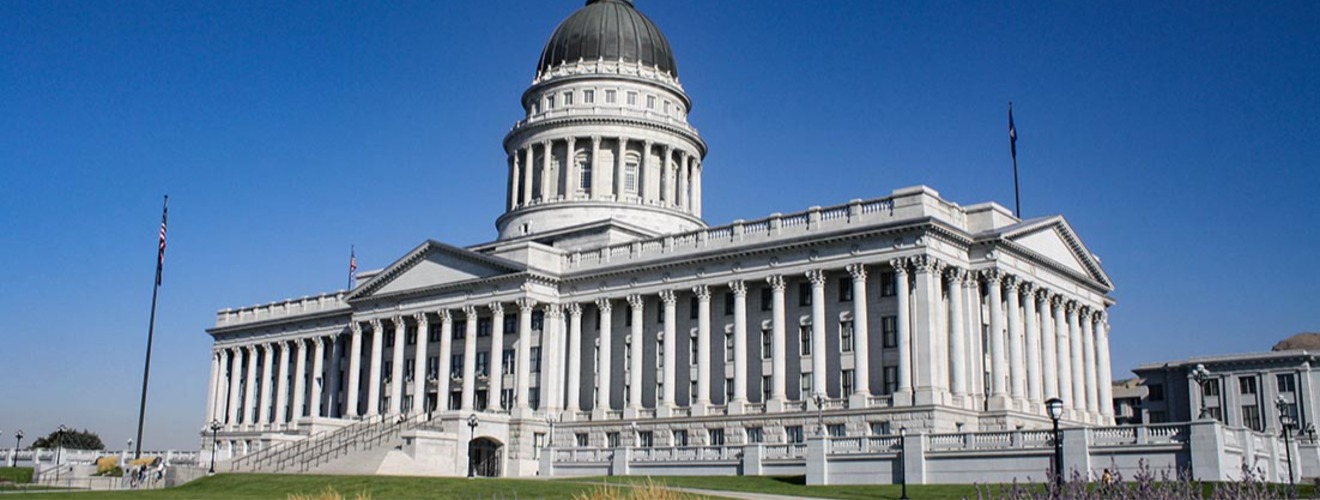
On Monday 21 September 1807 the Tennessee General Assembly convened at Kingston, organized itself, and voted to leave. The Senate divided 8 to 4 on a resolution to “adjourn forthwith” to the court-house in Knoxville. The public papers that had been carted in for the occasion were ordered “reconveyed from this place to Knoxville, as soon as practicable,” and some weeks later the Senate received “the claim of Jacob Jones for tables, &c. furnished the general assembly while sitting at Kingston.” The state’s own history sums it up: “the capital was Kingston for a day.”
It was not quite a whim. A year earlier the legislature had resolved that the state’s public offices be kept at Kingston “as the seat of government,” and a Cherokee treaty of 1805 had described the spot as “a desirable place for the assembly of the state of Tennessee to convene at,” which was a hope rather than a promise. Kingston shows why a list like this needs a rule. Governments have met in taverns, hotels, churches, banks and an opera house, and sat for a day, a season or most of a war in places that never became the capital.
Counted strictly, the formal moves run from Delaware’s act of May 1777 to Oklahoma’s of December 1910, and twenty-two states never made one at all, Maryland, Massachusetts and Hawaii among them. Louisiana, Georgia and Tennessee make up for the rest. What follows is every one, in the order the laws and votes were made.
Forty-nine relocations of a U.S. state’s seat of government took place between 1777 and 1910, in 47 entries across 28 states: permanent moves made by act, legislative vote, constitution or popular vote after statehood, not a legislature fleeing an army or sitting somewhere for a day. The list is compiled state by state from each state’s own record.
Delaware: New Castle to Dover (1777)
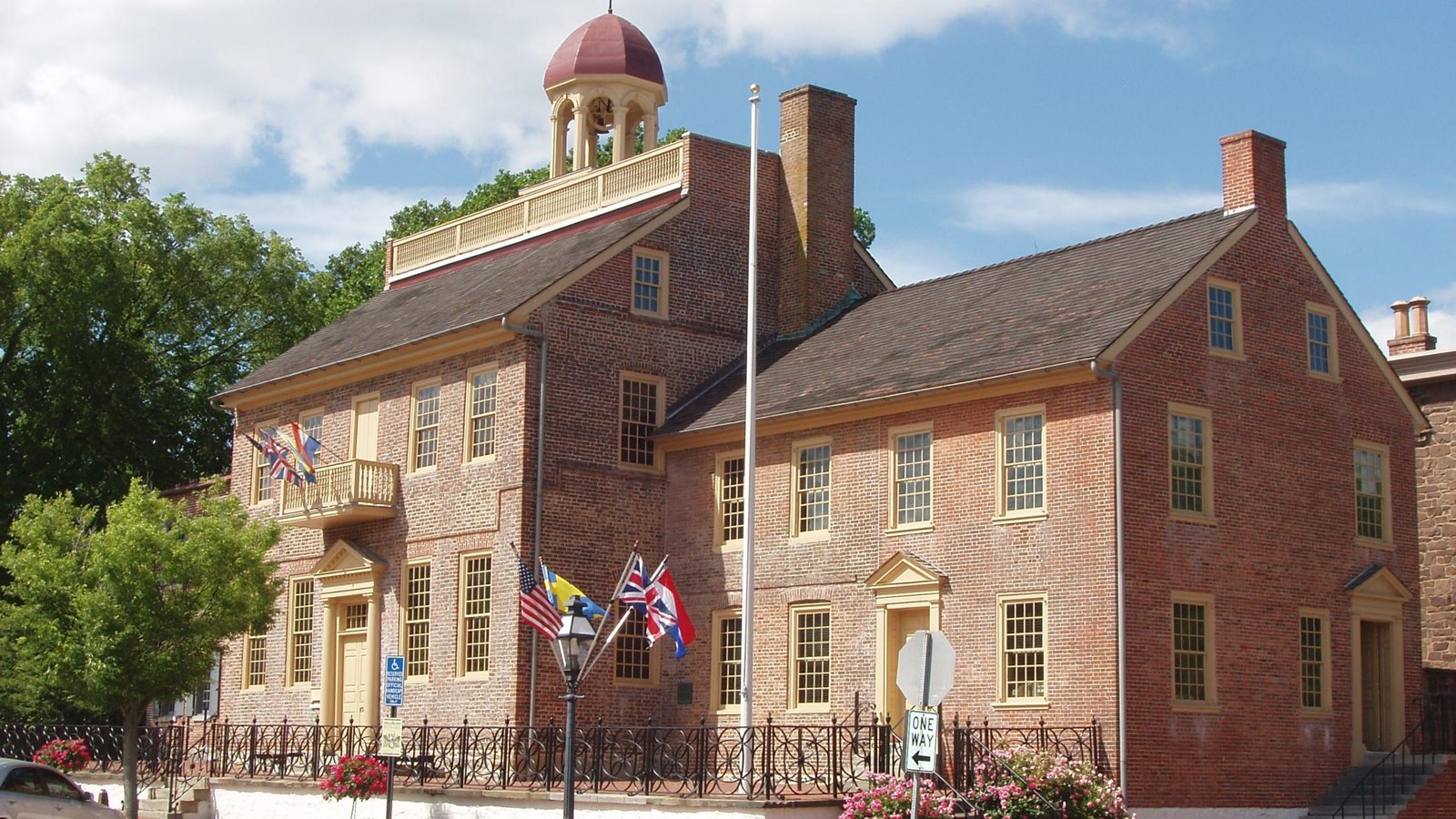
A traveler in 1747 counted twenty houses in Dover, not much of a town for a place William Penn had ordered laid out in 1683. On 12 May 1777 the General Assembly, sitting at New Castle, passed “An ACT for the holding of the General Assembly at Dover, in the county of Kent,” and gave its reasons with refreshing frankness: the seat of government should be “as central and convenient to all the inhabitants of the state as possible,” and the trek to New Castle had “been long found extremely burthensome” to the people of Kent and Sussex.
The act came before the worst of the war reached Delaware. President John McKinly was not captured until after the Battle of Brandywine, on 11 September 1777. The war did get at the paperwork. By 28 October 1779 a later act conceded that the enrolled 1777 law had “fallen into the hands of the British troops,” and fixed the Assembly’s yearly meeting at Dover “for ever.”
The first sitting at Dover, on 20 October 1777, was not a triumph. The Council lacked a quorum and adjourned from day to day, and the House never formed one at all, because a riotous election had kept every Sussex County member out of his seat. Lawmakers had no building of their own until the Old State House was finished in 1791. New Castle kept its courthouse and stayed a county seat for another hundred years, which is about as gracefully as anyone loses a capital.
Virginia: Williamsburg to Richmond (1779)
For eight days in May 1780, Virginia’s House of Delegates met in Richmond and adjourned, met and adjourned, for want of a quorum, until on 9 May enough members had straggled in to elect Benjamin Harrison Speaker. The room was the William Cunningham warehouse at Pearl and Cary Streets, possibly a tobacco warehouse confiscated from a loyalist, in a town of about 600 people. It served as the capitol until 1788.
The law behind all this, “An act for the removal of the seat of government,” was signed on 18 June 1779. Its preamble wanted a capital “more safe and central than any other town situated on navigable water,” safe meaning beyond “the insults and injuries of the publick enemy.” It reserved six whole squares for a capitol, courts, a jail and a governor’s house, capped the bill at twenty thousand pounds, and forbade the twelve freeholders valuing the land to take anything “either of meat or drink from any person whatever” until their work was sealed.
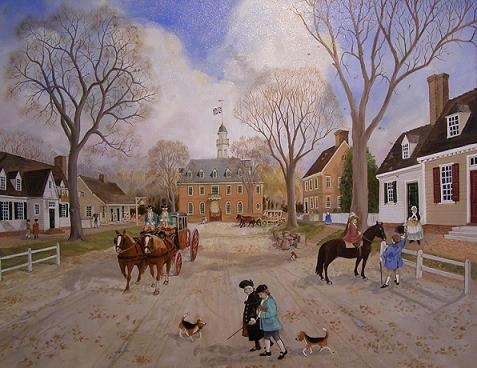
Williamsburg, which had been one of the colonial capitals of the thirteen original colonies since 1699, was left to George Wythe’s moot courts, and its old Capitol was later lost to fire. Richmond’s safety, meanwhile, was tested almost at once. In January 1781 Benedict Arnold arrived with about 2,000 British soldiers, and by June the legislature, having fled to Charlottesville, was meeting in the Episcopal Church in Staunton. It came back that October to the Cunningham warehouse, which had survived the visit.
Georgia: Savannah to Augusta (1785)
Quorums were the problem. Georgia’s legislature tried to convene at Augusta on 15 May 1783 and could not muster one until 8 July, and in July 1784 it failed again for a week, after which the members asked the governor to summon them when needed. On 22 February 1785, closing a Savannah session, the General Assembly resolved, by the New Georgia Encyclopedia’s account, that “all future meetings of the Legislature shall be and continue at that place (Augusta) until otherwise ordered by the General Assembly.”
Augusta won because the backcountry wanted its legislature within reach. The Assembly handled divorces, name changes, land grants, ferries, pardons and licenses to practice law, and the settlers asking for them lived upriver, not on the coast. Savannah had never had a statehouse anyway; lawmakers there probably met in taverns, Peter Tondee’s among them, and in private homes. At Augusta, where the first session under the resolution opened on 3 January 1786, they rented the house of Abraham Jones at Broad and Lincoln Streets.
The arrangement was provisional almost before it started. During that first Augusta session the legislature voted to build a brand-new capital from nothing and call it Louisville, keeping Augusta only until the buildings were up. Augusta still collected the occasions in the meantime. Georgia ratified the U.S. Constitution there on 2 January 1788, the fourth state to do so, and in 1789 the Assembly meeting in the town adopted the constitution that created the two-house legislature Georgia has kept since.
South Carolina: Charleston to Columbia (1786)
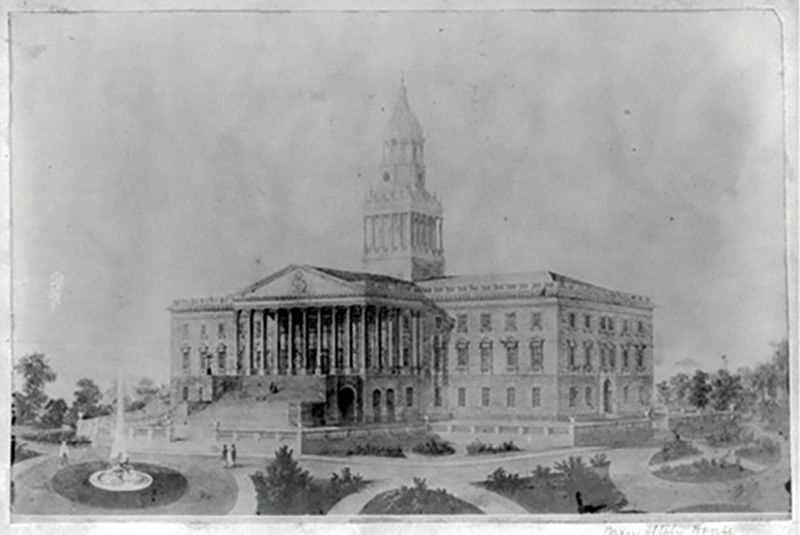
George Washington rode through in May 1791 and pronounced South Carolina’s new capital “an uncleared wood, with very few houses in it.” He was being accurate rather than rude. The legislature had voted for Columbia in 1786 and had been meeting there only since January 1790, in a State House that was not finished.
Act No. 1333 was ratified on 22 March 1786, its preamble complaining that keeping the government in Charleston was “productive of many inconveniencies and great expense to the citizens of this State.” It ordered a town two miles square near Friday’s Ferry on the Congaree River, with two principal streets 150 feet wide and a name, Columbia, chosen before a single lot was sold. Five commissioners, every one of whom, the South Carolina Encyclopedia notes, owned property in the neighborhood, bought 2,471 acres from ten landowners in April 1786. The catch was in the wording: Columbia would become the seat only once the public buildings were up, so Charleston carried on as capital for nearly four more years. Charleston’s own State House burned on 5 February 1788 while it waited.
Selling the town proved harder than drawing it. Buyers had to build a house at least thirty feet long and eighteen wide, with brick or stone chimneys, within three years, and some lots were, in the same encyclopedia’s phrase, “inexplicably under the waters of the Congaree.” The wooden State House lasted until 17 February 1865, when fire destroyed it as Sherman’s army took the city.
New Jersey: A Wandering Legislature Settles on Trenton (1790)
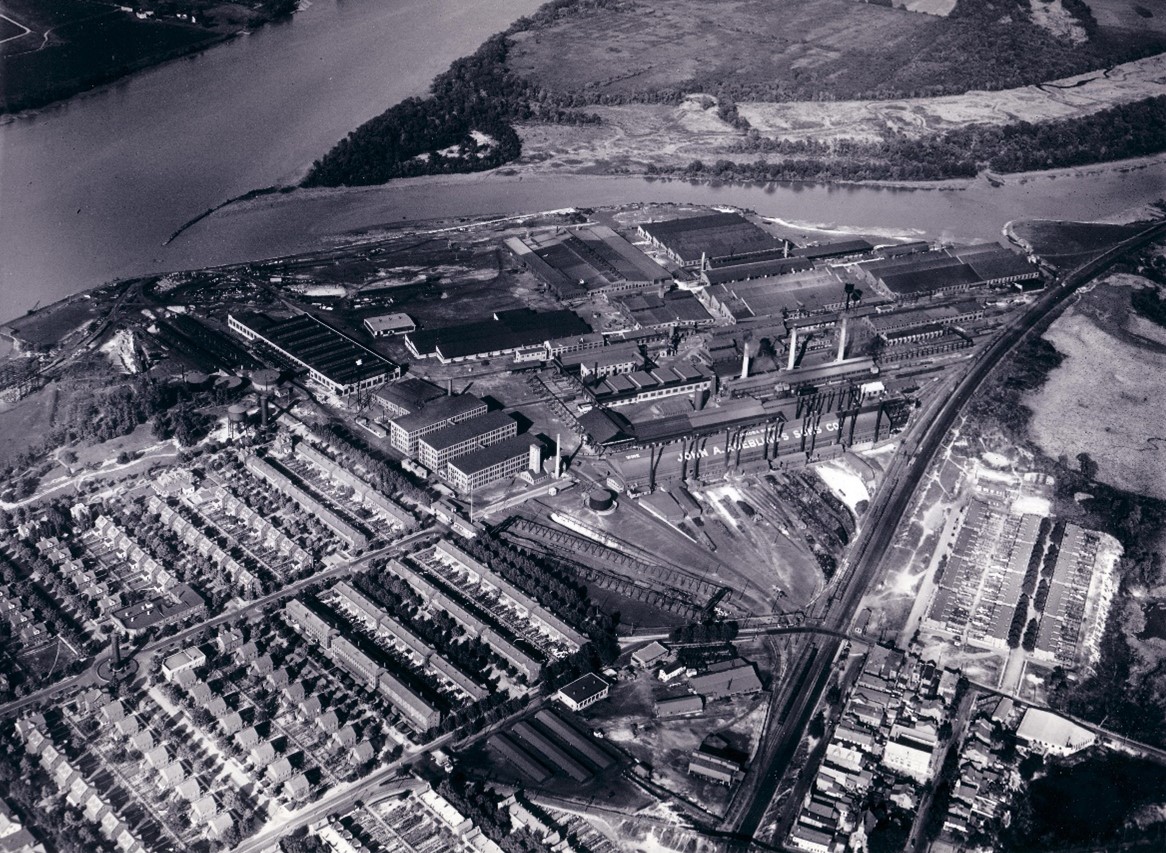
For most of the eighteenth century New Jersey had two capitals, Perth Amboy for East Jersey and Burlington for West Jersey, and independence did not settle the matter so much as add a third venue. The legislature opened its October sessions at Trenton in 1788, at Perth Amboy in 1789 and at Burlington in 1790. It was at Burlington, on 25 November 1790, that it finally passed “An act for fixing a permanent Seat of government in this state,” declaring that “Trenton, in the county of Hunterdon, shall henceforth be considered as the seat of the government of this state.”
The furniture had to catch up. The Assembly’s chairs and tables were stored at Perth Amboy in the care of James Parker, and the same day the clerk, Maskell Ewing, was ordered to get them moved “from Amboy to Trenton, the Place established by Law for the Seat of Government.” Seven commissioners bought about three and three-quarter acres running from West State Street down to the Delaware River for 250 pounds 5 shillings, and the State House that rose there, designed by Jonathan Doane, was finished in 1792 with a bell tower rather than a dome.
The legislature first met at Trenton under the new act on 25 October 1791. Paper took longer. In 1795 the legislature authorized a second building on the State House lot so that New Jersey’s public archives could, in the State Library’s word, “finally” sit in one place.
North Carolina: An Itinerant Assembly Settles on Raleigh (1792)
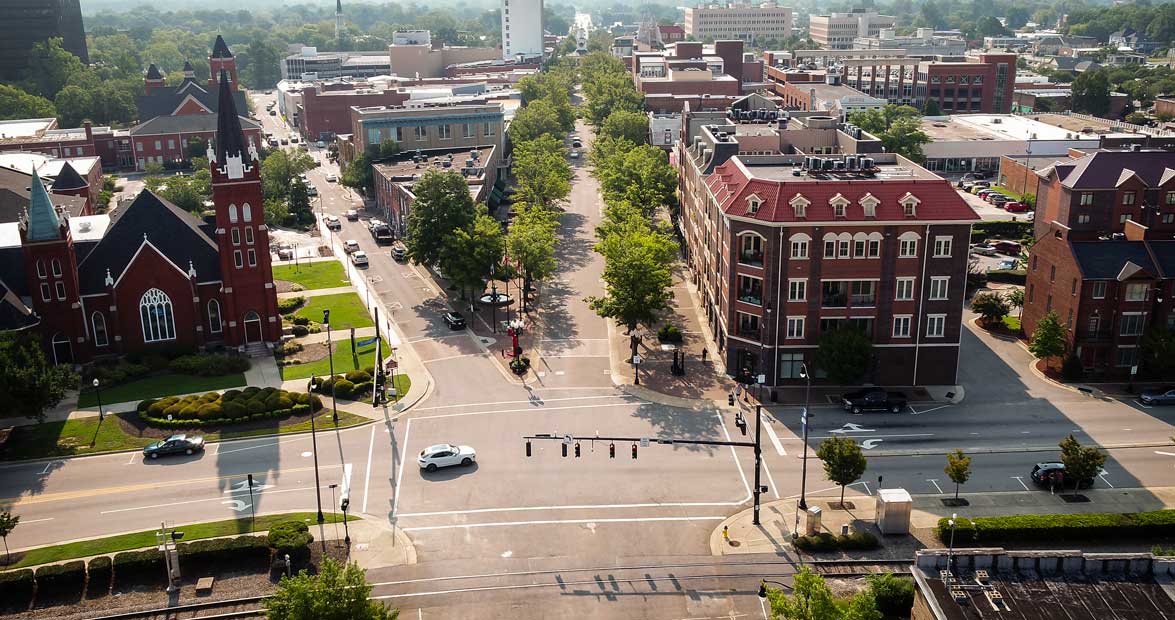
Between 1715 and 1787 North Carolina’s legislature met at Queen Anne’s Creek, Edenton, Wilmington, Bath, New Bern, Kinston, Halifax, Smithfield, Hillsboro, Salem, Fayetteville and Tarboro, and members sometimes rode hundreds of miles to find it. In August 1788 the Hillsborough Convention decided to stop moving and chose not a town but a radius: somewhere within ten miles of Isaac Hunter’s plantation in Wake County. According to NCpedia, 119 delegates signed a petition calling the place “unconnected with commerce” and predicting it would “never rise above the degree of a village.”
Then nothing happened. A bill to carry out the decision died narrowly in the Senate on 25 November 1790, its opponents referring to Wake County simply as “the wilderness.” When a bill finally passed, commissioners surveyed the land of 16 owners, voted twice, and on 5 April 1792 bought 1,000 acres not from Hunter but from Joel Lane, a Wake County senator, for 1,378 pounds. William Christmas laid out 400 acres in 276 lots around a six-acre Union Square, borrowing the 1758 plan for “George City,” a colonial capital never built.
The legislature named the place Raleigh, declared it “the permanent and unalterable seat of the government,” and first met there on 30 December 1794. Very few people wanted to live in it. An act, which NCpedia dates to 1798, made Raleigh the governor’s “common residence” and required him to advertise in the newspapers whenever he left town for more than 10 days. The petitioners of 1788 had a point.
Kentucky: Lexington to Frankfort (1792)
No legislature ever voted to put the capital of Kentucky at Frankfort. The 1792 constitution handed the decision to a jury of sorts: the House of Representatives nominated 21 men, the Mercer and Fayette County delegations struck names until five were left, and those five commissioners, John Allen, John Edwards, Henry Lee, Thomas Kennedy and Robert Todd, were given power “to fix on the place for the seat of government, to receive grants from individuals therefor.” Seven communities bid. On 5 December 1792 the commissioners chose Frankfort.
The grants made the difference. Andrew Holmes offered, according to early histories, his log house as a capitol for seven years, a number of town lots, 50 pounds’ worth of locks and hinges, 10 boxes of glass, 1,500 pounds of nails and $3,000 in gold. It was a hardware store’s idea of an inducement, and it worked. The Kentucky Gazette reported on 8 December 1792 that the commissioners “came to a final decision in favor of Frankfort,” a town whose name had worn down from “Frank’s Ford,” after a settler, Stephen Frank, killed at or near the site in 1780.
Lexington had only hosted the first General Assembly’s two sessions of 1792; no act naming it the capital has been found. Frankfort kept the job despite its buildings. The first capitol, finished by 1794, burned in 1813, and the legislature talked about leaving until donations from Frankfort’s citizens persuaded it to stay. The second, completed in 1816, burned in 1824.
Georgia: Augusta to Louisville (1795)
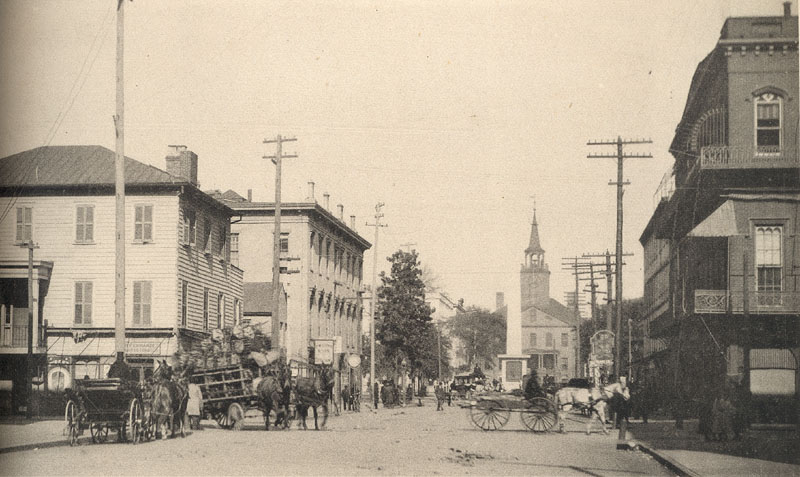
Fire from heaven, focused through a sunglass, is how the state’s own historical marker says the Yazoo land act was destroyed in 1796, on the grounds of Georgia’s new capitol at Louisville. The 1794 legislature had sold 35,000,000 acres along the Yazoo River at 1 1/2 cents an acre, James Jackson resigned from the U.S. Senate to undo it, and the Rescinding Act of 1796 nullified the sale. Burning the records was the ceremonial part. Louisville supplied the lawn.
The town had long existed on paper. A 1786 ordinance named it, sent three commissioners, Nathan Brownson, William Few and Hugh Lawson, to buy up to 1,000 acres within 20 miles of Galphin’s old town, and paid for it by selling the old government house in Savannah. The commissioners posted a 6,000-pound bond and could claim no more than 2 dollars a day in expenses. Then war debt, the threat of conflict with the Muscogee (Creek) Nation, a lack of money and the death of the contractor stalled everything until 1795.
The statehouse’s first business was not legislation at all. A constitutional convention met in it and, on 16 May 1795, adopted an article declaring “That Louisville be the permanent seat of government,” ordering the state’s officers there. The General Assembly followed in January 1796. Three years later the 1798 constitution named Louisville the seat of government again and quietly left out the word “permanent,” which proved to be the most farsighted thing in it.
New York: New York City to Albany (1797)
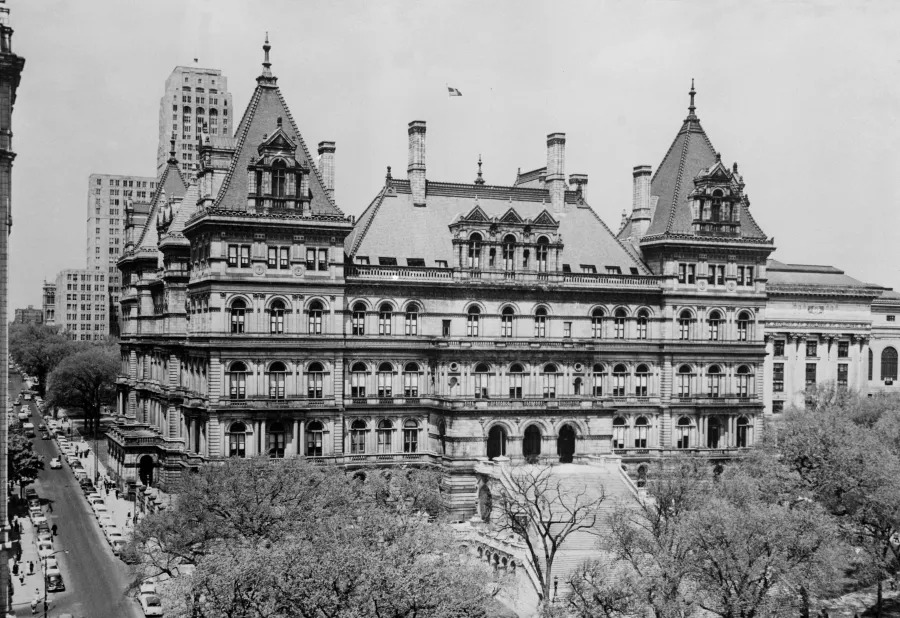
The bill that made Albany the home of New York’s government started life as “An act for establishing the permanent seat of government.” A committee renamed it “An act for erecting and establishing certain public offices in the city of Albany,” and the Laws printed it as “An ACT for erecting a public Building in the County of Albany, and for other purposes.” When it passed on 10 March 1797, the statute never used the words “capital” or “seat of government.”
It was also late. The legislature had opened its session in New York City on 1 November 1796, voted on 11 November to adjourn to Albany, and first sat there on 3 January 1797, more than two months before the law. It met in the Stadt Huys, a building that, as the New York State Senate’s history puts it, “also serves as the City Hall, County Court House, prison, and State House.” Sharing a roof with the jail was not meant as a comment.
What the statute actually changed was a fallback. Under a 1786 act, a legislature that had adjourned without naming a place met at “the Place at which the laft preceeding Meeting of the Legislature was held.” The 1797 act kept the sentence and swapped the ending for “the city of Albany.” It also allowed up to 10,000 dollars from the state prison fund for a records building. Albany became the capital of New York by default, in the most literal sense of the word.
Pennsylvania: Philadelphia to Lancaster (1799)
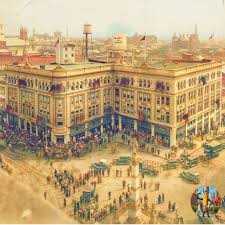
Nine votes to fourteen killed Harrisburg in the Pennsylvania Senate on 26 March 1799. The next day the same Senate passed a bill moving every state office to Lancaster, 14 to 10, and the House agreed 44 to 24 on 30 March. Governor Thomas Mifflin signed it on 3 April 1799, ordering the offices out of Philadelphia before the first Tuesday in November, to stay “until the permanent seat of the government shall be hereafter establish.”
Yellow fever did the persuading. Epidemics in 1793, 1797 and 1798 had, in the words of a House resolution of 18 January 1799, “raged at particular periods so as not only almost to depopulate the city, but to render it dangerous for the Members of the Legislature to meet therein.” Lancaster’s boosters had promised “the best accommodations available, a strengthened police force, and culture (through a new library subscription),” and room and board cost as little as two dollars a week. It had also been one of the cities that served as the U.S. capital, if only for one day, on 27 September 1777, as the Continental Congress fled Philadelphia.
Pennsylvania built nothing there. It rented the Lancaster County courthouse on Penn Square and governed from it from December 1799. As the state’s heritage magazine put it, “there was a strong feeling that it would be only a temporary seat of government,” and on that point everyone was right. The courthouse that residents took to calling the State House was demolished in 1853.
Georgia: Louisville to Milledgeville (1804)
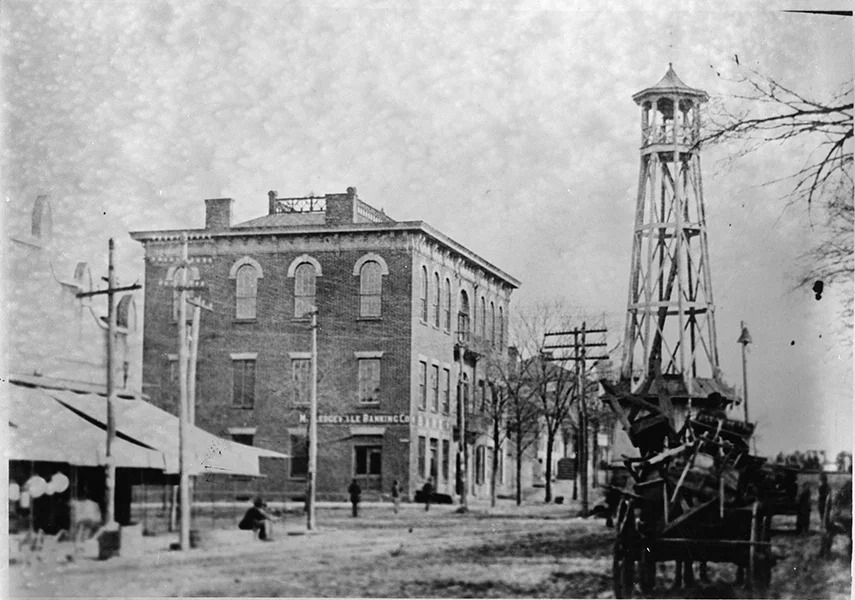
Fifteen wagons, escorted by troops, hauled Georgia’s treasury and public records out of Louisville in October 1807, according to the state encyclopedia. The law that sent them was by then old news. Act No. 161, assented by Governor John Milledge on 12 December 1804, made “the town of Milledgeville the permanent seat of Government,” but nobody was to go anywhere until the governor proclaimed the new State-House ready.
The town was named for the governor who signed the act. It was laid out on 500 acres in 84 four-acre squares, plus four public squares of 20 acres each, a plan the encyclopedia says borrowed from Savannah and Washington, D.C. Georgia paid for its capital by selling it: commissioners could auction up to twenty one-acre lots, no more than two per buyer, and every buyer had to improve his lot to the value of 100 dollars within two years or lose it. A second act in 1805 capped the brick State-House at 60,000 dollars and bonded the contractor for 40,000 to finish by 1 October 1807.
The building that resulted was Gothic revival, with brick walls about four feet thick and no dome, and in the encyclopedia’s words it “resembled instead a castle or fortress.” That suited the neighborhood. Early Milledgeville was “a rather crude frontier community with simple clapboard houses, a multitude of inns and taverns,” and the encyclopedia records travelers’ complaints of “the gambling, the dueling, and the bitter political feuds.” The legislature settled in comfortably.
Vermont: Fourteen Towns Give Way to Montpelier (1805)
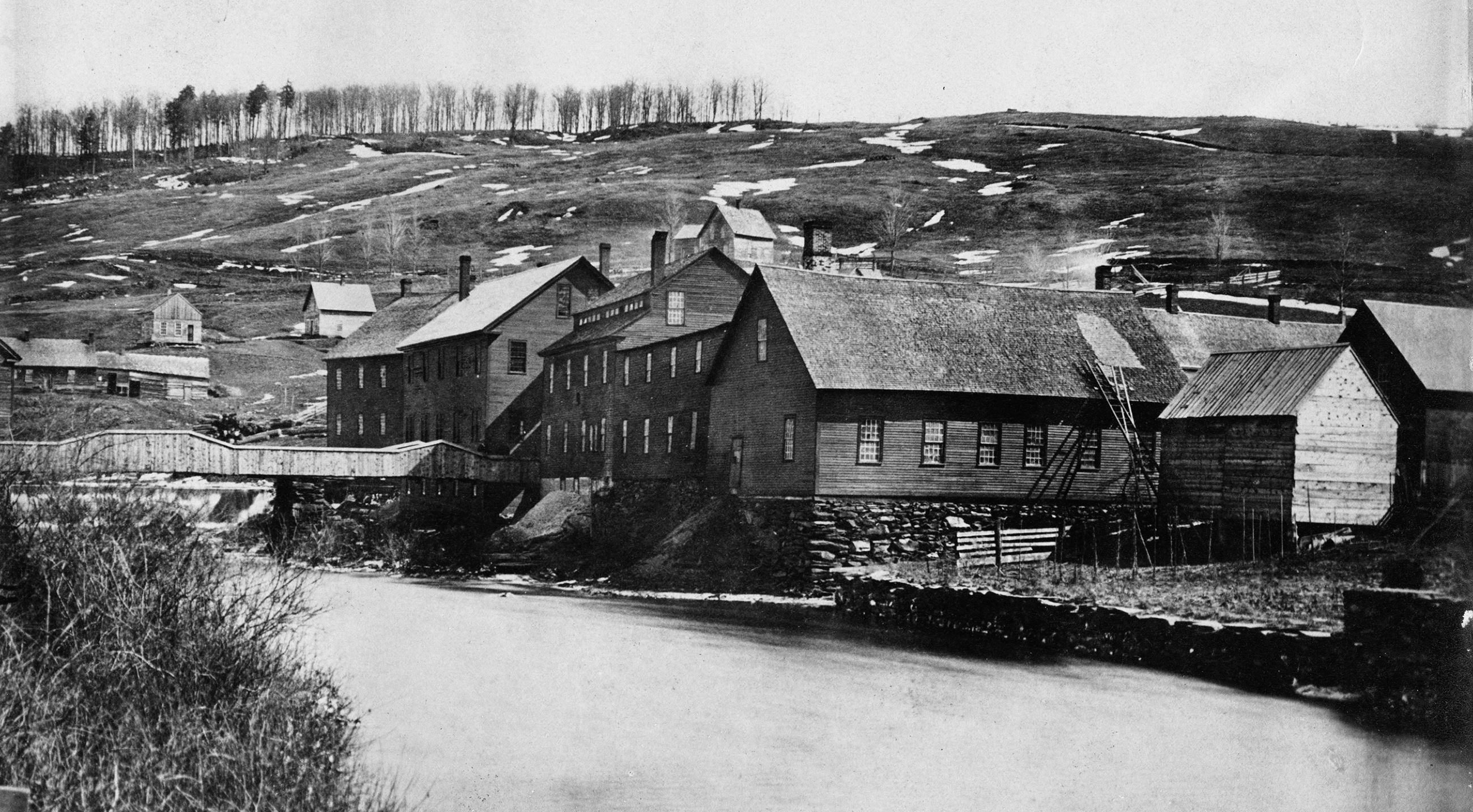
Vermont’s early lawmakers, according to the Secretary of State’s 1896 Legislative Directory, were “as peripatetic as German peddlers,” and with reason. Between 1777 and 1807 the General Assembly met 46 times in 14 different towns on both sides of the Green Mountains. For part of that time Vermont was one of the states that were once independent countries, having declared itself the State of New Connecticut on 15 January 1777 before joining the Union as the 14th state on 4 March 1791.
Montpelier won by being on neither side. A House committee “unanimously agreed on the expediency of the measure of fixing a permanent seat” and named Montpelier “the most convenient place for the accommodation of the state at large.” The act passed at Danville on 8 November 1805 with a condition: the town had to provide the land and build a State House by 1 September 1808. Thomas Davis gave the land, the building cost about 9,000 dollars, and a committee certified it “erected and finished” on 1 September 1808, the day of the deadline.
Finished was a generous word. When the Assembly first convened there on 13 October 1808, the House appointed a committee to see about “completing the painting of the state house, providing a bell.” Members sat at pine desks around a two-story stove, and one historian notes that many of the desks were “whittled out of use” by legislative jackknives. Montpelier had 113 inhabitants in 1791. It had acquired a captive audience.
New Hampshire: A Rotating Legislature Settles on Concord (1807)

The question before the legislature in June 1807 was not where New Hampshire’s capital should be. It was where the members should meet next June, which in New Hampshire came to the same thing. The state had no fixed seat; the general court met in churches, town halls and taverns around the state, and in December 1805 it had gone to Portsmouth “in compliment to Governor Langdon.” Hopkinton, Salisbury and Concord had been fighting over the June session for years.
On 18 June 1807 the House voted 89 to 61 for Hopkinton. The next day the Senate sent the vote back with an amendment “that the word Hopkinton be erased, and the word CONCORD inserted,” and the House concurred. The legislature met at Concord in June 1808 and never left, though nobody quite said so. The town’s historian notes that the recognition “had not been given by formal declaratory enactment – nor was so to be,” and in December 1808 the House was still voting on where to hold the following June’s session. It picked Concord again.
The first real commitment came on 22 June 1816, when a resolve ordered a State House built in Concord, provided the town gave the land and all the stone; prison convicts could be set to hammering the granite, and the building was ready for the June 1819 session. Concord adjusted to its new dignity in stages. In 1810 the town voted a penalty for “every swine found running at large” on Main Street.
Ohio: Chillicothe to Zanesville and Back (1810)
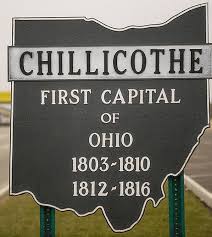
Almost as soon as it made Zanesville the capital of Ohio, the legislature arranged to replace it. “An act fixing the temporary seat of Government at Zanesville” passed in February 1810, after the House struck the word “permanently” from the bill, and on 20 February a second act sent five commissioners to find a permanent seat “not more than forty miles from what may be deemed the common center of the state.” Zanesville did not qualify.
It had won by building first. Zanesville raised a brick courthouse in 1809, on a 7,500-dollar contract backed by local men’s bonds, while Springfield across the Muskingum raised the Stone Academy, each town hoping the legislature would move into its building. “Neither town deceived the other as to its real intention,” the county’s history observes. The legislature took Zanesville’s and opened its first session there on 3 December 1810. According to the same county history, an earthquake one cold day in February 1811 set the steeple vibrating six inches and sent legislators out through the windows.
The return was settled on 14 February 1812, when the permanent-seat act made Chillicothe the temporary seat again from 1 May 1812, after the House had pushed it in over Lancaster 25 to 20. Zanesville kept one last duty. On 21 February 1812, its final day as host, the legislature resolved that the new town opposite Franklinton be called Columbus, having rejected “Ohio City” by 19 votes to 22. Zanesville had named its own replacement.
Pennsylvania: Lancaster to Harrisburg (1810)
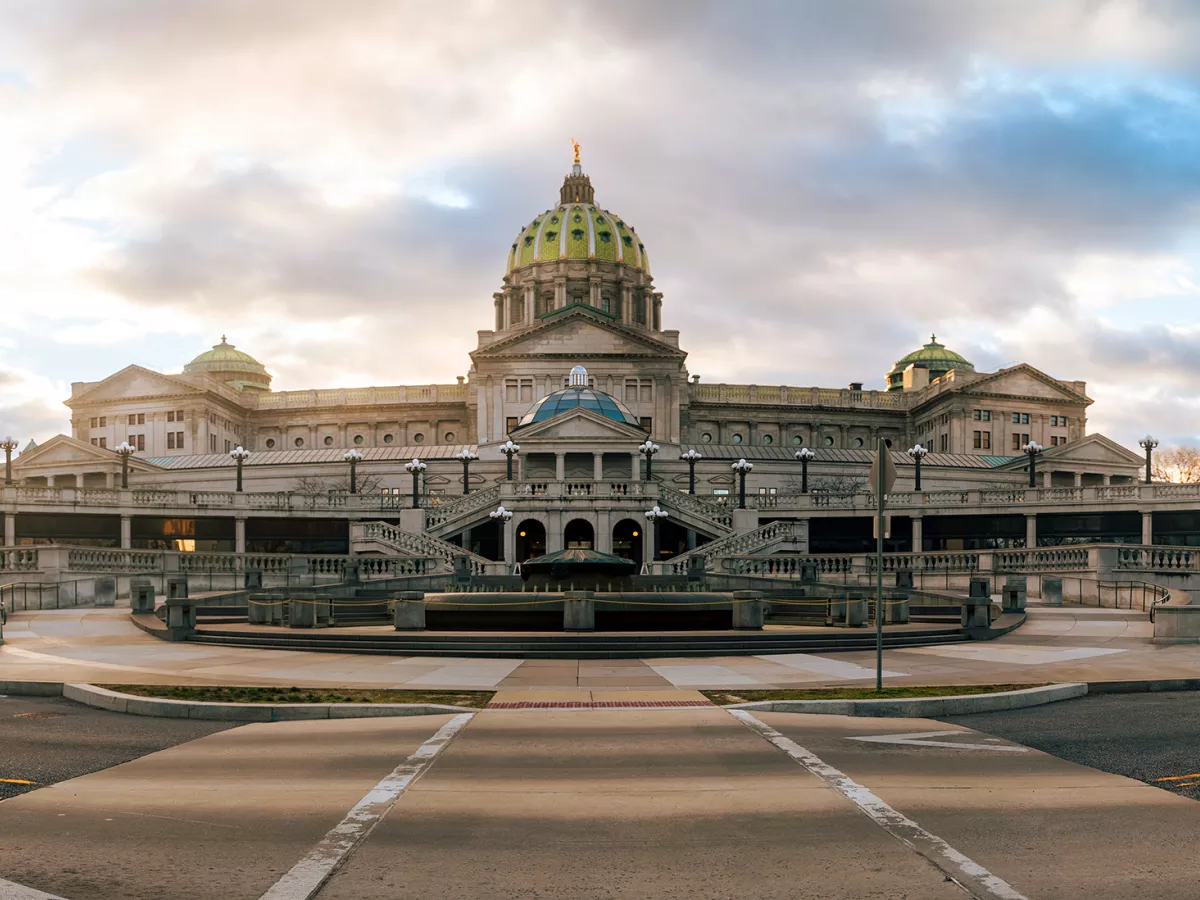
John Harris had left a place at the table. When Pennsylvania’s legislature voted to move to Harrisburg, its act of 21 February 1810 pointed to “the four acre lot formerly appropriated by John Harris, for the use of the state,” reserved by the town’s founder long before anyone decided where the capital should go. The state topped it up with ten adjoining acres bought from William M’Clay at one hundred dollars an acre.
Nobody was rushed. The act gave the government until October 1812 to pack, requiring every office to be out within the month of October 1812. It set aside $30,000 for six offices, each to be fire-proof for the safe keeping of the records, and paid the three commissioners who supervised the move, Robert Harris, George Hoyer and George Zeigler, $2.50 for each day’s attendance. By 3 December 1812, Governor Simon Snyder’s message was being “Delivered at Harrisburg.”
The legislature moved into somebody else’s building again, the Dauphin County Courthouse on Market Street, and stayed until 2 January 1822, when the architect Stephen Hills and 80 workmen led it in procession into the new Hills capitol. That building burned during a snowstorm on 2 February 1897 while the legislature was sitting, and there were moves to take the seat of government back to Philadelphia before the idea was postponed. Harrisburg has kept it since, which by Pennsylvania’s earlier standards counts as a long engagement.
Tennessee: Knoxville to Nashville (1811)
On 20 November 1811, one day before going home, Tennessee’s legislators voted on where to come back to. The joint resolution, introduced in the Senate by Mr. Foster, said that “the next meeting of the general assembly of this state, be in the town of NASHVILLE, there to remain until otherwise provided for by law.” The Senate carried it 8 to 3 and the House 14 to 11, but only after the House overruled its own Speaker on appeal and threw out a rival resolution for Carthage, 9 to 16.
This was not a statute, and in Tennessee it did not need to be. The 1796 constitution had fixed Knoxville as the seat only until 1802, so the capital had become wherever the legislature last voted to meet. The same day, the House resolved that John Bright, doorkeeper of the Senate, should take charge of the legislature’s “tables, chairs, ink stands” until they were wanted again.
They were wanted sooner than planned. Governor Willie Blount called the legislature to Nashville by proclamation, and the first General Assembly session ever held there opened on 7 September 1812, a sitting he described as “occasioned by extraordinary circumstances,” the country being at war with Britain. Blount told the members he was gratified by “the preparation made for the accommodation of the Legislature, at this their first session at this place.” The phrase “until otherwise provided for by law” proved to be the part of the resolution that mattered most.
Ohio: Chillicothe to Columbus (1812)
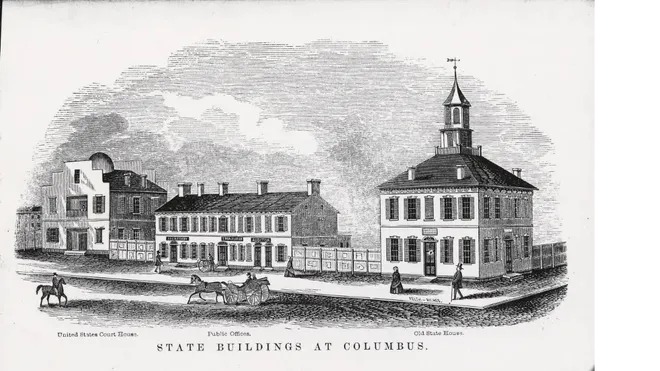
Four men with land to sell won Ohio its capital. Lyne Starling, John Kerr, Alexander McLaughlin and James Johnston backed their offer with a penal bond of $100,000, dated 10 February 1812, promising the state land and a statehouse, offices and a penitentiary built at their expense. Four days later, on 14 February 1812, the legislature declared the seat of government “fixed and permanently established” on the east bank of the Scioto opposite Franklinton, by 13 to 11 in the Senate and 27 to 19 in the House.
The site was a forest. At the first public sale of lots, on 18 June 1812, streets on the plat had to be traced through dense woods, and lots on High and Broad went for between $200 and $1,000. It was also the day the United States declared war on Britain. The plain brick statehouse that followed was built with bricks made from the earth of a prehistoric mound at High and Mound streets, and Jarvis Pike, who cleared the public square, grew wheat and corn on it.
An act of 17 February 1816 moved the timetable up, and the legislature first sat in Columbus on 2 December 1816. The proprietors then presented their bill, and the state settled it in 1817, deducting the $50,000 they were bound to give and paying them about $33,000 on top. A 1916 historian of the vote called 14 February “the legislative Valentine to the state of Ohio.” The partners did well out of the romance.
Tennessee: Nashville to Knoxville (1815)
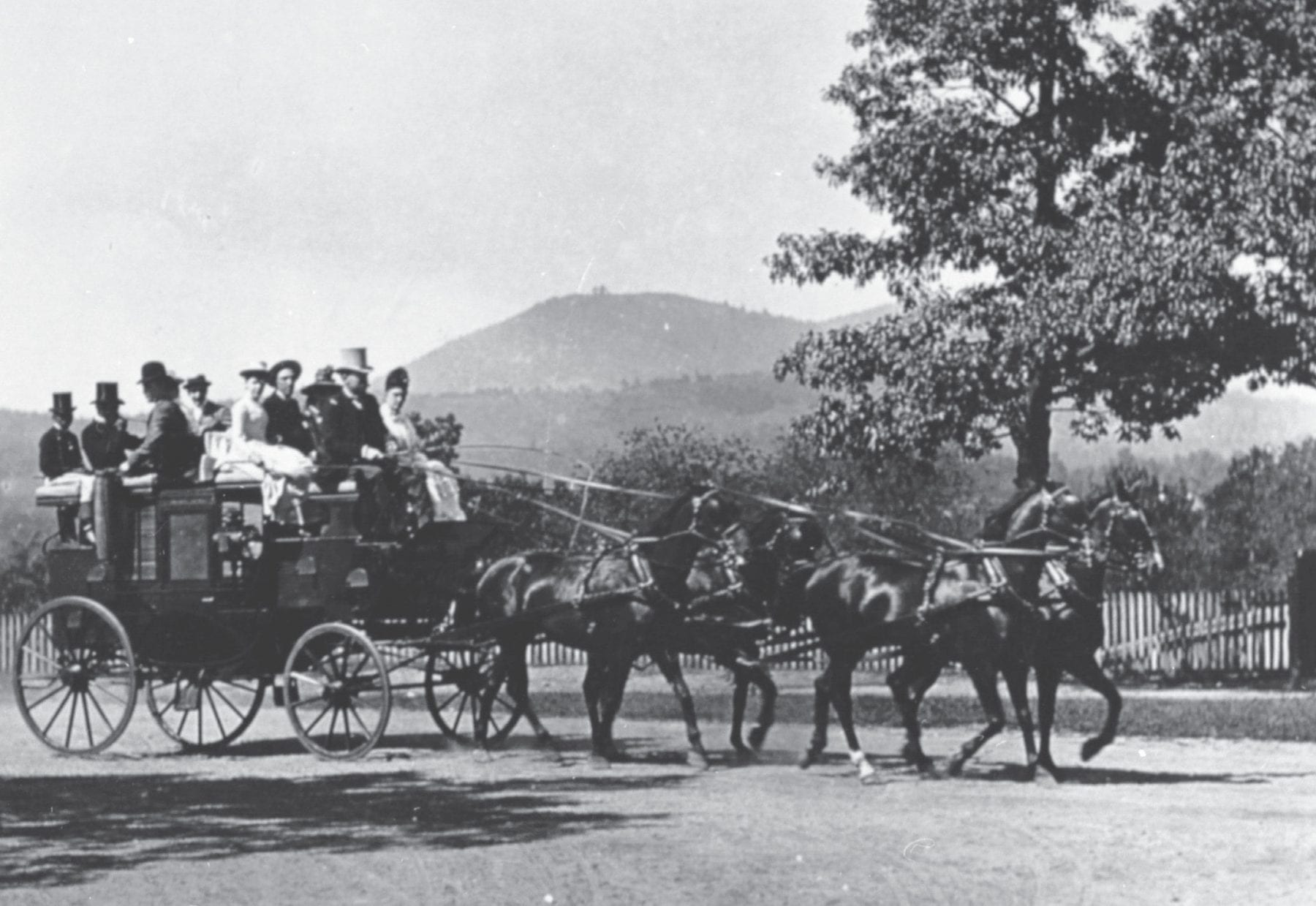
For a few days in November 1815, Tennessee’s next capital was Murfreesborough. The Eleventh General Assembly resolved at Nashville that “it is expedient to move the seat of government from Nashville,” and a resolution by Mr. Hamilton, arguing that Rutherford County was “the centre of this state,” sent the next legislature there. Then, on 17 November 1815, the last day of the session, the members changed their minds and adopted Mr. Frazier’s resolution that “the next general assembly meet at the town of Knoxville,” rescinding the Murfreesborough vote.
The Senate made one more attempt to stay put. A resolution to send the legislature back to Nashville tied 9 to 9, then passed 10 to 9 on reconsideration, but the House refused to concur, 14 to 23, and Knoxville stood. The Senate had carried the Knoxville resolution 11 to 7. Then nobody sat anywhere for almost two years: the State Library’s roster records “No second session,” and the next legislature did not open at Knoxville until 15 September 1817.
Knoxville had nowhere special to put it. The general assembly, as the Tennessee Encyclopedia puts it, “met in taverns and public buildings,” and in 1817 the legislature passed a bill allowing any court due to sit at the Knoxville court house to “adjourn such court to some other house in said town.” The arrangement lasted exactly one session. On 24 November 1817 the same legislature voted to try Murfreesborough after all.
Tennessee: Knoxville to Murfreesboro (1817)
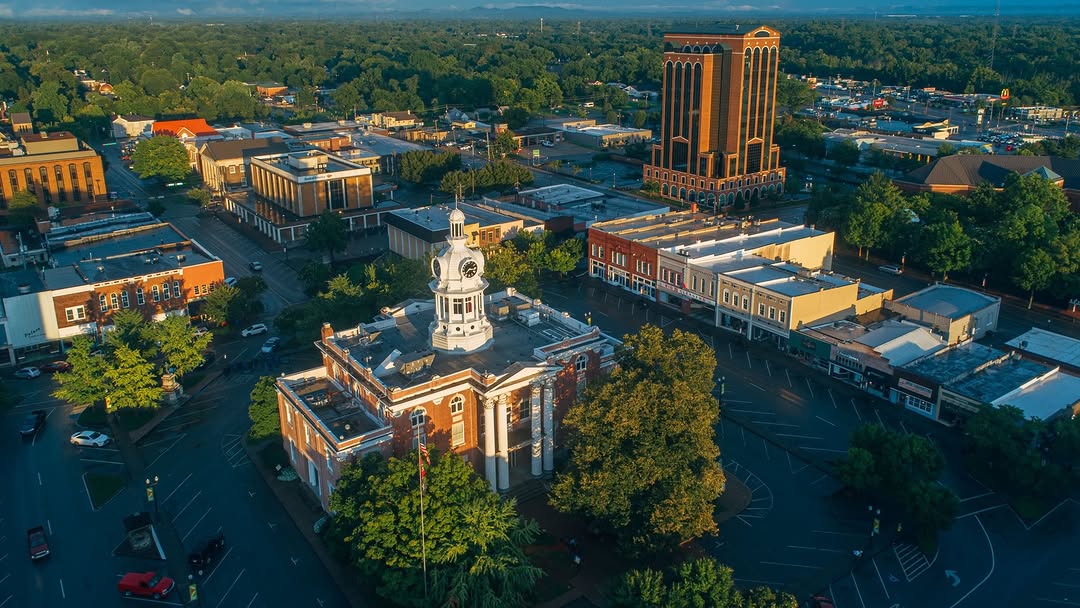
James K. Polk was 23 when the Tennessee Senate, opening its first session at Murfreesborough on 20 September 1819, elected him principal clerk, a job he held through re-elections in 1820 and 1822. He was a long way from the presidency and rather closer to Sarah Childress, a Murfreesboro woman he married there on 1 January 1824.
The vote that brought the legislature to Murfreesborough came on 24 November 1817, as the Knoxville session closed. Mr. Easley’s resolution, naming “the town of Murfreesborough in the county of Rutherford” as the next meeting place, carried 20 to 18 in the House and 10 to 9 in the Senate, after motions to substitute Knoxville, Nashville, Carthage, Sparta and Washington in Rhea County had all failed. The public offices were to be moved by 1 June 1818. The legislature itself did not arrive until September 1819, the Twelfth General Assembly having held, in the roster’s words, “No second session.”
Murfreesborough was new at being anything. For “thirty some days” it had been Cannonsburgh, named for Newton Cannon, before it was renamed for Colonel Hardy Murfree, and its claim to the capital rested on being, in the Tennessee Encyclopedia’s phrase, “the geographic center of the state.” The legislature kept returning, convening there in 1819, 1820, 1821, 1822, 1823, 1824 and 1825. Its second session of 1826 opened at Nashville. Polk had already taken the best of Murfreesboro with him.
Illinois: Kaskaskia to Vandalia (1819)
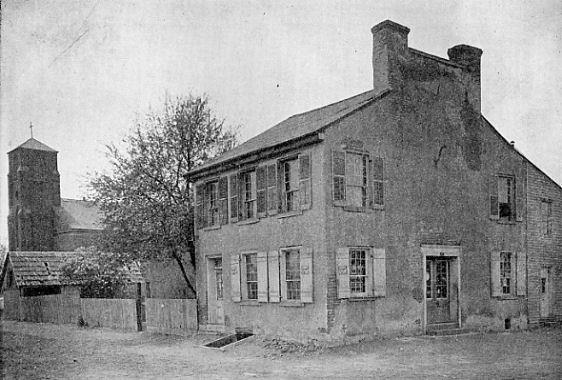
Illinois gave its new capital an expiry date before it existed. The 1818 constitution left the seat at Kaskaskia “until the general assembly shall otherwise provide,” asked Congress for land on the Kaskaskia River, and declared that the town built there “shall be the seat of government of this state for the term of twenty years.” An act of 30 March 1819 set the machinery going, and in May 1819 five commissioners traveling up the river chose a wooded rise called Reeve’s Bluff, about 80 miles northeast of Kaskaskia. They named it Vandalia, probably, the city’s own history admits, after the Germanic Vandal tribe.
Kaskaskia had never owned its capitol. The state rented a two-story brick building there for $4.00 a day, with the 29 members of the House on the first floor and the 14 Senators upstairs. The move was correspondingly modest: in 1820 young Sidney Breese earned $25 for hauling the state archives by wagon to Vandalia, where the Second General Assembly met in a plain two-story frame capitol on 4 December 1820.
The state’s Blue Book is blunt about why. “The removal of the Capital to Vandalia had been brought about by land speculators, including some of the State’s most prominent men, who felt that they could profit by instigating land booms in the unsettled areas.” Kaskaskia, the river town they left, declined after 1820 and was largely washed away when the Mississippi changed course in 1881.
Alabama: Huntsville to Cahawba (1819)

Before there was a state of Alabama, its capital had already been chosen. The constitution finished at Huntsville on 2 August 1819 put the first General Assembly at Huntsville and “all subsequent sessions at the town of Cahawba,” and a removal act ordering every state office there was approved on 13 December 1819. Congress admitted Alabama the following day, 14 December 1819, which makes Cahawba a capital fixed by a territory and occupied by a state.
The convention that drew it up had met in “the late Walker Allen’s cabinet shop.” Cahawba itself was a land rush on a riverbank: the Encyclopedia of Alabama reports lots bought at $1.25 an acre reselling within weeks for $60 to $70. The first branch of government to arrive was the Supreme Court, a committee of circuit judges who sat there on the second Monday in May 1820 and produced 23 opinions in the term. The General Assembly followed on 6 November 1820, with Thomas Bibb as acting governor, his brother William Wyatt Bibb having died that year.
The capital’s enemies had built a time limit into it. The territorial assembly allowed just $10,000 for a building for “temporary accommodation,” and the constitution forbade any appropriation for another State House before 1825, the year the legislature could choose again. It did, and Cahawba lost. By 1870 the town had 300 people, and by 1900 it was what the Alabama Historical Commission calls “Alabama’s most famous ghost town.”
Mississippi: Natchez to Columbia (1821)
By design, the move was a stopover. On 7 February 1821 Governor George Poindexter approved an act ordering that “the next, and each ensuing session of the Legislature of this state, shall be held at the town of Columbia, until otherwise altered by law.” On 12 February the same Assembly, still sitting at Natchez, named Thomas Hinds, James Patton and William Lattimore to find two sections of land “within twenty miles of the true centre of the state” for a permanent seat. Columbia was keeping the seat warm.
Natchez had never been a fixed capital, only where the legislature tended to gather, often in a private house called Texada. The map had moved under it. The Treaty of Doak’s Stand in 1820 nearly doubled the land open to settlement, and the population drifting from the river took the politics along. In the Senate, motions to substitute Liberty, the City of Natchez, Holmesville and the Choctaw Agency for Columbia all failed, two of them on ties broken by the President of the Senate voting no.
The legislature opened at Columbia on 5 November 1821, meeting, according to the Mississippi Department of Archives and History, in the Stovall Springs Hotel. Its journals were printed on the spot; the Senate’s title page reads “COLUMBIA: PRINTED BY PETER ISLER, STATE PRINTER, 1821.” By 28 November it had already fixed the permanent site on the Pearl River. Columbia hosted one more sitting, and Governor Walter Leake’s message to it was datelined “Columbia, June 4th 1822.”
Mississippi: Columbia to Jackson (1821)
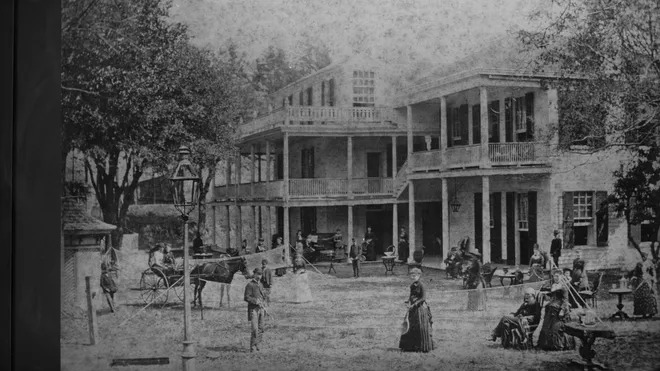
Governor Walter Leake was candid with the Senate on 24 December 1822. The town where it was meeting, he said, “was, but a short time since, entirely in the woods,” and “little more than six months have passed by, since the town of Jackson was laid off.” The legislature had convened there for the first time the day before, Monday 23 December 1822, in a statehouse built from scratch on a bluff above the Pearl River.
The act of 28 November 1821 had sent three commissioners, Thomas Hinds, William Lattimore and Peter A. Vandorn, to lay out the town and ordered it “called and known by the name of Jackson, in honor of major general Andrew Jackson.” The site was Le Fleur’s Bluff, named, as the state archives put it, “for the operator of a trading post.” The commissioners drew Capitol and State streets 100 feet wide around a checkerboard of open squares. The statehouse, two stories of brick and 2,400 square feet, went to Abram de France, brother of the tavern keeper whose Washington inn had hosted the territorial legislature, and Bennet Hines. A tanner, Henry Bone, was allowed to buy three acres around the tan-yard he had already set up nearby, for 100 dollars.
Jackson’s hold was shaky for a decade. Several relocation attempts were narrowly defeated before the 1832 constitution fixed sessions there until 1850 and provided that, unless the legislature then chose otherwise, the seat “shall continue permanently at the town of Jackson.”
Missouri: St. Charles to Jefferson City (1821)
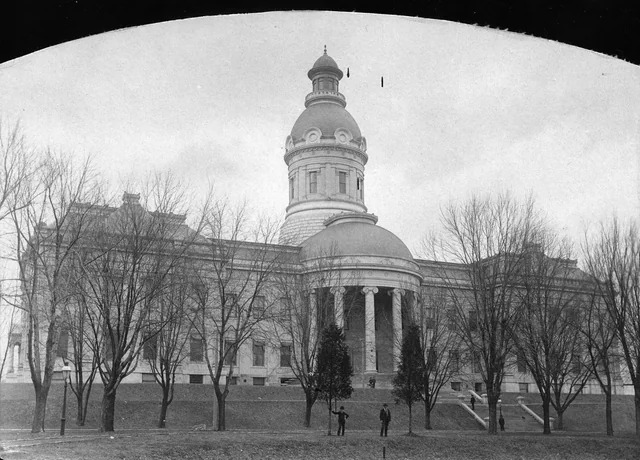
The deadline was written into the constitution. Missouri’s 1820 charter told five commissioners to find a site on the Missouri River “within forty miles of the mouth of the river Osage,” and made it the permanent seat from 1 October 1826, long before anything stood there. On 31 December 1821 the General Assembly accepted four sections of federal land on the south bank, and an act of 11 January 1822 named the town “City of Jefferson.”
In the meantime the legislature lived above the shops. St. Charles had won the temporary seat, in a contest among nine towns, by offering free space, and from 4 June 1821 lawmakers met on the second floor of two new brick buildings, one over the Peck brothers’ general store, the other over Chauncey Shepard’s carpenter shop. They met there for the last time on 21 March 1826.
Daniel M. Boone, the pioneer’s son, helped survey the town, and its first lots sold in May 1823. The first capitol was completed, by the city’s own record, on 1 October 1826, exactly on the constitutional date, and the House Journal of the Fourth General Assembly opens at “the City of Jefferson, on the third Monday, being the twentieth day of November” 1826. That capitol burned in 1837. Its successor burned on 5 February 1911 after lightning struck the dome. The rooms above the store in St. Charles fared better: the state acquired them in 1960 and restored eleven.
Indiana: Corydon to Indianapolis (1824)
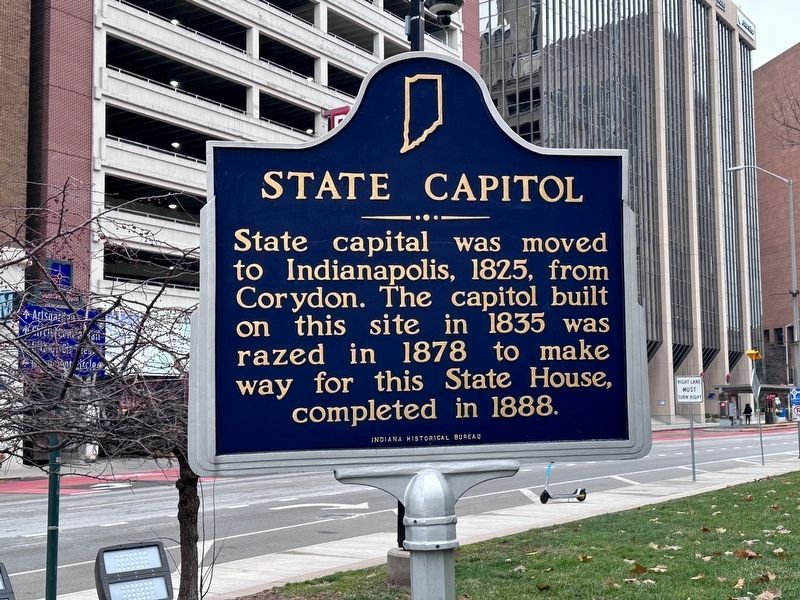
Moving the entire government of Indiana cost 65 dollars and 55 cents. Treasurer Samuel Merrill, whom the law put in charge, reported expenses of 118 dollars 7 cents, less 52 dollars 52 cents raised by selling off furniture at Corydon, for hauling 3,945 pounds of records and property at 1 dollar 90 cents a hundredweight. The figure is not a misprint.
The act, approved 20 January 1824 after the Senate passed it 9 votes to 8, made Indianapolis the permanent seat “upon, from and after the second Monday in January” 1825 and demoted Corydon to “the present temporary seat of government.” Corydon’s statehouse had been the Harrison County courthouse, with a flagstone floor covered in sawdust. The new capital, named by state Representative Jeremiah Sullivan, was barely a town, and the act reserved the Marion County courthouse to the legislature for fifty years and to the courts “forever.”
The journey is remembered through Merrill’s son, writing about 1895 from family memory: a wagon train leaving Corydon late in October 1824 with a strong box holding about 25,000 dollars, a driver who hung sleigh bells on the team to announce “that the seat of government was coming,” roads so bad that men cut a way with axes. The legislature opened at Indianapolis on 10 January 1825. When the teams pulled up at Blake and Henderson’s tavern, by the son’s account, every citizen went home saying “the fortune of Indianapolis is made.”
Louisiana: New Orleans to Donaldsonville and Back (1825)
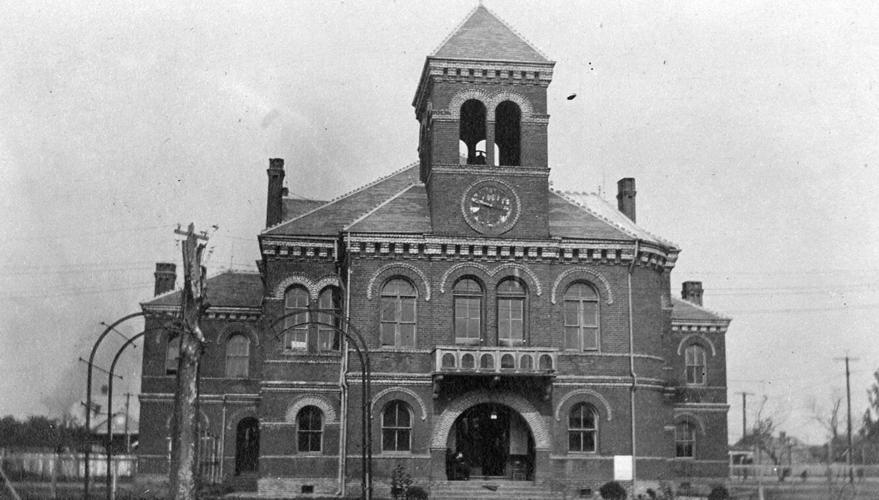
Twice in the same month, Louisiana’s legislature voted to leave New Orleans for Donaldsonville. An act of 4 February 1825 moved the seat from 1 December 1825; a second, on 19 February, postponed the first and decided New Orleans “shall remain” until 1 May 1829, when the seat would be “transferred to the town of Donaldsonville, in the parish of Ascension.” Five commissioners received 30,000 dollars for a lot and a State House.
The legislature arrived for its session of 4 January 1830 and came back to open the next one on 3 January 1831. That second session lasted three days. According to Fortier’s history, members were told the courthouse roof was coming off the next morning for repairs, found nowhere else to sit, and on 6 January approved Act No. 1, which ordered that from 8 January “the Legislature shall hold their sessions in New-Orleans.” Bernard Marigny later told a constitutional convention the roof was “a pretext,” and that while at Donaldsonville members had boarded every passing steamboat “almost in a body, to know the news from town.”
Donaldsonville’s citizens had paid to patch the building for that last session; the state reimbursed a committee 1,832 dollars for repairing “a certain building, commonly called the State House.” In 1833 the legislature gave it to the parish “as a seminary of learning.” The Law Library of Louisiana is plain about the matter: “The state legislature did not intend to return to Donaldsonville.”
Tennessee: Murfreesboro to Nashville (1825)
The legislature accepted a free room from the Freemasons. On 7 December 1825, as its session at Murfreesborough closed, the Sixteenth General Assembly adopted Mr. Gibbs’s resolution, 21 to 15 in the House and 11 to 8 in the Senate, that once the governor proclaimed Nashville’s Masonic Hall ready, “the sessions of the Legislature shall thereafter be holden in said house, until otherwise directed.” The proprietors had “tendered” the hall “gratis.”
The preamble’s other argument was clerical. Examining the Bank of the State of Tennessee at each meeting, it complained, “cannot be made under the existing state of things without much waste of time, and expenditure of public money.” Speaker William Brady’s motions to strike Nashville and insert Knoxville failed 13 to 21 and 11 to 23. In the Senate, an absent member was granted leave for the rest of the session after the doorkeeper, sent to fetch him, “returned without him.” The legislature first met in the Masonic Hall on 16 October 1826, under a proclamation from Governor William Carroll.
It was not permanent, and the members knew it. The same session recorded that the 1796 constitution had made no provision for fixing a seat, so the legislature “has adjourned from place to place, and may continue to do so, at the will of a majority of both houses.” Nashville was confirmed as the permanent capital only in 1843. The building it eventually got, William Strickland’s State Capitol, was completed in 1859.
Alabama: Cahawba to Tuscaloosa (1825)
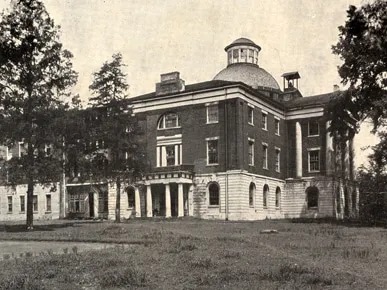
The Marquis de Lafayette’s tour through Alabama in 1825 cost the state 15,715 dollars 18 cents, the governor reported, with another 1,350 dollars claimed for transport. The Encyclopedia of Alabama observes that the roughly 17,000 dollars spent on the old general “was considerably more than it had spent on its own capitol building at Cahaba.” That same year the legislature voted the town out.
The case against Cahawba was mostly about water. A Senate committee reported the town “liable to be inundated by the waters of both the Cahawba and Alabama rivers,” so that “it has been impracticable to reach the state house without a conveyance by water,” and added that lawyers skipped the Supreme Court’s June sessions “from an apprehension of sickness.” The 1825 session chose Tuscaloosa instead, 11 to 10 in the Senate on 6 December and 38 to 26 in the House on 13 December 1825. Montgomery’s late offer of 240 acres was laid on the table.
The move came with no promise of a roof. A companion act told the governor to find rooms in Tuscaloosa “otherwise than by purchase,” adding that “nothing in this act shall be construed so as to authorise an expenditure of public money,” and the legislature first met there on 20 November 1826 at Bell Tavern. Those left behind sent a bill of their own. In December 1826 Cahawba’s lot buyers, who had paid 123,856 dollars for 182 lots in May 1819, petitioned the state for compensation.
Maine: Portland to Augusta (1827)
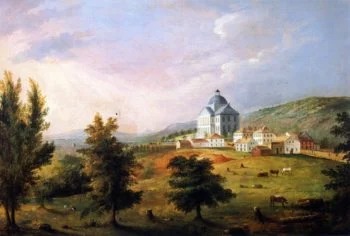
Seven towns wanted to be the capital of Maine: Portland, Brunswick, Hallowell, Waterville, Belfast, Wiscasset and Augusta, and in 1823 a legislative committee visited every one. Each offered a choice of valuable lots. If the seat had to be on the seaboard, the committee reported, Wiscasset was “entitled to a decided preference,” but for an interior site its members were “unanimously of opinion” that Augusta was best.
The act that settled it was approved on 24 February 1827, and then nothing happened for some time. It fixed the permanent seat at Augusta only from 1 January 1832 and kept the legislature meeting at Portland until then, so the first Augusta session opened on 4 January 1832. Portland had been named the “temporary capitol city” when Maine became a state on 15 March 1820, with “the general understanding that the site was not permanent.” The act let the governor accept a lot at Augusta only if “the same can be had without expense to the State,” and spent $500 having it “improved, fenced and ornamented with forest trees.”
The State House went to Charles Bulfinch, who had designed the Massachusetts State House and promised Maine a building that would keep its outline while preventing “its being a servile copy.” The cornerstone was laid on 4 July 1829, and oxen hauled the granite from Hallowell, one of the losing towns. Portland never really accepted the result, and kept trying to win the seat back until a last attempt failed in 1907.
Illinois: Vandalia to Springfield (1837)
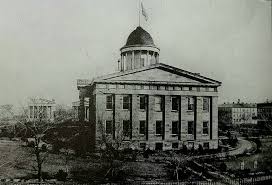
In the summer of 1836, to keep the capital, Vandalia tore down its own twelve-year-old statehouse and put up a $16,000 brick one. The state accepted the new building in February 1837, weeks before the legislature voted to leave it.
The act of 25 February 1837 ordered both houses to meet on 28 February at ten o’clock and pick a place by joint vote, the election not to “continue more than one day.” It took four ballots. Springfield gathered 35, then 43, then 53 and finally 73 votes while Vandalia sat at 16, and on the third ballot one senator voted for “Purgatory.” The winner paid its way: the law was void unless $50,000 was donated and secured by bonds and at least two acres were given free to the state. Sangamon County’s “Long Nine,” whose heights added up to fifty-four feet, had delivered. Among the 73 who voted for Springfield on the final ballot was Abraham Lincoln, who would later appear, as number 16, on the roster of every U.S. president.
The vote moved nobody yet. An act of 21 February 1839 declared that from 4 July 1839 the seat “shall be deemed and held to be at Springfield,” and the General Assembly convened there on 9 December 1839. Vandalia’s handsome brick building survives, kept by the state, in the words of the state’s own Blue Book, “as a reminder to Illinoisans of the expensive folly of the early Vandalia citizens.”
Alabama: Tuscaloosa to Montgomery (1846)
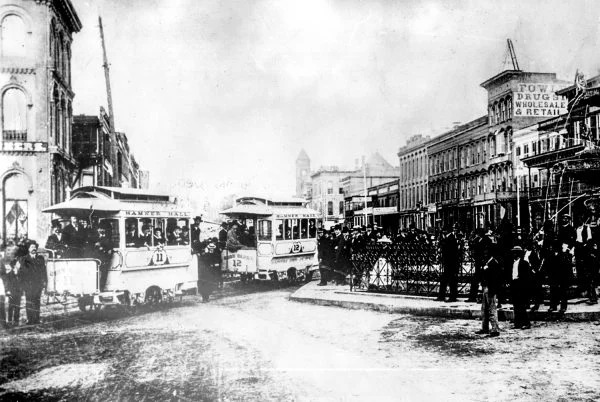
It took sixteen ballots. On 28 January 1846 Alabama’s legislators, meeting jointly at Tuscaloosa, worked through eight nominated places, Tuscaloosa, Wetumpka, Mobile, Montgomery, Statesville, Selma, Marion and Huntsville, until the Speaker could finally declare “the city of Montgomery, duly and constitutionally elected the Seat of Government of the State of Alabama, according to law.”
The voters had cleared the way the previous August, backing removal 33,798 to 27,320, and the legislature struck out the constitutional section that “permanently locates the Seat of Government.” Act No. 24, approved on 21 January 1846 after the Senate passed it 18 to 3, then set a condition to make any landlord blush. The seat was to “remain in the city of Tuscaloosa” until the winning town built a State House “equal in every respect” to the old one, at no public expense, and handed over the keys “as a present to the State.” The case for moving was practical. The Black Warrior River at Tuscaloosa was navigable for only part of the year; the Alabama River at Montgomery ran all year, through the most heavily populated part of the state.
Montgomery delivered. Its capitol, designed by the Philadelphia architect Stephen Button, was turned over on 26 October 1847, and the governor opened the first session on 6 December 1847 “Assembled at our new Seat of Government.” The building burned on 14 December 1849, with the legislature in session. Members argued about going back to Tuscaloosa, then rebuilt on the same site.
Louisiana: New Orleans to Baton Rouge (1846)
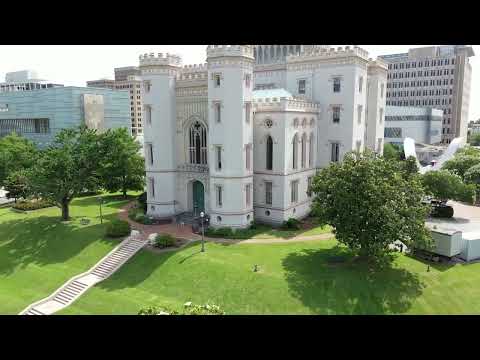
Distance, not a destination, was what Louisiana’s 1845 constitution prescribed. The seat of government had to be “not less than sixty miles from the City of New Orleans, by the nearest traveling route; and if on the Mississippi, by the meanders of the same.” According to the Old State Capitol museum, the delegates worried about “the concentration of wealth and power in the Crescent City – and the many distractions New Orleans offered.” Once the place was picked, moving again would take four-fifths of both houses.
It picked quickly. Act No. 3, approved by Governor Isaac Johnson on 9 March 1846, fixed the seat at “the town of Baton Rouge, in the parish of East Baton Rouge,” and promised sittings there from 1 January 1849. Construction ran late, and the Third Legislature did not begin its session at Baton Rouge until 21 January 1850. Preston W. Farrar, a New Orleans man who presided over the last session there, used his valedictory of March 1848 to surrender “to the iron will of the Convention the keys of the old Capitol.”
James Dakin designed the new capitol in a style he called “castellated Gothic.” Mark Twain was not charmed. “Sir Walter Scott is probably responsible for the Capitol building,” he wrote, “for it is not conceivable that this little sham castle would ever have been built if he had not run the people mad, a couple of generations ago, with his medieval romances.”
Michigan: Detroit to Lansing (1847)
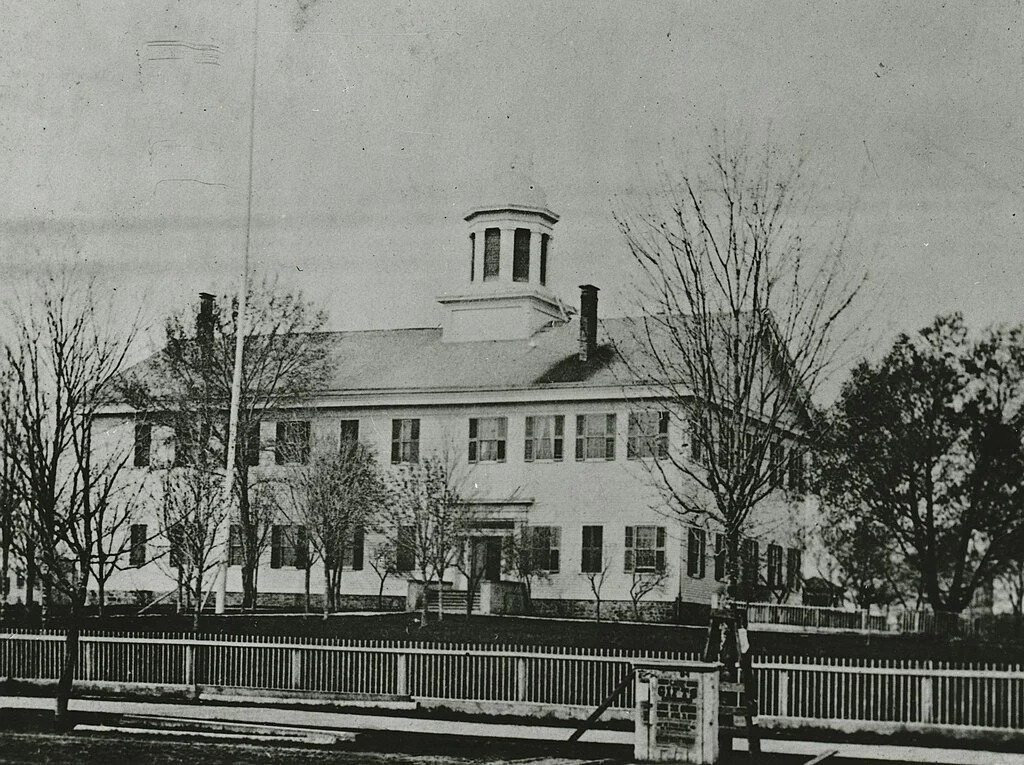
One sentence was all it took to locate Michigan’s capital, which “shall be in the township of Lansing, in the county of Ingham.” It was approved on 16 March 1847 to satisfy the 1835 constitution, which had left the seat at Detroit only until 1847, “when it shall be permanently located by the legislature.” Detroit’s last legislature went home the next day.
There was not so much as a village there, and observers called the new capital a “howling wilderness.” The site had been pushed by a land speculator, James Seymour, which may explain why a companion act made the three site commissioners swear they had no interest in land, or in “any profits or speculations,” in Ingham, Eaton, Ionia or Clinton counties. The village they laid out was to be platted as “the town of Michigan,” which produced the address Michigan, Michigan, a confusion settled a few months later by renaming it Lansing.
State officers were ordered to move by 25 December 1847, and a hastily built wooden capitol went up that winter. The Thirteenth Legislature took the oath there on Monday 3 January 1848, in a town that would not be incorporated as a city until 1859. The temporary building outlasted its job and was destroyed by fire on 16 December 1882. By then the 1850 constitution had closed the question, putting the seat at Lansing, “where it is now established.”
California: San Jose to Vallejo (1851)
One man offered the new state a capital city called Eureka. General Mariano Vallejo’s proposition included 156 acres, a capitol, schools, a botanical garden, a hospital, a prison and $370,000 toward the building, and at the general election of 7 October 1850 voters “overwhelmingly favored” it. The legislature, which had been meeting in a two-story adobe hotel in San Jose, accepted and renamed the city after the general.
The act of 4 February 1851 was conditional: if Vallejo “shall fail or refuse to comply with the terms of his proposition, in whole or in part,” it was void. When the Senate assembled at Vallejo on 5 January 1852, the furniture was not in place, there were no printing materials in town, and, the Sacramento Daily Union reported, the “music of the saw and hammer” could be “heard night and day.” The steamer Empire was berthed as a floating hotel. Two days later Governor John McDougal sent a written protest that the act had “become a nullity” because the buildings were not ready; the Senate laid it on the table.
The compromise was very Californian. Both houses declared Vallejo “the legal, permanent Seat of Government,” then left on 16 January 1852 to finish the session in Sacramento. Hubert Howe Bancroft later described the Vallejo capitol as “a rather insignificant two-story building with a drinking-saloon and a skittle alley in the basement – the third house, as it was ironically called.”
California: Vallejo to Benicia (1853)
From a town named after General Vallejo, California’s legislature moved to a town named after his wife. Benicia took its name from Francisca Benicia Carrillo de Vallejo, and on 4 February 1853 an act made “the city of Benicia, situated upon the Straits of Carquines, in the County of Solano” the permanent seat “on and after the fifth day of February.”
The same act settled accounts with the general. Its preamble records that he had petitioned to be released from his bond, admitting “his inability to comply,” and it freed him on condition that he give up “any and all claims, for relief or damages, against this State” over the location or removal of the seat. On the same day both houses asked the governor to demand the entire $370,000 he still owed. Benicia offered something better than promises: the free use of its new city hall, whose interior pillars were carved from the masts of ships abandoned in San Francisco Bay during the gold rush.
The Senate met at Benicia on 11 February 1853 without a quorum and did its first business on 14 February. On 18 May 1853 the legislature re-enacted the Benicia law without conditions. According to the State Capitol Museum, lawmakers were already worried that moving so often would wear away public confidence, and the government had picked up the nickname “the capital on wheels.” The building outlived the arrangement; the State Library calls it “the only pre-Sacramento capitol still standing.”
California: Benicia to Sacramento (1854)
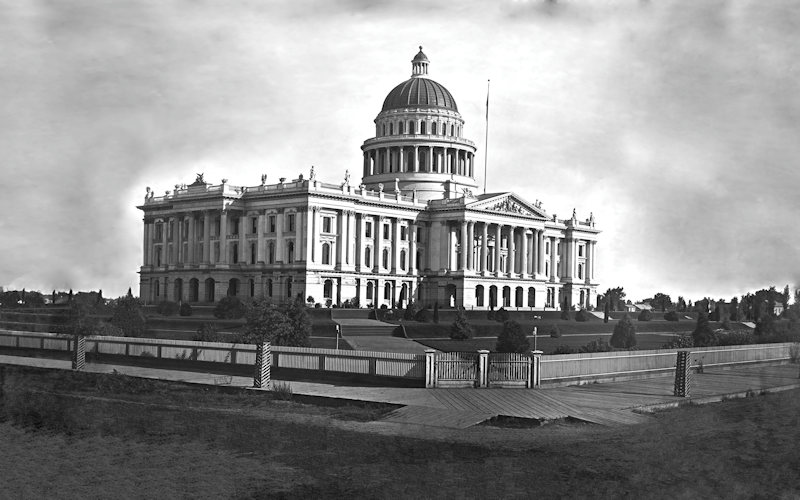
Fireproof vaults were part of the pitch. Governor John Bigler had complained that the state’s archives sat in “fragile frame buildings, without fireproof vaults or safes,” and Sacramento answered with a package: free use of the county courthouse as a capitol, rooms for state officers, fireproof vaults for the records, a free move from Benicia, and a site for a permanent capitol. Benicia’s shortage of beds helped. On 2 January 1854, the opening day of the session, it was reported that “at least a hundred men had no place to sleep except barrooms of saloons.”
Senator Amos Parmalee Catlin of Sacramento introduced the bill on 9 February 1854. It passed the Senate 15 to 12, cleared the Assembly 39 to 35 on 24 February, and was signed by Bigler the next day. The act repealed every earlier capital law and named Sacramento the permanent seat. The legislature left Benicia “bag and baggage” aboard the steamer Wilson G. Hunt and reconvened in Sacramento on 1 March 1854.
The courthouse was a wooden two-story building of 1851, for which the Daily Union had promised “a neat cupola, in which a bell is to be suspended, and a clock also will show its face and hands to late witnesses and trembling culprits.” That July the courthouse that had won the capital with its fireproof vaults burned down in a fire that took a considerable part of the city. The capital stayed anyway.
Iowa: Iowa City to Des Moines (1855)
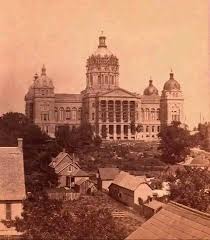
Ten yoke of oxen finally dragged the state treasurer’s safe into Des Moines. Hauled across the prairie in the autumn of 1857, it sat in the open near Little Four Mile creek in Polk County “for several days and nights” until the ground froze hard enough for a bob-sled, while inside it sat the coin to pay the state officers’ last month of salary.
Iowa’s act of 25 January 1855, “An Act to re-locate the Seat of Government,” sent five commissioners to fix a site within two miles of the junction of the Des Moines and Raccoon rivers, and it was stingy: “no money shall be paid out of the Treasury of the State for the erection of said buildings.” Des Moines citizens borrowed from the state school fund to build them, and the state did not repay it until 1864. The commissioners chose an east-side hill donated by W. A. Scott and Harrison Lyon over a richer west-side offer; all but one of them had become privately interested in land east of the river. General James A. Williamson, asked how he got the removal act through, cited “all lawful and legal means including Chesapeake and Sardinian appliances, and any quantity of whiskey.”
The 1857 constitution made Des Moines permanent, and the Seventh General Assembly first met there on 11 January 1858. Scott, who gave the land, died in 1859 and was buried on the Capitol grounds, which the state’s visitor guide says makes his the only burial plot there.
Louisiana: Baton Rouge to New Orleans (1864)
In 1864 Louisiana had, as Fortier’s history puts it, “two governors, a Confederate in the north and a Federal in the south.” The Confederate legislature sat at Shreveport on 18 January 1864. In New Orleans, under Union occupation, a convention called by General Nathaniel P. Banks on President Lincoln’s orders met at Liberty Hall and adopted a constitution on 23 July 1864, which voters ratified on 5 September 1864, 4,664 to 789 by Fortier’s count. Its Article 130 said that “the seat of government shall be and remain at New Orleans,” and that only a majority of both houses could move it.
The legislature it created met in New Orleans in October 1864, elected only in the parishes where voting could happen “with safety to the electors,” which meant the parishes the Union held. Its standing was contested from the start. Congress refused to admit its chosen senators, Hahn and Cutler, and the Reconstruction Act of 2 March 1867 declared that “no legal State governments” existed in the former Confederate states, Louisiana included. Voters had in fact rejected moving the capital to New Orleans once before, in a ballot counted on 1 December 1855.
The seat stayed regardless. Louisiana’s 1868 constitution declared the 1864 charter superseded and then fixed the capital in the same place, “The seat of government shall be established at the city of New Orleans,” where it remained until the legislature went back to Baton Rouge on 8 May 1882.
Nebraska: Omaha to Lincoln (1867)
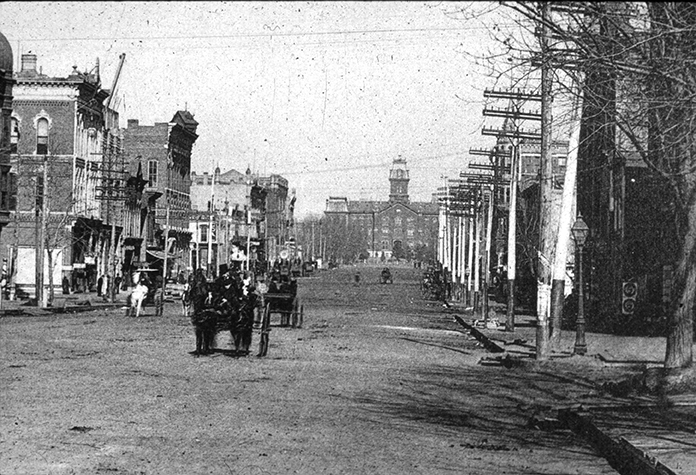
A name was supposed to kill the bill. Omaha’s legislators, fighting to keep the capital, loaded the removal bill with amendments, including one that, as History Nebraska tells it, “required the capital city to be named Lincoln in honor of the late president.” Abraham Lincoln, assassinated in April 1865 and so one of the presidents who died in office, was not a popular name in a South Platte region that was heavily Democratic. The bill passed anyway, 8 to 5 in the Senate and 25 to 14 in the House, and was approved on 14 June 1867.
The act left the choice to three officers, Governor David Butler, Secretary of State Thomas P. Kennard and Auditor John Gillespie, and on 29 July 1867, at the home of County Commissioner William T. Donovan, they settled on Lancaster, a village with a population of 30. They liked it as “the centre of a circle, of about 110 miles in diameter,” and believed, as History Nebraska says, “mistakenly,” that its salt deposits would prove valuable. Lot sales paid for the statehouse, which was built of a limestone that soon began to crumble, and the legislature first met in Lincoln on 7 January 1869.
Omaha took the loss as sportingly as could be expected. One Omaha newspaper, by the same account, predicted that “Nobody will ever go to Lincoln who does not go to the legislature, the lunatic asylum, the penitentiary, or some of the state institutions.”
Georgia: Milledgeville to Atlanta (1868)
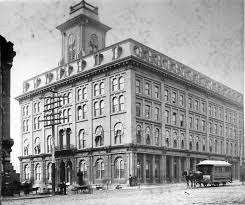
For about two decades Georgia’s legislature sat in an opera house whose builders had run out of money. The Kimball Opera House was a five-story brick shell when Edwin N. Kimball bought it at a receiver’s sale on 2 June 1868 for $31,750, and the legislature chose it that August as a temporary capitol. Georgians reviled it for as long as it stood.
The move itself came out of Reconstruction. The constitutional convention assembled in Atlanta on General John Pope’s orders, reportedly because Milledgeville innkeepers had made it known that Black delegates would not be welcome in their inns. Atlanta’s council offered the legislature, the governor and the courts their buildings free for ten years, plus a site for a capitol, and on 27 February 1868 the convention adopted the Atlanta clause by 99 votes to 30 after ruling a Macon substitute out of order. Article X of the new constitution put the seat “in the city of Atlanta” from the date of ratification, and voting began on 20 April 1868.
The legislature first met in Atlanta on 4 July 1868, in the City Hall and Fulton County Courthouse. On 30 June sixteen railcars had carried the old statehouse’s furniture and furnishings, among them five full-length portraits painted by C. R. Parker in 1826, of Franklin, Jefferson, Lafayette, Oglethorpe and Washington. Milledgeville did get one more chance. On 5 December 1877 voters were asked to choose between the two cities and kept Atlanta, 99,147 to 55,201.
West Virginia: Wheeling to Charleston (1869)
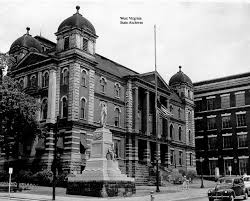
Captain James Newton refused to charge West Virginia a cent. When the state’s records and officials left the Wheeling levee aboard his steamboat, the Mountain Boy, on 28 March 1870, he declared: “I will go with cannon, music and floating flags and will consider the honor sufficient pay.” As the boat approached Charleston, the Kanawha Belle came out to meet her with a brass band and a reception committee.
The 1863 constitution had put the seat at Wheeling only “until a permanent seat of government be established by law,” and the state had been governing from the Linsly Institute, a boys’ school building, as a temporary capitol. The act of 26 February 1869 supplied the permanence: “The permanent seat of government for this State is hereby located at the town of Charleston, in the county of Kanawha.” It took effect on 1 April 1870. Charleston was not much of a city, and it had 4,192 people as late as 1880, but its backers wanted the capital where it would best develop the state’s natural resources. For its first months there the government worked out of the Bank of the West and the Merchants Bank.
Charleston’s first capitol was built by the State House Company, whose head, Dr. John P. Hale, received the contract and “ended up paying most of the cost himself.” The legislature first sat in Charleston in January 1871. The word “permanent” in the act held until 1875.
Connecticut: Hartford and New Haven to Hartford Alone (1873)

Two capitals, one legislature, and a calendar that told it which to use. From 1701 Connecticut’s General Assembly met at both Hartford and New Haven, May sessions in one and October sessions in the other, and after 1818 its single annual session alternated between them. The State Library dates the arrangement from 1701 to 1874.
Hartford had already started building before anyone voted. The legislature set up a capitol commission in 1871, and by September 1872 it had signed a contract with J. G. Batterson of Hartford for $875,000. On 21 May 1873 the Senate passed the amendment resolution 16 to 5, and at the town meetings of 6 October 1873 the voters approved it, 36,853 to 30,685. The Secretary of the State’s returns show the two rivals voting almost unanimously in opposite directions: Hartford 6,916 Yes to 9 No, New Haven 32 Yes to 10,156 No. The amendment provided that “All annual and special sessions of the general assembly shall on and after the first Wednesday of May A. D. 1875, be held at Hartford.”
The new Capitol was not ready in time. Until it opened to the General Assembly in January 1879, at a cost of $2,532,524.43, the legislature carried on in Hartford’s Old State House. New Haven’s last State House, a Greek Revival temple of 1831 by Ithiel Town and A. J. Davis, held its last legislative meeting in 1874. Connecticut History records that a crowd of roughly 3,000 later turned out to watch it demolished.
West Virginia: Charleston to Wheeling (1875)
A court injunction was supposed to keep West Virginia’s capital in Charleston. The legislature had passed “An act to remove the seat of government temporarily to Wheeling” on 20 February 1875, to take effect after ninety days, and five Wheeling citizens had agreed to provide accommodation “without cost thereto.” Charleston’s taxpayers went to law, and an injunction was awarded at Guyandotte on 30 March 1875.
It did not hold. The Kanawha circuit judge dissolved it on the ground that the act was constitutional, then suspended his own decree for an appeal, while Governor John Jacob declined to appear in his court. On 21 May 1875 the governor and the state officials boarded the Emma Graham, its arrival, by the Wheeling Intelligencer’s account, “announced by the roaring of cannon.” They changed at Parkersburg to the Chesapeake and reached Wheeling on 23 May. The governor, the same correspondent wrote, “had no troops, and desired no bloodshedding,” and left much of the public property behind, to follow in September 1875 on two barges and the steamer Iron Valley.
The Supreme Court of Appeals settled the legal question on 13 September 1875 in Slack v. Jacob, declaring the act “constitutional and valid” and holding that a judge who tried to enjoin the governor from carrying it out had committed “an invasion by the judiciary of executive powers.” Wheeling moved back into the Linsly Institute building, and the city presented the state with a new capitol on 4 December 1876.
West Virginia: Wheeling to Charleston Again (1877)
Three towns were on the ballot, and Wheeling was not one of them. The act of 21 February 1877 let West Virginia’s voters choose a permanent seat from Charleston, Clarksburg and Martinsburg only, and any other place written in “shall not be counted.” On 7 August 1877 Charleston took 41,243 votes, Clarksburg 29,942 and Martinsburg 8,046. Wheeling’s own Ohio County voted against Charleston, 3,358 to 218, which changed nothing.
The winner had a long wait. The statute made Charleston the seat only “from and after the first day of May” 1885, and once fixed it could be moved again only by a majority of the state’s voters at an election called for the purpose. Looking at the county returns, the West Virginia Encyclopedia notes that voters mostly backed whichever city was nearest them, “tending to discount politics as a major factor.”
At the start of May 1885 the capital left Wheeling for the last time aboard the steamers Chesapeake and Bell Prince, with the barge Nick Crawley in tow. The Wheeling Daily Intelligencer’s farewell ran under the headline “The capital of West Virginia is Charleston” and reported “considerable talk about the thorough manner in which the State House has been dismantled,” though the doors had been left. Its last line on the matter was practical: “Hereafter the State House is the City Hall.”
Louisiana: New Orleans to Baton Rouge Again (1879)
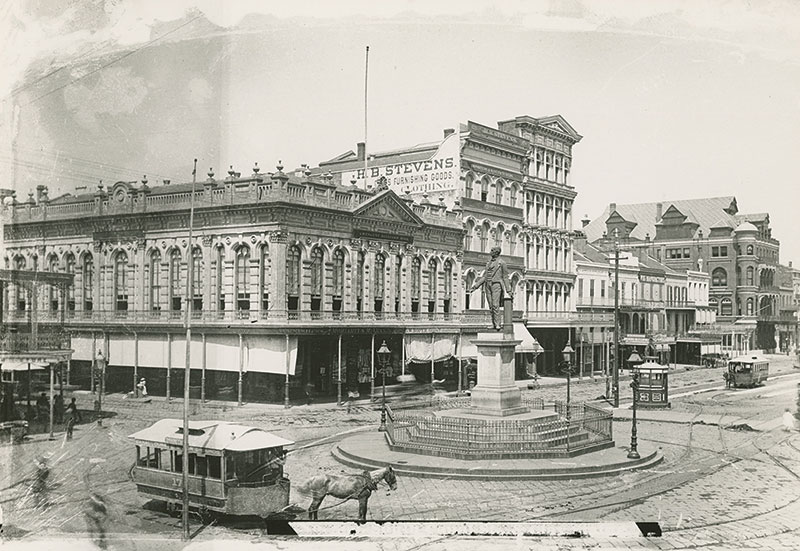
A hotel served as Louisiana’s state house through the second half of the 1870s. The legislature leased the old St. Louis Hotel in New Orleans in June 1874 and in February 1875 authorized buying it for $250,000, passing the bill over the governor’s veto, and floors were built into its 88-foot rotunda for the House and the Senate.
The constitution that sent the government back to Baton Rouge was adopted in convention on 23 July 1879 and ratified on 8 December 1879, declaring that the seat “shall be and remain at the city of Baton Rouge.” Baton Rouge paid for the privilege: the constitution accepted “the subscription of thirty-five thousand dollars, tendered by the citizens and the city council” toward repairing the old Capitol, on condition that the city pay it into the treasury first. The building needed it. It had stood gutted since a night in December 1862 when, the National Register nomination says, a cooking fire of the Union garrison got out of control, and vines had turned the shell into something resembling “the ruins of a Norman castle.”
The General Assembly kept meeting in New Orleans, in January 1880 and again from December 1881 into January 1882, while the architect William A. Freret added a fourth story, cast-iron turrets and a stained-glass dome. The executive offices moved on 1 March 1882, and lawmakers followed on the second Monday of May 1882, the day the constitution had fixed for them. The rebuilt Capitol served until 1932.
Rhode Island: Newport and Providence to Providence Alone (1900)

Five state houses, one in each county, once took turns hosting Rhode Island’s General Assembly. Under the 1842 constitution the May session sat at Newport, the October session went to South Kingstown in alternate years and to Bristol and East Greenwich in the years between, and an adjourned session met at Providence every year. An amendment of 1854 cut the circuit down to Newport and Providence, which is as far as the state’s attachment to its old towns would stretch for the next half-century.
The last General Assembly to convene at Newport met from 29 to 31 May 1900, and on 13 June it adjourned to meet “in the new State House, in Providence, on the first Tuesday of January, A. D. 1901.” The decision came at the polls on 6 November 1900. Article of Amendment XI said simply that “There shall be a session of the general assembly at Providence commencing on the first Tuesday of January in each year,” and annulled the 1854 amendment; the official state Manual records the vote as 24,351 to approve and 11,959 to reject.
The General Assembly met for the first time in the new McKim, Mead & White State House on 1 January 1901, in a building whose corner-stone had been laid on 15 October 1896 and which was not finished until 1904. Voters had approved the borrowing in 1896 and an additional $800,000 of State House bonds in 1898. Newport kept its Colony House, built in 1739.
Oklahoma: Guthrie to Oklahoma City (1910)
An election moved the capital without legally moving it. Governor Charles Haskell called a special election for 11 June 1910, and Oklahoma City received 96,261 votes, Guthrie 31,301 and Shawnee 8,402, according to the State Archives returns. Haskell did not wait for anything else. The day after the vote he wrote a proclamation on Huckins Hotel stationery declaring Oklahoma City the capital, and the state government, Supreme Court included, went to work in the hotel, the court in the basement.
The Great Seal went too. The Oklahoma Territorial Museum in Guthrie says the seal, “rumored to have been stolen,” was in fact legally removed by Haskell’s secretary, William Anthony. On 15 November 1910 the state Supreme Court ruled that the initiated bill had “failed of adoption,” because the question “Shall it be adopted?” had been left off the ballot. Haskell called a special session, and in December 1910 the legislature passed an act locating the capital at Oklahoma City anyway.
There remained the matter of Congress, whose 1906 Enabling Act had said the capital “shall temporarily be at the city of Guthrie” and could not move before 1913. A Guthrie property owner, W. H. Coyle, sued, and on 29 May 1911 the U.S. Supreme Court ruled in Coyle v. Smith that the restriction could not bind a state admitted “on an equal footing with the original states,” with Justices McKenna and Holmes dissenting. Guthrie tried again in 1912. Voters kept the capital where it was.
Frequently Asked Questions
Which state has moved its capital the most times?
Louisiana, with five moves under this list’s rule: to Donaldsonville in 1825 and back to New Orleans in 1831, to Baton Rouge in 1846, back to New Orleans by the constitution of 1864, and to Baton Rouge again by the constitution of 1879. Georgia and Tennessee follow with four moves each.
Has any state moved its capital since 1910?
No state has moved its capital since Oklahoma did in 1910. Alaska came closest. Voters approved a new capital in 1974 and chose Willow in 1976, then on 2 November 1982 rejected the cost of moving there, estimated at $2,843,147,000. In 1994 they turned down Wasilla as well, and Juneau stayed the capital.
Why aren’t wartime capitals on the list?
Because a government in flight was not choosing a new seat. Tennessee’s Confederate government went to Memphis in February 1862, Missouri’s secessionist legislature met at Neosho and Cassville in 1861, and Arkansas sat at Hot Springs in 1862, yet none of those episodes changed the legal capital, so none counts as a move.
Why is Nebraska on the list but not Kansas?
The same test gives opposite answers. Kansas held its first state legislature at Topeka on 26 March 1861, so its vote of 5 November 1861 confirmed a seat it already had. Nebraska was still governed from Omaha when it became a state on 1 March 1867, and its act of 14 June 1867 moved the capital.
Do territorial capital moves count?
No, only moves made after statehood. Territories shuffled their capitals constantly: Arizona’s went to Tucson in 1867, back to Prescott in 1877 and on to Phoenix in 1889, while Idaho’s territorial secretary left Lewiston for Boise in 1865 “with the territorial seal and as many of the territorial papers as he could carry.”
Was San Francisco ever the capital of California?
Only in an emergency. With Sacramento flooded, the legislature met in San Francisco’s Merchants’ Exchange Building from 24 January to 15 May 1862, while Sacramento remained the legal seat. The State Library’s account is brief: “the capital city was inundated.”
Did Texas ever move its capital?
Not after it became a state. Texas voted on its capital twice and kept Austin both times: in 1850, when Austin received 7,674 votes, and in 1872, when it beat Houston and Waco with 63,297 votes to 35,188 and 12,776. Those were reaffirmations, not moves, so Texas does not appear on the list.
- New Georgia Encyclopedia – Georgia’s Historic Capitals
- NCpedia (State Library of North Carolina) – Raleigh timeline
- Mississippi Department of Archives and History – Capitals and Capitols: Mississippi’s Seat of Government
- California State Library – Previous California Capitals
- Illinois Blue Book (Illinois Digital Archives)
- History Nebraska – How Lincoln Became the Nebraska State Capital
- Encyclopedia of Alabama – Cahaba
- e-WV: The West Virginia Encyclopedia – Capital Removal