Every Nuclear Weapon That Has Been Lost and Never Recovered
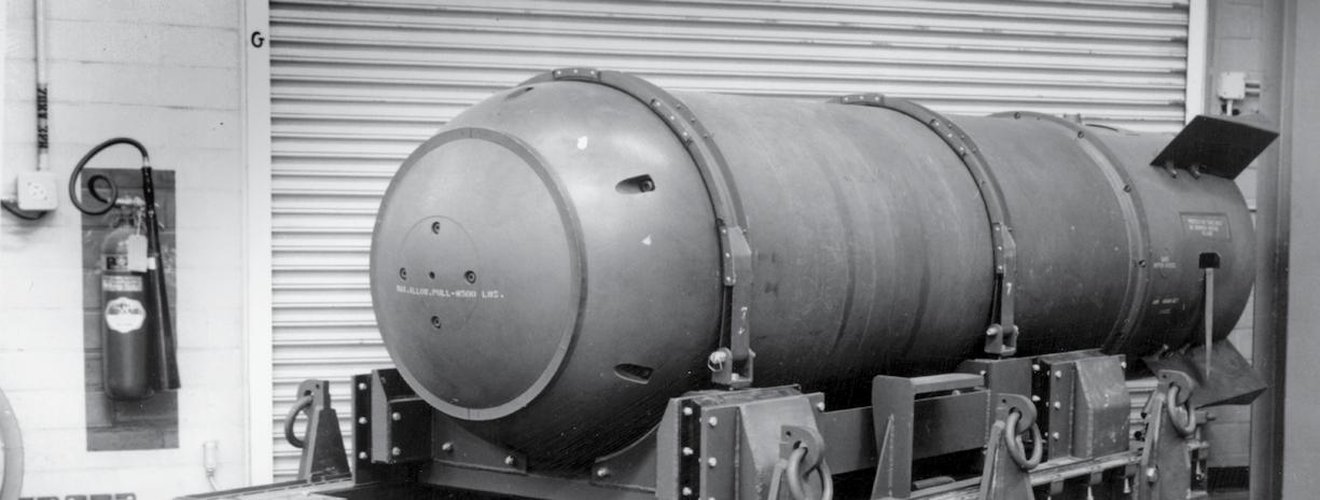
On March 10, 1956, a B-47 Stratojet left MacDill Air Force Base in Florida and headed east across the Atlantic, bound nonstop for an overseas base. Somewhere over the Mediterranean it simply failed to appear at its second scheduled aerial refueling. Three men were aboard. No wreckage was ever found, and neither was the cargo. For decades the vanished bomber has led list after list of lost nuclear weapons.
There is one problem with the legend, and the Pentagon put it in writing: ‘No weapons were aboard the aircraft, only two capsules of nuclear weapons material in carrying cases.’ The bomb that leads all those lists was not a bomb. It was a pair of containers of fissile material – in the government’s own taxonomy, a component loss, which is a different thing from losing a weapon. Hold the declassified record to that standard and the roster changes shape. Famous entries fall away. A forgotten flying boat joins.
What follows is the roster the primary documents actually support: every incident, American and Soviet, in which a complete nuclear weapon went somewhere humans could not retrieve it and stayed there. It starts off the beaches of New Jersey and ends near an Arctic island, and along the way it includes a bomb the CIA built the world’s strangest ship to fetch, and mostly didn’t.
Nine incidents between 1957 and 1989 left a complete nuclear weapon lost and never recovered: five American losses, from an Atlantic cargo jettison to the submarine USS Scorpion, and four Soviet submarine sinkings, from K-129 to K-278 Komsomolets. All of the weapons lie in the sea, and two of the sites are still monitored for radiation.
C-124 Globemaster Jettison
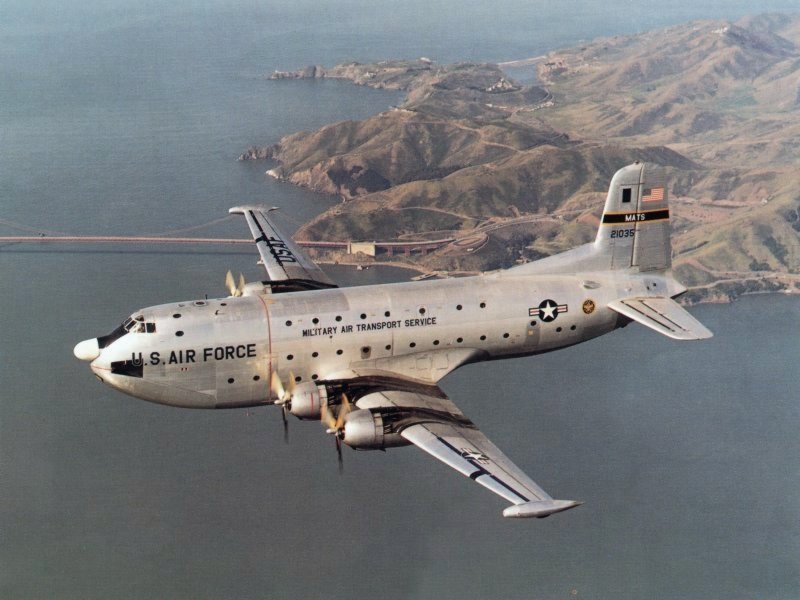
Halfway across a ferry run out of Dover Air Force Base, Delaware, on July 28, 1957, a C-124 Globemaster lost power from its number one and number two engines over the Atlantic and found it could not hold level flight even at maximum power on the pair that remained. The arithmetic aboard was uncomfortable, because the cargo was three nuclear weapons and one nuclear capsule.
The official account records what happened next with impressive calm: ‘The decision was made to jettison cargo in the interest of safety of the aircraft and crew.’ The first weapon went out at 4,500 feet. The second followed at approximately 2,500 feet. Neither had nuclear components installed, neither detonated, and a subsequent search for the weapons or debris had negative results. The crippled transport then limped to an airfield near Atlantic City, New Jersey, and landed with the third weapon and the capsule still aboard.
The two jettisoned weapons have never been found. The Center for Defense Information later placed them somewhere east of Rehoboth Beach, Delaware, and Cape May and Wildwood, New Jersey – which is to say, off the beach towns of the Jersey Shore. The incident surfaced publicly as entry number nine in the Pentagon’s declassified accounting. The swimmers have never seemed to mind.
Tybee Island Bomb
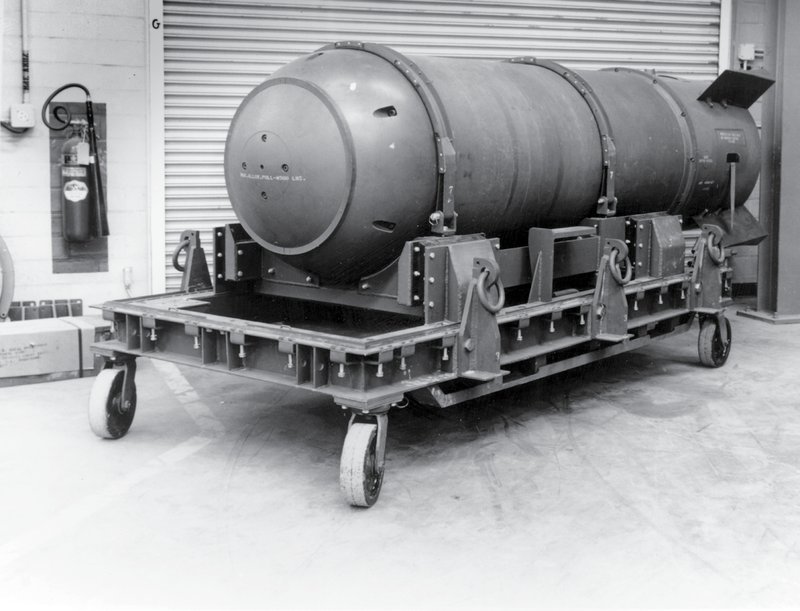
The collision happened at 38,000 feet, still listed by Guinness World Records as the highest-altitude mid-air collision on record. At 3:30 a.m. on February 5, 1958, an F-86 fighter struck a B-47 bomber near Savannah, Georgia during a simulated combat mission. Major Howard Richardson, unable to land his damaged bomber safely with the payload aboard, jettisoned a Mark 15 hydrogen bomb into Wassaw Sound from about 7,200 feet, brought the aircraft in, and received the Distinguished Flying Cross.
The bomb – roughly 7,600 pounds, 12 feet long, with 400 pounds of conventional high explosive – has been in the sound ever since. Divers and demolition technicians dragged and sonar-swept a three square mile area until April 16, 1958, when the weapon was written off as irretrievably lost. A 2001 Air Force reassessment figured it lies buried 5 to 15 feet under the seabed and recommended leaving it there.
What exactly is inside it depends on which government paper you trust. The custody receipt Richardson signed lists the capsule as ‘SIMULATED’, and the 2001 review concluded the bomb was a Mod 0; a 1966 Pentagon letter to Congress filed the same bomb under complete weapons. The two documents have never been reconciled. In 2004 a retired officer’s radiation readings briefly raised hopes of finding it – investigators traced them to monazite, a mineral the Georgia coast makes naturally.
P-5M Marlin Ditching
Two flat sentences close the Pentagon’s entire account of this one: ‘It was carrying an unarmed nuclear antisubmarine weapon containing no nuclear material. The weapon was not recovered.’
On September 25, 1959, a P-5M Marlin flying boat out of Naval Air Station Whidbey Island came down in the Pacific about 100 miles west of the Washington-Oregon border. All ten men aboard survived the ditching, and the Coast Guard cutter Yocona, out of Astoria, Oregon, collected their life raft roughly ten hours later after a Grumman Albatross seaplane spotted them – a rescue the accident summary never bothers to mention. The weapon that went down with the aircraft was, per researcher James N. Gibson’s 1996 book Nuclear Weapons of the United States, a Mark 90 ‘Betty’ nuclear depth charge: a shade over ten feet long, roughly 1,243 pounds, built around a warhead rated up to 32 kilotons.
The press was not notified at the time, and at least two standard references misplace the crash in Puget Sound, conflating the squadron’s home base with a site far out in open ocean. The Navy withdrew the Mark 90 from service entirely by 1960 – the whole weapon class was retired within about a year of the one example the fleet could never account for.
Philippine Sea A-4 Skyhawk
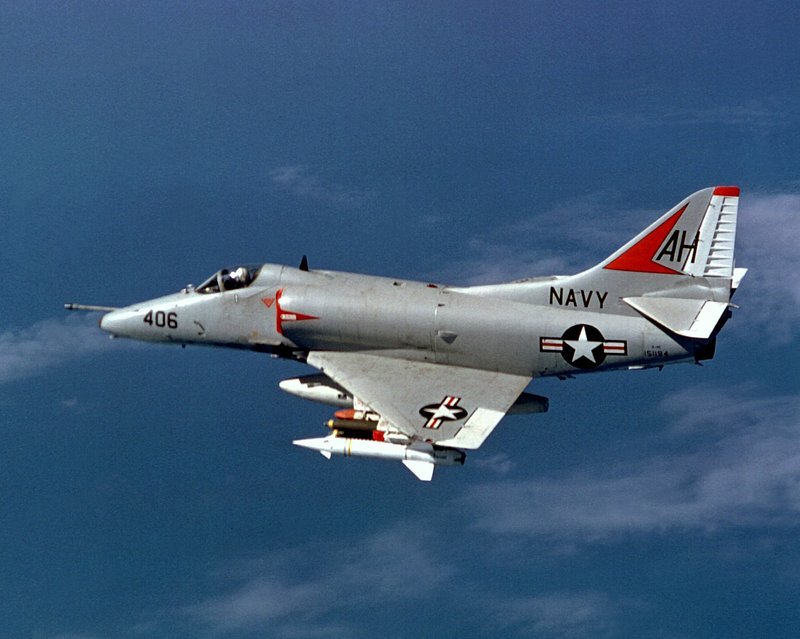
Of the pilot, the aircraft, and the bomb, the sea gave back one helmet. On December 5, 1965, as USS Ticonderoga steamed toward Yokosuka at the end of a Vietnam combat deployment, an A-4E Skyhawk being moved to the ship’s elevator rolled over the side. Lieutenant (junior grade) Douglas Webster, his aircraft, and the single one-megaton B43 thermonuclear bomb it carried went down together in about 16,000 feet of water, and nothing else of them was ever found.
That depth sounds final until you put it beside Challenger Deep, the deepest point of the Mariana Trench, which is more than twice as far down – and which the 33 people who have reached the bottom of the Mariana Trench have shown is reachable whenever anyone cares to try. Nobody has ever cared to try for the B43.
The Pentagon’s 1981 disclosure of the accident placed it ‘more than 500 miles from land.’ That was the version Japan lived with for eight years. The May 1989 disclosure put the wreck roughly 80 miles from Japan’s Ryukyu Islands, twenty-four years after the accident, and the correction landed on front pages across Japan. Japan’s government formally asked Washington for an explanation, and received one. The bomb, meanwhile, has not moved.
Soviet Submarine K-129
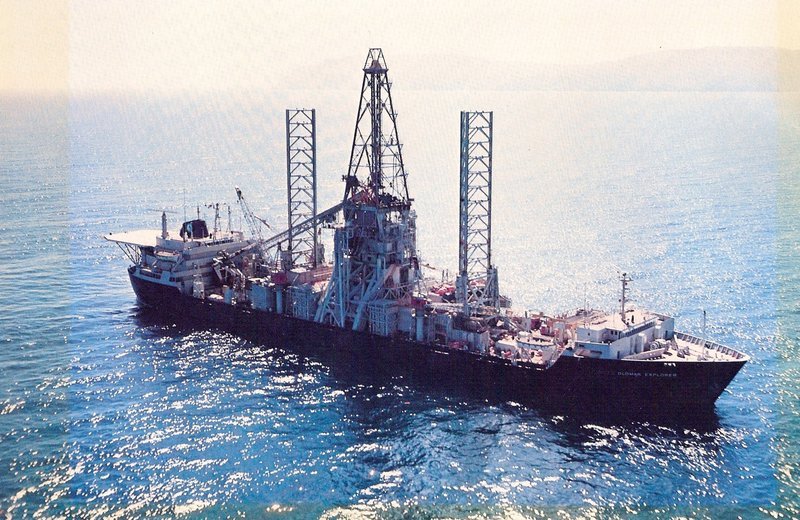
The CIA built a ship to steal this submarine. K-129, a Soviet ballistic missile boat, sank in March 1968 about 1,560 nautical miles northwest of Hawaii and settled 16,500 feet down; the USS Halibut photographed the wreck that August, a find worth a Presidential Unit Citation.
The result was Project AZORIAN and the Hughes Glomar Explorer – publicly a Howard Hughes venture to mine manganese nodules, actually a machine for dangling roughly 16,800 feet of drill pipe down to a claw nicknamed Clementine. The CIA has never said what the six-year program cost; outside estimates run from about $300 million to $800 million in 1974 dollars. Even for the agency that ran every CIA plot to assassinate Fidel Castro, it was extravagant. In August 1974 the claw got the submarine partway up before the hull broke. A 38-foot bow section came aboard carrying at least two nuclear-armed torpedoes and the remains of six Soviet submariners, whom the crew buried at sea with military honors.
The section holding the three ballistic missiles – ‘one of the most coveted prizes in the whole operation,’ in the CIA history’s words – fell back to the seafloor, and the planned second lift died when the press exposed the operation in 1975. Asked about it, the Agency coined the sentence it still uses: ‘we can neither confirm nor deny the existence of the information requested.’ The missile warheads it declined to discuss are down there still. The torpedoes it raised are not.
USS Scorpion
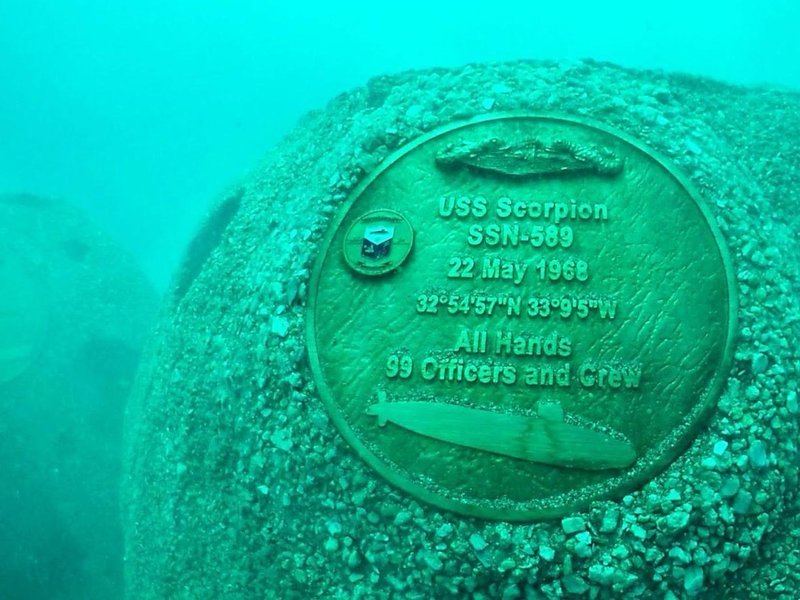
Nowhere in the government’s own list of nuclear weapons accidents does this boat’s name appear. One entry in the Pentagon’s declassified 1981 accounting gives a season, an ocean, and the words ‘details remain classified,’ and that is all.
The boat was USS Scorpion, a nuclear attack submarine that sank on May 22, 1968, about 400 miles southwest of the Azores with 99 men aboard. The research ship USNS Mizar found the wreck that October under more than 10,000 feet of water. The Navy’s Court of Inquiry concluded the certain cause of the loss could not be ascertained from the evidence available, and none has ever been established since. Scorpion was one of four submarines the world lost in 1968, alongside the Soviet K-129, the Israeli Dakar, and the French Minerve.
Two Mark 45 ASTOR nuclear torpedoes went down with her and are there now. Department of Energy teams checked the site in 1979, 1986, and 1998 and found no evidence of leakage from either weapon. They looked; they did not touch. Navy policy holds that its sunken military craft remain in place and undisturbed, so the site is honored the way the 15 people memorialized on the Moon are honored – by being left exactly where they are. On the loss’s 50th anniversary in 2018, the Navy read all 99 names aloud at Norfolk.
Soviet Submarine K-8
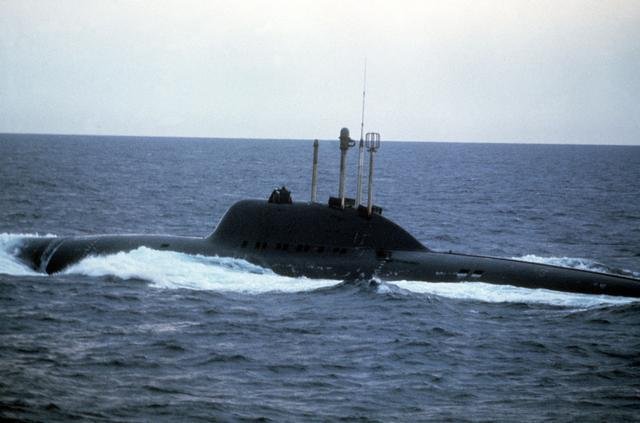
K-8 was steaming home from Okean-70 – ‘not merely the Soviet Navy’s but history’s largest peacetime naval exercise,’ in the judgment of USNI Proceedings – when fires broke out in two of its compartments at once on April 8, 1970, deep in the Bay of Biscay.
Captain Vsevolod Bessonov surfaced the boat, a decision that saved half his crew of 104. Bulgarian and Soviet merchant ships took off survivors while a skeleton crew reboarded the hull to manage a tow toward home. The tow failed. K-8 foundered on April 12, 1970, and 52 men died – 30 going down with the hull, 22 of exposure in the water – Bessonov among them. That June the Kremlin named him a Hero of the Soviet Union ‘for courage and valor displayed in performing military duty’ – the standard formula for men who did not come home.
What the boat carried to the bottom is recorded with a bureaucrat’s shrug. The IAEA’s table of accidents at sea lists the wreck at 4,000 metres with ‘Nuclear warheads’ aboard – no count offered – and ‘Recovered: No.’ One published chain of citations puts the load at four nuclear torpedoes and the depth closer to 4,680 metres. The figures have never been reconciled. The Bay of Biscay keeps the details.
Soviet Submarine K-219
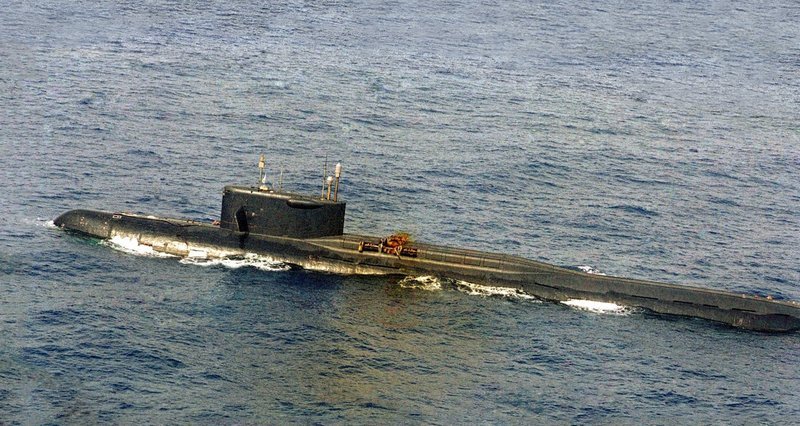
Days before Reagan and Gorbachev sat down at Reykjavik, a Soviet ballistic missile submarine tore itself open in the Atlantic. A failed seal in missile tube six of K-219 had let seawater seep onto residual liquid missile fuel – the boat already had one tube welded permanently shut after an earlier accident of exactly the same kind – and at 0538 on October 3, 1986, roughly 600 miles east of Bermuda, the tube exploded.
Inside the reactor compartment, a twenty-year-old seaman named Sergei Preminin forced the last control rod into place by hand after his officer collapsed, shutting the reactor down. He never came out. Russia made him a Hero of the Russian Federation on August 7, 1997. The rest of the crew evacuated, a towline from the freighter Krasnogvardeysk snapped at 0620 on October 6, and at 1102 that morning K-219 went down, falling roughly 18,000 feet to the Hatteras Abyssal Plain and breaking in two on the way. Its nuclear-armed missiles and nuclear torpedoes went with it. Published totals for the warheads disagree, so this list does not offer one.
At the Politburo session held the day the boat sank, Gorbachev asked whether it had happened ‘due to lack of competence of the crew or because of cowardice.’ Captain Igor Britanov was charged with negligence; the charges were dropped in 1987. The U.S. Navy’s own history records that ‘in the eyes of his government, there were no heroes on K-219.’
Soviet Submarine K-278 Komsomolets
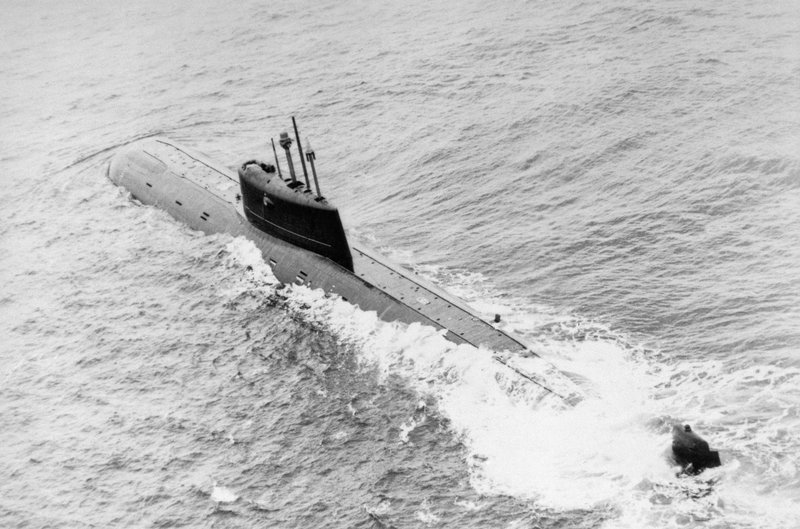
No combat submarine has ever gone deeper than K-278 Komsomolets, which took its titanium inner hull to 1,027 metres in the Norwegian Sea on August 4, 1985 and came back up.
On April 7, 1989, a fire broke out while the one-of-a-kind boat ran submerged near Bear Island, and she sank in roughly 1,680 metres of water. Forty-two of the 69 men aboard died: nine in the fire and sinking, thirty of hypothermia or injuries in near-freezing water, and three more aboard the rescue ship. Five men made it into the spherical escape capsule as she went down; its hatch tore away at the surface, and only Viktor Slyusarenko climbed out alive.
Two nuclear torpedoes went down in the bow, their warheads holding a combined 16 terabecquerels of plutonium by the count of Norway’s radiation authority. Russian Mir submersibles sealed the torpedo compartment’s fractures in 1995, and when researchers dove the wreck again in 2019 the coverings were still in place – though the same expedition measured cesium-137 from a ventilation pipe at readings as high as 800 becquerels per litre, roughly 800,000 times the background level of the surrounding sea. Norway’s monitors have found no sign of the warheads’ plutonium getting out. A 2026 study in the Proceedings of the National Academy of Sciences found the releases small and non-hazardous. Norway keeps checking anyway, and keeps publishing what it finds.
Frequently Asked Questions
Could the lost nuclear weapons still explode?
A nuclear blast is essentially ruled out. American designs are one-point safe, holding the odds of a meaningful accidental yield to about one in a million, and several of the lost weapons carried no fissile capsule at all. For every wreck on this list, the realistic long-term hazard is corrosion spreading plutonium or uranium.
What does the military mean by a Broken Arrow?
A Broken Arrow is the U.S. military’s term for a serious accident involving nuclear weapons or their components that does not create a risk of nuclear war. The Pentagon’s declassified record of them, Narrative Summaries of Accidents Involving U.S. Nuclear Weapons, catalogues 32 accidents between 1950 and 1980.
Why isn’t the Thule Air Base crash on this list?
Because no whole weapon survived to be lost. The four bombs aboard the B-52 that crashed near Thule, Greenland on January 21, 1968 were destroyed by fire, and what was never found is a weapon secondary – a component. A 1968 submersible survey reported that no parts of one were observed or recovered.
Has a lost nuclear weapon ever been recovered later?
Yes, which is exactly why this list requires never. The fourth Palomares hydrogen bomb fell into the Mediterranean on January 17, 1966 and came up intact on April 7, 1966, eighty days later, with help from the submersible Alvin. All four Palomares weapons were ultimately accounted for, so the accident everyone remembers does not qualify.
How close did the Goldsboro bomb come to detonating?
One switch. A declassified 1969 Sandia analysis by engineer Parker F. Jones found a single low-voltage switch stood between one of the two bombs dropped over Goldsboro, North Carolina on January 24, 1961 and a 3.8-megaton detonation, roughly 260 times the force of the Hiroshima bomb. The other bomb’s uranium secondary is still in the farmland.
- DoD, Narrative Summaries of Accidents Involving U.S. Nuclear Weapons 1950-1980
- W.J. Howard letter to the Joint Committee on Atomic Energy, April 22, 1966
- U.S. Air Force, Tybee Bomb Search and Recovery Assessment (2001)
- CIA, The Glomar Explorer (declassified history)
- National Security Archive, Project Azorian briefing book
- U.S. Department of Energy, Report NT-24-1 (Scorpion site monitoring)
- Naval History and Heritage Command, DANFS: Scorpion (SSN-589)
- National Security Archive, Soviet Politburo record on K-219 (October 6, 1986)