Every Spell Invented by a Specific Character in Harry Potter
The morning Harry Potter left Ron dangling upside-down by the ankle – he had been trying out one of the spells in his Potions book while reading in bed – Hermione put the obvious question over breakfast. “Dangling people upside-down by the ankle?” she said. “Who puts their time and energy into making up spells like that?” Ron, up-ending a ketchup bottle over his sausages, maintained that it had been a laugh.
The answer was whoever had owned Harry’s second-hand copy of Advanced Potion-Making, a book with barely a page left free of handwritten notes and, at the bottom of the back cover, the inscription “This Book is the Property of the Half-Blood Prince.” Ron had been handed a clean copy from the same cabinet – “Puked on, by the look of page fifty-two,” he complained – while Harry followed the scribbles instead of the print and brewed a Draught of Living Death good enough to win the Felix Felicis on offer in his first lesson. Two of the potions named in the series in one lesson, and neither of them was really his work.
The novels are stingy with this kind of credit. Almost all of their magic arrives with no maker attached, and the few spells they do pin to a named inventor come mostly out of those margins, plus a portrait on a hospital wall and one sentence in Quidditch Through the Ages. That is the test here: a charm, jinx, hex or curse that a character or the narration says a named person invented, in the seven novels or in Quidditch Through the Ages. The Marauder’s Map, the Deluminator and the Wolfsbane Potion all have makers on record but are not spells, and Voldemort’s boasts, Rowling’s remarks outside the books and spell names the books never use are dealt with in the questions at the end. The oldest invention comes first, and the Prince’s spells follow in the order Harry finds them, which keeps his identity for last.
The seven Harry Potter novels and Quidditch Through the Ages credit eight spells to a named inventor. Urquhart Rackharrow devised the Entrail-Expelling Curse and Elliot Smethwyck the Cushioning Charm; the Half-Blood Prince, Severus Snape, wrote the other six in his Potions-book margins: Levicorpus, its counter-jinx Liberacorpus, a toenail-growing hex, Langlock, Muffliato and Sectumsempra, with Muffliato credited only by implication.
Entrail-Expelling Curse
A hospital is a strange place to honour the man who invented a way of emptying people’s insides, but St Mungo’s does it anyway. Urquhart Rackharrow’s portrait hangs in the Dai Llewellyn Ward, and Order of the Phoenix credits him, in chapter 22, with inventing the Entrail-Expelling Curse. Harry and the Weasley children see the painting when they visit Arthur Weasley.
Mr Weasley is there because Nagini, Voldemort’s snake, bit him while he was guarding the Department of Mysteries – an attack Harry saw in a vision the night before the visit. Even getting inside takes a small deception. The hospital’s entrance is hidden in a condemned department store on a street full of Muggle shoppers, so that witches and wizards arriving to see a Healer pass for more people staring into an old shop window.
That is very nearly everything the books have to say on the subject. Rackharrow gets no dialogue and no story of his own, and the curse is never cast, shown in action or given an incantation; it exists in a single chapter and nowhere else in the seven novels. Why a hospital would want to remember a man for this particular contribution to medicine is never explained. It is probably best not to ask.
Cushioning Charm
Somebody had to make broomsticks comfortable, and Quidditch Through the Ages knows exactly who and when. It records that “the invention of the Cushioning Charm by Elliot Smethwyck in 1820 went a long way towards making broomsticks more comfortable than ever before.” The phrase “more comfortable than ever before” does a good deal of quiet work on behalf of everyone who flew before 1820.
It is an unusually tidy attribution – an inventor, a charm and a year, all in one sentence – and it is also the whole of Smethwyck’s record. No birth or death date is given for him, and he never appears in a scene. The novels do give St Mungo’s a Healer called Hippocrates Smethwyck, in charge of the ward for serious bites in Order of the Phoenix, and say nothing whatever about whether the two men are related.
The charm itself turns up in the novels once, and not on a broom. During the break-in at Gringotts in Deathly Hallows, Harry, Ron, Hermione, Griphook and the goblin Bogrod are thrown from a cart and fall a great distance, and Hermione casts a Cushioning Charm to break the fall. Smethwyck devised it to soften a broom handle. It turned out to soften a much longer drop.
Levicorpus and Liberacorpus
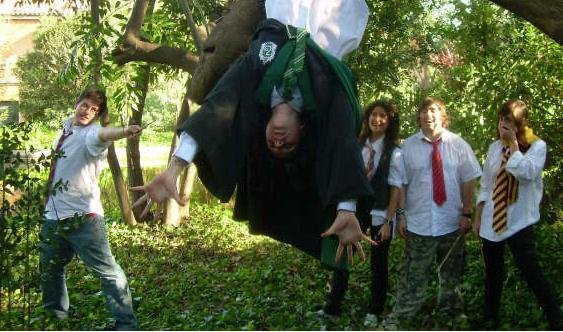
“Oh, that one had a great vogue during my time at Hogwarts,” Remus Lupin tells Harry when Levicorpus comes up in Half-Blood Prince. “There were a few months in my fifth year when you couldn’t move for being hoisted into the air by your ankle.” Harry had raised it for a reason. The Prince, Harry explained, “wrote spells all over it, spells he invented. One of them was Levicorpus -”
Harry had seen somebody left upside-down before. In Snape’s Worst Memory, one of the memories viewed in the Pensieve, a teenage James Potter leaves Snape “hanging upside-down in the air, his robes falling over his head,” and the book never names the jinx he used. The Prince’s margin was barely more forthcoming. It gave the incantation without saying what it did, but it did, mercifully, include the counter-jinx, Liberacorpus, which is how Ron got down after Harry tried the spell on him.
The night of that talk with Lupin, Harry dug the book out of his trunk and checked its publication date. It was “nearly fifty years old,” and “Neither his father, nor his father’s friends, had been at Hogwarts fifty years ago.” The logic was faulty, since a book can be written in long after it is printed. The conclusion happened to be right.
The Toenail-Growing Hex
The books never give it an incantation, which makes the toenail-growing hex the only one of the Prince’s spells here known purely by what it does. It turns up in chapter 12 of Half-Blood Prince, “Silver and Opals,” among the spells in the Prince’s hand, and its name is a description rather than a magic word: a hex that makes someone’s toenails grow.
Chapter 12 is also where the narration makes the case for the Prince as an inventor at all. Poring over the book, Harry notices “the imaginative little jinxes and hexes scribbled in the margins which Harry was sure, judging by the crossings-out and revisions, that the Prince had invented himself.” It is the reasoning of a good textual editor. Someone copying a finished spell out of a library book has no reason to cross it out and try again. Someone working one out does.
Read that way, the margins are a student’s workbook – drafts, corrections and second attempts, kept by someone who plainly enjoyed the work and did not much mind who it was done to. Most students’ rough work is homework. The Prince’s ran to jinxes and hexes, and one that makes toenails grow is the Prince in a playful mood, which says a good deal about the rest.
Langlock
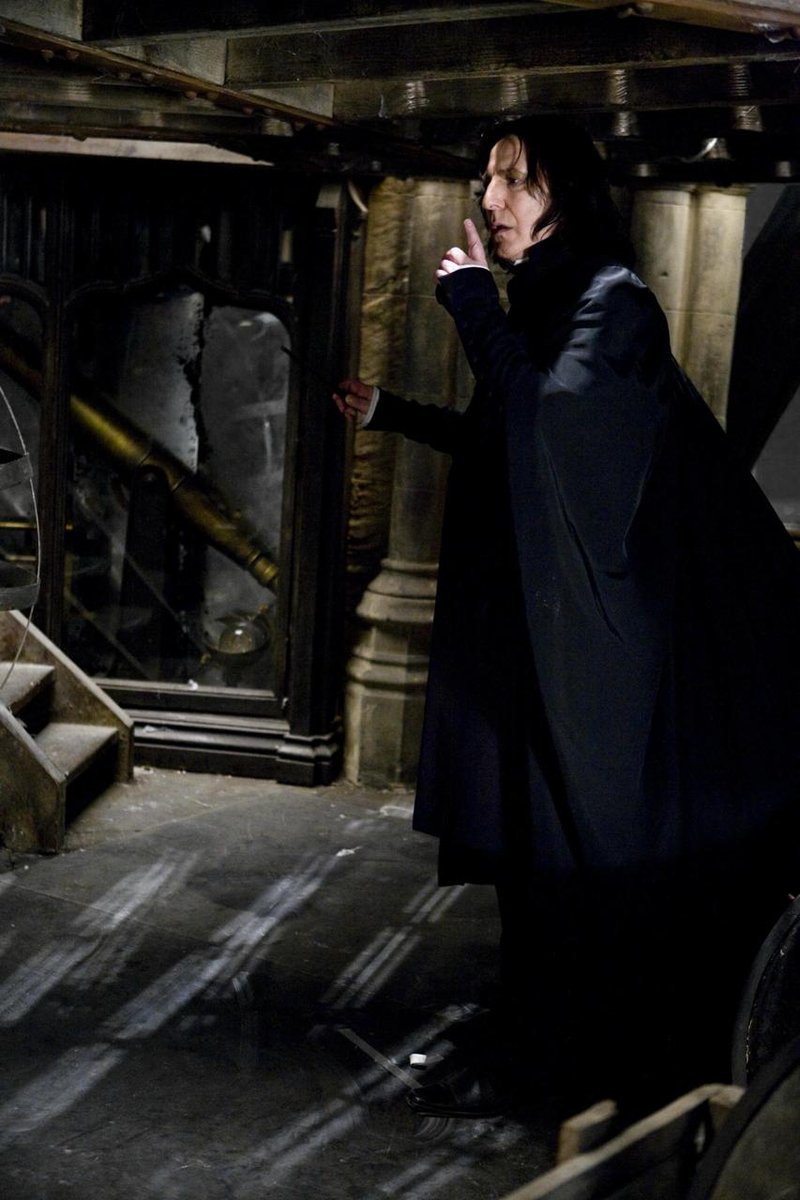
Argus Filch found out what Langlock does twice, to general applause. The jinx glues its target’s tongue to the roof of the mouth, and Harry used it on Filch early in Half-Blood Prince, in the same weeks he was discovering what else the Prince’s margins held. The official Harry Potter site files it among “Snape’s many self-invented hexes,” which is the kind of phrase that makes a reader wonder how many there were.
Its most satisfying victim came later. In chapter 19 Harry turns it on Peeves, whose tongue promptly “had glued itself to the roof of his mouth.” Peeves is a poltergeist – an “indestructible spirit of chaos,” in Rowling’s phrase, solid-looking where the ghosts are pearly white and transparent – and so not, strictly, one of the Hogwarts ghosts, though he haunts the same halls. In Order of the Phoenix, Dolores Umbridge had found him completely beyond her control. One word from the Prince’s margins shut him up.
Ron’s reaction showed how familiar the Prince’s work had become to the three of them. “Nice one,” he said, and then: “That was another Prince hex, wasn’t it?” He no longer needed to ask what one of Harry’s spells did, only whose it was.
Muffliato
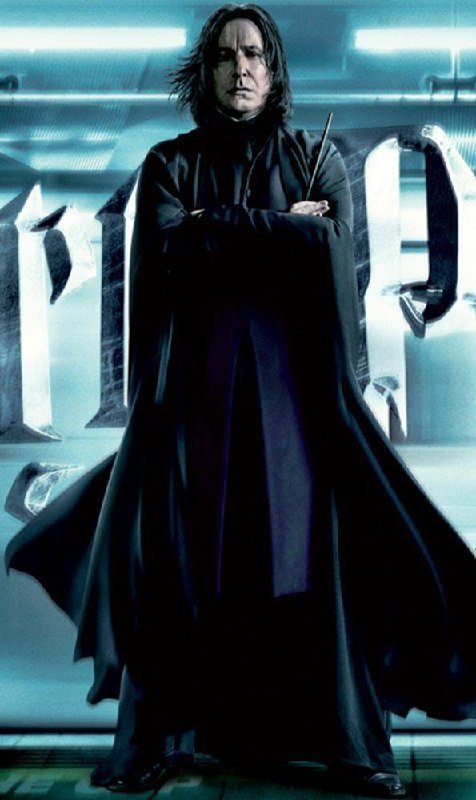
Muffliato belongs to the Prince without the books ever quite saying he invented it. It is in his handwriting, among the margin spells Harry picks up in the autumn of his sixth year, and chapter 10 of Half-Blood Prince had already noted that “Here and there were directions for what looked like spells that the Prince had made up himself.” No line singles out Muffliato as one of those, although features on the official Harry Potter site describe it as developed by the Half-Blood Prince.
What it does is disarmingly practical. The charm fills the ears of anyone nearby with an unidentifiable buzzing, so the caster can hold lengthy conversations without being overheard. Harry took to casting it on whoever was in the vicinity, and Hermione disapproved so firmly that she would refuse to talk at all if he had. Ron, caught chatting in class by Professor Sprout, later wished Harry had used it then.
Deathly Hallows supplies the punchline. On the night of Harry’s seventeenth birthday it is Hermione who casts Muffliato to cover a conversation with Harry and Ron, and once the three of them are on the run she includes it among the protective charms around their campsite. The spell she had refused to talk under ended up guarding her tent.
Sectumsempra
Two words in the margin, “for enemies,” were all the warning Harry had. In chapter 21 of Half-Blood Prince, he found them in the Prince’s hand, written beside Sectumsempra, and in chapter 24, with no idea what the spell did, he cast it at Draco Malfoy in Moaning Myrtle’s bathroom. Blood spurted from Malfoy’s face and chest “as though he had been slashed with an invisible sword.”
Snape arrived, traced the wounds with his wand and sang them closed. “Who taught you that spell?” he asked Harry, which is a remarkable question from the man who wrote it. Detention followed every Saturday until the end of term.
The Prince turned out to be Severus Snape – for years the Potions master, Head of Slytherin and, of all the Hogwarts professors, the one Harry liked least. When Harry tried the curse on him during Snape’s own escape in chapter 28 and failed, Snape answered: “You dare use my own spells against me, Potter? It was I who invented them – I, the Half-Blood Prince!” In Deathly Hallows, flying among the Death Eaters as Dumbledore’s double agent, he took off George Weasley’s ear with it. He had been aiming at another Death Eater’s wand hand.
Frequently Asked Questions
Did Voldemort invent any spells?
He says so, but the books never name one. In the graveyard in Goblet of Fire, Voldemort credits his weak, makeshift body partly to “a spell or two of my own invention.” He also flies unaided in Deathly Hallows, though Quidditch Through the Ages insists “No spell yet devised enables wizards to fly unaided in human form.”
Who invented the Dark Mark spell, Morsmordre?
Neither the novels nor Rowling name an inventor for Morsmordre. The books establish what the Mark is for – Snape tells Cornelius Fudge that “Every Death Eater had the sign burned into him by the Dark Lord,” as a means of summoning them – but crediting the spell itself to Voldemort is an inference, not anything the text states.
Did Dumbledore invent the Patronus message?
Rowling said so; the novels never do. Her website’s FAQ explained that the Order’s members learned to send messages with their Patronuses from Dumbledore, adding “(he invented this method of communication).” In the books, Dumbledore sends one to Hagrid in Goblet of Fire, two books before Tonks does, and nobody says who devised the technique.
Is Vulnera Sanentur in the books?
No. The name never appears in the seven novels. When Snape heals Draco Malfoy after the Sectumsempra duel in Half-Blood Prince, the book describes only “an incantation that sounded almost like song,” repeated three times over the wounds before the bleeding stops. The counter-curse is never given a name, so it cannot be credited to anyone here.
Why isn’t the Horton-Keitch Braking Charm on the list?
Because Quidditch Through the Ages calls it patented, not invented. Its sentence reads: “The patented Horton-Keitch braking charm meant that Quidditch players were much less likely to overshoot goals or fly offside.” Basil Horton and Randolph Keitch fitted it to their first broom, the Comet 140, in 1929; whether they devised the charm themselves, the book never says.
Did Hermione invent the jinx on the D.A. sign-up list?
The books never say she invented it, only that she cast it. Hermione bewitched the parchment the students signed at the Hog’s Head, in Order of the Phoenix; the jinx left marks on Marietta Edgecombe’s face that were still visible the following September. No line in the books claims the jinx was Hermione’s own design.
Does Rowling name any other spell inventors outside the books?
Yes. Her 2012 Wonderbook: Book of Spells, whose spell histories she said she helped bring to life, credits Jarleth Hobart with the Levitation Charm in 1544 and makes Elizabeth Smudgling the most likely inventor of the Disarming Charm, used to win a duelling competition on Dartmoor in 1379. Her website credited Felix Summerbee with Cheering Charms.
What about magical inventions that aren’t spells?
Several have named makers. Lupin says he, Sirius, Peter and James wrote the Marauder’s Map; Rufus Scrimgeour reports that Dumbledore designed the Deluminator; Slughorn credits Damocles Belby with inventing the Wolfsbane Potion; Hermione calls Nicolas Flamel “the only known maker of the Philosopher’s Stone”; and Quidditch Through the Ages credits Daisy Pennifold with the idea of a slow-falling Quaffle.
- Harry Potter, books 1-7 (Bloomsbury, 1997-2007), chapters as cited in the evidence record
- Quidditch Through the Ages, by Kennilworthy Whisp (J.K. Rowling), Bloomsbury
- Harry Potter Lexicon – chapter-citation index of spells, consulted for every entry
- Harry Potter (official site) – 8 times the Half-Blood Prince reveals the real Snape
- J.K. Rowling’s official website, FAQ (archived)
- J.K. Rowling’s official website, Wizard of the Month (archived text)
- PlayStation Blog – Wonderbook: Book of Spells features writing from J.K. Rowling