Every Vice President Who Inherited the Presidency
William Henry Harrison died at the White House on 4 April 1841, the first of the presidents to die in office, and in dying he exposed a sentence nobody had read carefully enough. The Constitution provided that on a president’s death the Same shall devolve on the Vice President. It did not say what the Same was. The National Archives concedes the point in as many words: Article II did not clarify whether it was only the powers and duties of the President that devolved onto the Vice President, or the office itself.
John Tyler answered the question by declining to ask it. He took the presidential oath on 6 April, called himself President, and left others to argue. The country then ran on his nerve for more than a century, because nothing was written down until the Twenty-Fifth Amendment was ratified on 10 February 1967. At the ceremony marking that ratification, Lyndon Johnson counted up every way the office had ever emptied: seven men have died while Vice President, John C. Calhoun resigned, and eight others left the Office vacant when succeeding to the Presidency. Eight was correct that day. The man who would make it nine had not yet been appointed, and would take the vice presidential oath under Johnson’s new amendment on 6 December 1973.
What follows is the nine vice presidents who became president this way, in the order the office fell to them. The oaths were taken in a hotel on Pennsylvania Avenue, a farmhouse parlour in Vermont, a private house on Lexington Avenue and the conference room of a parked aeroplane, which is not how anybody had drawn it up.
Nine vice presidents have succeeded to the presidency on the death or resignation of the man above them. Eight followed a death, from John Tyler in 1841 to Lyndon Johnson in 1963. The ninth, Gerald Ford, followed Richard Nixon’s resignation in 1974. Vice presidents who reached the office by winning an election are not counted here.
John Tyler
The certificate Judge William Cranch wrote out at Brown’s Hotel on 6 April 1841 may be the most tactful document in American history. Tyler, it records, deems himself qualified to perform the duties and exercise the powers and office of President without any other oath than that which he has taken as Vice-President. He was taking it anyway, Cranch explained, because doubts may arise, and for greater caution.
The doubts arose at once. Nobody knew whether Harrison’s death had handed Tyler the office or merely the work of it, and Tyler settled it by behaving as though there had never been a question. John Quincy Adams wrote on 16 April that Tyler styles himself President of the United States, and not Vice-President acting as President, which would be the correct style. The press was blunter. On 10 September the Louisville Daily Journal remarked that his Accidency is in a quandary – printed a day before the cabinet resigned, all but Daniel Webster.
Tyler was one of the presidents who owned slaves while in office. The Colored American reported on 20 November 1841 that President Tyler has in all 18 colored persons hired, and that he has but two of his slaves with him, as servants. In July 1842 Representative John Minor Botts presented a petition from Wetumpka, Alabama, asking that Tyler, the acting President of the United States, resign or be impeached. He did neither. Letters addressed to Acting President Tyler, the Miller Center records, came back unopened.
Millard Fillmore
Zachary Taylor spent 4 July 1850 sitting through Fourth of July orations at the unfinished Washington Monument, then walked along the Potomac and, hot and tired, drank iced water and ate large quantities of cherries and other fruits. He was dead five days later. His own cabinet wrote to Fillmore that night: He died at the President’s Mansion this evening, at half-past 10 o’clock.
Fillmore did the thing in public, which in 1850 was the reassuring option. He told Congress that he proposed this day, at 12 o’clock, in the Hall of the House of Representatives, in presence of both Houses of Congress, to take the oath prescribed by the Constitution. The judge who administered it was William Cranch, Chief Judge of the U.S. Circuit Court, who had done the same for John Tyler on 6 April 1841. Fillmore also wrote to the Senate to say he would no longer occupy its chair, so that it might choose someone else to sit in it.
Taylor had helped stall the Compromise of 1850 and the measures were going nowhere. His entire cabinet resigned as a body, and the new president curtly accepted all of them. Fillmore then appointed Daniel Webster secretary of state, backed the separate bills Stephen Douglas made of Henry Clay’s collapsed omnibus, and put his name to all five. Taylor had been told, days before he died, that his own vice president would vote to pass the compromise if the Senate tied. Fillmore signed it instead.
Andrew Johnson
The oath that made Andrew Johnson president was administered in his own rooms at the Kirkwood House, and he had come very close to not being there to take it. George Atzerodt had been given the vice president as John Wilkes Booth had been given Lincoln, and, as Ford’s Theatre puts it, could not bring himself to carry out the deed. Lewis Powell, sent for Secretary of State William H. Seward, did try.
Lincoln died at twenty-two minutes after 7 o’clock on the morning of 15 April 1865. The cabinet wrote to Johnson that same morning: By the death of President Lincoln the office of President has devolved, under the Constitution, upon you. At 11 o’clock a.m. Chief Justice Salmon P. Chase administered the oath in the presence of nearly all the Cabinet officers. Johnson had been vice president for forty-two days.
The House voted to impeach him on 24 February 1868. On 16 May the Senate divided 35 to convict and 19 to acquit, one short of the two thirds required. The part usually left out is who stood to gain. With the vice presidency empty, the next man in the line of succession was the Senate’s own president pro tempore, Benjamin Wade, and Wade voted to convict. Johnson kept the office, and afterwards recommended stripping that officer from the succession altogether, on the grounds of his self-interest in producing a vacancy in the White House.
Chester A. Arthur
Through the late summer of 1881 the Senate had no president pro tempore, and that was Chester Arthur’s doing. Presiding over it as vice president, he had refused to relinquish the chair long enough for one to be elected. Garfield had been shot by Charles Guiteau on 2 July and did not die until 19 September, so when Arthur moved up he left a second office empty behind him, and the Senate’s own history records both of them vacant that year.
Garfield died at about half past ten at night. Judge John R. Brady of the New York Supreme Court reached 123 Lexington Avenue at 1:50, and the ceremony was, out of courtesy, deferred until Judge Donohue’s arrival, at a little after 2 o’clock. Arthur wired the cabinet: In accordance with your suggestion, I have taken the oath of office as President before Hon. John R. Brady. The order announcing it to the army was signed by the Secretary of War, Robert T. Lincoln, whose father had died in office in April 1865.
Arthur reaches the list of presidents who were also generals by way of the New York Volunteers, where he was engineer-in-chief with the rank of quartermaster general and later brigadier general. His real trade was patronage: he ran the Port of New York from 1871 to 1878, with nearly 1,300 agents collecting about 75 percent of the nation’s import duties, until Hayes suspended him. On 16 January 1883 that man signed the Pendleton Act.
Theodore Roosevelt
Theodore Roosevelt was somewhere on Mount Marcy when the news started up the mountain after him. He had spent the night of 12 September 1901 on the mountain; on the afternoon of the thirteenth a messenger reached him with word that McKinley was dying, and he rode thirty-five miles by carriage through the dark to North Creek station, arriving just before dawn to learn McKinley was already dead.
He reached Buffalo at 1:30 that afternoon in a travelling suit and was put into formal clothes borrowed from other guests at Ansley Wilcox’s house on Delaware Avenue. The library was not a large one and was far from full: six cabinet members, the newspaper men all let in at the last moment, no photographs allowed, and no Bible. Judge John R. Hazel administered the oath. Roosevelt said it would be his aim to continue absolutely unbroken the policy of President McKinley, then held a cabinet meeting in the same room.
He was 42 years and 322 days old, the youngest person ever to become president. Kennedy, at 43 years and 236 days, was the youngest ever elected, which is a different record. Roosevelt then did what no nineteenth-century successor had managed and was elected in his own right, taking 336 electoral votes to Alton B. Parker’s 140. On election night he announced that under no circumstances will I be a candidate for or accept another nomination, a sentence he later wrote was among his greatest political mistakes.
Calvin Coolidge
There was no electricity at the Coolidge farmhouse in Plymouth Notch, Vermont, and no telephone either, which is why the news came up the road by messenger in the middle of the night. Warren Harding had died the previous evening at the Palace Hotel in San Francisco. The physicians’ statement, signed at 7:35 p.m., reported that he died instantaneously and without warning while conversing with members of his family.
John Calvin Coolidge Sr was a notary public and a justice of the peace, and at 2:47 in the morning of 3 August 1923 he administered the presidential oath to his son in the parlour of the family home by the light of a kerosene lamp. Harding was carried east by train, and on 8 August became one more president to have lain in state in the Capitol Rotunda.
There was a difficulty with the parlour. The elder Coolidge held his commission from the state of Vermont, and Solicitor General James Beck considered the oath the elder Coolidge had given illegal, though he would say only that his opinion was on file at the Department of Justice. So it was done a second time at the New Willard Hotel in Washington, before Associate Justice A. A. Hoehling of the District of Columbia Supreme Court, with nobody else present. Hoehling promised to keep the ceremony secret, and did, until a book by Harding’s attorney general forced it into the papers.
Harry S. Truman
Did you ever have a bull or a load of hay fall on you? Truman put that to reporters outside Les Biffle’s office in the first days of his presidency, and followed it with a request: I don’t know if you boys pray, but if you do, please pray God to help me carry this load. TIME printed the exchange in its issue of 23 April 1945.
Franklin Roosevelt had been pronounced dead at 3:35 p.m. on 12 April at Warm Springs, Georgia, having collapsed at about 1:15 complaining of a terrific headache. Chief Justice Harlan F. Stone administered the oath at 7:09 that evening in the Cabinet Room. A Bible had to be scurried up in a hurry; it stayed closed while Truman repeated the words, and he kissed it when he finished. By 8:10 p.m. his first statement as president was out, promising that we will prosecute the war on both fronts, east and west, with all the vigor we possess.
Among the Secret Service code names for presidents, Truman’s was General, which was a promotion: he had commanded a field artillery battery in France as a captain. He had been vice president for eighty-two days, and in the whole of that time nobody had told him what the war was about to end with. Stimson drew him aside that first evening to mention a new explosive of almost unbelievable destructive power. The full briefing came on 25 April.
Lyndon B. Johnson
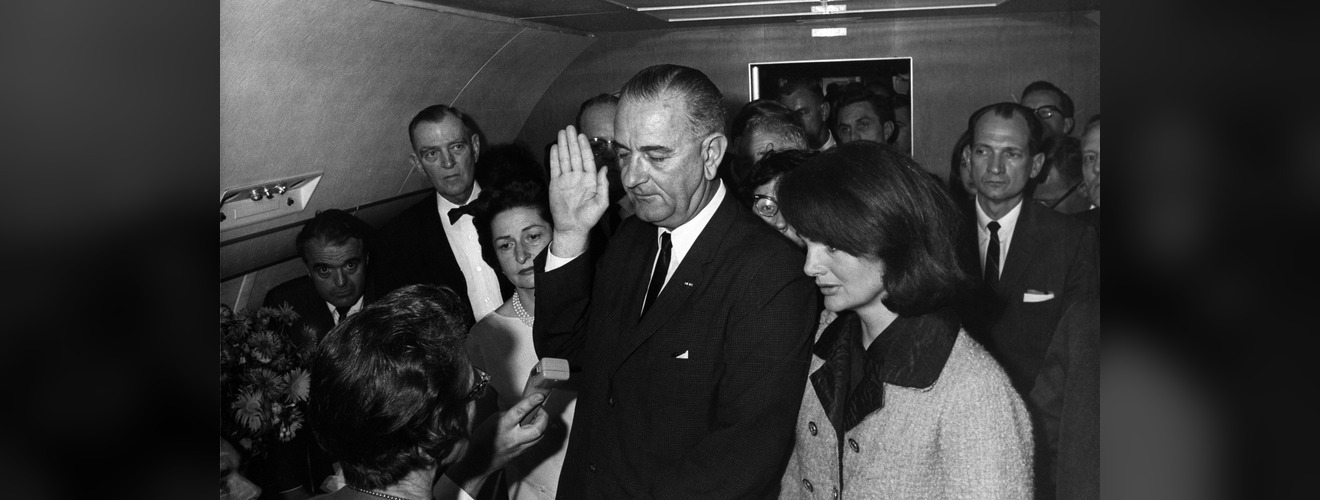
The judge who swore in Lyndon Johnson had been put on the federal bench by the man he was replacing. Sarah T. Hughes, a United States District Judge for the Northern District of Texas, was appointed by John F. Kennedy; on 22 November 1963 she stood in the conference room of his aeroplane at Love Field in Dallas and administered the oath to his successor. Kennedy had been pronounced dead at 1:00 p.m. Central time; Hughes gave the oath at 2:38 p.m., and in doing so became the first woman ever to administer the presidential oath.
The book under Johnson’s hand was not a Bible: somebody had found Kennedy’s Roman Catholic missal aboard the plane, a volume of prayers and biblical passages used at Mass, and that is what was used. At Andrews Air Force Base at 6:10 that evening Johnson read from a card: I will do my best. That is all I can do. I ask for your help – and God’s.
He won a term of his own the following November, taking 486 electoral votes to Barry Goldwater’s 52. For fourteen months, though, the United States had no vice president whatsoever. Next in the line of succession stood the Speaker of the House, John McCormack, and behind him the Senate’s president pro tempore, Carl Hayden. McCormack was 71 and Hayden was 86, which is a long way from the ticket the country had actually voted for.
Gerald R. Ford
Richard Nixon’s resignation ran to a single sentence. Dear Mr. Secretary: I hereby resign the Office of President of the United States. Alexander Haig carried it to Henry Kissinger’s office in the White House, where it was received at 11:35 a.m. on 9 August 1974. Nixon had told the country the previous evening that he would go effective at noon; the Foreign Relations of the United States series records the earlier time.
Ford took the oath from Chief Justice Warren Burger in the East Room on a Bible his wife held open at Proverbs 3:5-6, and spoke at 12:05. My fellow Americans, our long national nightmare is over, he said. Our Constitution works; our great Republic is a government of laws and not of men.
He was standing there because Spiro Agnew had resigned in October 1973 and Nixon had reached for Section 2 of the Twenty-Fifth Amendment, which nobody had used before. The Senate confirmed Ford 92 to 3 on 27 November 1973 and the House 387 to 35 on 6 December. Had Nixon gone during that vacancy, the Democratic Speaker, Carl Albert, would have had to resign his seat and act as president. Ford’s 895 days are the shortest of these nine presidencies, though not the shortest of all: Harding managed 881. Ford put the peculiarity of his position better than anyone has since. I am acutely aware that you have not elected me as your President by your ballots.
Frequently Asked Questions
Which of these presidents later won a term of their own?
Four did. The National Archives names them with their years: Roosevelt, 1904; Coolidge, 1924; Truman, 1948; and Johnson, 1964. The other five never won a presidential election at all, Ford losing to Jimmy Carter in 1976. Through the whole nineteenth century, no accidental president managed to be elected in his own right.
What does the Twenty-Fifth Amendment actually say about succession?
Section 1 reads: In case of the removal of the President from office or of his death or resignation, the Vice President shall become President. That one sentence turned Tyler’s improvisation into constitutional law. Section 2 supplied the missing half, allowing a president to nominate a new deputy subject to a majority in both Houses.
Has the presidency ever passed to somebody other than the vice president?
It has not. All nine transfers on record went to the sitting deputy. Congress has legislated a line beneath that office three separate times, in 1792, 1886 and 1947, first seating two congressional officers in it, then replacing them with the Cabinet, then restoring them in the reverse order.
What happened to the vice presidency each time one of these men moved up?
Eight times it simply stayed empty, because nothing existed to fill it with until the Twenty-Fifth Amendment. Ford was the exception: he nominated Nelson Rockefeller and the office was filled again on 19 December 1974. The National Archives counts 16 vacancies before the amendment, totalling 38 years, the last of them Johnson’s. Fifty people have served as vice president.
Is there any part of the Twenty-Fifth Amendment that has never been used?
Section 4 has never been invoked. It contemplates an alternative body to the Cabinet for judging whether a president can discharge the powers and duties of office, and Congress has never got round to creating one. A bill to establish a Commission on Presidential Capacity was introduced in the House on 14 April 2026.
Why does this list stop at nine?
Because it counts only the men who held the vice presidency and gained the top office through a vacancy. Fifteen deputies have reached the White House by one route or another; the rest got there by winning. On the Senate Historical Office’s own table, the phrase succeeded to the presidency is attached to exactly nine names.
- U.S. Senate Historical Office – Vice Presidents of the United States
- U.S. Senate – Vice President of the United States, historical overview
- National Archives – The Constitution: Amendments 11-27
- National Archives, Prologue – Abrupt Transition: Presidential Succession
- Library of Congress, Chronicling America – Daily National Intelligencer, 7 April 1841 (Cranch certificate)
- Library of Congress, Chronicling America – Louisville Daily Journal, 10 September 1841
- National Park Service – Theodore Roosevelt Inaugural Site
- National Park Service – Theodore Roosevelt and Mount Marcy, September 14