Every Named Wand in Harry Potter
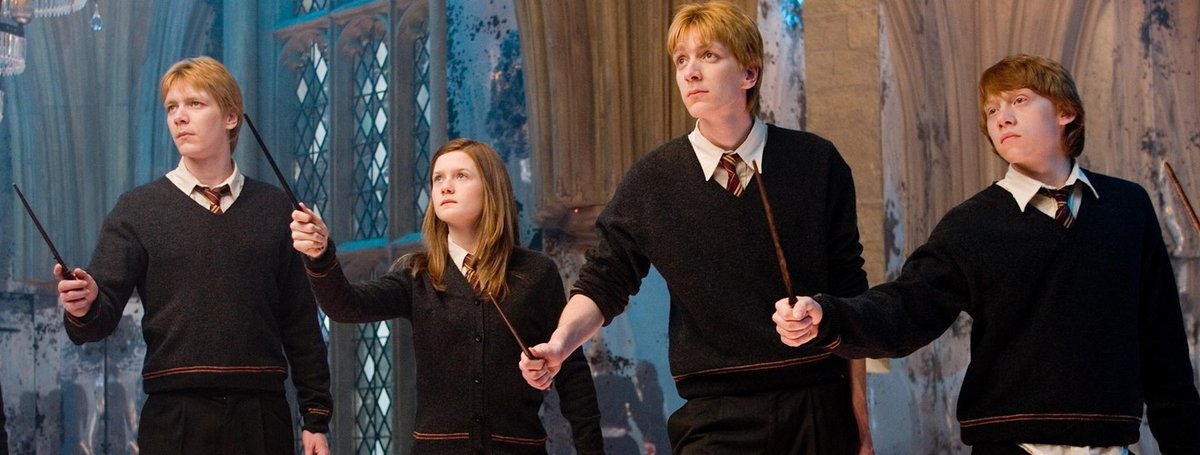
The gold letters over the door of Ollivanders read Makers of Fine Wands since 382 B.C., and the entire window display was one wand on a faded purple cushion. Harry Potter walked in on 31 July 1991, his eleventh birthday, and was handed wand after wand by a man who took each one back almost before he had raised it. When the right one finally came, Ollivander explained the whole business in a sentence the books never improve on: it’s really the wand that chooses the wizard, of course.
What a wand is made of matters as much as who holds it. Rowling later wrote, in Ollivander’s voice, that only three substances earn his name as a core – unicorn hair, dragon heartstring and phoenix feather, which she calls the three Supreme Cores – and each comes from one of the magical creatures of the Harry Potter books. Unicorn hair gives the most consistent magic and the most faithful wands. Dragon heartstring gives the most power and the most accidents. Phoenix feather is the rarest core type and always the pickiest about its owner. Most wands, she adds, run between 9 and 14 inches; anything 8 inches and under, or over 15, is exceptionally rare.
The Elder Wand goes by names of its own – the Deathstick, the Wand of Destiny. The others are known by their owners, and by what somebody said about them out loud: Ollivander reciting a wood and a length across his counter, Umbridge reading out a wand’s description at a hearing, Rowling filling in the gaps years afterwards on Pottermore. That is the record this list works from. A wand appears here when the novels state its wood, core or length, or when Rowling did so herself, and each of her additions is credited to her in the sentence that uses it.
Forty-two wands, grouped into thirty-five entries, have a wood, core or length stated either in the seven Harry Potter novels or in J.K. Rowling’s own Wizarding World writing. Nineteen entries rest on the books themselves and sixteen on Rowling’s later specifications, which the list attributes to her. Film props, merchandise, Cursed Child and video-game wands are excluded.
Harry Potter’s holly wand
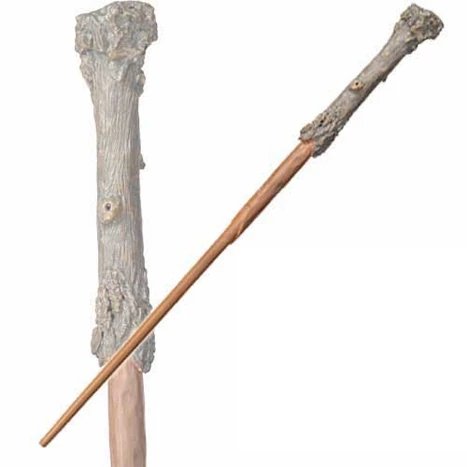
Harry’s wand chose him on the first swish, with a stream of red and gold sparks that shot from the end like a firework, and Ollivander cried Oh, bravo! as if he had won something himself. It was holly and phoenix feather, eleven inches, nice and supple. Then the old man went quiet, because the phoenix whose tail feather sat inside it gave another feather – just one other – and its brother had given Harry his scar.
Rowling, writing years later in Ollivander’s voice, called holly a notoriously difficult wood to team with phoenix feather, since the wood’s volatility conflicts strangely with the phoenix’s detachment. Holly wands, she added, often choose owners who are engaged in some dangerous and often spiritual quest. As wandlore goes, that is fairly pointed. The bird in question turned out to be Fawkes, Dumbledore’s own phoenix, which Harry learned from Dumbledore only after the two brother wands had locked together in the graveyard at Little Hangleton and forced Voldemort’s wand to give up the echoes of the people it had killed.
The holly wand broke by accident during the escape from Bathilda Bagshot’s house in Godric’s Hollow, in the chapter called Bathilda’s Secret. Harry carried the pieces until chapter 36 of Deathly Hallows, when he mended them with the Elder Wand, a repair that is normally impossible. He then put the famous one away. He kept the eleven-inch one.
The wands Harry tried first
Not every wand Ollivander handed over on 31 July 1991 was a failure worth recording, but two of them are on the record by wood and core, which is two more than most wizards’ actual wands ever get. The first was beechwood with dragon heartstring, and the wand did not choose him. The second Ollivander announced like a menu – Maple and phoenix feather. Seven inches. Quite whippy – and then took away almost before Harry had lifted it. Ollivander kept going, through a large number of wands, none of which seem quite right, and had called Harry a tricky customer by the time he reached for the holly.
The maple one carries a small puzzle. Its core was phoenix feather, and Fawkes gave only two feathers, both of which went into the holly and yew wands that would spend seven books trying to kill each other. So the maple wand’s feather came from some other phoenix entirely, a bird the books never identify, and the wand went back in its box.
The beechwood wand is even thinner on the record: no length, no flexibility, no remark from Ollivander about its temperament, just a wood, a core, and a refusal. Fan lists have since supplied Harry’s fitting with further rejects, complete with measurements and flexibilities. The maple one was in Harry’s hand for about a second. The book names these two and no more.
Lord Voldemort’s yew wand
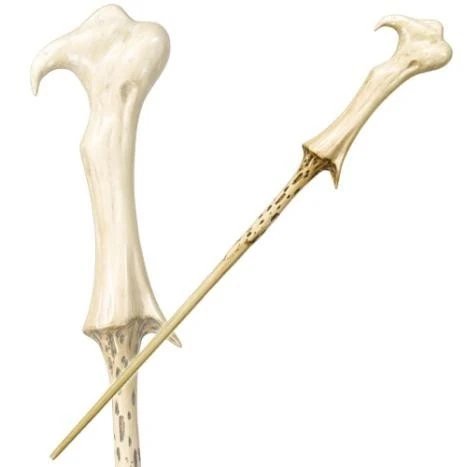
Tom Riddle bought his wand from the same shop as Harry and, as it turned out, from the same bird. It was yew, thirteen and a half inches, with a core of one of Fawkes’ feathers, and Ollivander remembered it well enough to bring it up, unprompted, with an eleven-year-old. Rowling, writing as Ollivander, says yew is reputed to endow its possessor with the power of life and death, and that the yew wand never chooses either a mediocre or a timid owner. She also notes that wizards buried with yew wands sometimes have the wand sprout into a tree guarding the dead owner’s grave. Voldemort had no intention of being buried.
As a Hogwarts student he was already researching Horcruxes, and concluded that if one Horcrux was good, seven would be better. The yew wand was the instrument of that whole project, the thing in his hand while he made the Horcruxes Voldemort made to cheat death. It was also the wand that met Harry’s in the graveyard and, connected to its brother, coughed up the shades of its victims in reverse order.
By 1997 Voldemort knew the yew wand could not be used against Harry at all. He borrowed Lucius Malfoy’s elm wand, which shattered in the Battle of the Seven Potters, and then took the Elder Wand from Dumbledore’s tomb. What became of the yew wand after that, the books never say.
James Potter’s mahogany wand
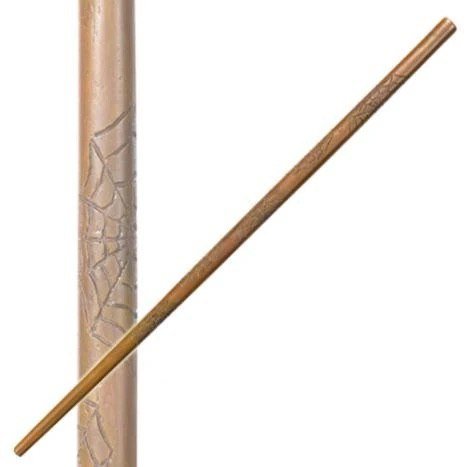
Ollivander’s memory of James Potter’s wand is the whole record of it: Your father, on the other hand, favored a mahogany wand. Eleven inches. Pliable. A little more power and excellent for transfiguration. He said this to an eleven-year-old who knew almost nothing about his father, and went on with the fitting. No core is ever given, not by Ollivander and not by Rowling afterwards, which leaves the wand known by its wood, its length and its temperament and nothing else.
The Transfiguration remark paid off. James spent his school years turning himself into a stag, an Animagus form he mastered while still a student, which is the origin of the nickname Prongs. Mahogany is also the wood of broom handles, as Ollivander mentions in the same breath, and the first broom Harry ever owned, a Nimbus 2000, had a mahogany handle. That is probably no coincidence, given where Harry’s flying came from. Rowling’s essay on wand woods, which runs alphabetically from acacia to yew and has an opinion on all of them, has no entry for mahogany. Ollivander’s four sentences across the counter are the last word on the subject, and on the wand.
James died at Godric’s Hollow on 31 October 1981. The books do not say what became of the wand. Eleven inches of mahogany, pliable, good for turning one thing into another, and then gone.
Lily Potter’s willow wand
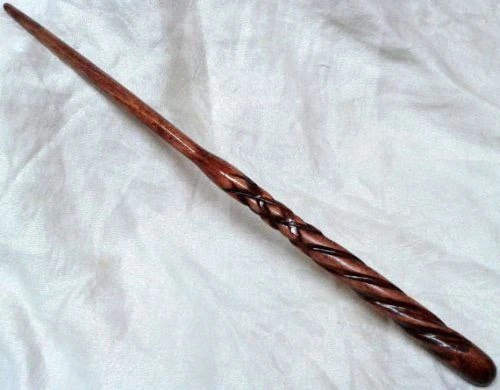
Among the first things Ollivander said to Harry was You have your mother’s eyes, and what followed was a wand order from a generation earlier: It seems only yesterday she was in here herself, buying her first wand. Ten and a quarter inches long, swishy, made of willow. Nice wand for charm work. That is Lily Evans’s wand in full. No core is ever stated for it, in the books or anywhere Rowling has written since, so it sits beside James’s mahogany as a wand the record describes without ever opening.
Rowling’s willow essay, written as Ollivander, calls it an uncommon wand wood with healing power and quotes a family proverb: he who has furthest to travel will go fastest with willow. Ollivander’s own remark about charm work has become Lily’s reputation, but the books never quite back it up. The one talent they credit her with directly is Potions, courtesy of Horace Slughorn, who called her one of the brightest I ever taught and praised her intuitive grasp of potion-making. The willow wand may have been nice for charms. Its owner was, on the evidence, better at cauldrons.
Lily was murdered the same night as James, 31 October 1981, and the protection her death left on Harry is the reason there is a series at all. Ollivander, remembering her wand a decade on, said it seemed like yesterday, and then sold her son his.
Rubeus Hagrid’s oak wand
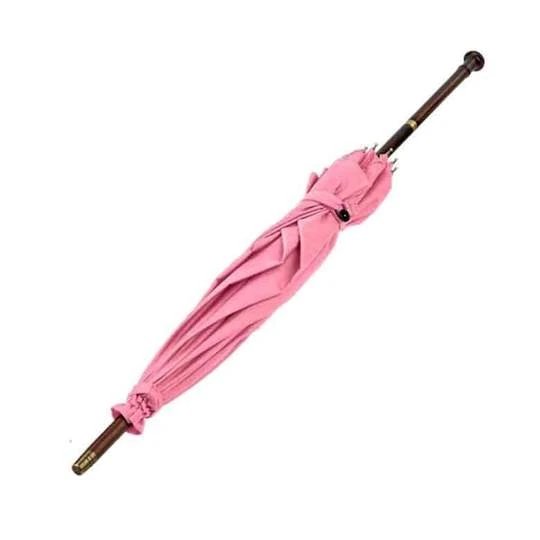
Sixteen inches of oak, rather bendy, is a wand Rowling’s own essay on lengths would file as exceptionally rare – she puts anything over 15 inches in that class, and has Ollivander say that such a length was demanded by a physical peculiarity. Hagrid, the son of a human and a giantess, qualifies.
The wand did not last. Hagrid tells Harry the story himself, the night they meet: I – er – got expelled, ter tell yeh the truth. In me third year. They snapped me wand in half an’ everything. But Dumbledore let me stay on as gamekeeper. Great man, Dumbledore. He had been framed by Tom Riddle for opening the Chamber of Secrets, and Dumbledore, then the Transfiguration teacher, arranged for the expelled boy to stay on the grounds. His name was not cleared until 1993.
What happened to the two halves is the best-known unanswered question in the books. Hagrid carries a pink flowery umbrella, and Harry believed the pieces were inside it; the official site puts it exactly that way: although the truth was never confirmed, it was Harry’s utmost belief. Rowling writes that wands of English oak demand partners of strength, courage and fidelity, and that their owners often have an affinity with the magic of the natural world, with the creatures and plants. She also records an old superstition she calls baseless: when his wand’s oak and hers is holly, then to marry would be folly. Harry’s wand is holly. They have managed.
Ron Weasley’s first wand (Charlie’s)
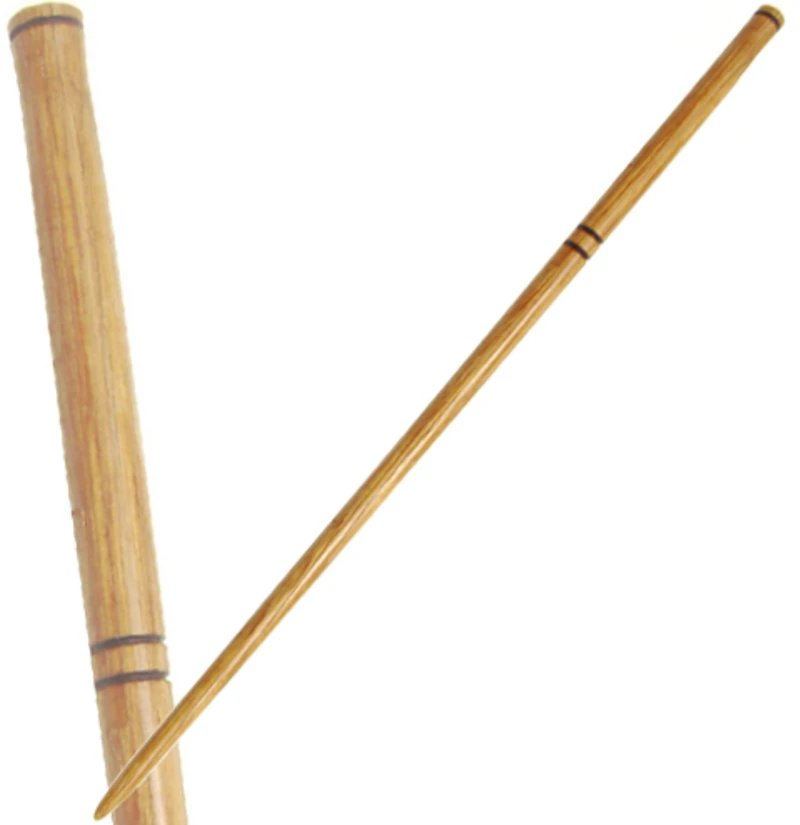
You never get anything new, either, with five brothers, Ron tells Harry on the Hogwarts Express. I’ve got Bill’s old robes, Charlie’s old wand and Percy’s old rat. The wand had a core of unicorn hair, which was easy to check: the official site describes it as already battered and chipped, with the hair nearly poking out of the end. Then the Whomping Willow almost snapped it in two, and no amount of Spellotape could make it work. The books never give its wood or length. Rowling later wrote that she gave Ron an ash wand on the strength of his birthday and a Celtic tree calendar, but she did not say which of his two wands she meant, so ash stays her word rather than the record’s.
What the record does hold is a catalogue of misfires. Ron aimed a slug-vomiting curse at Draco Malfoy and spent the afternoon producing slugs himself. The wand’s last act was its worst. In the tunnel beneath Hogwarts, Gilderoy Lockhart grabbed it to make his escape, and it backfired, blocking the tunnel with rock. Lockhart ended up in the Janus Thickey Ward at St Mungo’s, where he tends to wander off and get lost.
A hand-me-down that had never chosen Ron was never going to serve him. Rowling’s core essay says unicorn wands usually remain strongly attached to their first owner. Charlie’s had chosen Charlie.
Ron Weasley’s second wand
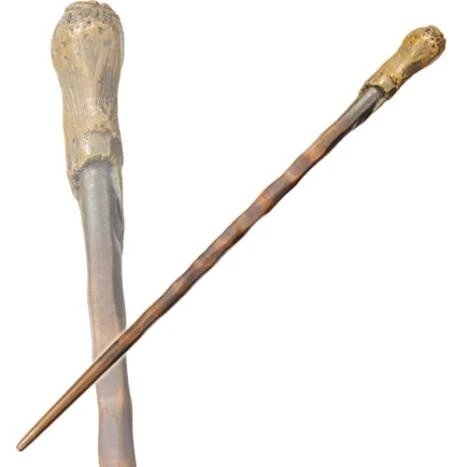
Look, said Ron, pulling a long thin box out of a bag and opening it. Brand-new wand. Fourteen inches, willow, containing one unicorn tail-hair. He bought it in Diagon Alley on 31 August 1993, the day before third year, and the box mattered nearly as much as the wand. Money was tight in the Weasley household and nearly everything Ron owned as the sixth son was hand-me-down or secondhand; this was something nobody had used before him.
Rowling’s wood essay, written as Ollivander, is quietly unkind about willow. She calls it an uncommon wood with healing power, then observes that the ideal owner for a willow wand often has some (usually unwarranted) insecurity, however well they may try and hide it. Ron, who spent seven books certain that his friends were better than him, is the textbook case. The unicorn core was the same kind that had sat in Charlie’s old wand, though this time it stayed inside.
The willow wand did years of steady service and then went the way of everything else in the war. Snatchers took it from Ron, and he never got it back. The rest of the fighting he did with Peter Pettigrew’s chestnut wand, won at Malfoy Manor, which is a story for further down this list.
Cedric Diggory’s ash wand
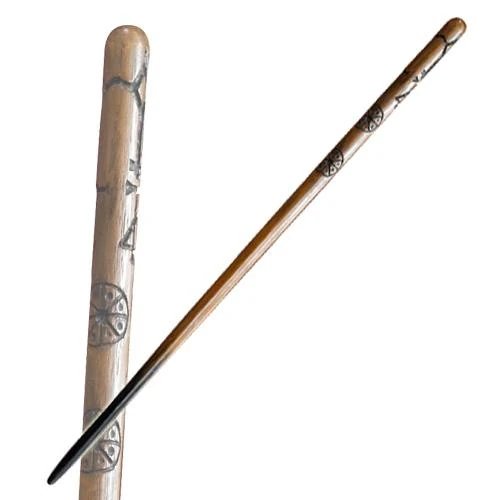
At the Weighing of the Wands, Ollivander picked up Cedric’s with a warmth he had not shown the foreign champions: Ah, now, this is one of mine, isn’t it? Yes, I remember it well. Containing a single hair from the tail of a particularly fine male unicorn ... must have been seventeen hands; nearly gored me with his horn after I plucked his tail. Twelve and a quarter inches ... ash ... pleasantly springy. It’s in fine condition ... you treat it regularly? Polished it last night, said Cedric, grinning. It is as complete a wand examination as the books offer, down to the size of the unicorn.
The Weighing was a formality of the Triwizard Tournament, held with Rita Skeeter in the room, at which Ollivander tested the champions’ wands by sending out silver smoke rings and a fountain of wine. Rowling’s essay on ash, written in Ollivander’s voice, says the ideal owner may be stubborn, and will certainly be courageous, but never crass or arrogant, and admits that the old rhyme has a nugget of truth: rowan gossips, chestnut drones, ash is stubborn, hazel moans. Cedric, on the evidence of the whole tournament, was ash to the grain.
He was killed on 24 June 1995, in the graveyard the Cup delivered him to, on three words from Voldemort: Kill the spare. He had reached it with a wand in fine condition.
Fleur Delacour’s rosewood wand
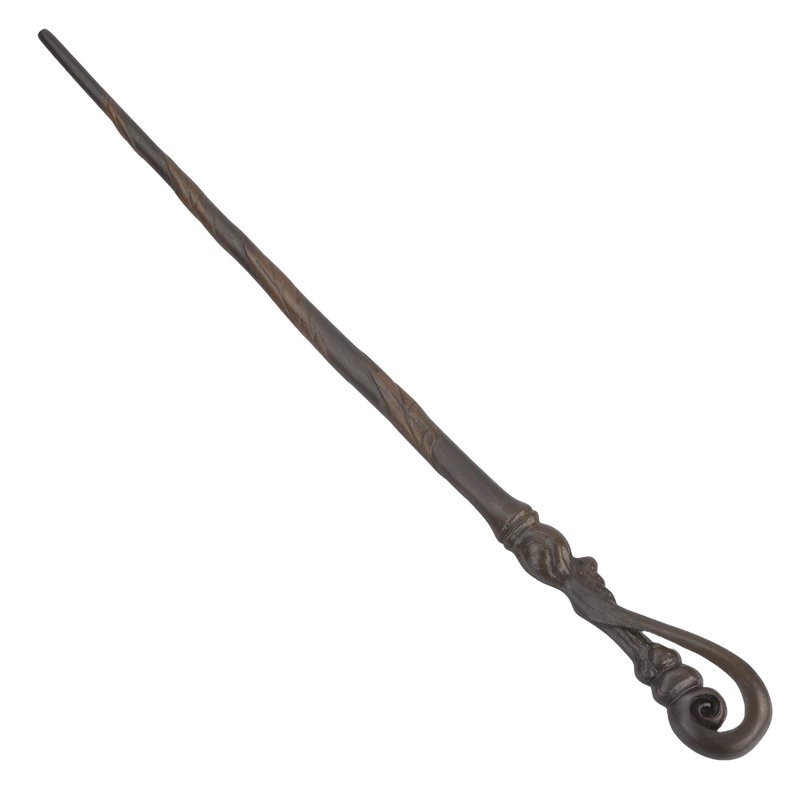
Ollivander does not use Veela hair, and he said so to the one Triwizard champion whose wand contained it. Fleur Delacour’s was rosewood, nine and a half inches, inflexible, and when he asked about the core she told him: An ’air from ze ’ead of a Veela, said Fleur. One of my grandmuzzer’s. Ollivander replied that he never used Veela hair himself, since it made for temperamental wands, and then conjured a bunch of flowers out of it with Orchideous, which is about as polite as a wandmaker’s disapproval gets.
The book says grandmother and nothing more, so nothing more appears here. When Fleur twirled the wand it produced pink and gold sparks. Rowling’s essay on cores, written in Ollivander’s voice, names the three substances that earn his name, and Veela hair is not among them, so the rosewood wand carries a core its examiner would never have put there. It worked anyway. It took Fleur through the Tournament and into the war.
Rowling’s note on flexibility says rigidity denotes the degree of adaptability and willingness to change possessed by the wand-and-owner pair. Inflexible, then. Fleur returned to France after the Tournament, found her way back to Britain, and married a Weasley. Between the two of them, the wand was clearly the stubborn one.
Viktor Krum’s hornbeam wand
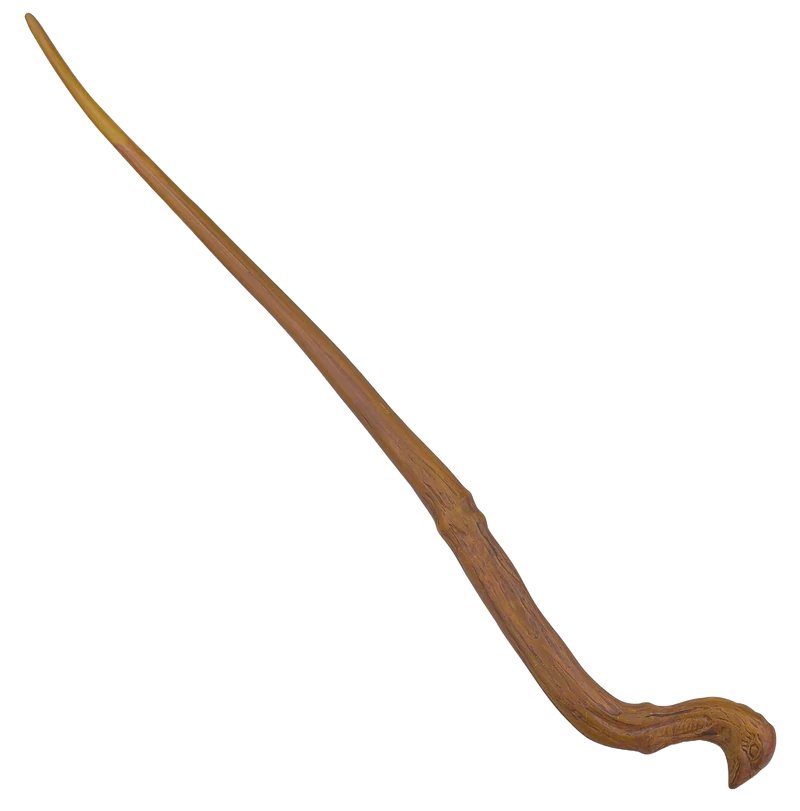
Gregorovitch made it, which Ollivander noted while weighing the champions’ wands, with the professional interest of one maker handling another’s work. Krum’s wand is hornbeam and dragon heartstring, ten and a quarter inches, and quite rigid, and Gregorovitch made few wands after it, retiring from business in the late 1980s. That is the specification in full, and the books never describe the wand again.
Rowling’s essay on hornbeam, written as Ollivander, says the wood selects for its life mate the talented witch or wizard with a single, pure passion, which some might call obsession (though I prefer the term ’vision’), and that hornbeam wands adapt more quickly than almost any other to their owner’s style of magic. Krum was a famous international Quidditch player for the Bulgarian National Team while still in school, and arrived at Hogwarts as Durmstrang’s champion with a hornbeam wand and, as far as anyone could tell, one topic of conversation.
He took Hermione Granger to the Yule Ball. At Bill and Fleur’s wedding he supplied a line worth keeping: Vot is the point of being an international Quidditch player if all the good-looking girls are taken? Rowling later wrote that he retired after losing the Snitch in the 2002 World Cup final and came back in 2014, at 38, to take Bulgaria to another final. Single, pure passion. Some might call it obsession.
Neville Longbottom’s cherry wand
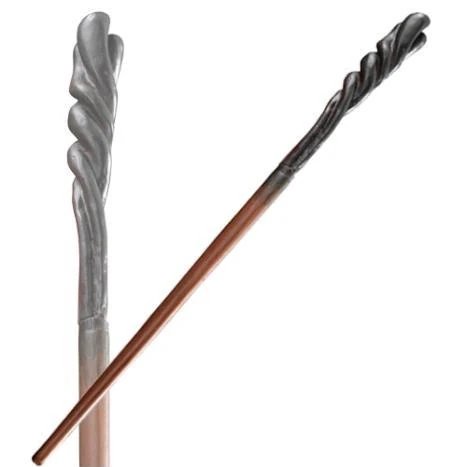
She bought me a new wand, look! Neville says on the train to sixth year, and produces it: Cherry and unicorn hair, he said proudly. We think it was one of the last Ollivander ever sold, he vanished next day – oi, come back here, Trevor! His grandmother, pleased with him for once, had paid for it: Says I’m starting to live up to my dad at long last.
The dad is the point. Until then Neville had fought with Frank Longbottom’s old wand, and it broke in the Department of Mysteries while he was bleeding from the nose: My gran’s going do kill be, dat was by dad’s old wand. Rowling’s essay on cherry, written as Ollivander, calls it a wand of strange power, most highly prized by the wizarding students of the school of Mahoutokoro in Japan, and warns that cherry wood often makes a wand that possesses truly lethal power, whatever the core. Nobody had ever said anything of the kind about Neville. The unicorn hair inside it is, per the same essays, the most faithful of the cores, and usually stays with its first owner.
No length is given for the cherry wand anywhere, so none appears here. Its owner’s decisive act, in any case, needed no wand at all. Held by Voldemort’s Body-Bind Curse with the Sorting Hat burning on his head, Neville pulled the Sword of Gryffindor out of the Hat and killed Nagini. The cherry wand, presumably, was in his pocket.
Lucius Malfoy’s elm wand
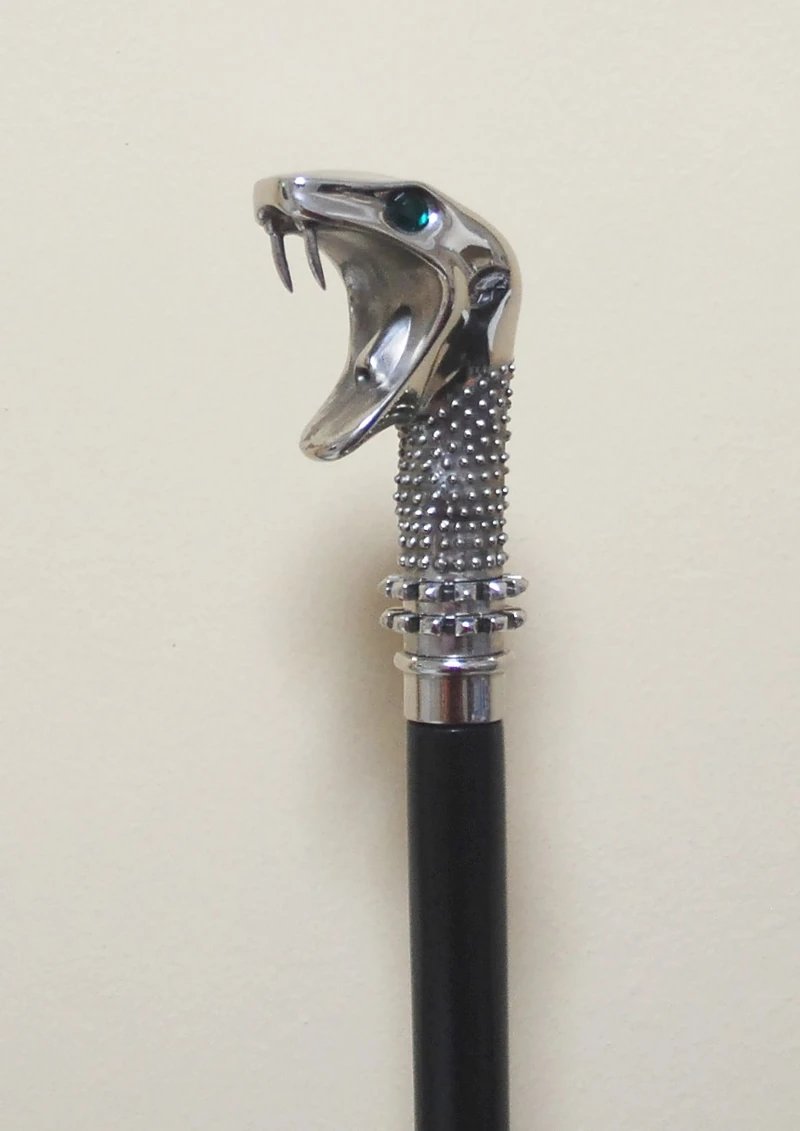
Nobody on this list lost a wand more publicly. In the first chapter of Deathly Hallows, at his own dining table, before the assembled Death Eaters, Voldemort asks Lucius Malfoy for his wand and gets it: Lucius, I see no reason for you to have a wand anymore. Voldemort asks what it is made of – elm and dragon heartstring – and that exchange is the entire specification. No length, no flexibility, and no cane; the walking stick is a film invention.
Rowling’s essay on elm, written as Ollivander, says elm wands prefer owners with presence, magical dexterity and a certain native dignity, and produce the fewest accidents and the most elegant charms and spells. It also records an unfounded belief that only pure-bloods can produce magic from elm wands, started, she writes, by some elm wand owner seeking to prove his own blood credentials. Ollivander has sold elm to Muggle-borns. Lucius would not have wanted to know.
It died badly. Voldemort carried it against the Seven Potters because his own could not face Harry’s, and Harry’s holly wand, acting of its own accord, sent golden fire at him and broke it. Dumbledore explained why at King’s Cross: Your wand now contained the power of your enormous courage and of Voldemort’s own deadly skill: What chance did that poor stick of Lucius Malfoy’s stand? Lucius was left wandless, a word the new order reserved for people assumed to have stolen their powers from a true wizard.
Mary Cattermole’s cherry wand
Umbridge read it out like a charge sheet. A wand was taken from you upon your arrival at the Ministry today, Mrs Cattermole, she said. Eight and three-quarter inches, cherry, unicorn hair core. Do you recognise that description? The Muggle-Born Registration Commission’s position was that a Muggle-born must have taken her magic from a real witch or wizard, and the wand was the evidence. Mary Cattermole, with dementors at the edge of the courtroom, managed an answer: I didn’t t-take it from anybody. I b-bought it when I was eleven years old. It-it-it-chose me.
Ollivander gives his specifications as compliments. Umbridge gave this one as an accusation. Harry was in the room, disguised as the Ministry official Albert Runcorn, with Hermione beside Umbridge as Mafalda Hopkirk, and the locket on Umbridge’s chest – Slytherin’s locket, a Horcrux she was wearing as a bribe – swung forward and dangled over the void as she leaned in. He stole it back before the chapter was out.
Reg Cattermole, of Magical Maintenance, had three children with Mary: Alfred, Ellie and Maisie. The family was strongly encouraged to leave the country, in Runcorn’s words, which were Harry’s: Go abroad if you can. Just get well away from the Ministry. That’s the – er – new official position. Rowling’s note on unicorn hair says such wands usually keep faith with the person they first chose. Mary Cattermole had said as much, through tears, to a woman wearing a stolen locket.
The blackthorn wand
Ron took it off a Snatcher. Harry’s holly wand had broken at Godric’s Hollow, and when Ron rejoined the hunt he brought a blackthorn wand taken from one of the gangs he described as trying to earn gold by rounding up Muggle-borns and blood traitors, there’s a reward from the Ministry for everyone captured. It did not want Harry. The blackthorn did not work well for him; his spells with it were weaker and, as the official site puts it, it felt intrusively unfamiliar.
Rowling’s essay on blackthorn, written as Ollivander, is the explanation, and it is a good one. Blackthorn has the reputation, in my view well-merited, of being best suited to a warrior, she writes, and blackthorn wands appear to need to pass through danger or hardship with their owners to become truly bonded, after which the blackthorn wand will become as loyal and faithful a servant as one could wish. Harry had passed through plenty of danger. Not with this wand.
No core and no length are given for it, and it should not be confused with the blackthorn-and-troll-whisker wand that legend gives Sir Cadogan, which is a different object in a different story. Harry set it aside as soon as he had won Draco Malfoy’s hawthorn wand at Malfoy Manor, a wand that showed Harry plenty of loyalty once he’d won it. The blackthorn got its danger. It never got its bond.
The Elder Wand
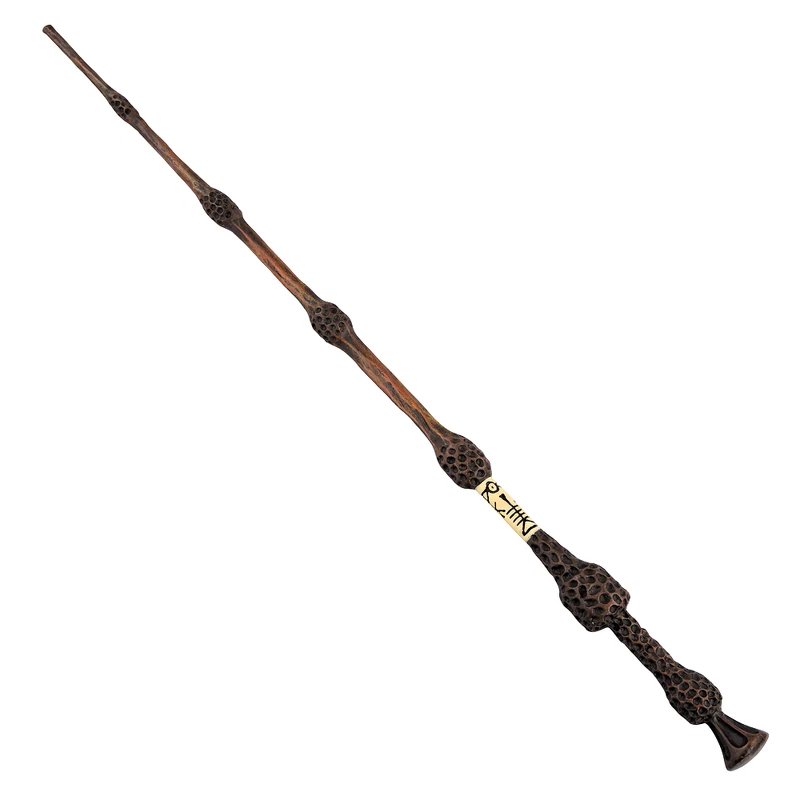
Death made it, according to the story, and gave it to the eldest of three brothers. That is the Tale of the Three Brothers, the story Xenophilius Lovegood sets before Harry, Ron and Hermione, from The Tales of Beedle the Bard, a storybook that exists in print among the Harry Potter books Rowling published. The record of the wand is short and exact: a core of Thestral tail hair, fifteen inches long, made of elder wood. The wood is in the novels; the core is Rowling’s, and the length the official site’s.
Legend calls it the most powerful of its kind, making its owner virtually unbeatable, and the novels spend their last third showing how little that is worth. Rowling has said it knows no loyalty except to strength. Gregorovitch had it and Grindelwald stole it; Dumbledore won it from Grindelwald in 1945 and was buried with it; Voldemort broke into the tomb and took it, but by then the wand answered to Draco Malfoy, who had disarmed Dumbledore on the Astronomy Tower, and then to Harry, who had disarmed Draco. Voldemort worked that out as the curse rebounded.
Rowling, writing as Ollivander, calls elder the rarest wand wood of all, reputed to be deeply unlucky, and quotes the superstition: wand of elder, never prosper. Harry, who prospered, used it for one thing, to mend his holly wand, and said he was putting it back where it came from. In the book, it goes back in the tomb.
Draco Malfoy’s hawthorn wand
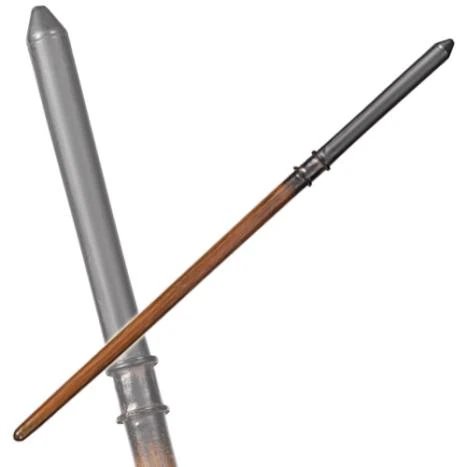
Harry won it by grabbing. Escaping Malfoy Manor, he wrestled Draco’s wand out of his hand, and Ollivander examined it at Shell Cottage: hawthorn, ten inches, reasonably springy, with a unicorn tail hair. The grab did two things. It gave Harry a wand that worked for him, which the blackthorn never had, and it made him master of the Elder Wand, because Draco had become its master by disarming Dumbledore on the Astronomy Tower with a plain Expelliarmus, and had never known it.
Rowling’s essay on hawthorn, written as Ollivander, quotes the rival wandmaker Gregorovitch rather than Ollivander himself: it makes a strange, contradictory wand, as full of paradoxes as the tree that gave it birth, whose leaves and blossoms heal, and yet whose cut branches smell of death. Ollivander concurs, adding that hawthorn seems most at home with a conflicted nature, or with a witch or wizard passing through a period of turmoil. Rowling says separately that Draco’s unicorn core was symbolic: there is, after all, some unextinguished good at the heart of Draco. She gave the boy named for a dragon a unicorn.
Draco asked for the wand back in the Room of Requirement and did not get it; by then its allegiance had changed. It was the hawthorn wand, not the holly, that Harry held when he disarmed Voldemort of the Elder Wand and the Killing Curse rebounded. Draco’s wand ended the war on the winning side, in someone else’s hand.
Bellatrix Lestrange’s walnut wand
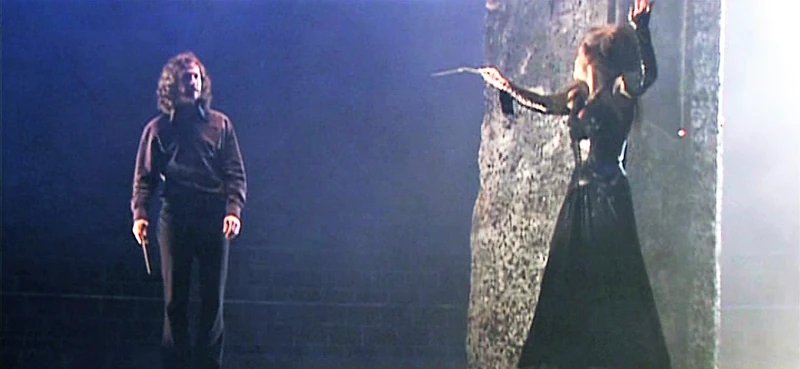
Twelve and three-quarter inches of walnut, dragon heartstring, unyielding: that was Ollivander’s verdict at Shell Cottage on the wand Harry had captured from Bellatrix Lestrange at Malfoy Manor. Rowling’s essay on walnut, written as Ollivander, says highly intelligent witches and wizards ought to be offered a walnut wand for trial first, because in nine cases out of ten, the two will find in each other their ideal mate. Then comes the warning. The walnut wand will, once subjugated, perform any task its owner desires, provided that the user is of sufficient brilliance. This makes for a truly lethal weapon in the hands of a witch or wizard of no conscience.
Bellatrix was among the most devoted of the Death Eaters the novels confirm by name, and at the Battle of Hogwarts, like her master she duelled three at once: Hermione, Ginny and Luna. Whether this is the wand she carried before Azkaban, the one that tortured the Longbottoms, the books never say.
Hermione carried it into Gringotts under Polyjuice, as Bellatrix, and hated it: It feels all wrong, it doesn’t work properly for me ... it’s like a bit of her. Molly Weasley killed Bellatrix at the Battle of Hogwarts on 2 May 1998, with a wand of her own that is not on this list, because nobody ever says what it was made of.
Peter Pettigrew’s chestnut wand
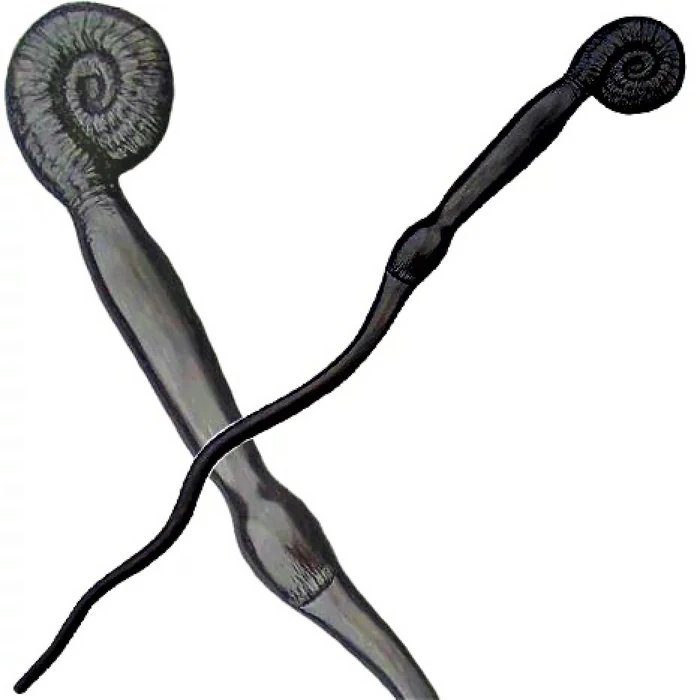
Ollivander made this one as a prisoner. Death Eaters took him around July 1996 and kept him in the cellar at Malfoy Manor for about a year and a half, and one of the wands he was forced to make there was Wormtail’s: chestnut and dragon heartstring. Nine-and-a-quarter inches ... Brittle. He gave that description at Shell Cottage, once rescued.
The dates matter, because a persistent version of this story has the wand killing Cedric Diggory. Cedric died in the graveyard on 24 June 1995, on Voldemort’s order to kill the spare, and the wand in Pettigrew’s hand was Voldemort’s own yew. The chestnut did not exist for another year. Rowling’s chestnut entry, in Ollivander’s voice, has the wood usually suiting skilled tamers of magical beasts, gifted herbologists and natural fliers, but chestnut paired with dragon heartstring may find its best match among those who are overfond of luxury and material things, and less scrupulous than they should be about how they are obtained. Ollivander, under duress, built the exact combination.
Pettigrew lost it without a spell. In the Malfoy Manor escape Ron simply pulled it out of his hand – And we’ll have that, whispered Ron, tugging Wormtail’s wand from his other hand – and Pettigrew died in the same chapter, on 30 March 1998, strangled by his own silver hand. Ron kept it for the rest of the war. It was won by brute force rather than by magic, which fits, since it was made that way too.
Hermione Granger’s vine wand
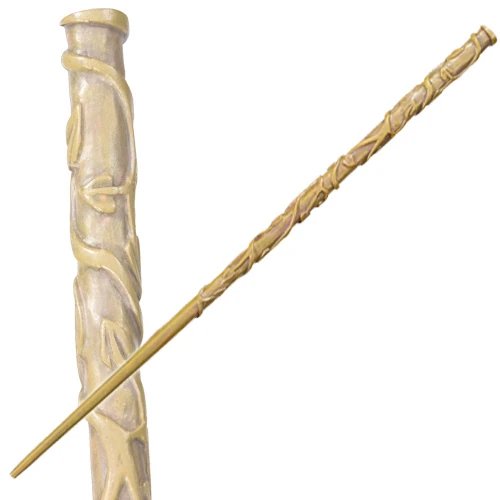
None of the seven books says what Hermione’s wand is made of. The cleverest witch of her year goes through the whole series without Ollivander, Umbridge or anyone else reciting her specification, so what follows is Rowling’s: vine wood, dragon heartstring, ten and three-quarter inches. The wood was not an accident. Rowling has written that she assigned Ron and Hermione their woods from the Celtic tree calendar, and that Hermione, who was born between September 2 and September 29, received a vine wood wand. Her birthday is 19 September.
Rowling’s essay on vine, in Ollivander’s voice, says its owners are nearly always those witches or wizards who seek a greater purpose, who have a vision beyond the ordinary and who frequently astound those who think they know them best, and that vine wands are strongly attracted by personalities with hidden depths. Dragon heartstring, per the core essay, is the one core of the three that is easiest to turn Dark, though it will not incline that way of its own accord. It is not a timid pairing.
The Snatchers took the vine wand from her on the way to Malfoy Manor, and she left the house carrying Bellatrix Lestrange’s instead. Whether she ever got her own back, the books do not say. Rowling, in her later writing, made her Minister for Magic, which is the sort of thing vine wands apparently see coming.
Garrick Ollivander’s hornbeam wand
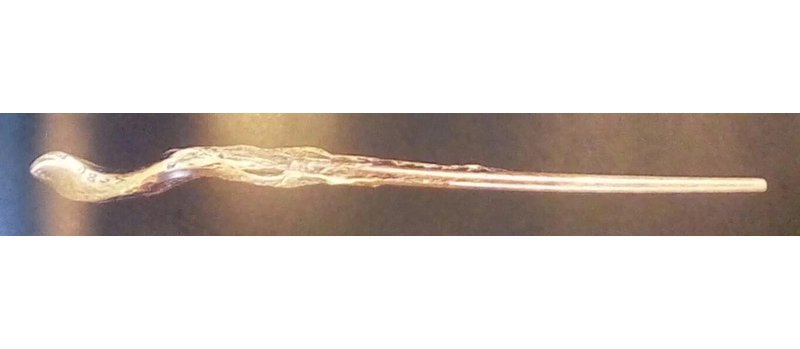
Rowling gave the wandmaker a wand of his own, and then let him explain it. Ollivander’s is hornbeam and dragon heartstring, twelve and three-quarter inches, per her Pottermore notes, and her wand-woods essay, written in his voice, opens the hornbeam entry with the admission: My own wand is made of hornbeam. Hornbeam wands, he goes on, absorb their owner’s code of honour, whatever that might be, and will refuse to perform acts – whether for good or ill – that do not tally with their master’s principles; they become so personalised, so quickly, that other people will find them extremely difficult to use even for the most simple of spells. A particularly fine-tuned and sentient wand, he concludes, with all due modesty.
His own principles are wands. Rowling’s companion essay on the man says he believes his earliest forebears in this country arrived with the Romans, and calls him a purist who insisted that the best wands would never be produced merely by encasing a customer’s sentimental keepsake in wood. Only three substances make the cut. Her notes also give him a birthday, September 25, and a house, Ravenclaw.
He told Harry on their first meeting: I remember every wand I’ve ever sold, Mr. Potter. Every single wand. The novels bear him out; he recites Bellatrix’s and Draco’s from memory at Shell Cottage, fresh out of a cellar. What became of his own hornbeam during the year and a half he spent in that cellar, nobody says.
Dolores Umbridge’s birch wand
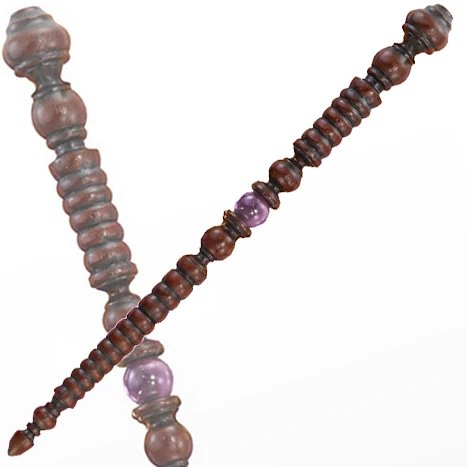
Eight inches. That is the length Rowling’s Pottermore card gives Dolores Umbridge’s wand, birch and dragon heartstring, and the card is the whole record; the novels never describe it. The number is the interesting part. In her essay on lengths, written as Ollivander, Rowling says that extremely short wands (eight inches and under) are exceptionally rare, and that abnormally short wands usually select those in whose character something is lacking, rather than because they are physically undersized. Umbridge’s sits exactly on that line. Rowling wrote both texts. Draw your own conclusions.
The wood is a quieter oddity. Birch has no entry in Rowling’s alphabet of wand woods, so whatever a birch wand is supposed to say about its owner, she never said it. Her essay on Umbridge herself makes up for the silence: Dolores means sorrow, something she undoubtedly inflicts on all around her, and Umbridge is a play on umbrage, from the British expression to take umbrage, meaning offence. Her desire to control, to punish and to inflict pain, Rowling adds, is every bit as reprehensible as Lord Voldemort’s unvarnished espousal of evil.
One of the wand’s recorded outings is in the Forbidden Forest, where Umbridge pointed it at the centaur Magorian and screamed Incarcerous, and the herd carried her off regardless. No source says the centaurs broke it. After the war, per Rowling, she was convicted of the torture, imprisonment and deaths of several people and sent to Azkaban, where nobody needs an eight-inch wand.
Remus Lupin’s cypress wand
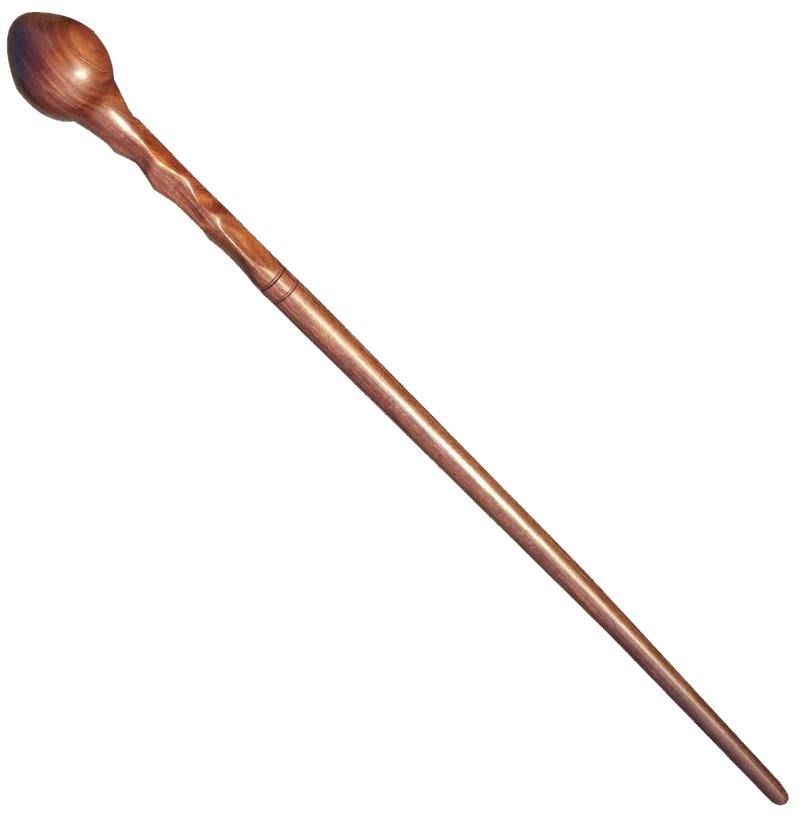
Geraint Ollivander, a medieval ancestor of the current one, was always honoured to match a cypress wand, according to Rowling’s essay on woods, for he knew he was meeting a witch or wizard who would die a heroic death. Cypress wands are associated with nobility, the essay goes on, and find their soul mates among the brave, the bold and the self-sacrificing: those who are unafraid to confront the shadows in their own and others’ natures. Rowling gave Remus Lupin a cypress wand, with unicorn hair, ten and a quarter inches, pliable, on his Pottermore card, and then killed him at the Battle of Hogwarts. She knew what she was doing.
The shadows in his own nature had a name. Rowling’s essay on Lupin says that shortly before his fifth birthday, as he slept peacefully in his bed, Fenrir Greyback forced open the boy’s window and attacked him, in revenge on Lupin’s father, Lyall, who had called werewolves soulless, evil, deserving nothing but death at a Ministry hearing. The unicorn hair inside the wand is, per Rowling’s core essay, the most faithful of the three, usually remaining strongly attached to its first owner, irrespective of whether he or she was an accomplished witch or wizard. Lupin was accomplished. He spent his life being told otherwise.
He died on 2 May 1998 at the hands of Antonin Dolohov, and was, Rowling writes, the first werewolf ever to be awarded the Order of Merlin, First Class. Cypress, as advertised.
Minerva McGonagall’s fir wand
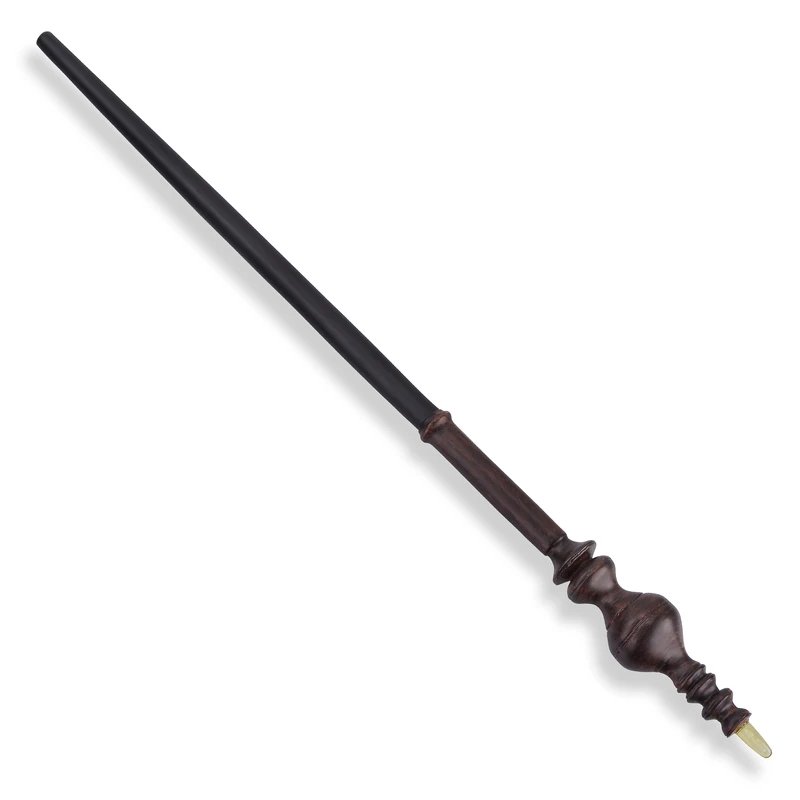
Nine and a half inches, fir, dragon heartstring, stiff: the wand Rowling’s Pottermore notes give the Transfiguration mistress. In her essay on woods, written as Ollivander, Rowling says his grandfather Gerbold Octavius Ollivander always called wands of this wood the survivor’s wand, having sold it to three wizards who subsequently passed through mortal peril unscathed, and that fir wands are particularly suited to Transfiguration, and favour owners of focused, strong-minded and, occasionally, intimidating demeanour. She then gave one to Minerva McGonagall, who taught Transfiguration for decades and could silence a corridor by walking into it.
Rowling’s essay on McGonagall fills in what the books never do. She was the first child, and only daughter, of a Scottish Presbyterian minister and a Hogwarts-educated witch – the Reverend Robert McGonagall and Isobel Ross, who kept her magic secret from him. Minerva learned her Animagus form under Dumbledore, and her animal form, with its distinctive markings (tabby cat, square spectacle-markings around eyes) were duly logged in the Ministry of Magic’s Animagus Registry. She had a stint in the Department of Magical Law Enforcement before she came back to teach. Her marriage to Elphinstone Urquart was cut tragically short, three years in, by a Venomous Tentacula.
In the last battle she drove Severus Snape from the castle and led the school against Voldemort, and her Patronus, a tabby cat with spectacle eye markings, matched the Animagus form exactly. A survivor’s wand, stiff, nine and a half inches. It never needed to be longer.
Horace Slughorn’s cedar wand
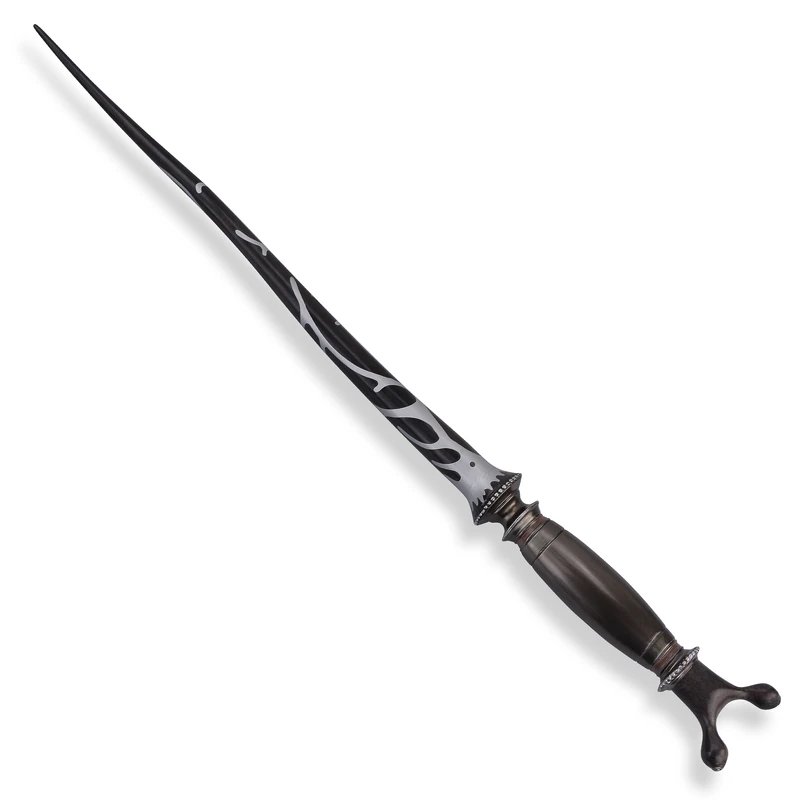
Ollivander’s father had a saying, per Rowling’s woods essay: you will never fool the cedar carrier. Whenever I meet one who carries a cedar wand, Ollivander goes on, I find strength of character and unusual loyalty, and I have never yet met the owner of a cedar wand whom I would care to cross, especially if harm is done to those of whom they are fond. Rowling’s Pottermore fact file gives Horace Slughorn cedar, ten and a quarter inches, dragon heartstring, fairly flexible, and the flexibility is the tell. A cedar wand’s owner, the essay says, carries the potential to be a frightening adversary, which often comes as a shock to those who have thoughtlessly challenged them.
Being underestimated suited him. Slughorn was Potions master and Head of Slytherin House until he retired unexpectedly at the end of the 1980-81 school year, and came back in the summer of 1996 at Dumbledore’s request, rejoining the professors who taught at Hogwarts in the novels for a second stint in the same job. It was Slughorn who told the young Tom Riddle about Horcruxes, and he later tampered with his own memory of the conversation. His fact file lists hobbies: the Slug Club, corresponding with famous ex-students, fine wines and confectionary. It preserves his toast: To friendship! To generosity! To ten Galleons a hair!
At the Battle of Hogwarts he duelled Voldemort in emerald-green silk pyjamas. Nobody who had read the cedar entry would have been surprised.
Sybill Trelawney’s hazel wand
When its owner dies, a hazel wand wilts, which is to say, it expels all its magic and refuses to perform – and if the core is unicorn hair, Rowling writes in Ollivander’s voice, there is no hope; the wand will almost certainly have died. Sybill Trelawney’s wand, per Rowling’s Pottermore fact file, is hazel with a unicorn hair core, nine and a half inches. Rowling gave the Divination teacher a wand that predicts its own end and keeps its word.
Hazel is a sensitive wand, the essay says, which often reflects its owner’s emotional state, and works best for a master who understands and can manage their own feelings, and it can detect water underground, emitting silvery, tear-shaped puffs of smoke over concealed springs and wells. No flexibility is on record for Trelawney’s wand, so none is given. Rowling’s essay on the woman makes her the great-great-granddaughter of a genuine Seer, Cassandra Trelawney, whose gift has been much diluted over ensuing generations, though Sybill does experience very rare flashes of genuine clairvoyance, which she can never remember afterwards.
Her fact file lists her hobbies as practising making doom-laden prophecies in front of the mirror, and sherry. Two genuine ones are on the record. The first, delivered during her interview with Dumbledore, got her the job. The second, delivered the day Sirius Black escaped, foretold that the servant would set out to rejoin his master, and Peter Pettigrew fled to find Voldemort. She did not remember saying it.
Quirinus Quirrell’s alder wand
Helpful, considerate and most likeable is Rowling’s description, in Ollivander’s voice, of the sort of person an alder wand chooses, and she gave one to the man with Voldemort on the back of his head. Quirrell’s Pottermore fact file reads: alder and unicorn hair, 9 inches long, bendy. The essay on woods calls alder an unyielding wood whose ideal owner is not stubborn or obstinate, and says that of all wand types, alder is best suited to non-verbal spell work, hence its reputation as a wand only for the most advanced witches and wizards. Quirrell, teaching Defence Against the Dark Arts with a Dark wizard under his hat, would have needed that.
The unicorn hair sharpens the joke: the core essay says wands with unicorn cores are generally the most difficult to turn to the Dark Arts. This one spent a school year under a turban. Rowling’s essay on Quirrell describes a clever young wizard who took a Grand Tour around the world before taking up his teaching post at Hogwarts; he had taught Muggle Studies first, met Voldemort in Albania on his travels, and came back to Defence with his master riding on the back of his skull.
The fact file gives his hobbies as travel and pressing wild flowers, and his death as 1992. He died because Harry’s skin burned him, a protection Dumbledore traced to Lily’s sacrifice, and because Voldemort, having no further use for the body, left it.
Gilderoy Lockhart’s cherry wand
Dumbledore hired him to be found out. Rowling’s essay on Lockhart says the headmaster happened to have known two of the wizards for whose life’s work Gilderoy Lockhart had taken credit, and was convinced that Lockhart needed only to be put back into an ordinary school setting to be revealed as a charlatan and a fraud. It worked inside a year. His Pottermore card reads cherry and dragon heartstring, nine inches, slightly bendy, and Rowling’s woods essay carries a warning about exactly that pairing: if teamed with dragon heartstring, the wand ought never to be teamed with a wizard without exceptional self-control and strength of mind.
Lockhart’s self-control ran to hair care. Born to a witch mother and a Muggle father, with two older sisters, he was Sorted into Ravenclaw and discovered that his name was unknown, his talents were unexceptional. He fixed that by perfecting one spell. With the Memory Charm, Rowling writes, he succeeded in modifying the recollections of a dozen highly accomplished and courageous witches and wizards, allowing him to take credit for their daring exploits. Dragon heartstring, per her core essay, learns quickly and is the most prone to accidents.
The novels never describe his wand at all. The spell that ended Lockhart’s career was cast with Ron’s broken hand-me-down, in a tunnel, at himself. His own nine inches of cherry were never the problem.
Silvanus Kettleburn’s chestnut wand
Sixty-two periods of probation is the number Rowling gives Silvanus Kettleburn, a record unbroken as of her 2015 essay, earned by a recklessness with dangerous creatures that his job seemed designed to reward. He finished his career with only one arm and half a leg. Dumbledore presented him with a full set of enchanted wooden limbs on his retirement, a gift that had to be replaced regularly, since his habit of visiting dragon sanctuaries meant that his prosthetics were frequently set on fire.
The specification sits in the official site’s profile, given there as Rowling’s, not in her essay: chestnut, eleven and a half inches, whippy, with a phoenix feather core. Rowling’s woods essay says chestnut is attracted to witches and wizards who are skilled tamers of magical beasts, those who possess great gifts in Herbology, and those who are natural fliers. Phoenix feather, per her core essay, shows the most initiative, sometimes acting of its own accord, a quality that many witches and wizards dislike. Kettleburn, who once caused the Great Hall to catch fire after enchanting an Ashwinder to play the Worm in a school play, was not among them.
He retired in 1993, to enjoy more time with his remaining limbs, as Dumbledore put it, and Hagrid took the job. During the Battle of Hogwarts, immobile in Hogsmeade, he clambered into his attic and threw his entire stock of Flobberworms out of the skylight at passing Death Eaters. It was generally felt to show the right spirit.
Celestina Warbeck’s larch wand
Rowling never lets the reader see her. Celestina Warbeck is a voice on the wireless, first heard on the Burrow’s kitchen radio in Chamber of Secrets and last heard on Christmas Eve in Half-Blood Prince, when Fleur decided to imitate Celestina singing A Cauldron Full of Hot, Strong Love, which was taken by everyone, once they had glimpsed Mrs. Weasley’s expression, to be the cue to go to bed. Neither scene mentions a wand. The specification is Rowling’s, from Pottermore: larch and phoenix feather, ten and a half inches, flexible.
Rowling’s essay gives her a Welsh origin, a Muggle mother who was a failed actress, and a wizard father who met her when the latter was attacked by a Lethifold disguised as a stage curtain. Her tickets often appear on the black market at vastly inflated prices, one reason, Rowling notes, why Molly Weasley has never yet seen her favourite singer live. Larch, in the woods essay, always creates wands of hidden talents and unexpected effects; its owner may never realise the full extent of their considerable talents until paired with it. For a singer nobody sees, that is about right.
Rowling calls her one of my favourite off-stage characters in the whole series, and always imagined her to resemble Shirley Bassey in both looks and style. On 15 December 2025 the official site announced Dame Shirley Bassey as the voice of Celestina Warbeck for the full-cast audio editions. The stage curtain, presumably, was checked.
The wands in Ollivander’s notes
If you seek integrity, search first among the poplars, was a great maxim of my grandfather, Gerbold Ollivander, Rowling writes in the wandmaker’s voice, and the poplar entry names two owners to prove it: two of the Ministry’s most accomplished Ministers for Magic, Eldritch Diggory and Evangeline Orpington, were the possessors of fine, Ollivander-made poplar wands. There is a tired old joke among lesser wandmakers, the essay adds, that no poplar wand has ever chosen a politician, but here they show their lamentable ignorance. Diggory was Minister from 1733 to 1747, established an Auror recruitment programme, and died in office of dragon pox. Orpington served from 1849 to 1855, was a good friend of Queen Victoria’s, who never realised she was a witch, and is believed to have intervened magically (and illegally) in the Crimean War.
The apple entry supplies a third name. An unusual ability to converse with other magical beings in their native tongues is often found among apple wand owners, who include the celebrated author of Merpeople: A Comprehensive Guide to Their Language and Customs, Dylan Marwood. Applewood wands are not made in great numbers, and their possessors are said to be well-loved and long-lived.
The fourth is the least certain; the English oak entry ends: It is said that Merlin’s wand was of English oak (though his grave has never been found, so this cannot be proven). Four wands, four woods, and not one core or length among them. Ollivander’s notes are a wood man’s notes.
Salazar Slytherin’s wand
Rowling never says what wood it was, which has not stopped anyone. What she does say, in her history of Ilvermorny, is what was inside: a fragment of a magical snake’s horn: in this case, a Basilisk. The wand had been taught by its creator to sleep when so instructed, and this secret had been handed down through the centuries to each member of Slytherin’s family who possessed it, which, generations later, meant Gormlaith Gaunt, in Ireland, who had raised her orphaned niece, Isolt Sayre.
Isolt stole it when she fled to America, since she had never been permitted her own, and in all the years that she had lived with it, Rowling writes, Isolt had never known that she held in her hand the wand of Salazar Slytherin. She used it to found a school. Then Gormlaith arrived at Ilvermorny and uttered a single sibilant word in Parseltongue, and the wand quivered once on the bedstand beside her as she slept, and became inactive. When Isolt raised it against her aunt, the sleeping wand might as well have been a stick she had found on the ground.
She and James Steward buried it outside the grounds, and within a year an unknown species of snakewood tree had grown out of the earth on the spot where the wand was buried. The tree, Rowling writes, seemed testament to the fact that Slytherin’s wand, like his scattered descendants, encompassed both noble and ignoble. Snakewood describes the tree, not the wand.
Gormlaith Gaunt’s Ollivander wand
Its core is known only from its owner’s death. Gormlaith Gaunt had purchased a wand at the despised Ollivanders to replace the precious family wand that had been handed down through generations before Isolt stole it, and Rowling’s Ilvermorny history never describes it while she is alive. Then William the Pukwudgie’s poisoned arrow tip pierced her through the heart, and the Ollivander wand fell to the ground and burst: all that was left of Gormlaith Gaunt was a pile of smoking dust, a broken stick and a charred dragon heartstring. That is the specification. Dragon heartstring, and whatever wood a broken stick is.
She had earned the arrow. Gormlaith was Isolt Sayre’s aunt, who rescued the girl from the fire that killed Isolt’s parents, a fire Rowling says Gormlaith had set herself. When Isolt fled with Slytherin’s wand, Gormlaith crossed the Atlantic in pursuit disguised as a man, travelling under the name of William Sayre, which was that of Isolt’s murdered father. At Ilvermorny she sent a powerful curse containing Isolt and James’s names towards the house, which forced them into an enchanted slumber, then put the family wand to sleep with a word.
The word woke the wrong wands. The Boot boys’ cores vibrated to the sound of the ancient language and, sensing danger to their masters, began to emit a low musical note, and the household came out fighting. The despised Ollivanders had sold Gormlaith a perfectly good wand. It was the customer that burst.
The Boot family wands
Isolt Sayre dreamed its core before she cut it. The night before Chadwick Boot’s eleventh birthday she dreamed the Horned Serpent rose up out of the water and bowed its head to her while she shaved a long shard from its horn, and at dawn it did. When Chadwick woke next day, Rowling writes, it was to find a finely carved wand of prickly ash enclosing the horn of the serpent. Isolt and James had succeeded in creating a wand of exceptional power. Webster’s held the same core, the horn of the river serpent; its wood is never named. Some protective instinct told Isolt to save the Horned Serpent cores only for her two adoptive sons.
The boys came with two older wands. Their parents had been murdered, and James Steward, at the graves, found the sparking core of dragon heartstring that protruded from Mr Boot’s; the pair had held dragon heartstring and unicorn hair, and both cores had long since shrivelled and died when Isolt promised the orphans wands of their own. She kept the promise with a serpent.
When Gormlaith reached Ilvermorny and hissed the family wand to sleep, the twin cores of the Boot boys’ wands, when used together against a common enemy, increased their power tenfold, and the boys fought before their guardians could be woken. Chadwick grew up to write Chadwick’s Charms, seven volumes of them, standard texts at the school. Webster’s descendants, Rowling adds, would be educated at Hogwarts.
Seraphina Picquery’s swamp mayhaw wand
Four great wandmakers served North America in the 1920s, according to Rowling’s history of the period, where unlike Britain no single Ollivanders was considered unbeatable. Violetta Beauvais, the famous wandmaker of New Orleans, refused for many years to divulge the secret core of her wands, which were always made of swamp mayhaw wood. Eventually it was discovered that they contained hair of the rougarou, the dangerous dog-headed monster that prowled Louisiana swamps. It was often said of Beauvais wands that they took to Dark magic like vampires to blood, Rowling writes, yet many an American wizarding hero of the 1920s went into battle armed only with a Beauvais wand, and President Picquery herself was known to possess one.
That sentence is the whole basis of this entry, and it is phrased as carefully as it sounds. Picquery was President of MACUSA from 1920 to 1928, a famously gifted witch from Savannah who, at Ilvermorny, chose Horned Serpent. Rowling records one of her rare light-hearted moments, on whether American wizards should be allowed a drink: The Gigglewater, as she famously told her Chief of Staff, is non-negotiable.
Beauvais’s rivals were Shikoba Wolfe, whose carved wands held Thunderbird tail feathers; Johannes Jonker, whose were inlaid with mother-of-pearl; and Thiago Quintana, whose sleek and usually lengthy wands encased a single translucent spine from the White River Monsters of Arkansas. Beauvais’s was the one the President carried. Whether it took to Dark magic in her hands, Rowling does not say.
Frequently Asked Questions
What is the longest wand in the Harry Potter books?
Hagrid’s oak wand, at 16 inches, is the longest wand whose length the seven novels state. The Elder Wand comes next at 15 inches, a figure the official site’s fact file gives and the novels do not. Rowling’s own essay on wand lengths calls anything over 15 inches exceptionally rare, a length demanded, she writes, by a physical peculiarity.
What is the shortest wand in Harry Potter?
Among wands the novels measure for a witch or wizard who owned one, Mary Cattermole’s cherry wand is the shortest, at 8.75 inches. The 7-inch maple wand Harry tried at Ollivanders is shorter but never belonged to anyone. On Pottermore, Rowling assigned Dolores Umbridge an 8-inch wand, the shortest length she gives any listed wand.
Why are Ginny Weasley’s and Bill Weasley’s wands not on this list?
Because no novel and no piece of Rowling’s writing gives them a wood, core or length. The yew and hazel specifications that circulate for them come from replica-wand merchandise, which this list excludes along with film props, Cursed Child and video games. Frank Longbottom’s wand, the one Neville broke, is left out for the same reason.
What wood was Salazar Slytherin’s wand made of?
Rowling never says. Her Ilvermorny history gives the wand a core of Basilisk horn and describes the unknown species of snakewood tree that grew where Isolt Sayre buried it, which is why the wand is so often called snakewood. Rowling’s text attaches that word to the tree, not to the wand, whose wood is never named.
Which wands on this list were not made by Ollivander?
Viktor Krum’s hornbeam wand was made by Gregorovitch, one of the last he produced before retiring. Seraphina Picquery’s swamp mayhaw wand came from Violetta Beauvais, and the Boot boys’ Horned Serpent wands were made by Isolt Sayre and James Steward. In legend, Death made the Elder Wand; Fleur’s rosewood, the blackthorn and Slytherin’s are among those with no named maker.
How many wands does Ron Weasley use in the books?
Three. He starts Hogwarts with his brother Charlie’s old wand, which the Whomping Willow nearly snaps in two, and replaces it with a new willow wand before third year. Snatchers take the willow wand in Deathly Hallows, and Ron finishes the war with the chestnut wand he pulled from Peter Pettigrew’s hand at Malfoy Manor.
- J.K. Rowling, Harry Potter, books 1-7 (Bloomsbury, 1997-2007), chapters as cited in the evidence record
- J.K. Rowling, The Tales of Beedle the Bard (Hogwarts Library)
- The Harry Potter Lexicon, Wands – chapter-citation index consulted for every entry
- J.K. Rowling, Wand Woods – Wizarding World
- J.K. Rowling, Wand Cores – Wizarding World
- J.K. Rowling, further Wizarding World writing cited in the text: Wand Lengths and Flexibility; Ilvermorny School of Witchcraft and Wizardry; 1920s Wizarding America
- J.K. Rowling, Pottermore character fact files (archived): Horace Slughorn, with Sybill Trelawney, Quirinus Quirrell and Gilderoy Lockhart as cited in the evidence record