Every Item on the Original 1948 McDonald's Speedee Service Menu
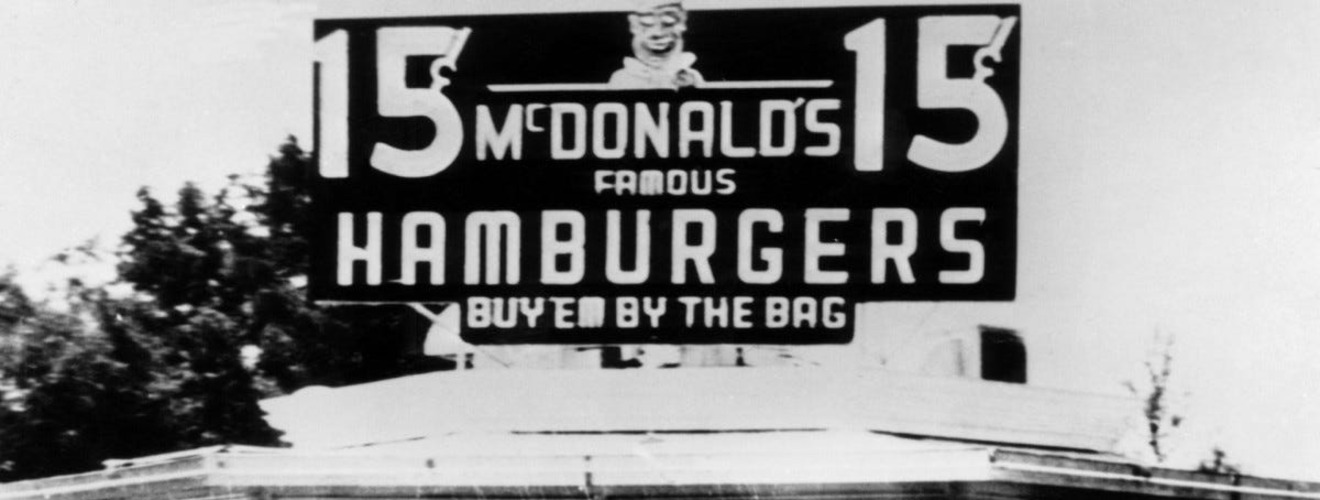
When Dick and Mac McDonald reopened their little barbecue drive-in, the entire operation had been rebuilt around a single sandwich. They had spent the previous three months tearing the place apart – firing twenty carhops, replacing the cast-iron grill with two stainless steel grills, throwing out the plates and silverware, and chalking the new kitchen layout on a tennis court behind their house. The Speedee Service System, as they called it, was designed around a hamburger that cost fifteen cents and arrived in fifteen seconds. A carhop drive-in across town would have taken twenty minutes to deliver the same sandwich.
What the brothers launched that winter was the founding document of fast food, although almost nobody at the time recognised it as such. The first few months were rough; old customers came in expecting carhops and left grumbling. Then working-class families discovered the prices, and children discovered that they could walk to the counter with a quarter and buy a complete meal on their own. The menu most people picture when they imagine this restaurant dates from about a year after the launch. The board that actually opened the era kept one foot in the soda-fountain age, stocked with sides and drinks that have since disappeared from the brand so completely that most customers would never guess they were once there.
What follows is every item the brothers unveiled at that reopening – the entire offering of the first true fast-food restaurant, before Ray Kroc, before there were two of these anywhere in the world.
Nine items made up the entire Speedee Service menu the McDonald brothers introduced in San Bernardino on December 12, 1948: hamburger, cheeseburger, potato chips, pie, coffee, milk, Coca-Cola, root beer, and orangeade. French fries and milkshakes were absent; both arrived in 1949, after the system had already proved itself.
Hamburger
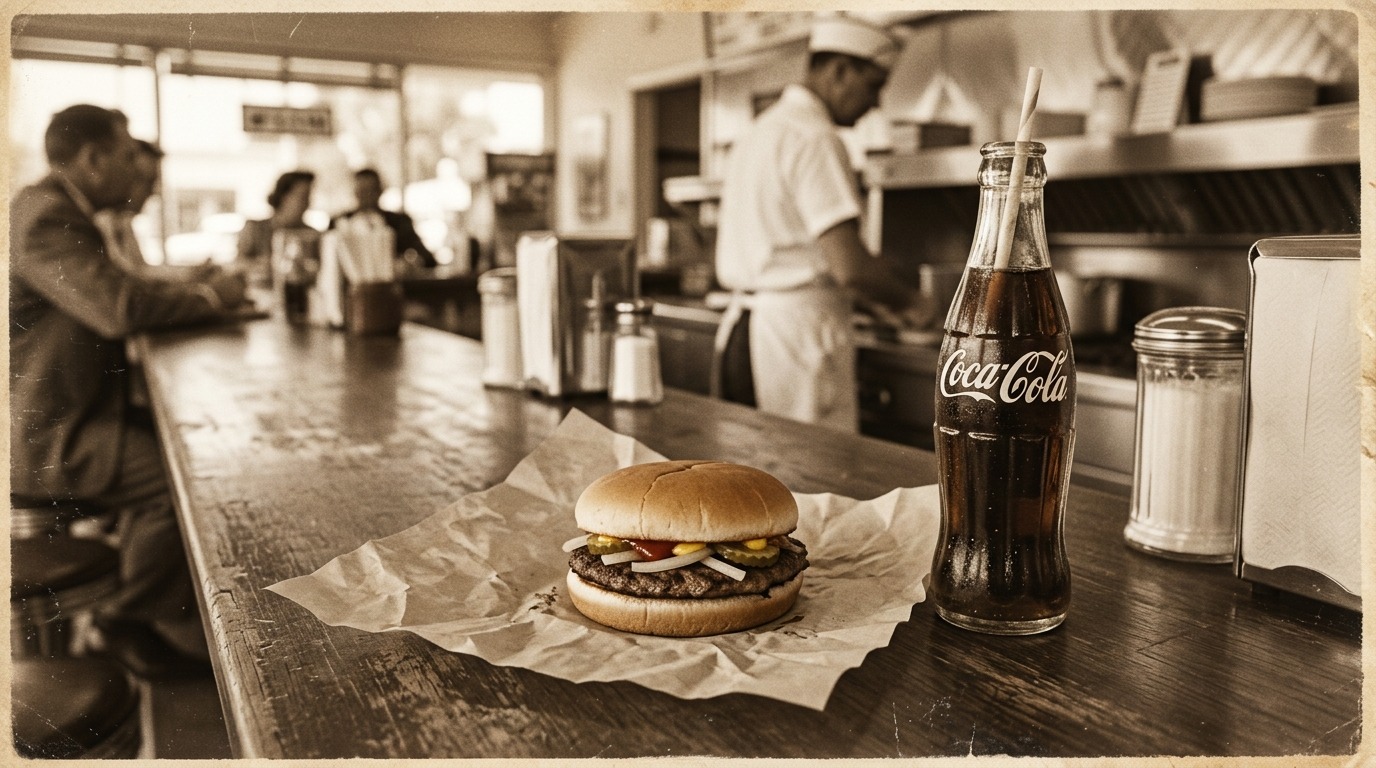
The hamburger was the entire point. The McDonald brothers had been running a successful barbecue drive-in in San Bernardino for eight years when they sat down with the receipts and noticed something uncomfortable: roughly 80% of their sales came from hamburgers. The pulled pork, the ham and beans, the chili, the ribs – the things they had built their identity around – were quietly being subsidised by a sandwich they treated as an afterthought.
So they closed the restaurant for three months and rebuilt it around the burger. The Speedee Service System launched on December 12, 1948, with the hamburger as its anchor item at 15 cents. To hit that price, the brothers shrank the patty: where they had previously gotten eight burgers from a pound of beef, they now got ten. Every burger came preset with mustard, ketchup, onions, and two pickles, eliminating the customisation that had slowed down the old kitchen. A customer who wanted it differently had to wait while everyone else moved past them.
The old cast-iron grill was replaced with two stainless steel grills, which held heat better and cleaned faster. Dick McDonald posed as a freelance reporter and visited candy companies to learn how they made identical peppermint patties; he then modified one of their patty-forming machines to produce uniform hamburger patties. The whole operation existed to deliver this one sandwich in fifteen seconds. They had been doing it in twenty minutes.
Cheeseburger
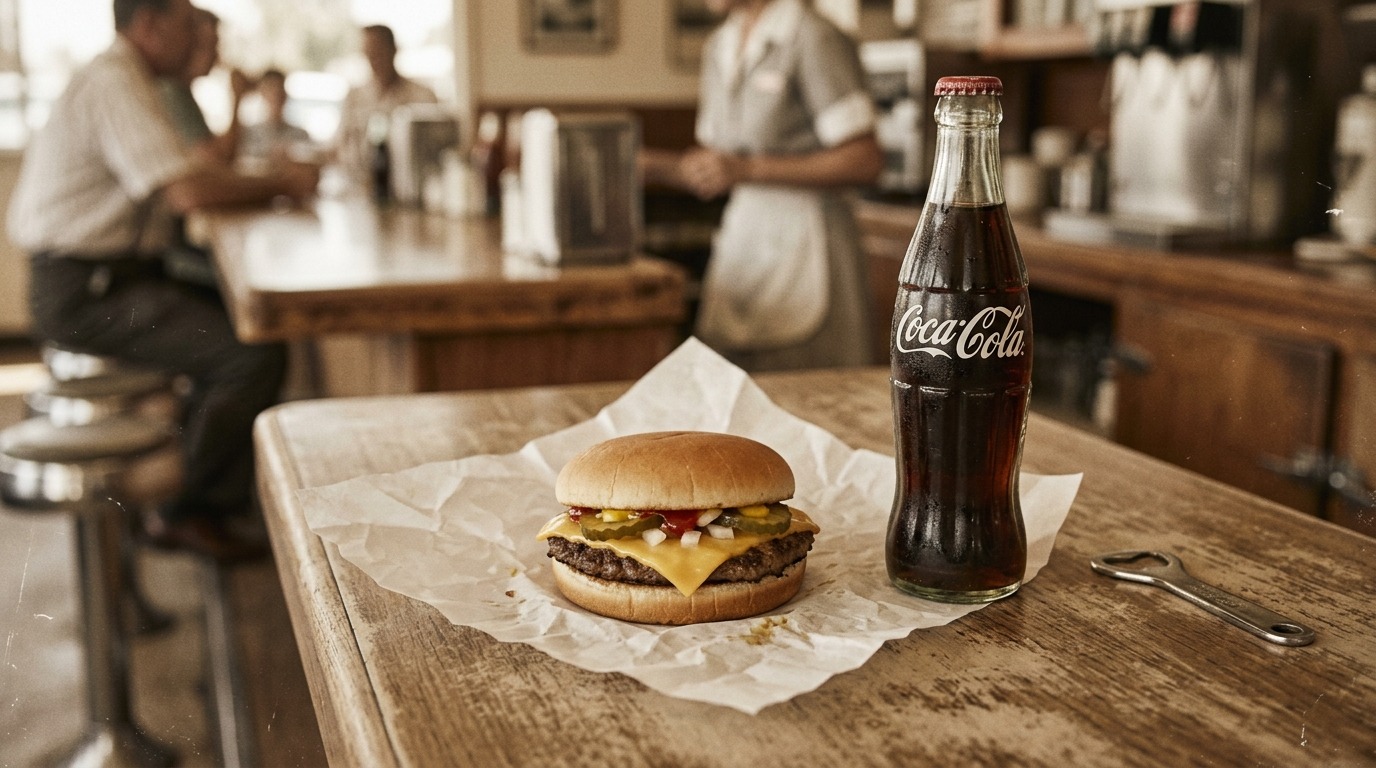
The cheeseburger was an extra four cents for a slice of American cheese. The math is roughly what you would expect: a slice of cheese cost a few cents wholesale in 1948, the brothers added a small margin, and the cheeseburger came out at 19 cents instead of a round 20. The price stayed exactly there for years, a piece of fast-food pricing that has almost no modern equivalent.
Cheeseburgers themselves were not a McDonald invention. Lionel Sternberger, a 16-year-old in Pasadena, had dropped a slab of American cheese onto a hamburger patty at his father’s sandwich shop in the mid-1920s and called it a cheese hamburger. Other claims exist – a Kentucky restaurateur in 1934, a Denver drive-in that actually trademarked the word in 1935 – but by the time McDonald’s opened in 1948 the cheeseburger had been a standard American menu item for over two decades. What the brothers contributed was the assembly line that could produce one in roughly the same time it took to wrap it.
The cheeseburger received the same preset condiments as the hamburger: mustard, ketchup, onions, two pickles. The cheese was added near the end of the cook so it would melt onto the patty. It was a small variation on the headline product, made possible because the kitchen had been redesigned specifically to handle that one variation without slowing anything down. Everything past hamburger and cheeseburger was, in production terms, exactly the same sandwich.
Potato Chips
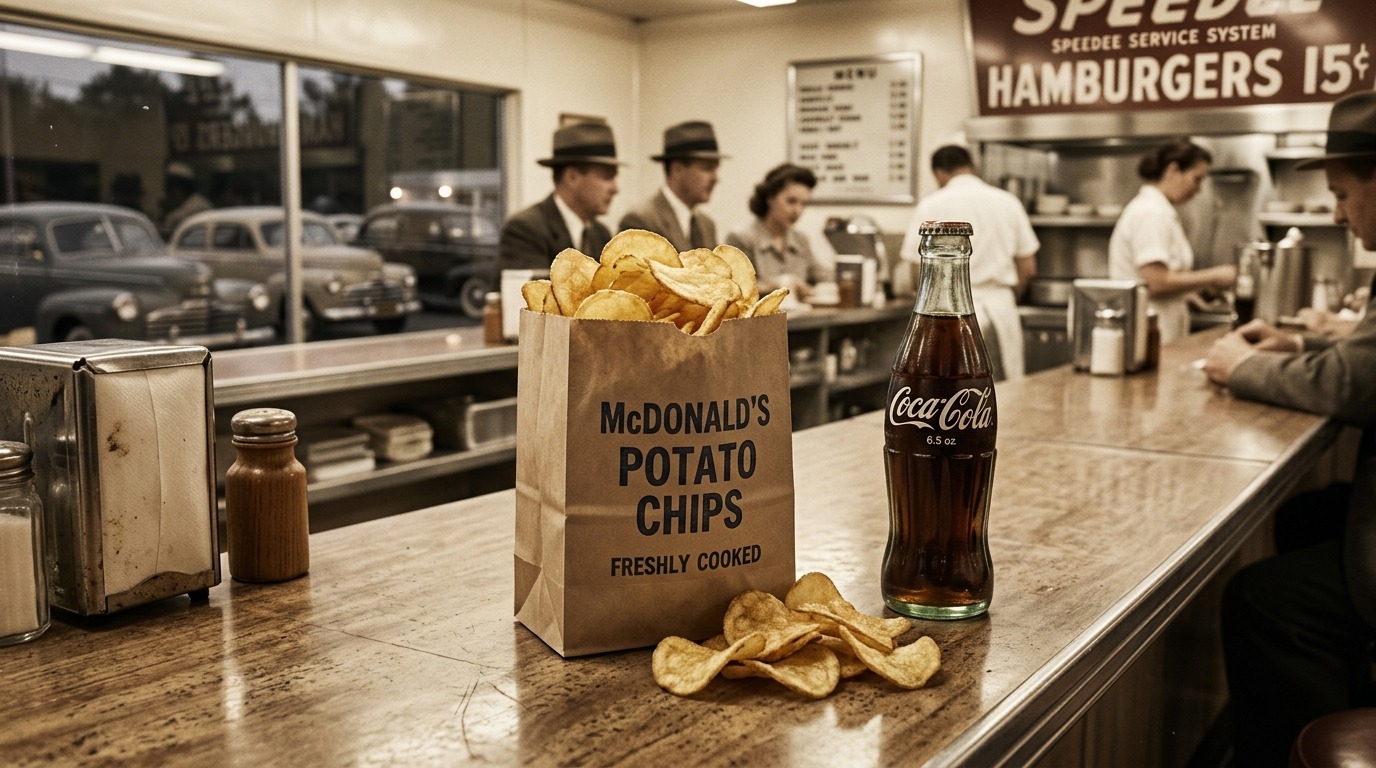
Almost nobody remembers that the original McDonald’s sold potato chips. The french fries that became inseparable from the brand were not on the menu when the Speedee Service System launched. Fries replaced chips in 1949, which is roughly twelve months after the reopening – just long enough for the chip era to be quietly written out of the popular memory of fast food.
The chips were sold as a side at 10 cents a bag, served in the same paper-wrapped style as everything else. They required no preparation, no fryer, no dedicated station, no skilled labour. Buy in bulk, hand over a bag, move to the next customer. For a kitchen designed around assembly-line speed, prepackaged chips were the perfect side dish. They never went cold, they never went soggy, and they could not be made wrong.
What ended them was the brothers’ own ambition. By 1949 they wanted a hot side, something that felt cooked and substantial enough to justify the price. Fries fit. The switch required a deep fryer, a designated fry station, and a procedure for cutting and blanching potatoes – all of which contradicted the original logic of the chip era. The kitchen got more complicated; the brand got the side dish that would eventually outsell its burgers. The image most people have of the December 1948 menu, with golden fries next to the 15-cent hamburger, is a year too early.
Coca-Cola
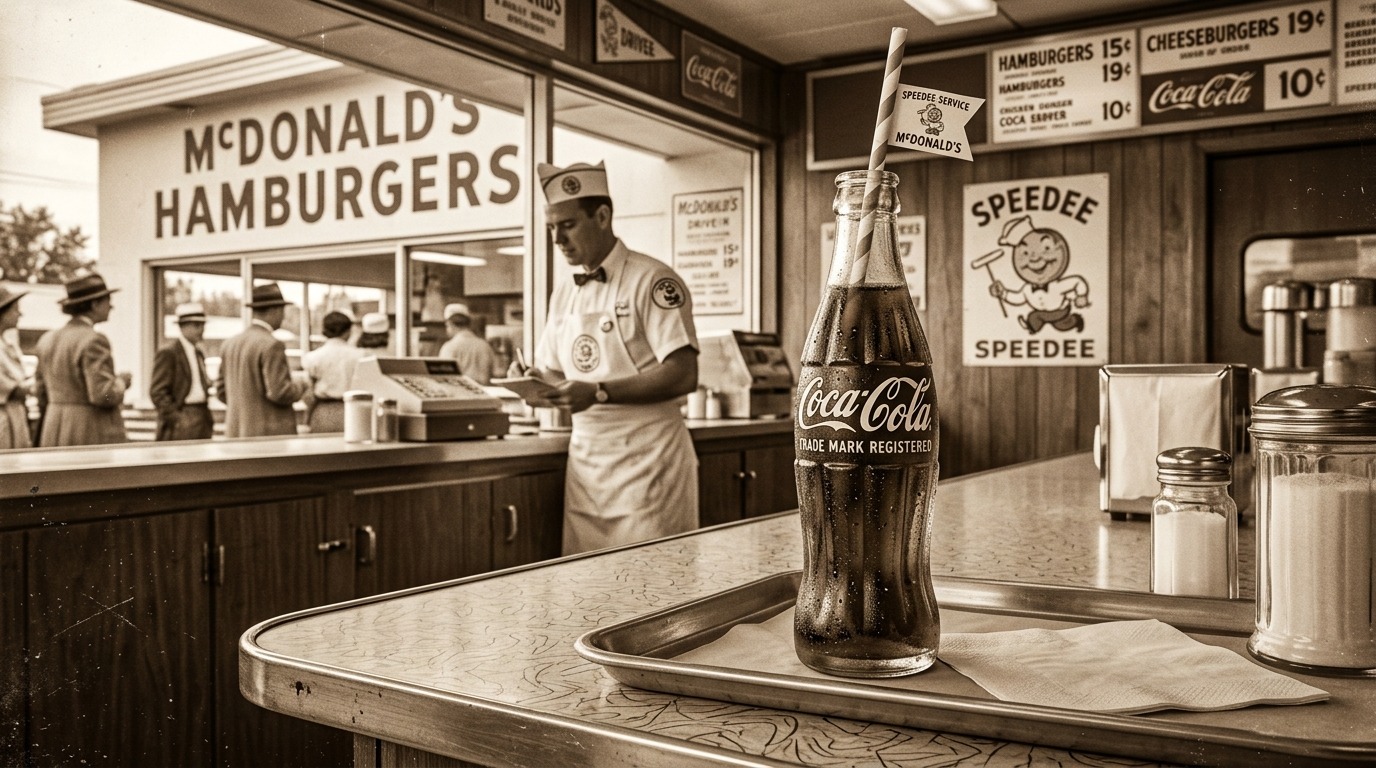
Coca-Cola at McDonald’s in 1948 came from a fountain, into a 12-ounce paper cup, for a dime. This is worth pausing on because the entire modern relationship between McDonald’s and Coca-Cola – the contractual exclusivity, the special stainless-steel tank delivery, the fact that McDonald’s Coke famously tastes better than other restaurants’ Coke – did not exist yet. The brothers were simply buying Coca-Cola syrup like any other soda fountain in southern California.
The 12-ounce paper cup was, however, a deliberate choice. Standard soda fountains used glassware that had to be washed, broken, replaced, and tracked. By switching to disposable paper cups, the brothers eliminated dishwashing entirely, removed a category of breakage loss, and built the cup into the cost of the drink. The same cup served all three soft drink flavours on the menu in the same single size – no medium, no large, no choice to slow down the order. You said Coke and you got the 12-ounce cup with Coke in it.
Ray Kroc’s later relationship with Coca-Cola is one of the most consequential in fast food. He negotiated a soft-drink contract for his first franchise in 1955 that has carried forward in some form ever since, and his deal eventually made McDonald’s Coca-Cola’s single largest customer. None of that was on Dick and Mac’s radar in 1948. They just needed three soft drinks on tap.
Root Beer
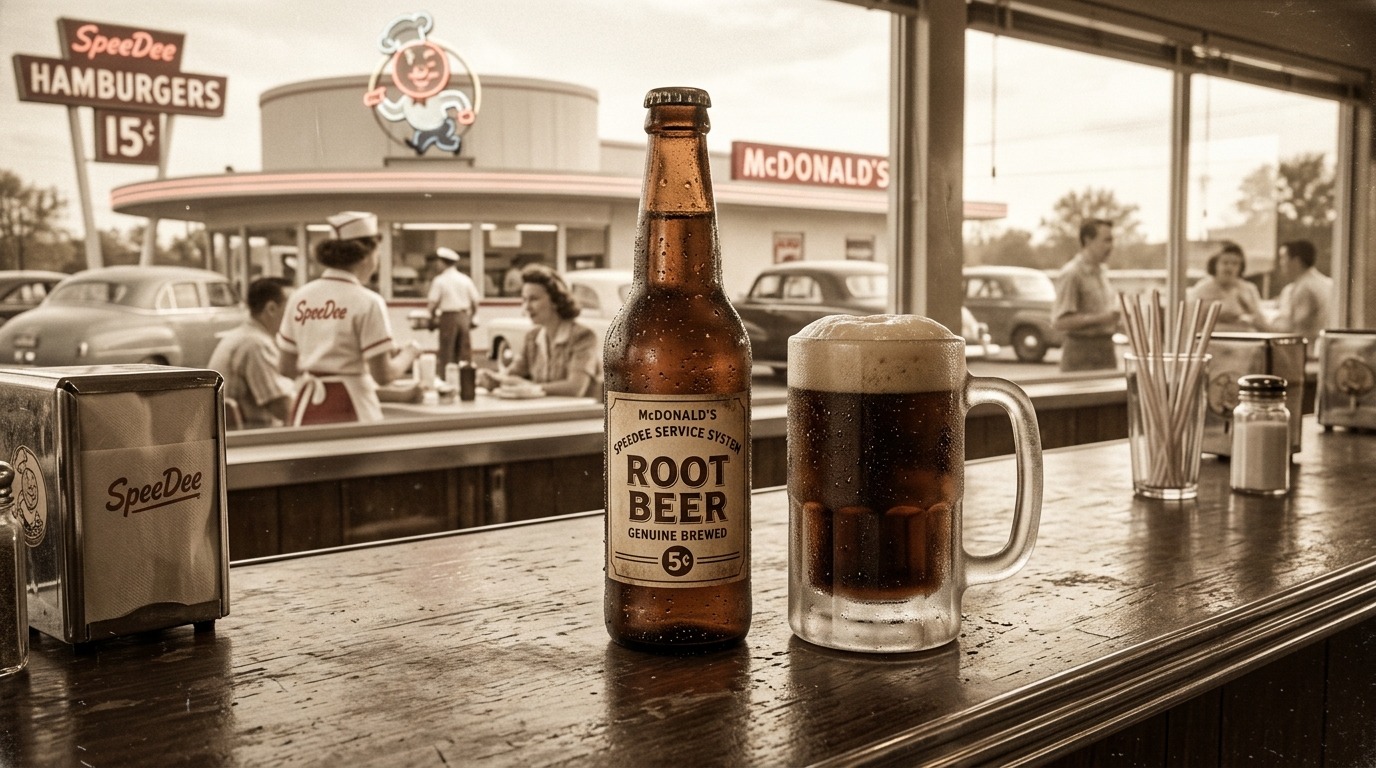
Of the three soft drinks the brothers put on the December 1948 menu, root beer is the one that has aged most strangely. It sold for a dime, came out of the same 12-ounce paper cup as Coca-Cola, and was one of three flavours offered from the consolidated fountain. The Speedee Service System did not differentiate between soft drinks at the operational level; the cup was identical and the price was identical, so the only variable was which lever the counter worker pulled.
What is striking is how thoroughly root beer has receded from the McDonald’s lineup. The modern menu does not carry it. Barq’s, which is owned by Coca-Cola, occasionally appears at participating locations, but it is not standard. A drink that was once one of three soft drink choices on the entire menu has been replaced over the decades by an assortment of Sprites, Fantas, Hi-Cs, Dr Peppers, and frozen variations of all of the above.
The reason root beer was on the original menu was simply that it was popular. In the 1940s, root beer competed seriously with cola for soda-fountain market share, and any operation that offered Coke also offered root beer almost by default. A modern customer ordering a hamburger, a bag of chips, and a root beer in December 1948 would have been making the most ordinary order imaginable. Sixty years later the same combination would feel deeply odd.
Orangeade
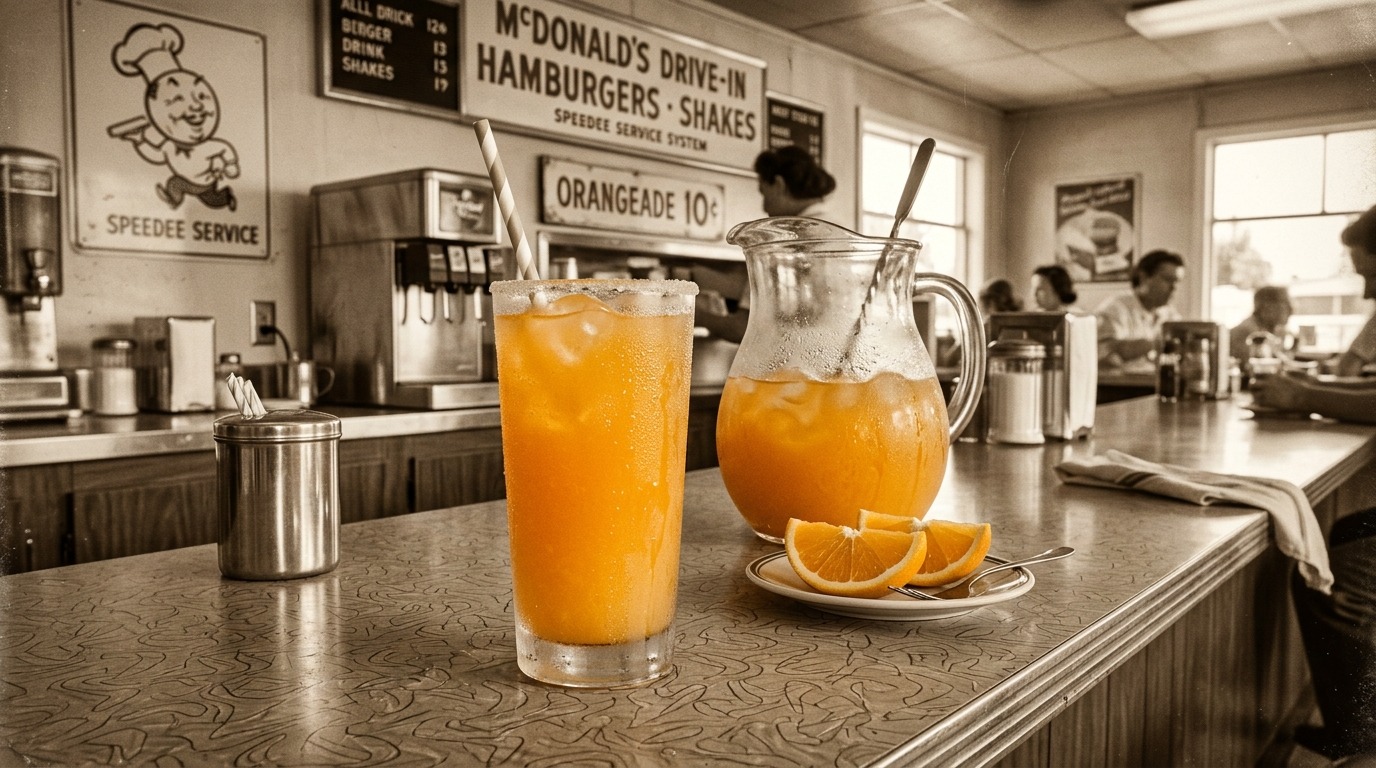
The McDonald brothers did not invent orangeade. By December 1948 it had been a soda-fountain staple for half a century – a non-carbonated mix of orange flavouring and sugar water, dispensed alongside lemonade and limeade as a hot-weather alternative to cola. The brothers offered it on the new menu for ten cents from the same 12-ounce paper cup as everything else.
The drink most people associate with McDonald’s orange flavour – the bright orange Hi-C dispensed from those red-and-yellow jugs at children’s parties – did not arrive until 1955, a year after Ray Kroc had visited San Bernardino. The 1948 orangeade was a more generic period drink, closer in character to a soda fountain mix than to a branded product. It would have tasted strongly of orange, strongly of sugar, and not particularly of orange juice.
What this item really represents on the December 1948 menu is the assumption that a fast-food restaurant should still carry the kind of drink a customer might have ordered in 1925. The brothers were transforming the format of food service – paper cups, no plates, no carhops, fifteen-second order fills – while keeping their drink offerings firmly anchored in soda-fountain tradition. Orangeade survived the transition because customers expected it. It then disappeared so completely that most people today, asked to name a drink McDonald’s once served, would never guess it.
Coffee
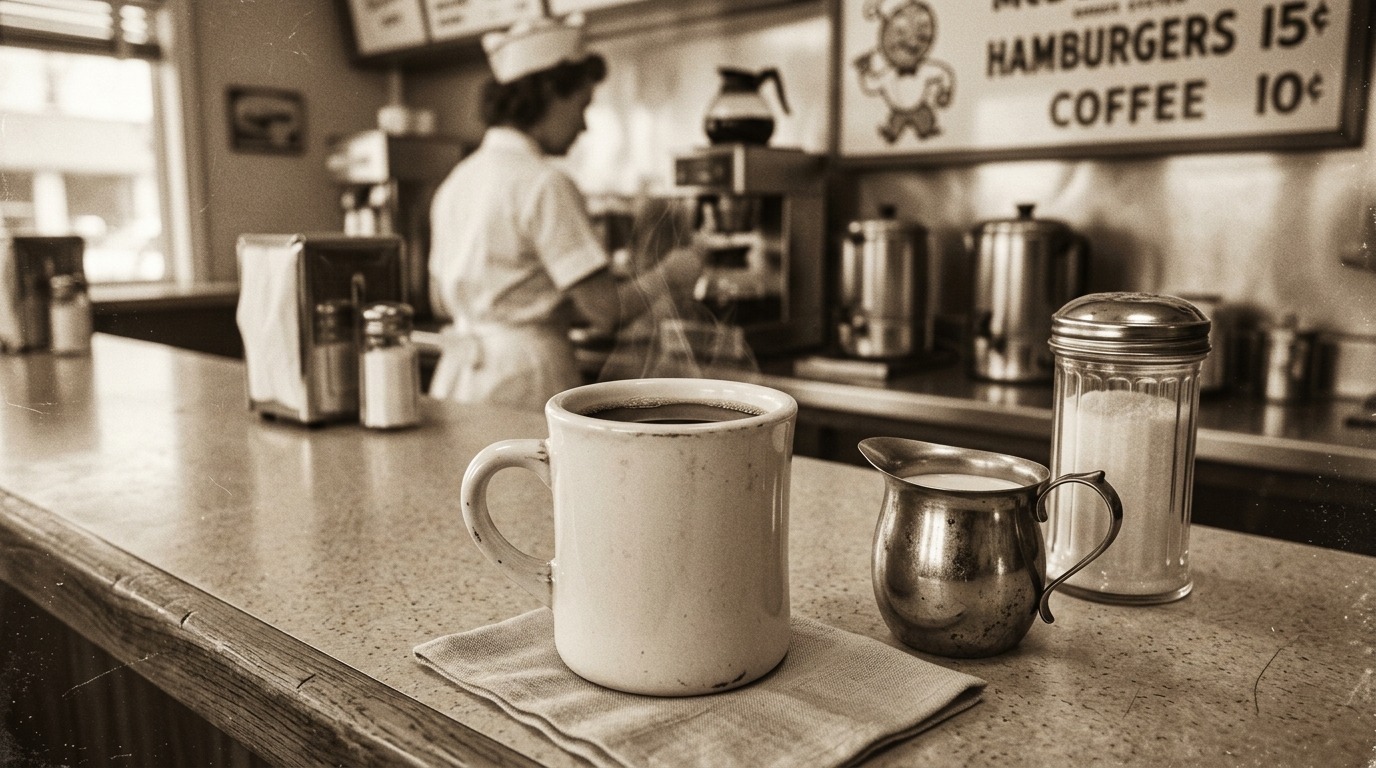
Coffee on the December 1948 menu cost a dime, which was a 100% price increase from the five cents the brothers had charged at the old Bar-B-Q stand. Almost nothing else on the new menu cost more than its barbecue equivalent. The hamburger was half its old price; the cheeseburger had been added cheaper than most old menu items; even the pie had come down. Coffee was the exception, the one item where the brothers raised the price during a reinvention designed around lower prices.
The reason was operational rather than greedy. A nickel coffee in 1948 was a loss-leader at a sit-down counter, the sort of price you set knowing the customer would order food alongside it and you would make your margin on the food. The Speedee Service System could not afford loss-leaders. Every item had to cover its own cost – the cup, the coffee, the labour to brew it – and produce a small profit on its own. Ten cents was what coffee needed to cost in a self-service paper-cup environment.
This is a quietly significant pricing decision. The brothers were prepared to make their hamburger drastically cheaper than the competition while making their coffee notably more expensive than the soda fountain across the street. They had identified what people would walk past their door for, and what people would simply pay whatever was asked for. Coffee, it turned out, was the second category.
Milk
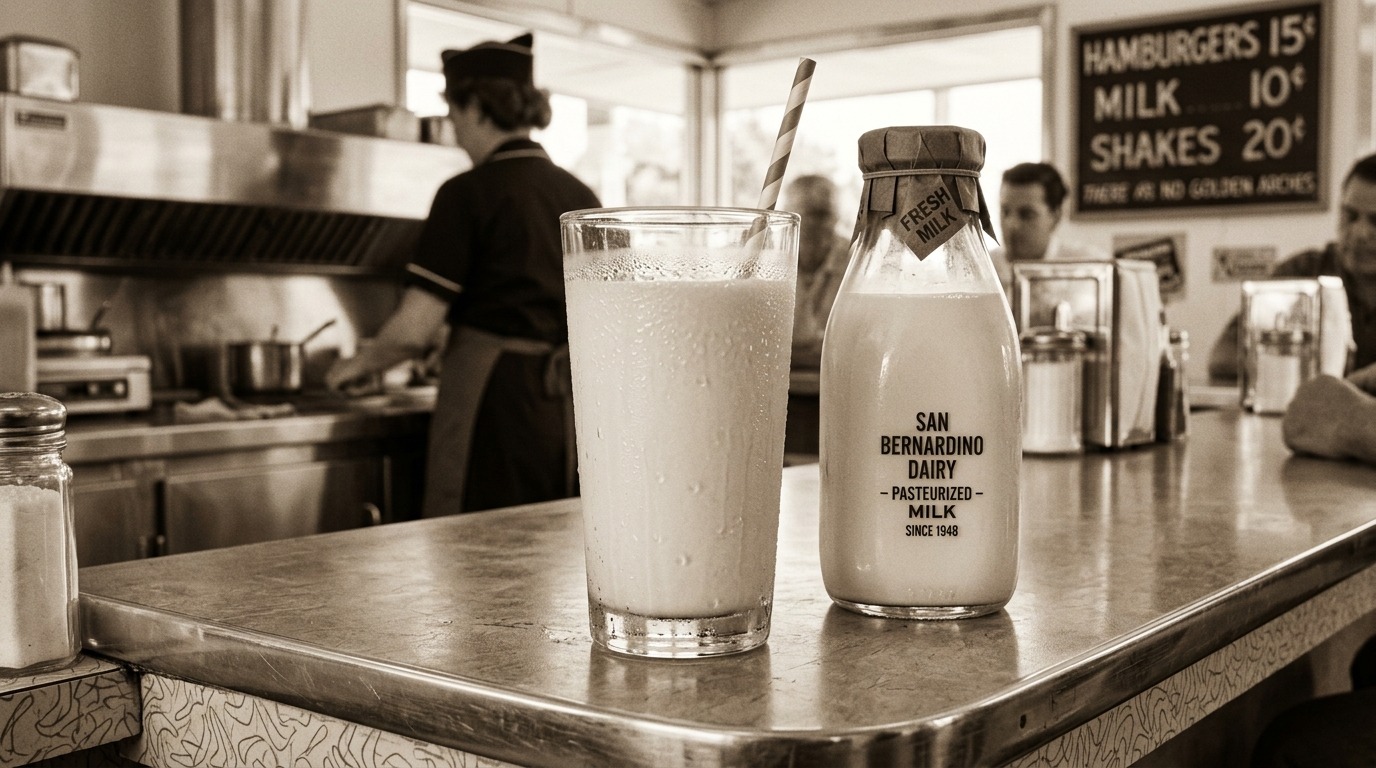
Children loved the milk. Employee Art Bender, who worked at the San Bernardino location in the early years, later recalled kids walking up to the counter with their parents still watching from the car, ordering a hamburger and a Coke or a hamburger and a milk with their own quarter. The under-ten demographic was a significant share of the new customer base in a way it had not been at the old carhop drive-in, and milk on the menu helped. A child could get a complete meal for a quarter and feel independent doing it.
Priced at ten cents – identical to a Coke, served in the same 12-ounce paper cup – this was unusual. Milk at most period diners and soda fountains was either notably cheaper than soft drinks, since milk was after all milk, or sold in a small glass aimed at kids. The McDonald brothers priced it identically to their cola, treating it as just another fountain option. A customer ordering milk got exactly the same size and exactly the same packaging as a customer ordering a Coke.
The 12-ounce serving was generous by modern standards. A McDonald’s small drink today is 16 ounces and a child-size milk is 8 ounces in a sealed carton, neither of which is what was happening at a paper-cup fountain in 1948. The milk came out of a refrigerated dispenser, into the same cup, and went out the window with everything else. It was simple, cold, and a dime.
Pie
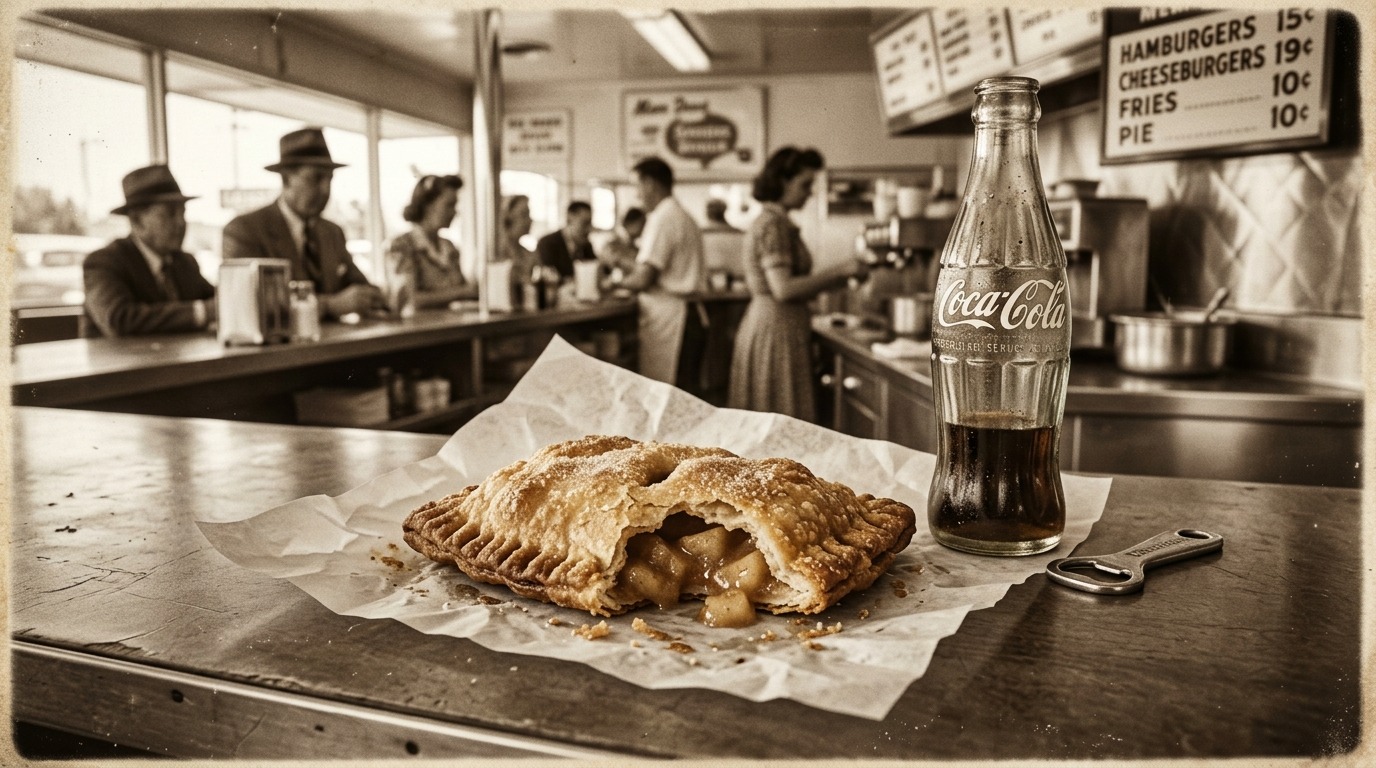
A slice of pie on the December 1948 menu cost a dime, came on a paper wrapper, and bore almost no resemblance to the fried apple-pie pouch most people now associate with McDonald’s. That product – the rectangular fried pie sealed in cardboard – did not appear until 1968, twenty years later, after a Tennessee franchisee named Litton Cochran started experimenting with desserts at his Knoxville location. The brothers in 1948 were selling pie the way every American diner sold pie: by the slice, from a baked round, on a paper plate. It was apple.
It did not last long. By 1949 the brothers had replaced pie with milkshakes, completing the transition to the menu most people now think of as the original. Pie required a refrigerated case, regular replacement of unsold portions, and a paper plate that was harder to dispose of than a paper cup. Milkshakes used the same paper cups as soft drinks, lasted indefinitely on the production line, and made the brothers far more money per serving.
The pie was, in retrospect, the last gesture toward the old sit-down restaurant tradition the brothers were otherwise abandoning. It belonged on a counter, not a fast-food menu. Within twelve months of the Speedee Service System launching, the brothers had figured this out and removed the one item that still smelled faintly of the place they had just blown up.
The system soon attracted a milkshake-machine salesman named Ray Kroc - but eight franchises already existed before him.
Frequently Asked Questions
What came on a hamburger at the original McDonald’s?
Every burger came dressed the same way: mustard, ketchup, onions, and two pickles, preset so the kitchen never had to stop and ask. A customer who wanted something different could have it, but the order left the line and its owner waited while everyone behind them got served.
Did the McDonald brothers invent the cheeseburger?
No. Lionel Sternberger, a teenager at his father’s Pasadena sandwich shop, holds the most-repeated claim, dating to the mid-1920s, and rivals in Louisville and Denver pressed their own – Denver’s Humpty Dumpty Drive-In went as far as trademarking the word in 1935. What the brothers added was a kitchen that could build one in seconds.
How much did a cheeseburger cost at the first McDonald’s?
Nineteen cents – a four-cent premium for a slice of American cheese melted on near the end of the cook. The figure sat just under a round twenty and stayed put for years, a stretch of price stability with almost no equivalent anywhere in modern fast food.
Who was Speedee?
Speedee was McDonald’s first mascot – a winking chef with a hamburger for a head, named for the brothers’ new service system. He appeared on signs from the beginning and lasted into the early 1960s, when the company retired him; the clown who replaced him, Ronald McDonald, debuted in 1963.
When did McDonald’s start selling its fried apple pie?
Not until 1968, twenty years into the chain’s existence. Litton Cochran, a franchisee in Knoxville, Tennessee, developed the rectangular deep-fried version there, and it spread from his stores to the whole system. The original stand sold its dessert baked and by the slice, like any diner in America.
How much did drinks cost at the original McDonald’s?
Ten cents, in one size: every drink came in the same 12-ounce paper cup, with no medium or large on offer. Glassware was gone entirely; disposable cups meant no dishwashing and no breakage, and the cup’s cost was built into the dime. Choice, the brothers had decided, was the enemy of speed.
Did any price go up when the brothers relaunched?
One did: coffee, which doubled from the nickel they had charged before the redesign. A cheap cup was a sit-down loss-leader, profitable only if food came with it, and the new self-service operation had no room for loss-leaders – every item had to pay its own way.
Why did the McDonald brothers stop selling barbecue?
Because the receipts told them to. After eight years running a successful barbecue drive-in, Dick and Mac noticed that roughly 80 percent of sales came from hamburgers, a sandwich they had treated as a sideline. The ribs and the pulled pork were dropped; the afterthought became the business.
Sources
- McDonald’s Corporate History – corporate.mcdonalds.com
- PBS SoCal – The Real McDonald’s: The San Bernardino Origins of a Fast Food Empire
- Britannica – McDonald’s entry
- Kottke.org – Early McDonald’s Menus (archival reading)
- New England Historical Society – When Dad Lost His Job, the McDonald Brothers Started a Fast-Food Empire
- Smithsonian National Museum of American History – McDonald’s Paper Cup collection notes
- David Halberstam, The Fifties